Octadecyltrichlorosilane: A Close Look
Historical Development
In the stretch of chemical history, few organosilicon compounds turned heads quite like Octadecyltrichlorosilane, or OTS for short. As far back as the late 1940s, researchers started experimenting with silanes to glimpse what happens when organic chains latch onto silicon compounds. OTS stuck out because it carried a long 18-carbon tail, making it extremely hydrophobic. Back then, the focus sat squarely on how to get surfaces like glass or quartz to shed water or resist sticking. Scientists at DuPont and academic labs figured out that treating clean glass with OTS could transform its surface from a water magnet to something droplets would slide right off. This laid the groundwork for decades of surface science, leading to today’s advanced coatings and sensors.
Product Overview
OTS falls under organosilane chemicals, sporting a silicon atom bound to three chlorine atoms and a long octadecyl group. It commonly shows up as a colorless to slightly yellowish liquid, usually sold in glass bottles with airtight seals. The product keeps best under dry nitrogen or argon, away from moisture or air. In its pure state, it packs a powerful odor—think pungent and sharp, almost like hydrochloric acid mixing with candle wax. OTS mixes well with common lab solvents, such as toluene or hexane, which matters when laying down thin films or coatings for electronics and optics work.
Physical & Chemical Properties
Octadecyltrichlorosilane clocks in with a molecular formula of C18H37Cl3Si and a molar mass near 389.94 g/mol. It drips as a dense liquid, thick enough to watch it crawl down the side of a vessel, with a boiling point hovering in the ballpark near 400°C. Water spells trouble for OTS, since it'll react right away—generating heat, hydrochloric acid, and a waxy byproduct known as siloxane. Mix it with alcohols, and the compound lets off similar energy, making safety a real concern. Its long hydrocarbon tail gives it that famous ability to create surfaces that hate water.
Technical Specifications & Labeling
Most chemical suppliers list the purity of OTS at or above 90%. Detailed labeling on containers always flags its air- and moisture-sensitivity, with hazard warnings about corrosivity and potential respiratory or skin harm. Shipment usually requires UN packing guidelines, clear hazard diamonds, and even custom documents for export. Some high-spec batches guarantee much tighter tolerances, with impurities down to a fraction of a percent, especially for use in electronics or life sciences.
Preparation Method
Industry typically manufactures OTS with a direct reaction between octadecyl alcohol and trichlorosilane in the presence of an acid catalyst. Operators handle the exothermic conditions carefully; run the process too hot or too wet, it clogs up with white solid siloxanes before forming the silane. Tight moisture control gets priority, and vacuum distillation polishes the crude mixture to the ultra-clean standards expected by semiconductor labs. Batch sizes can range from grams for research to barrels for larger industrial surface treatments.
Chemical Reactions & Modifications
OTS stands out in its ability to bond with hydroxyl-laden surfaces—especially glass, silicon, and metal oxides. Chemists working on microchips or biosensors lay down OTS films by dipping clean surfaces into dilute solutions, often in toluene. The hydrolysis step attaches the silane, while the long hydrophobic tail lines up, giving the surface a whole new feel and chemical identity. Further chemical tweaks can open the door to bioconjugation, adding new functionalities beyond water resistance. The resulting monolayers see use in everything from anti-fingerprint coatings for phones to platforms for enzyme sensors.
Synonyms & Product Names
OTS goes by different names: n-Octadecyltrichlorosilane, Octadecyltrichlorosilane, and Trichloro(octadecyl)silane. Some catalogs list it under English translations or shorthand like C18-silane. Trading names don’t carry the same weight as the IUPAC designation, but chemists know it’s the same core molecule behind popular surface modification kits and reagents from Sigma, Alfa Aesar, or Gelest.
Safety & Operational Standards
Experience handling OTS taught me to respect its hazards. The fumes sting eyes and burn lungs if allowed to vaporize. Gloves, goggles, and a lab hood sit absolutely center stage for safe work. Workers always store OTS in tightly closed bottles, away from water, acids, and bases. Emergency showers and eye stations take on new meaning—skin contact can trigger burns, and OTS runoff should never meet a sink drain. Cleanup runs with neutralizing agents, lots of ventilation, and strict adherence to local disposal laws.
Application Area
OTS carved out a niche in surface science, supporting the rise of microelectronics, sensing, and nanotechnology. It coats glassware and microscope slides to keep samples from sticking. In the semiconductor world, it lays down hydrophobic barriers that keep circuitry clean and dry. Fabric makers add OTS-based finishes to make gear with near-magical stain resistance. Even pharmaceutical companies got involved, coating medical devices and diagnostic chips, pushing lab-on-a-chip technology closer to mainstream use. Every new breakthrough seems to circle back to the importance of getting a clean, uniform OTS layer adhered just right.
Research & Development
Labs constantly chase more stable and more functional OTS layers. Research branched off into controlling film thickness down to individual molecules, crucial for reliable chip performance or biosensor accuracy. New work focuses on “patterned” OTS films—think invisible waterproof highways running alongside hydrophilic channels, all on the width of a hair. From personal experience, developing these patterns usually involves a mix of lithography, careful UV exposure, and sometimes a bit of luck. The growth of analytical tools like atomic force microscopy or X-ray photoelectron spectroscopy helps researchers see whether the OTS layer went down cleanly and evenly.
Toxicity Research
Scientists looked closely at the dangers posed by OTS, both in labs and once disposed. Acute exposure brings severe irritation to airways, skin, and eyes. Released chloride byproducts cause enough concern to require mandatory fume hoods during use. Once bound to surfaces, OTS loses its volatility, making end products much safer for human contact. Long-term studies on environmental breakdown showed that OTS does not travel far once disposed, usually decomposing into siloxanes—relatively benign compounds compared to their original state. Regulatory agencies and academic groups still watch for unexpected buildup or chronic effects, especially in water or soil near factories.
Future Prospects
OTS will not fade away from the chemical landscape anytime soon. Demand looks set to grow, especially as electronics shrink, medical diagnostics become more demanding, and new industries demand better water and fouling resistance. Researchers eye greener production routes with less chlorinated waste, as well as ways to graft new functional groups onto the OTS backbone for added versatility. Nanotechnology, wearable sensors, and advanced filtration promise to push OTS and related silanes into new territory. As new manufacturing and environmental standards come into force, expect ongoing innovation in both formulation and handling—always searching for safer, less wasteful, and more effective solutions.
What is Octadecyltrichlorosilane and what are its main uses?
What Makes Octadecyltrichlorosilane Stand Out
Octadecyltrichlorosilane, often called OTS, doesn’t show up often at the dinner table, but its fingerprints are all over the surfaces we touch and depend on. At its core, this compound belongs to a group of chemicals known as organosilanes. Unlike everyday substances, OTS brings a clever mix of silicon, chlorine, and a long bit of carbon and hydrogen—eighteen carbon atoms to be exact, all in a row. Once in the hands of chemists, it turns into a tool for reshaping surfaces so water just rolls right off or molecules cling tightly where they should.
Changing Surfaces at the Smallest Scale
OTS works its magic by binding to glass, silicon, and even some metals, laying down a near-invisible layer that makes the surface act differently. I’ve seen it used in university labs, where every scratch or stain on a microscope slide could spell wasted time. With OTS, scientists turn regular glass slides into super-smooth canvases that keep dust, dirt, and water at bay. Suddenly, writing with markers on these surfaces becomes possible, without smudges staining the results.
The key trick with OTS comes in its trichlorosilane group. Add a bit of moisture, and this part sticks fiercely to surfaces rich in oxygen, like glass or silicon wafers. The long chain trailing behind forms an orderly forest that stands tall, making the surface slippery for water and most contaminants. This simple chemistry cuts down on cleaning costs and lets researchers carry out precise experiments again and again without interference from leftover stains.
Real-World Uses that Touch Daily Life
Labs aren’t the only places OTS makes a difference. In electronics, OTS coatings help protect microchips and delicate sensors, improving their lifespan and reliability. The water-repellent layer wards off both moisture and dust, which can otherwise shorten the life of fragile circuits. Memory chips, for example, work more reliably when insulated from stray moisture, and OTS provides that shield.
Even outside high-tech halls, OTS has value. On windows and mirrors, it creates “self-cleaning” surfaces, cutting down on the need for scrubbing. Anyone who has had to deal with water stains on shower glass can appreciate a surface that repels both soap and scum. In the medical world, OTS helps keep bacteria from sticking to instrument surfaces, making sterilization simpler and safer. Hospitals can turn to coatings like OTS to lower infection risks with another layer of defense.
Why Safe Use and Scrutiny Matter
With all these benefits, the question of health and safety looms large. Octadecyltrichlorosilane reacts sharply with water, releasing hydrochloric acid. Anyone working with it needs good ventilation and proper gloves. Disposal and spill protocols deserve careful attention, especially as misuse can threaten water quality or air. These risks remind us nothing comes for free, and chemicals like OTS ask us to balance convenience with caution.
Looking ahead, the need for even safer and more universally-applicable surface coatings looks set to grow. Scientists are chasing greener alternatives that use less hazardous reagents, opening the door to similar effects with less worry over health. Until then, understanding and respecting what’s in a bottle of OTS keeps both innovation and safety front of mind.
How should Octadecyltrichlorosilane be stored and handled safely?
Understanding the Risks
Octadecyltrichlorosilane shows up in plenty of chemistry labs, especially where researchers want to build hydrophobic surfaces or perform nanoscale coatings. The stuff isn’t a stranger to chemical supply cabinets, but its behavior deserves real attention. This compound reacts vigorously with water, even the moisture in the air can start a reaction. Vapors rising from it carry hydrochloric acid fumes—a real threat to eyes, lungs, and skin.
I’ve stood in a cramped college lab, too many of us packed into a small space with shelves lined with sketchy glass bottles. One careless move with something like this, and you can feel your throat burn in seconds. It’s not just about reading the label, it’s about creating habits that keep that sort of accident from ever sneaking up on you.
Safe Storage Steps
Start by picking a spot that barely lets moisture inside. Seal every bottle tightly—think Teflon-lined caps, not just some plastic lid. Glass bottles work best, with clear labels and hazard warnings stuck right on the front. I’ve seen mistakes caused by hand-scribbled notes and fading ink, so don’t cut corners here.
Find a spot out of direct sunlight. These chemicals break down or react faster if they’re exposed to light and warmth. A cool, dark cupboard with controlled humidity feels boring, but it’s the kind of spot that preserves shelf life and keeps surprises to a minimum. Keep incompatible chemicals somewhere else. Storing anything with water or alcohol near octadecyltrichlorosilane can start trouble you didn’t plan for. Always double check storage locations against chemical compatibility charts—no exceptions.
Personal Protective Equipment and Handling
Handling this compound means putting on gloves, goggles, and a lab coat every time, no matter how well you think you know the bottle. I once watched an experienced colleague end up with a chemical burn near his eye. He’d forgotten his goggles just that one time. Nitrile gloves last longer against this compound than latex. Splash goggles go a long way, and a fresh lab coat means there’s less chance of something soaking through old stains or holes in the fabric.
Work inside a fume hood. The difference between handling this on an open bench versus inside a fume hood is the difference between breathing easy and having your lungs itch for hours. Keep a box of absorbent neutralizers—like sodium bicarbonate—on hand, not under a pile of unrelated stuff.
Emergency Measures
Spills are more common than most admit. I’ve mopped up after at least three in a decade of work. Have spill kits ready and keep the eyewash station clear—don’t store old glassware in the emergency shower or pile cardboard boxes in the pathway. If you get exposed, rinse right away and seek medical help. Quick reactions make the difference between a scare and a serious incident.
Training matters—one quick group session before new researchers get to work can prevent a lot of pain down the road. Talking through real-life cases sticks in memory longer than a stack of safety sheets ever will.
Choosing Better Solutions
People sometimes look for safer alternatives when possible, and greener chemistry keeps pushing new options into the market. Until those substitutes match the performance, every lab handling octadecyltrichlorosilane benefits from better routines, clear labels, and never skipping personal protection. It’s a daily, hands-on practice; that’s where peace of mind and safer work combine.
What are the typical applications of Octadecyltrichlorosilane in surface modification?
Turning Glass and Silicon Water-Repellent
Growing up around labs and machine shops, the struggle with water spots and smudges on glass always stood out. Octadecyltrichlorosilane, or OTS, quietly solves these problems for people working with surfaces that need to stay clean or repel moisture. If you treat glass or silicon wafers with OTS, the surface becomes water-repellent fast. This trait matters a lot in analytical chemistry, especially for thin-layer chromatography. Scientists can rely on the treated plates to steer clear of accidental mixing or spreading of chemicals. No more ambiguous readings, just clearer results.
Building Blocks for Micro- and Nanodevices
Touchscreen phones, microchips, and biosensors have stories that all start with surface chemistry. OTS acts as a primer, laying down a dense, tightly packed layer only a few molecules thick. Engineers depend on this sturdy base whenever they need to direct how molecules stick to or move across a surface. This trick lets them “draw” on silicon using self-assembled monolayers. Patterns of OTS change how tiny machines operate or help them recognize a drop of blood versus a drop of oil. In research labs, patterning this compound helps separate test regions and control reactions in real-time, keeping experiments cleaner and repeatable. Data keeps improving as a result.
Preventing Sticky Situations
Anyone who has worked in biology or medical testing knows about the challenge of things that stick where they shouldn’t. OTS treatments stop proteins, DNA, and microbes from clinging to glass slides, sensors, and microscope coverslips. This means clearer microscope images and more reliable results from diagnostic devices. Hospitals and clinics rely on slides that don’t blur or confuse diagnoses. OTS treatments lower the odds of misdiagnosis, helping patients get faster, more accurate care.
Improving Everyday Materials
Textbooks might not mention it, but several consumer goods owe their durability to surface treatments. Stain-resistant coatings on ceramics, anti-fogging covers for lenses, and protective films all build on tech born in chemistry labs using molecules like OTS. These treatments aren’t just about making things last longer—they mean fewer replacements, lower waste, and less hassle for everyday people. OTS’s super-thin layer shields against grime and moisture, keeping products looking new.
Challenges and Safer Handling
People handling OTS have to watch out for its harshness. The compound releases hydrochloric acid on contact with water. This limits its use without the right lab gear and precautions. There’s room for improvement in how we handle the risk. More labs turn to enclosed systems and spend time teaching safe handling practices, reducing harm while keeping the benefits. Sharing data on reaction byproducts and long-term exposure also matters, especially as more industries use these coatings.
Looking Forward
OTS and its cousins have transformed how we handle surfaces—moving from slippery microscope slides to the precise controls needed in today’s electronics and medical tools. These advances make technology safer, more consistent, and more accessible. The next big step sits in refining safety and expanding reuse and recycling. Reducing hazards without giving up performance will always matter, especially as research keeps unlocking new ways to use simple chemistry in surprisingly helpful places.
What precautions should be taken when working with Octadecyltrichlorosilane?
Understanding What You’re Handling
Octadecyltrichlorosilane, or OTS, lands on the bench of anyone working in labs focused on surface chemistry. This chemical gets a lot of attention for how it can lay down super-thin layers on glass or silicon, making those surfaces water-repellent and great for sensors or electronics projects. Still, it’s not something to treat lightly. Chlorosilanes in general can mess with your health, gear, and even the indoor air if you let your guard down.
Health Hazards Demand Respect
You don’t want OTS anywhere near your skin or eyes. Splash some on your hand, and you can expect a nasty burn. Catch some fumes in your face, and you’ll be coughing with a raw throat. The fumes can even eat through the delicate tissue in your lungs, leaving scars that don’t heal right. I once watched someone open a poorly sealed bottle—one puff, and the whole room stank like hydrochloric acid, with everyone scrambling for the exit.
Setting Up Your Work Area
A chemical like this calls for working in a fume hood, not just a bench with open windows. Those hoods don’t just vent away fumes; they also put a layer of safety between you and a cloud of corrosive vapor. Never leave OTS out, even for a minute. The stuff reacts with water in the air, kicking off hydrochloric acid. All containers stay tightly sealed, and you label the bottle in bold letters so nobody stumbles into trouble.
Personal Protective Equipment is Not Optional
Lab coats, goggles, and chemical-resistant gloves are the basic uniform. Nitrile gloves usually hold up well, but if you get any OTS on them, toss them out right away. If your project might make a mess, a face shield can mean the difference between a minor scare and a trip to urgent care. Speaking from experience, relying on thin latex gloves or skipping eyewear turns a routine task into a risky one.
Good Habits Make All the Difference
Spills can happen. If OTS gets on a surface, wipe it up with paper towels soaked in isopropanol, and be ready to neutralize the leftover acid with a weak base like sodium bicarbonate. Don’t clean up with just water—that just feeds the reaction. Keep plenty of waste bins nearby, and don’t let used towels sit out. The fumes linger, and even the trash becomes a hazard.
Training and Accountability Matter
It doesn’t help anyone to assume new lab members know the risks. Practical training outpaces written SOPs. Show newcomers how to handle and dispose of OTS safely. Check ventilation once a week. Have spill kits handy and know who to call in an emergency. I learned most from seeing real-life messes get fixed on the spot, not from flipping through thick manuals alone.
The Bottom Line
OTS brings a lot of utility to research and industry, but it demands respect at every stage. Fume hoods, real PPE, fastidious habits, and strong training keep people safe. These aren’t just procedures—they’re the difference between a productive day and a dangerous one.
What are the physical and chemical properties of Octadecyltrichlorosilane?
The Basics of Octadecyltrichlorosilane
Octadecyltrichlorosilane—or OTS if you want less of a tongue-twister—shows up in chemistry labs and engineering circles for good reason. This compound builds its reputation on two things: a long, waxy hydrocarbon chain that tails off at one end, and a trio of reactive chlorine atoms clinging to a silicon atom at the other. OTS moves from clear liquid to greasy solid around room temperature, depending on just how pure it is and how it’s stored.
Getting Hands-On: Physical Traits
OTS isn’t the kind of chemical you toss around without care. The stuff smells a bit sour, floating noticeable fumes if the cap’s off. If you spill any, you’ll notice a slimy sensation on your skin—its hydrocarbons go a long way toward feeling oily. It melts at about 24 degrees Celsius (a little higher than room temperature), which means you’ll spot it as a liquid most days unless your lab’s particularly chilly. Its long tail means it doesn’t dissolve much in water. In fact, it floats on top and stubbornly sticks to surfaces instead. Stick it in something like toluene or chloroform and it dissolves nicely, showing off strong nonpolar behavior.
Chemical Properties and Everyday Chemistry
This compound loves to react with water—but not in a calm way. Mix OTS with any trace of moisture and the chlorines don’t waste any time turning into hydrochloric acid gas, hissing out into the air and leaving behind silanols. Take it from anyone who's forgotten to close a bottle tight: you notice corrosive vapors pretty quickly and learn a healthy respect for gloves and goggles. Once OTS meets a glass surface, it clings tightly, turning that glass slippery and water-resistant. In tech, folks rely on this because you end up with surfaces that repel water and don’t collect grime.
Real-Life Impact and Uses
OTS plays a quiet but key role behind the scenes in technology. Its main trick sits in making surfaces hydrophobic—think of a windshield that shrugs off rain, or glass that resists fingerprints in your favorite gadgets. In microfabrication, engineers reach for OTS when they want to keep those tiny chips clean or guide the way that fluids glide over a surface. People running labs count on OTS when they need to prevent unwanted reactions in glassware. A simple OTS layer can turn a laboratory glass slide from a sticky mess into something that lets particles move freely, opening doors for experiments that just don’t work otherwise.
Straight Talk on Safety and Solutions
With all its value, OTS isn’t risk-free. Breathing its fumes or letting it touch your skin isn’t just uncomfortable—it’s dangerous. Hydrochloric acid’s no joke, and improper handling leaves you with burned lungs or skin. So, handling OTS depends on solid training, a working fume hood, and decent respect for what chemistry can do to a person. Labeling helps, but it’s personal responsibility that really keeps people safe.
The tech world could find greener routes to make surfaces hydrophobic. Innovations using plant-based compounds or less volatile silanes are gaining attention in academic circles. If the industry can shift toward less hazardous coatings without losing performance, that makes for safer labs and longer-lasting innovations. Using OTS means weighing its functional power against the costs to health and the potential for environmental impact.
Final Thoughts
OTS has power in its chemical makeup—strength that sets up everything from smudge-proof screens to clean lab slides. Its risks demand respect, and its success opens up a challenge: bringing the same results with safer tools. Until then, those working with it need to rely on skill, caution, and a clear-eyed view of what these crystals and liquids actually do in our world.
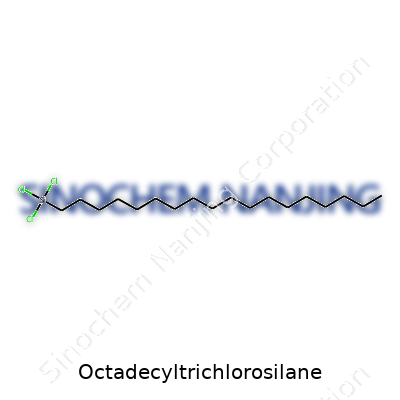
| Names | |
| Preferred IUPAC name | trichloro(octadecyl)silane |
| Other names |
n-Octadecyltrichlorosilane ODS Trichloro(octadecyl)silane |
| Pronunciation | /ˌɒk.təˌdeɪ.sɪl.traɪˌklɔː.rəˈsɪ.leɪn/ |
| Identifiers | |
| CAS Number | 112-04-9 |
| Beilstein Reference | 1363083 |
| ChEBI | CHEBI:52464 |
| ChEMBL | CHEMBL156728 |
| ChemSpider | 2032080 |
| DrugBank | **DB16543** |
| ECHA InfoCard | 100.046.798 |
| EC Number | 208-941-0 |
| Gmelin Reference | 78344 |
| KEGG | C19768 |
| MeSH | D017324 |
| PubChem CID | 3032637 |
| RTECS number | TY2470000 |
| UNII | L359HF70A7 |
| UN number | UN1818 |
| CompTox Dashboard (EPA) | DTXSID8020826 |
| Properties | |
| Chemical formula | C18H37Cl3Si |
| Molar mass | 353.94 g/mol |
| Appearance | Colorless to pale yellow liquid |
| Odor | Sharp |
| Density | 0.957 g/mL at 25 °C |
| Solubility in water | Insoluble |
| log P | 9.1 |
| Vapor pressure | 0.2 mmHg (25 °C) |
| Acidity (pKa) | ~2.5 |
| Basicity (pKb) | -6.4 |
| Magnetic susceptibility (χ) | -0.0000164 |
| Refractive index (nD) | 1.457 |
| Viscosity | 18 cP |
| Dipole moment | 2.68 D |
| Thermochemistry | |
| Std molar entropy (S⦵298) | 869.6 J·mol⁻¹·K⁻¹ |
| Std enthalpy of combustion (ΔcH⦵298) | -11720 kJ/mol |
| Hazards | |
| GHS labelling | GHS02, GHS05, GHS07 |
| Pictograms | GHS05,GHS07 |
| Signal word | Danger |
| Hazard statements | H314: Causes severe skin burns and eye damage. H335: May cause respiratory irritation. |
| Precautionary statements | P261, P280, P303+P361+P353, P305+P351+P338, P310 |
| NFPA 704 (fire diamond) | 2-3-2-W |
| Flash point | 94 °C |
| Autoignition temperature | 370 °C |
| Lethal dose or concentration | LD50 Oral - rat - 4,360 mg/kg |
| LD50 (median dose) | LD50 (oral, rat): 4,440 mg/kg |
| PEL (Permissible) | Not established |
| REL (Recommended) | 0.5 mg/m³ |
| IDLH (Immediate danger) | Not established |
| Related compounds | |
| Related compounds |
Trimethylchlorosilane Dimethyldichlorosilane Methyltrichlorosilane Octadecylsilane Octadecyltrimethoxysilane |



