Octadecylacetamide: A Comprehensive Insight
Historical Development
Chemists have always hunted for molecules that could deliver a mix of stability, safety, and chemical flexibility. Octadecylacetamide has a story dating back to the early twentieth century, when the fatty acid amides began catching attention for their slip-enhancing and anti-block attributes in materials. The long hydrocarbon chain with a terminal amide group gave rise to industrial interest as folks realized these molecules wouldn’t just slide over each other, but could act as lubricants and slip agents in plastic films. Demand in plastics manufacturing, especially for polyethylene and polypropylene, grew as industries found that this compound could reduce friction, prevent surface sticking during bag manufacturing, and offer an affordable answer compared with more complicated waxes or lubricants. Chemists in postwar Europe and the United States established refining and synthesis standards in the 1950s and 1960s, making laboratory quantities of octadecylacetamide available for researchers and factory workers alike. Even today, the substance plays a quiet but steady role in production plants everywhere.
Product Overview
A glance at octadecylacetamide shows a waxy, white to off-white solid that plays in fields as wide apart as plastics, pharmaceuticals, personal care, and food packaging. Its structure—a straight C18 hydrocarbon chain capped with an acetamide—offers thermal stability and amphiphilic properties. Anyone running a plastics extruder or working in a formulation lab will notice how easily it dissolves in certain organic solvents and its ability to subtly change the properties of a final product. Commercial forms usually arrive as powder, flakes, or fine granules. Producers label it for its slip-enhancing strength, lubricity, and at times, anti-caking or anti-static add-on value. This molecule rarely stands alone; it often acts as a background player, letting other ingredients shine by smoothing processing headaches or by refining tactile feel.
Physical & Chemical Properties
Octadecylacetamide features a melting point in the neighborhood of 95-104°C and starts decomposing well above common processing ranges for thermoplastics. The molecule measures out with a molecular weight near 297.5 g/mol. In water, it proves nearly insoluble, but it shows good solubility in hot ethanol, chloroform, and other organic solvents. Its physical form stays waxy and solid until significant heat steps in. Chemical inertia makes it ideal for situations where extended shelf life matters, or where reactivity would ruin a batch or formulation. The long aliphatic chain holds up under temperature swings, so outdoor and high-heat applications work out fine.
Technical Specifications & Labeling
Quality standards for octadecylacetamide draw a line around purity (often above 98%), controlled volatile content, and minimal ash after burning. Labels from top vendors include CAS number 124-20-9, standardized packaging weights, country of origin, and detailed safety data. Responsible handlers offer lot-specific documentation, with material safety datasheets (SDS) underlining proper use and transport methods. In various industries, labeling will also mention compliance with food contact regulations, as some varieties prepare for direct or indirect food contact or pharmaceutical uses.
Preparation Method
Making octadecylacetamide starts with octadecanol or stearic acid, both sourced from vegetable oils or animal fats in most commercial settings. Chemical acylation, using acetic anhydride or acetyl chloride, tacks on the acetyl group, creating the amide bond. Reaction conditions demand solvents, controlled heat, and efficient removal of water or hydrochloric acid byproducts, with typical yields maximizing when temperature and pH are tight. The process often finishes with washing, re-crystallization, and vacuum drying. In practice, good operators balance efficiency with careful waste handling to stay compliant with strict pollution control rules.
Chemical Reactions & Modifications
Though octadecylacetamide brings plenty of chemical resistance, its amide group can take part in certain reactions. Under strong acidic or basic conditions, hydrolysis breaks it back to stearic acid and acetic acid derivatives. Functionalization can target the alkyl tail for grafting, or the amide head for coupling with other active groups, turning it into a surfactant or additive for specialty formulations. Rarely, hydrogenation or crosslinking steps appear in technical literature, usually when folks seek new textures or performance tweaks in composites or coatings. The chemical predictability here holds real value, especially in firms that need repeat performance, batch after batch.
Synonyms & Product Names
Buyers searching the market may find octadecylacetamide listed under a handful of names: stearamide, N-octadecylacetamide, stearic acid amide, or just C18 amide. International chemical catalogs keep it in the fatty amide category. Brand names differ by supplier, reflecting house standards or targeted industries. Keeping track of synonyms matters for procurement professionals; an error at the ordering stage often means costly delays or rejected batches down the line.
Safety & Operational Standards
Industry workers rarely face acute hazards with octadecylacetamide, but handling guidelines still call for gloves, goggles, and dust masks in processing environments, mostly to cut skin contact or inhalation of airborne powder. It won’t ignite easily, but molten handling at high temps warrants care to avoid burns. Regulatory agencies like OSHA and ECHA maintain low-toxicity ratings, but waste handling—and especially cleaning up after spills—always follows EPA and local norms. Food packaging and pharmaceutical applications layer on additional scrutiny, so labs looking to qualify material need to document every step from incoming inspection to finished good.
Application Area
In my experience visiting plastics plants, octadecylacetamide often slips quietly into extrusion and compounding lines for films and sheets, where it helps reduce friction and unwanted sticking. Engineers blending masterbatches value it for making resin processing smoother; the effect ripples out to packaging films that run faster and release off rolls more easily. In personal care, skincare and cosmetics companies add it to creams or makeup for a richer skin-feel. Chalk manufacturers use it to boost anti-dusting. Across rubber processing, a touch of this amide can keep rollers clean and minimize plate-out. The reach into pharmaceuticals, where it acts as a flow agent or tablet lubricant, points to its broad safety track record.
Research & Development
R&D teams return repeatedly to octadecylacetamide when chasing altered surface effects or fine-tuning slip properties. Materials scientists examine its impact on the crystallinity and rheology of newly developed polymers, and pharmaceutical researchers design derivatives to act as slow-release additives. Stability testing keeps confirming low migration rates—critical for food or medical packaging. Nanoscale studies try to unravel how this molecule self-assembles on different substrates, opening doors for future coatings or nano-carriers. Universities chase after greener production routes as part of the global shift away from petroleum-derived feedstocks.
Toxicity Research
Decades of toxicological reviews give octadecylacetamide a generally low concern. Acute exposure studies in animals rarely point to severe health risks. Long-term feeding or inhalation tests yield limited evidence of carcinogenicity or mutagenicity. Some allergy concerns float around, common to many fatty compounds, but proper manufacturing removes most residual reactants. Regulatory agencies have kept their eyes on the compound for food and drug applications, repeatedly setting exposure limits higher than daily user intake. Wastewater studies track its persistence, but modern treatment plants break down released amounts effectively.
Future Prospects
Looking ahead, demand for high-performance plastics, green lubricants, and bio-based additives will keep octadecylacetamide in steady production. Research into renewable feedstocks looks promising, especially as palm oil and other plant-derived fatty acids get refined into the starting blocks. Regulatory pressures around food and pharma packaging will push for higher purity levels and new testing protocols. Additive manufacturers continue to hunt for tweaks that boost performance without raising toxicity or environmental harm. As global industry leans further into sustainability, expect ongoing attention on not just the chemistry, but the sourcing, lifecycle, and recyclability of this everyday additive.
What is Octadecylacetamide used for?
Behind the Name: What Octadecylacetamide Really Means
You won’t bump into octadecylacetamide at the hardware store, but it’s part of daily life for plenty of folks working with plastics, rubber, or lubrication. Octadecylacetamide, sometimes known as stearamide, has this slick way of showing up behind the scenes, helping products keep their shape, last longer, or move smoothly. The chemical itself comes from fatty acids and acetic acid. In practice, it lands in factories, not kitchens, but what it does from there shapes ordinary experiences.
Why Manufacturers Count on It
Plastics can stick, squeak, and wear out fast without something to make them behave. People sprinkle octadecylacetamide into the mix because its waxy structure keeps those problems at bay. I remember visiting a toy factory years ago and noticing workers prepping machine molds. The foreman told me without compounds like this, production lines gunk up. The toy cars would drag through the process instead of popping out clean. They count on octadecylacetamide to act as a slip agent; it stops components from binding up, making sure toys leave the mold bright and crisp.
The story’s the same if you look at the rubber end of things. Rubber masks and soles turn out smoother, less tacky, and more consistent thanks to the way octadecylacetamide keeps things separated during production. Factory floors value anything that saves time, money, and hassle, and this chemical delivers all three in ways that show up every time I lace up my running shoes and don’t feel a seam or lump underfoot.
Keeping Machines Running and Surfaces Smooth
There’s another world where this chemical proves handy: lubrication. We’ve all had a squeaky hinge or a rough zipper. On an industrial scale, friction isn’t just annoying—it’s expensive. Octadecylacetamide ends up in specialty lubricants and coatings, cutting down on wear and tear. My neighbor runs a woodworking shop, and he told me that special surface coatings keep his tools slick and his projects sharp. These coatings build on blends using octadecylacetamide to hold up under pressure—literally.
Safety, Environmental Choices, and the Bigger Picture
Chemicals in manufacturing always raise questions, though. Greater transparency matters, especially for substances added to consumer products. Scientific reviews of octadecylacetamide suggest it’s safe at typical use levels, but folks working closely with raw forms still wear gloves and masks. There’s long-term curiosity about how production or disposal affects water and soil. Environmental agencies keep tabs and expect reports from big users, part of a broader push to balance everyday convenience with responsibility.
I see a growing appetite for greener chemistry. More companies push suppliers for traceability. Some try plant-based alternatives that mimic what octadecylacetamide does but start with vegetable oil waste rather than petrochemicals. This kind of innovation may seem small, but over millions of toys or tires, it adds up. It’s one sign that progress means looking both at performance and footprint—without giving up the benefits that brought this chemical to factories in the first place.
Thinking Ahead
Octadecylacetamide works hard, rarely gets noticed, and keeps much of the stuff around us running smoothly. As industries keep moving toward better transparency and better choices, understanding what goes in—and why—leads to smarter questions and better answers for everyone down the line.
Is Octadecylacetamide safe for human use?
Looking Beyond Labels
Octadecylacetamide might sound unremarkable among long chemical names, but it shows up far more frequently than you might guess. Skincare conditioners use it for its silky feeling. Pills get it as a lubricant to help them slide out of the factory press. Food contact materials sometimes include it because it fights static and clumping. Spotting such a mouthful on an ingredient list can make anyone pause before using the product.
Having researched chemical safety for years and trained in public health, I pay close attention to what lands in consumer goods. Octadecylacetamide’s profile looks, at first glance, as non-threatening as some of its more famous waxy cousins like stearic acid. Cosmetic regulatory panels and toxicology handbooks list it as low-risk because studies show it doesn’t irritate skin or eyes in normal use and breaks down inside the body. The FDA allows it in food packaging. The European Food Safety Authority landed on a similar stance, clearing it for “intended uses.” This alignment between global agencies usually signals that experts have done their homework.
Real-World Exposure and What Matters
Most folks encounter Octadecylacetamide through lotions or tablets. Studies using both animal testing and lab-grown skin suggest that the risk of absorption and lasting harm remains very low. Acute toxicity studies don’t reveal anything worrisome at concentrations used in commercial goods. Over my career, I’ve dealt with countless regulatory filings. Many "safe" chemicals show nagging gaps in long-term data or gaps in vulnerable groups, but Octadecylacetamide seems to have a fuller deck of research. Chronic exposure studies and genetic toxicity assessments both land on the side of little or no risk for humans, at least under standard conditions.
This doesn’t mean product safety is forever fixed. Sensitive people with unusual allergies or folks working with bulk raw chemicals can face more exposure than typical consumers. Swallowing pure Octadecylacetamide is not recommended, of course—no more than it is for any industrial additive. Still, for daily use through consumer products, the risk stays low. I look for long-term studies and rare case reports everywhere, and haven’t found a clear pattern of harm at its approved levels.
The Push Toward Transparency
Product safety depends on trust and regular review. The chemical industry moves fast. Novel uses, manufacturing shortcuts, and rising global volumes sometimes bring overlooked risks to the surface. Keeping tabs on ingredients—especially for people with health conditions or small children—always matters. If I’m buying a lotion with dozens of synthetic ingredients, I’ll sometimes skip brands that don’t publish clear safety breakdowns. It helps to know which groups have looked into the ingredient and what red flags turned up in their work. In my family’s medicine cabinet, I don’t see Octadecylacetamide itself as a top red flag, but I always scan for regulatory updates a few times a year.
What Can Help
Smoother pathways to ingredient transparency would boost trust even more. If consumer goods companies posted their test results and explained ingredient roles in plain terms, skeptics could make better choices. Ongoing studies into long-term and high-dose scenarios bring added assurance. Regulatory agencies should keep demanding up-to-date data, especially as more complex blends hit the market.
In daily life, reading labels and checking for up-to-date health guidance remains one of the simplest protections. My own experience shows that ingredients like Octadecylacetamide, scrutinized and greenlit by global experts, rarely bring unexpected harm to everyday users. Still, collective vigilance and open information make the difference between safe use and surprises down the road.
What are the storage conditions for Octadecylacetamide?
Storage Often Gets Overlooked
Octadecylacetamide tends to show up in labs and factories as a reliable specialty chemical. It’s a solid choice for lubricants and slip agents, but the way it gets stored often decides whether it stays useful or loses its punch. My own time managing a shared chemical storeroom taught me that storage rules aren’t there for decoration. The quality of chemicals depends heavily on their environment, and many smart projects have skidded off track because someone didn’t read the label or understand what a stable, clean container could do for shelf life.
Temperature and Dryness Matter
This compound likes cool, dry, and ventilated conditions. Oily, waxy solids such as octadecylacetamide can clump or break down with enough heat, and humidity makes clumping or slow decomposition a problem. Temperatures around room temperature work fine, and dropping a container near radiators or inside a sun-filled window isn’t smart. In real life, I’ve seen containers left open or stacked haphazardly, leading to big lumps that ruin dosing. Moisture in storage areas—think summer humidity—can sneak in and stick to the material, especially if lids aren’t properly tight.
Best practice: keep containers tightly sealed. Avoid storing on the floor, where dampness sneaks in, and steer clear of rusty or dirty shelving. Basic, clean shelving on an inside wall, away from temperature swings, covers most risks. Some suppliers ship octadecylacetamide in plastic drums or lined bags; repackaging into smaller, well-labeled containers makes life easier and cuts down on cross-contamination in busy stockrooms.
Light and Air—Not Friends for Stability
Light, especially from windows or harsh overhead fixtures, will encourage breakdown, forming unwanted byproducts. Oxygen in the air also poses trouble; it won’t explode or anything dramatic, but slow, quiet oxidation leads to degradation. In my experience, amber or opaque containers work wonders, combined with airtight lids. Labeling containers with the date of receipt and opening adds a lot of value. Staff can spot aging inventory and move older stock out for use before it loses integrity.
Avoiding Contamination
Cleanliness ranks high on the list. The less exposure to air, hands, or other compounds, the better. Shared scoops, funnels, or spatulas often pick up residue from different chemicals. I’ve watched entire batches get spoiled by cross-contamination in open bins or between similar-looking powders. Using dedicated tools and labeling them by compound lets everyone avoid mix-ups that can wreck a whole process or compromise product safety. This kind of simple discipline often lacks glamour, but it draws a clear line between a professional operation and one that struggles with recalls or botched experiments.
Documentation and Monitoring
Clear protocols and signage help everyone follow the same playbook. Listing storage dates, lot numbers, and inspection dates on every container supports easy tracking and builds confidence in the material’s quality. Chemical management apps and spreadsheets streamline the process, making it tougher for expired or mishandled stock to sneak into production. Many labs conduct visual inspections, looking for lumps or discoloration, and staff who recognize the normal “look and feel” of octadecylacetamide can catch early warning signs that something isn’t right. Incorporating staff training, with reminders about storage conditions and the reasons behind the rules, tightens up compliance and helps less-experienced workers do the right thing.
Safety and Best Outcomes
Storing octadecylacetamide in conditions shielded from heat, sunlight, moisture, and careless handling keeps its properties intact across the shelf life promised by suppliers. Chemical safety plays a part as well—though not particularly hazardous, tidy storage keeps fire and slip hazards to a minimum and makes emergency responses faster and cleaner if an accident ever calls for them. The best outcomes come from treating this material with the same respect given to anything that feeds into finished consumer or industrial goods. With tight controls, fewer surprises show up down the line, and both safety and product quality get a real boost.
What is the chemical structure of Octadecylacetamide?
The Shape Behind the Name
Spotting “octadecylacetamide” in a chemical catalog triggers a familiar curiosity for anyone with hands-on chemistry experience. Put simply, its name already tells a lot. The backbone, “octadecyl,” means a chain pulled from octadecane, or eighteen saturated carbon atoms in a line—imagine a soft waxy tail looping through lab bottles. Tag an acetamide group at one end and now you have something with real-world bite. Structurally, you’ll see a long hydrocarbon chain with an amide end, chalked up as CH3(CH2)17CONH2. Three clusters—acetyl (CH3CO–), nitrogen (NH), and that unbroken tail—make up the heart of the molecule.
Why Chain Length Shapes Its Use
Any time you find such a long, straight hydrocarbon chain hooked up to an amide, grease and slip come to mind. The octadecyl “tail” repels water like oil on glass, driving the molecule into surfaces, gaps, and even fabrics. That hydrophobic trait makes it reliable for applications where moisture is not welcome. In my time helping develop surface treatments, I found that a splash of octadecyl-based amides in a mix gives plastics and paints some serious weather resistance—rain beads and runs right off. Once the molecule hits a surface, the tail lines up with others like it, building barriers you can’t see but definitely feel.
Stories from the Lab: How Structure Meets Function
Back in graduate school, we tested lubricants that featured octadecyl chains similar to those in octadecylacetamide. Under the microscope, these long chains stacked onto metal like tiny ropes, reducing friction more than shorter-chain cousins. On the factory floor, this means smoother machinery with less wear and less frequent repairs. The amide group at the end isn’t just a tag-on—its ability to form hydrogen bonds lets these molecules slip between surfaces, sticking just enough to last but not enough to clog.
Environmental and Health Conversations
In technical circles, every new batch of chemicals brings questions about safety and sustainability. Octadecylacetamide’s chemical relatives show up in skin products, lubricants, and coatings, so testing for toxic byproducts or unsafe breakdown products isn’t just smart—it’s necessary. Case-in-point: a poorly formulated batch in a coating factory led to contact dermatitis, later traced to contaminant amides. Careful purification and routine quality checks cleared up the problem. Fact-supported vigilance here protects workers and the environment.
Navigating the Supply Chain
Global sourcing for the octadecyl part often comes from palm oil or tallow—a practice that has raised ethics flags for deforestation and sustainability. Labs and manufacturers increasingly ask about palm-oil free grades or material traced to certified sources. In the mid-2010s, consumer watchdogs pressed suppliers to clarify their origin stories, and pressure from buyers caught up quickly. Solutions keep emerging: synthetic chemistry offers alternative chain sources, reducing demand on tropical ecosystems.
Key Takeaway
The chemical structure of octadecylacetamide may look simple—a marathon of carbon with a single amide finish line. But that shape unlocks its uses as a barrier, a lube, a water-blocker, and a surface-protector. Knowing both its capabilities and supply chain challenges makes a difference every time the product lands in a lab, a factory, or a consumer’s hand.
What is the purity of the Octadecylacetamide product?
Why Purity Matters in Chemical Products
Purity gets plenty of attention in the chemical industry, and for good reason. When I worked in a formulation lab, even the smallest impurity could throw the results of an entire batch off course. One stray contaminant might ruin weeks of work—not to mention create safety hazards if the final application sits close to people or the environment. Octadecylacetamide, a waxy solid used in everything from lubricants to pharmaceutical coatings, stands as a prime example. If a batch isn’t clean, everything downstream—whether a cosmetic cream, an electronics coating, or a tablet—will bear the risk.
Assessing the Purity of Octadecylacetamide
Labs measure chemical purity with techniques like gas chromatography and high-performance liquid chromatography. Most high-quality suppliers publish results, so we don’t have to guess. Typical commercial grades of octadecylacetamide usually reach 98% purity or higher. Pharmaceutical applications often raise that bar. Anything heading into a medical use can push purity claims above 99%. These statistics matter beyond paperwork—a single percent’s difference might mean peace of mind or a call-back from manufacturing.
Impurities come from incomplete reactions, leftover starting materials, or side reactions. Picture a busy kitchen: even with the freshest produce and sharpest knives, a little bit of shell or a stem might still sneak into the meal. For this product, common unwanted extras include stearamide, unreacted stearic acid, or leftover acetic acid. Some of these change the melting point, impact physical performance, or cause yellowing in finished goods. The customer pays the price.
How Purity Influences Industry Choices
Many industrial buyers still trust a certificate of analysis, but not everyone checks the paperwork. I’ve seen a few companies face trouble because they took a spec sheet at face value and skipped incoming QC checks. In one instance, a batch meant for a cosmetics factory tested a fraction below its claimed purity. That alone didn’t just affect shelf life—the color and texture changed, causing consumer complaints and wasted money.
Higher-purity raw materials typically fetch a higher price, but that upfront cost can avoid expensive headaches. In my practice, the buyers with strong background knowledge tend to ask for purity data, confirm analytical methods, and push for lot-specific documentation. Reputable suppliers answer straight, share lab results, and spell out impurity profiles. Whenever the supplier gets defensive or vague, it’s time to look elsewhere.
Building Trust with Quality Assurance
Genuine confidence in a raw material starts with transparency. It helps to work with suppliers who don’t just provide a number, but can explain how that number comes up, what it means for your application, and how it compares with established norms. Laboratories with international accreditation add another layer of trust.
Certain industries take an extra step: they request samples for independent testing before committing to a big order. In my view, that habit makes sense. Beyond just meeting specs on a sheet, those additional checks filter out suppliers who cut corners. And in any high-stakes process, real trust grows from sharing real data, not just marketing promises.
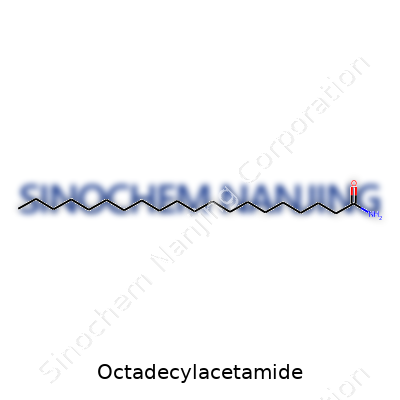
| Names | |
| Preferred IUPAC name | N-octadecylethanamide |
| Other names |
Stearamide Octadecanamide n-Octadecanamide Stearic acid amide |
| Pronunciation | /ˌɒk.təˈdiː.sɪl.əˈsiː.tə.maɪd/ |
| Identifiers | |
| CAS Number | 124-26-5 |
| Beilstein Reference | 873228 |
| ChEBI | CHEBI:38797 |
| ChEMBL | CHEMBL422489 |
| ChemSpider | 84145 |
| DrugBank | DB07762 |
| ECHA InfoCard | ECHA InfoCard: 100.044.320 |
| EC Number | 208-761-5 |
| Gmelin Reference | 9446 |
| KEGG | C14647 |
| MeSH | D000824 |
| PubChem CID | 82144 |
| RTECS number | RF1575000 |
| UNII | X2F99X9441 |
| UN number | UN3077 |
| CompTox Dashboard (EPA) | DTXSID4047922 |
| Properties | |
| Chemical formula | C20H41NO |
| Molar mass | 299.52 g/mol |
| Appearance | White crystalline powder |
| Odor | Odorless |
| Density | 0.829 g/cm3 |
| Solubility in water | Insoluble |
| log P | logP = 7.5 |
| Vapor pressure | Negligible |
| Acidity (pKa) | 14.7 |
| Basicity (pKb) | `-3.7` |
| Magnetic susceptibility (χ) | -75.0e-6 cm³/mol |
| Refractive index (nD) | 1.444 |
| Viscosity | Viscous liquid |
| Dipole moment | 3.67 D |
| Thermochemistry | |
| Std molar entropy (S⦵298) | 695.9 J·mol⁻¹·K⁻¹ |
| Std enthalpy of formation (ΔfH⦵298) | -528.2 kJ/mol |
| Std enthalpy of combustion (ΔcH⦵298) | -11620.7 kJ/mol |
| Pharmacology | |
| ATC code | N02BG10 |
| Hazards | |
| Main hazards | Harmful if swallowed. Causes skin and eye irritation. |
| GHS labelling | GHS07, GHS09 |
| Pictograms | GHS07 |
| Signal word | Warning |
| Hazard statements | H319: Causes serious eye irritation. |
| Precautionary statements | Precautionary statements: P261, P264, P271, P272, P280, P302+P352, P305+P351+P338, P362+P364, P501 |
| NFPA 704 (fire diamond) | Health: 1, Flammability: 1, Instability: 0, Special: - |
| Flash point | Flash point: > 230°C |
| Autoignition temperature | > 310 °C |
| Lethal dose or concentration | LD50 (rat, oral): > 5,000 mg/kg |
| LD50 (median dose) | LD50 (median dose) of Octadecylacetamide: **">8000 mg/kg (rat, oral)"** |
| NIOSH | NA7250000 |
| PEL (Permissible) | Not established |
| REL (Recommended) | 5 mg/m³ |
| Related compounds | |
| Related compounds |
Stearamide Octadecylamine Octadecanol Octadecanoic acid N,N-Dimethyloctadecylamine |



