Octadecyl Isocyanate: Growth, Character, and the Road Ahead
Historical Development
Octadecyl isocyanate, sometimes called stearyl isocyanate, emerged in the landscape of specialty chemicals during the mid-20th century. Chemists found a need for long-chain isocyanates while developing novel surface coatings and functionalized polymers. Early patents describing its synthesis laid the foundation for its spread into both academic labs and industrial settings. Over the years, research articles and technical manuals from major chemical producers began to mention octadecyl isocyanate as an important agent for surface modification. Scientists realized that this molecule’s hydrophobic tail changed how surfaces interacted with water, oils, and other substances. This feature made it an attractive candidate for applications ranging from advanced composites to molecular electronics research. Its story reflects a blend of curiosity-driven exploration and needs-driven industrial innovation.
Product Overview
Octadecyl isocyanate stands as a specialty reagent with a straight 18-carbon alkyl chain attached to an isocyanate group. This structure allows it to act as a bridge between organic surfaces and inorganic materials. It shows up as a white crystalline solid or sometimes as a waxy material, depending on the quality and manufacturing process. Chemists and engineers use it across several industries: in making water-repellent coatings, anti-fouling materials, and creating custom interfaces for electronic and diagnostic devices. The molecule gets steady demand not just for its role in surface science but for how it pushes forward creativity among researchers who want to tailor surface properties for novel uses.
Physical & Chemical Properties
A look at octadecyl isocyanate’s attributes shows a melting point typically around 38-42°C, a boiling point higher than most laboratory glassware cares to endure, and a slight odour reminiscent of other isocyanates. Its solubility in nonpolar organic solvents, like chloroform and toluene, opens up possibilities for coatings and surface treatments. At room temperature, the compound sits between solid and soft wax, easy to weigh but less simple to handle than a powder. The molecule features a reactive NCO group, ready to bond with alcohols, amines, and groups offering acidic hydrogens. This reactivity explains why chemists approach octadecyl isocyanate with both interest and caution.
Technical Specifications & Labeling
Most commercial labels state purity above 98%, sometimes even 99%, which matters for both research accuracy and product consistency. Bottles carry hazard statements referencing its eye, respiratory, and skin irritation potential. Labels also warn of the risk of violent reaction with water and alcohols, thanks to the potent isocyanate group. Some suppliers print batch-specific data on certificates of analysis, reflecting hydrolyzable chlorine and acid content. Handling guidelines suggest inert-atmosphere storage, usually in tightly sealed amber bottles, away from sources of moisture and strong bases or acids. Over the years, technical bulletins have encouraged responsible handling, not just out of safety, but also to preserve the material’s shelf life and utility.
Preparation Method
The synthesis of octadecyl isocyanate often starts from octadecylamine, a derivative of stearic acid widely available from natural fats and oils. Reacting octadecylamine with phosgene or its modern alternatives forms the desired isocyanate group directly on the long alkyl chain. This process requires careful moisture control: any stray water can hydrolyze the product, producing hazardous byproducts such as carbon dioxide and caustic residues. Some smaller-scale syntheses use diphosgene or triphosgene to avoid the risks and regulatory red tape associated with phosgene gas. The last step involves removing solvents and purifying through recrystallization or distillation under reduced pressure. Process engineers watch for proper ventilation and secondary containment, knowing the reaction’s violent side when handled carelessly.
Chemical Reactions & Modifications
With its isocyanate group, octadecyl isocyanate joins with a range of nucleophiles. Alcohols, phenols, and amines snap onto the carbon of the NCO group, forming carbamates or ureas in high yield. On glass or metal oxides, its long tail helps create self-assembled monolayers, transforming the original hydrophilic surface into a water-repellent interface. Researchers exploit this property during sensor design and nanotechnology applications. Additives based on octadecyl isocyanate often anchor themselves to inorganic nanoparticles, improving their compatibility with organic polymer matrices. Custom modifications allow further functionalization, such as attaching the molecule’s end to fluorophores or linker groups, greatly expanding its impact in analytical chemistry.
Synonyms & Product Names
Octadecyl isocyanate wears several hats in catalogs and papers. Stearyl isocyanate remains the most common alternative name, along with n-octadecyl isocyanate and 1-isocyanatooctadecane. In Germany, chemists sometimes refer to it as Stearyl-Isocyanat, while some older literature lists it as 1-octadecyl isocyanate. Commercial suppliers, from Sigma-Aldrich to local purveyors, present it under those variations, each emphasizing their specific grade or purification method. Research groups often mention product and batch number details in publications, emphasizing reproducibility and regulatory compliance.
Safety & Operational Standards
Safety protocols anchor every handling and storage step for octadecyl isocyanate. Isocyanates across the board have a reputation for irritation and sensitization; octadecyl is no exception. Staff wear gloves, goggles, and proper lab coats when opening bottles or weighing material. Fume hoods become mandatory, not just for respiratory safety, but for avoiding traces of airborne NCO groups. Industry rules ask for routine training, spill kits stocked and checked, and emergency plans written in plain language. Waste streams head for certified destruction and do not mix with ordinary trash. Regulators put this molecule on lists for chemical hygiene and workplace safety, with researchers and workers sharing responsibility to respect its hazards and educate each other about safe practices.
Application Area
Delivering new traits to surfaces forms the backbone of how octadecyl isocyanate shows value. Textile finishes get lasting water resistance from it, forests of silicon wafers ignore moisture in high-tech electronics, and diagnostic labs build samplers and sensors that hold up in wet environments. Research groups use octadecyl isocyanate to study molecular self-assembly, creating well-ordered films for basic science and practical use. Paint and coating makers reach for it when standard additives can’t deliver the chemical bonding or long-term performance they want. Even medical device companies investigate its use, building biocompatible coatings to control how cells and proteins interact with their products. Every year, more niche uses turn up in journals or patents, proving how versatile a long alkyl chain with a reactive end can be.
Research & Development
Research into octadecyl isocyanate keeps growing in both scope and technical sophistication. Universities, industry labs, and startups chase after better ways to prepare, modify, and deploy this molecule. Nanotechnology groups look into denser, more stable self-assembled monolayers for biosensors and chip-based devices. Materials scientists hunt for new derivatives with altered reactivity or greater environmental stability. Collaboration between chemists and engineers leads to new forms of chemical vapor deposition or liquid coating that change how surfaces behave. Environmental researchers track breakdown pathways and look for biocompatible or easily degradable follow-up compounds, reflecting concerns about residue and long-term exposure. Funding agencies support projects that move past legacy chemistries and lean into greener, safer processes.
Toxicity Research
Toxicology studies on octadecyl isocyanate build off decades of caution around isocyanates in general. Inhalation, skin contact, and ingestion all carry known risks, and prolonged or repeated exposure can sensitize workers, sometimes with lifelong allergy-like symptoms. Animal research gives a rough outline of its acute toxicity, but the long alkyl chain appears to limit some of the volatility and reactivity seen in shorter-chain cousins like methyl or tolyl isocyanate. Labs work with animal and cell models to gauge cumulative effects, intermediates, and breakdown products. Occupational health professionals push for personal monitoring and reinforced ventilation standards in workplaces. As more products enter consumer supply chains, calls increase for independent testing and transparent risk communication.
Future Prospects
Progress in material science and surface technology primes octadecyl isocyanate for even broader use. Companies already explore new synthetic routes that swap out hazardous reagents for more benign options. Researchers develop hybrid coatings combining this molecule with inorganic nanofillers or biomolecules, seeking advanced membranes, drug delivery systems, and filtration materials. Pressure from regulators and the wider public keeps development teams focused on greener processes and safer formulations, not just performance. The frontier lies in making use of octadecyl isocyanate’s unique dual character — hydrophobic long chain with a highly reactive end group — while respecting safety, sustainability, and health. These demands don’t just set limits; they help define the next chapter for this singular molecule.
What is Octadecyl Isocyanate used for?
A Hidden Ingredient with a Big Impact
Most people never hear about octadecyl isocyanate. Yet this oily chemical tends to pop up in a range of research labs and factories. It looks unremarkable, but chemists treat it like a special tool. The long carbon chain attached to a reactive “isocyanate” group gives it a unique personality. That mix makes it a key choice for a handful of challenges, especially anything that involves surface changes or special coatings.
Building Protective Layers
Octadecyl isocyanate gets serious attention for its role in creating self-assembled monolayers, or SAMs. In plain speak, this means it lines up its chains across surfaces like metal, glass, or silicon. You get a paper-thin blanket that changes how that surface behaves. Scientists realized early on that this chemical helps make materials repel water, block corrosion, or turn “slippery.” I remember a grad school project where we coated gold with different substances. The octadecyl layer always stood out under the microscope, giving the gold a glossy barrier you almost wanted to touch.
Microelectronics and Sensors: More Than Wires and Chips
Those working in electronics appreciate how octadecyl isocyanate can help shape the surface of tiny devices. It doesn’t just prevent parts from sticking together. It actively tunes how signals move or how a sensor reads its environment. Say you want a circuit to ignore water or dust in the air — this chemical creates a sort of shield. In medical sensors, it keeps proteins or cells from clinging to the wrong spots. This may sound small, but misreadings cause big headaches in diagnostics and research.
Tougher, Smoother Plastics
This chemical stands out inside certain high-end plastic coatings. Thanks to its long chain, octadecyl isocyanate lets manufacturers push ordinary polymers to repel oil, water, or even dirt. Consumer electronics, automotive trim, and lab tools benefit from this invisible armor. I’ve seen old lab benches treated with specialty coatings that still shed liquids like a duck’s back years later. The secret often lies in the chemistry of simple ingredients like octadecyl isocyanate.
Environmental and Safety Considerations
Danger can sneak in with any strong chemical. Octadecyl isocyanate comes with health warnings — the isocyanate group causes trouble if people inhale or touch it without protection. Manufacturers know to keep workspaces ventilated and gear up with gloves and eye shields. The industry learned the hard way that isocyanates have links to allergic reactions and breathing problems. So the story of octadecyl isocyanate includes a growing push for better safety practices, stricter exposure limits, and safer alternatives in some fields.
What’s Next?
There’s no shortage of work on refining how to use this chemical. Researchers keep testing new ways to anchor it to different surfaces and combine it with “greener” alternatives. Some look at swapping it for less hazardous chemicals, especially in factories that see heavy, daily use. Engineers try to recover more of it during manufacturing, cutting down on waste. This real-world experience pushes chemistry in a healthier direction while keeping the doors open for the creative uses that octadecyl isocyanate inspires.
What are the safety precautions when handling Octadecyl Isocyanate?
Why Octadecyl Isocyanate Demands Attention
Octadecyl isocyanate serves a purpose in many laboratories and manufacturing spaces. Its chemical properties open doors for coatings, advanced materials, and specialty polymers. But a big benefit often comes with big responsibility: isocyanates have a reputation for triggering severe health effects if not handled with strict caution. Anyone who’s spent time in a working lab knows the burn of mishandling a strong chemical isn’t something you soon forget.
Health Risks in Real Life
Skin exposure leads to painful irritation, sometimes with blistering. Breathing in vapors or particles can leave the lungs struggling for hours or longer. Some folks develop lifelong sensitivities after just one bad exposure to isocyanates—in this case, asthma-like symptoms aren’t rare. Getting some on your gloves, then rubbing your eyes, can send you straight for an eyewash station. According to data published by OSHA and CDC, isocyanate exposure remains a leading cause of occupational asthma in industries working with advanced chemicals.
Practical Steps: Protecting Yourself and Others
Simple routines make a world of difference. I’ve seen people skip gloves in a rush and pay dearly for it later. Nitrile or neoprene gloves must cover hands completely—latex won’t cut it. This isn’t the time for short sleeves; impervious lab coats and chemical splash goggles become your best friends. Respiratory protection also plays a key role. Engineering controls, such as a reliable chemical fume hood, reduce exposure at the source. Without these, the risk climbs, and so does the worry.
Another thing that helps: reading and understanding the Safety Data Sheet (SDS) every time a new shipment arrives. It sounds basic, but every batch comes with its own quirks, and ignoring this information can land someone in a bad spot. Never work alone with a strong irritant like octadecyl isocyanate. Keeping the workspace clutter-free, having neutralizing agents and plenty of spill pads on hand, and ensuring eyewash stations stay checked and functional—the everyday details matter more than fancy hazard phrases.
Best Practices in Storage and Disposal
A locked chemical cabinet, out of the sun and away from heat, keeps volatile substances from breaking down or reacting unexpectedly. Storing isocyanates next to acids or water-based chemicals causes problems quickly; it pays to separate storage. Regular inspections help spot damaged containers before they leak.
Waste from these chemicals needs labeling and prompt, responsible handling through a certified hazardous waste program—this isn’t something to pour down a drain or toss in regular trash. I once worked at a site where a spill outside the fume hood needed a full area evacuation, simply because someone failed to secure a cap. People remember those days.
Towards Safer Workspaces
Taking the time to train everyone—new employees, visiting researchers, maintenance staff—brings confidence and lowers the risk of a surprise accident. Frequent safety drills turn cautious behavior into second nature. Industries with good track records place as much value on straightforward checklists and reminders as they do on technical knowledge.
Nobody expects an accident until it happens. By focusing on real-world risks, clear routines, and consistent training, teams can keep this powerful chemical working for them, not against them.
What is the chemical formula and molecular weight of Octadecyl Isocyanate?
The Nuts and Bolts: Structure and Formula
In the world of specialty chemicals, small shifts in structure can lead to big shifts in behavior. Octadecyl isocyanate, with the chemical formula C19H37NO, provides a classic example. In practice, it means one long tail of carbon atoms — eighteen of them, in fact — capped with an isocyanate group. This isn’t just trivia for chemists; it actually shapes how the compound acts in coatings, surface treatments, and other applications.
Octadecyl isocyanate weighs in at about 295.51 grams per mole. That’s not light or heavy in the world of organic compounds, but it’s just hefty enough to help it stick to surfaces, fend off water, and build strong bonds with other molecules. The little bit of nitrogen and oxygen in that isocyanate group brings a reactive snap to the mix, letting it grab onto surfaces or react with amines to form durable urea linkages.
Why the Formula Matters in Real Life
Structurally, that C18H37 tail mimics the makeup of natural fats. That’s not just a coincidence. This similarity lets octadecyl isocyanate “blend in” with both organic, oily surfaces and synthetic polymers. The isocyanate group, on the other hand, makes it stick where other molecules can’t. Essentially, this single molecule combines flexibility with a reactive punch.
Some of the first projects I worked on as a materials scientist revolved around modifying surfaces to repel water or to bind certain chemicals. Using a compound like octadecyl isocyanate allowed us to customize surfaces in hours, not days. It flat-out worked better than many fancier-sounding options, thanks to its straightforward formula. You’d prep a glass slide or a polymer film, apply a solution with the isocyanate, and watch as the surface transformed from water-loving to water-fearing right before your eyes.
Down-to-Earth Impact — Not Just for Labs
Water-repellency sounds like a niche problem until you need to control corrosion or stop biological gunk from building up. The big hydrocarbon tail in this molecule offers a real shield without adding much thickness or brittleness. It nudges droplets off without much fuss, similar to how leaves bounce off dew. The nitty-gritty formula details end up powering some of the most durable industrial coatings, anti-fog surfaces, and even stealthier drug delivery systems.
For folks working outside the lab, the key challenge centers around safe handling. Isocyanates react sharply with water and skin, which means you don’t get many second chances if there’s a spill or a whiff of vapor. Solid protocols, ventilation, and respectful handling go a long way. Investing in digital sensors that can “smell” isocyanates in the air adds a layer of protection and lets workers focus on the job instead of fretting about invisible risks.
Smarter Solutions and Greener Chemistry
There’s growing pressure across industries to find chemical solutions that work just as well but leave less environmental trouble behind. Octadecyl isocyanate, with its high performance at low concentrations, can help cut down on overuse. Safety can improve through better packaging and training. Switching to greener isocyanate synthesis routes would also trim back pollution—plenty of research teams are looking at ways to produce this molecule using plant oils as a starting point instead of petrochemicals. A shift like that would nudge the field in the right direction, one carbon chain at a time.
How should Octadecyl Isocyanate be stored?
Understanding What You’re Dealing With
Octadecyl isocyanate isn’t exactly a household chemical. It’s used most in labs and manufacturing environments, often for coatings or surface treatments. It’s a colorless to pale yellow liquid, but don’t let a mild appearance fool you—like many isocyanates, it can cause real trouble if handled without respect. My background in chemical storage and safety means I’ve seen how minor lapses lead to major headaches, not just for workspaces but for health and safety down the line.
Why Storage Really Counts
This compound reacts with water and moisture in the air. Even everyday humidity will eventually break it down and create all sorts of nasty byproducts, including toxic gases. I once saw a warehouse team fail to notice a slow leak in their container; by the next morning, they were dealing with both strong odors and an evacuation. It isn’t worth testing your luck with improper capping or loose seals.
Making the Environment Work for You
Keep octadecyl isocyanate in tightly closed containers. Choose ones that won’t corrode or break down—glass with plastic screw caps or high-density polyethylene have given consistent, safe results in my experience. Just as important, dodge metal containers since certain metals can trigger ugly chemical reactions.
Temperature matters more than most folks realize. A cool, dry room where temps stay below 25°C will slow down any unwanted reactions. Avoid spaces near heat sources like radiators or direct sunlight. Over the years, I’ve watched careless box placement near HVAC exhausts trigger increases in room temperature—and that’s where problems sneak up.
No one wants to track drips around the building, so always store containers on trays or with secondary containment. Chemical sorbent pads or spill pallets save time and money if accidents do happen. Good storage doesn’t stop leaks, but it sure makes clean-up easier and keeps small issues from growing into full-blown incidents.
Air and Ventilation
Isocyanate vapors sting the eyes, nose, and lungs. Proper ventilation remains a must, especially for long-term storage. If you’re working in a warehouse, go for local exhaust systems or ensure the room cycles fresh air regularly. I can’t count the times I've walked into storage rooms thick with (sometimes invisible) fumes, and the health effects kicked in before anyone realized. A simple exhaust fan or an open window tricks people into feeling safe, but nothing beats a proper engineered solution.
Keeping an Eye on Labeling and Records
Label every container clearly. I’ve seen chemical mix-ups lead to dangerous reactions—all avoidable with a marker and ten seconds of attention. Don’t trust memory or sticky notes; use permanent, chemical-resistant labels. Track expiration dates and rotate older stock forward. Keep a log of use, inventory, and inspections. This approach ties right in with what regulatory bodies push for: traceability, accountability, safety.
Training Beats Complacency
Storage isn’t a “set and forget” situation. Everyone on-site should know the properties and dangers of isocyanates. Regular training, even for people who only pass through storage areas occasionally, ensures no one forgets how to handle an emergency. Safety data sheets belong outside the cupboard, not buried in a file drawer. Easy reference makes for quicker, smarter responses if things ever go sideways.
Improving the Big Picture
Proper handling of octadecyl isocyanate protects people as much as it shields inventory. Good practices—clean containers, smart positioning, sturdy labels, and regular checks—make for smoother, safer operations. Auditing storage areas twice a year often uncovers problems before they risk health or compliance fines. Small efforts on storage transform both workplace safety and bottom-line efficiency.
What are the common applications of Octadecyl Isocyanate in industry or research?
Surface Chemistry: A Game Changer for Research
Octadecyl isocyanate matters a lot in labs focused on tailoring surfaces. As someone who’s watched research teams puzzle over how to keep unwelcome materials from sticking to glassware, I’ve seen first-hand how chemists swear by this compound. It forms a solid, waxy coat on glass, silicon, or even metal. Picture handling a microscope slide where fluids bead up and roll off—those slides usually carry a thin film of octadecyl isocyanate. This trick is key for making surfaces that want to shrug off water or handle delicate biomolecules without interference. With digital sensors, researchers often use this chemical to prevent fouling, which keeps their devices running longer.
Nanoscale Engineering: Building from the Bottom Up
There’s no shortage of talk about nano-this and nano-that. In building super-thin films, octadecyl isocyanate steps up as a basic but powerful tool. It links to surfaces through strong chemical bonds, setting the stage for self-assembled monolayers. These single-molecule-thick coatings can block corrosive agents, drive cell adhesion, or steer how tiny particles come together. Take DNA chips as an example: these platforms require a layer that keeps everything stable and clean. In this space, the compound works behind the scenes to support reliable diagnostics and help researchers spot diseases early through molecular analysis.
Electronics and Semiconductors: Protecting Tiny Tech
Fresh off the assembly line, silicon wafers and microchips deal with environmental headaches like moisture and airborne dust. To extend their lives, manufacturers treat these surfaces with octadecyl isocyanate. This creates a barrier that fights off oxidation and chemical attack, locking down the chip’s performance and helping meet strict product lifetime targets. It’s not flashy work, but it’s essential. I’ve heard engineers mention that only a razor-thin treatment stands between success and an expensive recall.
Polymer and Plastics: Smoother, Tougher Products
Moving beyond the lab, chemical plants use octadecyl isocyanate to tune plastic surfaces. It can anchor colorants or make plastics less likely to absorb water. In medical devices, this reduces the risk of bacterial build-up. I’ve spoken with materials scientists who care deeply about making PICC lines and catheters safer for patients. A well-designed surface saves lives and cuts hospital costs. In packaging, brands look for longer shelf lives and easier cleaning, goals that octadecyl isocyanate coatings help achieve by creating water-repellent outer layers.
Potential Challenges and Responsible Use
Despite all these benefits, octadecyl isocyanate comes with health and environmental safety questions. The compound reacts quickly and can irritate skin or eyes if handled carelessly. Plants need strong training programs, fume hoods, and airtight containers. Regulatory frameworks now ask for closer tracking of where and how these chemicals travel, especially to prevent workplace injuries. Switching to safer alternatives is on the table, yet in most advanced labs, nothing matches the performance right now. I have seen new research into plant-based coatings and safer analogs—a promising sign that the industry isn’t standing still. Recognizing and addressing these concerns up front makes for more trustworthy and sustainable science.
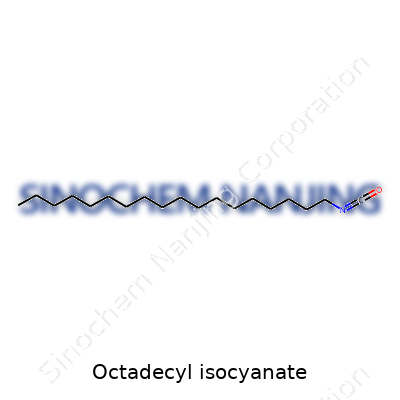
| Names | |
| Preferred IUPAC name | octadecyl isocyanide |
| Other names |
n-Octadecyl isocyanate Stearyl isocyanate Isocyanic acid octadecyl ester |
| Pronunciation | /ˌɒk.təˈdeɪ.sɪl ˌaɪ.səʊ.saɪˈə.neɪt/ |
| Identifiers | |
| CAS Number | 3029-23-0 |
| Beilstein Reference | 1428603 |
| ChEBI | CHEBI:34797 |
| ChEMBL | CHEMBL415353 |
| ChemSpider | 89639 |
| DrugBank | DB14174 |
| ECHA InfoCard | 03b664f6-9a25-4db7-b79b-ecbbf50b8c0b |
| EC Number | 2206-40-0 |
| Gmelin Reference | 790262 |
| KEGG | C19299 |
| MeSH | D007812 |
| PubChem CID | 12517 |
| RTECS number | NL2975000 |
| UNII | F6J3LZ7A3E |
| UN number | UN2811 |
| Properties | |
| Chemical formula | C19H37NO |
| Molar mass | 297.48 g/mol |
| Appearance | White to yellowish solid or liquid |
| Odor | Characteristic odor |
| Density | 0.862 g/mL at 25 °C (lit.) |
| Solubility in water | Insoluble |
| log P | 8.97 |
| Vapor pressure | Negligible |
| Acidity (pKa) | 13.2 |
| Magnetic susceptibility (χ) | Diamagnetic |
| Refractive index (nD) | 1.440 |
| Viscosity | 3 mPa·s |
| Dipole moment | 2.73 D |
| Thermochemistry | |
| Std molar entropy (S⦵298) | 328.7 J·mol⁻¹·K⁻¹ |
| Std enthalpy of formation (ΔfH⦵298) | Std enthalpy of formation (ΔfH⦵298) of Octadecyl Isocyanate is -300.7 kJ/mol |
| Hazards | |
| GHS labelling | GHS02, GHS05, GHS07 |
| Pictograms | GHS02,GHS05,GHS07 |
| Signal word | Danger |
| Hazard statements | H226, H301, H311, H314, H317, H331 |
| Precautionary statements | P260, P261, P264, P271, P272, P273, P280, P301+P310, P302+P352, P304+P340, P305+P351+P338, P308+P311, P321, P330, P337+P313, P362+P364, P403+P233, P405, P501 |
| NFPA 704 (fire diamond) | 1-3-1-W |
| Flash point | 165 °C |
| Autoignition temperature | 250°C |
| Lethal dose or concentration | LD50 (oral, rat) > 5,000 mg/kg |
| LD50 (median dose) | LD50 (median dose): Oral rat LD50 > 5000 mg/kg |
| NIOSH | SNB04550 |
| PEL (Permissible) | Not established |
| REL (Recommended) | 0.1-1.0% |
| Related compounds | |
| Related compounds |
Isocyanic acid Methyl isocyanate Phenyl isocyanate Stearoyl chloride |



