N-Propylcyclopentane: A Modern Look at a Classic Chemical
Historical Development
Curiosity about the chemistry of cycloalkanes picked up speed in the 20th century after foundational work nailed down the structure of cyclopentane itself. N-Propylcyclopentane grew out of a push to produce new derivatives for industrial expansion. As petrochemical industries flourished, researchers and manufacturers dug for ways to spin off new molecules that delivered better stability or performance compared to the crowd of lighter hydrocarbons. The development of n-Propylcyclopentane was not a sudden leap. Instead, it built up slowly as catalysts, synthetic routes, and distillation methods improved. Early papers on alkylcyclopentanes rarely mentioned n-Propylcyclopentane by name, but, as awareness of hydrocarbon diversity deepened, it earned its place as a distinct and useful molecule. Today, it reminds us how innovation often comes from tuning the familiar, not just chasing the unknown.
Product Overview
N-Propylcyclopentane carries a straightforward structure: a five-membered cyclopentane ring capped by a three-carbon n-propyl chain. This combination places it somewhere between nimble ring compounds and longer chain paraffins, and it strikes a balance many chemists appreciate. In the lab, it looks like a clear, colorless liquid. Refineries and research suppliers bottle n-Propylcyclopentane and label it ready for organic synthesis, materials research, and flavor or fragrance study. It has made its mark not by starring in massive volumes but by filling in gaps where other hydrocarbons fall flat. Its performance in solubilizing agents and specialty solvents keeps chemists reaching for it.
Physical & Chemical Properties
The liquid pours at room temperature, and like many similar hydrocarbons, it brings a distinctive low boiling point, usually clocking in near 115°C (239°F). Its density sits a shade below water, hovering around 0.75 g/cm³. That means it floats if mixed with H₂O. Its odor is subtle—less heady than smaller ring compounds. N-Propylcyclopentane resists water, shrugs off mild acids and bases, and does not corrode steel. It's flammable, though, and lets off vapors that need good ventilation. It resists rapid oxidation under ordinary conditions, so it doesn't break down in storage as quickly as some unsaturated hydrocarbons do. The saturated ring structure and the propyl side-chain make the molecule chemically stable, though it responds predictably to halogenation and cracking under vigorous conditions.
Technical Specifications & Labeling
Manufacturers report purity routinely above 98%, with common specifications listing water content by Karl Fischer testing and contamination with aromatic hydrocarbons held under tight control. Standard labeling clearly names the product (n-Propylcyclopentane), along with its CAS number (6081-87-2), hazard pictograms for flammability, warnings about inhalation and storage, and advice for protective gear. Barcodes, batch numbers, and expiry dates often appear on the label—important for anyone who values traceability and product history in a regulated lab or production shop. Technical sheets tend to give bond structure diagrams and note compliance with industry safety codes, as well as transport limitations by road, rail, or air.
Preparation Method
Large-scale n-Propylcyclopentane most often comes from catalytic alkylation of cyclopentane itself with n-propyl halides. Labs usually favor Friedel–Crafts alkylation, using aluminum chloride as a catalyst. This method, though decades old, stands out for steady yields and manageable byproducts. Some newer processes employ zeolites or more environmentally friendly supports to avoid difficult-to-dispose-of catalyst waste. Separation by fractional distillation follows synthesis to ensure that the product meets the needed purity level. Avoiding the formation of isopropyl or di-substituted cyclopentanes requires careful control of reaction conditions. Trying alternate strategies, such as catalytic hydrogenation of suitable unsaturated cyclopentanes, also takes the molecule from bench scale to more commercial quantities while letting teams skip harsh reagents.
Chemical Reactions & Modifications
This molecule submits readily to halogenation under appropriate laboratory conditions. Chlorination or bromination targets the side chain’s secondary hydrogens, or, if driven with enough light or heat, also adds halides to the ring carbons. Oxidation of the n-propyl group produces complex mixtures without careful control, but it can be achieved with strong oxidizers. Hydrogenation reactions don't add much unless unsaturated bonds exist at the start. Selective cracking can break down the n-propyl group, which interests teams studying hydrocarbon processing. The stability of the cyclopentane core means that substitution reactions often leave the five-membered ring untouched until more severe conditions come into play.
Synonyms & Product Names
Chemists may spot this chemical as Cyclopentane, n-propyl- or 1-Propylcyclopentane in literature. Less often, older catalogs use Propylpentamethylene for the same structure. The CAS number 6081-87-2 helps avoid confusion, as does the molecular formula C8H16. Global suppliers typically reference the IUPAC name while listing synonyms for regulatory compliance and customer cross-references.
Safety & Operational Standards
Flammability takes center stage in safe handling. Liquid and vapor both ignite easily, so grounding storage drums and avoiding open flames or hot surfaces stands as step one in risk management. Access to local exhaust or well-sized fume hoods helps control vapor exposure, cutting the risk of headaches and dizziness caused by inhalation. Spills need careful cleanup—absorbent pads, appropriate gloves, and eye protection serve as the minimum standard. Emergency teams examine the material safety data sheet in case of fire or accidental release, looking for flash point data and guidance on suitable extinguishing agents. Regulations strictly define safe shipping labels, including UN numbers and hazard classes for flammable liquids. In workplaces, storage containers often sit far from oxidizers or other ignition sources, and standard operating protocols emphasize both personal protection and environmental hygiene.
Application Area
N-Propylcyclopentane often finds its way into specialized solvent blends, where its structural balance gives desirable volatility and solvent power in paints and coatings. Researchers lean on its properties to test material performance or develop new analytical methods for hydrocarbon mixtures. The fragrance and flavor world sometimes employs cyclopentane derivatives to deliver certain odor characteristics or dissolve stubborn resinoids. A few manufacturers look at it for fuel research, comparing combustion and emission profiles with other cycloalkanes. Its chemical reactivity makes it a substrate in organic synthesis, particularly for studying alkyl substituent effects on ring stability. Though it flies under the radar compared to simpler paraffins, manufacturers value it for the unique combination of properties that open up otherwise tricky process or formulation problems.
Research & Development
R&D teams constantly cast about for molecules that strike a new balance between volatility, flammability, and safe biodegradation. N-Propylcyclopentane serves as a comparative reference for other alkylated cyclopentanes and similar ring systems. Technical teams report on its combustion chemistry, examining how the ring and side chain burn compared to linear alkanes. For environmental research, its fate in soil and water receives scrutiny by those studying hydrocarbon contamination and natural degradation. In synthesis, it provides a scaffold for functional group addition, which helps when developing targeted drugs or advanced polymers. Labs examining aroma chemical performance sometimes blend it with other hydrocarbons to tweak volatility and evaporation timelines. Since legal and environmental rules shift frequently, ongoing R&D examines modifications or substitutes to anticipate coming regulations.
Toxicity Research
Most of the available animal studies suggest n-Propylcyclopentane acts much like other mid-weight paraffinic hydrocarbons. Inhalation of vapor at high levels leads to short-term central nervous system effects—think nausea, headaches, drowsiness. Mice and rats exposed to high doses show liver and kidney effects, but only at concentrations far above workplace standards. Human exposure data remains limited, but existing reviews recommend standard industrial precautions and regular air monitoring. No evidence to date ties this molecule to persistent toxicity or carcinogenic effects with regular use under responsible lab or industrial conditions. Waste management focuses on preventing release to waterways, where local microbes eventually break it down, although rates vary with temperature and soil type. Regulators monitor developments closely, as hydrocarbon exposure standards tighten in many regions every few years.
Future Prospects
N-Propylcyclopentane faces a changing world as both regulatory pressures and market needs evolve. Its chemical stability and unique physical properties put it in an interesting spot, especially as industries keep searching for reliable, low-toxicity hydrocarbons. Interest grows in greener synthesis routes, which aim to reduce catalyst waste or energy use. Suppliers who refine these manufacturing methods may find new markets in specialty solvents, alternative fuels, or biodegradable blends for eco-friendly formulations. Research into degradation pathways keeps pressure on for safer end-of-life handling and full life-cycle assessment reports. The molecule’s straightforward structure makes it an appealing candidate for further substitution chemistry or incorporation into new functional materials. While demand may never match that of base solvents like hexane or toluene, n-Propylcyclopentane’s versatility, paired with ongoing technical refinement, keeps it squarely in the sights of both applied and academic research.
What is the chemical formula of N-Propylcyclopentane?
Knowing the Formula
N-Propylcyclopentane brings together a cyclopentane ring and a straight-chain propyl group. Put that together, and you get a chemical formula of C8H16. This number says a lot about the molecule. It carries eight carbon atoms and sixteen hydrogens, making it part of the alkane family. Every chemical formula tells a small story, and in this case, that story is all about connections—connecting how chemists see molecular structure and how users handle the real stuff in labs and industry.
Why Structure Gets So Much Attention
Organic chemistry doesn’t only live in textbooks. Visualizing this molecule means picturing a five-carbon ring, with a three-carbon chain (the propyl group) hooked up somewhere along the cycle. A formula like C8H16 can sometimes lead you to different structures. In this case, it’s the specific structure—propyl sticking onto the cyclopentane—that gives it unique properties compared to something like octane or methylcycloheptane. Whenever I end up discussing hydrocarbon structures, I remember how different arrangements can completely shift boiling points, behaviors, and even safety procedures.
Applications and Points to Consider
N-Propylcyclopentane gets attention in organic synthesis and as a reference compound for physicochemical studies. There’s nothing flashy about it, but if you care about volatility, flammability, or even just understanding how saturated hydrocarbons play out in the real world, knowing all carbon and hydrogen counts really helps. Solvent work, fuel science, or chromatography standards—each area demands a close look at the underlying chemistry.
Some hydrocarbon compounds with similar formulas show subtle health and environmental impacts. Clean handling matters. Short-term exposure deals more with flammable vapor risks, so practical safety measures like ventilation and proper storage have to be in place. Understanding what happens to C8H16 in the environment boils down to how it evaporates and reacts with sunlight or other compounds. Excessive release ends up adding to air pollution, and processes that slow down rates of emission or boost capture rates become valuable.
Data and Decision Making
The physics and chemistry of alkanes like N-propylcyclopentane have been researched for decades. Sources like the NIST Chemistry WebBook or organic chemistry handbooks lay out melting and boiling points, density, refractive index, and related values. I’ve always leaned on that kind of rigor to double-check assumptions. Whether you’re running a spectra comparison or drafting a lab safety sheet, the numbers matter.
At many workplaces, chemical stewardship relies on knowing your compounds down to the formula. There’s never any replacement for keeping up with current research and improving reporting. Teams who take the time to understand molecules—not just from a formulaic standpoint, but through their industrial journey—set themselves up for better problem-solving in the field.
Building Toward Better Outcomes
Being aware of a basic hydrocarbon like N-propylcyclopentane opens doors to deeper questions. What’s the next step in limiting emissions? How can we model behavior under real-world conditions? Increasingly, solutions point back to education, data sharing, and collective responsibility—both in research labs and throughout supply chains. The chemical formula C8H16 doesn’t just land on a label. It anchors safety, guides choices, and shapes new possibilities every day.
What are the main applications of N-Propylcyclopentane?
Where Industry Meets Chemistry
N-Propylcyclopentane remains one of those names that rarely pops up over dinner, yet its footprint shapes plenty of things out in the real world. This compound’s unusual ring structure with its propyl side group allows for more than just a role on paper; it's powering engines, fine-tuning products, and giving all sorts of manufacturers a real edge. There’s something striking about how a simple shift in a molecule’s structure can set off ripples across several sectors.
Fuel Performance Behind the Scenes
N-Propylcyclopentane finds a home in fuel research circles. Its physical properties—good volatility, excellent combustion traits—allow engineers and chemists to simulate fuel blends for testing engines and emissions. Decades back when some of the best minds I met debated engine knock and cleaner combustion, molecules like this helped us crack the code. Refineries pay close attention to such compounds since they reflect what really happens when an engine starts up, burns fuel, and deals with harsh, high-temperature conditions. Recent studies have shown that cyclopentane derivatives, including n-propylcyclopentane, can help in creating blending standards for research octane number, so the connection to today’s cleaner fuels holds real weight.
Keys in Organic Synthesis
This compound steps in as a handy intermediate when building up more complex molecules. Through experience, I’ve learned that chemists working in the lab need building blocks that stand up to tough conditions and deliver predictable reactions. N-Propylcyclopentane is stable, mixes well with nonpolar solvents, and stands up to high heat. Pharmaceutical research, agricultural chemistry, and specialty materials all make use of such intermediates. The market for these tailor-made molecules grows each year, fueled by a search for better-performing products and more sustainable chemistry. As green chemistry advances, safer alternatives with lower toxicity profiles become valuable, making n-propylcyclopentane’s relative non-reactivity a plus.
Solvents and Cleaning Power
The paint and coatings sector counts on hydrocarbons that don’t react with sensitive pigments or resins. N-Propylcyclopentane steps up with low polarity and steady evaporation rates, leading to cleaner finishes and sharper results. Paints, varnishes, and industrial cleaners often include such ringed hydrocarbons for their balance of solvency and gentle action on surfaces. Consumer goods testing points out that stable solvents protect both product integrity and worker safety.
Specialty Applications and Tomorrow’s Needs
Beyond its usual roles, specialty manufacturers use n-propylcyclopentane as a calibration standard or tracer in analytical chemistry. Laboratories rely on chemicals that don’t interfere with measurements or break down in unpredictable ways. This demand grows with tighter regulations around environmental monitoring and quality control. Some research groups also tap its structure as a model in computational chemistry, which might seem niche but underpins big advances in drug discovery and advanced materials.
Navigating Safety and Future Solutions
Anyone handling hydrocarbon compounds gets used to thinking ahead. Training sessions on chemistry lab floors drove home the importance of proper ventilation and protective equipment—not because these chemicals are public health enemies, but because carelessness adds up. As more companies adopt stricter safety standards, chemical producers will keep chasing purer grades and greener manufacturing methods. Finding safer substitutes remains a long-term target, but for now, thoughtful handling and responsible sourcing keep n-propylcyclopentane’s risks in check.
Research and certification trends point toward better oversight and targeted risk management for even well-understood compounds. By supporting transparency, worker training, and greener synthesis approaches, companies can keep accessing the specialized properties of molecules like n-propylcyclopentane without sacrificing safety or sustainability.
Is N-Propylcyclopentane hazardous or toxic?
Chemicals at Work: Looking Past the Hard-to-Pronounce Names
Talking about N-Propylcyclopentane, most people’s eyes glaze over. The name sounds like something tucked on a shelf in a high school chemistry lab, barely touched except by the teacher. Yet, for folks in certain industries—like petrochemicals, specialty manufacturing, and research—this chemical enters the picture much more directly. It’s a clear liquid, part of a family of hydrocarbons. Stuff like this finds its way into solvents, fuels, or sometimes into lab experiments meant to mimic real-world reactions. Few outside the field know much about it, but that doesn’t mean ignoring its impact is an option.
Hazard or Hype: What We Know
N-Propylcyclopentane doesn’t carry the fame (or infamy) of a household solvent or the dangers trumpeted around substances like benzene. No widespread bans, no evening news horror stories. But the lack of buzz shouldn’t trick anyone into thinking it’s harmless. Like other hydrocarbons, breathing in its vapors in an unventilated space brings real problems—headaches, dizziness, and in high concentrations, more serious nervous system effects. A few splashes on the skin, or even long repetitive exposure, can leave you with dryness or irritation. The stuff also lights quickly, which means one spark in its vicinity could cause serious problems.
Research and Regulation: What’s Missing
Folks who have spent years working around odd-sounding chemicals often get frustrated by how little non-specialists actually know about new or rarely-used compounds. In the case of N-Propylcyclopentane, hard data remains limited. U.S. regulations—OSHA, NIOSH—haven’t pinned down strict exposure limits. For companies and workers, this means falling back on pretty broad hydrocarbon rules. That relies on common sense, sharp ventilation, and protective gear. Without more focused research, guessing takes the place of evidence. That is rarely a recipe for long-term safety in warehouses, factories, or research labs.
Learning From Other Hydrocarbons
Experience with similar chemicals teaches an important lesson: even those with modest toxicity on paper can surprise us. Over the past twenty years, I’ve seen labs ramp up protective measures—not because a chemical ranked as “extremely hazardous,” but after small illnesses or near-misses forced everyone to rethink their guardrails. For N-Propylcyclopentane, goggles, gloves, and fume hoods count as the basics. Storing it well away from heat or ignition sources keeps things safer. Training that shows new workers the risks—right down to the symptoms of lightheadedness or skin irritation—isn’t just a box to check off. It’s about keeping real people healthy.
Solutions: Ask Questions, Demand Data
No matter how obscure a chemical sounds, no one benefits from hiding from the unknowns. Greater transparency—labels with honest hazard info, data sheets easily understood outside a PhD classroom—goes a long way. Researchers and regulators should push for specific toxicology studies, especially since industries tend to adopt new solvents or fuels quickly. Until data gets better, industry veterans know that treating lesser-known hydrocarbons with healthy suspicion keeps workers, neighbors, and the environment out of harm’s way. Day-to-day experience has taught me that complacency leaves you paying the bill in injuries and cleanup. In workplaces with strange names on bottles and barrels, information and caution walk hand-in-hand.
What is the boiling point of N-Propylcyclopentane?
What’s So Special about N-Propylcyclopentane?
Anyone spending time around organic chemistry labs or the industrial aisle of a chemical catalog comes across N-Propylcyclopentane. It’s a clear, colorless hydrocarbon known for its distinct five-membered carbon ring with a three-carbon straight chain branching off. This is not just a technical detail — this kind of structure influences everything from its physical properties to its behavior in complex reactions.
The Boiling Point: A Key Chapter
For those looking for quick facts, the boiling point of N-Propylcyclopentane lands at around 114–116°C (237–241°F). Numbers alone never paint the full picture, though. Take two hydrocarbons: compare N-Propylcyclopentane to its straight-chain cousin, n-nonane, or to cyclohexane. Minor tweaks in structure send boiling points skidding up or sliding down. This isn't trivial: reliability and predictability in solvent behavior, industrial separations, and safety protocols all hang on these values. Using a liquid’s boiling point as a touchstone has saved me from more failed purifications than I care to count.
The molecular shape and flexibility of N-Propylcyclopentane push its boiling point slightly higher than plain cyclopentane (about 49°C) and lower than much larger cyclic molecules. I used to run distillations in a college lab, and seeing the thermometer spike at an unexpected value quickly revealed contaminated batches or a wrongly labeled bottle. That’s why accurate data isn’t just for textbooks — it’s about trust and safety in the lab.
Why Boiling Point Stays Crucial Beyond Chemistry
Industry plays by the numbers, and solvents rule behind the scenes. The boiling point gives engineers a handle on everything from refining petroleum streams to choosing the right blend for fuel. N-Propylcyclopentane, with its midpoint boiling temperature, nestles comfortably between lighter solvents like pentane and heavier ones such as decalin. Picking the correct boiling range can make or break large-scale separations. If the boiling point overlaps with unwanted compounds, energy gets wasted, and purity slips. In the world of solvents, energy is cash. I’ve seen process engineers argue for hours over just five degrees’ difference, especially with energy bills on the line.
Safety sits front row, too. Lower boiling points can mean greater vapor pressure, higher fire risk, and rapid evaporation. Laboratories and factories rely on tight control, especially when storing or handling hundreds of liters. Personally, I learned respect for these numbers the hard way during a summer internship, after an unnoticed leak and high vapor pressure sent alarms ringing. If you’ve ever seen solvent snap into vapor under a heat lamp, you know just how crucial it is to respect that boiling point data.
Ways Forward: Discovery and Data Quality
Data on boiling points comes from countless careful measurements, but reality brings surprises: impurities, batch variations, and small errors in calibration. Digital databases have improved access, but labs sometimes trust old, handwritten notes more than online datasets. For students or researchers juggling different information sources, cross-checking values always matters. Investing in peer-reviewed publications, reliable reference handbooks, and training in experimental technique gives results that stand up to real-world needs.
How should N-Propylcyclopentane be stored and handled?
Why It Demands Attention
N-Propylcyclopentane doesn’t turn up in the local pharmacy, but plenty of folks in labs, specialty chemical plants, and research settings know its quirks. Volatile organic compounds like this one demand respect. I remember working with similar hydrocarbons in my university days—a single forgotten cap or a hot day in the wrong storage area could change everything fast. Bad odors were the least of it. Fumes stack up. Unexpected reactions start to happen if you’re careless.
This kind of solvent lives under strict rules for a reason. Anything flammable tends to make headlines in the worst way when safety is ignored. Fires started by improper storage ruin livelihoods, equipment, and sometimes worse. No chemical expert wants to see that.
Proper Storage Saves Real Trouble
N-Propylcyclopentane goes straight into a metal drum or glass bottle with a tightly fitting, chemical-resistant cap. I’ve never relied on plastic; too many organics eat through some plastics or leach out over time. Metal and glass always feel more reliable for this class of solvent. Keep things low and cool, usually under 30°C and out of sunlight. Direct sun speeds up pressure and pushes up risks.
Shelf space matters. These drums and bottles stay in a fire-resistant cabinet rated for flammable liquids. I always wanted these cabinets grounded because static sparks like dry air loves to hand out trouble. If you’ve never seen the aftermath of static catching some vapor, be glad.
Air circulation inside storage areas can’t turn into a luxury. Fumes pool near the ground. I learned to keep extractor fans running, and regular sniff tests from staff told me more about leaks than any detector would. And those cabinets? Every bottle’s got a label, a date, and the materials are arranged so spillages stay contained.
Handling Practices Protect People
Anytime someone lifts a bottle, gloves and eye protection come out first. I don’t care how careful you think you are. I’ve wiped solvent off my skin a few times—better safe than sitting in medical. Long sleeves help, but face shields matter every single time something could splash or spill.
Nobody opens containers near ignition sources. That goes beyond cigarettes—static, pilot lights, hot motors lurking nearby all count. If a spill shows up, out comes the spill kit: absorbent pads made for hydrocarbons, not regular kitchen towels that just smear the mess around. Old colleagues of mine learned the hard way to keep sand and proper coverage nearby; sawdust can spark just as easily in the wrong conditions.
Transport only happens in approved drums or bottles, strapped upright in well-ventilated vehicles. I’ve seen cracked bottles make a long highway trip hazardous—not worth saving a few minutes on cheap packaging.
Knowledge and Vigilance
N-Propylcyclopentane rewards routine. Everyone handling it needs up-to-date safety training. Data sheets should always sit nearby, not lost in a filing cabinet. Regular drills remind everyone what a fire extinguisher looks like—and how to use it on a chemical fire. Nothing builds confidence like practice.
Chemistry thrives in controlled environments. Respect for solvents, attention to proper containers, and training for everyone in the room guard against expensive or dangerous mistakes. Cleaning up at the end of the shift and staying true to simple routines always beats heroic efforts in emergencies. Compliance meets real-world safety in the habits we keep.
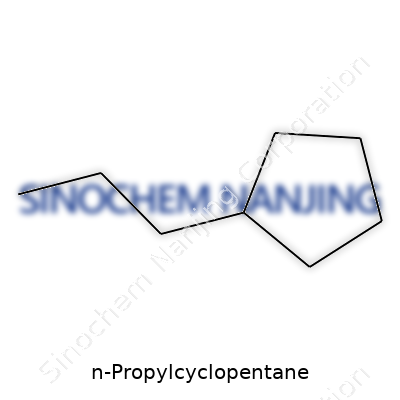
| Names | |
| Preferred IUPAC name | N-propylcyclopentanamine |
| Other names |
Cyclopentane, n-propyl- n-Propylcyclopentane Propylcyclopentane 1-Propylcyclopentane |
| Pronunciation | /ɛn-ˈproʊpɪl-saɪkloʊˈpɛnˌteɪn/ |
| Identifiers | |
| CAS Number | 6087-08-5 |
| Beilstein Reference | 1721197 |
| ChEBI | CHEBI:51338 |
| ChEMBL | CHEMBL3721778 |
| ChemSpider | 109515 |
| DrugBank | DB14182 |
| ECHA InfoCard | 03b3f278-0561-4d6c-ba15-a1a07fa610bb |
| EC Number | 208-759-1 |
| Gmelin Reference | 82839 |
| KEGG | C18908 |
| MeSH | D017875 |
| PubChem CID | 11649 |
| RTECS number | GQ3150000 |
| UNII | 2C897O4N3Z |
| UN number | UN2567 |
| CompTox Dashboard (EPA) | DTXSID7064299 |
| Properties | |
| Chemical formula | C8H16 |
| Molar mass | 128.26 g/mol |
| Appearance | Colorless liquid |
| Odor | mild odor |
| Density | 0.747 g/mL at 25 °C (lit.) |
| Solubility in water | Insoluble |
| log P | 2.1 |
| Vapor pressure | 2.8 mmHg (25°C) |
| Acidity (pKa) | 51.0 |
| Basicity (pKb) | Product not found |
| Magnetic susceptibility (χ) | -8.03 × 10⁻⁹ |
| Refractive index (nD) | 1.4143 |
| Viscosity | 0.68 cP (25 °C) |
| Dipole moment | 0.13 D |
| Thermochemistry | |
| Std molar entropy (S⦵298) | 322.7 J·mol⁻¹·K⁻¹ |
| Std enthalpy of formation (ΔfH⦵298) | -105.2 kJ/mol |
| Std enthalpy of combustion (ΔcH⦵298) | -4046.0 kJ/mol |
| Pharmacology | |
| ATC code | |
| Hazards | |
| GHS labelling | GHS labelling for N-Propylcyclopentane: **"Warning; H226; P210; P233; P240; P241; P242; P243; P280; P303+P361+P353; P370+P378; P403+P235; P501"** |
| Pictograms | GHS02 |
| Signal word | Warning |
| Precautionary statements | P210, P233, P240, P241, P242, P243, P261, P271, P301+P310, P303+P361+P353, P304+P340, P312, P331, P332+P313, P362+P364, P370+P378, P403+P235, P405, P501 |
| Flash point | 2 °C (36 °F; 275 K) |
| Autoignition temperature | 513°C |
| Explosive limits | 1.1–5.4% |
| Lethal dose or concentration | LD₅₀ (oral, rat): >2000 mg/kg |
| NIOSH | RN 5336 |
| PEL (Permissible) | Not established |
| REL (Recommended) | No REL established |
| IDLH (Immediate danger) | Unknown |
| Related compounds | |
| Related compounds |
N-Butylcyclopentane N-Pentylcyclopentane Cyclopentylmethane Cyclopentane N-Propylcyclohexane |



