N,N,N',N'-Tetramethylethylenediamine: Roles, Realities, and Responsibilities
Historical Development
Chemistry draws from a rich tradition of trial, error, and unexpected discoveries. N,N,N',N'-Tetramethylethylenediamine — more familiarly simply called TMEDA or TEMED — tells one of those stories. Its origins took root in the boom years of organic synthesis in the mid-twentieth century. Scientists in the 1950s, on the hunt for ligands and tools to wrangle difficult reactions, gave TMEDA a serious look. The reason? Not magic, just a marriage of simplicity and readiness to cooperate in the reaction flask. They saw, as many have since, that TMEDA doesn’t play hard to get; it partners easily with alkali metals and other catalysts, helping launch the whole family of enamine-driven chemical transformations forward.
Product Overview
Here’s what experience with TMEDA tells: it’s a clear, colorless liquid that comes with a fishy smell that any laboratory regular would recognize in an instant. Available from countless suppliers — Sigma-Aldrich, Thermo Fisher Scientific, and others — TMEDA arrives in tightly sealed glass or metal containers, usually in liter to multi-liter volumes, depending on whether it's destined for academic benches or industrial reactors. Each label comes stamped with purity specs (commonly upwards of 99%) and hazard warnings, because this is not a compound anyone should treat lightly.
Physical & Chemical Properties
TMEDA lives up to its reputation as a workhorse amine. At room temperature, it stands as a free-flowing liquid, boasting a boiling point near 121°C and melting just below minus 60°C. The molecular formula, C6H16N2, builds in predictable fashion: two dimethylamino groups connected by an ethylene bridge. What makes it so handy for chemists is not just its basicity, but its ability to dissolve in polar and nonpolar solvents alike. Physical experience counts: the pendulum swings between TMEDA’s utility in metal chelation and its volatility, which can fill a lab with pungent vapors after one careless spill.
Technical Specifications & Labeling
A bottle of TMEDA arrives emblazoned with hazard pictograms and cautionary statements, a reflection of its irritant properties. Chemical suppliers post certificates of analysis showing water content, GC purity, and storage recommendations. Many facilities require flammable safety cabinets for storage and record tamper-evident seals to track use for compliance. These details might sound mundane, but they matter for reproducibility and regulatory peace of mind. Labels must make it plain: TMEDA is both a facilitative chemical and a health hazard when mishandled.
Preparation Method
Making TMEDA never struck me as mystical. The process begins with methylation of ethylenediamine, often in the presence of formaldehyde and formic acid or dimethyl sulfate. Reaction conditions generally call for agitation and temperature control to prevent runaway exotherms and unwanted byproducts. Filtration, neutralization, and careful distillation step into play, with the collected fraction refined further until analytical instruments — GC, NMR — confirm high purity. Industrial operations scale up with distillation rigs running round the clock, capturing product and recycling heat wherever possible, echoing a constant chemical industry refrain: reduce waste, stay safe.
Chemical Reactions & Modifications
TMEDA steps eagerly into a number of classic and modern reactions. It functions as a bidentate ligand, forming tight complexes with metals like lithium, copper, and nickel. This behavior unlocks key organic transformations, especially in organolithium and Grignard chemistry, where TMEDA modulates reactivity and often sharpens selectivity. Its coordination can stabilize low-valent metal species, opening routes to cross-coupling and radical polymerizations that raise the ceiling for researchers. TMEDA’s structure allows further modifications — methylations, alkylations, or incorporation into polymers — though in practice, it mostly serves as a facilitator rather than a scaffold for further synthesis.
Synonyms & Product Names
Scientists and suppliers alike use shorthand for TMEDA. The names TEMED (N,N,N’,N’-Tetramethylethylenediamine), 1,2-bis(dimethylamino)ethane, or even the simple TMEDA all lead to the same bottle. Some catalogs list it as ethylenediamine, N,N,N',N'-tetramethyl-, while European regulations might tack on specific identifiers for customs or transport. These terms can feel redundant, but they keep global commerce running and prevent dangerous mix-ups in multilingual, multi-supplier environments.
Safety & Operational Standards
Years of handling TMEDA taught me respect for personal protective equipment. Splash-proof safety goggles, nitrile gloves, and a ready fume hood are not merely suggestions — even fleeting skin contact or inhalation stings. Safety protocols require chemical-resistant aprons and spill kits as backup. Laboratories review TMEDA’s SDS before every order, and disposal channels run strictly through approved hazardous waste streams. OSHA, the European Chemicals Agency, and national workplace safety authorities agree on this: TMEDA can irritate skin, eyes, and airways, and should stay well away from ignition sources. Emergency eyewash stations remain close at hand every time a bottle opens.
Application Area
TMEDA’s main value lies in laboratories and manufacturing plants dealing with fine chemicals, pharmaceuticals, polymers, and specialty materials. Its ability to stabilize reactive organometallic species supports the development of new molecules and complex synthesis routes. In polymer chemistry, acrylamide gels poured daily in biotech labs owe their clarity and speed to TMEDA, working hand in hand with ammonium persulfate. That collaboration produces chain reactions with results as visible as clear gels or resilient plastics. Battery materials, catalysts, and advanced materials research equally benefit from TMEDA’s chelating talents. These stories play out on benchtops in universities and production lines in industries where reproducible chemistry pays the bills and meets critical research goals.
Research & Development
Ongoing research continues finding new jobs for TMEDA. The push toward green chemistry means researchers look for less toxic, more sustainable replacements, but for some metal-mediated syntheses, TMEDA still delivers unmatched results. Work in catalysis increasingly centers on modifying TMEDA derivatives to tune metal-binding strength and selectivity, aiming to deliver cleaner, more targeted chemical transformations. Computational chemists simulate TMEDA’s behaviors to predict outcomes in drug discovery, electronics, and nanomaterials. The constant interplay between experiment and model helps sharpen TMEDA’s place in the chemist’s toolbox.
Toxicity Research
Decades of safety data point out clear hazards linked to TMEDA exposure. Laboratory studies show that it can cause moderate irritation to skin, eyes, and respiratory passages. Animal models document potential central nervous system effects at high doses, but everyday laboratory use rarely approaches such exposures. Long-term environmental persistence prompts waste management attention, as TMEDA degrades slowly and resists breaking down in water and soil. Regulators pressure manufacturers and users to tighten emissions and institute recycling wherever possible, reducing cumulative impact on ecosystems and communities downstream.
Future Prospects
Future directions for TMEDA land at the crossroads between necessity and innovation. As chemical manufacturing strives for greener, safer operations, designers re-examine TMEDA’s synthesis and application footprint, seeking bio-based starting materials and recyclable process streams. New catalytic systems occasionally nudge TMEDA aside in favor of less volatile or less persistent ligands, though few replacements capture its balance of volatility and efficacy. Advances in material science, energy storage, and catalysis keep TMEDA demand steady, putting pressure on supply chains to maintain purity and reliability. The next chapter for TMEDA, just like those before, will likely grow out of steady laboratory work and an ongoing commitment to safer, smarter chemistry in a changing world.
What is N,N,N',N'-Tetramethylethylenediamine used for?
Behind the Lab Bench: A Closer Look at TMEDA
N,N,N',N'-Tetramethylethylenediamine goes by an easier name in science circles: TMEDA. This chemical shows up often in labs and factories, but it rarely lands in the headlines. For something with such a tongue-twisting name, TMEDA plays quite a starring role in shaping products and technology walking into our homes every day.
Strengthening Organolithium Chemistry
Starting out in the world of chemistry research, TMEDA stood out as a real helper in organolithium reactions. In making carbon-carbon bonds—think pharmaceutical drugs, new plastics, and specialty coatings—organolithium compounds work hard to put certain atoms together just right. TMEDA steps in as a “ligand,” grabbing onto metal atoms and making organolithium compounds more soluble and reactive. With TMEDA, scientists unlock tricks for making molecules cleaner and faster. Without it, reactions can stall or go sideways, wasting time or expensive ingredients.
Turning Polyurethane into Everyday Goods
Outside the lab, TMEDA gets cast in larger roles. It shows up in polyurethane manufacturing, helping create the foam behind mattress pads, car seats, and cleaning sponges. Here, TMEDA speeds up the reaction between isocyanates and polyols, the basic building blocks for polyurethane. Quality foam relies on a steady reaction; TMEDA smooths out the chemistry, making production more predictable. That reliability means less waste and better products coming off the line each day.
Making Clean Water Happen
TMEDA wins points for supporting the people working on clean water solutions. In certain types of water treatment, this molecule helps coax metals out of solution. Chelation—where TMEDA locks up copper, nickel, or other metals—lets water treatment experts remove contaminants more efficiently. This matters, especially with rising concerns about groundwater pollution in areas near factories, mines, and cities. No single chemical solves the clean water puzzle, but TMEDA brings a useful tool to the table.
Playing a Part in Catalysis and Electronics
TMEDA also finds work in electronics manufacturing and specialty catalysts. During nickel or copper plating, it serves as a stabilizer, keeping metal ions ready for action. Plating quality can depend on details as tiny as how fast a metal ion reaches the target; TMEDA steadies the system so the finished electronic parts meet strict standards. Economic value starts long before a product hits the shelf, and a compound like TMEDA keeps whole industries moving.
Health, Safety, and the Path Forward
Not every chemical brings risk-free benefits. TMEDA comes with its list of health and safety questions. Strong smells, skin irritation, and toxic effects at high doses remind us to treat it with respect. Manufacturing plants invest in ventilation and protective gear, meeting regulatory frameworks set by agencies like OSHA and the EPA. Attention to worker health and environmental fate should match the drive to make industrial processes more efficient.
Thinking Toward Safer Chemistry
TMEDA demonstrates how a relatively simple molecule touches so many technologies. Researchers have started looking for drop-in alternatives, especially where regulations push for less toxic chemistry. Greener catalysts, new ligands, or reimagined production lines could lessen dependence on older compounds. The lesson from TMEDA is clear: success in chemistry ties directly to smart choices about what we use, how we use it, and what gets left behind.
What are the safety precautions when handling N,N,N',N'-Tetramethylethylenediamine?
The Hidden Risks Behind the Name
N,N,N',N'-Tetramethylethylenediamine—TMEDA for short—often pops up in organic labs. Chemists reach for it during tricky synthesis steps or to help out as a ligand. On the shelf, it doesn’t look scary, just a clear liquid. But behind its unassuming looks, TMEDA poses real risks. This mid-size amine gives off vapors that catch the nose fast, telling you it evaporates easily. A moment with the Material Safety Data Sheet reminds anyone why TMEDA deserves respect: flammable, irritating to skin and eyes, harmful if inhaled.
Why Prior Planning Matters
The dangers of TMEDA feel personal to those who care about safe science. Before even breaking open a new bottle, check for a working fume hood. TMEDA vapors irritate airways and lungs. I’ve watched newcomers get lazy, thinking a bit of fresh air suffices. They rush, and by lunch their eyes sting and coughs start. Old habits save skin and lungs—swap working in open rooms for a humming hood, always.
Gloves—nitrile or neoprene—keep that liquid away from fingers. TMEDA seeps through latex. Once, a spilled drop on the wrong glove taught a quick lesson: redness and burning, nothing you shake off. It goes beyond gloves. Good goggles mean TMEDA can’t burn eyes if it splashes. Forgetting protection even once brings pain, and no one has patience for a lab break that comes with medical paperwork.
Storage Isn’t an Afterthought
Keep TMEDA far from flames, hot plates, and anything that sparks. The flash point stays low—about 41°C—so even mild warmth spells trouble. My team learned after a careless shelf choice; a container ended up next to an old heating mantle and started leaking fumes. Move it to a metal flammables cabinet, lock it up, and that close call never repeats. TMEDA shouldn’t sit near strong oxidizers either. The mixture asks for explosions with just a little mistake.
Spills: Fast, Careful Response Makes the Difference
No one plans a spill, but accidents happen—elbows bump, caps drop. If TMEDA puddles on the bench, dampen it with absorbent pads or sand while wearing gloves and goggles. Never grab paper towels barehanded; the fumes rise right away. Scoop the mess into a sealable bag marked as hazardous. Wash down the whole area well, ventilate the lab, and mark it “do not use” until it airs out. My colleague once forgot that last part; students wandered in, coughing began, and we all lost a day fixing the oversight.
Training and the Right Attitude
New scientists deserve real demonstrations—no one learns good safety just by reading handouts. Walk the group through correct TMEDA handling. Show them the emergency shower, eyewash station, and spill kit before the first use. As labs grow busier, it’s easy to fall into shortcuts. Remind each other that TMEDA, like many chemicals, rewards respect and careful routines. Every person in the room depends on everyone else looking out for hazards, asking questions, and keeping the lab as safe as possible, every single time.
What is the molecular formula of N,N,N',N'-Tetramethylethylenediamine?
Why This Compound Matters
In the chemistry world, some names keep popping up because of how much work they do. N,N,N',N'-Tetramethylethylenediamine often gets shortened to TMEDA. For anyone mixing up reactions in a lab, this clear, amine smell-laden liquid stands as a helper and a stabilizer. People trust it to control how metals like lithium work, and it plays referee during many essential processes, like the Grignard reaction. Without such helpers, a lot of what we call modern organic synthesis would slow to a crawl.
The Formula That Packs a Punch
TMEDA keeps it simple, but packs a punch. Bring the basics back: the molecule grows out from ethylenediamine, where two carbons join with two nitrogen atoms. Each nitrogen grabs two methyl groups. So, for molecular formula, pile up carbon, hydrogen, and nitrogen. The result: C6H16N2.
Looking at it, those two nitrogens sit linked by an ethylene bridge (two carbons), and those four methyl groups hang off the nitrogens. The formula explains TMEDA’s basic, non-acidic tendencies and lets chemists predict how it joins in reactions. No need to memorize hoops of theory—just pull out a notepad and count: six carbons, sixteen hydrogens, two nitrogens. Chemistry gets intimidating, but it helps to break down complex terms and relate them to what you see in a bottle.
Taking TMEDA Beyond the Book
I’ve worked through clunky setups where one wrong solvent or catalyst causes days of wasted time. TMEDA served as a “safety net” that made reactive metals behave. It coordinates so well with lithium, sodium, and magnesium ions, making the metals dissolve in organic solvents. Thanks to that snug fit, TMEDA ramps up reactivity when we need it, paving the way for more effective synthetic paths. This makes research smoother and opens doors for quick drug development, plastic production, and improved materials.
The importance goes beyond lab tricks. TMEDA streamlines one-pot synthesis, saving energy and money for both academic and industrial labs. Less waste means greener chemistry. As research on sustainability grows, seeking efficient ligands such as TMEDA plays a strategic role in reducing chemical footprints. Every improved yield or cleaner isolation adds up.
The Price of Convenience
Here’s the catch: not every outside-the-lab worker hears about molecules like TMEDA, even as products they use rely on these reactions. Everyday items—medicines, plastics, specialty coatings—may owe their existence to a chemical like TMEDA. That’s reason enough to give the small stuff some credit. But all this widespread use means we need to treat it responsibly, too. If disposed of carelessly, TMEDA could become a pollutant.
Labs must train staff to handle and waste TMEDA safely. Regulations help, but personal responsibility makes all the difference. Keeping lids tight, using proper disposal channels, and choosing greener, less toxic replacement reagents where possible all minimize harm. Making small changes in daily routines stacks up, which corners environmental damage and protects the future for us all.
Looking Forward
TMEDA earns its keep—a tough, reliable player in the chemistry toolkit. The molecular formula C6H16N2 proves you don’t need a huge molecule for huge impact. Even the smallest changes in lab practices or industrial manufacturing habits ripple into lasting improvements. Remember, the right formula combines not just elements, but care and a sense of responsibility.
How should N,N,N',N'-Tetramethylethylenediamine be stored?
Understanding Storage Risks
N,N,N’,N’-Tetramethylethylenediamine packs a punch in labs and industrial settings. Its strong ammonia-like odor gives away just how reactive it can get. Anyone keeping bottles of TMEDA around learns this fast: the stuff catches fire more easily than rubbing alcohol, and it evaporates with a stubborn insistence, ready to irritate eyes and skin with just a little exposure. Lab safety manuals never mince words about it—and with good reason. Anyone who’s cracked open a bottle in a warm room knows how quickly those fumes hit the nose.
The Difference a Few Degrees Makes
TMEDA boils off around 121°C, far above room temperature, but its flash point drops all the way down to 41°C. If storage spaces warm up, the vapors can build up quickly. Think of a crowded storeroom on a summer day. Without proper ventilation, there’s a real risk of fume accumulation. A chemical left on a shelf near a window or heat source quickly turns a safe workspace into a hazard zone. Years spent working in shared academic labs taught me that a neglected fume hood or overheated shelf is just asking for trouble, especially with something as flammable as TMEDA.
The Right Materials Count
Plastic containers distort, so glass holds most chemicals—including TMEDA—best. But glass isn’t enough on its own. Tight-fitting, chemical-resistant caps matter as much as the vessel itself. Metal containers sound sturdy, but TMEDA’s vapors chew through some metals over time, and corrosion creeping into a cap means leaks aren’t far off. A friend’s experience with a corroded cap led to a storeroom reeking for days. Always check seals and swap out any cap that softens, cracks, or sticks.
No Room for Ignition Sources
Sparks spell real danger. Static, uncovered outlets, open flames, and even failing bulbs can ignite TMEDA vapors. The National Fire Protection Association (NFPA) puts TMEDA in the flammable category. Keeping the container in a dedicated flammables cabinet, away from acids and oxidizers, is non-negotiable. Lab veterans swear by self-closing doors and double-checking that nothing else in the cabinet can bump or tip a bottle over. These sound routine, but real accidents usually begin with small lapses.
Labeling and Inventory
One bottle looks much like another once the labels fade. Faded or handwritten stickers don’t do the trick. Clearly printed labels with date received, quantity, and the relevant hazard pictograms cut search time and confusion later. Many research teams log every opening of a TMEDA container. I worked in a lab where two different people tracked these logs, which sounds tedious until you realize the chaos from an untracked leak or spill. Reducing the risk of mistakes always pays off, especially in shared environments.
Reducing Waste
Buy only what the project needs. TMEDA doesn’t sit pretty for long after frequent openings. Small bottles cost more per milliliter but save headaches in the long run. Promptly disposing of expired bottles with a certified waste handler locks down safety. Letting old, half-full bottles collect dust becomes a liability for everyone working nearby.
Community and Responsibility
Safety hinges on more than strict rules. I always rely on colleagues who notice if a bottle loses its cap or a label peels off. Following established protocols and committing to double-checks form the backbone of responsible chemical storage. TMEDA proves that vigilance and teamwork prevent small oversights from turning into emergencies.
Is N,N,N',N'-Tetramethylethylenediamine hazardous to health or the environment?
Understanding the Chemical in Everyday Language
N,N,N',N'-Tetramethylethylenediamine, often just called TMEDA, gets tossed around a lot in laboratories and manufacturing. It works as a catalyst booster and copper chelator in organic syntheses. Chemists like its efficiency, especially when making plastics, resins, and in certain medical research processes.
I’ve worked with chemicals enough to know that every bottle, jug, or drum holds potential trouble if respect for the risks slips. TMEDA gives off a strong smell—a red flag in many labs that signals something volatile. I remember my own hesitation the first time I popped a cap on a TMEDA container, noticing the fumes right away.
Health Risks Deserve Straight Talk
Breathing in TMEDA fumes is known to irritate the nose, throat, and lungs. People working with it sometimes get headaches, dizziness, or feel nauseous. Splashing it on skin can cause redness and discomfort. There’s published data showing it penetrates through latex gloves. That stuck with me, as I learned early not to trust those thin gloves around this chemical—instead, use heavy-duty nitrile ones and swap them out regularly.
Longer-term exposure isn’t well-studied in humans, but animal studies hint at trouble for the liver and kidneys. Its effects on reproductive health, or risks of causing cancer, haven’t been ruled out. In the chemical industry, safety sheets (SDS) all flag TMEDA for caution—engineering controls, fume hoods, and personal protective equipment aren’t optional. One missed vent session or leaky seal can turn a simple experiment into a medical emergency, based on case reports I’ve seen.
Environmental Hazards—not Just a Lab Issue
Tossing TMEDA down the drain causes headaches downstream. It breaks down in the environment, but not quickly and not harmlessly. Once out in the open, it poses problems for aquatic life. Even at low concentrations, TMEDA can affect fish, insects, and invertebrates. These aren’t rare lab animal results—they’re seen in real environments where industrial spills or illegal dumping occurs.
TMEDA doesn’t stick well to soil, so it can move into groundwater. This increases contamination risk for drinking water or irrigation sources. Municipal waste treatment plants aren’t set up to deal with it efficiently. Mainstream research points to possible bioaccumulation up the food chain, although studies aren’t conclusive yet. That uncertainty alone is enough to spark concern for people who care where their water and seafood come from.
Better Handling and Smarter Solutions
Strict handling, solid training, and regular risk reviews should be the rule for anyone using TMEDA. Labs that track air quality and install local exhaust systems cut down on exposure. I’ve seen professional chemists push peer safety, double-checking when someone works with this stuff, which helps avoid accidents in the first place.
For environmental protection, process industries must upgrade containment, invest in proper waste neutralization, and report all releases. Alternatives to TMEDA don’t always exist, but more research will eventually give greener options for common applications. Policy also plays a role: tighter regulations on discharge limits, stronger oversight on transportation, and public tracking of spills force better habits onto everyone involved.
N,N,N',N'-Tetramethylethylenediamine won’t disappear from chemistry any time soon, but a respect for its real risks can stop it from causing harm to both people and the world around us.
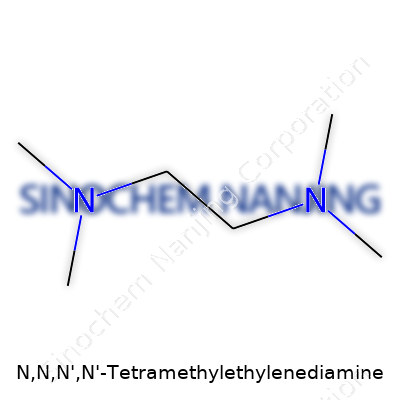
| Names | |
| Preferred IUPAC name | N,N,N′,N′-Tetramethylethane-1,2-diamine |
| Other names |
TMEDA Tetramethylethylenediamine N,N,N’,N’-Tetramethyl-1,2-ethanediamine N,N,N’,N’-Tetramethyl-ethylenediamine TEMED |
| Pronunciation | /ˌtiː.ɛtʃ.iː.diːˌtɛt.rəˈmɛθ.əlˌɛθ.əˌliːn.daɪˈæ.mɪn/ |
| Identifiers | |
| CAS Number | 110-18-9 |
| Beilstein Reference | **136545** |
| ChEBI | CHEBI:39051 |
| ChEMBL | CHEMBL139759 |
| ChemSpider | 7366 |
| DrugBank | DB03755 |
| ECHA InfoCard | 100.007.267 |
| EC Number | 203-195-2 |
| Gmelin Reference | 82253 |
| KEGG | C06147 |
| MeSH | D010556 |
| PubChem CID | 6096 |
| RTECS number | XR1400000 |
| UNII | 9X5LW7S51P |
| UN number | UN2372 |
| Properties | |
| Chemical formula | C6H16N2 |
| Molar mass | 116.20 g/mol |
| Appearance | Colorless to pale yellow liquid |
| Odor | Ammonia-like |
| Density | 0.775 g/mL at 25 °C |
| Solubility in water | Miscible |
| log P | 0.15 |
| Vapor pressure | 0.9 mmHg (20 °C) |
| Acidity (pKa) | 10.38 |
| Basicity (pKb) | 4.70 |
| Magnetic susceptibility (χ) | -72.8×10⁻⁶ cm³/mol |
| Refractive index (nD) | 1.423 |
| Viscosity | 0.38 cP (20 °C) |
| Dipole moment | 1.33 D |
| Thermochemistry | |
| Std molar entropy (S⦵298) | 189.6 J·mol⁻¹·K⁻¹ |
| Std enthalpy of formation (ΔfH⦵298) | -77.4 kJ/mol |
| Std enthalpy of combustion (ΔcH⦵298) | -3933 kJ·mol⁻¹ |
| Hazards | |
| GHS labelling | GHS02, GHS07 |
| Pictograms | GHS02,GHS07 |
| Signal word | Warning |
| Hazard statements | Harmful if swallowed. Causes severe skin burns and eye damage. May cause an allergic skin reaction. Harmful if inhaled. May cause respiratory irritation. Harmful to aquatic life with long lasting effects. |
| Precautionary statements | P210, P261, P280, P304+P340, P312, P337+P313, P403+P233 |
| NFPA 704 (fire diamond) | 2-3-0 |
| Flash point | 38 °C (100 °F) - closed cup |
| Autoignition temperature | 383 °C (721 °F; 656 K) |
| Explosive limits | 5.1–10.9% |
| Lethal dose or concentration | LD50 oral (rat): 890 mg/kg |
| LD50 (median dose) | Oral, rat: 1510 mg/kg |
| NIOSH | JN7875000 |
| PEL (Permissible) | 25 ppm |
| REL (Recommended) | 0.1 ppm |
| IDLH (Immediate danger) | 100 ppm |
| Related compounds | |
| Related compounds |
Ethylenediamine Trimethylethylenediamine Hexamethylenetetramine Tetramethylurea Tetramethylammonium hydroxide |



