N-Hexanal: From Discovery to Its Place in Modern Industry
Historical Development
N-Hexanal, also known as hexanal or caproaldehyde, entered the scientific lexicon in the late 19th century. Chemists first stumbled on this molecule during the early days of organic chemistry, digging into the distillation and oxidation of hexanol derived from plant oils and animal fats. Early industrial chemistry focused hard on extracting and refining simple aldehydes, since these substances bridged the gap between natural products chemists enjoyed extracting from living things and the synthetic approaches that shape our world now. Industrial breakthroughs, especially in catalytic oxidation, meant that chemical plants could churn out N-Hexanal at scale, and not just in research labs. As methods improved through the 20th century, the chemical started turning up in flavor labs, perfume houses, polymer factories, and in agricultural chemistry—in short, wherever engineers and technologists valued a light, grassy aldehyde.
Product Overview
Today, N-Hexanal holds a modest but respected profile across global markets. People use it not only as an intermediate for other chemicals, but also for what it brings to the table by itself—a sharp, green scent, the backbone for “fresh-cut grass” notes in fragrances and flavors. Suppliers distribute it in drums or tanks, keeping to strict quality controls. The push for green chemistry has sharpened attention on traceability and the true origins of hexanal, whether from petrochemical routes or more sustainable bio-based methods.
Physical & Chemical Properties
N-Hexanal comes as a colorless to pale yellow liquid, giving off a distinct grassy odor that’s hard to miss, and its scent threshold in air sits surprisingly low. The boiling point usually reads about 130–132°C, and it sits at a density near 0.8 g/cm³. Hexanal dissolves best in typical organic solvents—think ethanol, diethyl ether, acetone—and only grudgingly mixes with water. Its vapor catches fire easily, so large storage facilities have to treat this chemical with caution. Whether in the warehouse or the lab, chemical operators respect its volatility and reactive aldehyde group, which can cause unpleasant surprises if left unchecked.
Technical Specifications & Labeling
Chemical companies ship N-Hexanal with clear specifications listed on every drum or datasheet. Most industrial batches contain hexanal at 98% purity or greater, with trace analysis for water, acids, and related aldehydes. Labels mark N-Hexanal’s CAS number (66-25-1), UN shipping code, and GHS hazard symbols. All documentation aligns with ISO, REACH, and other regional chemical registration rules. Strict labeling isn’t just regulatory red tape; it helps avoid cross-contamination and mishandling by workers, protecting both staff and final products. Packaging usually means steel drums, fluoropolymer-lined barrels, or, for high-purity needs, small-volume glass containers.
Preparation Method
The dominant industrial process uses the catalytic oxidation of 1-hexanol, which itself comes from natural fats and oils via hydroformylation or cracking. Copper or silver catalysts encourage the alcohol to shed two hydrogens, yielding our aldehyde. Other methods include ozonolysis of 1-hexene, but these remain less common due to efficiency and cost constraints. Researchers have put significant energy into unlocking greener, less energy-intensive routes. Lately, biosynthetic research has zeroed in on microbial pathways for converting plant biomass into N-Hexanal directly. While scale-up lags behind petrochemical giants, pilot projects in countries with high renewable feedstock drive fresh conversations about sustainability.
Chemical Reactions & Modifications
That exposed carbonyl group in N-Hexanal lends itself to all kinds of transformations. Chemists run aldol condensations to build complex molecules, reduce hexanal to hexanol, or oxidize it to hexanoic acid. Industrial users rely on its reactivity to make plasticizers, detergents, lubricant additives, and even some pharmaceutical precursors. Modifying the carbon chain or switching out functional side groups unlocks dozens of tailored compounds. In agriculture, oxidation and condensation derivatives produce substances used in crop protection and pheromones, expanding the ways N-Hexanal shapes our everyday environment.
Synonyms & Product Names
Walk into a chemical supplier, and you’ll see N-Hexanal offered under a laundry list of synonyms. Names include Caproaldehyde, 1-Hexanal, and Hexyl aldehyde. Regulatory agencies and shipping documents depend on the CAS number (66-25-1) and systematic IUPAC name, but industrial buyers and lab technicians often stick to the short forms. Each name reflects its place in various commercial networks and frameworks, so for new chemists or safety officers, it pays to double-check label language before handling or blending.
Safety & Operational Standards
Aldehyde fumes from N-Hexanal irritate eyes, respiratory tracts, and skin. Long-exposure stories from older factories show why routine monitoring and engineering controls matter. Employers need strict local exhaust ventilation, personal protective equipment, and training on hazardous material protocols to keep accident rates down. Fire prevention looms large, since volatile aldehydes ignite easily. Global GHS standards trigger hazard pictograms for skin, eye, and respiratory irritation and for flammability concerns. Maintenance teams handle spill kits and containment systems, and facilities review emergency procedures regularly. Most of us who’ve worked around open containers can still remember the sting in the nose—even at concentrations well below reliable health limits.
Application Area
Fragrance experts build on N-Hexanal’s unmistakable green note for cosmetics and room scents. Flavor houses find value in its crisp, apple-peel note, used carefully at low levels to add freshness to packaged foods, beverages, and flavor concentrates. Polymer manufacturers use it as a key intermediate to create plasticizers and functional monomers. Agriculture draws heavily on its derivatives for slow-release pesticides, fruit and vegetable shelf-life extenders, and stimulators for natural plant defenses. Laboratory technicians track its use as a calibration standard, and pharmaceutical researchers explore its role as a synthetic building block. In each field, new applications keep emerging as technology and regulation evolve.
Research & Development
Academic centers and industry researchers dig deeper into bio-based pathways for N-Hexanal production, moving away from fossil-carbon sources. Promising trial projects show genetically engineered yeast can make the molecule straight from cellulosic feedstocks, slashing carbon emissions and broadening supply options. On the detection side, portable sensors now spot hexanal at trace levels in air, aiding both environmental monitoring and workplace safety. R&D dollars also chase new derivatives for pest management, shelf-life extension in fresh produce, and advanced polymer components. Funding from green tech consortia and national innovation programs has accelerated the pace, with a clear link to consumer demand for sustainable and safe chemistry.
Toxicity Research
Toxicologists have gathered real-world exposure data on N-Hexanal over decades, covering skin, inhalation, and oral routes. At moderate concentrations, it irritates the respiratory tract and mucous membranes; higher doses knock out central nervous functions, and rare reports highlight risks of allergic reactions particularly for sensitive individuals. Chronic animal studies flag up moderate liver and kidney impacts at sustained high doses, though regulatory limits remain well below these danger zones. Experts track bioaccumulation and breakdown pathways in soils, confirming rapid degradation under most agricultural conditions. That said, new attention focuses on the effects of inhaling small quantities day after day, driving fresh studies in environmental medicine and workplace epidemiology.
Future Prospects
N-Hexanal sits at a crossroads, balancing long-standing usage patterns with new visions for cleaner chemistry. Advances in biotechnology and green manufacturing could make it a flagship molecule for bio-based industry, especially if costs dip and consumer acceptance anchors in more sustainable sourcing. As regulatory bodies tighten standards for solvent residues, fragrance allergens, and workplace exposure, the industry must adapt handling, monitoring, and downstream processing. If agricultural applications succeed in blocking spoilage and waste, more produce could reach people safely and more affordably. Seeing where science, markets, and regulatory frameworks converge means N-Hexanal may shape conversations about safe, effective, and responsible chemistry long into the future.
What is N-Hexanal used for?
What N-Hexanal Actually Does
You might not have heard of n-hexanal, but chances are high that you’ve experienced its effects at least once in your life. N-hexanal is a clear liquid with a smell similar to freshly cut grass. This aroma pops up everywhere—from perfumes to foods. In the fragrance industry, those who design scents look for natural, memorable notes. N-hexanal gives that green, just-mowed edge to a perfume, helping a scent feel crisp or evoke pleasant outdoor memories. In my own kitchen experiments, cutting up green beans releases a hint of n-hexanal—giving vegetables that lively aroma. That’s not a lab creation; it’s nature doing its usual thing.
N-hexanal also gets used as a flavoring agent. Food makers add tiny amounts to processed foods to boost the taste or make packaged goods smell fresher longer. In baked goods, a touch brings a freshly-baked hint that works for pastries or even some snacks. The natural occurrence of n-hexanal, especially in fruits and veggies, encourages companies to use it in trace amounts to mimic real produce. Having lost count of the times I checked ingredient labels for artificial flavors, it’s striking to know that some of these “artificials” actually already exist in what grows in the back garden.
Why the Manufacturing World Pays Attention
N-hexanal ends up in far more than just fragrances and foods. Chemical manufacturers use it as a building block for bigger molecules. Plastics, lubricants, and even some pesticides start with n-hexanal. It reacts easily, which makes it popular among industrial chemists who want to synthesize something more complex. I once toured a plastics plant for a story, and the engineers told me about using chemicals like n-hexanal to start reactions that eventually become things as mundane as shopping bags or car parts. Most people don’t think about the journey their water bottle takes from barrels of chemicals to the store shelf.
This widespread use creates some issues. Factories handle thousands of liters of n-hexanal, meaning there’s always the risk of leaks or spills. Unlike table salt or vinegar, n-hexanal isn’t a substance anyone wants to touch, drink, or smell in large doses. It can cause irritation if inhaled or splashed on skin. According to safety datasheets, workers have to keep gear on whenever they’re near it. Factory managers told me they run regular drills and have sensors everywhere for chemicals of this type.
Concerns and the Push for Safety
Since n-hexanal flows through so many industry pipes, both environmental and human health risks arise if oversight slips. At an environmental conference, I heard a researcher talk about how n-hexanal breaks down fairly quickly in air, but runoff from factories could harm aquatic life if not controlled. Responsible companies install scrubbers and systems to contain and treat waste, trying to stop leaks before they could cause real trouble. But not every manufacturer has the same resources or motivation.
The answer isn't banning n-hexanal—it’s proven good at what it does. Tighter regulations, real monitoring, and responsible sourcing all make a difference. Customers should keep demanding transparency about how their foods, perfumes, and plastics get made. Regulators and scientists need to stay involved, pushing for best practices and updating guidelines as we learn more.
Looking Forward
N-hexanal shows up in everything from a loaf of bread to the scent of a new car. Its story is accidental yet important—a bridge between nature, industry, and our everyday routines. Care in handling, good science, and smart rules keep risks down and ensure the benefits come without unwanted side effects.
What are the safety precautions for handling N-Hexanal?
Understanding N-Hexanal Hazards
N-Hexanal shows up in many labs and factories as a clear, flammable liquid. Its sharp, fruity smell lets you know quickly if it’s nearby. If you’ve spent time working with solvents or organic chemicals, that instant whiff will tell you two things: first, it’s leaking, and second, you need to act fast. In my years working in chemical research, the sharp burn in the nose always got my attention. Even a little exposure can leave your skin irritated or your eyes watering.
Once I spilled N-Hexanal during a routine transfer because I didn’t double-check the fitting on the bottle. The splash missed my eyes, but my bare hands stung for hours, despite scrubbing with soap. Those sensations were clear reminders—N-Hexanal isn’t something to treat casually. According to the Centers for Disease Control and Prevention, it can cause headaches, drowsiness, and, in higher concentrations, serious respiratory problems.
Essential Personal Protection
Whenever N-Hexanal comes out of storage, I make sure my goggles and lab coat aren’t just sitting on the hook. Chemical splash goggles keep vapors from sneaking into your eyes, and the coat stops the liquid from burning your arms. I always use thick nitrile gloves since standard latex just doesn’t cut it—they swell up too quickly with organic solvents like this.
Fume hoods aren’t some luxury item—they’re essential. Any job involving N-Hexanal runs inside one. If you skip ventilation, you’ll get a headache faster than you think. Working out in the open teaches you quickly about the real effects of solvent fumes.
Storage and Handling Tips
Storing N-Hexanal with care saves you headaches on every shift. I keep it in tightly sealed containers, away from any open flame or heat source. Room temperature storage in a flammables cabinet works well. The vapor can find its way through cracked seals, so I always check lids after each use. If there’s ever a spill, I go straight to the absorbent pads and open the nearest window as backup.
From experience, combining solvents or transferring between bottles works best slow and steady. Rushing leads to splashes and spilled product. Before pouring, I walk through the process in my head and have every tool—funnels, absorbents, extra gloves—right at hand.
First Aid and Emergency Response
No one expects an accident, but quick response matters most. If N-Hexanal hits skin, washing for 15 minutes under running water can keep a minor burn from turning into something worse. Anyone exposed to vapor—coughing, dizziness, burning eyes—should get outside right away for fresh air. Calling for help right away makes it easier for emergency services to provide the right support. I always keep emergency numbers right by the chemical storage just to shave seconds off the response time.
Training and Continuous Vigilance
The best defense against accidents is regular training. In every job briefing, we go over the basic rules and run through spill drills. I bring new technicians to experienced hands first so they can see proper habits up close. OSHA recommends full documentation of safety data, including updated material safety data sheets. I keep a printed copy handy for every chemical in the lab.
Improving Safety Culture
Working with chemicals like N-Hexanal builds respect for proper safety culture. Open conversations, regular retraining, and having the right protection make all the difference. Manufacturers need to invest in clear labelling and tighter caps, but most of all, staff need to remember every task carries some risk. By taking every precaution, you don’t just protect yourself; you protect everyone who shares your workspace.
What is the chemical formula and molecular weight of N-Hexanal?
The Chemistry: Straightforward and Simple
N-Hexanal, a name that pops up in labs and chemical factories, holds a special spot as an aldehyde with a strong, grassy aroma. People working with algae, flavoring, or industrial applications often run into its straightforward formula, C6H12O. Six carbons, twelve hydrogens, one oxygen—simple, efficient, and practical. Each molecule weighs about 100.16 grams per mole.
Not Just Stuff in a Bottle
Running a test on a leaf or storing apples in a cold chamber, N-Hexanal doesn’t just sit around doing nothing. Exposure in everyday environments brings a real effect. Imagine walking through a field after grass has been cut—that smell in the air owes something to N-Hexanal. Responsible for the “fresh cut” note in both nature and synthetic fragrances, it pinpoints green, fruity tones in apples, cucumbers, or even tomatoes.
From an industrial perspective, anyone involved in food science or cosmetics manufacturing bumps into this compound often. Its fresh scent doesn’t just add pleasant notes; it signals changes. Food technologists use it as a marker for the ripening and spoilage of fruits and vegetables. It means that our fruit stays fresh, and cheese stays good a bit longer, thanks to spotting these early signs.
Health, Safety, and Environmental Perspective
People in laboratories or handling shipments in warehouses probably check safety data sheets pretty often. N-Hexanal, though not the most dangerous, brings a set of issues you can’t ignore. It causes irritation when spilled or if vapors get into lungs or eyes. The science backs this up—research from toxicology studies has flagged that high levels could mean headaches, dizziness, and allergic reactions. For folks working in close quarters with aldehydes, reliable ventilation and protective gear make a world of difference.
Why Details Like Molecular Weight and Formula Hold Value
No one in research or production picks up a bottle and ignores numbers like chemical formula and molecular weight. These bits of information drive every calculation and every safety assessment. Knowing that N-Hexanal means C6H12O, weighing in at 100.16 grams per mole, lets chemists figure out concentrations and dosages quickly. That’s critical for anyone determining how much to use when flavoring food or mixing up industrial batches.
Building Better Practices With Knowledge
Looking at the bigger picture, understanding the properties of compounds like N-Hexanal improves both workplace safety and product quality. Food safety officers, flavorists, and fragrance creators all depend on accurate data. On the regulation side, authorities like the European Food Safety Authority (EFSA) assess safe exposure levels and keep consumers from unsafe build-ups in processed foods or perfumes.
Many of the best outcomes come from transparency about chemical properties and potential risks. Training, clear labeling, and up-to-date databases help laboratories and factories reduce accidents and support sustainable practices. From my time consulting with chemical suppliers, eyes light up not from the formula itself but from knowing it means faster turnarounds, safer workflows, and fewer headaches down the line.
Real value appears once technical facts inform safer, smarter decisions. Whether you’re blending a fragrance, checking an apple shipment, or working on shelf-life tests, it pays to respect the chemistry behind what looks, at first glance, as nothing more than a line of numbers and letters.
How should N-Hexanal be stored?
N-Hexanal Demands Respect in Storage
N-Hexanal has earned a spot in many industrial labs and factories. Its use as a flavoring compound and building block in the chemical sector means it shows up in various places, from flavor houses to paint manufacturers. Back in my grad school days, I spent enough time in the stockroom to know chemicals with strong odors usually call for extra precautions. N-Hexanal, with its sharp scent and volatility, fits that bill.
The Risks are Real
It’s easy to underestimate hazards when a compound smells somewhat like grass—almost pleasant—but N-Hexanal is more threatening than it seems. This is a volatile organic compound, meaning it evaporates readily, releasing vapors that irritate eyes, lungs, and skin. Health agencies like the CDC list hexanal as both a respiratory and skin irritant, and it’s flammable to boot, with a flash point around 46°C (115°F). Any sloppy storage practices invite trouble, and workplace accidents involving fire or chemical burns often trace back to basic failures in containment or labeling.
What Proper Storage Looks Like
The elementary rule in every lab I’ve worked: Keep N-Hexanal sealed tightly in containers that don’t corrode or leak. Glass usually does the trick, but certain plastics can stand up to it as well. Put the lid back quickly every time you use it, because the less vapor you let escape, the better for your lungs and everyone else’s.
It belongs in a cool, well-ventilated storeroom, away from heat sources, flames, and direct sunlight. Paint thinner and strong acids should stay in a different bin—N-Hexanal doesn’t play nice with oxidizers or acids, and unwanted reactions do more than stain the floor. Nothing makes your heart pound quite like a runaway exothermic reaction in a cramped storeroom.
Labeling and Documentation Aren’t Optional
In my experience, friends at small manufacturing shops sometimes treat labeling as paperwork—easy to put off, easy to forget. Reality is stricter. OSHA won’t care if you were “just about to relabel.” Every container needs clear, non-smudged identification with the chemical name and a hazard warning. Store each vessel at floor level or in a chemical cabinet with secure doors. Spills and leaks cause less harm when everything is accessible and recordkeeping matches the contents.
Ventilation Saves More Than You Think
The first time I felt weak after breathing fumes in an old warehouse, I started appreciating fume hoods for their reliability. N-Hexanal vaporizes fast, filling up closed rooms with invisible hazards. Keep the storage zone ventilated with working fans or direct exhaust. Walk inside; if you catch the tang of freshly cut grass, air flow isn’t getting the job done.
In Case of a Spill
The best response is always preparation: spill kits should sit near the storage area, containing absorbent pads rated for organic solvents. Once, I witnessed someone try to mop up a spill with regular paper towels—only making things worse as the chemical soaked through. Absorbents designed for solvents can help contain and safely remove the mess.
Disposal isn’t just a trip to the dumpster. Follow local rules, and don’t forget to document every disposal—regulators now check these steps as part of audits since environmental harms don’t always show themselves quickly.
Personal Story Highlights the Stakes
Years ago, a small supplier I worked with lost inventory and credibility when a fire started near their organic storage shelf. Cleaning up afterward cost more than six months’ profit. Since then, I never treat “small” solvents as simple—especially N-Hexanal. Taking shortcuts with this chemical isn’t a time-saver. Safe storage stops accidents before they start and protects your health, as well as everyone else’s.
What are the physical and chemical properties of N-Hexanal?
N-Hexanal: A Closer Look
N-Hexanal catches the attention of both scientists and industry workers thanks to its distinct character. Sometimes called caproaldehyde, this chemical falls in the family of aliphatic aldehydes. Its molecular formula, C6H12O, might not ring a bell for the everyday person, but it plays a quiet role in everything from food processing to fragrances.
Physical Properties
Pour N-hexanal out, and you instantly notice its clear, colorless liquid form. A whiff brings out a grassy, sharp scent—one reason this chemical finds its way into flavorings and perfumes that want that fresh-cut green note. At room temperature, it’s a liquid with a low viscosity, so it pours easily. With a boiling point right around 130°C and melting at about –56°C, it doesn’t freeze in typical environmental settings or boil off in summer heat.
N-Hexanal blends nicely with organic solvents like ethanol and ether, but toss it in water and it resists mixing. This challenge matters for those handling spills, since water alone won’t do the clean-up job. Its vapor pressure sits fairly high, meaning it can evaporate into the air in warm areas. That’s not just a lab safety tidbit—it affects storage and transport, too.
Chemical Properties
N-Hexanal contains a straightforward structure: a six-carbon chain capped with an aldehyde group. The presence of that aldehyde group influences how it reacts with other chemicals. Leave it exposed to air and it reacts with oxygen, turning into hexanoic acid. That reactivity shapes its shelf life and asks for proper storage away from open air, especially if purity remains critical for a project.
Mix N-hexanal with strong oxidizing agents and it quickly changes form. In the lab, this behavior lets chemists use it as a building block for more complicated molecules. Its reactivity also means folks using it in large quantities must keep strict controls to avoid harmful byproducts and environmental impact.
Add it to a solution with an alcohol and an acid catalyst, it helps create acetals. These reactions underlie many industrial syntheses, proving value in both pharmaceuticals and fragrances. Yet, its high flammability needs real attention; it catches fire at low temperatures, raising the stakes in storage and handling.
Why It Matters and Where Challenges Arise
Industries lean on N-hexanal for more than just its scent. Used to craft flavors, solvents, and special chemicals, it quietly supports daily life through uses most folks never see. Still, exposure risks exist. Inhaled fumes can irritate the lungs and eyes, and skin contact sometimes triggers reactions. Responsible users take personal protection seriously.
Waste and emissions present another hurdle. Improper disposal feeds into ground or air pollution, raising concerns for health and safety. Researchers hunt for ways to filter, break down, or reuse waste streams from N-hexanal processes. Safer handling practices, closed-loop systems, and monitoring help contain the risks. Keeping exposure levels low, ensuring good ventilation, and sticking to recommended guidelines all go a long way toward safer outcomes.
With awareness and skillful management, those working with N-hexanal turn a reactive, useful chemical into a tool that shapes modern manufacturing, flavor and fragrance, and even pharmaceutical progress—all while protecting health and the environment.
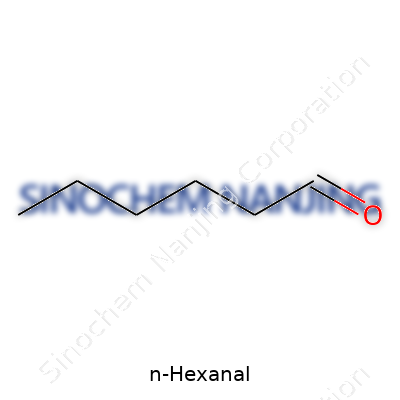
| Names | |
| Preferred IUPAC name | hexanal |
| Other names |
Hexyl aldehyde 1-Hexanal Hexanal Caproaldehyde |
| Pronunciation | /ɛnˈhɛk.sə.næl/ |
| Identifiers | |
| CAS Number | 111-31-9 |
| Beilstein Reference | 1209236 |
| ChEBI | CHEBI:15608 |
| ChEMBL | CHEMBL50478 |
| ChemSpider | 67013 |
| DrugBank | DB14096 |
| ECHA InfoCard | 100.003.690 |
| EC Number | 203-777-6 |
| Gmelin Reference | 63654 |
| KEGG | C01828 |
| MeSH | D006527 |
| PubChem CID | 7847 |
| RTECS number | MP5775000 |
| UNII | 80G6D59BHF |
| UN number | UN2372 |
| Properties | |
| Chemical formula | C6H12O |
| Molar mass | 100.16 g/mol |
| Appearance | Colorless liquid |
| Odor | penetrating, fruity, grassy |
| Density | 0.810 g/mL at 25 °C |
| Solubility in water | slightly soluble |
| log P | 1.88 |
| Vapor pressure | 1.74 mmHg (25°C) |
| Acidity (pKa) | 16.7 |
| Basicity (pKb) | 7.37 |
| Magnetic susceptibility (χ) | -8.6×10⁻⁶ |
| Refractive index (nD) | 1.410 |
| Viscosity | Viscosity: 0.613 mPa·s (20 °C) |
| Dipole moment | 2.47 D |
| Thermochemistry | |
| Std molar entropy (S⦵298) | 252.2 J·mol⁻¹·K⁻¹ |
| Std enthalpy of formation (ΔfH⦵298) | -169.0 kJ/mol |
| Std enthalpy of combustion (ΔcH⦵298) | -1670.7 kJ/mol |
| Pharmacology | |
| ATC code | N06AX13 |
| Hazards | |
| GHS labelling | GHS02, GHS07 |
| Pictograms | GHS02, GHS07 |
| Signal word | Warning |
| Hazard statements | H226, H315, H319, H335 |
| Precautionary statements | Precautionary statements: P210, P233, P240, P241, P242, P243, P280, P303+P361+P353, P370+P378, P403+P235 |
| NFPA 704 (fire diamond) | 1-2-0 |
| Flash point | -21 °C |
| Autoignition temperature | 220 °C |
| Explosive limits | Explosive limits: 1.2–7.5% |
| Lethal dose or concentration | LD50 oral rat 3700 mg/kg |
| LD50 (median dose) | LD50 (median dose) of N-Hexanal: "3100 mg/kg (oral, rat) |
| NIOSH | KM2975000 |
| PEL (Permissible) | 50 ppm (180 mg/m3) |
| REL (Recommended) | 75 |
| Related compounds | |
| Related compounds |
Pentanal Heptanal Octanal Hexanol Hexanoic acid Hexan-2-one Hexene |



