N-Ethyl-M-Toluidine: A Comprehensive Commentary
Historical Development
N-Ethyl-M-Toluidine traces its roots back to the early development of organic chemistry, where aromatic amines drew attention for their versatile reactivity. European dye industries started exploring methylated and ethylated anilines by the late 19th century, fueling the shift from natural to synthetic colorants. Scientists in those early decades recognized that tweaking side chains on aromatic rings led to changes in performance for dyes, rubber accelerants, and intermediates for pharmaceuticals. N-Ethyl-M-Toluidine emerged from such exploratory reactions, serving as a crucial intermediate. Over the 20th century, its production moved from small, batch processes in glass vessels to more controlled, large-scale synthesis with today’s focus on tighter purity, minimized environmental waste, and improved worker safety. Industry standards surrounding its handling and environmental controls reflect lessons learned from decades of both progress and mistakes in chemical manufacturing.
Product Overview
N-Ethyl-M-Toluidine stands out as a colorless to light yellow liquid with a distinct amine odor. Industrial producers typically supply it in steel drums or sturdy containers to address both its volatility and sensitivity to light. Buyers often find it listed under several synonyms, reflecting legacy naming conventions and regional market differences. Its primary markets include the synthesis of dyes and pigments, production of rubber processing aids, and intermediate use in select pharmaceuticals. Technology advances allow today’s buyers to demand precise impurity profiles and traceability with each batch they purchase. Small differences in purity or supply chain transparency carry noticeable consequences for end-use applications, especially in products shaped by regulatory scrutiny such as medical intermediates or consumer goods.
Physical & Chemical Properties
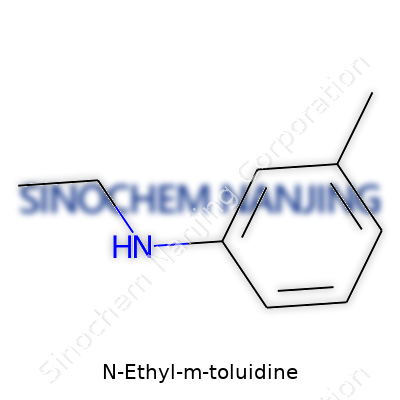
Under room temperature, N-Ethyl-M-Toluidine remains a clear liquid with a boiling point around 225°C and a melting point well below zero, factors that help define both its handling requirements and kinetic role in chemical synthesis. Solubility favors common organic solvents like benzene, toluene, and ether, while water solubility stays limited. Its molecular structure, containing both a methyl group and an ethylamino moiety on a benzene ring, drives predictable nucleophilicity and basicity. I’ve handled samples with refractive indices hovering near 1.55 and detected a density around 0.96 g/cm³. These physical features push it into a select group of intermediates compatible with large-scale blending in paint, polymer, and dye manufacturing.
Technical Specifications & Labeling
Across global supply chains, technical data sheets point to consistently narrow specifications for assay (above 99%), controlled levels of water (less than 0.2%), and low presence of byproducts like N,N-diethyl-m-toluidine. Labels comply with both GHS (Globally Harmonized System) and regional laws, carrying hazard pictograms for flammability and acute toxicity. Chemical manufacturers publish details like CAS numbers, HSN codes, and appropriate UN shipping numbers to allow fast traceability during audits. I’ve seen stricter requirements growing for heavy metal analysis and documentation of absence of persistent organic pollutants, especially for manufacturers serving the electronics or medical device sectors. Such measures aim to guard not just product performance, but also human health and reputational risk for downstream brands.
Preparation Method
Producers commonly synthesize N-Ethyl-M-Toluidine through alkylation of m-toluidine with ethyl halides or ethyl alcohol under controlled temperature and pressure, often with acid or base catalysis. Batch reactors provide flexibility for balancing yield and selectivity, minimizing the formation of diethylated or over-alkylated byproducts. Investments in continuous-flow setups over the last decade allowed better heat control, making larger volumes feasible while also enabling quick response to abnormal byproduct formation. Waste minimization efforts now include spent acid reprocessing and the scrubbing of volatile organics before venting, in response to tightening environmental discharge norms. Experience in these facilities shows that pH management, mixing intensity, and patience in product isolation can make all the difference between a high-purity output and a fouled batch.
Chemical Reactions & Modifications
N-Ethyl-M-Toluidine acts as both a building block and a reactive participant. It undergoes electrophilic substitution on the aromatic ring, allowing further functionalization for dye, pigment, and pharmaceutical applications. Strong oxidizers transform it into quinone derivatives, critical for specialty chemical synthesis. Its amine group enables acylation and diazotization, two modifications valuable in materials science. Having worked with reaction pathways using N-Ethyl-M-Toluidine, I’ve seen its stability under mild conditions yet strong reactivity once heated or mixed with aggressive agents. The balance between methyl and ethyl substituents supports unique downstream behavior, opening doors for tailored additives in the polymer and electronics industries.
Synonyms & Product Names
Across different markets and historical contexts, N-Ethyl-M-Toluidine appears under several alternative names. Common designations include 3-Methylaniline, N-Ethylaniline, and N-ethyl-3-methylaniline. Chemical catalogs might feature identifiers such as Ethyl(m-tolyl)amine or reference it by its recognized CAS number for supply chain management. Language differences across Europe and Asia have fostered a patchwork of formulas and trade names, sometimes posing a challenge for first-time buyers deciphering safety data. Suppliers now lean toward harmonized GHS labeling to bridge these gaps, but older packaging and product archives often still carry legacy terms that prompt closer scrutiny.
Safety & Operational Standards
Handling N-Ethyl-M-Toluidine demands respect, given its toxicity and the risk of skin or inhalation exposure. Facilities store the chemical away from sunlight in temperature-controlled spaces, kept apart from strong acids, oxidizers, and open flames. Standard operating procedures rely on pump-driven transfer rather than manual handling to cut down on accidental spills. Safety showers, eye wash stations, and thorough ventilation systems become non-negotiable for every storage bay and production line. Training drills for leaks and accidental skin contact help prepare workers for the rare emergency. While regulators like OSHA, REACH, and EPA publish evolving safety parameters, internal audits and third-party certifications increasingly focus on continuous improvement to keep up with new toxicological research.
Application Area
Industrial dye and pigment production dominate N-Ethyl-M-Toluidine’s end uses, but it also finds a crucial role in rubber manufacturing, serving as a curing accelerator and antioxidant. Specialty chemical companies tap it for intermediate production in pharmaceuticals, agricultural products, and emerging applications like optoelectronic materials. I’ve seen it referenced as a key starting material for photoinitiators used in UV-cured inks and coatings. Its capacity to act as a reducing agent in select catalytic cycles opens extra value in research and custom synthesis projects. Direct exposure in consumer goods stays limited due to toxicity, but indirect use brings it closer to everyday life than many realize—in car tires, printer inks, wire coatings, and beyond.
Research & Development
Research groups continue examining alternative alkylation methods, aiming to boost yield and cut down hazardous waste. Catalysis advances, such as heterogeneous or enzyme-driven pathways, promise greener production lines that comply with stricter VOC and emissions rules. Analytical chemists push limits for impurity profiling, using high-resolution mass spectrometry and NMR to guarantee product purity. Application research explores molecular tweaks for future applications in organic electronics and advanced composites. In my experience, effective R&D also means active cross-talk with industrial hygienists and regulatory experts to anticipate supply chain snags or public health shifts before they escalate into product recalls or, worse, liability claims.
Toxicity Research
According to published toxicology studies, acute exposure to N-Ethyl-M-Toluidine causes symptoms like skin irritation, headaches, dizziness, or in severe exposures, organ toxicity. Animal studies report hemolytic effects and possible impacts on liver and kidney function at elevated doses. Chronic toxicity data reveal risks of repeated exposure, underlining why every protocol emphasizes containment and minimization of skin contact. Regulatory agencies routinely reexamine permissible exposure limits in response to new findings, especially as more sensitive analytical tools bring trace level detections into focus. Industry health professionals keep close tabs on workers’ health, requiring routine medical monitoring, blood screenings, and workplace air quality assessments. The history of aromatic amines in public health serves as a cautionary tale—today’s producers bow to the science and opt for over-preparation in safety rather than restoring confidence after an incident.
Future Prospects
Global chemical industries face pressure to align with sustainable chemistry goals while responding to regulatory crackdowns on hazardous intermediates. For N-Ethyl-M-Toluidine, the future likely means tighter impurity standards, boosted transparency on supply chain risks, and rising demand for greener synthesis technologies. Startups and university labs keep searching for biobased feedstocks or catalytic breakthroughs that minimize hazardous residues. Application research points toward uses in next-generation electronics, advanced adhesives, or even smart materials, provided new safety hurdles can be cleared. Based on the arc of regulatory reform and shifting public expectations, companies involved in its production must stay alert, agile, and ready to adapt technology and process controls to protect both workers and reputation in a rapidly evolving global market.
What is N-Ethyl-M-Toluidine used for?
What Makes N-Ethyl-M-Toluidine Useful?
N-Ethyl-M-Toluidine pops up often in industrial circles. Factories trust it for a reason. Its real value shows up in the making of dyes and pigments. Paints get their bright, lasting shades thanks to chemicals like this. Every time someone admires a deep color on a car or notices the bright tint on a garden tool, chances are, N-Ethyl-M-Toluidine stood close behind that success.
This compound also plays a hidden but crucial role in certain adhesives and polymer products. It finds itself mixed in with compounds that need to cure or set firmly, like two-part epoxy glues. The curing process would drag or fall flat without something to kickstart the reaction. N-Ethyl-M-Toluidine pushes those bonds to form faster and sturdier.
The Health Aspect—Why Pay Attention?
Practical uses often come with trade-offs. Concerns about worker safety and environmental effects can't slide under the rug. People who handle this chemical in factories sometimes face real risks. Direct skin or eye exposure can burn or irritate. If inhaled or swallowed, it goes from nuisance to hazard, since research links certain toluidine compounds to long-term health problems, including cancer risks.
Workplace safety rules step in for good reason. Factories must give workers gloves, goggles, and proper training. Where there’s a real risk, having an eyewash station nearby feels less like a regulation and more like common sense. Good ventilation lowers exposure, cutting down on those risks from fumes.
Looking at the Environmental Footprint
Chemicals released into nature don’t disappear. N-Ethyl-M-Toluidine doesn’t break down quickly in water or soil. Runoff from industrial sites can carry it into streams, which disrupts aquatic life and, by extension, food chains. Waste treatment methods matter a lot. There is growing pressure from environmental groups to monitor and reduce these releases. Sometimes, regulators force certain industries to use scrubbers or to switch to safer alternatives.
Pushing for Safer Solutions
Years working in chemical manufacturing have shown that shortcuts with hazardous compounds always come back with a price. Safer substitutes make sense, not just for workers but for the planet. Research labs and universities hunt newer chemicals that copy the curing ability of N-Ethyl-M-Toluidine without the adverse health flags. Some companies already use catalysts based on less toxic, more biodegradable formulas. Regulators are part of this push as well, drafting stricter guidelines and updating safety thresholds.
Everyday Choices and Awareness
Industry insiders need to stay sharp about the materials they use. N-Ethyl-M-Toluidine won’t vanish overnight, but consumers deserve honesty about what goes into their products. Awareness matters. People may not check the fine print on every product, but those who do shape demand for safer goods. Steady improvements in chemical management and public pressure often steer companies to rethink their recipes, aiming for safer and greener production lines.
What are the safety precautions when handling N-Ethyl-M-Toluidine?
The Realities of Working with Chemicals
In most labs or factories you can smell it—faintly sweet, a signal drifting out from containers of N-Ethyl-M-Toluidine. Not many people know the stuff by name, but it pops up in things like dyes, rubber processing, and even some adhesives. I remember my first job out of college, unloading drums of it, gloves sticking to my skin in the midsummer heat. I didn’t think much about masks. One guy coughed so much we nervously joked about it. Truth is, we just wanted to finish without getting in trouble. Over time, I learned chemicals don’t care about shortcuts or schedules. They’ll get to you eventually if you don’t respect them.
The Hazards: What Goes Wrong
Any chemical with “toluidine” in the name can be rough on your health. N-Ethyl-M-Toluidine causes headaches, nausea, and worst of all, possible damage to blood and organs after long exposure. Breathing it in can irritate the lungs. Skin contact may trigger rashes, and your eyes might start burning within seconds. The worst-case scenario involves possible links to cancer, according to reports from the International Agency for Research on Cancer.
Simple Steps for Protection
Safety starts before you even open the cap. Grab those chemical-resistant gloves—nitrile works well. Splash goggles stay on your face, not your forehead or hanging from your neck. Lab coats, even if they feel overkill, will spare your arms from a spill. Don’t skip the fume hood. Every old-timer in the field can recount stories about people who tried to work without ventilation and ended up sick—or worse, unconscious.
Respirators sound unpleasant, but they keep vapors out of your lungs. Always check the cartridges are rated for organic vapors. I once watched a guy get sloppy, using the wrong filter. He paid for it with a pounding headache and a few lost days. Ear those warnings and take five extra minutes to double-check your gear.
Good Work Practices
Keep your workspace tidy. Open containers only when absolutely necessary, and seal them tightly afterward. Take care around spills—the chemical can seep into surfaces and linger, so wipe down your bench with the right solvents and dispose of wipes in marked bins. Make sure to label containers clearly; you don’t want someone thinking it’s something safer.
Don’t eat, drink, or apply cosmetics anywhere near the work zone. We all get hungry, but lunch can wait until you wash up. I kept a habit of leaving my phone outside the room, too—no distractions.
Planning for the Worst
An eyewash station within arm’s reach can save your sight if things go sideways. Emergency showers need to be working and tested, not just sitting as decorations. Let your coworkers know the protocols. I once had a lab partner mix up the evacuation drill and waste disposal instructions. Fortunately, our safety officer noticed before it became a problem. Regular training helps cement these steps in your memory.
Moving Forward Responsibly
Nobody gets perfect overnight, but taking a cautious, respectful approach keeps everyone safer. In my years around solvents and dyes, I found that professionalism isn’t complicated. It’s in small daily choices, from wearing the right gloves to triple-checking your station at the end of a shift. Tough chemicals demand healthy respect, not shortcuts.
What is the chemical formula of N-Ethyl-M-Toluidine?
Understanding N-Ethyl-M-Toluidine’s Structure
N-Ethyl-m-toluidine has the chemical formula C9H13N. That means each molecule holds nine carbon atoms, thirteen hydrogens, and a single nitrogen atom. Structurally, you get a benzene ring with a methyl group (the "toluidine" part) sitting at the meta position, plus an ethyl group attached to the nitrogen atom. This specific arrangement gives the compound its character and sets it apart from other toluidine derivatives.
The Real-World Relevance of Chemical Structure
It’s funny how chemistry feels abstract until you realize how connected it is to the stuff we use every day. In my own experience, clarity about a compound’s formula helps you identify safety concerns or make sense of its industrial uses. N-Ethyl-m-toluidine, for instance, shows up in dyes, chemicals for photography, and even fuel additives. I’ve seen plenty of cases where a simple difference in molecular structure meant completely different health and handling guidelines.
Take, for example, the case of toluidines as a group: some of these chemicals have shown links to health risks, especially if they’re not handled properly in manufacturing environments. Knowing exactly what you’re dealing with—down to the formula—can be the line between safe handling and real danger. The methyl group in the “meta” position changes toxicity and environmental fate compared to its “ortho” or “para” cousins. The ethyl group can further influence how the body processes the molecule.
Implications for Health and Industry
C9H13N is more than just a string of letters and numbers. The formula influences everything from how companies produce coloring agents for plastics to the way researchers assess exposure risks in the workplace. In the 2000s, industry guidelines started focusing on nitrosamine formation—a serious concern where toluidine-based chemicals are present. Those guidelines came in because some research found links between certain aromatic amines and cancer risks.
Taking preventive steps means not only learning the chemical formula but also grasping its implication on behavior in the environment and physiology. Over the years, industrial hygienists started pushing for ventilation upgrades or even substitution with safer alternatives. You can’t recommend those changes unless you have a deep understanding of the compound, right down to its formula and substitution patterns.
Making Use of the Information
If you go into the field—whether it’s as a lab tech, a product safety manager, or a student in organic chemistry—the value of knowing a formula like C9H13N becomes obvious. It gives you a foundation for uncovering where that chemical might appear, how to spot it on a label, or whether you need to worry about storage compatibility.
I’ve always noticed that the more familiar people are with basic chemistry, the less likely dangerous mistakes happen. Small differences in formula translate to big impact operationally. Chemical information should never just sit in a lab manual; it deserves a spot in everyday decisions, from purchasing to personal protective equipment.
Pathways for Safer and Smarter Use
Solutions begin with better education and access to data. Training staff to recognize the formula of N-Ethyl-m-toluidine as C9H13N arms them with the ability to spot hazards and minimize risk. Policy makers, educators, and industry leaders have a shared role to play in making chemical knowledge practical.
In my view, front-line workers need more than generic advice; they deserve specific, practical information. When people start seeing those letters and numbers as more than just labels, they start making smarter, safer choices both inside and outside the lab.
How should N-Ethyl-M-Toluidine be stored?
Understanding N-Ethyl-M-Toluidine’s Hazards
N-Ethyl-M-Toluidine, a clear yellow liquid, doesn’t draw much attention at first glance. I’ve seen how easy it is for someone to think it’s harmless just because it looks like so many other chemicals you’d find in a lab or workshop. But just like the more famous anilines and amines, this one carries real risks. It can irritate skin and eyes and its vapors can do a number on your respiratory system. Some researchers flag concerns about long-term exposure and carcinogenic effects. That’s enough for me to treat this liquid with real respect, no matter if it’s a tiny drop or a whole drum.
Choosing the Right Container
Storing N-Ethyl-M-Toluidine starts with the choice of container. I’ve learned through hard lessons that certain plastics just don’t hold up. Petroleum-based solvents like this one chew through polyethylene and some other resins in no time. Stainless steel drums or high-density glass bottles will hold up year after year without risk of leaks, which cuts out a whole category of accidents. You won’t find seasoned chemists pouring this stuff into soda bottles or any old jar. The right label goes on each container, not only for regulatory reasons but to make sure even the new guy on the team doesn't grab the wrong bottle after a long shift.
Temperature and Light: Quiet Factors That Matter
N-Ethyl-M-Toluidine won’t explode at room temperature and it isn’t especially volatile. That said, years of storing chemicals taught me that keeping an eye on temperature still makes a difference. Direct sunlight changes things. Light breaks down the liquid, leads to pressure build-up, and can sometimes mess with the chemical itself. I always kept containers out of sunlight and away from any source of heat—never on a window ledge, never near radiators. Any storage area should stay cool and dry, with a climate that’s as stable as possible. Forgetting this led to sticky, dangerous messes more than once in my career.
Keeping the Air Clean and the Space Dry
Vapors might not knock you off your feet with a single whiff, but with regular handling, they can build up fast. Good ventilation matters in every space where N-Ethyl-M-Toluidine gets stored or dispensed. At minimum, exhaust fans should keep the air moving. In big storage rooms, I recommend fixed systems with sensors to sniff for unwanted vapor spikes. Leaks often go unnoticed until someone feels nauseous or notices a chemical odor—by then, the exposure’s already happened.
Staying Ready for Spills and Fires
Putting one of these containers on a regular warehouse shelf invites trouble. I’ve seen chemicals like this react with oxidizers and acids, so I store them far from strong acids, peroxides, chlorine-based pool chemicals, and bleach. A dedicated flammable-liquid cabinet with lockable doors will cut down on risks of fire or accidental mixing. On top of that, it pays to have spill kits and fire extinguishers within arm’s reach—every bottle, drum, or can marks a potential hazard zone. Staff need to get regular hands-on drills, not just safety briefings. In the end, safe storage happens one decision at a time—no shortcuts, no excuses.
What are the potential health effects of exposure to N-Ethyl-M-Toluidine?
What N-Ethyl-M-Toluidine Does in the Real World
N-Ethyl-M-Toluidine shows up mostly in the chemical industry, often playing a part in making dyes, pigments, and as an accelerator in the polymer and plastics world. It doesn’t get much attention on news headlines, but folks working in industries using this chemical deal with it up close. Over the years, workplace stories and medical studies have pointed toward health problems linked with exposure to this compound, which prompts questions from workers, safety professionals, and ordinary citizens alike.
Tracing the Health Effects
Anyone who’s spent time around chemicals in a factory knows that some substances hit harder than others. Research on N-Ethyl-M-Toluidine shows a list of serious concerns. Breathing it for even a short time can cause dizziness, headaches, and sometimes feelings of nausea. More worrying signs emerge with longer or repeated exposure. Workers have reported blue-tinted skin and lips, a classic flag for methemoglobinemia—a condition where blood can’t deliver oxygen like it should. This can bring on fatigue, trouble breathing, and, in heavy cases, seizures or collapse.
There’s a bigger question about what this chemical does in the long run. Animal studies indicate possible damage to organs like the liver and kidneys and even a risk for cancer. The National Institute for Occupational Safety and Health (NIOSH) and other agencies keep tabs on it, naming it as a possible human carcinogen. Any time science flags cancer hazards, it usually ties back to DNA changes over time or chronic irritation. So, workers breathing in vapor or dust, or accidentally soaking it into their skin, face real risks.
Why These Risks Matter
Most people won’t wake up one morning to find N-Ethyl-M-Toluidine in the tap water or backyard. But for crews in manufacturing, there’s no luxury of avoidance. The moment health concerns become lawsuits or land on the evening news, public trust takes a hit—not just for the company, but also for regulators charged with keeping everyone safe.
Some factory workers I’ve met over the years shrugged off headaches or cracked jokes about “smurf hands” from chemical stains, but the laughter fades fast after a hospital trip. I remember hearing about an experienced machinist who felt tired and short of breath after a few months on a new line. Blood tests nailed it down to methemoglobinemia, right alongside detectable levels of N-Ethyl-M-Toluidine. That’s not something a shift supervisor—or anyone—should have to gamble on.
Practical Steps for Safer Workplaces
Protective gear can cut down on skin and lung exposure, but it’s the basics—ventilation, air monitoring, clear labels, and solid training—that do the heavy lifting. People need to know why a smell in the air or a stain on the skin isn’t just “part of the job.” Managers have a duty to push for safer substitutes where possible and to rotate staff to limit direct handling.
Modern tracking, backed by regular health checks, helps spot symptoms early. Developing a workplace culture that encourages reporting symptoms—without fear of hassle or pay cuts—goes a long way. Public health agencies also hold power through stricter rules, ongoing research, and plain-language safety bulletins. People can’t protect themselves from risks they don’t understand, but transparency turns statistics into stories that get attention.
| Names | |
| Preferred IUPAC name | N-ethyl-3-methylaniline |
| Other names |
N-Ethyl-3-methylaniline 3-Ethylaminotoluene N-ethyl-m-toluidine 3-Methylphenyl ethylamine |
| Pronunciation | /ɛn-ˈɛθɪl-ɛm-təˈluːɪdiːn/ |
| Identifiers | |
| CAS Number | 102-27-2 |
| Beilstein Reference | 873957 |
| ChEBI | CHEBI:38346 |
| ChEMBL | CHEMBL60370 |
| ChemSpider | 16377 |
| DrugBank | DB11332 |
| ECHA InfoCard | 100.014.258 |
| EC Number | 202-445-9 |
| Gmelin Reference | 8181 |
| KEGG | C01751 |
| MeSH | D000078139 |
| PubChem CID | 7538 |
| RTECS number | XN6475000 |
| UNII | 825YI8JV3F |
| UN number | UN2810 |
| CompTox Dashboard (EPA) | DTXSID0027012 |
| Properties | |
| Chemical formula | C9H13N |
| Molar mass | 135.21 g/mol |
| Appearance | Colorless to pale yellow liquid |
| Odor | Aromatic amine odor |
| Density | 0.945 g/mL at 25 °C |
| Solubility in water | slightly soluble |
| log P | 1.97 |
| Vapor pressure | 0.2 mmHg (20°C) |
| Acidity (pKa) | pKa 5.15 |
| Basicity (pKb) | 11.08 |
| Magnetic susceptibility (χ) | -7.58e-6 cm^3/mol |
| Refractive index (nD) | 1.553 |
| Viscosity | 13.6 mPa·s (20 °C) |
| Dipole moment | 2.37 D |
| Thermochemistry | |
| Std molar entropy (S⦵298) | 317.7 J·mol⁻¹·K⁻¹ |
| Std enthalpy of formation (ΔfH⦵298) | -32.6 kJ/mol |
| Std enthalpy of combustion (ΔcH⦵298) | -3862 kJ/mol |
| Pharmacology | |
| ATC code | D04AB03 |
| Hazards | |
| GHS labelling | GHS02, GHS06, GHS08 |
| Pictograms | GHS02, GHS06 |
| Signal word | Danger |
| Hazard statements | H302, H312, H332, H315, H319, H351, H412 |
| Precautionary statements | P210, P261, P264, P270, P271, P301+P310, P303+P361+P353, P304+P340, P311, P405, P501 |
| NFPA 704 (fire diamond) | 2-3-0 |
| Flash point | 87°C |
| Autoignition temperature | 424°C |
| Lethal dose or concentration | LD50 oral rat 1,415 mg/kg |
| LD50 (median dose) | LD50 (median dose): Oral rat 1296 mg/kg |
| NIOSH | DD4575000 |
| PEL (Permissible) | PEL: 2 mg/m³ |
| REL (Recommended) | 0.5 ppm |
| IDLH (Immediate danger) | IDLH: 100 ppm |
| Related compounds | |
| Related compounds |
N-Methylaniline N,N-Diethylaniline N-Ethylaniline m-Toluidine N-Isopropylaniline |



