N-Decane: More Than Just a Straight-Chain Alkane
Historical Development
People have worked with hydrocarbon mixtures for generations, right from early days when crude oil found its way from muddy hands into lanterns and lamps. Workers at refineries sifted through crude oil fractions, learning to split heavier stuff from lighter bits. As refining technology moved forward, researchers kept drilling deeper into the toolbox of hydrocarbons. Among them, n-decane stood out for its ten-carbon backbone — unbranched, no frills. Scientists in the mid-20th century paid extra attention to this compound, since its boiling point (174°C) fell in a sweet spot for calibration standards and fuel research. Technicians at petroleum labs latched onto n-decane for its predictable burn and clean break from more complicated molecules. Around the world, chemical companies lined up to produce n-decane at scale, making it much easier for labs and industry to pin down its performance versus other fractions.
Product Overview
N-Decane goes by many names—decane, n-decyl hydride, and a whole slew of catalog numbers from chemical suppliers. Little about its clear, oily liquid form grabs your attention at first glance, but it finds a home in both industrial plants and research benches. Technicians see n-decane as a key reference material for fuel testing, thanks to its predictable ignition and clean composition. Companies offer this hydrocarbon at several purity levels, with packaging ranging from glass September flasks in research catalogs to bulk steel drums at chemical wholesalers. Most people in fuel research know n-decane because it crops up in test fuels or acts as a baseline for reaction studies, but it slides quietly into the background in blending, solvent extraction, and calibration work.
Physical & Chemical Properties
Physical properties make n-decane predictable: it’s a colorless liquid, shows up under the umbrella of non-polar molecules, and floats with a slightly lower density than water (about 0.73 g/cm³ at room temperature). If you’ve ever smelled fresh gasoline or cleaner, you might detect something similar here, though n-decane’s aroma lacks the heavier, sulfurous kick of some other fractions. Chemists keep an eye on the flash point (46°C), boiling point (174°C), and vapor pressure, because these numbers guide safe handling and storage. It’s flammable, of course—most ten-carbon hydrocarbons burn steadily, with blue flames in enough oxygen. In labs, students measure its refractive index or toss it around in chromatography columns to separate out other non-polar compounds.
Technical Specifications & Labeling
Technical sheets provided by manufacturers lay out the usual metrics: purity (97% to 99.5%), specific gravity, distillation range, and trace content of sulfur, aromatics, and water. Chemicals like n-decane rarely come pure straight from crude oil, so distillation and purification steps get a spotlight on these data sheets. Labels with GHS pictograms—flame icons, health hazard warnings—keep everyone sharp about what’s inside the bottle. Some jurisdictions require manufacturers to mark cans with the UN number (UN 2247 for n-decane) and hazard class. For research-grade n-decane, technical teams chase after “trace analysis” levels for contaminants, since even a touch of sulfur or oxygenate can throw off results in engine and fuel testing. Transport regulations steer how drums of n-decane get trucked, shipped, and stored.
Preparation Method
In refinery settings, n-decane doesn’t get plucked directly out of the crude oil soup. It shows up as part of a diesel range aliphatic fraction, then gets separated out by fractional distillation. Once among a mix of C10 alkanes, careful distillation lines up n-decane at its boiling point. Further purification steps usually involve treating with molecular sieves to dry out water and washing away lingering aromatics or sulfur-based impurities through extraction. The resulting product passes through filters before bottling. For research or analytical-grade uses, companies sometimes use preparative chromatography to weed out other isomers or trace minutiae that would otherwise sneak past less stringent processes.
Chemical Reactions & Modifications
N-Decane doesn’t put up much resistance: as a saturated hydrocarbon, it reacts mostly through combustion or cracking. Engine researchers use it in controlled knock tests, finding how oxygen turns decane into carbon dioxide and water. Under strong heat or catalytic conditions, n-decane breaks apart in “cracking” reactions—yielding lighter products like pentane, hexane, or even ethylene. In academic settings, synthetic chemists might chlorinate or sulfonate n-decane, sometimes just to learn about radical chemistry or alkane modification. Less common, but worth a mention, lies in isomerization, where catalysts morph n-decane into branched isomers for fuel blending. Compared with aromatic or unsaturated compounds, n-decane’s reactive profile keeps it largely in the “background” of major chemical syntheses.
Synonyms & Product Names
Chemists who order from catalogs cross paths with several names: decane, normal decane, or even n-decyl hydride. Some trade suppliers slap on internal codes—Acros, Sigma-Aldrich, Fisher Scientific all have version numbers, CAS identifiers (124-18-5), and UN transport codes. For fuel researchers, ASTM and API documents talk about “n-decane” in protocols for cetane number measurement and volatility assessments. Some safety data sheets use European identifiers like EINECS: 204-686-4. Product catalogs from major chemical houses bundle n-decane images with full technical sheets, listing synonyms to untangle any confusion during procurement or compliance work.
Safety & Operational Standards
Handle a drum or flask of n-decane, and the first rule sticks in mind: it’s flammable. Laboratory safety teams and plant engineers both insist on grounded containers, proper ventilation, and static-discharging clothing so nobody sparks an accidental fire. Spill response guidelines call for foam or dry chemical rather than water-based methods, since hydrocarbons often float and spread. Working with n-decane over long hours or in tight spaces, staff should wear gloves, splash goggles, and sometimes even full-faced shields—especially if splashes could reach skin or eyes. Storage rules limit temperatures and spacing, based on fire codes and chemical compatibility. Disposal guidelines funnel waste n-decane into specific hazardous materials bins to stop accidental mixing with acids or oxidizers. Employees keep safety data sheets close, because local environmental rules about emissions, storage, and spill reporting set the tone for every shift.
Application Area
N-Decane plays several different roles across industries. Fuel labs pour it into standardized knock engines to probe diesel performance, where it offers a baseline for the cetane number scale. Lubricant makers sometimes use it as a diluent for grease and oil formulations, because it avoids triggering side reactions. Industrial solvent applications show up in paint thinners and extraction processes, where non-polar hydrocarbons strip away waxes or unwanted residues. In academic settings, n-decane serves as a test subject during environmental fate studies—especially around evaporation, dispersion, or biodegradation of petroleum hydrocarbons. Calibration standards for gas chromatography lists often include n-decane, since its clean single peak helps sort out more complex hydrocarbon mixtures.
Research & Development
University research labs and independent science teams keep returning to n-decane for both practical tests and theoretical groundwork. Engine researchers look at spray patterns, burning efficiency, and pollutant formation using n-decane as a “model” diesel fuel—simpler and more reproducible than complex real fuels. Cleaner-burning fuels and advanced combustion engines come under constant study, where n-decane witnesses experiments with injection timing, pressure, and alternative ignition systems. Environmental scientists trace how n-decane behaves in groundwater or contaminated soils, building insight into long-term fate of oil spills. Academic papers trace reaction networks, combustion chemistry, and atmospheric breakdown, where n-decane’s simplicity strips out distractions found in larger molecules. Instrument manufacturers include n-decane in standard mixtures for performance validation, supporting reliable testing work for years.
Toxicity Research
Researchers tracking hydrocarbon exposure and health outcomes look closely at n-decane, especially given its flammability and vapor presence. People working around open drums or leaky containers risk headaches, skin dryness, and eye irritation if exposed directly or over a long shift. Regulatory bodies set exposure limits for hydrocarbons in air—often at low parts-per-million levels—to discourage routine or accidental inhalation. Animal studies indicate that high vapor concentrations can depress the central nervous system, though n-decane doesn’t rank as acutely toxic as aromatic cousins like benzene or toluene. Scientists also keep an eye on environmental risks; spilled n-decane evaporates quickly, but what doesn’t escape into the air risks seeping down into soil and water tables. Long-term research continues to ask how repeated exposures impact worker health in both labs and industrial plants.
Future Prospects
N-Decane’s future looks tied to the evolving energy and chemical landscape. With bio-based fuels making waves, researchers test n-decane’s place as a benchmark against newer blends, helping industry tune engines and reduce emissions. Instrument developers keep refining calibration standards, and n-decane sticks around in new testing methods. Environmental work will keep focusing on tracking and remediating spills, since hydrocarbon pollution links directly to ecosystem health. Synthesis work sometimes turns n-decane into specialty chemicals, and its simplicity keeps making it a good teaching molecule in classrooms. As regulatory frameworks tighten on emissions and chemical exposure, suppliers work to boost safety standards and packaging transparency. Every time an engineer, scientist, or technician reaches for n-decane, the story continues—still useful, still reliable, always demanding clear-eyed attention to both science and responsibility.
What is N-Decane used for?
Hidden Workhorse Behind the Scenes
N-Decane hardly shows up in everyday conversations, but it plays a bigger role in daily life than most folks realize. Most people haven’t poured decane into an engine or mixed it with cleaning agents, but its fingerprints show up in plenty of overlooked places. Drawing on years spent poking around labs and workshops, it's clear that this twelve-carbon hydrocarbon quietly makes the modern world run a bit smoother.
N-Decane Fuels Real-World Testing
Flip through the pages of any automotive research journal, and decane gets a lot of attention as a fuel reference for diesel and jet engine research. In test cells, researchers need to strip away the complexity in regular diesel, which often contains a cocktail of hydrocarbons. Pure n-decane gives engineers a reliable base for examining combustion, emissions, and efficiency. Its predictable burning helps nail down what’s working and what isn’t. Without these reference fuels, advances in cleaner, more efficient engines would stall.
Essential Tool for Scientists and Engineers
Over the years, I’ve watched lab techs measure the flow of decane across surfaces, tracking how liquids spread, evaporate, or interact with different materials. This isn’t just a niche interest—these tests influence everything from oil spill models to safer pipeline designs. The way decane moves and evaporates helps researchers forecast how a real spill might behave or how fuel will interact with seals and metals in storage and transit.
Role in Calibration and Quality Control
Look inside a research-grade analytical lab, and there's a good chance someone’s calibrating an instrument with n-decane. Gas chromatography labs lean on it as a standard for checking retention times and instrument response. Accurate machines anchor reliable data: if fuel testers, environmental scientists, or quality inspectors can’t trust their instruments, mistakes slip through.
Not Just for the Test Tube
Out in the industrial world, decane takes on new duties as well. Some manufacturers use it as a solvent to help dissolve and process raw materials during production. Certain adhesives, coatings, and cleaners owe a piece of their recipe to n-decane, which gets chosen because it’s less volatile than lighter hydrocarbons but less sticky than heavier ones. These properties help fine-tune the speed at which materials dry or how they’re applied, allowing for smooth production lines and safer products.
Workplace Hazards and Safer Paths Forward
Spending hours in industrial sites and labs makes a person aware of every risk label and whiff of solvent in the air. Decane doesn’t escape scrutiny. Breathing too much can cause headaches, dizziness, or worse. Robust ventilation, closed handling systems, and frequent training mark the difference between routine and accident. Many companies already swap in safer alternatives where possible, aiming for greener solvents or stricter controls. Some push to recycle solvents through distillation, cutting down on waste and keeping costs in check.
Moving Toward a Cleaner Tomorrow
The story of n-decane doesn’t just revolve around what it can do; it’s about using it with care. Research continues on safer substitutes that offer similar performance without as many side effects. Until then, proper storage, diligent handling, and investment in cleaner tech stand as the simplest ways to keep workers safe and the environment a little cleaner.
What is the chemical formula of N-Decane?
The Basics of N-Decane
N-Decane carries the formula C10H22. Each molecule packs ten carbon atoms joined in a straight line, with twenty-two hydrogens latching on the sides. This shape gives the substance its name. In school chemistry labs, straight-chain alkanes like n-decane help students understand how molecular structure changes behavior. The formula may look simple, but its uses stretch far beyond the classroom.
The Role of N-Decane in Industry
A straight-chain hydrocarbon like this belongs to a family often found in fuels. Plenty of people living near refineries or fuel storage tanks have seen the heavy trucks rolling by, not realizing n-decane rides inside the mix. Engineers and scientists lean on it to build calibration standards and track pollutant behavior in air and water. I recall reading research from the U.S. EPA showing how volatile organic compounds escape into the environment. N-Decane often acts as the benchmark, showing which gases matter most for health studies.
Everyday Impact: Fuels and Safety
Long-chain alkanes such as n-decane help shape the character of gasoline, jet fuel, and diesel. I once toured a regional airport, staring at fuel trucks in the bright sun. The workers explained how fine-tuning the blend changes how engines react. Too many short-chain hydrocarbons, and engines knock or stall. Too many long ones, and cold starts turn sluggish. N-Decane sits in the sweet spot. It gives fuels stable burning and smooth performance, something every driver appreciates even if they don’t know it.
The flip side comes with safety. This hydrocarbon forms flammable vapors at ordinary temperatures. Firefighters receive specialized training on dealing with fuel leaks and spills. I’ve talked to first responders who stress the risks in storage and transport. They always double-check seals, look for corrosion on tanks, and drill evacuation routes. Public safety teams want local families to know the risks, and understanding the nature of these chemicals helps people take action quickly if something goes wrong.
Environmental and Health Paths
N-Decane breaks down in sunlight and fresh air, usually within a few days. Still, spills near water or soil last longer. Once, I joined a field study tracking pollutants down a storm runoff channel. Even low concentrations of hydrocarbons like n-decane can stress fish and disrupt plant growth. Labs use gas chromatography to test local water, focusing on areas near transport hubs. Careful environmental standards keep exposure below levels that threaten wildlife or public health.
Improving Practices and Accountability
Chemical handling always brings concern about leaks and accidents. Local governments pass regulations to keep sites secure and enforce strict reporting. Technology promises improvements, with sensors that quickly sniff out smaller spills and automated valves that shut off flow fast. Better data-sharing helps emergency crews coordinate. Risk education—especially teaching high school students, community groups, and plant employees what to watch for—builds accountability. Understanding even a basic formula like C10H22 helps people see the bigger system in motion and look out for one another’s safety.
Is N-Decane hazardous or toxic?
What Is N-Decane Used For?
N-Decane shows up in a lot more places than most folks realize. Refineries and research labs handle it all the time. It’s handy as a reference fuel for engine tests and plays a role in chemical synthesis. Lab technicians use it as a solvent now and then, and you’ll find it in classrooms when chemistry students learn about hydrocarbons. In every one of these settings, people eye the safety data carefully.
Why People Worry about Safety
Decane smells faintly sweet, almost like kerosene. After years around solvents and lab chemicals, I know that just because something smells mild doesn’t mean it’s safe. N-Decane belongs to the alkane family, which brings up memories of flammable vapors and headaches from breathing in fumes. I’ve watched a spill spread slick and invisible across a countertop, reminding me how fast these liquids evaporate and disappear into the air.
Health Hazards and Toxic Effects
The biggest risk usually comes from inhaling high concentrations of vapor. Workers in confined spaces or poor ventilation can start feeling lightheaded, dizzy, or outright sick. The American Conference of Governmental Industrial Hygienists pegs the exposure limit for N-Decane at 200 ppm over an eight-hour work shift. Over time, breathing solvents like this can irritate the nose and throat, and the headaches come on quickly. If a person passes out in a closed area filled with fumes, the situation turns dangerous fast.
On the skin, decane feels oily, but that grease strips away the skin’s natural barrier. Any technician who’s ever handled it without gloves can vouch for red, irritated hands and that dryness that sticks around for days. Swallowing decane isn’t a common accident, but it leads to nausea and even lung damage if someone coughs it up into the lungs—a real emergency.
Fire Hazards Aren’t Just a Minor Risk
N-Decane takes off quickly if there’s an ignition source. Its flash point sits at about 46°C, which means a warm day in a hot engine room or storage shed can make it risky. I’ve seen one spark turn a small puddle into a burst of flame. Fire marshals take storage seriously, keeping N-Decane away from acids and oxidizers that could react in dangerous ways.
Facts from Research and Industry
Reports from the National Institute for Occupational Safety and Health make it clear: N-Decane isn’t considered the most toxic solvent around, but chronic exposure matters. Repeated breathing of high levels in animal studies led to effects on the liver, kidney, and even central nervous system. The World Health Organization categorizes N-Decane as an irritant, though not as a confirmed carcinogen.
Working Toward Safer Handling
Nobody wants to banish useful chemicals, but preventing accidents starts with respect and training. In my own labs, we swapped open beakers for sealed waste jars and checked the fume hood airflow before opening a bottle. Ventilation stands out as the key control—most serious symptoms come from vapor building up indoors. Gloves and splash goggles earn their place on the checklist, too.
Companies can do more by sharing real-life stories: the near-miss in the pump room, or the time a careless pour led to a fire scare. These experiences teach newcomers faster than hazard labels ever will. Teaching new technicians to spot leaks and check ventilation helps cut down on bad days and hospital visits.
Summary of Concerns
While N-Decane stays out of the media spotlight, the risks sit right beside every bottle and barrel. Safety in science and industry means recognizing the hazards of even “mild” chemicals and giving workers the tools to handle them. That’s the plain truth I’ve seen on the job, and it still holds up today.
How should N-Decane be stored and handled?
N-Decane: Familiar, Yet Demanding Respect
A clear, colorless liquid that looks like water, n-decane often shows up in labs and industry. Its plain appearance hides a flammable nature and toxic side that both the seasoned chemist and new technician need to keep in mind. Many accidents happen not because people don’t know the rules, but because they lose sight of just how hazardous something familiar can become. I remember walking into a storage room at an old job, catching the strong scent of fuel—a reminder that n-decane evaporates more easily than people might think. Without good practices, a routine day can take a dangerous turn.
Ventilation Matters More Than People Admit
Whenever I’ve handled n-decane, the first thing I check is airflow. Good airflow keeps fumes from settling and minimizes the risk of fire. Stuffed closets and closed basements don’t cut it. I’ve seen engineers take shortcuts, thinking “it’s just another solvent.” Then an overheated light or a bit of static sets off trouble. Fires caused by vapor buildup aren't rare. N-decane needs a storage space where air moves freely and where sources of sparks and open flames stay far away.
Store Like It’s Always Been Spilled
Years ago, I learned to treat every chemical drum like it might leak. With n-decane, that habit pays off. Any sniff of its odor in a storeroom turns into a search for loose valves or cracked seals. Metal containers with self-closing lids work better than plastic ones, which n-decane can weaken over time. Every label stays easy to read, so there’s no confusion during busy days. The room itself stays cool: direct sun turns steel drums into miniature ovens, which raises vapor pressure and risks a blowout. I’ve witnessed folks stack incompatible chemicals together, thinking “they’re close enough” in safety. A can of oxidizer, unknowingly kept near decane, almost led to an explosive mix. Segregation is more than bureaucracy—it saves lives.
PPE and the Human Element
Standard operating procedures mention gloves and goggles, but routine can dull a sense of risk. I’ve watched careful workers skip gloves once or twice, thinking quick tasks don’t count. My own hands have tingled after a splash—a reminder that brief exposure still means danger. Splash-proof glasses and solvent-resistant gloves block direct contact, and a flame-retardant lab coat helps if fume-filled air ignites. In a fire, PPE only buys seconds, not safety, so staying alert matters most.
Disposal Demands Care
After the job ends, leftover decane calls for careful disposal. Pouring it down the drain sends pollution straight into the water, harming aquatic life and risking fines. Trained waste handlers collect every drop and incinerate it or treat it as hazardous waste. One time, someone poured used n-decane outside behind a shop. A week later, neighbors complained of headaches and dizziness. Environmental care isn’t red tape—it’s about health and community trust.
Training That Sticks
Safety rules fade unless people truly buy in. I’ve attended sessions led by folks who never touched a chemical. Their warnings didn’t land. The best lessons come from those who’ve seen both good practice and near-misses. They show why no shortcut is ever “worth it just this once.” Experience, ongoing education, and practical reminders keep everyone honest. Making safety part of daily work protects not just the individual, but everyone in shouting distance.
What are the physical properties of N-Decane?
Getting to Know N-Decane
Most people haven’t come across n-decane unless they work in a chemistry lab or an industry handling fuels. It’s a clear, colorless liquid you’d likely overlook in a bottle. Decane belongs to the family of alkanes, made up of simple chains of carbon and hydrogen. Its formula looks straightforward: C10H22. That “n” stands for “normal” and tells you it’s a straight-chain hydrocarbon, not a branched version. I remember the first time I poured n-decane during a college experiment—it clung to the glass like a heavier, less volatile cousin of gasoline. That heaviness comes from its molecular structure.
Physical Properties: Down to the Details
The boiling point of n-decane hovers around 174 °C (345 °F). That puts it right above lighter alkanes like octane and nonane, and makes it less prone to evaporation at room temperature. You won’t find it gassing off into your lab as quickly as something like pentane. Its melting point sits at about -30 °C, so at everyday temperatures, you’re looking at a stable liquid.
Density gives more insight into how it behaves—at around 0.73 grams per cubic centimeter at 20 °C, it floats on water just like most oils. That makes cleanup tricky during spills because it just spreads out over the surface. The viscosity is low, meaning it pours smoothly, much like other fuels and solvents. I’ve seen it rapidly soak through filter paper, reminding me that substances with low viscosity often spread much quicker than expected.
Why These Numbers Matter
Refineries and fuel researchers use decane to simulate diesel fuels since its boiling range roughly matches a part of the diesel spectrum. Testing engines with n-decane reveals how ignition, combustion, and emissions behave in a controlled setting. The low vapor pressure at room temperature keeps it from catching fire too quickly, but once the temperature rises, flammability becomes a bigger concern. Its flash point sits close to 46 °C, which puts it beyond the open flames of a kitchen, but well within reach during industrial processing.
One overlooked point: its refractive index, around 1.41 at 20 °C, matters for chemists tracking purity or concentration using spectroscopy. Toxicity can’t be brushed aside either. Breathe too much of its vapor, and you’re in for a headache. Contact with skin brings out that typical oily feeling, and even though it smells faintly similar to lighter hydrocarbons, nobody should mistake that odor as harmless.
Environmental Concerns and Safer Handling
Spills don’t mix well with groundwater. Decane floats, spreads, and seeps into soils. Its low solubility in water—about 0.0003 grams per liter—means it hangs around surfaces longer than you’d hope. Because it’s lighter than water, cleaning up after a leak at a site near a stream or lake can drag on for months. Regulations say containment and proper disposal are crucial, and I’ve seen firsthand how a moment’s carelessness in an industrial setting leads to headaches for everyone.
Safer handling comes down to basics: keep it away from flames, use adequate ventilation, and never let it near open water. Lab workers should reach for gloves and goggles, and chemical-resistant aprons keep splashes limited. In refineries, closed systems and regular sensor checks keep risks in check. I’ve learned that routine—double-checking containers, labeling, and proper storage—beats luck every time. That’s the real-world side of n-decane’s physical properties: they guide both research and careful, everyday use.
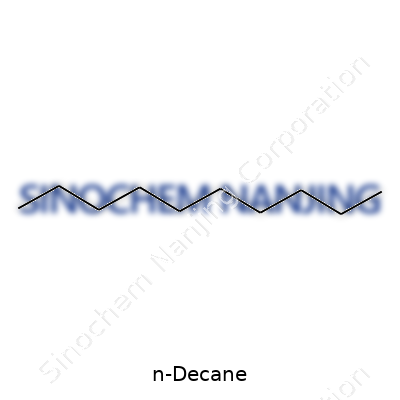
| Names | |
| Preferred IUPAC name | decane |
| Other names |
Decane n-Decane Normal decane n-Decyl hydride n-C10H22 n-Deckan |
| Pronunciation | /ɛnˈdɛɪn/ |
| Identifiers | |
| CAS Number | 124-18-5 |
| Beilstein Reference | 1030087 |
| ChEBI | CHEBI:28921 |
| ChEMBL | CHEMBL14270 |
| ChemSpider | 5507 |
| DrugBank | DB01994 |
| ECHA InfoCard | 100.003.731 |
| EC Number | EC 203-913-4 |
| Gmelin Reference | 60778 |
| KEGG | C01594 |
| MeSH | D003652 |
| PubChem CID | 15600 |
| RTECS number | HD0520000 |
| UNII | EC06VYX338 |
| UN number | UN2247 |
| Properties | |
| Chemical formula | C10H22 |
| Molar mass | 142.29 g/mol |
| Appearance | Clear colorless liquid |
| Odor | Odorless |
| Density | 0.73 g/cm³ |
| Solubility in water | Insoluble |
| log P | 5.98 |
| Vapor pressure | 1 mmHg (20 °C) |
| Acidity (pKa) | >50 |
| Basicity (pKb) | > 20 |
| Magnetic susceptibility (χ) | −7.2×10⁻⁹ |
| Refractive index (nD) | 1.4114 |
| Viscosity | 0.92 mPa·s (at 25°C) |
| Dipole moment | 0.00 D |
| Thermochemistry | |
| Std molar entropy (S⦵298) | 249.0 J·mol⁻¹·K⁻¹ |
| Std enthalpy of formation (ΔfH⦵298) | -277.0 kJ mol⁻¹ |
| Std enthalpy of combustion (ΔcH⦵298) | -6776.1 kJ/mol |
| Pharmacology | |
| ATC code | R01AX08 |
| Hazards | |
| GHS labelling | GHS02, GHS07 |
| Pictograms | GHS02, GHS07 |
| Signal word | Warning |
| Hazard statements | H225, H304, H336, H411 |
| Precautionary statements | P210, P233, P240, P241, P242, P243, P280, P303+P361+P353, P304+P340, P370+P378 |
| Flash point | 46 °C (115 °F; 319 K) |
| Autoignition temperature | +210 °C |
| Explosive limits | 1.2 - 7.0 % (in air) |
| Lethal dose or concentration | LD50 oral rat 11000 mg/kg |
| LD50 (median dose) | LD50 (median dose) of N-Decane: **> 5000 mg/kg (rat, oral)** |
| NIOSH | NIOSH: HM4025000 |
| PEL (Permissible) | PEL: 500 ppm (1800 mg/m³) |
| REL (Recommended) | 200 ppm |
| IDLH (Immediate danger) | 900 ppm |
| Related compounds | |
| Related compounds |
Methane Ethane Propane Butane Pentane Hexane Heptane Octane Nonane Undecane Dodecane |



