N-Butyraldehyde: A Closer Look at a Foundation Chemical
Historical Development
Originating from early industrial chemistry, N-butyraldehyde carved out a space in the chemical landscape by the 20th century. As oil refineries started exploring alcohols and aldehydes, chemists stumbled upon a reliable method to produce N-butyraldehyde via oxo synthesis—reacting propylene with synthesis gas. This key innovation fueled entire product lines, especially in the post-war chemical boom. Over decades, companies learned from both market expectations and environmental pressure, adapting their processes for better yield and fewer emissions. I’ve seen how these roots set the stage for today’s continuous development, whether in chemical plants near the Gulf Coast or research labs in Europe, all fighting to optimize efficiency and safety for products built on this simple aldehyde.
Product Overview
N-Butyraldehyde acts as an unsung workhorse in thousands of applications. It stands as a building block for products like plasticizers, solvents, and specialty chemicals. In daily manufacturing plants, workers see the value in a raw material that converts easily into 2-ethylhexanol or n-butanol. In personal care factories, supply chain managers pay close attention to quality and consistency, given how downstream processes rely on stable input. This chemical shows up behind the scenes in everything from paint production to the flavors in processed food.
Physical & Chemical Properties
With a pungent odor that’ll announce its presence, N-butyraldehyde carries a molecular formula of C4H8O. It boils near 75°C and lights up at a flash point of about -7°C. Its miscibility in water sits on the lower end, but it dissolves nicely in most organic solvents, which makes it a handy intermediate. The reactivity comes from its aldehyde group, highly attractive for further chemical modification. I remember handling this liquid; gloves felt mandatory, and its volatility demanded careful storage under a fume hood or in fire-resistant areas to avoid any trouble.
Technical Specifications & Labeling
Suppliers deliver this compound at purity standards at least 98%. Labels/containers carry the usual hazard markings: flammable liquid, acute toxicity, and skin/eye irritation potential. Global Harmonized System (GHS) pictograms leave little doubt about the protocols required: think flame, exclamation mark, and sometimes even the “skull and crossbones” for high concentration exposures. I’ve seen companies maintain rigorous batch testing, with infrared or gas chromatography ensuring that out-of-spec batches don’t sneak into customer shipments.
Preparation Method
Oxo synthesis, or hydroformylation, remains the preferred route. Propylene reacts with carbon monoxide and hydrogen, with a cobalt or rhodium catalyst steering things in the right direction. Large facilities run this process in closed loops, reclaiming catalyst metals and minimizing waste. Smaller labs sometimes use direct oxidation or other specialty methods, but on the industrial scale, oxo synthesis outperforms in both cost and yield. From experience, the rheology, temperature control, and gas ratios make or break the process—so attention to detail rewards patient operators.
Chemical Reactions & Modifications
Chemically, N-butyraldehyde shines through its reactivity with nucleophiles, reduction to alcohols, or condensation with amines. In the presence of hydrogen, reduction delivers n-butanol, which becomes a valuable solvent and plasticizer. Through aldol condensation, producers obtain 2-ethylhexanol—a famous ingredient in modern plasticizers. Chemical engineers appreciate how selective catalysts and pressure play a role in optimizing each route. Beyond main-line transformations, labs tweak conditions to spin out unique oximes, acetals, or Schiff bases, enabling the synthesis of flavors, fragrances, or even pharmaceuticals.
Synonyms & Product Names
The chemical registry lists plenty of names: butanal, n-butyl aldehyde, 1-butanal, and butyric aldehyde. Each supplier seems to favor its own naming conventions; I’ve seen invoices reference “Butyraldehyde” as a shipping name, even though “Butanal” makes more sense for chemists familiar with IUPAC style. Labeling consistency matters, especially when global companies integrate logistics across continents. Mislabeling causes confusion, delays, and sometimes even fines.
Safety & Operational Standards
From my days in process safety, I remember the tight controls around N-butyraldehyde storage and transport. Facilities ventilate storage rooms, double-check grounding cables, and train workers to avoid ignition sources. Even transfer pumps require explosion-proofing. Skin contact leads to irritation very quickly, and inhalation triggers headaches and nausea in minutes. Occupational exposure limits appear in both OSHA and EU guidelines, reinforcing the need for personal protection and atmosphere monitoring. Plant managers enforce spill containment procedures and keep neutralizing agents like sodium bisulfite in arm’s reach.
Application Area
N-butyraldehyde feeds industries from plastics to flavors. Plasticizer producers consume it in massive quantities, converting it to 2-ethylhexanol for PVC pipes, flooring, and cable insulation. Coatings and ink sectors value its role in specialty resins, giving products durability and flexibility. Food industries use trace quantities as an aroma chemical, simulating fruity notes in processed items. Agroscience labs check its use as an intermediate in crop protection products. Drug makers look at aldehyde reactivity for synthesizing active pharmaceutical ingredients, always with an eye on safety, purity, and cost.
Research & Development
Academic and industrial labs delve into green synthesis routes and catalyst improvements. Over the past decade, I’ve seen published studies focus on sustainability: using bio-based propylene, recycling CO2 to aid synthesis gas production, or applying solid-phase catalysts to cut waste. Intellectual property filings reveal patent races for new condensation catalysts and recycling systems. Emerging research looks at alternatives to fossil feedstocks—so the fundamentals I learned in my early days keep evolving.
Toxicity Research
Toxicology testing finds that N-butyraldehyde acts as a skin and eye irritant, and inhaling high vapor concentrations over time can damage respiratory tissue. Long-term worker studies check for cumulative effects, though the data shows that most risks fall within manageable bounds if workplaces enforce tight exposure controls. Researchers keep testing: animal models, cell cultures, and epidemiological studies all contribute to setting safety guidelines. In every facility, risk assessments focus on training and controls—since a slip in handling can mean both health and fire hazards.
Future Prospects
Chemical companies aim to shrink the environmental imprint by exploring non-fossil feedstocks, closing the carbon loop, or ramping up continuous processing. Regulatory frameworks continue nudging manufacturers toward safer practices and lower emissions. Innovations in catalysis and waste treatment shape a future where N-butyraldehyde holds its role as a flexible intermediary, serving both high-volume and specialty markets, all while meeting new standards for health, safety, and sustainability. Personal experience tells me that as long as manufacturing strives for better margins and cleaner results, compounds like this will keep evolving alongside technology and regulation.
What is N-Butyraldehyde used for?
What Does N-Butyraldehyde Do in the Real World?
N-Butyraldehyde doesn’t grab headlines much, but workers in chemical plants or people living near certain factories might recognize its strong, sharp smell. The thing about N-Butyraldehyde is that you find it working quietly behind the scenes in places that touch everyday life. It isn’t the kind of chemical you see on the store shelf, but it shapes products you probably use without thinking twice.
Creating Plasticizers and Solvents
Factories use N-Butyraldehyde to make plasticizers that keep vinyl products soft and flexible. Imagine touching a shower curtain or kitchen flooring that bends instead of cracking—chances are, plasticizers traced back to N-Butyraldehyde help make that possible. Chemical companies react N-Butyraldehyde with alcohol to create compounds like n-butyl alcohol, which then leads to more useful stuff further down the manufacturing chain. This same logic follows into paints and coatings, where N-Butyraldehyde turns into ingredients for solvents, which help spread color across surfaces smoothly, leaving behind a finished look that lasts longer and resists peeling.
Chemistry in Food and Fragrances
During days spent working with food production audits, I’ve run into flavor chemists using N-Butyraldehyde under strict guidelines to create artificial flavors. The amounts get checked and rechecked for safety, but it’s fascinating to see something so industrial mixed into the science of sweets and baked goods. Small traces help mimic fruity flavors when real fruit extracts aren’t stable or affordable. Perfume manufacturers spin it into fragrance ingredients too, giving certain scents more punch or complexity.
Pharmaceuticals and Agriculture
Pharmaceutical labs depend on N-Butyraldehyde for specialty reactions when designing medicines. I remember a tour through a drug plant where chemists relied on it as a building block for synthesizing vitamins, solvents for pills, and specialty drugs. The tools are precise, and quality checks happen at every stage to avoid contamination. Farms also benefit from this chemical, since companies use N-Butyraldehyde to make herbicides and insecticides that help with crop yields, making it possible to grow more food while keeping away destructive pests.
Handling Risks and Seeking Safer Practices
Chemicals like N-Butyraldehyde don’t come without responsibilities. Its strong odor points to the need for proper handling. Workers wear gloves and respirators, and plants use ventilation systems to keep exposure down. It takes a lot of training to know how to use and store the chemical without risking fires or health hazards. Modern guidelines from groups like the European Chemicals Agency and the U.S. Environmental Protection Agency guide how the process takes place. Companies invest in updating equipment, improving air monitoring, and shifting processes to reduce leaks, all to protect both workers and nearby communities.
Looking Forward
There’s growing interest in using renewable sources, like making N-Butyraldehyde from crops instead of petroleum. While that approach holds promise, it still faces technical and economic hurdles, including questions about energy use and the effects on food prices. My experience in sustainability audits has shown me that the march toward greener chemicals isn’t easy, but steady attention from scientists and regulators makes steady gains possible. Responsible production, clear labeling, and continued monitoring offer a path forward as society balances progress with protection. N-Butyraldehyde remains a backbone for modern materials, linking together worlds as different as plastic flooring, vanilla wafers, and farm fields.
Is N-Butyraldehyde hazardous or toxic?
What N-Butyraldehyde Does in Industry
Factories built on chemistry lean heavily on building blocks like N-Butyraldehyde. Workers blend it into plasticizers, flavors, resins, and more. It carries a sharp, sour smell and flows as a clear liquid. I learned about its wide reach after meeting a plastics engineer at a career fair. She explained how it turns up quietly in materials we take for granted—like PVC pipes, industrial coatings, and even certain scents in candy factories.
Toxicity and Exposure: What We Know
Whether in the air, on your skin, or near your eyes, N-Butyraldehyde brings hazards. Government guidelines set exposure limits. OSHA fixes the ceiling at one part per million over a short time—the kind of control you see around strong industrial solvents. Health literature links this compound to eye and skin irritation, cough, shortness of breath, or even headaches and dizziness if folks breathe it in without protection. Spill it on yourself? N-Butyraldehyde soaks in and dries out skin in no time, causing redness or burns. Breathing high levels raises bigger risks, and lab animal studies show effects on organs and behavior, making safety protocols non-negotiable.
The Right Way to Handle N-Butyraldehyde
From shared experience on factory tours, big chemical firms treat this liquid with a mix of gloves, goggles, face shields, and tightly sealed storage drums. Team leaders train everyone to handle leaks quickly, leaning on proper exhaust ventilation. Fire marshals worry; this compound ignites easily. One spill in a poorly ventilated storeroom can turn risky, fast. That’s why you’ll find showers close by in places storing N-Butyraldehyde.
Environmental Impact and Waste
Waste and runoff spark another layer of concern. If N-Butyraldehyde reaches a stream, it can harm fish and aquatic insects. Direct sunlight and air start breaking it down, but rain can still carry residues into the water supply. Every time I chat with plant operators, they stress waste capture as a must—closed systems, carbon filters, and guided disposal prevent most escapes. New hires learn this fast, sometimes through costly lessons from accidental releases.
Aiming for Safer Workplaces
Improving safety starts with knowledge. Workers need real training, not just binders on office shelves. Regular air monitoring, paired with reliable protective gear, gives teams genuine defense. Clear labeling, up-to-date storage plans, and drills keep mishaps rare. Manufacturers also keep an eye on emerging research; some try swapping in less hazardous alternatives for batch jobs involving smaller volumes. My own family includes a few folks who work turnaround shifts in plants, so these simple changes can bring real peace of mind.
What’s Next for Companies and Communities?
Communities living near chemical plants press for better transparency. They want details about local emissions and emergency response plans. Big plants run open houses or partner with local first responders for drills. Some even install real-time air monitors online for the public. Open conversation has cut accident rates—not just rules on paper, but steady pressure from workers and neighbors alike.
Final Thoughts
Ignoring the risks from N-Butyraldehyde never worked out for anyone—physical injuries and community fallout prove that much. Safer handling and honest conversations drive real progress. The facts show: treating chemicals with respect, and pressing for meaningful oversight, will always beat shortcuts.
What is the chemical formula of N-Butyraldehyde?
Understanding a Familiar Compound
N-Butyraldehyde carries the straightforward formula of C4H8O. This means each molecule contains four carbon atoms, eight hydrogen atoms, and a single oxygen atom. The structure tucks the oxygen neatly into an aldehyde group at one end, making it the simplest straight-chain aldehyde beyond propionaldehyde. I still remember the first time I came across this compound in a college organic chemistry lab—the sharp, slightly sweet smell lingered in the room long after class ended. Anyone who’s handled it knows you don’t forget that odor easily.
Where N-Butyraldehyde Shows Up
Factories pump out n-butyraldehyde for a wide range of purposes, and the numbers aren’t small. Over a million tons are produced worldwide every year. Manufacturers use it to make plasticizers, which soften plastics—the type you’ll find in everything from floor tiles to wires. It doesn’t stop there. You’ll find traces of its work behind paints, coatings, and even some perfumes, thanks to its ability to help synthesize more complicated chemicals. For anyone working in chemistry, n-butyraldehyde acts as a key stepping stone. It often opens the door for bigger, more complex molecules.
Health and Safety: What Works, What Doesn’t
Anyone dealing with n-butyraldehyde quickly learns about its risks. Inhaling too much vapor brings headaches, dizziness, coughs, and eye irritation. Skin contact can lead to burning and rashes. I remember a seasoned technician telling a rookie, “Gloves and goggles are cheaper than a hospital bill.” In my own time with this chemical, a fume hood proved absolutely essential. The liquid itself evaporates easily, making quick containment important for any spill.
The Occupational Safety and Health Administration (OSHA) sets exposure limits for a reason. Industrial sites typically hold workers to a permissible exposure limit of 25 parts per million over an eight-hour shift. That kind of rule didn’t come out of nowhere. Early studies traced chronic exposure to memory problems and respiratory issues. It feels tempting in a fast-paced setting to cut corners on protective gear, but real experience says mistakes happen fast.
Sustainable Choices and Future Directions
While the chemical formula of n-butyraldehyde hasn’t changed, the production methods are slowly shifting. In the past, refineries usually relied on hydroformylation of propylene using high-pressure reactors, strong catalysts, and plenty of energy. Environmental groups have since pushed for fewer emissions, prompting companies to hunt for more efficient catalysts and recycling systems. There’s ongoing research into bio-based routes too—imagine producing bulk chemicals like this using engineered bacteria instead of fossil fuels.
Green chemistry stands as more than a buzzword now. Some pilot plants already show that fermentation of renewable feedstocks can make n-butyraldehyde the same way yeast makes ethanol. It’s far from mainstream yet, but each year brings tweaks and advances. The big shift will only stick if demand for sustainability lines up with costs, but as someone who’s seen lab benches cluttered with single-use plastics, the draw of greener methods can’t be ignored.
Why Every Detail Matters
At a glance, n-butyraldehyde might seem like “just another chemical.” Look closer, and you see a basic compound playing a role across a spectrum from raw materials to consumer goods. Its formula—C4H8O—sits at the intersection of industry, health, and innovation. The habits we build in the lab and on the plant floor, the safety limits we follow, and our efforts to shrink the environmental impact all matter. The science behind this familiar formula reaches well beyond its carbon chain.
How should N-Butyraldehyde be stored?
Understanding the Risks Everyone Faces
N-Butyraldehyde, a clear liquid with a sharp smell, pops up in many labs and factories. Handle it wrong, you end up with headaches—sometimes literally, sometimes legally. Fires and chemical burns never do anyone any favors. Getting storage right keeps workers safe and helps companies avoid environmental messes that cause huge headaches with regulators and the people who live nearby.
Stability Depends on Storage
Many folks don’t realize N-Butyraldehyde lights up easily. Its vapors mix with air and create a nasty explosion risk. One time, on a plant tour, I saw a small leak near a light bulb. No sparks happened that day, but that same setup has led to bigger disasters at other places. Big lesson here: store N-Butyraldehyde in areas without open flames, sparks, or unprotected electrical sources.
Routine checks on storage areas catch problems before they grow. If paint starts peeling or the area smells stronger than normal, something’s up. Leak detectors and real noses work together. No substitute for a safety culture where people speak up.
Keeping Containers and Surroundings in Shape
Containers earn their keep in chemical safety. Metal drums or glass bottles with tight lids work well, but only if they stay undamaged and properly labeled. Sometimes folks reuse old containers carrying totally different chemicals, which throws safety out the window. Cross-contamination helps nobody.
Once I saw a drum with a rusty top outside on a winter morning. Later, it turned out rain had slowly gotten in, and some of that N-Butyraldehyde mixed with water and froze. The result: a pressure build-up that put the crew on high alert and forced everyone to rethink basic oversight. Keeping containers dry and away from sharp temperature changes stops small issues from snowballing.
Ventilation and Segregation Matter
Storage rooms with real airflow keep N-Butyraldehyde vapors from creeping above safe limits. Chemical fumes love to linger in dead air and cause health problems or sudden reactions, so room fans and exhaust systems aren’t optional luxuries. I remember speaking to a worker who got a splitting headache after thirty minutes in a poorly-ventilated storeroom. Proper ventilation fixed that fast.
Never place N-Butyraldehyde next to oxidizers or acids. Chemical neighbors sometimes don’t get along. Even mixing small amounts by accident can lead to heat and toxic fumes—something emergency room doctors know all too well. Safe facilities paint clear lines on the floor or install barriers, not just to impress auditors but to protect lives.
Training and Documentation: The Bedrock
Safety data sheets shouldn’t gather dust on a shelf. New employees, old hands—everyone needs regular refreshers on what to do if they see a leak, or if a container starts swelling. Proper logs guarantee nothing gets forgotten on busy days. I once watched a shipment mix-up nearly send the wrong chemical into a busy warehouse, but regular inventory checks caught the error.
Steps Toward Safer Storage
Regulators focus on fire codes for good reason. Grounded containers, spark-proof tools, spill kits, and good labeling help create habits that prevent injuries long before someone dials 911. Safe storage practices for N-Butyraldehyde start with real respect for the risks—and a focus on looking out for the health of everyone at work and at home.
What are the physical properties of N-Butyraldehyde?
Why People Care About N-Butyraldehyde
N-Butyraldehyde turns up in the chemicals we use to make everything from plasticizers to flavors. Factories rely on its distinct traits to help drive all sorts of reactions forward. Before anyone starts mixing or storing a chemical, they want to know how it behaves—how it looks, smells, pours, and catches fire.
Appearance and Smell
Most people run into N-Butyraldehyde in its liquid form. It looks colorless and thin, and as soon as you pop the lid off a bottle, a strong, stinging odor drifts out. The scent sometimes reminds folks of sharp, sweet fruit—think overripe apples with a chemical bite. That intense punch is more than just a nuisance in the lab. Smell alone tips people off to a leak, and the vapor can sting eyes and noses if left unchecked.
Boiling, Freezing, and Why It Matters
This liquid boils just above the steam point of water—around 75 degrees Celsius. That’s lower than a lot of solvents people run into. On a hot summer day, even modest warmth starts sending fumes into the air. At the other end, N-Butyraldehyde freezes near minus 96 degrees Celsius, so it keeps flowing even as a cold snap bites. These bookends play a big role in how it's handled and shipped. Nobody wants a surprise vapor cloud busting loose from a warm barrel.
How It Mixes and Moves
Water and oil don’t usually get along, and N-Butyraldehyde sits just between the two. It doesn’t blend well into water, but oils and organic solvents take it in much more easily. This split personality lets it work as a handy middleman when mixing up industrial recipes where engineers pull water out or create layered chemical cocktails.
The denser a liquid, the heavier it feels in your hand. N-Butyraldehyde has a lower density than water—about 0.8 grams for every cubic centimeter. Pouring it feels a bit like working with paint thinner or lighter fluids.
Flash Point and Flammability
One of the scary parts of N-Butyraldehyde? Its flash point. It doesn’t take much heat—just 20 to 30 degrees Celsius—to turn those vapors into a fire risk. Liquids with a flash point that close to room temperature keep safety managers on their toes. Sparks, open flames, even lightbulbs near spills can trigger trouble in a hurry. The heavy odor works as nature’s alarm, but proper storage and ventilation keep those flash fires at bay.
Practical Safety Tips
Working with this chemical over the years, I learned that care starts at the source. Opening a container inside a fume hood traps fumes. Safety goggles and gloves block any accidental splashes. Sand or spill kits stay nearby just in case. Facilities often stick to small containers rather than drums, since less volume means less vapor build-up if lids slip open.
Ventilation matters. Even a modest draft clears out vapors and cuts down long-term risks. Storing N-Butyraldehyde away from oxidizers makes sense because the combo can lead to violent reactions. MSDS sheets recommend grounding all equipment—static can set off a spark.
Looking Ahead
The chemical world keeps changing, but some properties always demand respect. Paying attention to boiling points, fire risks, and mixing behavior isn’t just for the books—it saves lives in real world factories and research labs. Even with decades of combined knowledge, regular refresher training keeps teams alert to the physical quirks and hazards of N-Butyraldehyde and chemicals like it. Trust and experience grow by putting these principles into steady practice.
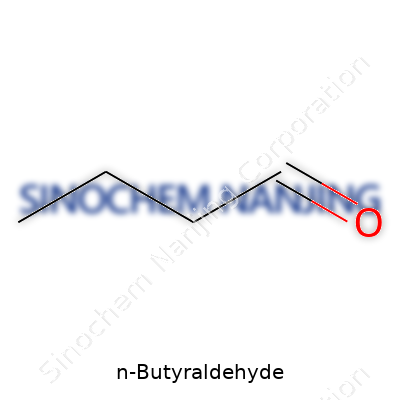
| Names | |
| Preferred IUPAC name | Butanal |
| Other names |
Butanal Butyral n-Butanal 1-Butanal Butyric aldehyde |
| Pronunciation | /ɛnˌbjuː.tɪrˈældɪhaɪd/ |
| Identifiers | |
| CAS Number | 123-72-8 |
| Beilstein Reference | 1209247 |
| ChEBI | CHEBI:28737 |
| ChEMBL | CHEMBL15860 |
| ChemSpider | 1193 |
| DrugBank | DB01958 |
| ECHA InfoCard | 100.003.319 |
| EC Number | 200-836-8 |
| Gmelin Reference | 71588 |
| KEGG | C01722 |
| MeSH | D001382 |
| PubChem CID | 8009 |
| RTECS number | EO1575000 |
| UNII | KMU8QZF8F7 |
| UN number | UN1129 |
| Properties | |
| Chemical formula | C4H8O |
| Molar mass | 72.11 g/mol |
| Appearance | Colorless transparent liquid |
| Odor | pungent |
| Density | 0.801 g/cm³ |
| Solubility in water | Moderately soluble |
| log P | 0.83 |
| Vapor pressure | 10 mmHg (20°C) |
| Acidity (pKa) | pKa ≈ 17 |
| Magnetic susceptibility (χ) | N-Butyraldehyde: "-7.43 x 10⁻⁶ cm³/mol |
| Refractive index (nD) | 1.378 |
| Viscosity | 1.13 mPa·s at 20°C |
| Dipole moment | 2.72 D |
| Thermochemistry | |
| Std molar entropy (S⦵298) | 216.0 J·mol⁻¹·K⁻¹ |
| Std enthalpy of formation (ΔfH⦵298) | -196.0 kJ/mol |
| Std enthalpy of combustion (ΔcH⦵298) | -2334.8 kJ/mol |
| Pharmacology | |
| ATC code | J03AX11 |
| Hazards | |
| GHS labelling | GHS02, GHS07, GHS08 |
| Pictograms | GHS02,GHS07,GHS08 |
| Signal word | Danger |
| Hazard statements | H226, H315, H319, H335 |
| Precautionary statements | P210, P233, P240, P241, P242, P243, P261, P280, P303+P361+P353, P304+P340, P305+P351+P338, P312, P337+P313, P370+P378, P403+P235, P501 |
| NFPA 704 (fire diamond) | 2-3-1 |
| Flash point | “-14 °C (Closed cup)” |
| Autoignition temperature | 185 °C (365 °F; 458 K) |
| Explosive limits | 1.8%–11.2% |
| Lethal dose or concentration | LD50 (oral, rat): 2,360 mg/kg |
| LD50 (median dose) | LD50 (median dose): 2 gm/kg (rat, oral) |
| NIOSH | WA8400000 |
| PEL (Permissible) | PEL (Permissible Exposure Limit) of N-Butyraldehyde is "25 ppm (TWA)". |
| REL (Recommended) | 10 ppm |
| IDLH (Immediate danger) | 200 ppm |



