Diphenylmercury: A Double-Edged Sword in Chemistry
Historical Development
Diphenylmercury entered the scene back when chemists approached new substances with both curiosity and caution. The compound carries a long history, stemming from the days where mercury chemistry played a key role in medicine, synthetic design, and materials science. By the time organic chemistry matured in the nineteenth and twentieth centuries, researchers had stumbled upon diphenylmercury in exploratory syntheses of organomercury compounds. While the uses for mercury have narrowed over time, largely due to its known risks, the story of diphenylmercury runs parallel with science’s evolving relationship with toxic substances. Its harsh reality as both a useful intermediate and a dangerous compound forced laboratories to rethink how safety and research go hand-in-hand.
Product Overview
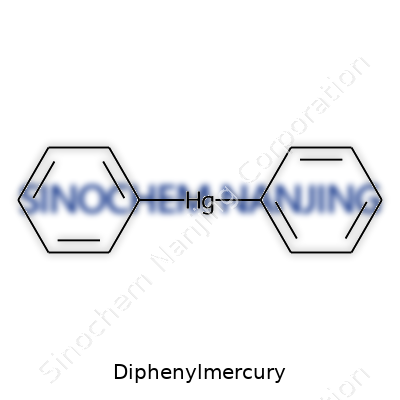
Diphenylmercury sits among the lesser-known but significant organometallics. It stands out thanks to its chemical backbone: two phenyl rings attached to a single mercury atom. Research settings treat this substance with a great deal of respect, given its role both as a laboratory curiosity and a benchmark in chemical synthesis. In my own time in academic labs, diphenylmercury mainly came up in the context of classic textbooks, rare reaction mechanisms, or as an example of hazardous substances requiring special storage and handling. Often, it’s what chemists reference when they talk about compounds with both intellectual value and serious risk.
Physical & Chemical Properties
In practice, diphenylmercury appears as a white or off-white crystalline solid. It doesn’t dissolve well in water, but blends into organic solvents like benzene and ether without much fuss. One interesting trait is that it remains stable under room temperatures, adding to the reasons why chemists turned to it for certain reaction studies. Nearly all organomercury compounds have a knack for sticking around unless broken down deliberately. Diphenylmercury fits this mold. But don’t let its stability fool you—it has enough volatility to make inhalation a concern in the wrong setting. Even after years in the field, I find it’s always the stable, seemingly quiet chemicals that deserve the most respect for potential toxicity.
Technical Specifications & Labeling
Any bottle marked diphenylmercury triggers a checklist in experienced chemists’ minds: clear hazard labels, secondary containment, limited storage in ventilated areas, and restricted access to trained personnel. The protocols for labeling aren’t just bureaucratic red tape; they serve as reminders of what’s at stake. Strict rules demand labels that signal mercury content and acute toxicity. Labs include details like the compound’s molar mass, recommended maximum temperature, and specific hazard pictograms. This approach protects both the people behind the bench and custodians who pick up the waste container at the end of the day.
Preparation Method
Chemists originally prepared diphenylmercury by direct reactions between phenyl Grignard reagents and mercury salts. Other methods involved swapping out halogenated benzenes for phenyl lithium, then reacting these with mercuric chloride. Each route left behind a brutal legacy of solvent waste and mercury contamination. Today’s research settings rarely attempt fresh syntheses of diphenylmercury outside of specialized projects. Environmental awareness discourages large-scale or casual uses. Stories from senior colleagues echo this shift: what once was routine now feels outdated, replaced by safer intermediates wherever possible.
Chemical Reactions & Modifications
Within the research world, diphenylmercury served as a participant in early studies into organometallic reaction mechanisms. The compound sometimes acted as a transfer agent for phenyl groups or as a reference in measuring the reactivity of organomercury bonds. Through reaction with halogens or nucleophiles, chemists could dissect the stability and breakdown pathways of similar compounds. Modern labs see far less new chemistry using diphenylmercury because other, safer alternatives now exist for introducing phenyl groups into molecules. Yet, the compound’s structure and reactivity still make it a classic example in theoretical discussions about carbon-mercury bonding.
Synonyms & Product Names
Not everyone calls it diphenylmercury in everyday talk. Some refer to it as mercury diphenyl or mercuric diphenyl. The chemical literature sometimes records it under its molecular formula, C12H10Hg, or by abbreviations unique to certain fields. It’s this jumble of synonyms that sometimes trips up students scanning old publications, and only hands-on experience—or a quick double check—prevents confusion with less hazardous molecules.
Safety & Operational Standards
The mercury atom in diphenylmercury sits at the center of its danger. Strictly enforced rules dictate usage behind fume hoods, double-gloving, spill kits within arm’s reach, and decontamination routines no one dares skip. A single drop or dust particle can bring exposure risks miles beyond most other lab reagents. Personal experience battling trace mercury contamination in lab settings proved this lesson. Solid waste and broken glass go into specialized containers, never the regular bins. Regulatory agencies also require tracking and documentation for every transfer, storage, or disposal event involving diphenylmercury.
Application Area
Historically, diphenylmercury appeared in research tied to organometallic reaction mechanisms, studies of metal-carbon bonding, and as an intermediate in deeper explorations into the behavior of organomercury compounds. These uses have waned as scientists develop new methods that cut out mercury at every possible stage. A handful of niche applications stick around in highly specialized studies focused on fundamental inorganic chemistry. Yet, outside of dedicated research, its value fades under the push for green and sustainable chemistry.
Research & Development
The main legacy of diphenylmercury runs through its role teaching generations of chemists about structure, bonding, and reaction chemistry involving heavy metals. R&D efforts in modern times focus less on the compound itself, and more on ways to remediate past contamination and find safer substitutes for traditional mercury chemistry. Environmental protection laws and stricter workplace regulations keep driving innovation away from these substances, shaping the training and perspective of up-and-coming scientists who see mercury more as a lesson than as a tool.
Toxicity Research
Diphenylmercury holds a grim reputation as one of the most toxic organomercury compounds ever synthesized. Chronic and acute effects are well documented: damage to the central nervous system, kidneys, and other vital organs can result from exposure, sometimes after only limited contact. Researchers have measured routes of exposure, dose responses, and bioaccumulation risks not just in lab workers, but also in environmental settings affected by improper disposal. Decades of safety data testify to the permanent risks. One slip-up can cause life-altering harm. These sobering realities influenced major policy changes about how toxins should be handled—or phased out—altogether.
Future Prospects
Diphenylmercury’s place in tomorrow’s science seems assured, but only as a warning from the past. Young chemists encounter it in toxicology lectures or as an example of compounds now largely left behind. As new technologies drive chemical development, compounds like diphenylmercury fall further out of favor—replaced by reagents that avoid mercury entirely. The field now reaches for greener, less hazardous chemistry wherever possible, with the story of diphenylmercury helping steer safety culture and regulatory demand. No matter how advanced research gets, there’s always a need to remember why safety matters—and to recognize the lingering lessons from substances best left on the shelf.
What is diphenylmercury used for?
A Toxic Compound With A History In Research
Diphenylmercury rarely shows up outside specialized chemistry labs, and there’s good reason for that. It’s a chemical most chemists learn to avoid after a few cautionary tales in textbooks. I still remember a near-lecture in grad school, warn us not to touch it, breathe it, or even consider working with it unless absolutely necessary. The toxicity isn’t subtle—one slip, and it’s a hospital visit or worse.
The compound, built with two phenyl groups bonded to a mercury atom, caught researchers’ attention long ago for its extreme reactivity and noteworthy physical properties. Back in the day, some organic chemists used diphenylmercury to transfer phenyl groups to other molecules. That role faded partly because chemists could turn to safer, more predictable reagents. Safety standards tightened, and awareness about mercury compounds spread. The knowledge that a few milligrams could threaten a life made people step back.
Why Would Anyone Keep It Around?
Academic interest in diphenylmercury didn’t vanish; it just got pushed to the edges. Researchers exploring unusual organometallic reactions still reference its old reactions, like the preparation of certain mercury-based compounds. Some historical syntheses used it as an intermediate. Modern labs rarely need to produce it from scratch, but legacy protocols or the study of environmental mercury behavior sometimes call on its chemical relatives.
You can find diphenylmercury cited in the study of mercury’s impact on biology and environmental systems. Looking at how mercury and its derivatives interact with living tissue helps toxicologists and environmental scientists predict and manage risks. Since compounds like diphenylmercury bind with proteins and enzymes, studies involving it have revealed just how quickly and strongly mercury can disrupt biological functions. Its ability to cross membranes underscores the dangers of methylmercury in seafood, too.
Obsolete In Industry
Industry has no practical use for diphenylmercury. Regulations have turned away from most non-essential mercury applications, not only because safer alternatives exist but also because the risks are just too high to justify the benefits. Even in rare analytical settings, chemists tend to rely on other mercury compounds with somewhat less severe toxicity profiles, if they rely on any at all.
Safety, Awareness, and the Future
Learning about diphenylmercury still matters today, but more as a lesson in the history of chemical safety than as a tool for modern discovery. The lessons it offers about handling toxic substances, proper laboratory practices, and the unforgiving nature of organomercury chemicals stay relevant. Even now, anyone working with mercury, in any form, faces tight restrictions where spills must be cleaned up with special gear and disposal gets recorded and traced to prevent environmental leaks.
Science progresses most when researchers can focus on discovery without risking their health or the environment. Substances like diphenylmercury, with their heavy safety baggage, push scientists to invent new, less hazardous alternatives. For most people, the only place they’ll meet diphenylmercury is in a cautionary case study—or hopefully, not at all.
Is diphenylmercury dangerous or toxic?
Understanding Diphenylmercury’s Risks
Heavy metals have long been a point of concern, and mercury stands out as one of the most dangerous. Diphenylmercury, an organomercury compound, sits among the chemicals that seldom come up in everyday conversation but can bring outsized consequences if ignored. Anyone who’s handled chemicals in a lab knows some substances demand extra respect. Diphenylmercury sits squarely in this camp, and its danger goes well past the normal warning labels you find on household cleaners.
What Sets Diphenylmercury Apart?
Anyone who has spent time around mercury knows it’s risky. Elemental mercury spills always call for gloves, goggles, and a pile of paperwork. Diphenylmercury raises the stakes. This chemical doesn’t just pose the old risk of vapor exposure. It can get right through your skin, and even a tiny amount can deliver a serious hit to your nervous system.
Lab accidents involving organomercury compounds have led to irreversible harm. Karen Wetterhahn, a respected chemistry professor, died in 1997 from exposure to dimethylmercury—another organomercury cousin, but the comparison holds. Just a few drops penetrated her gloves, and months later, severe neurological symptoms emerged. Diphenylmercury shares this skin-penetrating, brain-damaging behavior. These compounds bypass the usual protective barriers and hang around in the body, especially in fatty tissues and nerves.
How Toxic Is It, Really?
Diphenylmercury doesn’t feature in many standard lab experiments, mostly because of its fierce toxicity. Even small exposures can produce effects that creep up slowly, with early symptoms like tingling fingers or blurred vision, and later, irreversible brain damage. Once mercury gets into the system, there’s no simple cure. Chelation therapy offers a slim hope, but it comes with side effects and works best when given early, which rarely happens because symptoms start out mild.
The Environmental Protection Agency and the Centers for Disease Control warn against any exposure to organic mercury compounds. Animal studies confirm that these chemicals attack the nervous system, kidneys, and, sometimes, the heart. Diphenylmercury, with its ability to slip across barriers, forces even experienced chemists to reconsider their equipment and methods.
Why Should This Matter Beyond the Lab?
Some might assume diphenylmercury matters only for researchers, but mistakes happen, and an old bottle may sit forgotten in a school storeroom. Mercury waste enters the environment through poor disposal. If dumped down a drain or tossed into regular trash, it lurks in soil and water, threatening wildlife and trickling into the food chain. Minamata disease, a tragedy in Japan from organic mercury in seafood, stands as a stark warning. A few drops might seem trivial, but bioaccumulation pushes small exposures into long-term disasters.
What Can Be Done?
Most labs now avoid diphenylmercury unless absolutely necessary. The best protection starts with keeping it off order forms. Protective gear should include not only gloves but specialty gloves tested against mercury compounds. Standard latex doesn’t cut it. Safety data sheets must be read—not just scanned. Regular lab inspections can catch forgotten vials before they turn into an emergency.
For educators and facilities staff, clear labeling and responsible disposal are key. Mercury pick-up programs run in many states and universities—use them. In the rare case of exposure, medical attention can’t wait. Real stories from the chemistry community show nobody gets a “safe” pass with diphenylmercury.
So, is diphenylmercury dangerous? No question about it. Its risks run deep, go silent before showing symptoms, and leave a mark that sticks around for life.
How should diphenylmercury be stored safely?
Why Diphenylmercury Spells Trouble
Most folks, even in the chemistry field, don’t cross paths with diphenylmercury. That’s because it’s not just another lab chemical. This compound is extremely toxic—so much so, a spill or splash could turn into a medical emergency. Imagine working with something far more dangerous than mercury itself; that’s the reality here. Inhalation, ingestion, or skin contact all pose serious risks. Even a tiny mistake may lead to long-term neurological problems or worse. Not many chemicals demand such care for this reason alone.
Storing It Right
Any laboratory holding diphenylmercury has to take extra steps to keep everyone safe. Forget sticking the bottle on a random shelf. The substance should be stored in sealed glass containers. Plastic, even the really tough stuff, won’t cut it because solvents can wear down plastics and lead to leaks. Keep glass tightly sealed, with clearly readable hazard labels. No shortcuts here.
Those glass containers belong in a locked, dedicated poison cabinet. You don’t want this stuff mixed in among general reagents. The cabinet should keep light out and sit in a cool, dry corner far from heat sources, direct sunlight, or points where people come and go all day. Temperature swings often weaken seals, so consistency matters. Ventilation should draw any accidental fumes away from people—don’t use a closet where air just gets stale.
Personal Protective Equipment (PPE) Is Not Optional
Latex or nitrile gloves alone won’t do much against diphenylmercury if it ever gets loose. Thick, chemical-resistant gloves work best—go with a pair tested for mercury compounds. Add in a lab coat, goggles, and if there’s even a whiff of a spill, a face shield too. Any work with this chemical really should take place in a fume hood, not out on the open bench. This saves both workers and cleanup crews later on.
Legal & Environmental Concerns
Disposal isn’t as simple as pouring down the drain or tossing in regular waste. Local rules about mercury disposal often change, but they always demand certified hazardous waste collection. Failure to comply can bring big fines and even criminal charges. I once spoke to a lab manager who spent three months unraveling the paperwork after a colleague dumped even a small amount in the wrong container. That brings home the point: diphenylmercury is a set-and-forget chemical—it requires attention all the way to the end.
Beyond the Basics
Lab managers should run regular training, including safety drills. Experience alone won’t help in a surprise emergency—clear procedures, updated contact info for first responders, and chemical spill kits kept close at hand all make a difference. Don’t just buy the kits; remind everyone where they’re kept and how to use them.
If anyone ever questions the need for the extra effort, point to the long history of fatalities and permanent injury from mercury compound exposures. Document everything—inventory, inspection dates, training sessions, disposal attempts. Audits come up, and memory fades, but paperwork covers the gaps.
Looking for Alternatives
In my own work, the push to replace legacy compounds with safer alternatives grows each year. Sometimes old protocols still call for dangerous substances like diphenylmercury, but new research almost always uncovers something less risky. Pushing for these substitutions doesn’t just protect whoever’s in the room—it benefits everyone down the line, from custodians to the wider environment.
If a lab absolutely must keep diphenylmercury, leadership can’t ignore their duty to make safety the baseline, not the exception.
What are the symptoms of diphenylmercury exposure?
Recognizing the Signs in Real Life
I’ve run into my fair share of unsettling chemicals at work. Some carry reputations that make even seasoned researchers uneasy. Diphenylmercury falls into that category. Getting exposed by accident can set off some of the worst symptoms I’ve ever read about in toxicology manuals, and the aftermath sticks around like a stubborn engine trouble light.
Symptoms That Blow Past the Usual Hazards
The trouble often starts slow. Early exposure can bring on headaches, a heavy fatigue that sleep won’t shake, and problems thinking straight. People often feel a strange pins-and-needles sensation in their fingers and toes. Sometimes, the hands start to shake. Hearing can go out of tune, with odd ringing or muffled sounds, and vision turns blurry. Folks joke about brain fog, but with this stuff, it’s no joke—memory slips, and personality shifts stick out to close friends and coworkers.
Muscle weakness can show up out of nowhere, and walking a straight line may become a challenge. Once these symptoms show, things don’t just resolve on their own. Mercury, especially in organic forms like diphenylmercury, heads straight for the nervous system. This isn’t limited to lab workers. People cleaning up old chemicals or working in industries where mercury compounds sit on shelves could run into exposure.
Digging Deeper into Physical Effects
The nervous system takes the first hit, but other organs join the struggle. Gums might swell or bleed. Hands tremble uncontrollably, and sometimes speech grows slurred. Some report an odd metallic taste in the mouth. Forgetful moments pile up. As symptoms get worse, coordination crumbles. People lose the ability to write steadily or button a shirt. Weight drops off, even with the same eating habits.
Long-term exposure leaves an even harsher mark. The kidneys suffer. Stomach pain and diarrhea can last weeks. The immune system weakens. It’s not only heartbreaking—it’s expensive and hard to treat. The damage lingers, and people have lost careers over chronic problems after missed warning signs.
Real-World Lessons and Solutions
This isn’t some rare chemical scare story. Even tiny amounts can cause problems—mercury doesn’t leave the body easily. The best way to address this is old-fashioned prevention. Good gloves, tight lab protocols, and ventilation cut risks way down. Training and labeling chemicals clearly isn’t just a box-ticking exercise. Colleagues who don’t take shortcuts have saved lives by spotting leaks, cleaning small spills right away, or correcting bad habits.
Anyone who suspects exposure should speak up fast. Blood and urine tests catch problems early. Strong workplace policies that encourage people to report symptoms, even if they seem minor, can keep a close call from turning into a crisis. For anyone who handles diphenylmercury: never forget, the stakes go beyond job performance—long-term health hangs in the balance.
Putting People Over Protocol
Medicine can treat some symptoms, but no pill can replace a nervous system ravaged by mercury. I’ve learned from experience that being careful isn’t paranoia—it’s respect for the chemicals and for the people you work with. Real safety culture means never ignoring the early signs that something is wrong, no matter how busy the day gets.
What precautions need to be taken when handling diphenylmercury?
Real Risks Lurk Here: Knowing the Danger
Diphenylmercury gave me a chill the first time I read about it in graduate school. In chemistry circles, its reputation goes beyond the usual lab hazards. You don’t need a background in toxicology to realize how a drop on your glove can put your nervous system in jeopardy. Dr. Karen Wetterhahn, a professor at Dartmouth, paid the ultimate price working with a similar organic mercury compound, and her story still haunts safety briefings everywhere. Everyone who plans to handle diphenylmercury owes it to themselves and their community to take that lesson seriously.
No Substitutes for Physical Barriers
I remember pushing back when someone tried to save a few bucks by ordering thin nitrile gloves for handling rough chemicals. Cutting corners never seems worth it after walking through the facts. Diphenylmercury passes straight through latex, nitrile, and other common gloves in minutes. The only real barrier comes from heavy-duty laminate gloves—like Silver Shield or 4H—sometimes worn under a pair of vinyl gloves for grip. Double-gloving feels clumsy, but nerve damage will mess with your dexterity forever.
Keep the Space Under Control
Whenever you pull out a bottle of something this nasty, a chemical fume hood stands between a safe experiment and a disaster. Mercury vapor doesn’t just irritate noses; it poisons. Even trace exposure piles up slowly and quietly. I’ve seen how small mistakes start with loose lids, a quick sniff, or a splash that nobody notices until the burning starts. Keeping spill kits, dedicated waste containers, and cold traps within arm’s reach makes a difference. Training labs to treat mercury spills isn’t optional—it stops nightmares before they grow.
Limit Who Handles It—and How
Graduate students sometimes feel invincible until they face the ICU. Only those with hands-on training and years of chemical handling experience should open bottles of diphenylmercury. It’s not about gatekeeping—training works best with a culture that expects accountability and allows anyone to speak up if they spot trouble. I’ve seen peer checks catch a rushed colleague about to skip a safety step, and that simple moment avoided disaster. Supervisors should watch for overconfidence and fatigue, which chip away at careful habits.
Don’t Rely on Methods You Can’t Trust
Some labs keep outdated chemical hygiene plans. When protocols rely on old glove charts or generic fume hood policies, danger slips through their cracks. Every procedure involving diphenylmercury gets a review from a certified industrial hygienist. Relying on rumors or traditions in chemistry has hurt too many people. Manufacturers now publish compatibility guides and incident reports online—ignoring them courts tragedy.
What Can Change for the Better?
Growing up, my dad worked construction, and hearing his stories made one lesson stick: you can only control your own choices. In research, that means updating gloves after every use, signing out every gram, and logging exposures. For leadership, policies should discourage solo work with diphenylmercury, and support budgets for the right PPE. Sharing near-miss reports helps the next generation learn without paying the highest price.
Depth of Respect Trumps Routine
Chemistry rewards respect. Taking diphenylmercury lightly brings consequences nobody wants to witness. Respecting protocols and putting safety above convenience means everyone goes home. The most dangerous moment arrives when risks fade into the background. In my experience, culture and vigilance matter more than memorized rules. Safe handling begins before the bottle opens and doesn’t end until every surface gets wiped down. No experiment is worth more than your life or your team’s health.
| Names | |
| Preferred IUPAC name | Diphenylmercury |
| Other names |
Mercury, diphenyl- Phenylmercury, diphenyl- Diphenylhydrargyum Diphenylmercury(II) |
| Pronunciation | /daɪˌfiːnɪlˈmɜːkjʊri/ |
| Identifiers | |
| CAS Number | 583-74-8 |
| Beilstein Reference | 1464881 |
| ChEBI | CHEBI:34652 |
| ChEMBL | CHEMBL272424 |
| ChemSpider | 12187 |
| DrugBank | DB13870 |
| ECHA InfoCard | 100.005.597 |
| EC Number | 200-413-6 |
| Gmelin Reference | 3017 |
| KEGG | C19268 |
| MeSH | D008394 |
| PubChem CID | 8296 |
| RTECS number | OV9625000 |
| UNII | 4V645T6S4Y |
| UN number | UN2025 |
| Properties | |
| Chemical formula | (C6H5)2Hg |
| Molar mass | 502.43 g/mol |
| Appearance | White crystalline solid |
| Odor | Odorless |
| Density | 3.286 g/cm³ |
| Solubility in water | Insoluble |
| log P | 3.8 |
| Vapor pressure | 1 mmHg (at 238 °C) |
| Basicity (pKb) | -2.5 |
| Magnetic susceptibility (χ) | -1158.0e-6 cm³/mol |
| Refractive index (nD) | 1.684 |
| Viscosity | Viscous liquid |
| Dipole moment | 0 D |
| Thermochemistry | |
| Std molar entropy (S⦵298) | 323.8 J·mol⁻¹·K⁻¹ |
| Std enthalpy of formation (ΔfH⦵298) | -7.4 kJ/mol |
| Std enthalpy of combustion (ΔcH⦵298) | -73.5 kJ/mol |
| Hazards | |
| Main hazards | Highly toxic by ingestion, inhalation, and skin absorption; causes damage to nervous system, kidneys, and other organs; very dangerous environmental hazard. |
| GHS labelling | GHS02, GHS06, GHS09 |
| Pictograms | GHS06,GHS09 |
| Signal word | Danger |
| Hazard statements | H300 + H310 + H330: Fatal if swallowed, in contact with skin or if inhaled. H373: May cause damage to organs through prolonged or repeated exposure. H410: Very toxic to aquatic life with long lasting effects. |
| Precautionary statements | P260, P262, P264, P273, P280, P301+P310, P302+P352, P304+P340, P308+P311, P314, P391, P501 |
| NFPA 704 (fire diamond) | NFPA 704: "4-2-2-☠ |
| Flash point | Flash point: 113°C |
| Autoignition temperature | Autoignition temperature: 400 °C |
| Lethal dose or concentration | LD50 oral rat 160 mg/kg |
| LD50 (median dose) | 250 mg/kg (oral, rat) |
| NIOSH | DG3325000 |
| PEL (Permissible) | 0.1 mg/m³ |
| REL (Recommended) | 2 to 8°C |
| IDLH (Immediate danger) | 5 mg/m3 |
| Related compounds | |
| Related compounds |
Phenylmercury(II) acetate Phenylmercury(II) nitrate |



