Mercuric Diiodide: Old Roots, New Questions
Looking Back at Mercuric Diiodide’s Early Days
Walk into any chemistry lab stash from the turn of the 20th century, and you’d likely find mercuric diiodide labeled with bright warnings. Chemists have known about this red-orange crystalline compound for a long time; it first surfaced in laboratory notebooks soon after iodine extraction became routine, sometime around the early 1800s. Glass jar, deep vermilion powder—folks back then didn’t fuss much over mercury risks the way we do now. In the years that followed, researchers toyed with the stuff to figure out what it could do and what made it tick. It quickly became a bit of a litmus test material, revealing chemical quirks and helping scientists fine-tune their techniques in the burgeoning fields of spectroscopy, detection, and materials science.
The Real Substance Behind the Name
Mercuric diiodide, or HgI2, wears a lot of hats. Flip through old science books, and you’ll also see it called mercury(II) iodide or just red iodide of mercury—along with a handful of translations and older synonyms like “hydragyrum diiodatum.” But cutting through the names, you find a compound that changes color based on its crystalline form, laying out rich red and yellow transitions as it shifts between room temperature and elevated conditions. Under the microscope, the crystals sometimes look like sharp miniature blades. The stuff doesn’t dissolve well in water, but put a little in hot alcohol and it’ll go into solution. Pull it out again, crystals start to form right away as it cools down. Once you get used to handling it, you realize that its shimmering color only hints at broader potential, but the handling part still makes you pause.
Physical and Chemical Profile—What’s the Big Deal?
Anytime mercury walks into the room, chemists perk up. Mercuric diiodide’s high density—packing nearly seven grams per cubic centimeter—makes for a hefty jar. The color isn’t just for show, either. That red forms at regular lab temperature, but crank the heat above 126°C and you watch it flip yellow as it forms a different crystalline shape. Chemists have leaned heavily on these color changes while checking for temperature shifts or identifying the substance. Unfortunately, much like other mercury compounds, the taste of danger never quite leaves, partly because of the quick ways it can interact with other chemicals and partly because once you’ve got mercury on your bench, you’ve got a mess if your safety habits slip.
Digging Into the Details: Technical Sheet and Labeling
Regulations don’t just demand clear warnings about toxicity for show. The typical label now runs with skull-and-crossbones symbols, signal words like DANGER, and sections on known acute and chronic hazards. Every bottle tells you this is not something to breathe, ingest, or leave where it can contaminate workspaces. For storage, I always kept mine well-sealed and inside a secondary container. Most lab safety instructors I know agree: you treat anything with mercury much like a loaded gun—potentially hazardous in ways that rarely come up until they do. On the technical side, HgI2 usually appears with purity standards listed in terms of trace metals and halide content, as some applications—especially in electronics—need to keep impurities in check.
Production: It’s About Mixing with Precision
In the lab, the usual approach starts with soluble mercury(II) salts and a dose of potassium iodide in water. The moment they meet, an unmistakable red precipitate forms, sinking quickly. Wash to remove leftover ions, filter, and dry—no rocket science, but the purity depends on careful handling. Too much leftover iodine, and you can end up with unwanted byproducts. Industrial production scales this up, sticking to closed systems to avoid mercury vapors. This method hasn’t changed much in a century because the chemistry remains stubbornly straightforward. Some tweaks add organic solvents to get different-sized crystals, an important factor for detector technology. But every synthesis ends the same way: scrutinizing the product, balancing yield, and minimizing waste.
Chemical Reactions and Tinkering with the Molecule
Despite looking pretty inert sitting on a shelf, mercuric diiodide shows a wild side with strong bases, sulfides, and reducing agents. It breaks down to release elemental mercury under intense reduction, which sets off immediate alarms for safety. Add heat or alternate halides, and you can coax out mixed mercury halides, a trick often used to custom-tailor optical or sensor properties. Some researchers yank the crystal lattice around, stretching or substituting atoms to spawn materials for x-ray detection. These twists on the basic molecule highlight the intersection of art and science in modern chemistry; changing the recipe slightly can alter the outcome completely.
What’s in a Name?
Mercuric diiodide’s alternate names matter in research because literature often splits synonyms across decades. I’ve run into “biniodide of mercury” and “mercury iodide” in old patents and even in labeling on imported jars from Europe and Russia. Some confusion still drags on today, especially when new researchers cross-reference early 20th-century papers. Nomenclature matters—missing a synonym can easily lead to wasted effort or worse, duplicating accidents or discoveries already on record.
Staying Safe: Real Lessons from the Workplace
Stories of mercury exposure still circulate in labs. There’s no wiggle room for shortcuts—mercuric diiodide belongs only in a fume hood, and you always keep eye protection on. Even trace exposure can add up, so I’ve always doubled up on gloves and never used the same pipettes for anything other than its solutions. Disposal isn’t a short walk to the sink, either; proper hazardous waste channels stay busy in facilities using this compound. I’ve seen temporary lab closures after spill events—protocol matters, not because the paperwork says so but because mercury doesn’t forgive mistakes. Regulatory changes push for alternatives in education and routine research settings, recognizing the heavy price that follows poor handling.
Why Bother? Current and Expanding Application Areas
For all its risks, mercuric diiodide found niches that other materials have yet to match completely. Its biggest splash comes in radiation detection. The large atomic numbers of mercury and iodine grab x-rays and gamma rays better than many competitors, so thin plates of this material form the backbone of compact detectors. Portable x-ray and gamma detectors used by security teams, customs offices, and archeological surveyors often use HgI2 crystals, especially in field analysis kits where bulk and sensitivity fight for priority. Occasionally, its bright color turns up in pigment history or rare analytical reagents, though those roles shrink in the face of toxicity concerns. The electronics world pokes at it for photovoltaic and photoconductive properties, chasing longer-lasting detectors for specific wavelengths. Despite all this, strict regulations slam the brakes on many new applications outside controlled environments.
In the Trenches: Research and Ongoing Challenges
Modern research leans hard into what makes mercuric diiodide unique as a semiconductor. The direct bandgap, quick response to incoming radiation, and impressive efficiency at room temperature tempt physicists and engineers alike. Teams still pour time into growing flawless crystals, hunting for defects that mess with performance. I’ve watched researchers wrestle with issues like charge trapping—the problem where mobile electrons end up stuck in the crystal, draining sensitivity and accuracy. Manufacturers experiment with doping—plugging new atoms into the grid—to tame these defects. Each breakthrough inches tech forward but always runs into the same old question: can these improvements ever balance out the element’s toxic legacy? Materials scientists keep searching for competitors made from safer elements, but so far, few replacements match the sheer combination of sensitivity and resolution this compound delivers.
Lessons from Safety and Toxicity Research
Any scientist with mercury scars on their record knows why safety studies matter. Researchers map out every entry and exit path for mercury within biological systems. Inhaled, ingested, or even absorbed through the skin, inorganic mercury poisons organs and damages nerves. Data from chronic workplace exposures ties mercury compounds—including HgI2—to kidney failure, memory loss, and vision problems, even at doses just above background. Some animal studies flag reproductive and developmental risks. With these realities, research pivots from justification to risk mitigation: focus falls on new containment strategies, better monitoring for low-level mercury leaks, and strict exposure thresholds in labs and manufacturing sites.
What Might Come Next for Mercuric Diiodide?
Despite decades of warnings, mercuric diiodide occupies a space that’s hard to fill. Researchers who depend on its exceptional sensitivity keep pushing for safer production and recycling processes, recognizing that outright bans could throttle progress in radiation detection. I’ve sat through conference talks where teams demo promising substitutes, but no single material ticks all the boxes. Experts forecast demand lingering for the most high-stakes detection devices, especially in border security and advanced physics. Future breakthroughs may hinge on miniaturizing crystals even further, or integrating microfluidic containment to curb exposure. Some policy advocates press for international tracking of all mercury compounds, echoing the Minamata Convention spirit. In my view, the past and future of mercuric diiodide show the tug-of-war at the heart of science: valuable features invite use, but responsibility and safety never drift far from the debate.
What is Mercuric Diiodide used for?
Old Chemical, New Uses
Step inside a physics or chemistry lab, and you might spot a crimson-red powder resting in a tightly sealed container. That’s mercuric diiodide, a compound that often catches both curiosity and caution. Its vivid color and toxic reputation overshadow the fact that it drives important work in science. I remember staring at it during college, feeling a mix of fascination and worry, echoing the warnings from my chemistry instructor about gloves and fume hoods. Despite strict handling rules, research teams still use it for what it can do.
Radiation Detectors in Action
Mercuric diiodide shines (not literally, don’t eat it) in radiation detection. The compound, with the formula HgI2, responds to x-rays and gamma rays with impressive agility. Medical imaging tools, portable detector arrays, and environmental sensors lean on its ability to convert radiation directly into electronic signals. Unlike bulky materials, this red salt packs sensitivity and accuracy, all at room temperature. Cancer hospitals sometimes rely on devices built with it, where early and clear results mean everything. The CDC highlights how radiation detectors offer frontline defense during emergencies; HgI2 squares up in those moments.
Teaching Crystals and Physics Lessons
I watched undergrads wide-eyed as instructors grew mercuric diiodide crystals for demonstrations. Its flat, shiny plates turn up in solid-state labs to teach about crystal growth and charge transport. Unlike clear quartz or boring plastics, HgI2 slaps you with color and structure. It doubles as a case study in how certain elements make for effective solid-state electronics. The lessons stick when danger and beauty walk together.
Scientific Rigor and Real-World Risks
Mercuric diiodide helps drive high-stakes science, but it also drags old baggage. Mercury stands out among toxic elements, and this salt is no exception. Direct contact or inhalation spells trouble for kidneys and nerves. Labs follow regulations shaped by health agencies—think chemical fume hoods, strict waste disposal, and rigorous documentation. These steps keep students, staff, and the wider community safe.
Making Way for Safer Technology
Not every scientific essential stands the test of time. As technology gets smarter, some researchers look for safer alternatives. Silicon and compound semiconductors now fill roles once reserved for mercuric diiodide, especially where performance holds up. The market for radiation detectors is shifting. Still, for applications that demand sharp, reliable signals at normal temperatures, scientists keep turning to this classic material.
Possible Solutions and a Path Forward
Optimizing safety means keeping protocols tight, using less hazardous substances when possible, and upgrading to modern detectors. Funding helps research teams screen and test novel materials that don’t risk public health. Universities and companies encourage staff to look beyond old habits and weigh the bigger picture—performance balanced with safety. The story of mercuric diiodide isn’t just one of chemistry; it’s about justice and progress, with lives and discoveries in the balance.
What are the safety precautions when handling Mercuric Diiodide?
The Risks Aren’t Just on Paper
Mercuric diiodide, the red crystalline compound you find in labs, isn’t just another bottle on the shelf. It mixes the dangers of mercury and iodine in ways that shouldn’t be ignored. Once, a colleague wiped down a counter with bare hands after a spill. Later, he felt numbness and saw a local doctor. This incident turned into a real lesson about chemicals that go far beyond their textbook reputation.
Personal Protective Equipment is Non-Negotiable
Nitrile gloves, tight goggles, and a lab coat form the real basics for handling this stuff. Disposable gloves will do the job, but double-gloving adds peace of mind. Tiny crystals dust off easily, and just touching a contaminated flask can poison over time. Fume hoods change the stakes by catching fumes and dust before you get a dose. I’ve seen gloves melt after a splash and, without quick washing, skin ends up tingling. Always put on protection before even opening a container. Never count on skin washing to play catch up if you’re careless.
Don’t Trust Your Eyes and Nose
Mercury compounds won’t always show themselves with a smell or color change in the air. Fine dust can float, and anybody who’s tried to clean a messy benchtop knows that wiping or brushing spreads it around. Vacuuming releases more unless you use a special filter. That ghostly film after weighing out a few grams might send up invisible particles. Without a fume hood, small exposures add up. Your regular exhaust fan barely scratches the surface here.
Storage: Not Just a Cabinet Call
Every bottle should get a secondary container, usually a thick plastic tub with a tight lid. Humidity damages the compound, and the wrong shelf can set up accidental mix-ups with incompatible substances. Sharp labels matter. One coworker, tired at the end of a long day, almost grabbed a bottle of a similar-looking substance, thinking it was potassium iodide. That story came close to disaster. Redundant labeling, clear hazard signs, and separation from acids or bases grant one more layer of safety.
Dealing with Spills and Waste
The fastest way to get into trouble: treat spills as a quick paper-towel fix. Mercury compounds require special disposal. Wipe up mercury diiodide with damp cloths and collect all contaminated material in a sealed, labeled bag for proper hazardous waste handling. Never toss lab rags or gloves into regular bins. Even trace amounts make their way into the environment, and water treatment plants aren’t built to catch mercury waste. Good labs keep a dedicated spill kit nearby—sulfur powder, disposable scrapers, and proper chemical-resistant pads.
Training Goes Beyond Orientation Day
Some labs handle this chemical for decades without a problem, mostly because basic rules get drilled into new people. I remember a training session with a safety specialist who locked the storeroom door after every use and insisted nobody worked alone. Pairing up in case of exposure can save valuable minutes if things go wrong. Established reporting channels help, too. If you feel off after a session with any mercury compounds, telling a supervisor isn’t oversharing—it’s safeguarding your health and everyone else’s.
Solutions: Respect, Preparation, and Vigilance
Exposure to mercuric diiodide builds gradually, so respect for chemical hygiene keeps people out of the ER. Regular blood tests for those handling mercury often pay off, catching problems before symptoms get worse. Local poison control centers can give advice in a pinch. The playbook stays simple: protect skin, keep the air clear, manage waste at every stage, and communicate. Science grows safely only when everyone acts like exposure is a real risk, not just a line in the safety manual.
What is the chemical formula and structure of Mercuric Diiodide?
Getting to Know Mercuric Diiodide
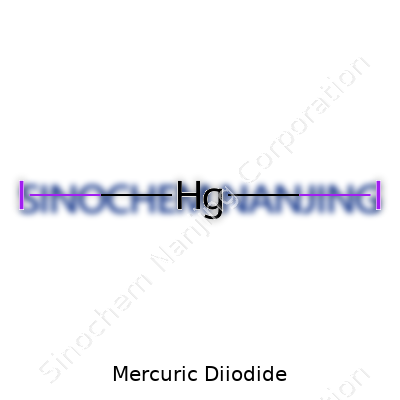
Mercuric diiodide stands out for more than just a striking color. Chemically, it goes by the formula HgI2. This compound builds on one atom of mercury bonded to two atoms of iodine. Even a quick glance at its red crystals can spark curiosity about what the structure says about its behavior. In my lab days, opening a sample vial felt a bit like uncovering a mineral in the field—unexpected beauty, but with a heavy warning due to its mercury content.
How Its Structure Shapes Properties
Mercuric diiodide brings two different crystal forms. The most familiar is the bright red tetragonal form, stable at room temperature. Scientists describe this arrangement like a tightly packed stack—simple at first glance, but loaded with implications for reactivity and light absorption. Heat the compound past about 126°C, and the red form shifts to a yellow orthorhombic crystal structure, something you don’t see every day. This color change points to the atomic arrangement actively influencing how the material interacts with light.
This structural sensitivity to temperature gives researchers a handy way to monitor phase transitions. Studying this phenomenon has helped crystallographers understand polymorphism, where elements arrange in more than one way in the same substance. These discoveries rippled out to fields like pharmacology, influencing how drugs are formulated today—another example of how a small detail in a minor compound can shine light on bigger questions.
Applications, Hazards, and the Quest for Safer Alternatives
Instruments that measure X-rays and gamma rays have relied on mercuric diiodide’s unique electrical properties. In the semiconductor world, its ability to convert high-energy photons into clear signals opened doors for compact medical devices and portable detectors. During the early 2000s, I watched researchers test these crystals while keeping strict handling protocols in place, voices muffled by masks and thick gloves. The tradeoff became clear: valuable performance shadowed by real health risks.
Mercury compounds have a long legacy of toxicity. Direct contact or accidental inhalation triggers harmful effects—shakes, cognitive decline, even organ failure in extreme cases. As a seasoned chemist, seeing safety data sheets loaded with red flags meant double-checking every procedure. Environmental contamination remains an ongoing problem, especially as mercury doesn’t easily break down. Communities living near old mining sites or dumps have wrestled with unyielding mercury in soil and water, leading to painful lessons about environmental stewardship.
Rethinking Use and Exploring Solutions
Scientists now aim to limit direct mercury exposure and develop alternatives. Silver halide detectors, organic materials, and even lead-free perovskites have captured a share of specialized detection markets. The goal: match or exceed performance without the poisonous legacy. Some countries enforce regulations restricting mercuric diiodide in research and manufacturing. Companies adopting green chemistry practices substitute safer reagents where possible, even though a perfect substitute rarely exists for every niche application.
Tracking the story of mercuric diiodide means seeing the crossroads between innovation and responsibility. Chemistry offers wonderful discoveries, but the burden of safe practice lands squarely on those who use and make these compounds. The push for less hazardous alternatives keeps growing, and with it, a stronger sense of caution echoes across labs, classrooms, and factories.
How should Mercuric Diiodide be stored?
Looking at the Risks
Working in a lab filled with reactive chemicals taught me early on that small mistakes around storage could turn into painful lessons. Mercuric diiodide, a strikingly red, crystalline compound, grabbed my attention the first time I saw it. Besides its color, the thing that stuck was how it demands a serious approach because of its toxicity and sensitivity. This material contains mercury, and that brings health and environmental hazards directly into the storage room.
Safe Storage: No Shortcuts
There’s no room for improvisation here. You lock mercuric diiodide away in a tightly sealed glass or plastic container—never metal. I’ve seen what a careless spill does to a floor and what mercury compounds can do to air quality. Moisture, light, and heat turn mercuric diiodide unstable, so we stash it in a cool, dry, shaded cabinet, far from acids and bases. Storing this compound away from incompatible materials stops reactions that would turn a chemical room into an emergency scene.
Humidity and temperature swings inside a storage area set off decomposition and increase the risk of releasing mercury vapors. I once walked into a storeroom where condensation collected inside a cabinet, and immediately flagged it. Seals degrade fast in the presence of even small leaks, putting people and property at risk.
Labeling and Accountability
Sloppy labeling always sparks confusion, and with hazardous substances, it breeds danger. Every bottle of mercuric diiodide gets the boldest label on the shelf. The dangers—acute toxicity, environmental threat, and possible cancer risk—stand front and center. As a young technician, I learned that one unlabeled jar could cause a scramble to identify contents safely. Properly date every package and keep disposal dates clear.
Don’t assume everyone on your team remembers best practices. Training sessions matter just as much as chemical locks. Years ago, one well-meaning coworker reorganized the shelves and nearly mixed strong acid bottles with our mercury stock. That moment hammered home why written storage protocols do more than satisfy an audit—they protect you on the bad day someone makes a mistake.
PPE and Emergency Prep
Gear up before handling mercuric compounds. Gloves, goggles, and coats block accidental splashes from reaching skin or eyes. Even quick tasks like transferring from bulk stock into a working bottle could mean exposure. Mercury’s poisonous reputation is well earned. So the spill kit—containing sulfur powder for mercury cleanups and labeled containers—needs to be within arm’s reach, not buried behind other chemicals.
Emergency eyewash and running water should be set up in the same room. I remember a lab supervisor telling us, “If you can’t wash your eyes in twenty seconds, you’re not ready to work with the bottle open.” I’ve remembered that line every time I set up a new workspace.
Solutions and Accountability
Legal limits for how you store and record hazardous substances serve as more than red tape. These laws resulted from real disasters. Good chemical storage keeps accident rates down. I’ve visited labs where barcoded inventory systems track every transfer and disposal timeline automatically. That approach doesn’t just satisfy regulators; it protects workers by eliminating confusion—especially in facilities where workers come and go.
Mercuric diiodide should always be stored behind physical locks with controlled access, limiting direct handling to those with real training. No shortcut replaces ongoing education and thorough records when toxic materials are involved.
Is Mercuric Diiodide toxic or hazardous to health?
What Happens When People Handle Mercuric Diiodide?
Anyone who’s worked in an academic lab might remember mercuric diiodide by its bright red-orange color and its chemical formula, HgI2. My own first encounter with it came in a cramped storeroom during college, as we rummaged for demonstration samples in glass jars marked with skulls. Our professor never let us touch it without double gloves, insisting we stand clear of the balance. He wasn’t being dramatic—he was right about the risks.
This compound carries two well-known hazards: mercury and iodine both cause problems for human health, and combined, they don’t go gentle on the body. Even a small amount absorbed through skin or inhaled as dust can damage kidneys and nerves, two areas that never recover well from toxic insults. Mercury in any form attacks the brain, slowly, playing tricks with mood and movement.
How Bad Does Exposure Get?
I didn’t need textbooks to see the caution—researchers and technicians everywhere treat red compounds with suspicion. Contact with bare skin invites burning, rash, and the risk that microscopic traces end up in the bloodstream. Some people show signs of tremors, mood swings, or memory loss. The risk ratchets up if the stuff gets heated: for instance, boiling points in the lab or broken equipment can release vapors laced with mercury, far easier to breathe in than you’d guess.
Spills bring a nasty dose of trouble. Mop up a few crystals with a dry towel, and those fibers stay toxic. Lab equipment that touched mercuric diiodide can’t be washed out easily. Tossing contaminated gear into the regular trash isn’t just illegal in most countries, it puts janitors and waste workers at risk. Long-term exposure, even at low levels, causes a slow build-up of mercury in bones and fat.
Why Do Some Labs Still Use It?
It’s not just a relic. Mercuric diiodide turns up in specialty electronics, sometimes for X-ray or gamma-ray detection, and loiters in a few chemistry classrooms for crystal growth demos. The unique properties come at a price. Some researchers swear by its sensitivity in radiation detection. Most labs weigh those benefits against the health costs, and in my experience, many have switched to safer Alternatives.
No sensible person keeps a jar of mercuric diiodide for fun. Every container carries warnings, and for a reason: at the atomic scale, mercury doesn’t care whether exposure is an accident or routine. The compound’s legacy lingers in environmental stories too. In poorly managed trash heaps, or in countries with loose regulations, it can seep toward groundwater or poison wildlife, especially birds and aquatic life.
Is There a Safer Way Forward?
People who work with hazardous substances need training, not just gloves and goggles. In the last decade, many universities replaced mercury-based compounds across labs with less toxic substitutes. The cost grows if hospitals or research institutes have to decontaminate a spill—specialized teams suit up, and disposal requires incinerators certified for heavy metals.
My advice to any student or lab manager: look hard for an alternative if one exists, and weigh every drop of benefit against the headache of exposure. If a compound needs special disposal, costs more to ship, and comes with more liability than everyday chemicals, maybe it’s time to find a safer option.
The scientific community already knows the dangers; the tougher problem is making sure everyone—from grad students to techs—respects just how little it takes to do harm.
| Names | |
| Preferred IUPAC name | Diiodomercury |
| Other names |
Biniodide of mercury Mercury(II) iodide red mercuric iodide |
| Pronunciation | /ˈmɜː.kjʊr.ɪk daɪˈaɪ.əʊ.daɪd/ |
| Identifiers | |
| CAS Number | 7774-29-0 |
| Beilstein Reference | 1206737 |
| ChEBI | CHEBI:50395 |
| ChEMBL | CHEMBL1287141 |
| ChemSpider | 33140 |
| DrugBank | DB06770 |
| ECHA InfoCard | ECHA InfoCard: 100.029.764 |
| EC Number | 231-872-1 |
| Gmelin Reference | 88353 |
| KEGG | C18603 |
| MeSH | D006486 |
| PubChem CID | 24635 |
| RTECS number | OV8650000 |
| UNII | NLX65Q960U |
| UN number | UN1641 |
| CompTox Dashboard (EPA) | DTXSID0044361 |
| Properties | |
| Chemical formula | HgI2 |
| Molar mass | 454.42 g/mol |
| Appearance | Red crystalline powder |
| Odor | Odorless |
| Density | 6.49 g/cm³ |
| Solubility in water | 0.06 g/100 mL (25 °C) |
| log P | 0.34 |
| Vapor pressure | Negligible |
| Acidity (pKa) | -0.1 |
| Basicity (pKb) | 11.6 |
| Magnetic susceptibility (χ) | −98.8×10⁻⁶ cm³/mol |
| Refractive index (nD) | 2.6 |
| Dipole moment | 0 D |
| Thermochemistry | |
| Std molar entropy (S⦵298) | 147.7 J/(mol·K) |
| Std enthalpy of formation (ΔfH⦵298) | −187.8 kJ·mol⁻¹ |
| Pharmacology | |
| ATC code | V09CX04 |
| Hazards | |
| Main hazards | Toxic if swallowed, inhaled or in contact with skin; causes severe skin burns and eye damage; may cause damage to organs through prolonged or repeated exposure. |
| GHS labelling | GHS02, GHS06, GHS08 |
| Pictograms | GHS06,GHS08 |
| Signal word | Danger |
| Hazard statements | H300 + H310 + H330: Fatal if swallowed, in contact with skin or if inhaled. |
| Precautionary statements | P260, P262, P273, P280, P301+P310, P302+P352, P304+P340, P305+P351+P338, P308+P313, P314, P391, P403+P233, P501 |
| NFPA 704 (fire diamond) | 1-2-0-ALPHA |
| Explosive limits | Not explosive |
| Lethal dose or concentration | LD50 oral rat 30 mg/kg |
| LD50 (median dose) | 79 mg/kg (Oral, Rat) |
| PEL (Permissible) | PEL (Permissible Exposure Limit) of Mercuric Diiodide: "0.1 mg/m3 (as Hg) |
| REL (Recommended) | 0.1 mg/m³ |
| IDLH (Immediate danger) | 10 mg/m3 |
| Related compounds | |
| Related compounds |
Mercuric chloride Mercurous iodide Mercurous chloride Mercury(II) bromide |



