Lutetium Nitrate: An In-Depth Look at its Past, Present, and Future
Historical Development
Stories about rare earths usually start in the late 19th century, and Lutetium isn’t an exception. Its discovery came after long periods of confusion in lanthanide chemistry, as separation tricks weren’t very reliable. Around 1907, independent chemists from France, Germany, and the US began isolating Lutetium, using painstaking fractional crystallization methods. For years, production was slow, with little real-world use, mainly because Lutetium’s sources gave such tiny yields. Decades rolled by before chemists found practical ways to separate Lutetium from similar elements, thanks to advanced ion-exchange and solvent extraction. Lutetium nitrate only really entered mainstream chemistry labs after that, opening quieter but important chapters in research on luminescence, catalysts, and nuclear medicine.
Product Overview
Lutetium nitrate feels like a rare treat in chemical supply catalogs. Produced mostly as a hydrate, it brings a pale white appearance to the bench. It dissolves easily in water thanks to its ionic nature, delivering Lu3+ ions for experimental needs. You’ll see it offered for thin-film phosphor preparation and as a precursor to other lutetium compounds rather than for any direct commercial application. Most labs don’t stock it for fun—it comes out for jobs where its high atomic number and special electronic structure matter.
Physical & Chemical Properties
Lutetium nitrate shows up as a white crystalline solid, deliquescent and gentle unlike some more boisterous nitrates. The formula is usually written as Lu(NO3)3·nH2O, where n can vary; most often you get six water molecules clinging to each lutetium center. At room temperature, it stays stable, but don’t leave the lid off or it’ll draw moisture from the air and turn sticky. Throw it in water, and you get a clear solution with high ionic strength. It doesn’t smell or fume, but heated strongly it breaks down to form lutetium oxide, spewing out nitrogen oxides—unpleasant and unhealthy gases.
Technical Specifications & Labeling
Commercial lutetium nitrate gets labeled with purity levels, with rare earth chemists pushing for 99.9% or better, especially if the user wants to avoid interference from terbium or ytterbium. Product labels detail trace metal content—sometimes down to parts per million—because a tiny bit of gadolinium or dysprosium can alter spectroscopic experiments. Information on hydration level matters since it affects how much lutetium ends up in your flask. Batch lot, expiration, storage, and manufacturer address—those details help with regulatory compliance and repeatability, especially in pharmaceutical and electronics settings.
Preparation Method
To produce lutetium nitrate, chemists usually start from lutetium oxide (Lu2O3). Introducing cold, concentrated nitric acid to ground oxide triggers a gentle reaction that dissolves the oxide and releases heat. The resulting solution gets filtered, then evaporated down to form crystalline lutetium nitrate. Hydrate numbers can shift depending on drying time and temperature, so getting a consistent hexahydrate or pentahydrate sometimes takes a practiced touch. On an industrial scale, keeping everything ultra-clean is critical to prevent cross-contamination with other rare earths, since raw ores rarely contain pure lutetium.
Chemical Reactions & Modifications
Lutetium nitrate sets the stage for all sorts of downstream chemistry. Adding ammonium oxalate throws down a precipitate of lutetium oxalate, allowing conversion to lutetium oxide by ignition in air. Mix it with fluoride, and you end up with lutetium fluoride—useful in optics and electronics. Combining with ligands in aqueous solution creates dozens of specialty complexes, each with possible uses in materials science. Its nitrate ions bring strong oxidizing power, so safety protocols stay tight in labs storing them near organics or combustibles. In photonics, mixing lutetium nitrate with other lanthanide salts produces laser host crystals. These reactions prove handy for anyone needing customized rare earth materials for sensor, imaging, or lighting research.
Synonyms & Product Names
Lutetium nitrate often gets listed as Lutetium(III) nitrate, Lutetium trinitrate, or just Lu(NO3)3. Trade catalogs sometimes call it Lutetium nitrate hydrate, or specify the hydration number. I’ve seen older papers refer to it as “nitrate of lutecia,” a nod to early-20th-century naming conventions. Whether searching for “lutetium nitrate nonahydrate,” “Nitrate de Lutétium,” or some variation, the core compound remains the same—a simple but powerful lanthanide salt.
Safety & Operational Standards
Lutetium nitrate doesn’t explode on contact, but its handling still demands respect. The nitrate part oxidizes, so storing it away from reducing agents and organics makes practical sense. Working with it in a well-ventilated area, with gloves and safety glasses, prevents unnecessary exposure. Inhalation or ingestion isn’t common, but chronic contact—or contamination by hot acid—raises toxicity concerns. Disposal regulations vary, but nobody wants traces of heavy metals carried down the drain; waste collection for rare earths ensures environmental safeguards. For anyone using it in electronics or medicine, strict documentation on purity and trace contaminants becomes non-negotiable, tied directly to performance or safety assurances.
Application Area
Lutetium nitrate rarely finds itself as an end-use item; it acts as a stepping stone in creating other lutetium-based compounds. In my experience, it opens doors in areas like medical imaging and radiotherapy, where lutetium serves as a critical component for radiopharmaceuticals. Labs fashioning up nanoparticle sensors or luminescent labels rely on its stable, water-soluble form, while materials researchers exploring laser crystals blend it with other rare earth precursors. Its high atomic number lends itself to use in detectors, with research plugging away at turning lutetium-based ceramics into advanced scintillators or photonic devices.
Research & Development
Over the last decade, R&D teams have ramped up the study of lutetium nitrate, mostly due to advances in analytical techniques and demand for high-value niche applications. Focus lands on tailoring lutetium-based nanoparticles for new types of molecular imaging—especially in cancer research—where precise targeting can mean better outcomes with lower radiation. Academic work explores doping lutetium compounds with other lanthanides to craft crystals for more efficient lasers and optical amplifiers. Environmental monitoring benefits, too: researchers use lutetium nitrate as a marker or tracer in geochemical studies since its scarcity and distinctive spectral lines make it easier to track subtle processes. The lab bench stays busy with efforts to understand reaction kinetics, ligand interactions, and alternate synthesis routes that boost yield and purity while staying cost-effective.
Toxicity Research
Early toxicological work on lutetium compounds tended to lump them in with other rare earths, with assumptions based on gross chemical similarity. Recent studies dig deeper, with methods ranging from in vitro cell cultures to animal models. Medical researchers keep an eye out for cytotoxicity, organ accumulation, and excretion rates. Acute exposures generally lead to low-level irritation, yet repeated doses or accidental high-level exposures prompt more systematic investigation. Ethically, anyone dealing with rare earths has to think ahead, since their presence in medical and electronic waste is on the rise. Regulatory agencies call for more rigorous, longer-term data, especially as lutetium’s rollout in drugs and devices continues apace.
Future Prospects
Looking ahead, lutetium nitrate stands on the cusp of greater attention as a specialty chemical. Medical fields eye it for next-generation diagnostic agents and therapies, where isotopically enriched lutetium plays a pivotal role. Demand could jump sharply if new detectors, laser systems, or quantum devices reach commercial maturity and prove reliant on lutetium’s unique traits. Efficiency pressures push manufacturers to minimize waste and maximize extraction from byproducts—an ongoing challenge given how little lutetium comes out of mined ores. Some predict expansion in the use of lutetium-based materials for clean-energy technologies, especially as the world chases more advanced optical, electronic, and catalytic materials. Cross-disciplinary teams—chemists, engineers, medical physicists—are likely to write the next chapters, driven by both curiosity and need, determined to tap new value from this understated rare earth compound.
What is Lutetium Nitrate used for?
Digging Into Lutetium Nitrate’s Place in Science and Technology
Lutetium nitrate might not pop up in everyday conversation, but in research and some high-tech industries, it pulls a lot of weight. Lutetium comes from the rare earth family, and chemists value it for some unique properties. The nitrate form keeps it soluble and ready for different applications that wouldn’t work with solid metals or other compounds.
Use in Medical Imaging
Hospitals rely on imaging technologies to catch health problems early or plan treatments. Lutetium nitrate helps make this possible, often finding itself at the core of advanced detectors in PET scanners. By feeding the compound into the production of lutetium-based crystals, manufacturers can build detectors that pick up even faint signals. Getting sharper images helps doctors spot issues that older machines might miss, and turns guesswork into precision care. The high atomic number of lutetium makes detection more sensitive and accurate, which in turn improves outcomes for patients.
Innovation in Catalyst Research
Chemical plants work under constant pressure to find better catalysts—those secret ingredients that make reactions faster, cleaner, or safer. Lutetium nitrate often finds its way into laboratories testing new reaction pathways. In my own student days, even small samples of rare earth nitrates were treated like gold. Researchers tinker with these compounds in hopes of building greener production processes, especially for making specialty plastics or pharmaceuticals. Lutetium’s unique chemistry lets it stand out in a crowded field; even subtle changes can cut waste or energy use. Indirectly, this trickles into lower costs or less pollution down the line.
Laser and Electronic Advancements
Labs working on next-generation electronics turn to lutetium nitrate for its role in producing crystal materials. These about as ‘pure’ as you can get in the world of electronics. Lutetium-based crystals end up inside lasers for industrial cutting, medical surgery, and even research into quantum computing. Clarity, low defect rates, and good conductivity all rest on starting with the right ingredients. Reliable, high-quality source materials can make or break a new device, and lutetium nitrate gives researchers that starting point.
Challenges in Supply and Cost
Rare earth elements have a reputation for supply chain twists and steep prices. I remember stories from colleagues scrambling to find sources, since mines sit scattered across just a handful of countries. Lutetium commands a higher price tag than most of its cousins, leading some research teams to re-examine budgets or cut back on experiments. Without a stable supply, it’s tough to expand use beyond specialized roles in industry or academia.
Looking for Solutions
Spotty availability sharpens the focus on recycling and alternative sources. Recovery projects try to pull rare earths out of old electronics, batteries, or manufacturing scraps. Supporting these efforts could ease the pressure on raw materials and protect the environment. Governments and companies have been scouting for new mines too, but the process takes years. Innovation often comes from small labs rethinking how to get the most utility from the smallest amounts, or building products that use rare materials only where absolutely necessary.
Importance for Science and Industry
Lutetium nitrate might ride under the radar for most people, but it touches a surprising sweep of technologies. Medical care, chemical manufacturing, and advanced electronics all draw on the unique strengths of this compound. Industry needs a steady source, so it’s worth paying attention to sustainable ways to keep it flowing. New discoveries, better recycling, and smarter design all shape what’s next for this small but mighty corner of the periodic table.
What is the chemical formula of Lutetium Nitrate?
The Chemical Formula and What It Represents
Lutetium nitrate walks into the lab as Lu(NO3)3. Each molecule brings together one atom of lutetium and three nitrate groups. Anyone who's handled rare earth chemistry knows how often these nitrates enter the picture, whether it’s for research, electronics, or medical markets. This specific combination sets up lutetium to dissolve nicely in water and take a stroll through various experiments, from optical crystals to catalysts.
Why Lutetium Compounds Matter These Days
Real progress in medicine and clean energy technology needs dependable rare earths. Lutetium doesn’t show up in every conversation, but its impact flies under the radar in cancer therapy and nuclear medicine. Lutetium-based compounds—especially lutetium nitrate—help researchers create the radiopharmaceuticals we depend on for targeting stubborn cancer cells. It feels personal for anyone who's watched a loved one go through radiation treatments. Some forms of lutetium can be made radioactive (think Lu-177), which the medical field uses to treat tumors not just with general radiation but specifically where it counts.
From Ore to Lu(NO3)3: More than Chemistry
Getting pure lutetium isn’t straightforward. It starts deep underground, locked up with other rare earth elements. Each separation step calls for skill and attention you don’t always see in other areas of chemistry. Purifying lutetium takes patience, using techniques that have gotten better but still cost time and money. After extraction, converting it into useful forms like lutetium nitrate turns it from geology into chemistry. That move from raw ore to a pure Lu(NO3)3 solution stands as a testament to how far materials science has come.
Environmental Questions and Supply Security
Supply chain worries keep chemists and companies alert. Countries with more lutetium-bearing minerals control the storyline. Those in the business know that price spikes and bottlenecks are real, as rare earth mining kicks up the demand for responsible sourcing. Lutetium nitrate’s journey through the market shows how choices made around mining and refining ripple out across industries. As energy and electronics keep shifting, questions about sustainability don’t go away. I’ve seen projects go on hold because materials couldn’t be sourced cleanly, leaving a lot of innovation on the shelf.
Room for Practical Solutions
Recycling electronics and finding smart substitutes can stretch supplies. Research teams working on separation methods and environmental standards bring in the kind of problem-solving that actually helps change how materials like lutetium nitrate support tech growth. The more we look for alternative extraction and recycling routes, the better off future projects get. It’s not just about keeping up with demand—it’s about making sure that the next wave of engineers and doctors don’t hit a bottleneck because we dropped the ball today.
Why It All Adds Up
Lutetium nitrate, with its straightforward formula Lu(NO3)3, stands as more than chemistry on a whiteboard. Its path, from deep minerals to life-saving treatments, shows what’s possible when teams across fields respect both the science and the people counting on it. That’s the sort of lesson chemistry teachers can pass on to the next generation—rare earths may look small, but their influence reaches further than we used to think.
How should Lutetium Nitrate be stored?
Why Lutetium Nitrate Demands Special Attention
Lutetium nitrate fits into that narrow category of lab chemicals that challenge even experienced staff. With decades spent working in labs that stock everything from sugars to rare earths, I've learned that rare earth nitrates bring two key threats: reactivity and moisture sensitivity. Some people overlook how fast a nitrate compound pulls water from the air, turning even a small spill into a sticky mess, ready to corrode anything it touches. Nicked containers, loose caps, or cross-contamination often leave someone cleaning up for hours and praying no equipment got ruined. Getting storage right from the start can make or break safety around this material.
Humidity and Air Lead To Waste
Most forms of lutetium nitrate draw humidity like a sponge. That fact alone means packing this chemical in a high-quality bottle is not just about cleanliness—it’s about avoiding total loss. I've used amber glass bottles tight with PTFE-lined caps since plastic just doesn’t keep moisture out for long. Desiccators, especially vacuum types with fresh silica gel, turn into the real unsung heroes here. Dust and debris inside storage can contaminate the entire batch, so keeping a clean environment means less loss and fewer headaches.
Temperature Curbs Risk
Lutetium nitrate decomposes if left in heat. Even a mid-20s Celsius room for a few days can cause jars to fill with gas or even burst under the right conditions. I've watched a colleague store a similar compound in a fume hood “out of the way”, only for the entire lab to close for a day because the jar ruptured. Shelving Lutetium nitrate on a lower shelf in a cool, well-ventilated space takes five minutes but prevents every ounce of that trouble. Refrigerators labeled for chemical use, set just above freezing, also work well, but only if the chemical won’t mix with other stored items in case of spills.
Separate From Acids and Organics
Storing Lutetium nitrate alongside acids or strong organic solvents ramps up fire and explosion risks. At one site, folks stored multiple rare earths right next to acid baths—an accident waiting to happen. Pairing strong oxidizers with acids or combustibles is a recipe for disaster. Lockboxes or cabinets specified for oxidizers give an extra layer of protection, and clear signage goes a long way toward reminding everyone that even seasoned researchers make mistakes.
Clear Labeling Cuts Down Human Error
Too many labs write hastily on sticky notes or Sharpie-marks straight on glass. I once grabbed the wrong container because the critical nitrate warning had faded. Chemical-specific warning labels, fresh dates, and hazard symbols stop confusion and accidental mix-ups. Assigning one person each day to check labels maintains consistency and keeps records tidy for inspectors or new staff.
Waste Disposal and Spill Management Remain Critical
Even with airtight storage, spills happen. Small leaks left overnight turn into slippery, corrosive puddles. Spills on benches can corrode metal, cloud glass, and contaminate costly equipment. Proper chemical spill kits right inside or next to the storage preserve both safety and budgets. Regular waste disposal with trained personnel closes the circle, making sure Lutetium nitrate doesn’t turn into a costly mistake that jeopardizes both people and research projects.
Is Lutetium Nitrate hazardous to health?
Understanding Lutetium Nitrate Beyond the Lab
Lutetium nitrate doesn’t show up on everyday shopping lists and rarely grabs headlines outside specialty science circles. I’ve spent a few years in research labs myself, and strange compounds on the bench always got me thinking about their story. Lutetium sits at the far end of the lanthanide family — these rare earth elements challenge both chemists and safety officers who manage them.
Health Hazards or Hype?
Working closely with lutetium nitrate means handling a substance that’s mildly hazardous. Studies identify it as an irritant, especially for skin, eyes, and the respiratory tract. I recall a cough after a careless whiff of lanthanide dust in a college lab that drove home the message—protective gear matters, even for “exotic” chemicals that don’t seem as fearsome as mercury or cyanide.
Direct skin contact may trigger irritation or a rash. Eyes hit by tiny crystals can redden and sting for days if not washed right away. Inhaling dust or fine spray brings headaches, a scratchy throat, or worse if exposure is prolonged. Long-term data on lutetium nitrate’s effects is limited because it’s not widely used outside research, though animal studies hint at kidney and liver changes when large amounts build up in the body. Daily civilian risk remains low, since lutetium nitrate rarely leaves controlled settings.
Comparing Risks and Recognizing Patterns
It’s easy to lump all rare earth compounds together, but not all cause the same trouble. Lutetium nitrate lacks the notorious reputation of radioactive or carcinogenic substances. That said, a compound that irritates tissues and accumulates in organs shouldn’t ever be dismissed. The Occupational Safety and Health Administration (OSHA) and the National Institute for Occupational Safety and Health (NIOSH) treat it with respect: lab workers receive training, gloves and eye protection remain standard, and fume hoods stay in use.
I’ve seen stories where small spills and poor labeling have led to unnecessary panic, partly because information flows slowly or doesn’t break down the real risks involved. Universities and tech labs in Asia, Europe, and the United States all reinforce the basics: don’t touch, don’t inhale, and clean up spills right away. Their approach, rooted in real incident reports instead of vague internet warnings, feels responsible.
What About Wider Environmental Exposure?
Environmental scientists worry more when rare earths reach water supplies or soil. Lutetium nitrate dissolves in water, potentially carrying the metal into streams or city water pipes if accidents occur. Natural deposits of lutetium exist, but industrial pollution, unchecked mining, and waste mismanagement tip the scales toward concern. So far, no major environmental scandal links directly to lutetium nitrate, but I’ve seen studies stressing precaution, particularly near mining operations where sloppiness can hit whole communities.
Steps To Stay Safe and Sane
The old lab habits keep most workers out of trouble: gloves, goggles, and ventilation fans handle most real-world risks. Anyone storing, transporting, or disposing of lutetium nitrate needs clear labeling and locked cabinets. In case of exposure, quick eye washing or a shower followed by straightforward reporting usually limits problems. Emergency teams train for chemical accidents—not because lutetium nitrate sends people to the hospital every week, but because unpredictability creeps in when even niche chemicals spread outside science labs.
Focusing on training and having real information available for anyone working with or living near rare earth compound handling makes all the difference. Common sense, supported by current science and proper oversight, helps avoid health drama or careless risk-taking.
What are the typical purity levels for Lutetium Nitrate products?
Setting the Standard for Rare Earth Chemicals
Lutetium nitrate isn’t something you’ll find in a kitchen cabinet. This rare earth compound sits in a small circle of specialty chemicals used for laser crystals, catalysts, and nuclear medicine. The conversation often circles back to a crucial question: how pure is pure enough? In practice, the market splits purity grades into a few distinct categories, each climbing closer to perfection. Standard products land at about 99.9% purity (often labeled as three nines, or “3N”). Premium grades reach 99.99% (4N) or higher, and some labs chase 99.999% (5N) when even the tiniest trace of other elements risks fouling up results.
Why So Pure?
Take it from years of working with demanding researchers: just a sliver of contamination from other rare earths, even a fraction of a percent, can send whole batches of expensive material to waste. A catalysis experiment, for example, will fall flat if those trace impurities snatch electrons away from the reaction. In medical imaging, impurities do more than undercut performance—they can pose real safety risks. Lower grades might work for bulk phosphors or some ceramics, but high-tech markets won’t sign off on material until the certificate of analysis proves it hits those 99.99% or 99.999% milestones.
Chasing Perfection—But at What Cost?
Pushing purity always costs more. Chemical separation and repeated purification chew up time and money. Each round of processing strips away another decimal point of impurity, and the price per gram jumps. For industries with deeper pockets—think defense, medical imaging, or cutting-edge tech—premium products aren’t a luxury, they’re the buy-in. Often, purchasing managers will insist on seeing documented impurity profiles that list every potentially troublesome atom: iron, europium, terbium. It’s part of a broader demand for traceability and accountability in material sourcing. In some of these regulated industries, you can’t swap in a lower purity “just to see.” Quality controls block the door.
What Lurks Beyond the Numbers?
On paper, 99.9% looks almost spotless. Context tells another story. That remaining tenth of a percent can spell trouble, especially if those residual atoms happen to interact with the core application. In fields like optical glasswork or nuclear technology, off-brand impurities can change how light bends, how safely isotopes behave, or how efficiently a crystal stores energy. Anyone who’s ever wrangled with “mystery” performance issues in research knows the frustration of discovering the culprit was a contaminant stubbornly hiding below the rounding error.
Pushing for Cleaner Supply Chains
Too often, purity isn’t just about what’s in the jar—it tracks back to mining origin, the design of purification plants, and the attention of every lab tech along the way. A solid supplier will invest in advanced analytical tools: mass spectrometry, ICP-OES, and sensitive fluorometers. It’s one thing to claim 4N. It’s another to back it up with batch-level data and rigorous audits. Some companies fund third-party verification just to keep competitive. On the practical side, end-users should push for regular data, not just blanket assurances or outdated lot numbers.
Raising the Bar on Quality
Solutions don’t always demand more expensive gear or slower output. Industry partnerships help share best practices, improve trace analysis methods, and develop smarter, faster chemical separations. Governments and research institutes play a role in keeping an eye on compliance and helping move updated standards out into the marketplace. For buyers and researchers, the takeaway: always dig deeper than a headline purity number. Understanding what’s in your lutetium nitrate—and just as important, what’s not—makes or breaks high-stakes innovation.
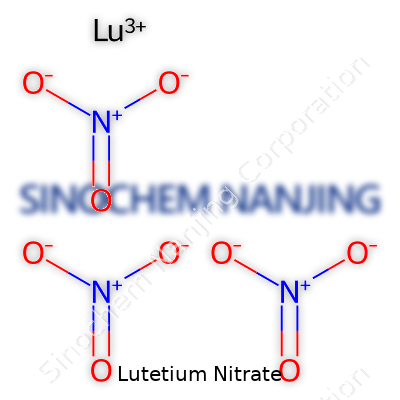
| Names | |
| Preferred IUPAC name | lutetium(3+) nitrate |
| Other names |
Lutetium(III) nitrate Lutetium trinitrate Lutetium nitrate hydrate Lutetium(3+) nitrate |
| Pronunciation | /luːˈtiːʃiəm ˈnaɪtreɪt/ |
| Identifiers | |
| CAS Number | 10099-66-8 |
| Beilstein Reference | 1907540 |
| ChEBI | CHEBI:88259 |
| ChEMBL | CHEMBL4296649 |
| ChemSpider | 22893 |
| DrugBank | DB11338 |
| ECHA InfoCard | 17f30bf7-36b9-44fb-991a-7d4f7121bf41 |
| EC Number | 231-104-6 |
| Gmelin Reference | 86084 |
| KEGG | C18662 |
| MeSH | D017865 |
| PubChem CID | 159227 |
| RTECS number | OG8050000 |
| UNII | S4I2T35T53 |
| UN number | UN3276 |
| Properties | |
| Chemical formula | Lu(NO3)3 |
| Molar mass | 451.01 g/mol |
| Appearance | White crystalline powder |
| Odor | Odorless |
| Density | 4.2 g/cm3 |
| Solubility in water | Soluble |
| log P | -4.08 |
| Vapor pressure | Negligible |
| Basicity (pKb) | 6.4 |
| Magnetic susceptibility (χ) | Nº0.000000 (25 °C) |
| Refractive index (nD) | 1.672 |
| Dipole moment | 0 D |
| Thermochemistry | |
| Std molar entropy (S⦵298) | 394.6 J·mol⁻¹·K⁻¹ |
| Std enthalpy of formation (ΔfH⦵298) | -1798 kJ/mol |
| Pharmacology | |
| ATC code | V10BX06 |
| Hazards | |
| Main hazards | Oxidizing, harmful if swallowed, causes serious eye irritation |
| GHS labelling | GHS02, GHS07, GHS09 |
| Pictograms | GHS05,GHS07 |
| Signal word | Danger |
| Hazard statements | H272, H315, H319, H335 |
| Precautionary statements | P264, P270, P273, P280, P301+P312, P305+P351+P338, P330, P337+P313, P501 |
| NFPA 704 (fire diamond) | 2-0-0-OX |
| Lethal dose or concentration | LD50 (oral, rat): > 5000 mg/kg |
| LD50 (median dose) | LD50 (median dose): >5 g/kg (oral, rat) |
| NIOSH | Not Listed |
| PEL (Permissible) | PEL (Permissible Exposure Limit) for Lutetium Nitrate: Not established |
| REL (Recommended) | 275 mg/m3 |
| IDLH (Immediate danger) | Not established |
| Related compounds | |
| Related compounds |
Lutetium(III) oxide Lutetium(III) chloride Lutetium(III) fluoride |



