Isopropyl Thiocyanate: Examining a Unique Chemical and Its Place in Modern Industry
Historical Journey of Isopropyl Thiocyanate
Chemicals like Isopropyl Thiocyanate don’t show up in the spotlight too often, but for people who keep an eye on chemical manufacturing or research, its story matters. Tracing the path of this compound takes us back to the mid-20th century, a time when organic chemists pushed boundaries in both academia and factories. Early work focused on understanding how the thiocyanate group could widen the toolkit for synthetic chemists. As laboratories gained better glassware and purification tools, researchers learned how to reliably attach the isopropyl group to the thiocyanate backbone, giving birth to Isopropyl Thiocyanate. Over the decades, shifting industrial needs and research trends caused its popularity to rise and fall. Each time, curiosity over structure, function, and toxicological properties seemed to drag the molecule back into the frame. During the heyday of dye, pesticide, and pharmaceutical innovation, its unique reactivity gave researchers hope for new products.
What Makes Isopropyl Thiocyanate Stand Out
Chemistry isn’t just a catalog of substances, it’s the art of reinventing the familiar. Isopropyl Thiocyanate, a modest molecule built from carbon, hydrogen, sulfur, and nitrogen, offers an interesting twist. Its molecular formula, C4H7NS, gives rise to a volatile liquid with a pungent smell. Out in the lab, you don’t forget that odor quickly. The reactivity comes from the thiocyanate group attached to the isopropyl backbone. With a flash point lower than water’s boiling point and a boiling range under 150°C, it creates both opportunities and risks, especially for those handling kilograms or more. Chemical properties also shape how it behaves: its moderate polarity and solubility in organic solvents mean it finds a niche in organic synthesis and industrial chemistry, but resists mixing cleanly with water. Technical specifications, including purity grade and contaminant thresholds, matter for industrial users who want consistent results or minimal side products.
Technical Details Worth Knowing
Regulatory and technical disciplines expect a thorough understanding of both labeling and handling. Isopropyl Thiocyanate generally appears in containers marked with hazard warnings tied to flammability and acute toxicity. Industry standards require clear labeling that tells users exactly what kind of risks they’re signing up for—some of us remember opening a shipment, seeing unmistakable hazard diamonds, and making sure every container fit strictly within environmental and workplace protocols. The chemical identity is crucial for downstream traceability, especially where slight impurities shift the final behavior. For those using analytical tools like NMR or chromatography, fine differences in purity or isomeric composition can throw a wrench in both results and scale-up.
Making Isopropyl Thiocyanate
Synthesis sits at the core of the chemical’s story. Historically, chemists start with isopropyl halides—these are easy to make and available in bulk. Mixing those with an alkali thiocyanate salt, typically under reflux in a non-polar solvent, initiates a nucleophilic substitution, swapping out the halide for a thiocyanate group. Into the fume hood goes the flask, bubbling away and releasing characteristic smells. The product can be distilled off, usually under vacuum, to purify and separate it from side products. Yields depend on the skills of the chemist and the quality of the reactants. Experienced practitioners pay close attention to reaction times and temperatures; rushing means unwanted byproducts, waiting too long risks decomposition. Preparation tactics change depending on whether the end use is a small-scale laboratory experiment or batch production.
Chemical Reactions and Modifications
What keeps Isopropyl Thiocyanate interesting for scientists isn’t just making it, but what it allows you to build next. As a functional group carrier, the thiocyanate can undergo all sorts of transformations. In organic synthesis, it reacts with a range of nucleophiles and electrophiles, opening the door to sulfur- and nitrogen-containing heterocycles, isothiocyanates, and more. Some synthetic chemists push this molecule to act as a stepping stone, adding complexity to molecules that would otherwise be impossible to build. In industry, small creative tweaks—say, changing reaction partners or catalysts—lead to a range of derivatives that work better for specific processes or improve safety profiles.
Other Names and Identifiers
Several synonyms circulate in reference books and safety sheets: isopropyl mustard oil, propan-2-yl thiocyanate, and 2-propyl thiocyanate turn up most often. Those who’ve worked in older labs probably remember seeing dusty labels with these names. Synonyms lead to confusion, especially when ordering or reading historical texts. A savvy chemist double-checks identifiers like CAS numbers to avoid mishaps or embarrassing orders.
Looking at Safety and Compliance
There’s no shortcut when handling Isopropyl Thiocyanate. Its pungent smell is more than a nuisance—it signals the real toxicological risk involved. Extended exposure, whether through skin, inhalation, or ingestion, can harm. Handlers wear the right gloves and face protection, while ventilation and containment systems run full time even in small volumes. Spills demand quick, methodical responses—nobody wants to end up on the wrong end of a chemical incident report. Safety data sheets and regulatory frameworks like OSHA or REACH frame the conversation about how companies store, use, and dispose of the compound. In my experience, set protocols and regular training help prevent the rare but dramatic accidents that can upend entire facilities or neighborhoods.
Where Does It Get Used?
Outside the lab, Isopropyl Thiocyanate doesn’t make it into home cabinets or generic consumer goods. Instead, it mostly finds work in the chemical, pharmaceutical, and agrochemical industries. Researchers use it as a synthetic intermediate, especially in exploring new sulfur- and nitrogen-containing molecules. Sometimes, it appears as a precursor to specialty agents in dyes or pesticides, though stricter regulation of toxic substances has trimmed some of its applications over the years. For those working in niches like custom syntheses or advanced material research, its utility sometimes outweighs the handling difficulties. In the classroom, teachers pull it out rarely, usually only for advanced student labs exploring nucleophilic substitution or characterization techniques.
Recent Research and Development Focus
On the research front, teams keep testing ways to make and use Isopropyl Thiocyanate more efficiently and safely. Scientists publish on newer catalysts that promise to cut energy use or boost selectivity. Others dig into alternative synthetic pathways that limit toxic byproducts or improve atom economy—a big deal for companies trying to trim waste streams. Academics investigate how the thiocyanate group interacts with biological systems, hoping to uncover new pharmaceutical leads or mechanisms of toxicity. Fresh eyes and modern tools like high-resolution spectrometers and automated systems speed up discovery, offering glimpses of properties or risks that went unnoticed for decades. Collaborative efforts between industry and academia show promise in updating best practices for safe handling and creative reuse.
Toxicity Research: Risks and Responsibilities
Toxicity always hangs over chemicals like Isopropyl Thiocyanate. Animal studies and workplace case reports flag acute effects from short exposures, with symptoms ranging from headaches to respiratory distress. Chronic exposure, even to trace residues, has drawn scrutiny thanks to its suspected influence on liver and nervous system function. Decades of effort have gone into understanding how it metabolizes in living organisms—pharmacologists examine breakdown products, while toxicologists track dose-response curves. Data gaps persist; regulatory bodies push for more rigorous and transparent studies to bridge them. Factories and research facilities bring in medical surveillance and environmental monitoring out of both ethical and legal obligation. As regulations evolve and new toxicological findings emerge, companies need to keep pace, adopting best practices and reformulating products where necessary.
Thinking Ahead: Where Does Isopropyl Thiocyanate Go Next?
Looking to the future, the trajectory for Isopropyl Thiocyanate seems tied to shifting research priorities and environmental demands. Sustainability pressures demand safer alternatives or cleaner methods of synthesis. At the same time, those unique chemical properties keep it relevant for advanced synthesis, particularly where alternatives won’t fit the bill. Some innovation comes from miniaturized synthesis, microreactors, and greener solvents that shrink hazard footprints. The most responsible companies keep scanning the horizon for replacement substances, supported by breakthroughs in computational modeling and predictive toxicology. Regulators ask tougher questions about both human health and environmental impact, which drives investment in remediation and exposure control technologies. Maybe the biggest opportunity, though, lies in cross-disciplinary collaboration—chemists, toxicologists, environmental scientists, and manufacturers working together to reckon with both the promise and the peril of compounds like Isopropyl Thiocyanate. In my view, honest risk assessment and knowledge sharing remain the clearest path forward for anyone looking to balance innovation with safety.
What is Isopropyl Thiocyanate used for?
How Isopropyl Thiocyanate Gets Used
I spent a stretch of my working life around commercial laboratories and chemical plants, and back then, you start to see how chemicals with odd-sounding names carve out their own important spots. Isopropyl thiocyanate, for all its syllables, lands in a niche with some practical value. In the flavor and fragrance world, it’s an ingredient some manufacturers reach for when creating complex scents. Not because anybody actually wants their air to smell like chemicals, but because isopropyl thiocyanate, used in minute concentrations, brings in gentle flavor nuances — usually a faint, almost radishy, note that balances blends in industrial flavors and perfumes.
It surprises a lot of people to learn that food chemistry sometimes borrows from chemical families you wouldn’t consider in your own kitchen. Regulatory bodies like the FDA and EFSA watch these closely, setting limits on how much can safely end up in finished goods. Still, chemists prize the compound when they want to replicate flavors anchored in roots and vegetables—especially if the alternative means synthesizing something much trickier or less stable.
Behind the Lab Door: Other Uses
Away from food, isopropyl thiocyanate performs in industrial applications. It enters the picture as a tool in organic synthesis, helping chemists build thiocyanate-containing molecules they, in turn, use for developing agrochemicals or pharmaceuticals. Because it dissolves easily and reacts in predictable ways, lab workers prefer it when precision matters.
I remember a time we were trying to design a molecule for crop protection, working to block fungal infections in seeds. One path led through an isopropyl thiocyanate intermediate. The process demanded attention to detail and careful waste handling, but the outcome — crops less prone to rot — showed what targeted chemistry can do.
It rarely comes up outside the lab, but for scientists designing new materials, isopropyl thiocyanate sometimes acts as a starting block for compounding plastics or specialty rubbers. These end up in things like electronics casings or industrial coatings, where their mechanical and weather-resistant properties get put to the test.
Keeping Safety at the Center
Several years back, I visited a small fabrication facility and got a firsthand lesson in lab safety: The folks there respected chemicals like isopropyl thiocyanate, storing them in sealed containers and handling them inside ventilated hoods. Even tiny spills call for fast cleanup and protective gear. If you read the material safety data sheets, you see warnings about respiratory irritation and environmental hazards.
Unlike surfactants or solvents you hear about every day, isopropyl thiocyanate doesn’t usually make headlines. But the hazards aren’t just theoretical—accidental exposure means risk of skin irritation or more severe health issues. Some accidental releases in the past have led to environmental concerns, especially if local water supplies got impacted downstream.
Solutions and Responsibility
Strong regulations work best when paired with personal and institutional responsibility. Companies using isopropyl thiocyanate invest in staff training and monitoring equipment to limit spills or leaks. Waste management plans guide every step, from on-site neutralization procedures to sealed containers destined for certified incinerators.
In my experience, familiarity can breed carelessness, but routine reminders drive home how crucial safe handling is. Chemists stay alert because they respect both the tools they use and the communities around them. Using isopropyl thiocyanate responsibly means understanding what it can do, what harm improper use could cause, and keeping safety measures front and center at every stage.
Final Thoughts
Isopropyl thiocyanate rarely finds its way into public discussions, yet it holds a set of jobs that quietly shape the products around us. Careful management and science-backed oversight let the industry draw out its benefits while minimizing downside for workers and the world beyond the lab.
What are the safety precautions when handling Isopropyl Thiocyanate?
Rolling Up Your Sleeves: What Makes Isopropyl Thiocyanate Demanding?
Whenever I’ve handled chemicals in the lab, I learned pretty quickly which ones deserved respect. Isopropyl thiocyanate belongs on the list. This liquid packs a punch with its strong smell and ability to irritate the eyes and skin in seconds. I’ve seen cases where folks touched their faces without gloves and paid the price with days of redness or worse. Respecting this compound keeps life uncomplicated and accidents out of the news.
Don’t Cut Corners on Personal Protective Gear
No matter how quick the job seems, gloves built for chemical resistance sit right at the core of safe handling. Nitrile gloves block splashes, and safety glasses with side guards keep fumes and droplets away from your eyes. I’ve seen coworkers ignore the advice and regret it almost every time. Cotton lab coats offer little defense. A full apron or chemical-resistant suit stands up better if a bottle tips.
Venting Out the Danger
Fumes from isopropyl thiocyanate create trouble. One sniff, and you’ll know this isn’t something you want in your lungs. Proper ventilation isn’t optional. At home, that means working outside or in a workspace with serious airflow, even if it means propping up fans and checking cross-breezes. In a lab, a chemical fume hood earns its keep. Breathing masks rated for organic vapors? Worth every penny if something goes sideways.
Mixing with Other Chemicals? Think First
Every job has stories of people who mixed the wrong stuff and faced a fire drill or worse. Isopropyl thiocyanate reacts with strong acids, bases, and oxidizers, sometimes throwing off toxic fumes or even sparking a blaze. I once saw someone absentmindedly pour waste into the wrong container, only to have the lid bulge from the pressure. If your job means using more than one chemical, label everything and double-check before you pour. This isn’t paranoia—just common sense backed by real risk.
Storing it Right: Spare Yourself a Mess
Don’t stash isopropyl thiocyanate anywhere near heat or flame. Flammable cabinets aren’t fancy—they work. I’ve known people who tossed bottles under a sink, and months later, cleaned up a tacky, dangerous mess after a leak. Secondary containment trays save time on cleanup later. Seal every container tight. Twice I’ve seen loose caps spread vapors through whole rooms. A proper inventory log also helps in tracking bottles and expiration dates, so nothing unexpected sneaks up on you.
Immediate Response Beats Regret
Splashes and spills happen, even to careful folks. If you get the liquid on your skin, washing with soap and water for several minutes beats any shortcut. A trip to the emergency room sounds dramatic, but I’ve worked with people who put it off and ended up with nasty burns or breathing problems. Keep the emergency shower and eyewash station in sight—and don’t let them gather dust.
Real Solutions: Training and Mindset
In my experience, the best safety tool isn’t equipment. It’s habit. Regular safety training keeps everyone on their toes. Peer checks save more skin than any poster on the wall. If something looks off—a funny smell, a brittle label, someone working without gloves—speak up. Guiding each other helps more than any checklist. Industry data show workplaces with active safety cultures see fewer chemical injuries, and it all starts with looking out for each other and sticking to hard-learned routines.
Looking Ahead
Isopropyl thiocyanate doesn’t forgive shortcuts. A mix of proven gear, honest communication, and a willingness to stop and think keeps people safe. From storage to cleanup, the choices you make stick with you. Trust your training, respect the hazard, and tomorrow’s headlines won’t have your name in them.
What is the chemical formula and structure of Isopropyl Thiocyanate?
The Basics of Isopropyl Thiocyanate
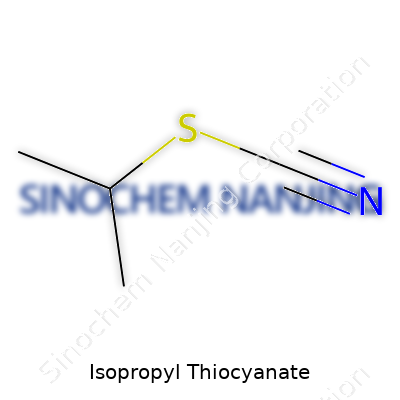
Isopropyl thiocyanate stands as a straightforward but intriguing organic compound. Its chemical formula is C4H7NS, reflecting a structure built from carbon, hydrogen, nitrogen, and sulfur atoms. The arrangement looks like this: (CH3)2CHSCN. The three-carbon isopropyl group hooks up with a thiocyanate group, giving this compound its distinctive features. The backbone carries the sulfur atom connected to a cyanide group, which in turn links to the isopropyl part.
Understanding the Structure
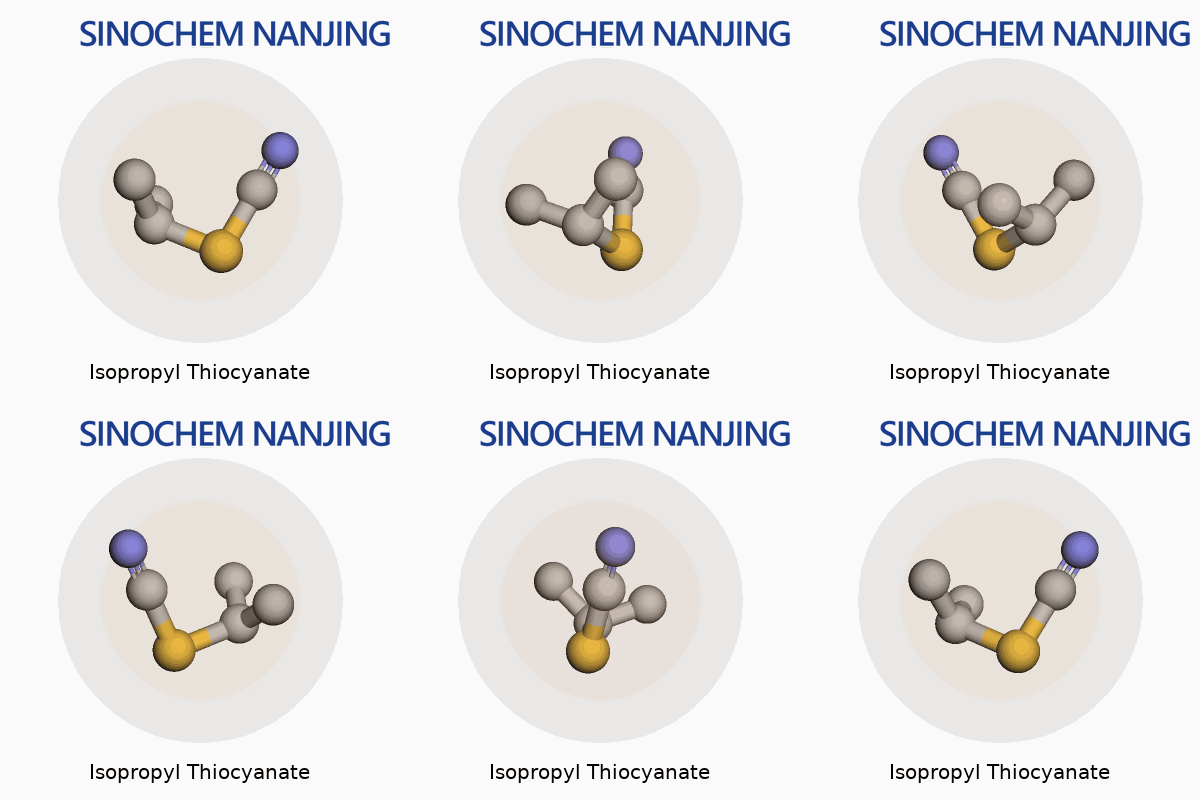
The molecule features the isopropyl group, a branching that shapes the physical and chemical characteristics. The thiocyanate piece (−SCN) attaches to the central carbon, replacing hydrogen in the normal isopropane lineup. Sketching out this molecule, you’d see the isopropyl portion (two methyl groups attached to a central carbon) joined to the sulfur, followed by a triple bond between carbon and nitrogen at the chain’s end. This linear structure shapes much of the reactivity, solubility, and how the human nose might notice it. To put it simply, the presence of the thiocyanate branch punches up the compound’s potential uses and safety concerns.
Practical Uses and Hazards
In labs, Isopropyl thiocyanate occasionally pops up as an intermediate or a specialty reagent. It doesn’t have the commercial fame of acetone or urea, but it does open doors for organic synthesis, especially for chemists seeking to introduce the SCN group or generate isopropyl derivatives. Some research labs also dig into variants of these molecules for studying biological interactions or as candidate molecules for pharmaceuticals — though safety always takes the front seat due to its pungency and toxicity profile.
Handling thiocyanates brings its own stories. I remember the sharp, biting odor during my own time in the lab. That whiff left no doubt in your mind: here’s a compound you don’t want loose on your clothes or skin. Sulfur- and nitrogen-containing compounds love to announce themselves. Safety goggles, gloves, and responsible waste disposal make a difference: spills with these chemicals can lead to headaches, eye irritation, or worse if ignored. Thinking back, I’d rather spend extra time double-checking seals and labeling than deal with a rushed cleanup.
Why Chemists Care About Structure-Function Connections
Understanding the exact skeleton of Isopropyl thiocyanate means better predicting how it will react in various conditions. That’s a lesson that goes way beyond textbooks. For example, knowing where the sulfur sits — or if the thiocyanate points in a different direction — can mean dramatic shifts in toxicity, odor, and how quickly a compound breaks down in the environment. By sticking to reliable data, researchers can avoid mistakes that put people and projects at risk.
Responsible Use and Safer Labs
Better ventilation, reliable chemical inventories, and clear protocols all play into making labs safer places to work. Companies sourcing Isopropyl thiocyanate need to train their teams not just on how to measure it out, but on recognizing the symptoms of overexposure and managing the aftermath of a spill. Fact-driven decisions, not shortcuts, build trust in chemistry — and that trust rests on a foundation of working knowledge like the exact structure and formula of every compound on the bench.
How should Isopropyl Thiocyanate be stored?
Understanding the Risks in Everyday Terms
Walk into any research lab or chemical warehouse, and there’s a certain respect given to bottles labeled Isopropyl Thiocyanate. With a sharp odor and the kind of volatility that keeps even seasoned chemists alert, this compound calls for no-nonsense caution. From my years helping set up shared lab spaces, a lot of headaches have come from folks underestimating how small oversights—an open window or careless shelving—turn safe storage into a hazard. Chemical burns, skin irritation, and sometimes explosive vapors aren’t theoretical risks; they’re stories you hear from people who let their guard down just once.
Containers: No Room for Guesswork
Strong, airtight, and chemical-resistant containers win every time. Glass works well for Isopropyl Thiocyanate unless you’re mixing with reactive cleaners or moving containers around when they’re wet. Polyethylene containers resist corrosion, so I’ve seen more labs switching over for longer-term storage. Make sure the lids seal tight; I remember a colleague who wrapped tape around the cap after seeing fumes fogging up the shelf. It’s good practice, not paranoia.
Temperature and Ventilation: The Real Grown-Up Concerns
Some new tech labs run hot, especially with all the electronics humming away. Isopropyl Thiocyanate should not sit anywhere near a heat source. Keep the room cool and steady. Temperatures jumping above 25°C put everyone at risk. I’ve watched people cut corners by sticking chemicals on a sunny window ledge — big mistake. Exposure to sunlight not only breaks down the compound, spilling dangerous byproducts, but it sets the stage for pressure build-up and accidental exposure.
Ventilation matters far more than most realize. Proper air flow in the storage room protects you from vapor build-up. Fume hoods aren’t just for the main workspace; they belong in any area where volatile substances get stored. Investing in a good ventilation system saves time and health later. Government agencies and chemical safety boards emphasize this point for a reason, citing dozens of accidental inhalation events reported every year.
Labels and Segregation—Lessons from Experience
Labels fade, fall off, or get smudged. Permanent, clear chemical labels make a real difference. Mark poisoning risks, flammability warnings, and expiration dates. After watching someone mix up vials in a rush, I always urge people to double up with color coding or a digital log.
Never keep Isopropyl Thiocyanate next to acids, oxidizers, or bases. That’s not overkill; it’s a response to real incidents in underfunded labs or after-hours maintenance rooms. Reactions between tiny spills have led to evacuations and, in a few unlucky cases, fires. Making a habit of using spill trays and secondary containment ensures one mistake doesn’t become a full-blown emergency.
Protecting People: Simple Rules, Big Results
Personal protective gear saves skin and lungs. Even routine chores like restocking or cleaning benefit from nitrile gloves and goggles. People shrug off these steps until they’ve had a close call. Storing safety data sheets nearby, and running mock drills on handling spills, brings textbook advice into real practice. No one expects an accident, but being prepared limits harm and avoids frantic 3AM emergency calls.
Looking Ahead: Building Confidence in Chemical Storage
Communities trust labs and warehouses to keep dangerous chemicals like Isopropyl Thiocyanate controlled, out of sight, and away from leaks. These best practices grow from the mix of lived experience, regulatory guidance, and a priority on human safety. Anyone responsible for these chemicals owes it to the people around them to treat storage as a critical skill, not an afterthought.
What are the potential health hazards of Isopropyl Thiocyanate?
Looking Beyond the Lab Bench
Isopropyl thiocyanate gets used in chemical labs and sometimes ends up in the conversation among folks handling industrial chemicals. Most people rarely hear about it outside science circles, but health and chemical safety shouldn’t just live in boardrooms or textbooks. Anyone who works around chemicals like this inherits a responsibility: understanding what could go wrong and what it means for daily life and long-term health.
Direct Effects on the Body
Contact with isopropyl thiocyanate isn’t just a nuisance — it brings real risks. Skin gets irritated fast, sometimes with burning or rashes if the exposure lingers. Eyes sting, turn red, and water nearly right away on exposure. Workers once told me that a single drop made them step back from their bench for an hour; the stinging didn’t let up. If the fumes sneak into the lungs (and they’re volatile enough to do so), coughing and sore throats start in minutes. Not all reactions settle quickly — some folks might even develop chemical sensitivity over time, meaning responses get worse after even small exposures.
Longer-Term Concerns
Over months or years, chemicals like isopropyl thiocyanate don’t just disappear without a trace. Every researcher who’s attended safety training learns stories of workers developing chronic headaches, fatigue, or trouble concentrating after years of handling volatile organic compounds. Inhalation leads to headaches, dizziness, and sometimes even confusion if the air’s contaminated enough. Not much separates a bad day from a dangerous one if local exhaust or proper gloves aren’t used.
Animal studies show that swallowing or breathing larger amounts can affect more than just the lungs. Liver, kidneys, and even the nervous system may take a hit. Humans are not immune — while data is sparse, the risk stays on the table when handling any thiocyanate compound. My chemistry professor used to say, “If you wouldn’t lick it, don’t trust it.” Practical advice once you realize how traces left on your hands might show up in a lunchroom or on your phone.
Environment and Secondary Exposure
Chemicals don’t clock out. Improper storage or cleaning rinses isopropyl thiocyanate into drains, where it can join streams, soil, or even the air. In the industrial world, routine accidents or careless disposal feed low-level exposures that ripple far beyond one workplace. Families of workers, especially kids, might see the impact, even without stepping foot in a lab.
Staying Safe, Not Sorry
So many accidents stem from rushing or skipping the “unseen step.” Real safety grows from habits: gloves built for chemical resistance, goggles splashed less often than street puddles, and fume hoods treated like sacred territory. Facilities upgrade equipment, but a culture of caution brings the real change. Training needs bite-sized, repeatable lessons — not dull, annual checklists.
For those who make policy, transparency plays a bigger role than most admit. Label updates, open safety data, and basic education for everyone handling these compounds keep risks from being swept under the rug. If you understand the hazard, you create opportunities to keep your coworkers, your family, and yourself out of the ER.
Solutions Everyone Can Use
I’ve learned that open conversation produces more safety than any rulebook. Reporting near-misses without fear, supporting coworkers who double-check everything, and keeping PPE handy makes handling isopropyl thiocyanate just another part of a day — not a disaster in waiting. Constant reminders, accessible first aid, and a culture of “tell someone if you’re unsure” saves more than just time. It anchors real, practical protection for everyone in the room.
| Names | |
| Preferred IUPAC name | Propan-2-yl thiocyanate |
| Other names |
Isopropyl thiocyanate 2-Propy lthiocyanate Thiocyanic acid, isopropyl ester Isopropyl rhodanide Isopropyl sulphocyanate |
| Pronunciation | /ˌaɪ.səˈproʊ.pɪl ˌθaɪ.oʊ.saɪˈæ.neɪt/ |
| Identifiers | |
| CAS Number | 3319-96-4 |
| 3D model (JSmol) | `Isopropyl thiocyanate JSmol 3D model string`: ``` C(C)SC#N ``` |
| Beilstein Reference | 1209276 |
| ChEBI | CHEBI:86448 |
| ChEMBL | CHEMBL21785 |
| ChemSpider | 10778 |
| DrugBank | DB14006 |
| ECHA InfoCard | 100.018.178 |
| EC Number | 209-790-9 |
| Gmelin Reference | 2328 |
| KEGG | C19502 |
| MeSH | D016621 |
| PubChem CID | 66138 |
| RTECS number | WN5250000 |
| UNII | YEH3PQH2T4 |
| UN number | UN2810 |
| Properties | |
| Chemical formula | C4H7NS |
| Molar mass | 117.19 g/mol |
| Appearance | Colorless to pale yellow liquid |
| Odor | penetrating |
| Density | 0.967 g/mL at 25 °C (lit.) |
| Solubility in water | insoluble |
| log P | 1.85 |
| Vapor pressure | 4 mmHg (20°C) |
| Acidity (pKa) | 23.3 |
| Basicity (pKb) | pKb = 6.06 |
| Magnetic susceptibility (χ) | -61.0 × 10⁻⁶ cm³/mol |
| Refractive index (nD) | 1.447 |
| Viscosity | 0.490 cP (20°C) |
| Dipole moment | 3.74 D |
| Thermochemistry | |
| Std molar entropy (S⦵298) | 220.6 J·mol⁻¹·K⁻¹ |
| Std enthalpy of formation (ΔfH⦵298) | -54.7 kJ/mol |
| Std enthalpy of combustion (ΔcH⦵298) | -236.3 kJ/mol |
| Pharmacology | |
| ATC code | R01AA15 |
| Hazards | |
| GHS labelling | GHS02, GHS06, GHS07 |
| Pictograms | GHS02,GHS06 |
| Signal word | Danger |
| Hazard statements | H226, H301, H311, H331, H411 |
| Precautionary statements | P210, P261, P271, P280, P302+P352, P304+P340, P312, P321, P330, P363, P501 |
| NFPA 704 (fire diamond) | 3-3-0 |
| Flash point | 44 °C (111 °F; 317 K) |
| Autoignition temperature | 400°C |
| Explosive limits | Explosive limits: 2–11% |
| Lethal dose or concentration | LD50 oral rat 40 mg/kg |
| LD50 (median dose) | LD50 (median dose): Oral rat 60 mg/kg |
| NIOSH | RN1400 |
| PEL (Permissible) | PEL (Permissible Exposure Limit) of Isopropyl Thiocyanate: "2 ppm (10 mg/m3) |
| REL (Recommended) | string: 5 ppm |
| IDLH (Immediate danger) | IDLH: 2 ppm |
| Related compounds | |
| Related compounds |
n-Propyl thiocyanate S-Isopropyl thioacetate Isopropyl isothiocyanate Methyl thiocyanate Ethyl thiocyanate Isopropyl cyanate |



