Isopropyl Nitrite: Fact, Discovery, Use, and Challenges
Historical Development of Isopropyl Nitrite
Isopropyl nitrite stepped into the public eye around the 1970s, following the public popularity and regulatory crackdown on amyl nitrite. Chemists in perfumery and, unavoidably, in black markets, started looking for alternatives that sidestep strict scheduling. Isopropyl nitrite fit the bill. Its roots trace back to a much older tradition — nitrites found steady use as vasodilators and even “poppers” for medical relief in angina, sporting a legacy from Victorian clinics to disco floors, with each substitute striving for the same punch without legal risks. Changes in supply chains, especially post-2007, reflect renewed crackdowns, sending manufacturers hunting for affordable, effective responses to consumer demand and evolving laws.
Product Overview
Isopropyl nitrite stands as a colorless to pale yellow liquid, usually sold in small vials or ampoules. Retailers often market it under various euphemisms, shifting names as regulation shifts from country to country. Its reputation as a recreational inhalant often overshadows its roots in industrial and chemical settings, but its behavior in both worlds stays tied to the same attributes — quick-acting, volatile, and sharp on the nose. Most buyers encounter it sold as “room odorizer,” “liquid incense,” or “air freshener” — all code for its intended illicit use. Professional and regulated settings see much more controlled handling and documentation, but the street versions rarely come with any reliable label or safety data sheet.
Physical & Chemical Properties
At room temperature, isopropyl nitrite presents as a volatile liquid with a fruity, almost sickly sweet scent that quickly fills a small space. Its boiling point hovers around 40 °C, making it extremely easy to vaporize — hence its popularity as an inhalant. Solubility in water counts as low, but it blends easily with alcohols and organic solvents. This nitrite decomposes rapidly in light and in contact with moisture, breaking down to form nitrogen oxides and alcohol, leaving distinct stains on glassware if not stored well. Anyone handling this compound soon notices its fast evaporation and the headache-inducing fumes it leaves behind, acting as a stark warning of its potency and instability outside controlled containers.
Technical Specifications & Labeling
The technical standards for isopropyl nitrite gravitate toward purity — most bottles advertise 95% or higher grades, though actual lab-grade samples bear batch codes, CAS numbers, and essential warnings. Legal commercial packaging demands detailed hazard communication, listing explosive vapor risks and need for airtight handling. On the black market, vials rarely contain any honest labeling, leaving uninformed buyers at the mercy of whatever batch came off the line that week. Compliance with international standards like GHS (Globally Harmonized System) labeling gets patchy, especially outside regulated retail. Work with industrial or laboratory samples, and the labels will reveal more: fire diamond symbols, storage protocols, emergency procedures, and accurate chemical names.
Preparation Method
Chemists synthesize isopropyl nitrite through the acid-catalyzed reaction of isopropyl alcohol and sodium nitrite, a process historically common in European chemical plants. They mix sodium nitrite with concentrated sulfuric or hydrochloric acid, producing nitrous acid in situ, which then reacts with isopropanol. The resulting isopropyl nitrite floats up and separates out as an oily layer, skimmed off, washed with sodium carbonate solution to neutralize excess acid, and then dried — though clandestine labs often skip these careful purification steps, leading to impurities that can amplify risk. In larger factory settings, built-in scrubbers help handle toxic nitrogen dioxide produced along the way, but such equipment rarely shows up in amateur operations.
Chemical Reactions & Modifications
Isopropyl nitrite acts as a strong electron donor, prone to oxidation and unimpressed by light or heat — it breaks down to give off toxic nitrogen oxides and isopropanol. Mix it with reducing agents and things get unpredictable fast, producing everything from unpleasant fumes to explosive mixtures. In organic synthesis, nitrites sometimes serve as nitrosating agents, donating their NO group to create complex molecules, though isopropyl nitrite’s volatility and toxicity keep its role limited in professional labs. It resists extensive chemical modification; most synthetic chemists focusing on nitrites seek higher purity, not heavier functionalization. At home, the risks far outweigh any claimed “tweaks,” with most modifications leading to breakdown or loss of potency.
Synonyms & Product Names
Isopropyl nitrite answers to a revolving door of names: 2-propyl nitrite, poppers, ICE, liquid incense, air freshener in some circles. Each name tries to outpace regulations and hint at a legal loophole. Buyers spot bottle labels like “Power Rush,” “Jungle Juice,” or “Quick Silver,” none of which reflect the actual molecular payload or its hazards. Street vernacular often conflates it with amyl nitrite, though the two differ in chemical backbone and effects. In chemical trade, its main designations include its CAS number (541-42-4), precise IUPAC name, and sometimes a list of local regulatory codes, though these quickly vanish from products once they move outside formal channels.
Safety & Operational Standards
No matter how casual pop culture treats isopropyl nitrite, professionals know its risk profile: flammable, explosive under pressure, highly irritating to the skin and respiratory system. Safe handling insists on working in fume hoods, gloves, and eye protection. A single spill can fill a room with choking fumes, and direct skin contact causes burns or rashes. Regulations often demand locked, ventilated storage and strict logbooks, which most street sellers ignore completely. Long-term exposure raises methemoglobinemia risks, a serious blood disorder where oxygen-carrying cells lose their edge. Removing vapor traces from air means deploying activated charcoal and constant ventilation; complacency with these measures invites accident or chronic illness.
Application Area
Legitimate use for isopropyl nitrite grows rare as substitutes enter clinical practice. Few hospitals see nitrites stocking emergency carts these days, but select chemical industries still turn to them for fleeting solvent roles or specialty nitrosation, where other compounds fall short. The recreational world accounts for the highest sales by a wide margin; here, users seek transient euphoria, muscle relaxation, or a fleeting head rush. These effects come at a price many overlook — hazardous fumes, skin reactions, and serious cardiovascular stress. Law enforcement agencies, health clinics, and poison control experts deal with far more consequences than claimed benefits, and product shrink among industrial users tracks closely with tightening export rules and workplace safety codes.
Research & Development
Academic curiosity about isopropyl nitrite centers less on new use cases and more on minimizing harm or finding acceptable analytic controls. Toxicologists, environmental chemists, and law enforcement forensics steer current research, trying to quantify vapor phase breakdown, assess chronic exposure, and develop portable detection equipment for customs and street policing. Published studies detail its metabolic breakdown and document the rise in accidental poisonings, especially after changes to amyl nitrite scheduling. Production R&D, where it still exists, focuses on streamlining synthesis with less hazardous byproduct, but routine innovation grinds to a halt as safer compounds outcompete nitrites for most technical roles.
Toxicity Research
Exposure research on isopropyl nitrite tells a familiar story: potent vasodilators come with harsh penalties when overused, inhaled, or absorbed through the skin. Methemoglobinemia ranks as the most pressing threat where hemoglobin stops carrying enough oxygen, leading to rapid shortness of breath, blue lips, even unconsciousness. Chronic exposure links to neurological changes, arrhythmias, and organ stress. Recent poison center records from Europe and North America show spikes in overdoses and occupational incidents, with outcomes ranging from mild dizziness to acute respiratory collapse. Safety sheets flag every relevant hazard: flammable liquid, toxic vapor, corrosive residue. Toxicologists still battle the lack of consistent formulation from street sources, complicating data collection and medical response.
Future Prospects
Looking ahead, isopropyl nitrite’s prospects in medicine or mainstream industry look dim. Both stricter laws and shifting consumer preferences push safer alternatives to the front. Lawmakers keep closing loopholes, and retailers bounce from one synonym to another, but longevity for this compound as a commercial product appears uncertain. Harm reduction groups advocate for honest labeling, plain-language warnings, and public education on risks, trying to reduce emergency visits and poisonings tied to black market bottles. Environmental scientists take a keen interest in how volatile nitrites pollute air and groundwater near production sites, pushing for better containment protocols and clean-up programs. Beyond niche chemical reactions in well-managed labs, future conversations around isopropyl nitrite will focus on limiting harm, tracing illicit production, and finding safe exit ramps for users and industry alike.
What is Isopropyl Nitrite used for?
How Isopropyl Nitrite Gets Used
Some chemicals show up in unexpected places, and isopropyl nitrite sits among them. For years, people have mixed it into the “poppers” sold in small bottles at clubs, parties, or certain stores. These products carry wild names and often come with a warning label that’s easy to ignore.
Ask someone in nightlife about poppers, and you probably hear words like “rush” or “head high.” Isopropyl nitrite works by relaxing smooth muscle — not just in blood vessels, but all over the body. People usually inhale it for an instant, sharp buzz. This feeling only lasts a minute or two, but that’s the draw for some users.
Why It Shows Up on the Market
Unlike medicine, isopropyl nitrite doesn’t arrive at the pharmacy counter with a prescription. Its main draw in consumer products comes from the short-lived, intense sensation it makes possible. Some communities have relied on poppers since the 1970s to decrease discomfort during sex. The effect on muscles especially appeals to men who have sex with men. Among this group, word of mouth and tradition keep isopropyl nitrite around—and legal loopholes have let small shops and online stores keep it stocked.
Manufacturers usually market these bottles as “room aromas,” “leather cleaner,” or “video head cleaner.” Few users actually clean anything with them. The real motive sits on the inhalant side.
Health Risks That Deserve Attention
Using isopropyl nitrite brings clear risks. It drops blood pressure fast, sometimes to dangerous lows. In my experience, talking with healthcare workers in city emergency rooms, people don’t always realize the toll. Fainting and headaches show up often. A big danger lands on those with heart conditions or folks mixing with other meds—especially erectile dysfunction pills. Combining the two can set the stage for a heart crisis.
Long-term or frequent use brings in other worries. Isopropyl nitrite can damage red blood cells through a condition called methemoglobinemia. This means the blood can’t carry oxygen very well, so you end up feeling exhausted or short of breath. My peers who work in toxicology talk about blue lips showing up in rare but real overdose cases.
Looking at Regulation and Harm Reduction
National rules don’t line up everywhere. Some countries regulate isopropyl nitrite by treating poppers like any other inhalant; others pay less attention. Bans don’t always lead to less use—they sometimes drive things underground, where users have less guidance and no control over purity. The danger then often comes from bad batches and fake products, not just the intended chemical.
Education outperforms scare tactics. Public health campaigns in urban centers have tried spelling out the health facts rather than plain prohibition. Hospitals have started to warn at-risk groups about mixing poppers with heart drugs. Harm reduction clinics hand out printed tips for safer use, pointing out signs of overdose or red flags with certain medications.
Steps Toward Safer Decisions
The reality is, isopropyl nitrite won’t vanish from markets overnight. More honest dialogue helps. As a writer covering health, I’ve noticed people respond better when told the facts than when told to just say no. Health workers can watch out for warning signs, and regulators can keep one eye out for tainted products. The rest depends on clear info—explaining exactly what’s at stake, what the risks feel like, and how to spot trouble before it starts.
Is Isopropyl Nitrite safe to inhale?
Looking at What Isopropyl Nitrite Really Does
A lot of people ask about “poppers” and what goes into these little bottles at clubs, festivals, and private parties. Isopropyl nitrite is one of the most common ingredients. The stuff gets passed around because it makes people feel lightheaded and maybe a bit uninhibited. It acts fast and fades quickly, which gives it a certain appeal.
With so many stories floating around about what poppers do, it makes sense to pay attention to the science and what doctors are seeing in real life. Isopropyl nitrite works by causing blood vessels to widen, dropping blood pressure for a few minutes and giving that head rush. It isn’t a new invention, but it's gained popularity over time among certain crowds, especially in nightlife settings.
The Real Health Impact: What Doctors and Science Report
Most doctors get worried about chemicals that mess with heart rate and blood pressure. Isopropyl nitrite belongs in this group. Short-term use might mean some dizziness, flushing, and headaches. There are reports of heart racing or even fainting after a heavy sniff, which doesn’t come as a shock because lowering blood pressure on purpose has risks.
What really raises alarms is the risk of methemoglobinemia. That’s a long word, but it describes a problem where blood can’t carry oxygen as well. Skin turns blue, breathing gets hard, and the brain stops working right. It’s rare, but the cases that surface in hospital emergency rooms are scary. More than a few people think of “poppers” as just a fun party drug with little downside, but the chemicals inside hit every system in the body.
Doctors have documented people losing vision or struggling with their eyesight after use. Other users have described chest pain that feels like a heart attack. Animal studies also suggest repeated exposure might hurt the immune system and damage the liver. Sometimes, people mix poppers with other substances. That adds more unpredictability and trouble, especially with drugs for erections or other stimulants.
Legal Status and Quality Control Concerns
Rules about isopropyl nitrite change from country to country. Some places restrict sales, some don’t care, others ban them after hospital cases make the news. Since these little bottles don’t get any real quality testing, nobody can promise what’s inside. Labels might say “air freshener” or “leather cleaner,” but regular folks know what’s really going on. A bottle could be diluted, faked, or laced without anyone knowing. That has led to poisonings and trips to the ER from adulterants and impurities—not just the nitrite itself.
Why Risk Grows in Real-World Use
A lot of people don’t know how their health will react. Folks with asthma, heart problems, or anemia get hit hardest. Some just want a wild night, not realizing how quickly things can go sideways. Higher doses chase a better rush, but that pushes risk even higher. Throw alcohol into the mix, and you can’t predict the outcome.
It’s easy to forget about these risks if you’re surrounded by friends who never ran into trouble. Real harm usually shows up quietly, without dramatic warning—trouble breathing, chest pain, or even a trip to intensive care. Over years, nobody tracks long-term impact well, so the story doesn’t get out.
What Choices Exist for Harm Reduction?
Anyone considering isopropyl nitrite should think about safer ways to enjoy social nights. Checking labels, talking honestly with doctors, and choosing better-ventilated settings go a long way. Friends should look out for one another. If anyone shows trouble breathing or odd blue skin, they need medical help—fast.
No substance comes without risks. Isopropyl nitrite hits harder for some people than others. Anyone thinking about it deserves straight talk, not scare tactics. Honest stories, fact-based discussions, and open eyes save lives and protect health.
What are the side effects of Isopropyl Nitrite?
Why People Use Isopropyl Nitrite
Isopropyl nitrite turns up in conversation mostly through recreational use. Some call it a party enhancer; others know the compound from its pharmacy shelf days. It's a clear liquid, once marketed for cleaning or “room odourising,” but most people inhale it because it brings a brief, intense head rush. That burst of euphoria comes with risks that seem easy to ignore—until they show up in your body.
Common Side Effects: Not Just a Quick High
The immediate physical effects show up fast. Flushed skin, warmth in the face, and a pounding heart skip past the nerves. That sensation might feel harmless, but the dizziness and drop in blood pressure can leave users lightheaded or even unable to stand. Nausea and headaches set in quickly for some, wrecking any fun. As a college student, I once watched someone pass out just after a single sniff at a loud party. The laughter stopped when it took a few minutes to bring him around.
Short-lived effects hide a deeper problem. Isopropyl nitrite relaxes smooth muscles, not just in your blood vessels, but everywhere. That includes the anal sphincter, which is why this substance pops up among people trying to ease certain intimate experiences. The drawback: once the muscle-relaxing fades, some feel pain and discomfort that sticks around for hours.
Breathing Problems and Risks to the Heart
Folks with asthma or breathing problems notice trouble almost right away. Vapours irritate the airway, making it harder to catch a breath. Even those with healthy lungs get a burning sensation. On the heart front, the chemical’s action pushes blood pressure down fast, demanding the heart pump harder to make up the difference. For people pressured by stress or carrying cardiac risk, that strain sometimes leads to chest pain. There have been reports of heart attacks, most often after combining the drug with others or mixing in alcohol.
Oxygen Trouble, “Poppers Maculopathy,” and More
Heavy use pushes a rare but dangerous risk called methemoglobinemia. This term means that the blood stops carrying enough oxygen. Fingernails or lips turn blue, and tiredness sets in. That’s not a hangover—it's the body running low on air. If it gets bad, emergency help becomes urgent. Eye damage pops up lately as well. Some call it “poppers maculopathy”—a kind of vision loss that can hang around for months or end up permanent. This has even shown up in medical journals and caught the eye of eye doctors across Europe.
Keeping Risks in Check
Many countries ban isopropyl nitrite or put it behind the pharmacy counter for good reason. Even among friends or at a club, nobody can really guess who’ll react badly. Safer choices mean finding pleasure or release in ways that skip the risk of low oxygen, heart strain, unconsciousness, or vision loss. Advice from doctors matters: if you use or know someone who does, ask a professional about the signs to watch for, and never hesitate to get help if symptoms appear. Real peace of mind starts with the facts, not false safety in numbers.
Is Isopropyl Nitrite legal to buy?
The Legal Puzzle Around Isopropyl Nitrite
You often see small brown bottles behind the counter at certain shops, sometimes labeled with odd names and coded branding. Isopropyl nitrite usually sits there, unsure if it's welcomed or banned, depending on where you are. Some might call it room deodorizer; others know it as one of those “poppers” that have circulated nightclubs and parties since the 1970s. The question that keeps coming up: “Can you legally buy it?”
The Laws Are Complicated
Federal law in the United States groups nitrites together in a hazy way. The Anti-Drug Abuse Act of 1988 targets products containing alkyl nitrite that are intended for human consumption. Retailers aren’t supposed to promote or sell isopropyl nitrite for inhalation. Yet, the law leaves a gap: as long as the product isn’t labeled or marketed for direct inhalation, it often makes its way onto shelves in some cities. One quick online search gives you dozens of options—sold as liquid incense, leather cleaner, or video head cleaner.
Other countries take different stances. The United Kingdom added isopropyl nitrite to its list of controlled substances in 2016 by way of the Psychoactive Substances Act. Australia and Canada also restrict the sale and import, treating it as a public health concern. European regulation varies, but pharmacies rarely—if ever—carry the substance over the counter.
Why the Fuss?
I’ve seen people underestimate these tiny bottles, thinking over-the-counter means harmless. But the British Heart Foundation published studies linking nitrite inhalation to increased risk of sudden drops in blood pressure and fainting. Emergency room doctors have raised concerns about accidental poisoning, especially among young people trying to experiment or older adults reliving their disco days. The concern runs deeper with chronic exposure: vision loss has been traced to repeated use, and some people land in the ER after barely reading the label.
Why This Matters
Laws alone don’t settle things. Black-and-white rules get blurred by clever marketing. Retailers aren’t always transparent. The federal ban in the US singles out products sold for inhalation, which lets manufacturers slide through on a technicality using wink-wink labels. No real regulation means no clear ingredient lists or safety assurances. People get hurt when they go in blind.
Many who buy isopropyl nitrite never see a risk warning. They often can’t talk to a pharmacist about drug interactions, much less hear evidence-based safety advice. If a law makes something illegal, but it’s still on the street and online, has public health won anything?
What Could Improve the Situation?
Honest information gives people a better shot at safety than shadow bans or resorting to trickery. Experts at the CDC and World Health Organization pointed out that legal gray zones around recreational chemicals rarely keep users safe. Public service campaigns talking about the real risks and harm reduction steps work better than blanket criminalization.
Clearer labeling, mandatory health warnings, and real conversations about harm could limit trips to the hospital. Shops shouldn’t hide behind technicalities or clever language. A safer approach would mean open dialogue between healthcare providers and those who buy these products, making sure nobody goes in blind just because they felt curious or wanted to fit in for a night out.
How should Isopropyl Nitrite be stored?
Pocket-sized Bottles, Big Responsibility
Isopropyl nitrite sounds niche, but many people recognize its reputation in certain circles, often used as a recreational substance. The stuff comes in small bottles, rarely bigger than ones you’d see for eye drops. It seems harmless at a glance, but what matters most is the way it's tucked away after use. Storing this chemical isn’t about being extra cautious “just in case.” Real risks come up with mishandling—like accidental exposure, deterioration, or, worst of all, fires.
Why Care About Storage So Much?
Chemical safety gets talked about in labs, but once you leave the white coats behind, people tend to wing it. Even with homeowners and casual users, it pays to treat isopropyl nitrite with respect. The liquid evaporates effortlessly, sending strong fumes into the air. Inhaling too much or letting those fumes linger in living rooms raises health risks. I once listened to a neighbor share how a half-spilled bottle left his place smelling strange for days. He didn’t realize until too late that the vapors weren’t just unpleasant—they can trigger headaches, dizziness, and dangerous oxygen deprivation.
Temperature and Light Matter More Than You’d Think
Heat and sunlight don’t mix with these nitrite bottles. Direct sunlight can speed up decomposition, making the compound even more unstable. Isopropyl nitrite also loves to break down at temperatures you’d hit during a hot summer afternoon. Keep it cool and keep it dark. I have seen reliable advice suggest cupboard shelves or the back of a closet, well away from radiators or sunny windowsills.
A medicine cabinet might seem convenient, but it’s a mistake—steam and heat from showers cause bottles to leak or degrade faster. Try a dry spot with stable temperatures instead; think the top shelf in a dark pantry, not under the bathroom sink.
Sealing and Air: Two Parts of the Puzzle
Isopropyl nitrite evaporates quickly. The more the bottle gets opened, the more likely fumes will sneak out. Tight sealing cuts down on evaporation and limits the smell that sometimes lingers through a room. Never transfer the liquid to makeshift containers, as the original bottles are built for chemical resistance. Besides, glass is always better than plastic—plastic can warp or react if conditions get too extreme.
Protecting People and Pets
No matter how careful a person thinks they are, there’s always a risk with chemicals around pets or kids. Stash bottles where curious hands can’t find them. Lockboxes add a layer of protection, not just against kids, but also against embarrassing spills you’d rather not explain to houseguests. Cats and dogs can sniff and paw at things left on low shelves.
Plan for the Worst—Fire Hazards and Disposal
Isopropyl nitrite catches fire easily. In the case of a fire at home, the bottle turns into a small bomb. A safe way is to avoid storing it anywhere near stoves, heaters, or electrical outlets. If a bottle goes bad—if it smells especially sour, or turns cloudy—don gloves, place it in a sturdy sealed bag, and bring it to hazardous waste disposal. Pouring it in the sink or tossing it in the trash risks harm to your home and the environment.
Final Thoughts on Being Smart With Storage
Responsible handling of isopropyl nitrite leaves nothing to chance. For anyone who chooses to keep it, taking extra time for safe storage saves headaches and bigger dangers. You protect yourself, your family, and your home from accidents that easily sneak up on those who cut corners.
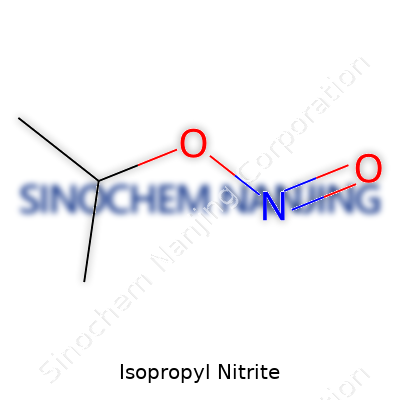
| Names | |
| Preferred IUPAC name | propan-2-yl nitrite |
| Other names |
2-Propylnitrite Isopropyl nitrite Nitroisopropane Isopropyl alcohol nitrite |
| Pronunciation | /ˌaɪ.səˈprəʊ.pɪl ˈnaɪ.traɪt/ |
| Identifiers | |
| CAS Number | 541-42-4 |
| 3D model (JSmol) | `JSmol.loadInline("data/mol/C3H7NO2.mol")` |
| Beilstein Reference | 1631659 |
| ChEBI | CHEBI:87242 |
| ChEMBL | CHEMBL1946362 |
| ChemSpider | 64878 |
| DrugBank | DB14030 |
| ECHA InfoCard | 100.007.874 |
| EC Number | 208-779-0 |
| Gmelin Reference | 7834 |
| KEGG | C19443 |
| MeSH | D019349 |
| PubChem CID | 522142 |
| RTECS number | TZ4300000 |
| UNII | 208K232IKW |
| UN number | UN2059 |
| Properties | |
| Chemical formula | C3H7NO2 |
| Molar mass | 89.09 g/mol |
| Appearance | Yellow liquid |
| Odor | sweet, fruity |
| Density | 0.872 g/cm³ |
| Solubility in water | slightly soluble |
| log P | 2.1 |
| Vapor pressure | 46 mmHg (20°C) |
| Acidity (pKa) | 11.0 |
| Basicity (pKb) | pKb ≈ 3.6 |
| Magnetic susceptibility (χ) | -28.0×10⁻⁶ cm³/mol |
| Refractive index (nD) | 1.393 |
| Viscosity | 10 cP (20 °C) |
| Dipole moment | 3.0204 D |
| Thermochemistry | |
| Std molar entropy (S⦵298) | 274.8 J·mol⁻¹·K⁻¹ |
| Std enthalpy of formation (ΔfH⦵298) | -144.8 kJ/mol |
| Std enthalpy of combustion (ΔcH⦵298) | -1794 kJ/mol |
| Pharmacology | |
| ATC code | N02AD10 |
| Hazards | |
| GHS labelling | GHS02, GHS06 |
| Pictograms | GHS02, GHS06 |
| Signal word | Danger |
| Hazard statements | H225, H302, H315, H319, H335 |
| Precautionary statements | P210, P261, P264, P271, P304+P340, P312, P501 |
| NFPA 704 (fire diamond) | 3-4-0 |
| Flash point | The flash point of Isopropyl Nitrite is **"-20°C"**. |
| Autoignition temperature | 130 °C |
| Explosive limits | 2 – 10.46% (in air) |
| Lethal dose or concentration | LD₅₀ (oral, rat): 410 mg/kg |
| LD50 (median dose) | LD50 (median dose): 0.667 mL/kg (rat, oral) |
| NIOSH | RN 541-42-4 |
| PEL (Permissible) | PEL: 10 ppm |
| REL (Recommended) | 20 ppm |
| IDLH (Immediate danger) | 800 ppm |
| Related compounds | |
| Related compounds |
Amyl nitrite Butyl nitrite Ethyl nitrite Methyl nitrite Nitroglycerin |



