Isophthaloyl Chloride: A Hard Look at a Chemical Powerhouse
Historical Development
Chemistry classrooms love to toss out names like “isophthaloyl chloride,” but most folks outside specialty manufacturing rarely hear much about it. The story of this compound starts with the rise of aromatic chemistry in the nineteenth century. Researchers in those old European laboratories, working their way through coal tar derivatives, originally isolated isophthalic acid from petroleum byproducts. Once organic chemists figured out how to make acid chlorides from dicarboxylic acids, the stage set itself for the birth of isophthaloyl chloride. As the plastics and fibers revolution took off in the 1940s and 50s, big chemical companies turned to compounds like this one when seeking better intermediates for high-performance polymers and resins. This history shapes its reputation for reliability — and, honestly, some headaches on the shop floor.
Product Overview
Isophthaloyl chloride has carved its niche as a versatile intermediate, especially in the world of polymer chemistry. It’s a pale yellow solid at room temperature, fond of water about as much as a cat taking a bath. You find it in tough everyday items: high-strength fibers, advanced resins, special coatings, even some stuff you might touch in a hospital or cleanroom. Folks like me, with their hands in the chemical supply business, see it as one of those boringly critical links in the chain. Nobody buys isophthaloyl chloride for itself — it’s always a means to an end. That’s its calling card: getting tucked into molecules where durability and chemical resistance are top priorities.
Physical & Chemical Properties
This chemical stands out with a melting point just above room temperature, usually settling somewhere in the mid-40 degrees Celsius range. Its pungent odor is unforgettable, especially on a humid afternoon in a poorly ventilated lab. Contact with moisture causes it to fume, and the hydrochloric acid released goes after skin and steel with equal gusto. Its solubility profile skews toward non-polar organic solvents because polar solvents, especially those with a trace of water, kick off hydrolysis and ruin batches in a heartbeat. This reactivity explains why those working with isophthaloyl chloride often describe it as fussy and quick to bite if you forget your gloves. The molecule packs two acid chloride groups onto a benzene ring, balanced apart from each other, and that arrangement defines how it acts in any given reaction.
Technical Specifications & Labeling
Packaging and labeling for isophthaloyl chloride don’t just serve legal needs: they save lives and protect equipment. Chemical grade requirements call for detailed reporting on purity, typically greater than 99% for most industrial use. Residues of free acid or tar are tracked in the low single digits. Documentation covers everything from quality control batch numbers to pictograms warning against inhalation, skin contact, and letting any stray moisture sneak in. I’ve seen enough battered drums leaking their labels in forgotten storage rooms to appreciate the strict standards behind every container leaving a reputable supplier’s warehouse. Without discipline at this level, downstream processes get derailed fast.
Preparation Method
The standard prep for isophthaloyl chloride leans on the old favorite: thionyl chloride. You start from isophthalic acid, combine it with thionyl chloride, and stir the mixture under anhydrous conditions, usually with just enough heat to keep the reaction moving. Hydrogen chloride and sulfur dioxide bubble off, demanding serious handling infrastructure. Keeping water out stays at the top of every operator’s list, since an accidental splash turns an expensive batch into a foaming, corrosive mess. Many chemists have tales of ruined boots and burnt nostrils from an afternoon with this reaction gone sideways. After purification, the finished product hits the shelves as either a melted or solid form, sometimes packed under nitrogen for longer shelf life.
Chemical Reactions & Modifications
Isophthaloyl chloride behaves like other acid chlorides, attacking nucleophiles all day long. Where it really shines is in coupling reactions — think polyamide or polyester synthesis — linking up with diamines or diols to form the building blocks for modern advanced materials. Each conversion lays down backbones for materials strong enough for jet engines or thin enough for medical membranes. The industry standard reactions run best under dry, inert atmospheres with tight temperature control, and the tiniest water leak torpedoes yields. Chemical engineers and synthetic chemists alike have chased methods to modify the core reactivity, fine-tuning polymer features by playing with side groups or process conditions. Every time a new demand comes in from the world of electronics or biomedicine, it sends the lab back to the drawing board with this molecule in hand.
Synonyms & Product Names
Chemists love to confuse outsiders with a mess of names. Isophthaloyl chloride pops up in technical papers as m-Phthaloyl chloride or benzene-1,3-dicarbonyl dichloride. Some patents and product catalogs swap in 1,3-benzenedicarbonyl dichloride, while older literature sticks to simple abbreviations like IPC. These aliases make searching not just a headache but also a test of patience for anyone who isn’t fluent in chemical taxonomy. In daily practice, specifying the CAS number beats dancing around long-winded names, helping buyers avoid costly mix-ups.
Safety & Operational Standards
Safety culture keeps rearing its head in the world of hazardous chemicals, and isophthaloyl chloride demands respect every step of the way. Its fumes corrode metal vents and inflame lungs, and skin contact turns workdays into ER visits for even the most careful tech. Proper protective gear stretches beyond gloves and goggles to include full-face shields and chemically resistant clothing. Workers need training not just on routine handling but on spill response and first aid. Regulatory agencies push for closed systems, vapor extraction, and meticulous maintenance in any facility that stocks this stuff. I’ve watched old-timers retire early after letting their guard down, and the lesson sticks: you don’t cut corners with this compound. Quality assurance goes as far as regular leak checks, air monitoring, and detailed reporting, which supports not just compliance but also common sense.
Application Area
Most folks brushing up against isophthaloyl chloride do so through the materials built from it, rather than the raw stuff itself. In my time watching product development cycles, demand rises and falls based on shifts in high-end composites, specialty plastics, and advanced coatings. Its backbone ends up in everything from bulletproof vests to membranes scrubbing industrial exhaust. Aerospace and defense teams lean on the fibers it helps create to push performance further without weighing down designs. The medical field turns to sterilizable plastics crafted with its input to fend off infections. Even water treatment systems benefit, using membranes born from its chemistry to filter the smallest contaminants. Each application brings a new regulatory requirement or performance spec, sending procurement teams scurrying for new sources or safer grades. That cycle has kept isophthaloyl chloride a staple in most supply lists, even while its risks make it a hard sell in greener, more health-conscious economies.
Research & Development
Researchers never seem to run out of ideas for squeezing more out of tried-and-true intermediates like isophthaloyl chloride. The emphasis lately has shifted toward lowering byproducts, boosting atom efficiency, and finding replacements for the nasty reagents that have stuck around since the last century. Green chemistry conferences keep showcasing how to limit environmental impacts through better catalysts or alternative reaction routes. I’ve seen academic groups partnering with big industrial labs, hunting for milder protocols that sidestep thionyl chloride altogether. On the materials side, labs push new copolymers and functional coatings aimed at novel uses, from electronics packaging to artificial organs. Staying a step ahead of regulatory crackdowns and customer fears about toxic residues drives companies to pour resources into research, hoping the next breakthrough nets both better safety and bigger profits.
Toxicity Research
I’ve lost count of the lab safety meetings spent hashing out hazard data on isophthaloyl chloride. Its acute toxicity centers on those reactive acid chloride groups — inhaling vapors or getting splashed can leave lasting respiratory damage and severe burns. Chronic exposure brings up worries about cumulative organ effects and hypersensitivity, especially for workers in poorly ventilated spaces. Toxicologists keep poking for data on metabolites, knowing that acidic hydrolysis products can linger in wastewater if neutralization steps get skipped. The literature remains thin on long-term environmental fate, thanks partly to confidentiality in industry. If anything, the drive for more transparency in chemical safety has pushed companies to look harder at not just acute symptoms but also subtle risks, like trace contamination in polymers meant for food or medical use.
Future Prospects
Isophthaloyl chloride won't vanish from the marketplace soon. The pressure to innovate in materials science means companies will keep reaching for molecular scaffolds that deliver both strength and versatility. Regulation marches forward, nudging chemists to rework processes for less waste and lower toxicity. For those of us who’ve watched the industry evolve, a dual challenge emerges: keep pace with stricter “green” standards while maintaining affordable, reliable supply chains. There’s no silver bullet on the horizon; instead, progress crawls forward through tweaks to production methods, smarter waste handling, and relentless data gathering on safety. With new polymers and composites rolling out each year, the future for isophthaloyl chloride looks stable but always up for a rethink. This chemical stays central to so many innovations that, even as safety drives change, its story will keep evolving in labs and factories around the globe.
What is Isophthaloyl Chloride used for?
What Makes Isophthaloyl Chloride Essential?
Walking through a home improvement store, most folks focus on finished goods—paints, plumbing, maybe bike helmets on the sporting aisle. Few realize the journey of the raw materials that shaped these products. Isophthaloyl chloride quietly fuels a wide range of manufacturing. It's a clear, pungent liquid, but the real action starts once it reacts with other chemicals. In the world of chemistry, a little goes a long way if the molecule happens to connect the right stuff together.
Key Uses: More Than a Lab Curiosity
Manufacturers count on isophthaloyl chloride for polyesters and polyamides. These words sound technical, yet they point to materials found in water bottles, synthetic clothing fibers, car interiors, and electrical insulation. Technologies changed plenty since the early era of plastic, and isophthaloyl chloride offers several properties that bulk up durability and temperature resistance.
Think about packaging—stretch film needs resilience but not the brittleness seen in cheap plastics. Isophthaloyl chloride brings flexibility by forming tight bonds at the molecular level, securing plastic chains together. Sporting goods brands rely on similar chemistry for protective gear. Bike helmet shells, for example, depend on strength and shock resistance to do their job. Chemicals like this won’t make the headlines, but the safety of a helmet comes from what remains invisible to the user.
Now, turn to fibers. Next time a polyester parka beats back winter wind, or luggage fabric shrugs off airport abuse, isophthaloyl chloride likely played a role. This chemical produces polymers that hold up against abrasion and moisture. Manufacturers need these qualities when customers demand gear that won’t fail mid-trip or mid-hike.
Specialty Applications Step In
Electronics is a quieter market, yet reliability here matters no less. Switches, connectors, and insulating parts endure heat and current. Isophthaloyl chloride blends into the manufacture of polyimide films, materials that don’t melt even at high temperatures. Data centers, electric vehicles, and solar panels all rely on components built from stable chemistry. These industries demand lifespans measured in years, not months.
Research labs also use isophthaloyl chloride to create custom polymers. These experiments pave the way for more energy-efficient batteries, medical devices, or water filtration membranes. By linking settings on a molecular scale, even small tweaks can lead to lighter or safer materials that serve new purposes down the road.
Risks and Practical Solutions
Nothing in manufacturing comes without trade-offs. Isophthaloyl chloride reacts with moisture in the air—it stings eyes and burns skin without careful handling. Workers deserve strong ventilation and solid training. Factories need equipment and systems that keep chemical leaks under control. Studies on chemical safety show that regular monitoring and fast response protocols help reduce accidents.
Waste handling carries another layer of challenge. This chemical breaks down into hydrochloric acid in water, raising concerns for wastewater treatment. Local regulations push for neutralization before discharge. Technology can help here, too: closed-loop systems recapture waste streams and convert hazardous byproducts.
Building Smarter, Lasting Materials
Experience shows that no single chemical solves every problem. Isophthaloyl chloride earns its spot for making strong, reliable plastics and fibers that touch many parts of daily life. People working in factories, product design, and safety management see firsthand how raw chemicals shape both what we use and how we protect workers and the environment. Smarter engineering and ongoing research continue to improve both product performance and safety—a lesson worth carrying into any industry that leans on modern materials.
What is the chemical formula of Isophthaloyl Chloride?
Understanding Isophthaloyl Chloride’s Formula
Anyone working around polymers has handled isophthaloyl chloride at least once. Its chemical formula, C8H4Cl2O2, maps out like a simple code connecting benzene rings with chemical functionality that drives big industries. This molecule shapes everything from water bottles to bulletproof vests—not in the glamorous headline-grabbing way, but at the grinder bench, where innovation happens molecule by molecule.
Where Knowledge Meets Application
Years in a lab have taught me that formulas are more than symbols on paper. C8H4Cl2O2 starts with a six-carbon benzene ring, two carboxylic acid chloride groups attach at the 1 and 3 positions. Those chlorides bring well-placed reactivity, letting the molecule create strong links with diamines. This reliable bond creates aromatic polyamides (aramids), most recognized by the trade name Kevlar. Behind the scenes, isophthaloyl chloride gives chemical toughness to countless objects expected to handle rough treatment.
Impact on Materials Science and Safety
This chemical doesn’t just make plastics; it gives structural integrity to products relied on for safety. In the early 2000s, the need for lightweight, durable armor shot up. Research teams, including my own, hit on isophthaloyl chloride’s unique setup—two acyl chloride groups spread far apart—making it perfect for long, strong polymer chains. This proved vital, both for soft ballistic vests and for lightweight reinforcements in aircraft.
Health, Handling, and Environmental Concerns
People often pay less attention to the flip side of reactivity. Handling isophthaloyl chloride demands good ventilation, protective gloves, and a real respect for splash risks. The chemical stings on contact, and fumes cause irritation. Extra care means fewer accidents in small workshops and large plants alike. Proper storage—dry, cool, in well-sealed containers—keeps everyone safe on long shifts.
Waste treatment creates another discussion. Many producers face challenges disposing of leftover material and hydrochloric acid by-products. High demand for polyamides means large production scales, raising tough questions. Neutralizing acidic residues, using scrubbers, and investing in recycling can reduce the environmental toll. Companies that look ahead now often avoid regulatory headaches and costly cleanups later.
Responsible Progress in Polymer Manufacturing
Chemistry classes barely scratch the surface of industrial reality. In practice, strict controls, oversight, and respect for hazardous intermediates make innovation sustainable. Synthetic know-how meets social responsibility: safe handling, judicious disposal, and efforts to develop greener alternatives. As research pushes into new uses—conductive polymers, membrane filters, high-performance composites—the same chemical foundation supports a safer, more inventive future.
What safety precautions should be taken when handling Isophthaloyl Chloride?
Why This Chemical Calls for Caution
Isophthaloyl chloride isn’t a household name, but it turns up often in the plastics and polymers industry. Ask anyone who’s worked in those settings, and they’ll tell you this chemical isn’t something to mess with. I worked in a mid-sized specialty plastics company for a few years, clocking in next to the process bay, and nothing killed the mood faster than a spill. Some days, just the vapor snuck through the corner of a gasket and we’d feel it in the back of our throats. That’s a sign in itself—skip the short sleeves or open shoes anywhere near it.
Skin, Eyes, and Lungs Take the Biggest Hits
Isophthaloyl chloride can burn right through clothing, irritate eyes, and if you inhale it, you’ll know straight away. Swapping out jeans and sweaters for a full splash-proof apron, chemical gloves, and tight-fitting goggles made a noticeable difference. Even with quick jobs, it’s tempting to ‘just do it’ and skip the gear, but nobody wants red, raw skin for a week. For anyone new, learning why long sleeves and fast use of eyewash stations matter took a quick splash to the wrist.
Ventilation Means Everything
Chemists who know their stuff always set up fume hoods or solid extraction fans before uncapping anything. These systems don’t just remove the odor; they grab the toxic vapors before anyone breathes them in. I remember the sting in the air when a fresh intern missed a cracked valve and the fan was off. He ended up outside for an hour, head pounding and eyes watering. Since then, everyone checked airflow before anything opened up. Getting this right kept accidents from becoming full-blown incidents.
Proper Storage Makes Everyone Safer
Leaving isophthaloyl chloride on a general storage rack never ended well. We switched to clear-label, corrosion-resistant drums, and kept everything separate from water sources. This chemical loves to react with water, forming hydrochloric acid almost instantly. Keeping an absorbent spill kit close helped mop up small leaks quickly without panic. After trying to clean a sticky spill with just rags, the team pushed for proper containment trays under every drum—no more sticky shoes or ruined floor tiles.
Regular Training Makes Mishaps Less Likely
Our crew ran short safety refreshers every few months. The most memorable lessons always came with real-life stories: the time a senior tech forgot his gloves and wound up with red streaks on his arms, or the event that sent emergency alarms wailing because someone forgot to flip on the extractor fan. We walked through the procedure for dealing with splashes or inhalation, and practiced using the emergency shower and eyewash unit. Muscle memory meant fewer pauses in a real crisis.
The Gear and Smarts to Get By
Synthetic rubber gloves that reach the elbow, thick aprons, shaded goggles, and a pair of chemical-resistant boots made every shift safer. After a couple months, putting on the gear felt natural. We ran daily checks on the fume system, watched storage temperature, and backed every chemical transfer with a documented checklist. Mixing these habits with a healthy respect for the risks made for smooth, safe shifts on every job.
Looking Out for Each Other Works Best
Nobody should have to learn the hard way. Having a team that talks out loud about safety steps, double-checks labels, and keeps alert pays off. In my experience, tough days got easier when everyone on the floor felt like looking out for each other belonged in the routine. If you’re working near isophthaloyl chloride, or supervising a team, clear rules and hands-on safety walk-throughs are worth the extra time.
How should Isophthaloyl Chloride be stored?
Treat This Chemical With Respect
Anyone who’s spent time working around chemicals knows safety begins with storage. Isophthaloyl chloride stands out as a chemical that demands careful handling. It’s not just about ticking off safety checklists or ticking a box on an audit sheet. It's about avoiding disaster in the lab or plant.
Understanding the Risks
Isophthaloyl chloride reacts violently with water and moisture, producing toxic byproducts like hydrogen chloride gas. Once, a leaky container left in a humid storeroom forced the whole floor to evacuate. The sharp odor hit everyone at once, a burning, inescapable sting. No one wants to repeat that mistake.
Storing this chemical where there’s any chance of humidity won’t cut it. Regular cardboard or loosely sealed bins don’t work. People sometimes underestimate just how quickly water vapor can ruin a batch of chemicals and create hazardous gas. It’s not a hypothetical risk. Accidents from improper storage can put workers and first responders in danger, and contaminated product means wasted money.
Choosing Safe Containers and Locations
Solid storage starts with the right containers. Always stick to tightly sealed glass or high-grade plastic—polyethylene or Teflon work, but metals corrode and create their own hazards. I’ve found that suppliers usually dispatch it in sturdy, airtight drums for a reason. After breaking the seal, transferring to smaller containers with proper screw caps protects both the chemical and the people.
Location plays a big role. Shoving these containers on any old shelf, next to acids or bases, spells trouble. I remember seeing a shelf labeled for “miscellaneous organics,” and I shuddered at the sight. Mixing incompatible chemicals in storage areas can lead to fires or toxic fumes. A dedicated chemical cabinet, well away from sunlight and heat, offers the safest bet. Cool, well-ventilated, and dry storage rooms—with desiccant packs added for good measure—have kept my labs running incident-free.
Labeling, Routine Checks, and Emergency Planning
Clear labels prevent mix-ups. You don’t want to rush, grab a jug at the end of a shift, and realize too late you poured the wrong liquid into a reactor. A bold, unmistakable label on every container has saved me more than once.
Relying on “just in time” ordering seems tempting, but small labs sometimes hold onto older reagents to save costs. This invites leaks and contamination. Once per month, I make it a habit to check for corroded lids, dampness, or odd smells in the chemical cabinets.
Good intentions won’t help during a spill. Spill kits with absorbent pads, full-face respirators, and neutralizers stay close by. Everyone who works nearby should know how to use them—and more than once, those few minutes before help arrives have made the difference between a routine cleanup and a full-blown incident.
Training the Next Generation
Teaching proper storage isn’t just for compliance or passing audits. My first mentor told me that chemical safety habits keep your fingers attached and your lungs clean. Walking through storage protocols with every intern, every new team member, means less risk and more confidence. Isophthaloyl chloride has a place in industry, but only those who show it real respect keep themselves, and their colleagues, safe.
What are the physical properties of Isophthaloyl Chloride?
Look, Touch, and Smell: How Isophthaloyl Chloride Shows Up
White, flaky, and powdery describe isophthaloyl chloride on a table in a lab. Some call it a crystalline solid, and it usually means you’re handling a substance that doesn't clump together. If you've ever seen benzene-based compounds, this one stands apart by giving off a sharp, pungent odor. Folks working near it learn quickly: a sniff can linger in the air and demand a well-ventilated room.
Melting and Boiling Points—Why These Matter
At about 77°C, this powder starts to melt, slipping into a clear liquid. This isn’t a high melting point by chemical standards, which means ordinary heat sources in the lab can cause a change of state. The boiling point sits at 265°C. Those who work with it know that, even if it looks stable on the shelf, the compound reacts long before high temperatures cause it to boil. So storage and temperature control aren’t optional—they’re a must for safety and purity.
Solubility and Reactivity: Mixing and Matching
Try mixing isophthaloyl chloride with water, and you get a quick, flash-like reaction. Instead of dissolving, it breaks down, releasing hydrogen chloride gas. The same goes for any moist conditions, so the folks handling it need dry gloves, dry scoops, dry everything. In organic solvents like dichloromethane or chloroform, it dissolves easily. This gives chemical manufacturers a way to whip up several important polymers and specialty plastics. Its reactivity makes it just as much a benefit for industry as a hazard for careless storage.
Storing and Handling—Risks Are Real
I’ve watched new chemists learn the hard way: even a little exposure to isophthaloyl chloride on skin or through inhalation stings and can end a workday fast. You’ll see people take real care—special gloves, face shields, sealed bottles. Chemical supply houses pack it tightly because even a bit of humidity can trigger a reaction. That’s not just lab paranoia; it comes from stories where a loose lid meant ruined reagents and an emergency call.
Why All This Matters In Real Life
Polymers, resins, and specialty fibers wouldn’t exist without people who know how to manage tricky compounds like isophthaloyl chloride. Its physical properties influence every decision—from the guy moving it from warehouse to lab, to the engineer picking storage containers. Sure, it’s a building block. But it’s also something that brings real risks if you miss a safety step. Chemical burns, ruined work, and health issues follow shortcuts with this one.
Thoughtful Solutions—A Culture, Not Just A Checklist
Training hands-on beats any warning label. In every lab I’ve worked in, the best safety came from people sharing their mistakes and lessons right in front of the bench. Investing in airtight containers and clear labeling looks like a small thing, but it avoids major headaches. Good ventilation and routine checks for leaks and spills make a bigger difference than another shelf of paperwork ever could. Mixing experience, caution, and solid supplies—those shape the real approach to dealing with materials like isophthaloyl chloride.
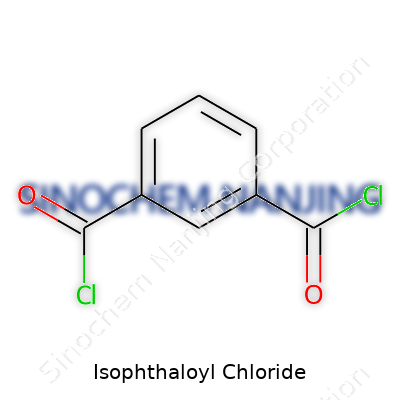
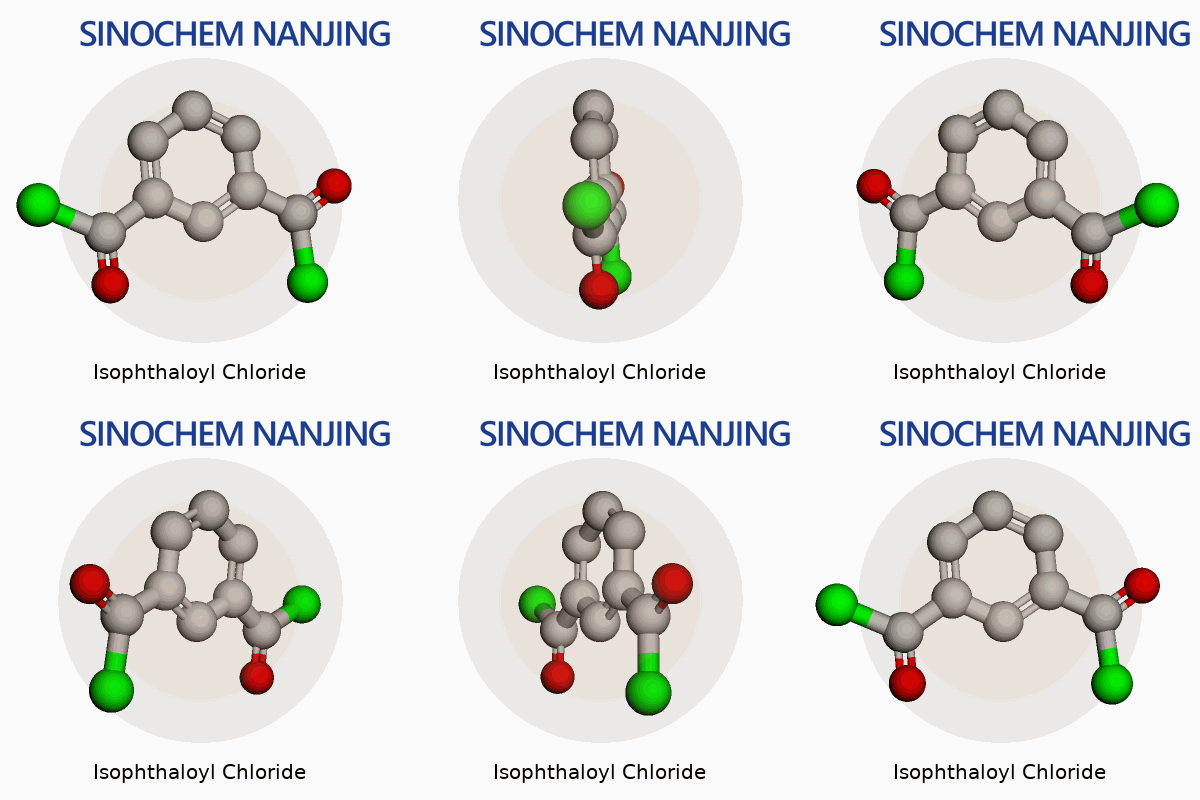
| Names | |
| Preferred IUPAC name | benzene-1,3-dicarbonyl dichloride |
| Other names |
IPA Cl Isophthaloyl dichloride 1,3-Benzenedicarbonyl chloride 1,3-Benzenedicarboxylic acid chloride Isophthalic acid dichloride |
| Pronunciation | /ˌaɪˌsɒfˈθæloʊɪl ˈklɔːraɪd/ |
| Identifiers | |
| CAS Number | 99-63-8 |
| 3D model (JSmol) | `Isophthaloyl Chloride JSmol 3D model string: "C1=CC(=CC=C1C(=O)Cl)C(=O)Cl"` |
| Beilstein Reference | 1208733 |
| ChEBI | CHEBI:34705 |
| ChEMBL | CHEMBL1230490 |
| ChemSpider | 55349 |
| DrugBank | DB03239 |
| ECHA InfoCard | 03b1a0d2-acc8-4164-adbb-f255cf495998 |
| EC Number | 211-893-4 |
| Gmelin Reference | 149564 |
| KEGG | C14364 |
| MeSH | D007693 |
| PubChem CID | 8595 |
| RTECS number | GW4050000 |
| UNII | 6T6P94251T |
| UN number | UN3261 |
| CompTox Dashboard (EPA) | DTXSID4034674 |
| Properties | |
| Chemical formula | C8H4Cl2O2 |
| Molar mass | 203.03 g/mol |
| Appearance | White to pale yellow flakes or powder |
| Odor | Pungent |
| Density | 1.51 g/cm3 |
| Solubility in water | Reacts with water |
| log P | 1.74 |
| Vapor pressure | 0.001 mmHg (25 °C) |
| Acidity (pKa) | pKa -2.5 |
| Basicity (pKb) | Basicity (pKb) : -3.3 |
| Magnetic susceptibility (χ) | -60.0e-6 cm³/mol |
| Refractive index (nD) | 1.578 |
| Viscosity | 1.7 mPa·s (at 25 °C) |
| Dipole moment | 2.70 D |
| Thermochemistry | |
| Std molar entropy (S⦵298) | 354.6 J·mol⁻¹·K⁻¹ |
| Std enthalpy of formation (ΔfH⦵298) | -325.0 kJ/mol |
| Hazards | |
| GHS labelling | GHS02, GHS05, GHS07, GHS08 |
| Pictograms | GHS05,GHS06 |
| Signal word | Danger |
| Hazard statements | H301, H314, H317, H319, H331, H335 |
| Precautionary statements | Precautionary statements of Isophthaloyl Chloride: "P261, P264, P271, P272, P280, P301+P330+P331, P303+P361+P353, P304+P340, P305+P351+P338, P310, P321, P363, P405, P501 |
| NFPA 704 (fire diamond) | 3-1-2-W |
| Flash point | Flash point: 120 °C (closed cup) |
| Autoignition temperature | 525 °C |
| Lethal dose or concentration | LD50 oral rat 4840 mg/kg |
| LD50 (median dose) | LD50 (median dose): Oral rat LD50 = 4270 mg/kg |
| NIOSH | SN1225000 |
| PEL (Permissible) | PEL: 0.05 ppm |
| REL (Recommended) | 1.0 mg/L |
| IDLH (Immediate danger) | N/D |
| Related compounds | |
| Related compounds |
Terephthaloyl chloride Phthaloyl chloride Isophthalic acid Terephthalic acid |



