Looking Closer at Isobutyl Chloride: More Than Just a Chemical Compound
Historical Development
Back in the early days of organic chemistry, discoveries moved quickly and chemicals like isobutyl chloride stood out for their versatility. Chemists, experimenting with alcohols and acids, found that treating isobutanol with hydrochloric acid gave rise to this liquid, which turned out to have far-reaching uses in both academic labs and industry. Over decades, this discovery drove forward research into making and modifying alkyl halides, eventually integrating isobutyl chloride into processes involving pharmaceuticals, agrochemicals, and polymer science. Picking apart this history isn’t only about tracking inventions—it tells us something about the role of small molecules in changing whole industries and everyday products.
Product Overview
Isobutyl chloride belongs to the family of alkyl halides and boasts a simple structure: a four-carbon chain with a chlorine atom replacing a hydrogen on the second carbon. Though it sits on the shelf as a clear, colorless liquid, it brings a strong, pungent smell—an obvious sign you need proper ventilation if working with it. A lot of folks see chemicals as esoteric, but this compound actually finds its way into practical tasks like making fragrances, synthesis of specialty chemicals, and as a building block for more elaborate molecules. Many common items, including flavors, pharmaceutical components, and even some plastics, trace back in part to this thoroughly researched compound.
Physical & Chemical Properties
Isobutyl chloride holds a low boiling point, around 68°C, and it doesn’t mix with water. Its density sits a bit lower than water, so spills float and evaporate quickly. The chemical reacts sharply with strong bases and oxidizing agents, sometimes in dramatic fashion. Anyone who has spilled a halide like this in a lab remembers the distinct, uncomfortable odor and the tantrum it can throw with air or flames nearby. That volatility complicates storage and transport, so those working with it usually keep it under tight controls. This also draws attention to the question of environmental safety: given its ability to vaporize, making sure it doesn’t leak matters a great deal for both worker health and minimizing emissions.
Technical Specifications & Labeling
Manufacturers producing and selling isobutyl chloride print technical data about purity, moisture content, and labeling requirements on their paperwork, following global chemical naming conventions. Typical grades must exceed certain purity thresholds, often above 98 percent. Labels warn of flammability, health risks, and proper handling. Legal frameworks like OSHA, REACH, and local standards shape this part of the process, pushing chemical producers to identify hazards clearly and maintain transparency about the origin, hazards, and safe storage of every container. Though these may seem like bureaucratic hurdles, they directly protect people up and down the supply chain—including anyone who might accidentally come across this liquid in the wrong setting.
Preparation Method
Most isobutyl chloride comes from treating isobutanol with a chlorinating agent, most commonly hydrochloric acid or thionyl chloride. Chemists often run this reaction in glassware fitted with condensers to capture escaping vapors, and then purify the final product by distillation. This classic approach draws on principles first established in the nineteenth century, reflecting how many “old” chemical methods still define modern synthesis. Over time, tweaks like adding catalysts or using greener solvents have emerged, acknowledging the risks tied to older methods and the priority placed on cleaner chemistry. Commercial producers scale up laboratory methods carefully, since increasing batch sizes multiplies safety and environmental challenges exponentially.
Chemical Reactions & Modifications
Organic chemists value isobutyl chloride for its ability to participate in nucleophilic substitution, a foundational reaction for building more complex chemicals. Reacting it with sodium cyanide leads to isobutyronitrile, which itself serves as a building block for pharmaceuticals and agrochemicals. Adding alcohols or amines pushes the molecule into new territory, forming ethers or amines tailored for particular uses. Each reaction comes with choices about speed, solvent, and temperature, which experienced chemists optimize to improve yields and reduce hazardous waste. Whether in laboratories or industrial reactors, isobutyl chloride’s reactivity often opens doors for downstream innovation in product design.
Synonyms & Product Names
Chemicals don’t always travel under the same name. Isobutyl chloride sometimes shows up as 2-chlorobutane, 1-chloro-2-methylpropane, or isobutylchloride, depending on context. Knowing these differences matters—mislabeled shipments or product confusion can lead to dangerous mix-ups. International regulatory agencies insist on standardized nomenclature, but a social side persists as scientists and technicians hold on to local or historical names. This can make global collaborations tricky, highlighting the ongoing need for education across technical and language barriers.
Safety & Operational Standards
No one takes short cuts with isobutyl chloride. You use gloves, splash goggles, and chemical fume hoods, because one brief exposure can irritate eyes, respiratory tract, and skin. Guidelines for safe handling come from practiced routines and are constantly reviewed after incidents, accidents, or new research. Storage needs low temperatures and tight seals to avoid evaporation and accidental ignition. Clean-up demands both speed and care—spill kits with neutralizing agents, absorbents, and double-bagging of wastes. Facilities handling the chemical require training for everyone involved—not only chemists, but also maintenance, shipping, and emergency crews. Regular drills and up-to-date signage close the loop, helping workers internalize risks and respond quickly if something goes wrong.
Application Area
Chemists and industry workers have wrung surprising value from isobutyl chloride. In pharmaceuticals, it anchors syntheses of active ingredients and intermediates, serving as a launching point for drugs that treat both common and rare illnesses. In the field of agricultural chemicals, companies turn to it for building blocks of pesticides and herbicides. Makers of flavors and fragrances turn its unique backbone into molecules that define recognizable scents and tastes. This compound’s reactivity lets it slip into research projects for polymers, lubricants, and specialty coatings as well. Lab instructors use it to teach reaction mechanisms to students, putting it right in the thick of chemical education. With every new project, researchers find novel routes or purposes for this tiny but mighty molecule.
Research & Development
Innovation doesn’t stand still. Chemists continue to poke and prod at isobutyl chloride’s structure, designing better syntheses, more efficient catalysts, and creative routes to minimize waste. The broader research community keeps running trials on alternative halogenating agents, aiming for lower emissions and improved safety. Collaborative projects between universities and industry bring together fundamental research with commercial-scale realities, leveraging new spectroscopic methods and computational models to shorten development cycles. Green chemistry—the quest to reduce toxins, energy use, and emissions—pushes every research group not to rest on old methods, but hunt for improvements that address both efficiency and environmental responsibility.
Toxicity Research
No discussion of isobutyl chloride can dodge toxicity. Research points to acute effects if inhaled or absorbed, such as nose and throat irritation or dizziness, and long-term exposure brings more serious risks. Studies in both animals and cell cultures track how different organs and systems react to repeated contact or high concentrations. Environmental scientists look at breakdown rates in soil and water, focusing on possible accumulation or harmful byproducts. Regulatory agencies watch for updated research, sometimes adjusting acceptable exposure limits or setting new rules for permitted release. All these ongoing studies keep the chemical community alert and force a continuous dialogue between science, safety, and policy.
Future Prospects
Looking ahead, the path for isobutyl chloride will lead toward safer, more sustainable production and use. Efforts to design reactors with smaller environmental footprints run alongside projects to develop bio-based or more benign halogenating methods. Regulatory changes might tighten standards, and scientists explore opportunities to swap in alternative compounds with similar performance but milder safety profiles. Educational initiatives push for deeper understanding of risks at every career stage, from classroom to boardroom. As industries keep expanding the toolkit of available molecules, the legacy of this compound feels less about its original invention and more about the steady march towards cleaner, smarter, and safer chemistry. The work never truly wraps up—each research paper, regulatory shift, and market application renews the responsibility to blend technical progress with genuine stewardship.
What is Isobutyl Chloride used for?
What Sets Isobutyl Chloride Apart
Isobutyl chloride shows up in places most people overlook. This colorless liquid carries a sharp, pleasant scent, but its real role sits deep in the backbone of industry. Lab coats and chemical formulas make it easy to glance past how something like this shapes the products we use daily.
A Building Block for A Lot of Things
Picture the shelves at your local pharmacy. Behind many medications sits a string of hidden steps in the manufacturing pipeline. Isobutyl chloride helps build compounds for pharmaceuticals — often feeding into the creation of painkillers, antibiotics, and heart medicines. Its structure lets scientists tack it onto other molecules, changing their properties for different jobs. This kind of flexibility gives drug developers more options.
Its presence also appears in perfumes and fragrances. People don’t usually picture chemicals like isobutyl chloride in a bottle of cologne, but it helps by reacting with other materials to produce a smoother, more refined smell. Fragrance creators rely on isobutyl chloride to construct complex scent molecules, giving perfumes that distinct base note that lasts.
Rubber and plastic manufacturers also find this chemical useful. Additives made from isobutyl chloride help stabilize polyisobutylene — a material found in everything from adhesives to inner tubes. By holding the whole structure together, it makes sure the material doesn’t break down too early. If you’ve ever used a rubber seal or a waterproof tape, there’s a good chance a bit of isobutyl chloride factored somewhere into its journey.
Why Its Production Matters
Big plants producing isobutyl chloride have to walk a careful line. This substance reacts strongly with water and some metals, raising concerns for worker safety. Mistakes in handling can lead to accidents and environmental spills, which puts extra pressure on companies to stay vigilant. History offers plenty of cases where chemical factories have overlooked safety and ended up in the news for the wrong reasons. Regulations like the EPA’s Risk Management Program force companies to put in safety systems — leak detectors, ventilation, and employee training — since public trust crumbles fast after a chemical spill.
From an environmental angle, isobutyl chloride can irritate skin, eyes, and lungs. Wastewater treatment and air purification equipment are not just recommendations; they are standards. Those working in close contact wear masks, gloves, and proper gear to cut down on health risks.
Safer Alternatives and Future Shifts
Companies are always searching for greener options. Green chemistry pushes for processes that swap toxic chemicals for safer ones wherever possible. Some research groups try to limit isobutyl chloride’s use, especially in consumer products, by testing less hazardous compounds. The trade-off comes in performance and price. Old habits in chemical manufacturing often put reliability over change, so progress runs slow.
Keeping these chemicals out of waterways and air means more than just following rules — it lines up with what communities expect from local industry. Showing up for public safety meetings, offering workers training and serious health coverage, and sticking to high cleanup standards all go well beyond paperwork. People care about what happens near their homes, and everyone benefits when companies treat chemical handling as a public responsibility.
What This Means for Everyday Life
Most folks won’t ever see a bottle labeled “isobutyl chloride” at the store, but the product’s reach stands wide. From medicine cabinets to car repair shops, it threads through everyday life almost invisibly. Pushing for better safety in its production and storage keeps neighborhoods protected, while research into greener chemistry opens the door for cleaner and safer choices. This balance, between proven utility and public responsibility, shows up every time someone uses a product built on a reliable chemical foundation.
What is the chemical formula of Isobutyl Chloride?
Getting Familiar with Isobutyl Chloride
Isobutyl chloride goes by the formula C4H9Cl. Its structure tells a story about rearrangement. Unlike n-butyl chloride, it branches at the second carbon. This seems like a small change, but branching changes the game in chemistry. The formula reveals four carbon atoms, nine hydrogen atoms, and one chlorine atom, giving it some unique properties. Anyone who has spent time in a laboratory knows how slight structural twists affect reactivity and volatility. I remember the first time I handled isobutyl chloride in an undergraduate lab—its sharp, characteristic odor is unforgettable, and a reminder of its potent presence, even in small amounts.
A Closer Look at Uses
Isobutyl chloride serves as a starting point for synthesizing other organic compounds. Companies rely on it in pharmaceuticals, agrochemicals, and fragrance manufacturing. Its chemical makeup allows industry workers to swap out the chlorine atom for other groups, opening the door for drug precursors and specialty chemicals. Having seen the synthetic process in action, the efficiency depends as much on the structure of the starting material as on the skill of the chemist. The ability to engineer molecules from such a straightforward compound reflects the evolution of organic chemistry.
Potential Risks and Why Safety Counts
Isobutyl chloride comes with its own set of hazards. It irritates the skin and eyes and gives off fumes that can overwhelm small rooms quickly. Mishandling it often means quick lessons in setting up good ventilation and wearing gloves. Stories circulate among lab workers about spills and scrambles for the nearest eyewash station. Just as with other chlorinated solvents, inhaling its vapors puts people at risk for coughing or respiratory discomfort. Agencies like the Occupational Safety and Health Administration (OSHA) build rules around limits for such chemicals, since countless workers encounter them each year. For those storing or transporting isobutyl chloride, the tightly sealed containers and clearly marked labels are not just bureaucracy—they stop accidents before they happen.
Environmental and Health Connections
Leaks or improper disposal can put isobutyl chloride into soil or water, where it can harm aquatic life and linger for long stretches. I’ve spoken with wastewater engineers who worry about chlorinated organics altering microbial activity in treatment ponds. In the context of chemical management, that means responsible companies monitor emissions and invest in scrubbers or recovery units, aiming to keep release numbers low. With growing attention on sustainable manufacturing, the push grows for greener solvents and recycling measures. Isobutyl chloride highlights how each step, from handling to breakdown, links to bigger concerns about public health and the environment.
Working Toward Safer Chemistry
Simple steps can make a difference: proper labeling, worker training, and routine monitoring often keep risks in check. Institutions, from schools to big manufacturers, look for ways to substitute safer chemicals where possible. Green chemistry research continues to chip away at the need for dangerous chlorinated solvents, sometimes swapping in bio-based or less reactive options. At its core, using a compound like isobutyl chloride responsibly demands respect for its chemical structure—and for the community using, and living near, these important molecules.
What safety precautions should be taken when handling Isobutyl Chloride?
Know the Risks Before Opening That Drum
Some chemicals ask for extra respect right out of the gate. Isobutyl chloride fits the bill. With its low flash point, flammable vapors, and corrosive tendencies, it isn’t the kind of thing to handle on instinct or without some real preparation. My own background in industrial labs taught me warnings exist for a reason. I’ve seen what can happen if someone shrugs off gloves for “just a quick look” or figures the ventilation will take care of itself.
Get Personal Protective Gear Sorted Every Time
At the top of the list: gloves made of materials that actually resist chlorinated solvents, such as nitrile or butyl rubber. Too many times I’ve seen folks grab latex out of habit. Eye protection isn’t optional, either. Full splash goggles, preferably combined with a face shield, keep droplets away from delicate spots. Isobutyl chloride can cause burns and serious irritation in seconds.
Lab coats or chemical aprons make spills less scary. Closed-toe shoes that cover the whole foot matter even in small quantities. In hot weather or cramped quarters, the gear may feel like overkill, but there’s nothing worse than regretting you skipped a step after the fact.
Respect Your Lungs and Surroundings
Ventilation matters more than some folks realize. Fume hoods, local exhausts, or even a well-designed general ventilation system play a huge role. Isobutyl chloride vapors catch fire easily and can irritate lungs, so it never pays to trust a single cracked window or a lazy fan.
Never pour the chemical near open flames, sparks, or anything that could set off vapor ignition. Static can sometimes do the trick, especially on dry winter days. I learned early in my career to ground containers and use spark-proof tools.
Storage: Keep It Dry, Cool, and Contained
I’ve seen more mishaps from bad storage habits than any other cause. Isobutyl chloride belongs in a flammable materials cabinet, locked away from direct sunlight, heat sources, or incompatible chemicals like water, alcohols, and strong bases. Moisture encourages it to break down and give off hydrochloric acid—which eats through containers, gear, and skin with equal gusto.
Secondary containment—plastic trays or spill-proof bins—has saved people from mopping disaster off the floor more than once. Label every container clearly, even the smallest. It only takes one mix-up for a “routine” day at the bench to spiral.
What If Something Goes Wrong?
No one plans for trouble, but it pays to walk through spill drills as a team. Eyewash stations, safety showers, and fire extinguishers are only helpful if you can get to them fast. That means clearing paths and knowing who to call in a pinch. Using absorbent pads made for solvents keeps cleanup simple—the wrong absorbent makes fumes worse.
If someone gets splashed, quick action saves skin and eyes. I’ve learned from experience that cool, running water for at least fifteen minutes isn’t a guess—it’s company policy for good reason. Inhalation incidents call for fresh air and a trip to medical help, without delay.
Prevention Comes Down to Attitude
Handling isobutyl chloride safely takes more than checklists. It grows from a willingness to ask questions, run drills, and admit when conditions aren’t ideal. Training and equipment make a difference, but mindset counts for just as much. If the people on your team look out for each other and take these risks seriously, everyone goes home healthy. That’s what matters most.
What are the storage requirements for Isobutyl Chloride?
Why This Chemical Gets Everyone’s Attention
Anyone who spends time around chemical plants or warehouses knows that isobutyl chloride draws a crowd for both what it does—and what it can do if ignored. I used to work with operators who took pride in keeping volatile chemicals in line. You get to know the character of each one. Isobutyl chloride packs a punch with its flammability and tendency to send up toxic fumes. The stuff has a sharp odor you don’t easily forget, and mishandling it could ruin more than your day.
Containers and Compatibility Count
Strong, leak-proof drums or tanks carry the load. One slip-up with material choice, and you might end up with ruined equipment and worse. Carbon steel and stainless steel pass the durability test for isobutyl chloride. Many facilities trust coated drums specifically rated for chlorinated hydrocarbons. I’ve seen folks tempted to cut corners, putting cost savings over safety, but that route ends in expensive spills, lost reputations, and headaches with the safety inspector breathing down your neck.
No One Wants an Explosion—Temperature and Ventilation Make the Difference
Isobutyl chloride turns into a fireball if mishandled. Its flash point sits around -10 °C (14 °F), so sparks, open flames, and hot machinery spell trouble. Rooms should have the right explosion-proof electricals, and even lighting gets scrutinized in the annual inspection. Keeping stock cool matters—not freezing cold, but away from anything that swings into the heat wave range. Evaporation accelerates with warmth, sending vapors farther and faster. Good airflow keeps those vapors from building up to dangerous levels. I remember once seeing vapors collect unnoticed in a corner because a fan went out; two operators ended up with dizzy spells.
Moisture Turns This Stuff Nasty
Humidity triggers real trouble, not just sticky hands on a hot day. Isobutyl chloride and water do not make friends. A splash of moisture starts a reaction with hydrochloric acid as the nasty byproduct; that’s both corrosive and toxic. Keeping stock bone-dry involves careful seals on barrels and making sure storage rooms stay shut against the rain or high humidity. Back in my early days, someone once used a garden hose to ‘clean up’ a small spill; the cleanup bill and ruined floor tiles taught everyone to check protocol before acting.
Labeling and Access: The Human Side of Storage Safety
Clear labels make all the difference in the world. Labels fill in for memory. Unless you want to gamble on someone forgetting what’s in a drum, every container should feature hazard symbols and handling instructions. No exceptions for “short-term” or “it’ll only be here an hour.” Training remains non-negotiable. Newcomers and old hands both benefit from refreshers on the risks of isobutyl chloride. One of my mentors drilled ‘read twice, touch once’ into us all—those extra seconds keep emergencies from ever happening.
Building a Safer Routine
Improvement starts with those on the floor—not with distant managers. Gathering input from the staff who deal with isobutyl chloride daily leads to practical, workable storage plans. Regular reviews, updated material safety data sheets, and well-rehearsed leak response drills become the foundation for safety. No fancy technology replaces simple vigilance and the experience earned from each shift. That’s where smarter storage for isobutyl chloride begins and ends.
Is Isobutyl Chloride hazardous to health or the environment?
The Stuff Few People Talk About
Growing up near an industrial area, I learned to pay attention to what floats around in the air and water. Some chemicals have names that don't mean much at first glance. Isobutyl chloride sounds technical, but it plays a big role in making things like pharmaceuticals, pesticides, and even fragrances. The less glamorous side comes from what this chemical can do to people and the world outside.
Health Risks in Everyday Language
A person doesn’t need to be a chemist to know when something smells off. Isobutyl chloride gives off a sharp, irritating odor. You walk by a spill or even work with it in an industrial plant, your nose and eyes might start to sting. That’s an instant red flag. Its vapors can bother your lungs, and after breathing it for a while, things get rough — dizziness, headaches, maybe nausea.
Personal experience taught me to trust the warning signs our bodies give us. The Occupational Safety and Health Administration (OSHA) has set strict exposure limits for isobutyl chloride, not out of habit, but because of solid evidence. People who handle it regularly without protection sometimes see skin burns or blisters. If the chemical gets into your eyes, you could face serious damage or even lose your vision. Repeated contact also dries out the skin and can trigger allergic reactions.
What Science Says About the Environment
Factories that process isobutyl chloride need to manage it well, since it evaporates easily and doesn’t just disappear. The vapor drifts into the air, reacting with sunlight and other compounds to form chemicals that compromise air quality. Those reactions create smog. Where I come from, those hazy clouds mean more asthma and coughing, especially among the elderly and kids.
If isobutyl chloride leaks out and seeps into soil or groundwater, it doesn’t break down very fast. This poses a real threat for plants and animals, not just fish or bugs, but birds and small mammals too. It can taint the water that flows into rivers or streams, building up in the bodies of creatures and throwing off local ecosystems. Many cities test for these sorts of contaminants, but the damage happens quicker than the paperwork catches up.
Practical Solutions and Real Steps Forward
A neighbor of mine once said, “Better safe than sorry,” especially when dealing with stuff like this. Protective gear and proper training can make a huge difference for workers handling isobutyl chloride. Industrial plants with modern ventilation and emergency showers prove that the right investment beats regretting a shortcut.
Communities also benefit when businesses follow best practices for storing and transporting isobutyl chloride. Strong, leak-proof containers matter more than people realize. Quick, honest reporting of any spill or exposure speeds up clean-ups and limits harm. Regulators play their part, but every employee and manager should feel responsible for keeping air, water, and people safe.
Switching to safer alternatives when possible brings long-term rewards. Some companies invest in research to develop less hazardous substitutes, and I’ve seen firsthand how that improves both workplace morale and neighborhood air quality. Clean technology, effective public health messaging, and regular monitoring work together to tackle problems before they turn into full-blown disasters.
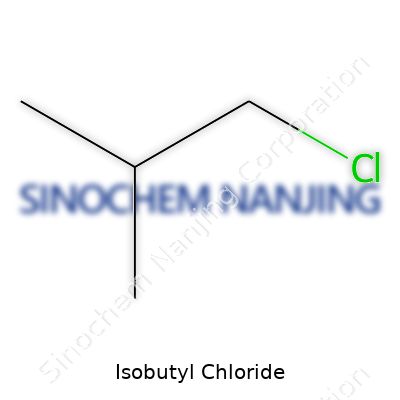
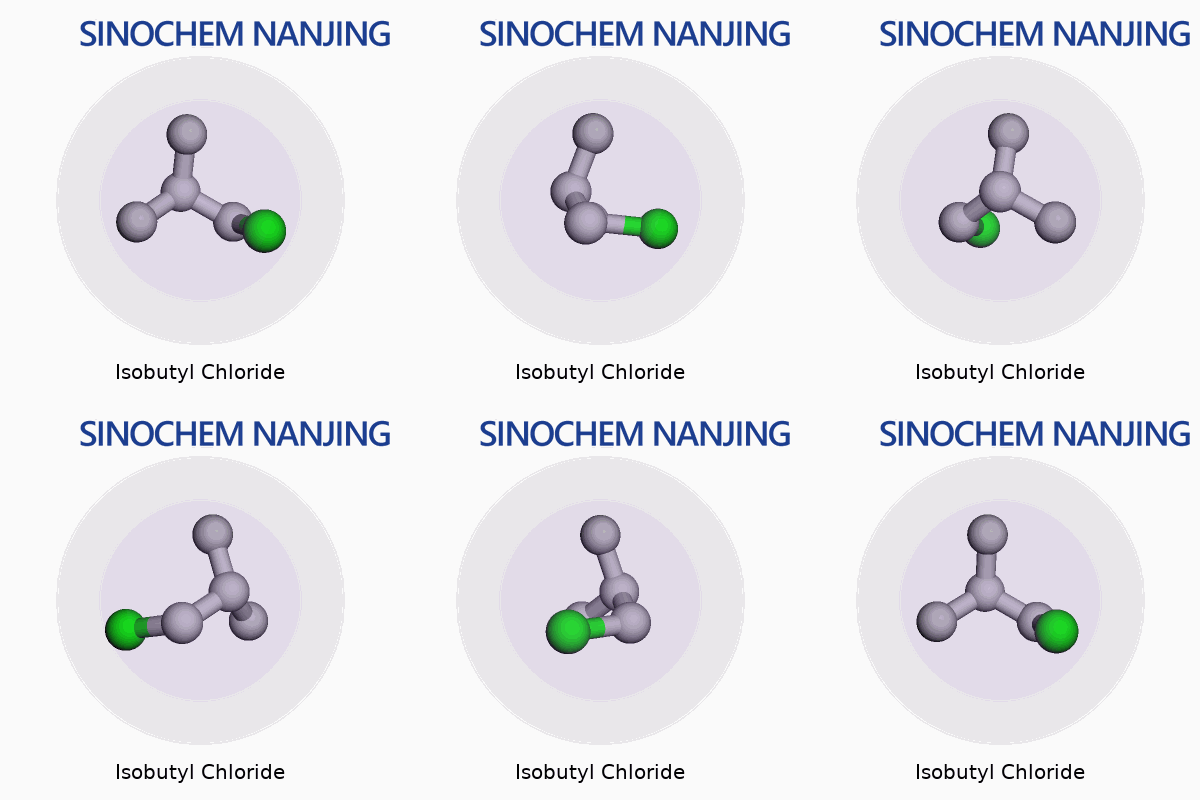
| Names | |
| Preferred IUPAC name | 2-Chlorobutane |
| Other names |
1-Chloro-2-methylpropane Isobutylchloride 2-Methylpropyl chloride |
| Pronunciation | /ˌaɪ.səˈbjuː.tɪl ˈklɔː.raɪd/ |
| Identifiers | |
| CAS Number | 513-46-4 |
| Beilstein Reference | 803873 |
| ChEBI | CHEBI:142546 |
| ChEMBL | CHEMBL13962 |
| ChemSpider | ChemSpider ID: 6102 |
| DrugBank | DB13855 |
| ECHA InfoCard | The ECHA InfoCard of Isobutyl Chloride is "03e08eaf-6d42-4207-a7dc-c99f8a8bc053". |
| EC Number | 202-851-5 |
| Gmelin Reference | 7898 |
| KEGG | C06535 |
| MeSH | D007578 |
| PubChem CID | 6577 |
| RTECS number | NT6825000 |
| UNII | CPE8S46F44 |
| UN number | UN1208 |
| CompTox Dashboard (EPA) | DTXSID3024113 |
| Properties | |
| Chemical formula | C4H9Cl |
| Molar mass | 92.57 g/mol |
| Appearance | Colorless liquid |
| Odor | Sharp, irritating odor |
| Density | 0.86 g/cm³ |
| Solubility in water | Insoluble |
| log P | 1.97 |
| Vapor pressure | 18.4 psi (20°C) |
| Acidity (pKa) | pKa ≈ -7 |
| Basicity (pKb) | Isobutyl chloride does not have a pKb value because it is not a base. |
| Magnetic susceptibility (χ) | -69.5×10⁻⁶ cm³/mol |
| Refractive index (nD) | 1.398 |
| Viscosity | 0.73 mPa·s (at 20 °C) |
| Dipole moment | 2.11 D |
| Thermochemistry | |
| Std molar entropy (S⦵298) | 222.3 J·mol⁻¹·K⁻¹ |
| Std enthalpy of formation (ΔfH⦵298) | -130.6 kJ/mol |
| Std enthalpy of combustion (ΔcH⦵298) | -687.6 kJ/mol |
| Pharmacology | |
| ATC code | There is no ATC code for Isobutyl Chloride. |
| Hazards | |
| GHS labelling | GHS02, GHS07 |
| Pictograms | GHS02,GHS07 |
| Signal word | Danger |
| Hazard statements | H225, H315, H319, H335 |
| Precautionary statements | P210, P261, P264, P271, P301+P312, P303+P361+P353, P304+P340, P305+P351+P338, P312, P403+P233, P405, P501 |
| NFPA 704 (fire diamond) | 2-4-1 |
| Flash point | -17 °C (1 °F) (closed cup) |
| Autoignition temperature | ~ 365°C |
| Explosive limits | Explosive limits: 1.8% - 8.3% |
| Lethal dose or concentration | LD50 oral rat 1830 mg/kg |
| LD50 (median dose) | LD50 (median dose): Oral, rat: 860 mg/kg |
| NIOSH | NIOSH: NR4025000 |
| PEL (Permissible) | PEL = 50 ppm (190 mg/m³) |
| REL (Recommended) | 50 ppm |
| IDLH (Immediate danger) | 500 ppm |
| Related compounds | |
| Related compounds |
n-Butyl chloride tert-Butyl chloride Isobutyl bromide Isobutyl alcohol Isobutyl iodide |



