Iodine Monobromide: A Deep Dive into a Unique Halogen Compound
Historical Development
Chemists in the 19th century didn’t waste much time finding new ways to combine the elements they pulled from the earth, air, or sea. Among their discoveries, iodine monobromide grabbed attention after researchers noticed its curious properties by reacting elemental iodine and bromine. Early work went beyond curiosity, as chemical industry giants saw this new compound as more than another laboratory oddity. As research in halogens advanced, iodine monobromide earned its place in analytical chemistry. Unlike many compounds with fleeting relevance, IBr bridged older techniques with modern-day innovations. Following early analytical applications, its use trickled into titration and halogen exchange, proving time and again that even simple binary compounds can pack a punch. The journey from glass-stoppered flasks in dimly lit laboratories to high-purity bottles on today’s reagent shelves shows not so much a reinvention, but a growing respect for iodine monobromide’s reliability when predictable reaction outcomes matter.
Product Overview
Iodine monobromide, sometimes called Iodine(I) bromide or Iodanyl bromide, carries a simple formula: IBr. It stands out thanks to a deep red-brown appearance, and it delivers a hefty molecular weight that sits just above everyday halogen mixtures. Supply houses typically sell it as a crystalline solid or, in climate-controlled settings, dissolved in glacial acetic acid to prevent vapor losses. For anyone who measures or dispenses this compound, a red-tinged color warns of its halogen origins, and a harsh, suffocating odor confirms it. The days of sourcing it as a curiosity are long gone; now, chemists go straight to reputable manufacturers, often looking for precise purity levels. Laboratories favor this compound for its distinct reactivity, and detailed labeling lets users know exactly what grade and storage temperature to expect.
Physical & Chemical Properties
The physical properties of iodine monobromide put it in a category shared by only a handful of other halogen compounds. IBr forms crystalline solids at room temperature, often manifesting as elongated needles or plates. Its melting point sits rather low, melting at about 42 °C, so a slight rise in temperature leaves it as a heavy, viscous liquid. This physical behavior matters in laboratory handling since a hot afternoon in the summer can turn carefully weighed crystals back into a troublesome liquid. When talking about solubility, it goes into organic solvents like chloroform, carbon disulfide, and glacial acetic acid without a fight. The chemical side leans heavily on its role as an oxidizing agent; IBr reacts swiftly with a range of analytes and shuffles halogen atoms in and out of molecules, often defined by its ability to act both as a donor and acceptor of halogen species. This duality, in turn, gives it a reputation for acting both as a brominating and iodinating agent depending on the context of the reaction.
Technical Specifications & Labeling
Manufacturers don’t take details lightly on labels: they note minimum assay values, melting point ranges, water content, heavy metal tolerances, and recommended storage statements. Typical assay values often run 98-99% for analytical grade stock. Some companies provide specialized data sheets including spectral data and safety certifications that go above the expectations of researchers who rely on uncontaminated materials. IBr ships in dark or amber glass bottles, always stored away from light and moisture. Labeling goes beyond just names—hazard statements, GHS pictograms, and quality batch numbers help users trace every bottle back to its origins, a necessity when dealing with halogen compounds that could pose safety risks if used carelessly.
Preparation Method
Laboratories looking to make IBr don’t need complex equipment, yet success hinges on precise technique and strong ventilation. Synthesizing IBr involves directly combining solid iodine with bromine vapor under controlled, cool conditions; the reaction’s almost textbook in its simplicity. Add iodine crystals to an evacuated flask, introduce bromine dropwise, and crystals of IBr start appearing rapidly. Product handling from that point must keep out air and moisture, and filtration needs to be quick to avoid unwanted reactions. Some modern industrial methods skip manual synthesis, favoring enclosed reactors that automatically control temperature and reagent addition for scale-up. In both setups, precision in stoichiometry pays off; skewing the ratio leaves unreacted reagents or polyhalide byproducts.
Chemical Reactions & Modifications
Iodine monobromide reacts in ways that make seasoned chemists take note. As an electrophile, IBr brings an I+ center ready to interact with alkenes, aromatics, and other nucleophilic sites—brominating or iodinating these substrates based on conditions. For example, adding IBr to an alkene almost always delivers trans addition, a defining feature useful in organic synthesis. In redox titrations, IBr serves as a standard for determining double bonds due to its predictable stoichiometry with unsaturated fatty acids, a method that’s still part of classic food adulteration testing. Chemists sometimes modify IBr by shifting the relative concentrations of iodine and bromine, which nudges the product closer to dihalogen mixtures or polyhalide salts, opening doors to tailored reagents for new niches.
Synonyms & Product Names
This compound goes by several names: Iodine(I) bromide, Iodanyl bromide, Iodine bromide, and simply IBr in shorthand chemical notation. When ordering from suppliers, double-checking product numbers and synonyms prevents costly mix-ups, given that halogen compounds sometimes share confusingly similar stock labels. Not all product aliases mean a change in purity or origin, but some brands tag extra identifiers—such as “ultra-dry” or “titrant grade”—to flag modifications to water content or certification for analytical use.
Safety & Operational Standards
Working with iodine monobromide carries serious risk; protective equipment isn’t just suggested, it’s essential. Direct contact with skin or inhalation can cause burns, respiratory distress, and even long-term health concerns. The fumes carry a sharp, acrid odor that irritates eyes and lungs after even brief exposure. Eye washes, gloves, lab coats, splash goggles, and strong fume hoods remain the norm for anyone moving beyond unopened bottles. Material Safety Data Sheets spell out incompatibilities—avoid strong reducers, flammable solvents, and metals. Storage in shaded, dry environments keeps IBr stable, while keeping emergency neutralizing agents like sodium thiosulfate or sodium bisulfite nearby gives peace of mind if accidents happen. I’ve witnessed mishaps in shared laboratory spaces where poor planning led to accidental vapor emissions, reinforcing the importance of routine risk assessments and emergency planning.
Application Area
Iodine monobromide forged its niche in analytical chemistry, especially in redox titrations for fat analysis—hundreds of labs worldwide rely on its predictable reactions for the classic Wijs and Hanus iodine value methods. The food industry trusts these titration reactions to spot adulteration or fraud in edible oils, a safeguard with direct effects on consumer health. Textile laboratories use IBr to identify unsaturation in fibers and polymers, which helps bring quality control up to par. Pharmaceutical researchers have experimented with IBr in electrophilic halogenations, especially where targeted halogen substitution can transform the properties of lead compounds or metabolites. Environmental chemists have turned to IBr as an oxidizer in trace analysis, probing new water treatment protocols or monitoring pollutants in industrial effluents. Anyone working in organohalide research, whether in the classroom or on industrial projects, has felt the influence of this compound’s straightforward chemistry.
Research & Development
Efforts to expand the role of iodine monobromide pick up speed as green chemistry and efficiency targets shift. Researchers have worked to swap out volatile organic solvents with more sustainable alternatives or have designed continuous-flow microreactors that let them sidestep some of the old safety hazards attached to manual synthesis. There’s interest in developing immobilized IBr reagents, tethering the molecule to supports for cleaner workup and less waste at the end of a reaction. New analytical techniques—such as mass spectrometry and nuclear magnetic resonance—let chemists dissect reaction pathways with unprecedented detail, honing IBr’s legacy as a reliable workhorse in percent unsaturation measurements or regioselective halogenation. Cross-disciplinary teams, from synthetic chemists to materials scientists, look at IBr not just for what it does, but for the foundation it lays for future halogen transfer or environmental applications.
Toxicity Research
Any discussion about iodine monobromide must address its toxicity. Both animal studies and workplace monitoring have shown the dangers of acute and chronic exposure. Short-term effects include irritation, bronchospasm, and chemical burns. Prolonged or repeated contact can damage lungs and thyroid function. IBr’s reactivity means every spill or mishap has the potential to escalate quickly. Safety assessments highlight the limits for allowable workplace concentrations and stress that prolonged exposure—even to low levels—leads to accumulation in the body, with knock-on effects on metabolism and hormonal balance. Regulatory bodies have enforced lower exposure limits, strict labeling, and personal protective policies based on mounting evidence from academic and industrial toxicology studies. Keeping up with new reports from occupational health researchers ensures that safety procedures don’t lag behind current understanding.
Future Prospects
Looking forward, iodine monobromide has a future shaped as much by sustainability and advanced materials demands as by its classic reliability. Ongoing research is probing IBr as a green alternative in oxidation reactions that once relied on heavy-metal catalysts, pursuing cleaner and safer routes to important industrial intermediates. There’s talk of adapting IBr for applications in nanomaterials, phase transfer catalysis, and next-generation batteries—all sectors hungry for predictable, selective halogen sources. Academic labs, meanwhile, are building on IBr’s historical role, teaching new chemists to respect both its utility and dangers. Research funding continues to trickle in for studies on recyclability, less hazardous handling, and environmental impact assessment for large-scale use. To me, the compound stands as a reminder that even established chemicals can adapt and thrive as science finds new ways to synthesize, use, and safeguard them for future generations.
What is Iodine Monobromide used for?
Looking Closer at a Useful Halogen Compound
Iodine monobromide sticks out as one of those chemicals that almost never shares the spotlight. You don’t see it on headlines, or making waves on social media, but it plays a role wherever analysis and accurate measurements matter. Working in a chemistry lab makes you appreciate not only the things that catch fire, but also the ones that help us see what’s really happening at a molecular level. Iodine monobromide comes under this latter category.
Why Labs Keep Iodine Monobromide on Their Shelves
This compound gets used most in analytical laboratories—think food, pharmaceuticals, and environmental testing. If you want to find out how much unsaturated fat sits in a bottle of salad oil, iodometric titration steps up. That’s where iodine monobromide asserts its value. Analysts add a solution of this reddish-brown compound—sometimes called IBr—to edible oils and fats. The way it reacts with double bonds in fatty acids helps nail down the exact iodine value. That’s not just academic: Olive oil, margarine, and plenty of foods get their nutritional reputation checked with this test.
People probably don’t realize the role iodine monobromide plays in pharmaceutical quality control. Medicines demand a known profile, with no guesswork on the presence or absence of certain ingredients. This halogen mixture can help flag unsaturated impurities and confirm the quality of raw materials. When pharmacists and regulators check for adulteration or off-spec batches, compounds like iodine monobromide do the heavy lifting.
Environmental Impact and Solutions
Taking water samples from lakes and rivers isn’t much different—just a matter of scale. Detecting sulfide ions involves adding iodine monobromide, which reacts in predictable ways. Technicians can spot pollution from sewage or decaying matter based on how this compound changes the sample. As environmental monitoring ramps up due to climate fears and industrial expansion, tools like IBr will matter even more.
Labs don’t use huge amounts of iodine monobromide, but safety must come first. It can be corrosive, and fumes irritate the eyes and nose. Having handled it myself, I learned that decent ventilation and proper gloves make a huge difference. Some labs look to safer alternatives, mainly for very specific titrations, but nothing quite brings the same reliability across different sample types. While the chemical’s risks are real, they’re managed tightly with good practice and training. Regulators and research organizations continue searching for even safer or greener options, especially as environmental awareness grows.
Facts to Remember in Practice
Data from the World Health Organization and multiple food safety authorities confirm that analytical standards count on halogen compounds for nutritional testing. An unreliable iodine value confuses everyone from plant managers to end consumers. Trends toward plant-based oils and complex food products add even more value to dependable testing reagents.
The next leap in chemical analysis will likely come from automation and digital monitoring. For the chemistry that underpins food labels and quality assurance, iodine monobromide still claims a seat at the table until proven faster, less hazardous replacements come along.
Staying Aware
Ongoing education and investment in safer lab procedures help reduce any risks iodine monobromide brings with it. The rise of next-generation analytical chemistry means young scientists need to know both the tools that built today’s industry and the cleaner methods we all hope to use in the future. Putting this into practice, every new standard or alternative gets checked against a system that has worked well for decades—a system where iodine monobromide plays an unsung, but powerful, part.
What is the chemical formula of Iodine Monobromide?
Unpacking Iodine Monobromide
Science can offer lots of surprises, but the name “Iodine Monobromide” spells out its story fairly clearly. This compound combines two halogen elements—iodine and bromine—into a single molecule. Chemists write its formula as IBr. Sometimes folks imagine chemistry as jam-packed with complexity, but this one offers a straightforward formula because “mono-” means one. Iodine Monobromide equals one iodine atom plus one bromine atom, nothing more, nothing less.
Practical Reasons IBr Matters
IBr doesn’t show up on every home counter, but it certainly matters beyond the lab. Many researchers rely on Iodine Monobromide to analyze fats and oils in food and in industrial chemistry. It has just the right balance of reactivity for certain analytical tasks. Take iodine value testing, for example. This little molecule helps figure out how many unsaturated bonds exist in fats—a key measure for the nutrition industry, not to mention biodiesel production. Incorrect readings can change how we judge everything from olive oil to fuel efficiency.
Personal Perspective: Simplifying Complex Chemistry
In school, chemical formulas sometimes seemed like alphabet soup. Getting to IBr—the answer to today’s question—reminded me how chemistry often rewards clear, direct thinking. It’s not just about memorizing a set of letters. It’s about understanding why iodine and bromine pair up, how their electron shells invite combination, and what that means for practical uses. When teaching younger students, this concrete example turns a wall of periodic table symbols into something tangible.
Proven Safety and Handling Issues
IBr comes with its own set of safety notes. Its reddish-brown color warns of its reactive nature. Contact can irritate skin or eyes, and breathing the vapors poses health risks. The facts don’t mince words: store it in tightly sealed glass containers and use gloves and eye protection. Knowledge gaps in lab safety have hurt a lot of folks, so organizations like the CDC and OSHA provide guidelines. Following common sense steps can cut the risk of accidents.
Environmental and Industry Impact
Moving outside the lab, the impact of halogen compounds draws attention in broader public discussions. Many halogens can contribute to persistent environmental contamination or ozone depletion. While IBr doesn’t show up as a major pollutant, its relatives do, so handling and disposal sit under scrutiny. Sustainable chemistry means rethinking how we use and discard every compound, even ones that seem minor compared to industrial heavyweights.
Education and Transparency Go Hand in Hand
Years of research, both inside formal science and through online learning, drive home the need for transparency and accuracy. Students and professionals look for more than just a formula—they want context. The right approach comes from mixing real-world examples with proven facts. IBr doesn’t just represent a pairing on the periodic table. It opens a window onto the relationship between science, industry, and day-to-day life.
Solutions: Promoting Safe and Smart Chemistry
Communication between scientists, educators, and the public makes a real difference. Workshops on safe lab technique, more access to chemical safety data, and up-to-date digital resources all support better handling of iodine monobromide and other reactants. Keeping safety simple helps avoid accidents, and keeping industry accountable prevents environmental harm. The formula IBr may be short, but the lessons it offers reach well beyond a textbook.
Is Iodine Monobromide hazardous or toxic?
A Closer Look at Iodine Monobromide
Iodine monobromide doesn’t usually draw attention outside the world of labs and chemical processes, yet questions keep cropping up about its safety. The stuff shows up as a reddish-brown liquid and has enough chemical punch to be useful for adding halogens in organic chemistry and a few analytical applications. Folks working in labs may remember the warnings attached to the bottle, but the wider public often hears little about the risks.
Handling Hazards: What You Might Face
Eye irritation hits fast if a splash happens. A single whiff of the vapors causes a sharp, burning sensation in the nose and throat. In my first year on lab duty, a small fume drifted up because my classmate was careless with the hood — that was enough to send everyone backing up. The liquid stains skin and may burn if left unwashed. Touching iodine monobromide without gloves brings on a stinging lesson. It absorbs rapidly through the skin, and even a small exposure leaves behind inflammation. Inhalation takes the risk to another level. Sometimes, people exposed to even moderate concentrations develop coughing, shortness of breath, or, with enough time, serious lung damage.
Long-term health isn’t spared either. Chronic exposure can cause persistent skin issues, eye damage, or complications with the respiratory tract. Workers who skip protective gear, or labs lacking good ventilation, face a higher chance of real damage. The material shows signs of corrosiveness, eating away at surfaces or, given enough time and exposure, soft tissue. Chemicals with halogens usually set off alarms for a reason, and this one deserves caution.
Environmental Impact
It’s not just a personal safety risk. Iodine monobromide’s effects carry outside the lab. Accidental spills can do real harm to aquatic life. It proves toxic to some fish and other water creatures. Water treatment plants, rivers, and even storm drains all need protection to stop unsafe chemicals from entering the wrong places. Laboratories and businesses have a responsibility to manage disposal, which means following strict hazardous waste protocols. Washing it down the sink does more than break the law — it puts natural systems in jeopardy and may threaten drinking water supplies.
Managing Risks with Common Sense
Personal protective equipment saves trouble. Face shields, nitrile gloves, and lab coats help keep exposure to a minimum. Chemical fume hoods get used for a reason; even short stints pouring or mixing iodine monobromide demand good airflow. Those who train staff properly and enforce handling rules rarely face major accidents. In my own experience, seeing eye-wash stations and fresh gloves ready has become second nature, and it makes a difference in the event someone slips up.
Training often overlooks environmental discharge, but it absolutely matters. Employees need instruction on spill response — using absorbent pads, sealing waste in proper containers, and telling environmental safety officers if something goes wrong. Thorough documentation, including safety data sheets, keeps everyone on the same page and ready for inspections or emergencies.
Fact-Driven Solutions
Iodine monobromide doesn’t belong in everyday work or home environments. Its useful properties come with real responsibility. Keeping stock locked away, not overordering, and using safer alternatives where possible all help. Anyone working with this compound owes it to their coworkers and community to keep up. Most problems come not from the chemical itself, but from shortcuts, poor training, or ignorance about what can go wrong. Vigilance, preparation, and education — supported by current science — help make sure the risks remain under control.
How should Iodine Monobromide be stored?
Iodine monobromide isn’t your average household chemical. It comes with its own set of quirks and hazards. Anyone who’s ever handled this deep reddish-brown liquid knows that careless storage isn’t just sloppy—it's risky. This compound reacts instinctively with moisture, giving off corrosive vapors. Stories from chem labs, where a cracked bottle left fumes lingering in the air for days, highlight the real-world headaches that can crop up.
Understanding the Risks
The first lesson with iodine monobromide: avoid storing it out in the open, especially in humid spots. Water in the air triggers reactions, and pretty soon you’re sniffing out bromine and hydrogen iodide, both nasty for lungs and eyes. I remember once at university, a sealed jar ended up near the sink. A week later, corrosion had chewed through the cap, turning a quiet storage closet into a gas chamber. It drove home just how unfriendly this chemical can be once it gets access to moisture.
People forget that even the container matters. Ordinary plastic won’t cut it. Glass with a tight PTFE-lined (that’s Teflon-based) lid blocks unwanted leaks and resists attack from the vapors inside. Metal or cork creates a chemical soup you don’t want to manage, and cheap plastic ends up brittle or eaten through. Glass worked in every lab I’ve known, offering clarity for visual inspection and a barrier against fumes.
Location, Location, Location
Every facility should keep iodine monobromide locked away in a dedicated chemical cabinet. These cabinets don’t double as locker space or breakfast nooks. The ideal cabinet resists corrosion itself—the kind of paint designed for laboratories—and sits away from sources of heat or direct sunlight. Exposure to light, particularly UV, isn’t just bad for the chemical—it can start breakdowns that raise fresh safety problems. Dark, cool, and well-ventilated works best, based on years of trial and error in various labs.
Separation from Incompatible Chemicals
No one wants to find out what happens if iodine monobromide mixes with organic material, strong reducing agents, or metals. The reactions can spill over, literally, or set the stage for explosions. Always check if other chemicals nearby play nicely; many labs use color coding or strict shelf rules, and for good reason. Mixing oxidizers and fuels in the same spot isn’t just lazy—it’s an accident waiting to happen.
Training and Good Habits
Storage rules only work if everyone understands them. I’ve seen what a single new student can do when left unsupervised—like grabbing iodine monobromide with bare hands or opening containers without eye protection. Annual refreshers, clear signage, and easy-to-read safety sheets all help build a culture where mistakes shrink. Nobody likes paperwork, but incident logs tell the real story. They show near-misses and push teams to do better next time.
Staying Ahead of Trouble
Replacing cracked lids, wiping off residue, and rotating stock seems tedious until you skip these steps. Leaks build up, eat through shelving, and turn a cheap bottle of chemicals into a major clean-up. I’ve watched facilities bring in the hazmat team for what started as a drip from a poorly maintained jar. Regular checks don’t just save money—they keep people healthy and protect the environment from careless spills.
Mishandling iodine monobromide isn’t just a technical issue. It’s about building trust in who shares your workspace and caring enough to avoid common traps. Every time a bottle sits undisturbed and intact, it speaks to habits formed by experience, teamwork, and simple respect for the risks chemicals bring.
What are the physical properties of Iodine Monobromide?
Understanding the Look and Feel of Iodine Monobromide
Iodine monobromide, usually known as IBr, stands out on the lab shelf with its deep red, almost chocolate-colored appearance. I’ve handled small vials before, and right away, that vivid color demands respect—and maybe a bit of caution. This compound appears as a solid at room temperature. At around 42°C, it melts into a dark, viscous liquid, looking almost like motor oil. This low melting point reveals how easily it shifts between solid and liquid—something that matters when you need to handle or store it in the lab.
Once it finds itself in liquid form, IBr releases reddish-brown vapors. If you’ve ever worked in a chemistry lab, that vapor lingers in the air and warns you to avoid sniffing it directly. Its vapors can irritate the eyes and nose. As a result, chemists treat IBr with care, working in fume hoods and storing it in glass bottles with tight lids.
Density and Solubility in Practice
Handling iodine monobromide means grappling with a dense material. The solid boasts a density around 5.18 g/cm³. Measurements like these come alive in the lab, especially when you’re weighing out small quantities using a precision balance. Dropping a chunk into a beaker, you’ll watch it sink straight down without hesitation.
IBr dissolves with enthusiasm in many organic solvents. Chloroform, carbon tetrachloride, and acetic acid all welcome it easily. Mix up a solution in one of these, and it quickly shifts into a homogenous reddish mixture. Try water, and you’ll notice it doesn’t play along—it doesn’t dissolve well, forming only a faint, reddish balance on the surface. A chemist sees right away that for reactions demanding water solubility, this compound sits out the game.
Stability and Reactivity Insights
Iodine monobromide walks a fine line between stability and reactivity. Store it in the dark, away from sunlight or bright lights—otherwise, it breaks down, releasing iodine and bromine. There’s nothing abstract about this: You can physically watch the color deepen or even see traces of crystalline iodine collect in the storage vial. This breakdown shortens shelf life and pushes labs to only order as much as they need.
The compound’s reactivity stems directly from its structure. Chemists know it functions as a halogenating agent. This means it reacts easily with other molecules, adding either bromine or iodine wherever you want in an organic synthesis. I’ve watched reactions speed up and grow more efficient simply by introducing IBr—good evidence for why practicality guides its use, not just chemical theory.
Practical Use and Risks Up Close
IBr’s color stains skin and solid lab benches. Protective gloves and quick clean-up mean less risk for yourself and your workspace. Exposure causes irritation, demanding full attention and respect for safety. Its melting and boiling points let labs use it in both solid and liquid applications. In industry, this compound assists in tracking fat content in food and helps in pharmaceutical processes that demand precise halogenation.
Its physical properties draw a line: use it for efficiency and power in synthesis, but keep the safety goggles within reach. The balance between potential and hazard isn’t a theory—every seasoned chemist feels it in the air each time they break the seal on a dark red vial of iodine monobromide.
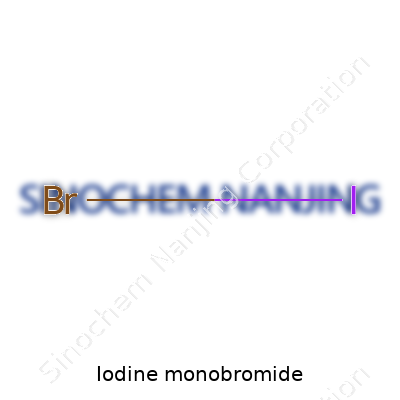
| Names | |
| Preferred IUPAC name | Iodine bromide |
| Other names |
Iodine bromide Iodobromide Iodobromine |
| Pronunciation | /ˈaɪəˌdiːn ˌmɒnoʊˈbroʊmaɪd/ |
| Identifiers | |
| CAS Number | 7789-33-5 |
| Beilstein Reference | 3589867 |
| ChEBI | CHEBI:30779 |
| ChEMBL | CHEMBL137884 |
| ChemSpider | 15102 |
| DrugBank | DB11377 |
| ECHA InfoCard | 100.916.233 |
| EC Number | 231-969-9 |
| Gmelin Reference | 84978 |
| KEGG | C00791 |
| MeSH | D007398 |
| PubChem CID | 24603 |
| RTECS number | NL9100000 |
| UNII | MQ5L1WD55Z |
| UN number | UN2883 |
| Properties | |
| Chemical formula | IBr |
| Molar mass | 206.809 g/mol |
| Appearance | Reddish-brown crystalline solid |
| Odor | pungent |
| Density | 4.64 g/cm³ |
| Solubility in water | Soluble |
| log P | 2.96 |
| Vapor pressure | 1 mmHg (113 °C) |
| Acidity (pKa) | 10.61 |
| Basicity (pKb) | -4.2 |
| Magnetic susceptibility (χ) | +209.6·10⁻⁶ cm³/mol |
| Refractive index (nD) | 2.22 |
| Viscosity | 3.26 mPa·s (25 °C) |
| Dipole moment | 2.60 D |
| Thermochemistry | |
| Std molar entropy (S⦵298) | 221.6 J·mol⁻¹·K⁻¹ |
| Std enthalpy of formation (ΔfH⦵298) | -96.4 kJ/mol |
| Std enthalpy of combustion (ΔcH⦵298) | -71.1 kJ/mol |
| Pharmacology | |
| ATC code | V09IA04 |
| Hazards | |
| Main hazards | Harmful if swallowed, causes burns, irritating to eyes and respiratory system. |
| GHS labelling | GHS02, GHS05, GHS06 |
| Pictograms | GHS05,GHS06 |
| Signal word | Danger |
| Hazard statements | H302, H314, H400 |
| Precautionary statements | P210, P220, P262, P280, P301+P330+P331, P305+P351+P338, P310 |
| NFPA 704 (fire diamond) | 3-0-1-OX |
| Flash point | 113°C (235°F) |
| Autoignition temperature | 128°C |
| Lethal dose or concentration | LD50 (oral, rat): 100 mg/kg |
| LD50 (median dose) | LD50 (median dose): Oral-rat LD50: 100 mg/kg |
| NIOSH | NLKM00010 |
| PEL (Permissible) | Not established |
| REL (Recommended) | 18 months |
| Related compounds | |
| Related compounds |
Iodine monochloride Iodine pentafluoride Bromine monochloride |



