Hexanitrodiphenylamine: A Clear-Eyed Commentary
Historical Development
Hexanitrodiphenylamine has a history tied closely to the rise of high-energy materials in the early twentieth century. During the substantial changes in military technology of the World Wars, demand for more stable and powerful explosives led chemists to tinker with every combination of nitro groups and aromatic rings. Around this period, diphenylamine, already used as a stabilizer in smokeless powder, became the skeleton for more powerful compounds through nitration—eventually landing on the recipe that gives us hexanitrodiphenylamine. Its significance traces back to shifting military needs, tight resource management, and a relentless drive to pack more energy into smaller charges for demolition, artillery, or specialized munitions. Unlike some of its better-known cousins like TNT or RDX, hexanitrodiphenylamine never stole the same spotlight, but its reliability found it a place in select formulations, sometimes as a component or a booster in composite explosives. This speaks to a universal truth about innovation: often the workhorses run in the background while flashier options take the headlines.
Product Overview
In the world of nitroaromatic explosives, hexanitrodiphenylamine stands out thanks to its six nitro groups packed onto a bulky diphenylamine core. This configuration grants it a degree of thermal stability that makes it attractive for uses where safety during handling and storage becomes paramount. It is a pale yellow to brown solid, more dense and less sensitive than many alternatives. Chemists value it for its blend of power and predictability, traits you look for regardless of whether you care about civilian or defense applications. The downside comes in its demanding synthesis and sometimes challenging purification, balancing benefits against the cost and effort required to produce it safely at scale.
Physical & Chemical Properties
Hexanitrodiphenylamine pulls a good deal of its properties straight from the crowded arrangement of nitro groups. With a molecular weight tipping over 400 g/mol, and a melting point generally sitting in the range that makes it less prone to spontaneous decomposition than some of its siblings, it fits a particular niche. The density, somewhere above 1.6 g/cm³, lets it deliver a solid energy punch. Chemically, it is stubbornly resistant to mild acids or bases but will break down under strong reduction or extended heating—making it both useful and a challenge to handle. This molecule packs enough nitro groups to make anyone handling it think twice, but its relatively low volatility and moderate friction sensitivity make it a candidate for careful, considered use.
Technical Specifications & Labeling
Technical standards for hexanitrodiphenylamine reflect a hard-earned concern for safety and consistency. Proper documentation, batch identification, and hazard classification based on various transport and storage guidelines help keep the risks manageable. Labeling must note its explosive class, any relevant hazard pictograms, and strict instructions for temperature limits and incompatibilities. Chemists, transport workers, and operators all rely on this information being up-to-date and mistake-free, as errors in this arena rarely offer second chances. These standards, shaped by decades of incident reports and regulatory adjustments, demand respect rather than compliance for its own sake.
Preparation Method
Manufacturing hexanitrodiphenylamine takes a steady hand and plenty of know-how. The process starts with diphenylamine undergoing stepwise nitration in a multi-stage reaction with mixed acid. Each stage brings its own challenges: precisely controlling temperature, monitoring the addition of acids, and preventing runaway reactions. Chemists break up the process, washing and purifying after each nitration step to keep byproducts and acidic residues in check. Filtration, recrystallization, and careful drying come next, especially since careless handling during these steps can trigger decomposition or, in worse cases, detonation. It’s a process shaped not just by science, but by the careful culture of experience and near-misses passed down through generations of bench chemists.
Chemical Reactions & Modifications
Hexanitrodiphenylamine owes much of its unique reactivity to the electron-withdrawing force of those nitro groups. This makes it relatively inert to mild conditions but reactive in carefully designed reduction or substitution reactions. Researchers have looked at ways to tweak functional groups around the diphenylamine core, often chasing slightly better stability or power, though the fundamental structure resists easy improvement. Some modifications aim to increase compatibility with binders in polymer-bonded explosives or to increase insensitivity to impact and friction, always with one eye on maintaining the careful balance struck in the base molecule. This kind of tailoring reflects the tradeoffs found in most high-energy chemistry: wringing more performance from a molecule almost always invites new headaches in stability or manufacturability.
Synonyms & Product Names
Hexanitrodiphenylamine is also known within technical communities as HND, and sometimes hexyl for short. On paper, it has appeared under a handful of trade and military designations, each reflecting the specific use or standard. These names matter because a miscommunication can be the difference between routine testing and a serious misadventure due to mismatched formulations. I’ve seen more than a few technical conferences where older veterans still prefer the older nomenclature, sometimes leading to confusion for newcomers who learned under different systems. This culture of naming—built on practicality and regional standards—can trip up even experienced hands, and serves as a reminder that chemistry remains, at heart, a human-centered practice.
Safety & Operational Standards
No one familiar with explosives takes safety lightly, and hexanitrodiphenylamine drives that home with its balance of stability and underlying hazard. Safety measures stretch from the big things—such as remote handling lines, spark-resistant tools, and tightly controlled temperature regimes—to the smaller, daily habits: checking for static buildup, keeping records scrupulously, and ensuring trained eyes inspect every critical step. Regulatory agencies enforce strict storage and transport rules, sometimes after high-profile mishaps. Protocols call for blast-proof barriers, minimal batch sizes in working spaces, and continuous environmental monitoring. The aim isn’t just compliance, but real trust in the systems and people around you. I’ve worked in labs where every new technician, regardless of resume, spent weeks shadowing experienced hands. This patient onboarding speaks volumes: here, routines become survival skills.
Application Area
Most uses of hexanitrodiphenylamine can be traced to specialized military charges, certain composite explosives, and some niche detonators. The compound’s thermal stability makes it a trusted part of munitions left exposed to harsh conditions, such as those found in tropical storage depots or desert campaigns, where less stable explosives break down. Some advanced formulations use it as a secondary charge, boosting the overall effect when triggered by a more sensitive primary. The civilian realm doesn’t see much of it anymore, as newer, easier-to-handle compounds have edged it out in mining and demolition. Where I’ve seen it in use, the approach tends to be businesslike and cautious, with everyone on the team clear about the risks and rewards unique to this material.
Research & Development
In the world of energetic materials research, hexanitrodiphenylamine persists as both a challenge and a bench test for new synthetic routes. Even though military budgets now push for lower-toxicity and “greener” explosives, its story isn’t done. Research circles keep poking at its structure, searching for derivatives with fewer environmental drawbacks or improved insensitivity, and logging data on byproducts, breakdown pathways, and compatibility with modern binders. Publications from technical conferences often compare new candidates to the historical benchmarks set by compounds like HND, using its spec sheet as a yardstick for power, safety, and reliability. The quest is not just for more energy, but less environmental baggage, and every new finding leans on the generations of practical know-how built around these old standards.
Toxicity Research
Handling and exposure risks drive much of the recent research into hexanitrodiphenylamine. Studies dating back decades noted its toxic effects, especially in chronic exposure scenarios, with impacts on blood parameters, organ function, and possibly carcinogenicity under certain conditions. Technicians must wear personal protective equipment and avoid inhalation or skin contact. Any spill response is coordinated and aggressive, as historical incidents have linked lax handling with real, lasting harm. Modern protocols draw on environmental monitoring and routine blood checks for staff with regular exposure. There remains a lot of work in understanding just how this compound breaks down in soil and water, and whether those breakdown products travel up food chains. The current understanding is still incomplete, and that uncertainty pushes for both caution and innovation.
Future Prospects
The future for hexanitrodiphenylamine sits on a knife edge. Developments in green chemistry threaten its long reign in certain applications. Researchers lean hard into finding replacements that tick the same stability and energetic boxes, but with less toxicity and environmental fallout. There’s a continued role for it in legacy systems, where retrofitting stockpiles with new compounds requires huge resources and political will that rarely matches technical need. Storage and disposal regulations only get stricter, and so new projects often chase alternatives unless existing infrastructure demands HND’s specific profile. For those interested in energetic materials, it remains both a benchmark and a warning—an example both of how far the field has come and what hurdles remain as technology, policy, and human health edge forward in tandem.
What is Hexanitrodiphenylamine used for?
Looking Closer at Explosives
Hexanitrodiphenylamine, known among chemists as HND, plays a role in producing some of the world’s most powerful explosives. People might picture explosives as simple sticks of dynamite or maybe military shells, but the chemistry behind them gets tricky. HND doesn’t turn up in household products or fireworks. Its place sits squarely in the world of specialty munitions.
Factories started making HND back in the early 20th century, mostly to help out with large military requirements. Its six nitro groups pack a real punch, which is why it appealed to militaries looking for explosives with a higher detonation velocity. HND doesn’t work alone. In most cases, experts mix it with other chemicals to create products that can cut through armor, blast rock in mining, or serve bigger defense strategies.
Why Manufacturers Pick HND
In my time working around scientists and reading a few research journals, I’ve seen the focus on stability as much as power. HND resists heat better than TNT, which can matter a lot when transport gets rough or climates run hot. Stability keeps explosions predictable, not accidental. During World War II, engineers put HND to use mostly in armor-piercing shells. It handled the job because it detonated exactly when needed, not before. These facts show how safety and reliability often trump raw strength.
Mining companies turned to mixtures containing HND for tough projects like rock blasting, especially under conditions where sweating dynamite or accidental detonation couldn’t be tolerated. Today, HND’s use has faded in mining in favor of less toxic alternatives. Still, those old patents and technical manuals show its legacy in the field.
Safety and Environmental Risks
Nobody ignores the risks anymore. HND carries real dangers to human health and the environment. Its chemical structure might look impressive in the lab, but it becomes a problem in the soil or water. Military waste dumps and mishandled munitions have leaked HND into the environment. Tests show it damages aquatic life and builds up in living things. I’ve heard from environmental scientists who worry about old munitions sites where engineers never cleaned up properly.
Handling HND means gearing up with strong ventilation and heavy gloves. Even a small spill in a workplace could spark trouble. Regulations around chemical safety and proper disposal stepped up for a reason. Workers learned from accidents, and policy changed to reduce harm.
Where Things Stand Now
In today’s labs, you find less of HND compared to the big days of the mid-1900s. Safer options now exist, both for making explosives and for breaking up rock. Chemists keep searching for compounds that bring the power without the lasting risks. Governments push for tighter cleanup rules at military bases and weapon depots, hoping to repair some of the damage caused by old munitions waste.
Some ideas that surface in conversations include speeding up environmental remediation and holding companies accountable for safe disposal. More research funding can help find greener chemical solutions. Young chemists and engineers can make a difference by choosing paths that put safety first.
Today, the shadow of HND reminds us how progress comes with responsibility. Every powerful chemical needs careful watching, from start to finish.
Is Hexanitrodiphenylamine hazardous or toxic?
Understanding the Chemical
Hexanitrodiphenylamine, sometimes called HND or Hexyl, has been around since the early days of explosives research. During the twentieth century, militaries across Europe used this chemical in artillery shells and detonators. Its reputation isn’t based solely on its performance as an explosive; safety and toxicity shape how experts approach it. Unpacking what this chemical does to people and the environment tells a more important story than military history lessons.
Health Concerns with Exposure
Exposure to hexanitrodiphenylamine doesn’t happen by accident for most of us. People near munitions facilities or those handling demolition materials face bigger risks than the public. Inhaling its dust, absorbing it through the skin, or getting it in the eyes can trigger health problems.
The main danger: HND contains six nitro groups. High-nitro compounds tend to mess with the blood by causing methemoglobinemia — a condition where the blood's ability to carry oxygen drops. Symptoms follow: fatigue, headaches, dizziness, sometimes a bluish skin tint. Chronic exposure can leave the liver and kidneys struggling, since they're working overtime to clear this stuff out. Data from military studies in the 1940s showed workers develop chronic coughs and anemia after extended exposure to HND dust.
This chemical won’t just irritate you; repeated handling or high-level exposure demands serious respect for protective gear and hygiene. In my experience, even a benign-seeming chemical can leave you with lingering headaches and a distinct sense that the lab’s air doesn’t quite feel right — HND is no exception.
Environmental Impact
Once this chemical gets into the soil or waterways, it sticks around for a long time. HND doesn’t break down quickly in natural environments, so contamination near old ammunition depots or storage sites presents lingering risk. Plants and animals that soak up HND can pass it along through the food web, showing the hazard goes further than human health alone.
The US Environmental Protection Agency places HND on the list of hazardous substances for this very reason. Research tracing waterways around decommissioned military sites in Europe has found measurable levels of persistent nitroaromatic compounds, with hexanitrodiphenylamine sometimes among them. Fish living in those streams have shown reduced survival and increased tissue damage.
Reducing Risk and Managing Waste
Once a chemical has proven itself toxic and persistent, ignoring it stops being an option. People deserve cleaner air and water. Decades ago, military organizations shifted away from HND and toward chemicals that break down faster or pose fewer health risks. Current sites with contamination problems require ongoing cleanup — a mix of soil removal, groundwater treatment, and tight regulations. In my time volunteering with an environmental project, I watched community groups push hard for regular water testing and government transparency. Local activism gets results that waiting for bureaucracy never guarantees.
Anyone who works near HND needs thorough training and reliable safety protocols. Industrial hygiene experts insist on personal protective equipment, air monitoring, and routine health checks. For people living downwind or downstream of a contaminated site, easy access to test results matters just as much as public oversight of any cleanup process.
Why It Matters Now
Legacy chemicals like hexanitrodiphenylamine won’t just fade away. Cleaning them up opens the door to safer communities and healthier environments. Holding polluters accountable and demanding ongoing research are choices that add up over time. Risks can be managed, but only if people know the facts and insist that those in power don’t cut corners. Transparency, access to data, and a willingness to face tough realities ultimately give everyone a better shot at safety.
What are the storage and handling requirements for Hexanitrodiphenylamine?
A Closer Look at an Explosive Chemical
Hexanitrodiphenylamine doesn't come up in most people's daily conversations, but it’s a big deal in industries that deal with explosives and propellants. The stakes run high because this isn’t just another chemical you can toss on a shelf. Its instability can turn a simple misstep into a disaster. Over the years, I’ve learned that dabbing in risky materials changes the way you think about that old saying: “Handle with care.”
Keep It Cool—Literally and Figuratively
High temperatures spark trouble with hexanitrodiphenylamine. Storage works best in a temperature-controlled area, well below 30°C, far from heat sources like steam pipes, heaters, or even direct sunlight sneaking in through a window. I’ve seen folks pile up boxes near radiators, thinking nothing of it until the alarms started blaring. Even a slight increase in heat can speed up decomposition, letting off toxic fumes and raising the possibility of an explosion. That lesson sticks with you.
No Room for Moisture or Open Flames
Moisture seems innocent enough—no one thinks water is a big threat unless you’re in the explosives business. Humidity tweaks the chemical’s stability, and sometimes the smallest drip from a pipe overhead means disaster. Always pick a storage spot with low humidity. Store it far from oxidizers, acids, and anything flammable. Sparks, static, or a random open flame from a nearby welder can turn the storage site into ground zero for a catastrophe. More than one incident report got its start from carelessness with break rooms, coffee makers, or a stray lighter.
Container Choices Matter
Hexanitrodiphenylamine goes in tightly sealed, non-reactive containers—metal drums lined with an inert coating or high-grade polyethylene work best. Damaged containers mean leaks, and even residue on the outside of a drum can spark a nasty surprise. I always check for corrosion after seeing what small leaks can do, not only to the stock itself but to everyone nearby. Labels need to stand out with clear hazard markings for identification. Water-proofing those labels pays off after a week or two of warehouse humidity.
Train for the Worst So It Never Happens
Casual attitude kills faster than the chemical itself. Any staff working anywhere near the storage facility should get real safety training—no shortcuts or paper exercises. Emergency gear, spill control supplies, and the right type of fire extinguishers count more than a locked door. Keeping walkways clear and maintaining up-to-date inventory logs makes all the difference when seconds matter. Security around these materials ties directly into public safety; too many news stories start with “unauthorized access.”
Personal Experience Makes a Difference
I’ve never forgotten my first hazardous materials safety drill, watching a simulated leak response. All those safety rules clicked: one slip-up puts lives at risk. Hexanitrodiphenylamine isn’t forgiving. Treating it with respect means paying attention to every step, from the way you stack containers to the number of people with access to the storage area. Think of it like handling nitroglycerin—with nerves steady and eyes wide open. The risky stuff demands systems, routines, and a relentless focus on training. That approach keeps people safe, property intact, and communities out of the headlines.
What is the chemical structure of Hexanitrodiphenylamine?
The Backbone: Chemical Structure of Hexanitrodiphenylamine
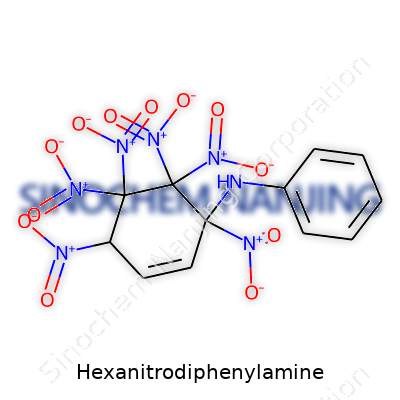
Hexanitrodiphenylamine is a compound that brings together two benzene rings, linked by a single nitrogen atom. Each benzene ring carries three nitro groups (NO2), making a total of six nitro groups across the whole molecule. The formal name often used in research circles is 2,4,6-trinitro-N-(2,4,6-trinitrophenyl)aniline. The molecular formula is C12H5N7O12, and the arrangement of nitro groups brings a heavy oxygen presence, not to mention a unique pattern of electron withdrawal that reshapes the behavior of each ring.
Placing three nitro groups on each aromatic ring creates a molecule with decreased stability compared to simpler aromatics. All these nitro groups mean more chances for the molecule to support energetic reactions. It's the chemistry behind explosives that gets attention from both military and scientific fields. If you ever wondered why energetic materials like hexanitrodiphenylamine are of such concern, it's the arrangement of these groups that gives away the answer: They pack a punch.
Why This Structure Draws Attention
When looking at the chemical backbone, it's impossible to overlook the impact that six nitro groups have. Nitro groups pull electrons from the aromatic rings, which changes how each ring interacts with its environment. In practical terms, those who handle explosive materials have long learned that this class of compounds needs careful respect. Recent years have seen increased international regulation around these substances due to the devastation that comes with mishandling or misuse.
Chemists often spend months trying to tweak such molecules. Add more nitro groups, and you usually get more energy out. Take them away, and you lose that edge. Sometimes I sat through lectures where my professors highlighted the difficulties of synthesizing compounds like hexanitrodiphenylamine. Each step introduces hazards, especially under scale-up conditions. Academic and industrial labs both face challenges in keeping reactions stable when working with energetic materials.
Health and Environmental Considerations
Handling hexanitrodiphenylamine presents direct risks. The nitro groups not only drive up explosive potential but also tie into toxicology. Exposure may impact human health—think of organ damage or long-term complications from chronic exposure. Countries mandate safety procedures because accidental exposure, inhalation, or spills can trigger serious health incidents.
If waste containing hexanitrodiphenylamine goes untreated, serious environmental problems follow. Nitrated aromatics linger in water and soil. They resist breaking down and can move through ecosystems, affecting both plant and animal life. I've read case studies where improper disposal led to groundwater contamination—the clean-up ran into millions of dollars and took years to finish. These aren’t hypothetical risks; they're grounded in experience and documented incident reports.
Managing Risks and Looking for Solutions
Safe practices start in the lab, extend to handling, transportation, and storage. Regulatory bodies like OSHA and the EPA in the United States press for strict monitoring. Labels, containment systems, and even specialized blast-resistant storage facilities show up in facilities where these chemicals appear.
Modern research looks for replacement compounds with less impact or for ways to neutralize old stockpiles. Chemical destruction, rather than dumping, shrinks environmental risks. More investment in non-toxic energetic materials may eventually push older substances like hexanitrodiphenylamine into history books. Until then, strong structures on paper require even stronger structures in policy and culture around chemical safety.
Where can I purchase Hexanitrodiphenylamine?
Understanding What’s at Stake
Hexanitrodiphenylamine doesn’t turn up on shop shelves or in standard e-commerce listings. Most folks never hear of it unless they spend years in chemistry circles, explosive ordnance discussions, or advanced material science research. This chemical often falls under the umbrella of substances used in explosives due to its energetic nature. That’s a huge reason why access stays tightly regulated across nearly every country that values public safety.
Regulation Holds a Purpose
Growing up in a family of engineers and working in labs for a stretch of my own career, I watched the balance between innovation and responsibility. In many fields, researchers crave access to niche compounds to push boundaries. Hexanitrodiphenylamine lands on restricted lists because of its potential misuse. Open trade in chemicals like this invites real risks, not just theoretical ones. The safety and security principles relied on by chemical suppliers reflect years of hard-learned lessons from tragic incidents. A slip here costs lives, not just dollars.
Gatekeeping in Chemical Supply
Reputable vendors require thorough documentation from buyers. Anyone looking to purchase restricted chemicals needs credentials: business details, proof of legitimate research, special licenses, end-use declarations, and sometimes government approval. Fake stories of casual online shopping for sensitive chemicals just don’t match reality. Stepping through the process, expect questions, visits, audits, and plenty of paperwork. This keeps chemicals out of the wrong hands.
Why Transparency Builds Trust
In the science field, accountability earns you repeat business and respect. Well-run suppliers do due diligence not just for the law, but out of respect for their own employees and the communities surrounding them. They keep sharp records, report suspicious inquiries, and stay current with legal changes. The industry sees watchdogs everywhere—from local fire marshals to trade groups to intelligence agencies. That’s as it should be, given the stakes.
Routes for Legitimate Research
If you have real reason, such as sanctioned academic or industrial research, routes for purchasing exist but they don’t run through Amazon, eBay, or anonymous website forms. Industrial chemical dealers only respond to buyers who can show regulatory clearance. University procurement departments face months of vetting for such orders, and every step requires signoff from people responsible for lab safety and legal compliance.
Paths That Stay Ethical
For those frustrated by long waits or paperwork, remember stories of chemicals gone missing or misused throughout history. I’ve sat through enough safety briefings to know the fallout. Following the law and respecting the regulatory process isn’t red tape—it’s respect for life. Any robust scientific effort can withstand transparency and checks. There’s always a lane for legitimate work when goals are clear, risks are managed, and all cards are on the table.
Safer Alternatives and Rethinking Needs
Often, project teams wind up looking into alternatives and substitutes—compounds that offer similar performance without baggage or risk of legal headaches. Open discussion with chemists or regulatory experts may reveal safer options, perhaps even new avenues for progress. Protecting people matters more than convenience, and responsible sourcing of materials protects everyone. Progress isn’t about shortcuts; it’s about finding solutions that don’t come at a hidden price.
| Names | |
| Preferred IUPAC name | N,N-Bis(2,4,6-trinitrophenyl)amine |
| Other names |
Dinitroamine Hexyl Hexogen Dipicrylamine Yellow D |
| Pronunciation | /ˌhɛksəˌnaɪtroʊdaɪˌfɛnɪlˈæmiːn/ |
| Identifiers | |
| CAS Number | 131-73-7 |
| Beilstein Reference | 1102047 |
| ChEBI | CHEBI:142574 |
| ChEMBL | CHEMBL430594 |
| ChemSpider | 157358 |
| DrugBank | DB12937 |
| ECHA InfoCard | 100.016.516 |
| EC Number | 208-973-6 |
| Gmelin Reference | 126255 |
| KEGG | C18153 |
| MeSH | D006536 |
| PubChem CID | 8650 |
| RTECS number | JP5950000 |
| UNII | 4K8XRW2F8P |
| UN number | 1321 |
| Properties | |
| Chemical formula | C12H5N7O12 |
| Molar mass | 365.14 g/mol |
| Appearance | Yellow crystalline powder |
| Odor | Odorless |
| Density | 1.71 g/cm³ |
| Solubility in water | Insoluble |
| log P | 2.87 |
| Vapor pressure | Negligible |
| Acidity (pKa) | 18.7 |
| Basicity (pKb) | 8.83 |
| Magnetic susceptibility (χ) | -0.9e-5 |
| Refractive index (nD) | 1.656 |
| Viscosity | Viscosity: 0.98 mPa·s |
| Dipole moment | 3.9 D |
| Thermochemistry | |
| Std molar entropy (S⦵298) | 311.8 J·mol⁻¹·K⁻¹ |
| Std enthalpy of formation (ΔfH⦵298) | -231.0 kJ/mol |
| Std enthalpy of combustion (ΔcH⦵298) | -2405 kJ·mol⁻¹ |
| Hazards | |
| Main hazards | Explosive; toxic by inhalation, ingestion, or skin absorption; irritant to skin, eyes, and respiratory tract. |
| GHS labelling | GHS02, GHS03, GHS06, GHS08 |
| Pictograms | GHS06, GHS03, GHS09 |
| Signal word | Danger |
| Hazard statements | H302, H318, H335, H341, H351, H372, H410 |
| Precautionary statements | P260, P261, P264, P270, P271, P273, P280, P284, P301+P310, P304+P340, P305+P351+P338, P310, P320, P330, P337+P313, P342+P311, P403+P233, P405, P501 |
| NFPA 704 (fire diamond) | 3-1-4-OX |
| Flash point | > 316°C |
| Autoignition temperature | 220 °C |
| Lethal dose or concentration | LD50 oral rat 175 mg/kg |
| LD50 (median dose) | LD50 (median dose): 340 mg/kg (oral, rat) |
| NIOSH | WF8220000 |
| PEL (Permissible) | 1.5 mg/m3 |
| REL (Recommended) | 0.08 mg/m³ |
| IDLH (Immediate danger) | Unknown |
| Related compounds | |
| Related compounds |
Hexyl nitrite Dinitrophenylamine Tetryl |



