Heptanenitrile: A Close Look at Its Journey, Uses, and Impact
Historical Development
Chemists first drew interest to heptanenitrile while exploring the versatility of nitriles back in the twentieth century. The discovery traveled through the corridors of academic and industrial labs, picking up attention from those tackling synthetic routes for specialty chemicals. Its roots tie directly to the efforts of organic chemists searching for straight-chain nitriles to serve as building blocks. Over the decades, this compound found its place not only in chemical research but also in commercial preparation, mostly due to advancements in methodologies for large-scale nitrile production. Instead of appearing in every chemical textbook, the practical value of heptanenitrile grew quietly, often among a list of niche reagents, but its role has started carving a clearer niche due to shifts in specialty manufacturing and intermediate synthesis needs.
Product Overview
Heptanenitrile stands out in the family of aliphatic nitriles for its seven-carbon chain and distinctive odor, offering more than just an intermediate nothingness between hexanenitrile and octanenitrile. The relatively simple structure paves ways for a range of modifications, and its reactivity as a nitrile keeps it on the radar for folks in chemical development. Blending practicality and reactivity, this compound doesn’t play a high-profile role, but its ability to bridge simple alkanes and functionalized organics proves important at the bench.
Physical & Chemical Properties
At room temperature, heptanenitrile takes the form of a colorless to slightly yellow liquid with a subtle, almond-like scent common among low-weight nitriles. Its boiling point hovers just below 190°C, and the liquid resists mixing easily with water, leaning instead toward organic solvents for comfortable dissolution. The molecule stretches out in an unbranched, unassuming line: C6H13CN, making it more approachable than heavily substituted molecules. Handling it without strong gloves can quickly irritate the skin, so its physical form isn’t just a curiosity — it demands respect from the people who work with it. Unlike heavily functionalized organics, heptanenitrile doesn’t react wildly under ambient conditions, but anyone trained in nitrile chemistry treats its hydrolysis and reduction routes with the care they deserve.
Technical Specifications & Labeling
Working with heptanenitrile means paying attention to purity, which affects both yield and downstream reactions. Labs often demand a minimum of 98% purity, with specific labeling to warn about its flammability and health risks. Bottles carry hazard pictograms for acute toxicity and environmental caution. You’ll spot the chemical name, CAS number, and supplier details, all essential when cross-referencing regulatory paperwork or storage logs. Labs storing heptanenitrile must tuck it away from open flames and in spaces designed to handle volatile, toxic materials. Safety data sheets say a lot, but nothing replaces real familiarity with its behaviors in practice.
Preparation Method
Most synthesis starts by reacting 1-bromoheptane with sodium cyanide, giving heptanenitrile through standard nucleophilic substitution. This SN2 process remains a classic in undergraduate labs, but on a larger scale, the method demands extra effort toward managing cyanide waste and controlling exposure. Industrial players sometimes turn to ammonolysis of heptanoic acid derivatives or dehydration of heptanamide for alternative access, especially where cyanide handling runs up against tighter rules. Each route brings practical challenges, and the cost often hinges on access to safe, reliable sources of either starting material or the catalyst needed for newer catalytic processes.
Chemical Reactions & Modifications
Chemists lean on heptanenitrile’s functional group when aiming for transformations to primary amines or carboxylic acids. Hydrogenation turns the nitrile straight into heptan-1-amine, important for surfactant or pharmaceutical intermediate creation. Acid or base hydrolysis pushes the process toward heptanoic acid, fulfilling a need for specialty fatty acids. While the nitrile group points to reactivity, its carbon backbone also becomes a platform for further chain extension or cross-coupling, giving rise to more interesting, value-added molecules. Modifying the compound for targeted synthesis takes a level of skill only seasoned organic chemists truly appreciate.
Synonyms & Product Names
Tracking down this chemical sometimes means knowing all its aliases. The lab supply catalogs list it under heptanonitrile, and 1-cyanohexane also points to the same structure. Some circles stick with n-heptanenitrile or the straightforward heptane nitrile, but regardless of the synonym, the industry knows it by its unique CAS identifier. Recognizing these alternate names keeps communications clear between purchasing, safety teams, and researchers slogging through pages of patent literature.
Safety & Operational Standards
No measure of technical curiosity outweighs the urgency of safety with heptanenitrile. Prolonged or careless exposure can irritate eyes and skin and, with enough inhalation, trigger far worse effects. Much like other small nitriles, the chemical brings acute toxicity risks up close, making good ventilation and appropriate handling gear non-negotiable, especially in settings where spill risks run high. Workers must know their protocols: keep it away from acids, bases, and oxidizers, and use chemical fume hoods. To meet current safety codes, storage calls for fire-resistant cabinets, regular monitoring for leaks, and detailed incident response drills. Those with routine exposure need regular health checks and up-to-date training tailored to the hazards posed by volatile, toxic liquids.
Application Area
Heptanenitrile mostly travels under the radar but finds its home in fine chemicals, specialty surfactants, and as a tailored intermediate in pharmaceutical or agrochemical synthesis. Organic chemists sometimes turn to it when other long-chain nitriles don’t fit the bill, especially for targeted chain-length products. In my experience, requests for this compound rarely come from routine syntheses; instead, it pops up on projects demanding specific backbones, specialty lubricants, or complex molecule assembly lines. Its reactivity opens doors for amine or acid syntheses, making it more than just another member of the nitrile family. Schools may touch upon its chemistry, but industry leans on it where scale-up and specialty matter.
Research & Development
Laboratories eager for cleaner transformations and greener chemistry have tried tweaking catalytic systems to push heptanenitrile through hydrogenation or hydrolysis under milder, more efficient conditions. The drive for less hazardous synthesis also led to more attention for phase-transfer catalysts and safer cyanide sources. Newer research focuses on how to capture value from side streams and waste, either turning byproducts into useful compounds or minimizing disposal footprints. Collaboration between academic labs and industrial partners has accelerated discovery in process intensification, hoping to bring down costs and improve safety at each stage of synthesis.
Toxicity Research
Decades ago, evidence started piling up on the hazards linked to nitrile exposure. Heptanenitrile’s acute toxicity shows up quickly in lab animals, with central nervous system symptoms drawing the most concern. Long-term exposure data calls for caution, especially since similar nitriles metabolize to release cyanide under certain conditions. Regulators set strict handling limits and waste disposal rules as a direct response to this toxicity, and many labs now use robust monitoring and ventilation to minimize exposure. Every step in the supply chain, from synthesis to use and ultimate disposal, circles back to a single point: protecting human health and the environment demands constant vigilance, not complacency.
Future Prospects
What’s coming next for heptanenitrile depends on demand for downstream specialty chemicals, advances in sustainable chemistry, and the shifting regulatory climate. As the chemical industry looks to reduce waste and adopt bio-based feedstocks, fresh preparation routes could emerge. Existing knowledge will probably drive iterative improvements in how efficiently and safely researchers handle, modify, and recycle nitrile intermediates. Research groups are hunting for catalysts that simplify conversions and methods that reclaim nitrile-containing waste, carving a pathway for greener operations. Regulatory agencies have begun nudging chemists toward less hazardous alternatives, but for certain syntheses, heptanenitrile remains essential. The conversation will keep balancing performance, safety, and sustainability, weaving old bench chemistry with tomorrow’s best practices.
What is Heptanenitrile used for?
What Is Heptanenitrile Doing in the Lab?
Heptanenitrile doesn’t make headlines the way some industrial chemicals do. It’s a clear liquid, with a strong smell, that comes out of the petrochemical industry. A long carbon chain and a nitrile group give it a structure that actually turns out to be pretty useful in making things like flavors, pharmaceuticals, and other chemicals that rely on building blocks.
Behind the Scenes in Chemical Synthesis
In my experience working in chemical research, heptanenitrile pops up more in the notes than the splashy presentations. That’s because labs and factories use it to build more complicated molecules. Its main trick is acting as an intermediate. Start with heptanenitrile, put it through some smart chemistry, and you can land on dozens of other useful compounds. Some pharmaceutical companies use it for this reason, shaping its carbon skeleton into new drug compounds. In the world of crop protection, it may be turned into certain agrochemicals, helping farms fight off pests and keep plants healthy.
The Perfume Game and Fragrance Chemistry
One of the more surprising spots for heptanenitrile is the fragrance industry. Now, it doesn’t go straight into perfumes—nobody wants to smell like raw nitriles—but chemists take advantage of its structure to spin up molecules that do smell good. They’ll add oxygen, strip atoms, and shift its shape until it takes on scents that designers want. It’s a quiet role, but without intermediates like heptanenitrile, creating new fragrances would hit a wall.
Safety and Environmental Factors
Every chemical comes with a cost, and heptanenitrile asks for respect. Its smell is sharp, and it shouldn’t touch your skin or go down the drain. Handling it requires goggles, gloves, and a fume hood. I learned quickly that a splash on skin feels nothing like water—it tingles, reminding you this isn’t a household cleaner. Factories work hard to capture and neutralize any heptanenitrile waste. They turn it into less harmful byproducts before discharge, which cuts down risks to water and soil. In the lab, waste goes into a separate container lined up for specialized disposal, not with ordinary trash.
Room for Better Practices
Problems arise when rules slip—improper disposal can seep chemicals into groundwater, or fumes might hit workers unprepared. Strong oversight and training make a difference. Having spent time in different labs, I’ve seen how straightforward checklists and regular safety drills cut mistakes to almost zero. Some companies move toward greener processes, swapping out heptanenitrile or using safer downstream chemicals. Researchers keep tinkering with synthetic routes to trim down waste and reduce reliance on hazardous compounds.
Bottom Line
Heptanenitrile won’t show up in your garage or medicine cabinet, yet its fingerprints are all over modern chemistry. Its use in pharmaceuticals, agriculture, and fragrance rests on the ability to shape molecules with precision. That brings both opportunity and responsibility—balancing its benefits against human and environmental health calls for vigilance and a bit of humility.
What is the chemical formula of Heptanenitrile?
Understanding Heptanenitrile Beyond the Classroom
Heptanenitrile, with the chemical formula C7H13N, might sound like just another entry in a chemistry handbook. For most people, chemical names and formulas breeze past in a chemistry lesson, and that’s where they stay. But the value of recognizing such a formula stretches into practical life, especially in areas where chemicals touch products and environments we interact with every day.
From Structure to Real-World Value
C7H13N stands for one nitrile group hanging off a straight-chain seven-carbon backbone. Picture it as seven carbons, a handful of hydrogens, capped by a tightly-bound nitrogen triple-bonded to the last carbon atom. That arrangement—simple, yet effective—makes heptanenitrile useful in a range of industrial applications. It doesn’t just exist in a flask. Labs rely on it to craft new molecules and, in the hands of skilled chemists, it opens doors for research, pharmaceuticals, and chemical modifications.
Years back, while shadowing a small specialty chemical producer, I saw firsthand how even “obscure” compounds find homes in manufacturing. A single drum of heptanenitrile turned out to be a key intermediate for making custom pheromones for pest control in vineyards. Watching people use it in a synthesis step reinforced for me how essential a clear grasp of molecular structure is—without that, optimizing purity or managing risks would be left to guesswork. It’s not only about reciting formulas but about anticipating reactions, troubleshooting, and making informed decisions on safety and disposal.
Safety Starts With Knowing the Building Blocks
Chemical literacy boosts safety inside and outside the lab. That’s where knowing C7H13N’s risks comes in. Heptanenitrile belongs to the nitrile family—similar to acetonitrile and benzonitrile, both of which can produce toxic byproducts if burned or metabolized. Clear labeling and careful record-keeping hinge on understanding what’s inside the container. There have been enough stories of accidental exposure from simple bottle swaps or label misreading to know this matters. Labeling something as “heptanenitrile” means little without a shared language about what that actually means, structurally and functionally. C7H13N communicates a specific arrangement tied to real-world consequences.
In labs, training always runs better when newcomers grasp that C7H13N carries a caution sign for both flammability and toxicity. The chemical’s properties stem from its formula: volatility, flash point, and reactivity. Direct exposure might cause headaches or worse, so storage and ventilation protocols come down to nothing more complicated than understanding what the formula represents—and taking it seriously.
Education Fuels Progress and Responsibility
Accurate information sits at the core of E-E-A-T: experience, expertise, authority, and trust. Chemists earn trust through clear communication grounded in correct data. Wrong numbers or overlooked details lower everyone’s standard. It’s not just the pros who benefit, either. Consumers reading a label or a Material Safety Data Sheet deserve clarity about what’s really inside.
Looking Ahead: Building a Safer, Smarter Chemical Landscape
Improving general knowledge of formulas like C7H13N could lessen accidental exposures, improve product labeling, and help future scientists become better stewards of their environments. Schools could spark more curiosity by linking formulas to real-life examples, showing how small changes in a molecule lead to big differences in function and safety. Companies should support ongoing chemical safety training, emphasizing transparency about composition and clear documentation.
Is Heptanenitrile hazardous or toxic?
What Is Heptanenitrile?
Heptanenitrile isn’t the type of chemical most folks have heard about, though it pops up in several industrial settings. It carries a faint, sharp odor, is colorless, and goes by the formula C7H13N. Companies sometimes use it while making fragrances, specialty chemicals, rubber accelerators, and other intermediate products.
A Closer Look at Health Hazards
Anyone who’s worked in a lab with organic nitriles knows they demand respect. Heptanenitrile falls squarely in the category of “use with caution.” Breathing in its vapor or letting it get on your skin brings a real risk of acute irritation. Lab tests show high doses can quickly damage the central nervous system. Short-term exposure may trigger symptoms like headaches, dizziness, nausea, or, in extreme cases, convulsions and loss of consciousness. Chronic or repeated contact could hurt the liver or kidneys—organs which handle the grime of chemical break-down. More worrying, the chemical’s nitrile group allows it to release cyanide when metabolized in the body, and cyanide toxicity presents a life-threatening risk.
How Dangerous Is Heptanenitrile—Fact Check
The Occupational Safety and Health Administration hasn’t set a public exposure limit for heptanenitrile, but Material Safety Data Sheets flag it as hazardous. Toxicity studies in animals show an LD50 (lethal dose for 50% of subjects) in the few hundred milligrams per kilogram range—right in the territory where vigilance is essential. Scenarios involving poor ventilation, absent or leaky protective gear, or accidental spills can escalate health risks fast.
I remember doing summer work in a chemical plant with protocols tighter than a drumhead. One missed glove meant raw, tingling skin; a cracked mask left you queasy for hours. You learn quick that even gloves and goggles only do so much if someone gets careless. The reality: It’s easy to underestimate a clear liquid that doesn’t smoke or fume right out of the bottle, and some workers start banking on luck when shifts get busy. Shortsighted, for sure—since a splash of heptanenitrile in the eyes could mean permanent damage.
Environmental Worries
Like many organic solvents, heptanenitrile threatens both the water table and local ecosystems if it leaks out. Fish and aquatic life feel the brunt of sudden chemical exposure, and the breakdown products play havoc with natural cycles. Cleanup costs and fines for accidental dumping send a strong signal that this compound needs thoughtful handling.
Managing The Problem
Worker training stands front and center. The most up-to-date Material Safety Data Sheet for heptanenitrile, easy access to properly maintained chemical hoods, and regular gear inspections help cut preventable accidents. Fast cleanup of spills, continuous air monitoring, and ready-to-go wash stations add another layer of defense. Good policy means every transport container gets double-checked, and no worker faces these hazards alone or unsupervised.
Industries see mounting pressure from safety regulators and the public to report, minimize, and eventually replace hazardous chemicals like heptanenitrile. Some companies fund research to swap out nitrile solvents for bio-based or less toxic ingredients. Until replacement becomes routine, keeping exposure low and acting quickly if mishaps occur has to work as the short-term fix.
Why Accountability Matters
Heptanenitrile isn’t the most famous industrial toxin, but its risks remind us that even compounds with plain looks can carry hidden costs. Open records of plant mishaps, honest reporting of exposures, and worker-driven safety initiatives shift the odds in everyone’s favor. Respect for the science, the safety culture, and, above all, the people handling these chemicals, keeps tragedies from being just one mistake away.
What are the storage requirements for Heptanenitrile?
Why Storage Rules Matter for Heptanenitrile
People curious about chemicals might not bump into heptanenitrile every day, but those working in labs or the chemical industry know its risks. Even though this stuff isn’t flammable like gasoline, it comes with its hazards. One whiff is enough to remind you it’s no ordinary liquid—nitriles carry toxicity that deserves respect. If you overlook safe storage, workers pay the price, and small accidents lead to bigger harm. Having worked around chemical stores, I’ve seen what sloppy habits do, and it always costs someone in the end.
Where Temperature and Ventilation Step In
Temperature builds the foundation of chemical safety. Heptanenitrile doesn’t catch fire as quickly as some other nitriles, but it will break down at higher heat, leading to pressure problems or dangerous fumes. The right move? Store it below 30°C, away from hot pipes, boilers, and sunlight. Once, a lab I visited had their chemical stores next to an exterior wall soaked in sunlight—the bottles inside didn’t make it through the summer in good condition. Small shortcuts multiply risk.
Ventilation serves just as much. Enclosed air means fumes hang around, raising exposure. Fume hoods and ventilated storage cabinets help. At another site, engineers used open shelves in a windowless basement; it only took one leak for everyone to understand why that layout didn’t work. Proper airflow flushes away trouble before it starts.
Container Choices and Spill Control
Glass and high-quality plastic bottles keep heptanenitrile contained. Metal caps and fittings end up corroded or leaking, especially if someone accidentally grabs incompatible lids. I’ve had to clean up slick, sour-smelling puddles from cheap cap failures, and it takes longer—and costs more—than prevention ever does. Label every container clearly so coworkers know what they’re opening.
Accidents don’t wait for business hours. Good storage plans always include spill kits nearby—absorbent pads, neutralizing agents, even simple sand for quick damming. Years ago, I watched a new employee panic during a spill, unsure where anything was. Training and clearly marked emergency supplies erased that stress the following week. Investing five minutes in a drill means staying ready for surprises.
Shielding from Incompatibles
Hazardous reactions often spark from careless mixing. Heptanenitrile shouldn’t sit near strong acids, bases, or oxidizers. In one facility, chemicals lined up alphabetically. That might sound organized, but it placed acids next to incompatible solvents. We swapped things around—separating storage by hazard type, not by name—after a minor cloud formed from a dropped bottle. Chemical compatibility charts should hang on the wall and sit in staff binders.
Personal Responsibility and Regulations
Anyone storing heptanenitrile learns fast that rules from OSHA or local authorities protect everyone on-site. Safety Data Sheets (SDS) give the straight facts about temperature limits, container choices, and emergency steps. Passing these documents around doesn’t guarantee safety, though. It takes regular reviews, direct conversations, and spot checks. I saw a supervisor quiz us twice monthly: not to hassle the team, but to keep knowledge fresh and prevent bad habits.
Simple Steps Lead to Safer Work
Heptanenitrile, like many lab solvents, rewards care. Secure containers, reliable ventilation, temperature control, and clear separation from incompatible chemicals lay the groundwork. Regular training and easy-access emergency supplies finish the job. Every worker deserves a safe space; small, steady efforts make that a reality.
What are the physical properties of Heptanenitrile?
Understanding Heptanenitrile from the Ground Up
Whenever someone mentions a chemical like heptanenitrile, it’s easy to reach for a dusty reference book or type the formula into a search engine. Instead, it’s worth looking closer at real-world experience with this liquid to get a sense of what matters in a lab or production setting.
Heptanenitrile, also called n-heptanenitrile or valeronitrile, pops up whenever folks need a building block for organic synthesis. Its chemical structure—seven carbons capped with a nitrile group—makes it more than a dry concept from textbooks. Its look and behavior tell you more than numbers ever could. Most people notice an oily, colorless appearance, not much different than mineral oil. If you spill some on a lab bench, you’ll see a clear liquid that spreads fast but leaves a pungent, sweet almond-like smell. The nose doesn’t lie; that scent signals both the presence of the nitrile group and a need for proper ventilation.
Density, Boiling, and Handling
Pouring heptanenitrile out of a bottle, you’ll notice its density feels closer to water—about 0.82 grams per cubic centimeter. This is lighter than many common solvents, so it floats above heavier chemicals, which comes in handy if someone tries to separate it with a simple funnel in the lab.
Heat it up, and you run into one of its more important traits: a boiling point just shy of 191 degrees Celsius. That’s a lot higher than acetone or ether, so open flames and high heat sources bring real risk. The flash point, a key safety marker, sits around 76 degrees Celsius. That means a hot plate or even a careless hand with a lighter turns things risky fast. Storing it with care and away from anything that sparks isn’t just safety theater—it keeps people out of the emergency room.
Solubility and Compatibility
Organic lab work often hinges on mixing and dissolving, and here heptanenitrile stands apart. Water can’t touch it; this chemical floats right on top, barely mixing at all. Drop it into methanol, ethanol, or ether, and you get a clear solution without trouble. This pattern echoes what folks see with other long-chain nitriles—nonpolar solvents welcome heptanenitrile, but polar ones like water pretty much ignore it.
Getting hands-on with heptanenitrile reveals its similarities to other nitriles: the liquid slips across glassware, resists water, yet mixes smoothly in most organic media. This behavior helps during extraction or purification steps. A chemist preparing intermediates or tweaking reaction conditions can count on easy separation.
Why These Properties Matter in the Real World
Practical use cuts through technical talk. In pharma or materials science, knowing how a chemical behaves saves time and helps avoid mistakes that cost more than money. Picture a scaled-up synthesis—heptanenitrile’s low water solubility and moderate volatility mean less loss to evaporation and easier containment during transfer. The risk lies in those same properties: a nitrile not respected for its volatility or toxicity can sneak up on a technician and cause headaches, dizziness, or worse.
Regulating bodies, including OSHA and ECHA, pay close attention to nitriles for these health reasons. Skin contact, vapor inhalation, and even small spills need swift cleanup and a keen sense for personal safety. Lab coats, chemical gloves, and goggles aren’t just recommendations—they’re what keep folks healthy.
Smarter storage and stronger training go a long way. Chemical fume hoods, flame-proof cabinets, and spill kits keep small accidents from turning big. Good chemical sense—learned over years, passed down in workrooms—remains the best tool when dealing with something as common yet potentially hazardous as heptanenitrile.
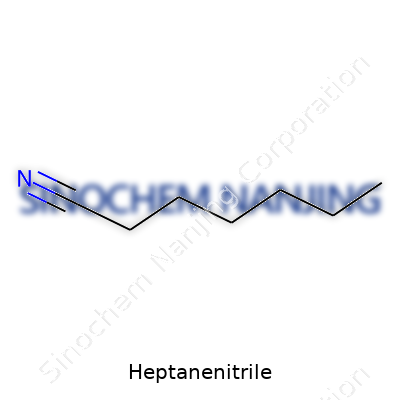
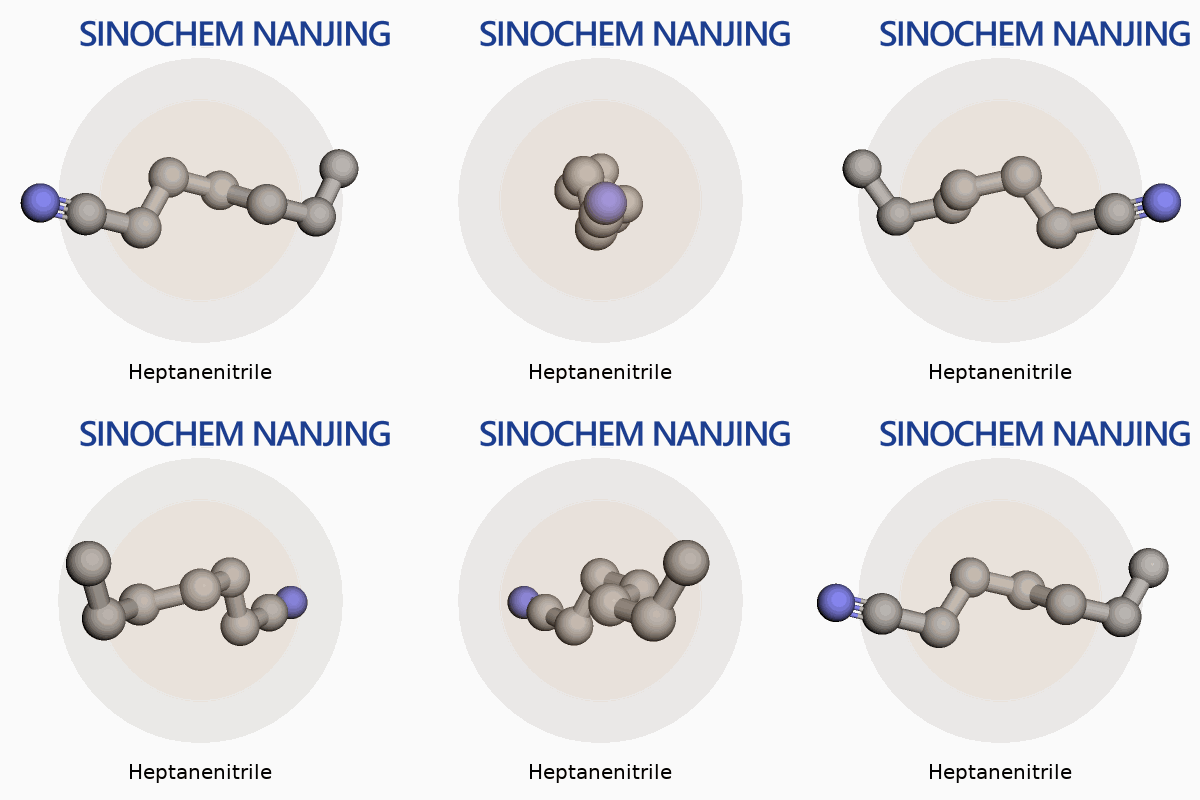
| Names | |
| Preferred IUPAC name | Heptanenitrile |
| Other names |
Heptanenitrile Heptonitrile N-Capronitrile n-Heptane nitrile 1-Cyanohexane |
| Pronunciation | /ˌhɛpˌteɪnˈnaɪtraɪl/ |
| Identifiers | |
| CAS Number | 629-09-4 |
| Beilstein Reference | 87368 |
| ChEBI | CHEBI:36485 |
| ChEMBL | CHEMBL36252 |
| ChemSpider | 11949 |
| DrugBank | DB14109 |
| ECHA InfoCard | 100.045.225 |
| EC Number | 203-696-6 |
| Gmelin Reference | 7557 |
| KEGG | C01493 |
| MeSH | D006528 |
| PubChem CID | 8127 |
| RTECS number | MI8575000 |
| UNII | 2L88M0M6QF |
| UN number | UN3276 |
| Properties | |
| Chemical formula | C7H13N |
| Molar mass | 109.18 g/mol |
| Appearance | Colorless liquid |
| Odor | Sweet, aromatic |
| Density | 0.81 g/mL at 25 °C (lit.) |
| Solubility in water | insoluble |
| log P | 1.92 |
| Vapor pressure | 0.133 mmHg (25 °C) |
| Acidity (pKa) | pKa ≈ 25 |
| Basicity (pKb) | pKb = 4.73 |
| Magnetic susceptibility (χ) | -68.2e-6 cm³/mol |
| Refractive index (nD) | 1.399 |
| Viscosity | 0.753 mPa·s (25 °C) |
| Dipole moment | 4.06 D |
| Thermochemistry | |
| Std molar entropy (S⦵298) | 292.6 J·mol⁻¹·K⁻¹ |
| Std enthalpy of formation (ΔfH⦵298) | -54.3 kJ/mol |
| Std enthalpy of combustion (ΔcH⦵298) | -4165.8 kJ/mol |
| Pharmacology | |
| ATC code | Heptanenitrile does not have an ATC code. |
| Hazards | |
| GHS labelling | GHS02, GHS07 |
| Pictograms | GHS06,GHS08 |
| Signal word | Warning |
| Hazard statements | H226, H302, H312, H315, H319, H332, H335, H373 |
| Precautionary statements | P210, P261, P264, P271, P280, P301+P312, P304+P340, P312, P330, P403+P233, P405, P501 |
| NFPA 704 (fire diamond) | 2-3-0 |
| Flash point | 86 °C |
| Autoignition temperature | 540 °C |
| Explosive limits | Lower explosive limit: 1.1%, Upper explosive limit: 6.0% |
| Lethal dose or concentration | LD50 oral rat 960 mg/kg |
| LD50 (median dose) | LD50: 880 mg/kg (rat, oral) |
| NIOSH | NA0596 |
| PEL (Permissible) | PEL (Permissible Exposure Limit) of Heptanenitrile: "5 ppm (skin) |
| REL (Recommended) | 5 ppm |
| IDLH (Immediate danger) | IDLH: 500 ppm |
| Related compounds | |
| Related compounds |
Hexanenitrile Octanenitrile |



