Germanium Tetrachloride: A Deep Dive into Its Legacy and Future
Historical Development
Early work with germanium traced back to the late 19th century, a time when chemists raced to chart the periodic table’s then-mysterious gaps. Clemens Winkler, the man behind germanium’s discovery, paved the way for further exploration into its compounds. By the mid-20th century, germanium tetrachloride started showing up in tech and chemical circles, as researchers isolated it from byproducts in zinc refining or from direct reactions with chlorine. This intersection of historical discovery and industrial ambition put germanium tetrachloride firmly in the toolbox of both chemical engineers and materials scientists. Close attention to purity and sourcing became more prominent, leading to better processes and wider adoption. Ever since, advances in analytical chemistry and engineering have encouraged further refinement, whereas the basic approach has stayed true to its roots.
Product Overview
Germanium tetrachloride generally appears as a clear, colorless, volatile liquid. The pungent, stinging odor signals its reactive nature. Producers often ship it in tightly sealed glass or metal containers to keep out moisture, which can turn it into toxic, corrosive hydrochloric acid fumes. For those working in fiber optics, infrared optics, or semiconductor manufacturing, this compound often stands among the basic building blocks, offering reliable routes to high-purity germanium or specialized optical glasses. Supply chains usually trace from metal ore refinement, with additional purification stages, to meet the standards expected in high-tech industries.
Physical & Chemical Properties
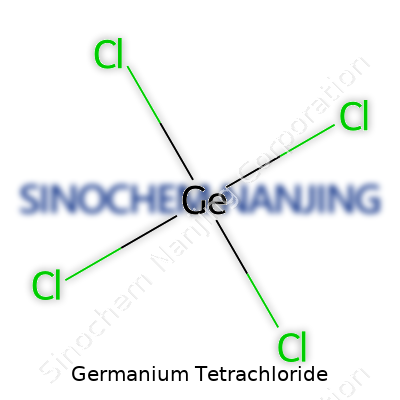
Germanium tetrachloride, GeCl4, features a relatively high density for a halide (1.88 g/cm3 at 25°C) and a low melting point near -49°C. Its boiling point, around 86°C, keeps it liquid under ambient conditions, yet it evaporates rapidly. Exposure to air triggers an aggressive reaction with water vapor, breaking down to hydrochloric acid and germanium dioxide. Such high reactivity puts it in the "handle with care" category in any lab or factory. Beyond its volatility, GeCl4's molecular geometry, with a tetrahedral structure, grants stability in closed systems, but airflow and moisture transform it quickly. The sharp, acrid scent that wafts from an open container sends a straightforward message about its irritant qualities.
Technical Specifications & Labeling
Quality standards often focus on the purity of germanium tetrachloride, typically labeled in parts per million for metal or other halide contamination. In my own lab experience, precise specifications become crucial for optical fibers, as trace elements interfere with signal clarity. Bottles usually feature hazard symbols citing corrosive and toxic properties. Shipping documents emphasize compliance with international safety codes, as UN number 2735 governs its transport due to the hazards posed. Anyone relying on this compound learns to check for the manufacturer’s lot numbers, storage recommendations (generally between 15 and 25°C in a dry, ventilated space), and instructions for emergency procedures, reflecting the compound’s legal and practical obligations.
Preparation Method
Manufacturers usually react chlorine gas with high-grade powdered germanium, often extracted from smelter dust after zinc refining. The process looks simple in textbook diagrams but demands painstaking control under real conditions. Direct chlorination happens inside glass or metal reactors under careful temperature monitoring, as runaway reactions can result in unwanted byproducts or hazardous pressure spikes. In many plants, the raw GeCl4 is then fractionally distilled, driving off solvents and impurities, to ensure technical or even electronic grade purity. Those pursuing laboratory synthesis often swap the scale but face the same necessity for dry reagents, inert atmospheres, and well-designed ventilation. A slip in moisture control leads to contamination, lost yield, and dangerous fumes.
Chemical Reactions & Modifications
Germanium tetrachloride doesn’t sit still—water, alcohols, and basic media transform it rapidly. A few drops of water instantly hydrolyze GeCl4, producing white germanium dioxide and releasing clouds of hydrochloric acid gas. Organic chemists sometimes react it with alcohols to make germanium alkoxides, while reducing agents can help extract elemental germanium. Semiconductor fabricators use highly pure GeCl4 as a feedstock for chemical vapor deposition, often converting it on-site to optical-grade GeO2. Small changes in reaction conditions, pressure, or solvents nudge the compound in new directions, offering a toolbox for chemists looking to tailor their end-products in electronics or optics. Even at small scales, these modifications demand a healthy respect for the risks involved and the expertise to keep reactions on track and contamination to a minimum.
Synonyms & Product Names
On shipping containers, datasheets, or in procurement databases, germanium tetrachloride also turns up as “Germanium(IV) chloride,” “tetrachlorogermane,” or just “GeCl4.” Different countries and contexts may use variations—some refer to it as “germanium chloride (4+).” These naming differences underline a need for attention to labeling, as mix-ups can cause confusion or, worse yet, handling mistakes with non-equivalent substances. The many names often reflect historical sources or local conventions in academic or industrial circles, and anyone ordering, storing, or using these materials learns to read labels with care to avoid costly errors.
Safety & Operational Standards
Daily work with germanium tetrachloride means recognizing a serious risk profile. Direct contact burns skin and eyes, and inhaling vapors irritates the respiratory tract. People in my field learn quickly to rely on personal protective equipment—goggles, gloves, and chemical fume hoods. Storage protocols require lined, airtight vessels away from water sources, in ventilated locations. Safety data sheets recommend specialized spill kits with neutralizing agents and warn that ordinary absorbents may cause secondary reactions. Facilities handling large quantities need well-drilled emergency drills to deal with accidental releases. Regulatory frameworks, including OSHA and EU REACH, classify GeCl4 as a hazardous material and enforce stringent limits on workplace exposure and permissible emissions. In my observation, labs and factories invest heavily in air monitoring and closed-system transfers to keep both workers and the environment safe.
Application Area
The application landscape for germanium tetrachloride has shifted dramatically as technology advanced. Telecommunications companies depend on it to manufacture the core of most optical fibers, where it boosts the refractive index in silica glass, enabling high-speed, long-distance data transfer. In semiconductors, technicians use it for thin-layer deposition, laying down ultra-pure, defect-free germanium films. Infrared optics manufacturers rely on it for specialty glasses used in night vision, thermal imaging, and precision sensors. Analytical chemists turn to it as a precursor in making pure germanium standards or reagents. In my professional circle, colleagues stress its pivotal role in creating photodetectors and advanced lens systems, devices central to fields from astronomy to defense. Despite growing calls for alternatives, many sectors view germanium compounds as irreplaceable for achieving clarity and performance at the fiber-optic level.
Research & Development
Research teams keep looking for new methods to make and use germanium tetrachloride. Universities and industry consortia fund projects aimed at greener production pathways, such as recycling post-consumer electronics for feedstock or minimizing the reliance on chlorine gas. Analytical chemists develop protocols to detect lower and lower trace-metal levels, pushing the compound’s purity closer to theoretical limits. Optical engineers test doping profiles that promise less signal loss and broader bandwidth, hoping to meet next-generation telecom demands. Materials scientists keep striving to refine the crystalline quality of germanium from this precursor, critical for new photonic chips and quantum technologies. Recent funding calls from government labs focus on security of supply, exploring closed-loop recycling to cushion against geopolitical disruptions. R&D circles have embraced machine learning to optimize both synthesis and predictive modeling, opening up new windows for tuning physical or chemical properties.
Toxicity Research
Toxicologists have documented that inhaling germanium tetrachloride or its hydrolysis products can cause immediate damage, targeting respiratory and eye tissues. Chronic, low-level exposure studies still leave gaps in statistical certainty, yet repeated small-dose contact often causes inflammation or skin sensitization. Environmental scientists warn that spills near waterways convert GeCl4 into hydrochloric acid, endangering aquatic life. Regulatory agencies responded by requiring robust ventilation, spill containment, and health monitoring in workplaces. Toxicity studies published over the past decade suggest that carefully engineered ventilation systems and rigorous employee training keep incidents rare, but some earlier plant records detail higher-than-average rates of reported eye and respiratory complaints. Since risk can’t be designed out entirely, preventative approaches and strict protocols shape every aspect of its handling. The ongoing dialogue between toxicology and process design leads to improved safeguards for everyone involved.
Future Prospects
Looking ahead, demand for germanium tetrachloride stands likely to rise in tandem with broader telecommunications and cloud infrastructure expansion. Emerging opportunities in photonic computing, smart sensors, and next-generation medical imaging put new pressure on supply chains. Some researchers push for synthetic substitutes that mimic GeCl4’s core optical behavior, though cost and complexity slow adoption. Circular economy concepts gain traction in both research and public policy, with recycling used optical fiber and electronics promising a supplemental source. My own networks signal increased collaboration between government, academia, and industry to secure sustainable access in light of global supply risks. Digital tools, better data analysis, and robotics look set to make synthesis, purification, and application safer and more efficient. Despite complexity and risk, the trajectory of innovation in both chemistry and materials science offers hope that the product’s legacy will continue to drive progress across high-tech sectors while reducing its environmental and health footprint.
What is Germanium Tetrachloride used for?
The Backbone of Fiber Optics
Germanium tetrachloride plays a practical role in internet technology. It takes center stage in the production of optical fibers, which make up our modern communication highways. Thousands of miles of glass threads run below oceans and across continents, letting people stream videos, make calls, or send emails in seconds. Without this chemical compound, these fibers wouldn’t exist as we know them. Telecom companies depend heavily on it to keep up with rising global data needs. As demand for high-speed networks keeps climbing, so does the importance of germanium tetrachloride.
Pushing Forward Medical Imaging
In healthcare, accuracy in diagnosis saves lives. Germanium, thanks to its high refractive index and infrared transmission, works in medical optics for use in imaging systems. The compound’s purity lets companies pull out ultra-clean germanium dioxide after hydrolysis, which then moves on into lenses and windows for lasers and IR spectrometers. This sort of high-precision glass enhances CAT scanners and thermal imaging, improving early detection and patient outcomes.
Demands in the Semiconductor World
Semiconductors power everything from smartphones to vehicles. Manufacturers use germanium tetrachloride in specialized doping processes. Doping isn’t about illegal shortcuts; it increases a chip’s speed by tweaking electrical properties of pure silicon. Some of the world’s leading chip fabrication plants rely on chemical vapor deposition with this material during manufacturing advanced transistors. Sharing a workspace with semiconductor engineers, I watched how small mistakes in chemical quality could stall an entire production line. It gives a person respect for supply consistency and safety controls in these facilities.
Challenges Around Safety and Environment
This material doesn’t arrive without risks. It reacts strongly with water and moisture, giving off hydrochloric acid. Engineers and technicians handling the compound depend on robust workplace safety practices, including sealed systems and heavy-duty respirators. Chemical spills threaten both workers and water sources. Proper containment, disposal, and emergency planning matter as much as scientific innovation.
Tighter regulations and watchdog initiatives in recent years have nudged chemical makers toward greener production steps. Recovery and recycling programs for spent germanium compounds are building steam. I’ve talked to colleagues who switched to closed-loop manufacturing; they reduced waste and saw fewer health incidents. These steps prove that sustainability doesn’t have to mean less profit if businesses rethink their priorities.
The Bigger Picture in Global Supply Chains
Like rare earths and other specialty elements, germanium supplies jump with geopolitics. Trade disputes and export bans affect pricing and prompt countries to look for substitute materials. For a long time, major deposits came from byproducts of zinc mining, and only a handful of regions produce enough to affect world markets. Stress on supply can ripple through to internet reliability or access to medical devices.
Encouraging new research into alternative fibers or less toxic production methods would put less pressure on one critical input. Some startups think outside the box by working on synthetic materials capable of replacing part of the need for germanium. Creating policies supporting recycling and securing diversified sources would help keep innovation on track without surprise shortages or price spikes.
What is the chemical formula of Germanium Tetrachloride?
Understanding Germanium Tetrachloride
Germanium tetrachloride carries the chemical formula GeCl4. This compound stands out in the world of specialty chemicals, thanks in part to the rising demand for high-speed fiber-optic networks. As someone who grew up in a small town where internet speeds lagged behind, seeing how fiber optics have changed the way we live feels personal. Many cities now rely on those tiny glass threads, and GeCl4 helps turn the promise of rapid data transfer into a reality.
From Formula to Real-World Use
GeCl4 doesn’t stay in the lab; it steps into factories and production lines. Making optical fibers requires germanium dioxide, which starts out as germanium tetrachloride. That clear, oily liquid gets purified through distillation, a process not unlike how distilleries separate different spirits. Once the GeCl4 is clean, it’s burned with oxygen to yield the ultra-pure dioxide glass used in communication cables.
GeCl4 also plays a role beyond communication. It pops up in electronics and infrared optics. Smartphones, medical imaging devices, and even solar cell industries call on germanium compounds to improve performance. The formula itself might look basic, but the ways people use the molecule suggest otherwise.
Hazards and Environmental Concerns
Simple structures don’t always mean harmless. GeCl4 reacts strongly with water, generating hydrochloric acid and heat. A single spill in a lab or factory can create harmful fumes and pose serious burn risks. I remember my days in the university chemistry lab—nothing matched the urgency a supervisor barked out after a spill of this kind. Quick thinking, proper ventilation, and following safety protocols saved that day.
The production and use of GeCl4 bring up environmental concerns, too. Industrial waste, especially if not managed with care, sends a mix of toxic byproducts into water sources. Germanium itself isn’t notorious for toxicity, but the chlorine in this compound causes damage if left unchecked. Regulations exist for a reason, yet news cycles still report violations and unsafe storage in some places.
Moving Toward Safer and Smarter Use
Factory managers and process engineers have found better ways to handle GeCl4 over the years. Closed-loop systems and improved leak detection stand out among practical improvements. Workers now receive better training to identify issues and prevent mishaps. This isn’t just about ticking boxes—it saves lives and ecosystems, lessons I relearn each time I mentor new science students or visit manufacturing centers.
Researchers keep searching for safer alternatives or processes that use less hazardous reagents. Recycling and reclaiming leftover GeCl4 also got more common, making the most out of available material and lowering the burden on the environment. Strong policies ensure companies measure up to community and global expectations—after all, anything less only kicks the problems further down the road.
Germanium tetrachloride’s chemical formula, GeCl4, might not look complicated on paper. Behind that simplicity, though, lies a story filled with risks and rewards that touch daily life. Responsible innovation holds the key to safer, more connected communities. Knowledge, applied with care, powers the next step forward.
Is Germanium Tetrachloride hazardous or toxic?
What Is Germanium Tetrachloride?
Germanium tetrachloride stands out in the world of specialty chemicals, especially for folks who deal with fiber-optic cables and advanced electronics. It shows up as a colorless, fuming liquid with a sharp, irritating smell. Many people in research labs and big manufacturing plants rely on it for its role in making high-purity germanium for high-speed fiber connections. The question comes up, though: Is it as dangerous as it sounds?
Inhaling the Risks
Take a deep breath near an open bottle of germanium tetrachloride, and you quickly learn it doesn’t belong anywhere near your airways. Breathing in its vapors irritates the nose, throat, and lungs almost instantly. Short-term exposure causes coughing, choking, and sore throats. Long-term contact has even heavier consequences, including severe breathing trouble and burns. The chemical reacts with moisture in the air, forming hydrochloric acid, and nobody wants acid forming in their lungs.
What Happens on Your Skin?
It doesn’t treat skin with any more kindness. A small splash stings and burns. Redness, blisters, even deep chemical burns develop in just seconds. I’ve seen the aftermath on a lab partner’s arm. Quick action with water saved her from lasting scars, but it drove home that protective gloves and goggles aren’t optional gear. Hands and eyes are at real risk if you’re careless.
Spills and Water Worries
Dumping this liquid near water creates more than puddles. Germanium tetrachloride turns water into hydrochloric acid vapor and heat — sometimes enough to boil off steam and send irritating fumes everywhere. These vapors can drift, affecting anyone nearby. Spills at an industrial scale demand a speedy, careful response, as both the chemical and byproducts can damage pipes and threaten the safety of workers and first responders.
Environmental Hazards
Nature doesn’t fare any better. Hungarian researchers published studies that showed runoff from accidental spills harmed local fish and invertebrates. The acid byproducts change the pH of streams, making them unlivable for sensitive species. Cleaning up a spill isn’t only about protecting people, but about keeping local water life out of harm’s way — something too easy to forget in a rush to keep operations moving.
Making Safer Choices
So why is germanium tetrachloride still in use? Its role in optics at this point can’t be underplayed — high-speed internet and medical imaging both depend on high purity germanium, and this compound remains the best way to get there. The challenge falls to companies and regulators to set strong safety rules. Closed systems, heavy-duty ventilation, and strict training make a difference. Engineers on the ground, not just in offices, keep an eye out for leaks and careless habits.
Lessons Learned
People need clear information about what’s in their workplace or community. Training saves more injuries than the toughest suit or goggles. Open conversations between industry, employees, and community watchdogs can build habits that prevent accidents before they happen. As technology races ahead, there’s little excuse for forgetting the basics: respect the dangers, prepare for accidents, and learn from mistakes, so germanium tetrachloride remains a valuable tool — not a health crisis.
How should Germanium Tetrachloride be stored and handled?
Why Germanium Tetrachloride Demands A Careful Approach
Anyone who has worked in a chemistry or manufacturing setting knows certain chemicals spark extra caution. Germanium tetrachloride lands high on that list because of its nasty habit: it reacts sharply with water and moisture, breaking down into hydrochloric acid. I've seen glassware fogging up, signals warning of a leak, and the sharp scent letting everyone know trouble lurks. Stories like these aren’t scare tactics; they explain why handling this material calls for practical know-how, common sense, and respect for the risks.
Simple Storage, Big Consequences
You can’t treat germanium tetrachloride like ordinary lab chemicals. Storing it means keeping it far away from even a hint of water vapor or humidity. People use tightly sealed glass containers, sometimes lined with Teflon, and stow them in dry, well-ventilated cabinets. If you’ve ever seen steel or plastic corrode in hours, you understand why glass usually wins. Not every workplace invests in humidity monitoring, though everyone probably should. Small investments in storage tech can prevent thousand-dollar mistakes and keep workers safe.
A secondary containment tray helps catch leaks. I’ve seen teams rotate stock and inspect every bottle for broken seals or corrosion—habits learned the hard way. Some rely on color-changing indicators that flag moisture. All it takes is one slip for a store room to fill with a lung-searing haze. A controlled access policy—locking up the chemicals, keeping logs, limiting keys—stops untrained hands from causing bigger problems.
PPE Is Not Optional
No one who’s handled volatile chemicals forgets the sting of acid vapors on skin or lungs. With germanium tetrachloride, gloves, goggles, face shields, and chemical-resistant aprons all earn a spot at the bench. Nitrile or butyl rubber gloves stand up better than latex or vinyl to this chemical’s aggressive personality. Good lab coats and proper footwear finish off the uniform. I’ve yet to meet anyone who enjoys the aftermath of a splash or a spill, so I never skip these steps in the real world.
Workplace Practice Matters
Training sits at the heart of the problem—no one can wing it when handling reactive chemicals. New hires sit through direct instruction and watch veterans demonstrate decanting, transfer, and disposal. Running an emergency drill, with the eyewash and neutralization stations tested in real time, pushes these lessons from theory to muscle memory. Printed guidelines must stay readable and visible—not hidden in a binder.
Spill kits containing soda ash or lime stand ready since water makes things worse. Used bottles get neutralized, rinsed, and disposed of following hazardous waste procedures, never tossed in regular trash. I keep the emergency phone number posted. Quick action beats panic every time.
Technology Helps, But Culture Carries Weight
Modern air monitors, self-closing cabinets, and remote handling tools all reduce risk, but none replace a culture of alertness. Supporting workers with up-to-date safety information, frequent checks, and honest reporting creates an environment where trouble gets stopped early. Upkeep costs less than disaster, both in human and financial terms.
In chemistry, mistakes carry real consequences. Working with germanium tetrachloride means showing up prepared, listening to those with experience, and treating every session like an exam you can’t afford to fail. I’ve seen smart people take shortcuts and pay for them. Paying respect to the risks means heading home healthy, every night, no drama.
What is the appearance and physical properties of Germanium Tetrachloride?
Unpacking Germanium Tetrachloride in the Real World
Germanium tetrachloride doesn’t make headlines like other chemicals, but anyone working in telecommunications or optical fiber production has come across it. Most folks would never encounter this substance up close, but its physical properties make it pretty important behind the scenes. In my early days in a chemistry lab, I learned the hard way that this is not a chemical you want to handle lightly. Its reputation for being touchy in the air stays with most chemists.
Appearance Counts for More Than Looks
This compound appears as a colorless, fuming liquid. There’s a certain clarity to it that almost seems harmless at first glance, but after opening a sealed container, a sharp acidic odor gives away its true nature. Left exposed, it reacts quickly with moisture in air, releasing fumes of hydrogen chloride. On humid days in the lab, just opening a vial could make your eyes sting and your nose burn. This property sets it apart: it doesn’t just sit around waiting to be used. It’s always reacting to its environment, reminding you to treat it with respect.
Boiling, Freezing, and Everything in Between
Temperatures shape how easily we work with it. Germanium tetrachloride boils at about 86 degrees Celsius. In practical terms, it’s a liquid under normal room conditions, but a bit of heat pushes it to gas form in no time. The melting point sits near -49 degrees Celsius, so unless you live in an unusually cold spot, you’ll only encounter it as a liquid. This matters for shipping and storing; those in industry often use special containers and tight seals, as leaks would let it escape or react with air fast. My team learned to keep all our glassware dry and tightly closed -- one careless moment and the stuff would corrode metal surfaces or make a puddle of acid right where you least want it.
What Makes It Useful—or Dangerous
So why work with a chemical that reacts so quickly with the everyday world? It all comes back to purity and precision. Germanium tetrachloride helps produce the pure germanium dioxide needed for optical fibers. These fibers form the backbone of internet connections across the globe. In other words, a rapid, reactive liquid like this underpins modern communication by providing materials free of contamination. Confidence in performance and reliability can hinge on chemists' ability to keep this chemical pure and dry.
Health and Safety Aren’t Just Buzzwords
This isn’t a compound that forgives mistakes. Even brief skin contact can cause burns. Inhalation irritates airways and damages lungs, especially in workspaces with poor ventilation. Anyone working with it wears gloves, goggles, and often uses fume hoods designed for aggressive chemicals. Emergency washes sit nearby at all times. Publicly available reports show that accidental exposure drops sharply in regulated labs, emphasizing the impact of clearly enforced safety protocols.
Better Outcomes Through Training and Structure
Stronger safety education, clear procedures, and routine reviews improve the odds. Speaking personally, routine training saved us more than once from mistakes—a drill or reminder may feel repetitive, but in chemistry, repetition forms a safety net. Companies that combine experienced staff with detailed protocols consistently see fewer incidents. Sharing best practices across companies and research institutions builds a safer future for everyone, keeping this useful but risky chemical in check.
| Names | |
| Preferred IUPAC name | Tetrachlorogermane |
| Other names |
Germanium(IV) chloride Germanium chloride Tetrachlorogermane |
| Pronunciation | /ˌdʒɜːˈmeɪniəm ˌtɛtrəˈklɔːraɪd/ |
| Identifiers | |
| CAS Number | 10038-98-9 |
| 3D model (JSmol) | `JSmol('GeCl4')` |
| Beilstein Reference | 85707 |
| ChEBI | CHEBI:30178 |
| ChEMBL | CHEMBL1201879 |
| ChemSpider | 20585 |
| DrugBank | **DB14616** |
| ECHA InfoCard | 100.028.760 |
| EC Number | 232-118-3 |
| Gmelin Reference | 58786 |
| KEGG | C18908 |
| MeSH | D005856 |
| PubChem CID | 66203 |
| RTECS number | GE7175000 |
| UNII | RQK4E8Q2G6 |
| UN number | UN1931 |
| CompTox Dashboard (EPA) | EPA CompTox Dashboard: **DTXSID0020638** |
| Properties | |
| Chemical formula | GeCl4 |
| Molar mass | 214.40 g/mol |
| Appearance | Colorless to pale yellow fuming liquid |
| Odor | Pungent |
| Density | 1.88 g/cm³ |
| Solubility in water | Reacts with water |
| log P | 1.9 |
| Vapor pressure | 23.4 hPa (20 °C) |
| Acidity (pKa) | 1.1 |
| Basicity (pKb) | -2.7 |
| Magnetic susceptibility (χ) | −54.0×10⁻⁶ |
| Refractive index (nD) | 1.513 |
| Viscosity | 2.41 mPa·s (25 °C) |
| Dipole moment | 0 D |
| Thermochemistry | |
| Std molar entropy (S⦵298) | 290.6 J·mol⁻¹·K⁻¹ |
| Std enthalpy of formation (ΔfH⦵298) | -524.6 kJ/mol |
| Std enthalpy of combustion (ΔcH⦵298) | -582.2 kJ·mol⁻¹ |
| Pharmacology | |
| ATC code | V03AX10 |
| Hazards | |
| Main hazards | Corrosive, causes severe skin burns and eye damage, harmful if inhaled, reacts violently with water releasing toxic gases. |
| GHS labelling | GHS02, GHS05, GHS07 |
| Pictograms | GHS05,GHS06 |
| Signal word | Danger |
| Hazard statements | H301 + H331: Toxic if swallowed or if inhaled. H314: Causes severe skin burns and eye damage. H335: May cause respiratory irritation. |
| Precautionary statements | P261, P264, P271, P280, P301+P330+P331, P303+P361+P353, P304+P340, P305+P351+P338, P310, P312, P321, P363, P405, P501 |
| NFPA 704 (fire diamond) | 3-0-2-W |
| Autoignition temperature | 226 °C |
| Explosive limits | Not explosive |
| Lethal dose or concentration | LD50 oral rat 1520 mg/kg |
| LD50 (median dose) | LD50 (median dose): Oral-rat LD50: 3710 mg/kg |
| NIOSH | TTI01250 |
| PEL (Permissible) | PEL: 1 mg/m³ |
| REL (Recommended) | REL (Recommended Exposure Limit) of Germanium Tetrachloride: "0.1 ppm (0.56 mg/m3) as a 8-hour TWA |
| IDLH (Immediate danger) | 300 ppm |
| Related compounds | |
| Related compounds |
Silicon tetrachloride Tin tetrachloride Lead tetrachloride Carbon tetrachloride |



