Methyl N-Butyrate: A Comprehensive Look
Historical Development
Back in the days before modern chemistry labs, people encountered methyl n-butyrate as part of natural flavors. In the late 19th and early 20th centuries, as organic chemistry took off, scientists learned to isolate, identify, and produce simple esters. Methyl n-butyrate got attention for its fruity, pineapple-like aroma, which turned it into a favorite for food and fragrance applications. Through decades, production methods evolved. Synthetic pathways grew cleaner and more efficient as demand increased, especially during boom years in the flavor and fragrance industry. Regulations and analytical techniques developed side by side, helping keep this compound both desirable and safe.
Product Overview
Methyl n-butyrate stands out as a colorless liquid that captures the nose with a clean, sweet, fruity odor. This compound often ends up in artificial flavors, perfumery, and sometimes in low concentrations as a solvent. Its low toxicity and mild odor contribute to its broad acceptance. Producers supply the compound either as a lab-grade chemical or a food-grade agent, depending on where it gets used. I have seen flavor companies favor it for strawberry, apple, and pineapple notes, which makes sense due to its fresh scent. Users appreciate its volatility and easy miscibility with alcohol, which aligns with commercial needs in food, beverage, and cosmetic spaces.
Physical & Chemical Properties
To the naked eye, methyl n-butyrate barely stands out—clear and watery in appearance. Boiling point hovers around 102-103°C, making it evaporate quickly in open air. Specific gravity sits at about 0.87, and the liquid floats on water, yet dissolves only in trace amounts. Chemists recognize its structure as an ester formed from butyric acid and methanol. In my time working with esters, I found its reactivity low under ambient conditions, but it will hydrolyze in strong acidic or basic solutions. It doesn’t stain skin, but the scent lingers. In vapor form, it can become flammable, so storage often demands cool and ventilated areas.
Technical Specifications & Labeling
Industrial and laboratory suppliers provide methyl n-butyrate at different purity grades. For most flavor applications, 98% or higher purity usually suffices. Labels list the CAS number, the chemical formula C5H10O2, and a basic hazard warning, especially noting its flammability. Food-grade batches face stricter checks, looking for residual solvents and possible contaminants. Transport containers, whether glass or stainless steel drum, get marked for compatibility and safety. I rarely see a reputable supplier skip out on proper SDS sheets, since global transport standards focus heavily on clear hazard communication.
Preparation Method
Synthesis leans heavily on the classic Fischer esterification. Mixing butyric acid and methanol with a drop or two of concentrated sulfuric acid sets the stage. The mix heats under reflux, often for several hours. Excess methanol gets removed later, while the crude ester undergoes neutralization and washing, then distillation under reduced pressure. Labs may tweak the catalyst or solvent depending on scale and purity requirements. Commercial manufacturing focuses on yield and cutting down waste acid, which makes continuous reactors attractive for larger volumes. Over time, enzyme-catalyzed routes popped up for greener labs, but acid-catalyzed processes still remain widespread.
Chemical Reactions & Modifications
Ester hydrolysis breaks methyl n-butyrate back into methanol and butyric acid, especially under strong acidic or basic treatment. As with other esters, transesterification with another alcohol can swap out the methyl group, producing different esters. For anyone in organic synthesis, its relatively low reactivity keeps side products minimal, which is a plus for predictable results. Advanced labs sometimes modify it with halogenating agents, but such reactions don’t appear in broad commercial practice. Handling the compound rarely involves complex chemistry on the industrial side; most changes center on reformulation into fragrances or flavors.
Synonyms & Product Names
Many labels call it simply "Butyric acid, methyl ester." Other product listings read methyl butanoate or methyl n-butanoate. In flavor literature, some catalogs refer to it as "pineapple oil, synthetic" or even under code names tailored to proprietary blends. Chemists often default to the IUPAC name, but buyers in the food and fragrance world tend to stick with the common methyl n-butyrate. Synonyms usually signal the same base compound, so cross-checking CAS numbers keeps things straight—particularly important for regulatory filing or customs work.
Safety & Operational Standards
Most safety data sheets highlight methyl n-butyrate’s combustibility and advise against inhaling concentrated vapors. Proper PPE includes gloves, goggles, and a fume hood. I’ve seen fire regulations place it in the same hazard bracket as other common organic solvents—store tightly sealed and away from heat. For food-grade use, codes like the US FDA and the European Food Safety Authority set strict limits on purity, heavy metal content, and allowable concentration in finished products. Companies running large flavor batches wisely incorporate airflow systems, regular leak checks, and staff drills to prevent possible accidents.
Application Area
The food industry remains the biggest destination. I watched manufacturers favor methyl n-butyrate for boosting fruit flavors in candy, drinks, baked goods, and ice cream. Perfumers tap into its fresh top notes for cologne, haircare products, and air fresheners. Small quantities end up as solvents for certain resins or extraction agents in lab work. In agriculture, some companies explored it as a component for insect attractants, based on its strong, pleasant scent. The versatility springs from its mild toxicity and well-documented aroma contributions, giving flavorists and product developers reliable results batch after batch.
Research & Development
Recent years saw researchers look for greener, more efficient production, sometimes turning to enzyme-catalyzed or biotechnological pathways. Academia and commercial labs alike investigate microbial factories—bacteria or yeast capable of fermenting simple sugars to methyl n-butyrate, which could sidestep harsh chemical conditions. Analytical teams study trace-level quantification in food matrices for regulatory and quality testing. Some groups dig into its sensory profile, clarifying how it blends with other esters or contributes to signature flavor bouquets. Researchers also explore decontamination methods in case of accidental spills, since its aroma flags problems instantly.
Toxicity Research
Toxicity studies frame methyl n-butyrate as low risk at typical exposure levels. Acute oral LD50 in rodents sits well above doses found in food, and short-term studies find no evidence of carcinogenicity or reproductive harm. Eyes and mucous membranes react to concentrated vapors, so workplace exposure limits get defined accordingly. In rare cases, people sensitive to esters might notice headaches or nausea from strong scents, but incidents remain isolated. Food authorities set intake limits based on decades of animal testing and survey data from food and fragrance industries. Recent reviews reinforce a favorable safety profile as long as guidelines get observed.
Future Prospects
Trends suggest a rising demand for natural and sustainable flavor ingredients, and methyl n-butyrate aligns with both, if biotech production reaches scale. The flavor and fragrance sector looks for reliable, traceable sources, and fermentation-based synthesis could help. Regulatory scrutiny on trace contaminants remains high, so process innovations target greater purity with fewer byproducts. Research points to expanded agricultural and pest control roles, with field trials exploring new delivery methods. In the lab, microencapsulation and slow-release systems get a close look for stabilizing the compound in packaged goods. Long-term prospects tie closely to evolving consumer tastes, but methyl n-butyrate holds a decades-long track record of reliable performance across so many industries that its value rarely gets questioned.
What is Methyl N-Butyrate used for?
What Methyl N-Butyrate Brings to the Table
Methyl N-butyrate isn’t some mystery chemical brewed in secret labs. It’s an ester that pops up in everyday life, often without anyone even realizing it. The sweet, fruity aroma reminiscent of apples and pineapples makes it a favorite in the flavor and fragrance industry. From the perspective of someone who pays attention to labels or even just enjoys the occasional flavored yogurt, this compound shows up more often than you’d expect. A splash in a candy recipe or just a few drops in a beverage formula, and you’re hit with a crisp, clean smell or taste that reminds you of biting into a fresh apple.
Applications in Flavor and Fragrance
Manufacturers gravitate toward methyl n-butyrate because nature doesn’t always deliver enough of those pleasant notes by itself. Years ago, I worked alongside a team responsible for formulating flavors in snack foods. There were endless samples of the same product, each with just a little tweak in the mix. Over and over, the samples with a trace of methyl n-butyrate stood out. Research backs this up—scientists have cataloged it as a key player in apple, pineapple, and other fruit flavors (European Food Safety Authority, 2011). Perfume creators lean into this ester because it brings a bright, uplifting top note that lingers just long enough for people to notice.
Methyl N-Butyrate in Lab Research
Chemists don’t stop at flavors and perfumes. They use methyl n-butyrate to create more complex molecules or as a reference compound when figuring out how to identify substances in unknown samples. Back in college, during an organic chemistry lab, the process of making esters taught us a lot about reactions, yields, and purity—and methyl n-butyrate was one of the first ones we worked with. It's as close to hands-on as chemistry education gets. The familiarity of its scent made experiment days more tolerable too. Across research, it pops up as a standard compound, always ready for an experiment or calibration.
Inside the Food Industry
Food safety regulators have taken a close look at methyl n-butyrate’s safety profile. The U.S. Food and Drug Administration (FDA) lists it as generally recognized as safe (GRAS) when used in typical amounts for food flavoring. That matters, because plenty of people worry about chemicals they can’t pronounce. The science says methyl n-butyrate breaks down easily in the body and at the low concentrations found in food, it doesn’t present much risk. For someone shopping for groceries, understanding that sort of background can take away some of the anxiety piled on by ingredient lists full of unfamiliar terms.
Environmental Impact and Production
As demand grows, responsible production methods take on more importance. Sustainable synthesis routes now use renewable resources, cutting down reliance on fossil fuels. Companies can shave down their carbon footprints by keeping the process cleaner. Waste management in chemical manufacture used to lag behind, but regulatory changes and public pressure have pushed the industry to clean up its act. A few decades back, stories of chemical waste would splash across headlines at least once every few years. Now, with pressure and oversight, production facilities put real effort into lowering emissions and properly treating byproducts.
Looking for Solutions and Future Use
Methyl n-butyrate offers consistent results at low costs, so companies get repeatable results without breaking the bank. There’s always room for improving how it’s produced: moving closer to bio-based processes, adopting green chemistry even at small scales, and staying transparent with consumers. Better education about what goes into flavorings and fragrances helps keep trust in food and consumer products. Open communication builds confidence, and people feel more comfortable with their choices when they understand what’s behind the names on the label.
Is Methyl N-Butyrate safe to handle?
What Methyl N-Butyrate Actually Is
Methyl N-Butyrate shows up in labs as a clear liquid with a fruity, pineapple-like scent. Chemists know it. It’s used for flavoring, fragrances, and now and then in research projects. On paper, it looks pretty harmless—after all, a lot of people have handled it over the years without trouble. Yet safety isn’t about past luck. It’s about what actually happens when things go off-script.
Risks You Should Know
Smelling like fruit doesn’t make a chemical gentle. Methyl N-Butyrate can irritate the skin, eyes, and even the lungs. Spilling a bit on your hand can spark a burning feeling or redness. Breathing in the fumes could lead to headaches or dizziness. The real risk ramps up in poorly ventilated spaces. With enough exposure, even mild-seeming chemicals can build up and pack a punch. That risk grows if you forget about safety basics—chemical-resistant gloves, a lab coat, goggles. Years in the lab have taught me that nobody gets to skip those, not even for the “safe” stuff.
Why Handling Practices Matter
Too many folks remember to glove up for obvious threats but slack off with esters and similar liquids. I’ve seen people pour methyl N-butyrate without a care, trusting the light scent as a safety signal. That’s a mistake. Studies show this compound isn’t acutely toxic, but you’ll find it on the list of irritants for a reason. The safety data sheet flags its flammability. Imagine splashing some on a bench near a hot plate—that can turn into a fire in seconds. My own rule has always been simple: treat every volatile compound with respect. Spills, vapor clouds, and unexpected reactions don’t just happen in textbooks.
What Science Tells Us
The National Institute for Occupational Safety and Health (NIOSH) and the European Union have both flagged methyl N-butyrate as an irritant. OSHA doesn’t set a formal exposure limit for it, but occupational guidelines suggest treating it like other low-to-moderate risk chemicals. It’s not classified as a carcinogen or reproductive toxin. Chronic effects seem unlikely based on the current science, but nobody has run decades-long studies on daily exposure. Flammability remains the headline risk, followed by skin or eye contact.
Building Safer Habits
Good lab habits count for more than any warning label. Wearing gloves and goggles remains the minimum, not the exception. Use methyl N-butyrate with the fume hood on. Check the spill kit before starting work. If you splash a bit, don’t shrug—it’s easy to wash off with soap and water, but it’s easier to avoid making contact in the first place. Make sure containers always show the right label. You’ll never regret taking five extra seconds to double-check, but you’ll always regret that one moment of carelessness that leads to someone getting hurt.
Takeaway for Everyday Handling
Methyl N-Butyrate can be handled safely, and people do it every day in labs worldwide. It just asks for some attention and the right gear. None of the risks are mysterious—the science is clear, as are the protective steps. Want to avoid incidents? Stick with habits that keep your hands, skin, and lungs out of harm’s way. That, more than anything, makes this compound uneventful and boring—and for anything that can catch fire or sting your skin, boring is exactly what you want.
What is the chemical formula of Methyl N-Butyrate?
Methyl N-Butyrate Explained
Methyl n-butyrate, with its fruity scent, often sneaks onto the ingredient lists of flavors and fragrances. The chemical formula—C5H10O2—tells a simple story: five carbons, ten hydrogens, and two oxygens that lock together in a way that delivers a familiar smell, reminiscent of apples or pineapples. This clear liquid travels from chemistry labs straight into food science, perfumery, and even perfumed cleaning products. Its structure isn’t just trivia; it sets the boundaries for the way it reacts, dissolves, and blends in with other ingredients.
Real World Importance
Sometimes, the everyday products on kitchen countertops draw from molecules like this. I’ve worked with people who care about what goes onto or into what they eat. Reading the formula gives more than just a label. Methyl n-butyrate, for example, is an ester, and esters often carry fresh, light scents. This helps specialists decide where to use it or what to avoid if allergies pop up. Authenticity matters. Recipes that claim to use all-natural compounds sometimes turn out to be completely synthetic—the only real way to know is by checking the chemical fingerprint.
What C5H10O2 Means in Safety and Use
That formula might look dry, but it delivers practical help. Researchers can figure out safety levels for workers who might get exposed to vapors in factories. Food scientists look up these numbers when testing how much is safe to add to a soft drink or candy. These decisions aren’t just guesswork. They’re based on toxicity, solubility, and even photoreactivity. Without this formula, nobody could design a lab test for methyl n-butyrate, check residue on food, or answer questions if unexpected allergies show up in the population. I remember walking through a flavor plant, the air thick with a dozen fruity-smelling esters—including methyl n-butyrate. No guesswork there. Tracking quantities required chemistry, not just training your nose.
Challenges and Solutions in Labeling Chemicals
There’s room for improvement in the way these chemicals land on food ingredient lists or cleaning product bottles. Mislabeling happens, sometimes by mistake, sometimes on purpose. For people who care about allergens or chemical sensitivities, transparency isn’t just a buzzword, it protects health. Regulators need easy ways to cross-check actual chemical content against what shows up on labels. Trust can fall apart fast if people suspect companies are hiding or swapping out ingredients. Third-party labs offer one answer. Clearer standards on labeling, regular spot checks, and better education for anyone working in industrial kitchens or bottling factories can bridge the gap.
Why a Chemical Formula Isn’t Just for Chemists
Methyl n-butyrate’s formula does more than fill a line in a textbook. It connects chemistry classrooms to coffee shops, labs to grocery aisles. The food tastes you chase, the fragrances loved or avoided, the safety standards that keep workplaces healthy—all link back to knowing exactly what’s going in and why. For anyone who prefers honest food, safe workplaces, and truth in advertising, it pays to pay attention to a formula as simple as C5H10O2.
What are the storage requirements for Methyl N-Butyrate?
Why Storage Conditions Matter
Methyl N-Butyrate is an organic compound with a sweet, fruity aroma, often found in flavors and fragrances. People rarely stop to think about what goes on between chemical production and actual use, but proper storage plays a big role. Even though Methyl N-Butyrate seems pretty benign compared to many industrial chemicals, skipping over the storage details can have costly or even dangerous consequences.
Keeping Things Cool and Dry
This substance has a flash point that sits at a relatively low temperature. Heat sources around a warehouse pose a real risk. Once vapors ignite, fires spread quickly. Placing Methyl N-Butyrate containers in a cool, well-ventilated area isn't just a matter of best practice. It keeps workers and property safe. In the places I’ve worked, nobody trusted old thermometers; digital thermometers made it easier to check during every shift.
Humidity can impact chemicals more than most people expect. Water might sneak into containers through loose lids or broken seals, especially if the supplier uses metal drums that corrode. Dampness not only dilutes the product but also changes its chemical profile. I remember pulling open a drum only to catch a whiff that didn’t fit the sharp, fruity odor—it meant contamination had set in. Regular checks of seals and keeping stock off the concrete floor with pallets can help avoid these moments.
Common Sense About Containers
Metal reacts with plenty of chemicals. I’ve seen rust in poorly maintained storage cause leaks and loss of product. Stainless steel or HDPE plastic containers are wise choices here. Not all warehouses have the same standards—one time, we transferred liquid from a rusty drum to new containers after discovering a leak. Better to use non-reactive containers from the start.
Protect From Sunlight and Sparks
Direct sunlight can speed up breakdown and build up pressure in containers. Storing drums away from windows or adding UV-proof covers avoids these problems. Methyl N-Butyrate can release vapors that, when ignored, become hazardous. Small sparks from equipment or even static electricity near open containers present serious risks. Workers in environments with chemical storage benefit from regular checks for exposed wiring and grounding procedures—practices that seem routine until they aren’t followed and something goes wrong.
Labeling and Isolation
Mislabeled chemicals create uncertainty about what is actually inside each drum. Sorting through old containers and updating inventory prevents mishaps. Segregating Methyl N-Butyrate from acids, oxidizers, or basic substances makes sense because accidental mixing can trigger reactions. In my experience, color-coded labels and simple diagrams on storage maps keep everyone on the same page, even when people rotate between shifts frequently.
Spill Control and Ventilation
Minor spills happen, so workplaces with proper absorbent materials and ventilation fare much better than those caught unprepared. Strong ventilation removes vapors, reducing inhalation risk for workers and helping prevent the buildup of flammable concentrations. In facilities where the planners gave thought to air movement, everyone breathed a bit easier—literally and figuratively.
Training Prevents Trouble
Storage rules mean little if nobody follows them. Regular training sessions help workers spot trouble before it worsens. Simple checklists and real-life examples from incidents—close calls and actual accidents—make the information sink in. No checklist catches everything, but lots of small habits keep things running smoothly.
Does Methyl N-Butyrate have a strong odor?
Getting Real About the Smell
Working in a research lab, it only takes one spill or one whiff from a bottle cap for everyone to learn which chemicals can make an entire room take on a personality of their own. Methyl n-butyrate definitely carries its own banner on that list. It’s not just a subtle nudge you get as you measure out a tiny sample—its aroma spreads fast and lingers. Industry folk and perfumers both give it some respect for how it takes over a space.
This ester sits in fruit essences. Open a bottle, and you get a burst of something sweet and fruity. Some say it flashes images of pineapples, apples, and sometimes pears. I get memories of my own early days peeling apple-flavored candy wrappers, noticing that manufactured sweetness echo through my nose. There’s science behind all this. The volatility of methyl n-butyrate means even a small open bottle sends molecules flying straight into your airways.
Why Our Noses Notice
Not every strong-smelling chemical finds its way to the snack aisle, but methyl n-butyrate does for a reason. Our brains link it to ripe fruit and freshness. This compound’s strength helps food scientists in flavoring batches of candies, sodas, and even chewing gum. Sure, it smells good in small concentrations, but too much can turn pleasant into headache territory, especially in a tiny room. I’ve seen colleagues chase the source of an unexpected sweetness for half a day—turned out someone left a drop on the lid of their workstation.
Researchers tested the scent threshold, and it shows up fast, with detection possible even at a couple parts per million. This low threshold is good for business where impact matters. Whoever pours even a small amount knows to keep the bottle away from their face. Pour a drop on a paper, leave it for five minutes, and the office suddenly feels like the fruit aisle of a supermarket—only stronger and wilder.
Managing Strong Odors in the Workplace
There’s no special trick that erases a room full of methyl n-butyrate. In labs, nothing replaces good airflow. Open windows, run exhaust fans, and keep chemical fume hoods working. Even if a sweet scent seems safe, inhaling vapors nonstop isn’t something anyone recommends. Over time, even natural-like compounds add up. Safety sheets for methyl n-butyrate warn about this too, giving everyone a reality check about using gloves and keeping containers sealed tight. Oversight agencies keep these rules in place, not just to follow paperwork but to keep daily headaches, dizziness, and nose fatigue in check for those in food flavoring and chemistry jobs.
Striking a Balance
Methyl n-butyrate’s strength as a scent maker raises a point most people only notice on accident. The food industry gets punchy flavors and fruit character with this compound, but workers walk a fine line each shift. It’s easy to appreciate that fresh fruity burst, but folks inside a facility know why storage, handling, and respect for the chemical count just as much as its claim to fame. It’s not the kind of fragrance folks want to wear home after a busy day.
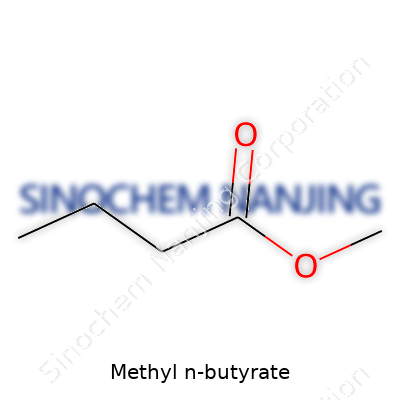
| Names | |
| Preferred IUPAC name | methyl butanoate |
| Other names |
Butyric acid methyl ester Methyl butanoate Methyl n-butanoate |
| Pronunciation | /ˈmɛθɪl ɛn ˈbjuːtɪreɪt/ |
| Identifiers | |
| CAS Number | 623-42-7 |
| 3D model (JSmol) | `C(C)CC(=O)OC` |
| Beilstein Reference | Beilstein Reference: **1720234** |
| ChEBI | CHEBI:77727 |
| ChEMBL | CHEMBL3184436 |
| ChemSpider | 15414 |
| DrugBank | DB14160 |
| ECHA InfoCard | 100.008.479 |
| EC Number | 203-303-4 |
| Gmelin Reference | 794 |
| KEGG | C14400 |
| MeSH | D008770 |
| PubChem CID | 7792 |
| RTECS number | WN5250000 |
| UNII | 7XL5J9A2NW |
| UN number | UN3272 |
| CompTox Dashboard (EPA) | DTXSID7020156 |
| Properties | |
| Chemical formula | C5H10O2 |
| Molar mass | 102.13 g/mol |
| Appearance | Colorless to pale yellow liquid |
| Odor | fruity |
| Density | 0.893 g/mL at 25 °C (lit.) |
| Solubility in water | 1.3 g/L (20 °C) |
| log P | 1.96 |
| Vapor pressure | 3.9 mmHg (20 °C) |
| Acidity (pKa) | pKa ≈ 25 |
| Basicity (pKb) | 16.04 |
| Magnetic susceptibility (χ) | -6.08×10⁻⁶ |
| Refractive index (nD) | 1.400-1.404 |
| Viscosity | 0.488 mPa·s (25 °C) |
| Dipole moment | 1.72 D |
| Thermochemistry | |
| Std molar entropy (S⦵298) | 237.6 J·mol⁻¹·K⁻¹ |
| Std enthalpy of formation (ΔfH⦵298) | −454.7 kJ·mol⁻¹ |
| Std enthalpy of combustion (ΔcH⦵298) | -2351.7 kJ/mol |
| Pharmacology | |
| ATC code | V03AB37 |
| Hazards | |
| GHS labelling | GHS02, GHS07 |
| Pictograms | GHS02,GHS07 |
| Signal word | Warning |
| Precautionary statements | P210, P233, P240, P241, P242, P243, P261, P271, P273, P280, P303+P361+P353, P304+P340, P305+P351+P338, P312, P337+P313, P370+P378, P403+P235, P501 |
| Flash point | 64 °F (18 °C) |
| Autoignition temperature | 216 °C |
| Explosive limits | Explosive limits: 1.5% - 7.6% |
| Lethal dose or concentration | LD50 oral rat 5350 mg/kg |
| LD50 (median dose) | LD50 (median dose): Oral rat LD50 = 5,300 mg/kg |
| NIOSH | WIthout additional context, the NIOSH identifier for **Methyl N-Butyrate** is: "OA1575000 |
| PEL (Permissible) | PEL (Permissible Exposure Limit) for Methyl N-Butyrate: "PEL: 5 ppm (parts per million) (OSHA) |
| REL (Recommended) | 10 ppm |
| IDLH (Immediate danger) | 1700 ppm |
| Related compounds | |
| Related compounds |
Ethyl butyrate Methyl acetate Methyl propionate Methyl valerate Butyric acid |



