Dodecyltrichlorosilane: A Closer Look At A Key Organosilicon Compound
Historical Development
Interest in organosilicon chemistry surged after World War II, as industries started chasing better plastics, coatings, and surface treatments. Chemists noticed the value in modifying silica surfaces to give materials new properties, especially hydrophobicity and compatibility with organic products. Dodecyltrichlorosilane emerged from these efforts. It didn’t just appear; it grew out of a lineage of shorter and bulkier trichlorosilanes. Researchers started looking for longer alkyl chains to avoid unwanted surface aggregation and increase hydrophobicity. Academic publications in the 1960s highlighted the use of dodecyltrichlorosilane for controlling surface energy and building self-assembled monolayers. The demand didn’t rise from one industry — electronics, coatings, and analytical chemistry all drove experimentation and scale-up. Today’s commercial streams trace their roots to those exploratory decades.
Product Overview
Dodecyltrichlorosilane. Not a name you hear in casual conversation, but for synthetic chemists and material scientists, it carries weight. The molecule has a straight twelve-carbon alkyl chain linked to a silicon atom, which connects to three chlorine atoms. Its formula, C12H25SiCl3, signals two opposing personalities—a long, waxy tail and a volatile silyl head. Most folks using dodecyltrichlorosilane look for its ability to lay down water-repellent skins on glass or silicon wafers or to change how particles stick to each other. Chemical suppliers package the oily liquid with strict warnings, since it reacts fast with moisture. Typical customers care more about the purity and packaging than the face value, since stray contaminants can mess up delicate surface experiments.
Physical & Chemical Properties
This silane shows up as a clear, colorless-to-yellowish liquid. Its boiling point runs high for a molecule with twelve carbons — clocking in above 300°C — but watch out: it fumes in humid air due to rapid reaction with water. Its density sits just under one gram per milliliter. The material smells sharp, almost pungent, a warning about its appetite for water. Dodecyltrichlorosilane resists mixing with water, floating on its surface and quickly breaking down to dodecylsilanol, hydrochloric acid, and related byproducts. The Si–Cl bonds are its most reactive sites; once they hit water, they hydrolyze, triggering cascades that leave silicon-oxygen frameworks behind. Its alkyl chain stays flexible, making it great for bending into surface layers or linking with compatible organic groups. The chemical’s volatility is low compared to smaller silanes, but its reactivity stays high.
Technical Specifications & Labeling
Manufacturers pay close attention to purity, since impurities—often shorter or longer alkyl chain homologues—can disrupt downstream results. Labels show content by liquid chromatography and titration, and reputable suppliers ensure water content stays below threshold values. Shipping containers stick to well-sealed glass, metal, or specialized plastic, given the chemical’s hunger for hydrolysis. Safety data sheets flag the UN number for dangerous goods, and the container typically carries hazard pictograms addressing severe skin and eye burns, as well as environmental toxicity. Users rely on these details because small mistakes can scuttle a whole round of high-stakes laboratory work.
Preparation Method
Dodecyltrichlorosilane springs from dichlorododecylsilane or dodecylmagnesium bromide as its key building block. One industry approach starts with dodecyl alcohol, which chemists first chlorinate to the alkyl chloride. This reacts in the presence of copper catalysts and elemental silicon, forming the silane skeleton. Direct reaction with silicon tetrachloride also gives high yields if the right Grignard reagent serves as starting material. Careful distillation purifies the crude product, removing smaller alkyl trichlorosilanes and silicone oils. Most improvements in yield come from optimizing catalyst loading or reaction times, not from changing the starting chemistry. In industrial plants, the challenge sits in controlling temperature and excluding water at every step, as hydrolysis chews through margins and fouls up equipment with sticky by-products.
Chemical Reactions & Modifications
This silane acts as a workhorse for forming self-assembled monolayers on oxidized silicon, glass, or metal oxide surfaces. The Si–Cl groups attack exposed –OH sites, creating robust Si–O–Si bonds while the dodecyl group points away, building a soft, water-resistant shell. Besides plain deposition, chemists have modified dodecyltrichlorosilane to anchor dyes, polymers, or functional nanoparticles at the molecular level. It can serve as a starting material for the synthesis of dodecylsilanols and dodecylsiloxanes. Most labs avoid large-scale modification, since the parent compound handles most applications. When pushed, the molecule can be partially hydrolyzed, cross-linked, or grafted with other alkyl chains, tailoring surfaces for specific wetting or anti-stiction needs.
Synonyms & Product Names
A chemical with a name like this comes with plenty of aliases. Some suppliers call it Dodecyltrichlorosilane, others use Trichlorododecylsilane. Common catalog entries include n-Dodecyltrichlorosilane, Lauryltrichlorosilane, and Trichloro(n-dodecyl)silane. Academic papers refer to it under its IUPAC name or shorthand like C12-silane or C12-TCS. SAF numbers, UN codes, and CAS registries track its production across borders and suppliers. These alternate names matter. The research community and factory buyers rely on clear naming to avoid mix-ups and ensure lab protocols match up with shipped goods.
Safety & Operational Standards
This silane catches attention from a safety angle. On contact with water—even skin moisture—it triggers violent hydrolysis, venting corrosive hydrochloric acid. Splash the oil on skin or eyes, and a burn can develop fast. Respiratory exposure irritates airways, especially in closed spaces. Proper gloves, goggles, and fume hoods become non-negotiable. Spilled material doesn’t wait for a checklist; it fizzes and smokes as soon as it hits open air, so response drills at many labs include special training. Storage containers need tight seals and stay under a blanket of dry nitrogen or argon. Empty containers retain hazard, often releasing fumes. It’s clear that whoever buys or handles this product has to take training seriously, read labels, and practice with the right spill kits on hand. The risk sits not just in the parent compound, but also in its aggressive breakdown products.
Application Area
Industries don’t keep ordering dodecyltrichlorosilane without a reason. In microelectronics, it turns silicon wafers into water-repellent, dust-shedding platforms, critical in pushing chip yields higher. Fuel cell labs modify electrodes with this silane to tune wetting for better performance. Materials engineers build anti-fouling surfaces for marine and medical devices, where the dodecyl layer helps block adhesion of proteins, algae, or bacteria. Chemists in separation science use it for tailoring the surface chemistry of chromatographic supports. In solar cells, it reduces optical losses caused by surface contamination. Some textile engineers have explored its use for water-resistance in smart fabrics, though most large-scale textile applications still stick to fluorinated coatings. The draw here comes from the versatility—the silane doesn’t just protect, it lets researchers graft new functionalities on solid platforms.
Research & Development
Academic groups are always looking for how dodecyltrichlorosilane sets the baseline. From there, they experiment with adding sensors, fluorophores, or catalysts, using click-reactions and surface ligations. As nanotechnology trends evolve, more teams turn to it for coating nanoparticles, controlling surface energies, and designing drug delivery systems that need release-on-command features. Evaluation now includes not just surface coverage but how these films survive aggressive washing, weathering, or chemical attack. Industrial labs keep tweaking conditions to cut waste, minimize work-up, and recycle solvents. During my own stint in a research group, we found that changing the silane’s chain length tweaked how proteins stuck to glass, opening up new biosensor ideas that outperformed previous methods. Each research group has their reasons, but the common ground shows that tweaking just one molecule can switch up whole technological strategies.
Toxicity Research
Awareness about chemical hazards keeps growing, and this silane has drawn its share of scrutiny. Acute exposure causes burns, coughing, and severe irritation—mostly due to hydrolysis products like hydrochloric acid. Animal studies and in vitro tests reveal significant irritation at exposure points, along with cell death and tissue damage. Chronic effects are harder to pin down, since workers rarely get repeated long-term exposure under modern industry standards. Environmental review pins some concern on aquatic toxicity, due in part to the persistence and reactivity of residue by-products. It’s clear that dodecyltrichlorosilane doesn’t belong anywhere near unprotected users or open water streams. Waste handling routes funnel spent chemicals into neutralization units, often combining alkali wash with rigorous air handling. Regulatory agencies in Europe and the United States keep conditions tight, flagging this compound on safety data for import, export, and use.
Future Prospects
The future for dodecyltrichlorosilane blends steady industrial routine with hopeful curiosity. New sectors — like microfluidics, next-generation flexible electronics, and implantable medical devices — demand coatings with more functionality but lower toxicity and environmental impact. Green chemistry pushes for silanes that pack less hazard, are easier to clean up, or come from renewable feedstocks. Some research groups now work on dodecyltrichlorosilane analogs with biodegradable alkyl chains or light-triggered breakdown handles. High-throughput screening speeds up how researchers explore structure-property trade-offs, helping pinpoint versions that balance safety, performance, and manufacturing cost. Machine learning and automation step in to optimize reaction protocols, making legacy compounds like this safer to make and use. For companies, the calculus balances the tried-and-true with the promise of breakthrough designs—moving slowly, but always forward, as engineers and scientists swap experience and move applied science into daily life.
What is Dodecyltrichlorosilane used for?
Real Workhorses in the Lab
Every time someone asks about Dodecyltrichlorosilane, the name alone usually gets a few eyes to glaze over. This chemical, which falls into the broader group known as organosilanes, rarely gets discussed outside scientific circles. Yet its uses touch a surprising number of industries. I first crossed paths with it during a project on waterproof coatings, wiping it onto a glass slide in a cramped university lab. Small actions like that are shaping bigger changes in how we interact with surfaces every day.
Making Surfaces Repel Water
One big job for Dodecyltrichlorosilane lies in creating water-repellent surfaces. Laboratories often treat glassware or silicon wafers with this compound to keep unwanted water off sensitive instruments and chips. It’s part of a quick chemical reaction—expose a surface to Dodecyltrichlorosilane in the right conditions, and you end up with a microscopic coating that turns even the cleanest glass slippery. In research settings, this stops biological samples from sticking, which gives more reliable results for experiments and cuts down on cleanup time. Not just labs benefit—many electronics companies lean on this same trick to protect circuit boards or parts during manufacturing.
Boosting Performance in Electronics
Electronics manufacturers have their own reasons for reaching for Dodecyltrichlorosilane. In the race to build smaller, faster chips, companies need ways to keep delicate circuits separate and contamination-free. By forming a thin layer on the surface, this chemical blocks water and other impurities. Better performance and less chance of short circuits translate to more uptime for devices. My engineer friends in the semiconductor world talk about surface chemistry as a silent hero—never front-page news, always crucial to success.
Building Blocks for New Materials
Materials science is always hungry for new tools, and Dodecyltrichlorosilane fits the bill. It has long, greasy “tails” that help scientists build complex molecular structures, including self-assembled monolayers. These ultra-thin films play an important role in sensors, solar panels, and even drug delivery systems. I’ve seen teams use this chemistry to control exactly how a liquid moves across a surface or how a material picks up electrical charge. By laying down these simple, invisible barriers, we open the door to smarter technologies.
Managing Health and Safety
Here’s the piece not everyone likes to talk about—Dodecyltrichlorosilane demands respect in handling. It reacts aggressively with water, giving off hydrochloric acid. Even a small spill can lead to a nasty situation. Clear workplace rules, reliable fume extraction, and correct protective gear make the difference between a routine day and a disaster. Most facilities train staff as part of regular safety briefings. Good habits and attention are not optional here; I’ve seen what happens when even careful scientists cut corners, and it never ends well.
Responsible Use and the Way Forward
Industries keep searching for cleaner, safer alternatives, but for now, Dodecyltrichlorosilane delivers on performance. The onus falls on manufacturers and end-users to track exposures, stick to proven engineering controls, and keep updating safety data. Researchers continue to explore new coatings and materials that match or beat the old standards without some of the risks. Any time powerful chemistry touches everyday products, staying informed is the best line of defense.
How should Dodecyltrichlorosilane be stored?
A Chemical That Demands Respect
Dodecyltrichlorosilane shows up in a wide range of research labs. Its use goes from making self-assembled monolayers to modifying surfaces for better performance. Through my own time in academic chemistry labs, I quickly found out that not all bottles belong together on the chemical shelf. Dodecyltrichlorosilane is one of those bottles that makes you think twice before handling it. This is not because of its fancy applications–but because of how quickly things can go bad without the right precautions.
Why Moisture Is the Enemy
This liquid reacts severely with water, releasing corrosive hydrochloric acid and heat in the process. Thanks to that reactivity, water, humidity, or even damp air spells trouble. In one early project, I saw what happened after someone left a bottle loosely capped near a slightly leaky sink. The next morning, the glass around the rim felt sticky, and a sharp, choking smell filled the cabinet. That close call taught me to store this compound in a spot where moisture never sneaks in.
Finding the Right Spot
Dry storage protects everyone in the lab. I picked up the habit of keeping dodecyltrichlorosilane bottles in a desiccator–those airtight containers filled with drying agents like silica gel. Some labs use dedicated desiccator cabinets with monitor displays for humidity. Before adding any bottle inside, I make sure its cap sits tight and intact. If there’s any sign of cracking or a weak seal, the risk grows. New bottles usually arrive under nitrogen–a smart move to keep moisture away until you need it. Leaving the bottle open, even for a few minutes, means trouble, so it helps to plan every use.
Keeping Temperatures Cool and Stable
This chemical doesn’t like extreme temperatures either. Direct sunlight, warm radiators, or fluctuating heat all push for faster breakdown. At school, I saw students toss random bottles on sunny counters or windowsills, but with dodecyltrichlorosilane, that shortcut never made sense. Standard recommendations suggest a cool, well-ventilated storage area—ideally below 25°C. Just tucking the bottle into a lower cupboard, far away from light and heat sources, protects both the user and the chemical. If refrigeration fits the guidelines, a flammable-safe refrigerator does the trick, but avoiding freezing matters, too.
Separating from Incompatible Materials
Many storage accidents happen because someone overlooks what’s nearby. Dodecyltrichlorosilane should never share space with strong bases, acids, or oxidizers. An old friend once put an open bottle of ammonium hydroxide next to it—luckily, a sharp-eyed supervisor moved it. That story made its way through the lab for years as a cautionary tale. I find it safer to shelve these containers apart from each other, with clear labeling, so there’s less chance anyone makes a quick mistake during a busy day.
Factoring in Safety and Transparency
Good ventilation helps, too. Fume hoods offer another layer of protection—limiting exposure to lingering vapors, especially during dispensing. I keep safety goggles and gloves on my bench nearby. Training newer researchers in proper handling should never fall to the side. No one benefits from leaving important steps open to guesswork. A clear, step-by-step protocol and open conversations about past mistakes help everyone stay safe.
Practical Steps for Everyday Storage
Dry containers, low humidity, away from heat and incompatible chemicals, with clear labeling—these steps mean less stress and fewer surprises. Taking a few extra minutes to check on storage pays off, especially with chemicals as reactive as dodecyltrichlorosilane. In my experience, safety often starts with these small, practical habits.
What safety precautions are needed when handling Dodecyltrichlorosilane?
Understanding the Hazards
Dodecyltrichlorosilane stands among those chemicals that can turn a routine day in the lab into an emergency if things get sloppy. From my years working both in university labs and industry, I’ve watched newcomers respect flammable solvents but underestimate dry reagents like this one—especially since it doesn’t have a strong odor or obvious fume. You don’t see the threat, so it’s easy to ignore. But this liquid wants to react, especially if it finds moisture. Fumes can sting eyes right away and start a cough, and direct skin contact risks burns that hurt long after the shift ends.
Personal Protective Gear: Suit Up Properly
Too often, I’ve seen people skip proper gloves or wear open sleeves because it’s hotter than the sun in the lab. Silicone-resistant gloves—nitrile or neoprene—keep your hands in good shape. Face shields and goggles aren’t just “extra”—they’re what you’ll be grateful for if the reagent spits during pipetting. A lab coat and long pants are an absolute must. Always tie back hair, and never underestimate the splash that hits at the exact moment you get distracted. Every serious chemist I know regrets the time they left a bit of wrist skin uncovered.
Ventilation and Fume Hoods
I still remember working in a small organic lab where someone thought a small amount didn’t need a hood. The whole back room quickly filled with sharp-smelling vapors; someone had to step outside just to catch their breath. Dodecyltrichlorosilane interacts quickly with water, which means that humid air just encourages trouble. I always use a certified, functioning fume hood—check airflow before you start, close the sash as much as possible, and avoid sticking your head inside for a close look.
Safe Handling Practices
Don’t pour straight from the bottle. Lab training drilled those lessons into my head for good reason. Use a glass pipette or a syringe—plastic can get brittle if you spill, and squeeze bulbs break down much faster than you think. Keep every container dry—any drop of water ends up creating heat, popping sounds, and nasty fumes. If something does splash, I reach for inert sand or a spill kit instead of water, since water makes things worse.
Storage and Waste Management
The bottle can’t just sit on a countertop, even if no one is around. Good storage means a well-labelled, sealed container inside a flammables cabinet away from acids or bases. I’ve seen harsh chemicals leak through subpar caps, so always check for cracks or rust. When the container empties, every scrap goes into a dedicated waste bin. Working with these chemicals in shared spaces taught me that poor labeling breeds confusion and accidents. A trash can isn’t a safe spot for this stuff.
If Something Goes Wrong
No one wants to use the emergency shower or eyewash, but quick action matters. If you get a splash, wash the spot for at least fifteen minutes. Call for help early—embarrassment fades, scars last. Keep the emergency contact sheet posted right near the lab entrance. In the past, quick phone calls and a working eyewash made all the difference for a colleague. Missteps with this kind of reagent rarely end quietly.
Building Good Habits
Every safe chemist I know keeps routines simple but strict. Routine safety drills and quick debriefs after each session help. New people learn best from shared stories: the time a hood alarm saved a class, or a loose lid nearly spilled down a bench. Good habits grow stronger in a culture where people speak up when things look off.
What is the chemical formula of Dodecyltrichlorosilane?
Understanding the Structure
Dodecyltrichlorosilane isn’t something people mention in daily conversations, but its chemistry matters for many industries. The chemical formula for dodecyltrichlorosilane is C12H25SiCl3. This breaks down to a twelve-carbon straight-chain (the dodecyl part), connected to a silicon atom with three chlorines. Visualize a hydrocarbon tail and a silicon “head” capped with three chlorines—basic on paper, surprisingly useful in labs and factories.
Why This Formula Stands Out
Organosilanes like dodecyltrichlorosilane show up in all sorts of places. I once saw a water-repellent treatment based on a cousin of this molecule, and the science stuck with me. The secret lies in that mix between oil-loving carbon chains and the reactive silicon-chlorine end. Play with the balance and you change how surfaces interact with moisture, dust, metals, or even living tissues in medical tech.
Anyone dealing with glass or ceramic surfaces will tell you: plain surfaces aren’t enough. Taking that silicon head with its hungry chlorines, you attach it to hydroxyl-rich materials. The three chlorines on dodecyltrichlorosilane don’t hang around—they react, latching onto surfaces and sticking the hydrocarbon tail outward. Suddenly, a glass slide sheds water instead of clinging to it.
Significance in Everyday Use
This little molecule changes product performance, durability, and safety. Hydrophobic coatings on glass, anti-fog mirrors, labware—the ripple effect touches day-to-day life more often than most realize. Poorly treated surfaces attract grime, let water sneak in, or lose their edge suit for lab experiments. With dodecyltrichlorosilane, materials get harder, cleaner, and a whole lot less friendly to water.
Diving into the technical world, this isn’t just chemistry for chemistry’s sake. Smart application helps reduce maintenance, keep surfaces clear, and even extend the lifespan of optical lenses and laboratory equipment. The trick: knowing the formula reveals the reactivity. Chlorines on the silane play their part and open doors for bonding—without that triple-chlorine punch, you don’t get a long-lasting effect.
Concerns Within the Industry
A molecule like dodecyltrichlorosilane isn’t just impressive—it also comes with challenges. Handling requires care; the chlorine atoms react with water, including the moisture on your skin or in the air. In some settings, accidental spills mean potentially corrosive clouds and tough cleanups. My own university had strict safety protocols: lab goggles, gloves, and a dedicated hood. There’s little room for carelessness.
Waste management poses a headache as well. Dodecyltrichlorosilane decomposes to hydrochloric acid and other byproducts. Pouring leftovers down the drain not only damages plumbing but can release harmful fumes. Many researchers rely on neutralization tanks and special waste collections. Controlled disposal shouldn’t be negotiable—public health and environmental safety depend on it.
Finding Smarter Solutions
Looking at the broader picture, innovation must run alongside responsibility. More labs experiment with alternative silanes offering lower toxicity and environmental risk. Some companies push for greener supply chains, moving away from heavy chlorine reagents. Training workers, investing in safer ventilation, and keeping strong emergency resources nearby make a difference.
Knowledge about formulas isn’t just a textbook exercise—it shapes tomorrow’s materials and safety practices. By understanding both the advantages and risks of chemicals like dodecyltrichlorosilane, industries find ways to stay productive while raising their standards for health and sustainability.
Is Dodecyltrichlorosilane compatible with all solvents?
Understanding the Behavior of Dodecyltrichlorosilane
Dodecyltrichlorosilane, often popping up in chemistry labs, brings a mix of curiosity and caution. Someone working with it won’t forget the sharp odor or the way it fumes on contact with water. This compound’s long hydrophobic tail and reactive silicon-chlorine bond give it a unique knack for changing surface properties, especially in treatments that demand a water-repellent layer.
Fact-Checking Compatibility Claims
Is it true that dodecyltrichlorosilane blends smoothly with any solvent? Far from it. The complexity of this molecule pushes anyone involved in research or industry to pay close attention. While people might assume one can simply dissolve it anywhere, the science says otherwise. Let’s talk about facts that influence these assumptions:
- Moisture Sensitivity: Expose dodecyltrichlorosilane to water or alcohol-rich solvents, and trouble starts. The silicon-chlorine bonds snap, giving off hydrogen chloride. The result: decomposition, unwanted byproducts, and sometimes ruined experiments or coated surfaces.
- Solubility Trends: Non-polar organic solvents like hexane, toluene, or chloroform offer a friendly environment for this silane. The molecule can spread out, stay intact, and react where you want it. Move to anything polar, especially protic solvents such as ethanol or acetone, and stability drops. Anyone in a surface chemistry lab may remember the sticky mess or fumes created from the wrong solvent choice.
Real-World Stakes
Early in my lab days, a colleague tried to prep a silanization solution with methanol. Instantly, we could smell the acid, and the glassware turned opaque. A small error with solvent choice wasted both time and reagents. Mistakes like these aren’t rare in academic labs. In industry, scale-ups magnify these risks, making compatibility checks even more crucial for worker safety and product yield.
OSHA and other regulatory bodies list dodecyltrichlorosilane as hazardous, adding the need for fume hoods and tight solvent controls. The Centers for Disease Control and Prevention warn about the effects of inhaling the resulting hydrogen chloride gas, highlighting that poor solvent management isn’t just a technical glitch but a real safety risk.
Better Approaches for Safer Chemistry
Independent validation matters, especially for newcomers using this chemical for coatings or microfabrication. The most reliable results come from pairing dodecyltrichlorosilane with dry, neutral, non-polar solvents in clean and controlled environments. Laboratories prioritize anhydrous conditions—not just as ritual, but because it’s proven in practice.
Many universities and private companies offer training for safe handling, and research papers continue to document compatibility data. Online forums still buzz with questions about failed reactions and cloudy solutions, showing that this topic remains pressing. Researchers and technicians share experiences, which not only helps others avoid wasting precious material but also maintains safer lab environments for everyone.
The hard truth is, dodecyltrichlorosilane will not tolerate all solvents. Fact-driven choices, respect for basic chemistry, and a careful hand are what separate successful applications from frustrating setbacks. Lowering risks and improving results come from knowing the details, rather than treating every solvent as equally suited for the job.
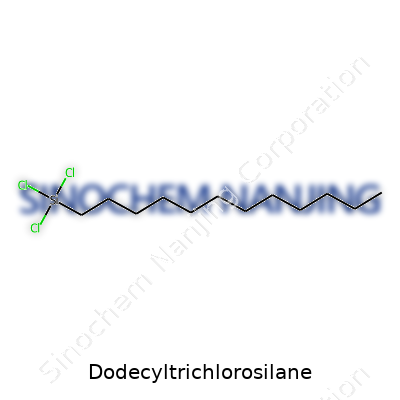
| Names | |
| Preferred IUPAC name | trichloro(dodecyl)silane |
| Other names |
Dodecyltrichlorosilane n-Dodecyltrichlorosilane Trichlorododecylsilane Trichloro(n-dodecyl)silane Lauryltrichlorosilane |
| Pronunciation | /ˈdoʊˌdɛs.ɪlˌtraɪˌklɔːr.oʊˈsaɪ.leɪn/ |
| Identifiers | |
| CAS Number | 112-18-5 |
| Beilstein Reference | 2036524 |
| ChEBI | CHEBI:52495 |
| ChEMBL | CHEMBL3724124 |
| ChemSpider | 156429 |
| DrugBank | DB11103 |
| ECHA InfoCard | 100.030.095 |
| EC Number | 206-216-7 |
| Gmelin Reference | 89820 |
| KEGG | C19322 |
| MeSH | D002984 |
| PubChem CID | 3034412 |
| RTECS number | VV5950000 |
| UNII | DN8X6UK452 |
| UN number | UN1838 |
| CompTox Dashboard (EPA) | DTXSID5038207 |
| Properties | |
| Chemical formula | C12H25Cl3Si |
| Molar mass | 325.76 g/mol |
| Appearance | Colorless to pale yellow liquid |
| Odor | Strong, acrid odor |
| Density | 0.944 g/mL |
| Solubility in water | Decomposes |
| log P | 6.5 |
| Vapor pressure | <0.1 hPa (20 °C) |
| Acidity (pKa) | ~2.0 |
| Magnetic susceptibility (χ) | -0.0000856 |
| Refractive index (nD) | 1.447 |
| Viscosity | 1 mPa·s |
| Dipole moment | 3.44 D |
| Thermochemistry | |
| Std molar entropy (S⦵298) | 557.6 J·mol⁻¹·K⁻¹ |
| Std enthalpy of formation (ΔfH⦵298) | -1301.7 kJ/mol |
| Std enthalpy of combustion (ΔcH⦵298) | -7672.7 kJ/mol |
| Pharmacology | |
| ATC code | V04CX |
| Hazards | |
| GHS labelling | GHS02, GHS05, GHS07 |
| Pictograms | GHS05,GHS07 |
| Signal word | Danger |
| Precautionary statements | P260, P262, P264, P271, P280, P301+P330+P331, P303+P361+P353, P304+P340, P305+P351+P338, P310, P321, P363, P405, P501 |
| NFPA 704 (fire diamond) | 3-2-0-☢ |
| Flash point | 77 °C |
| Autoignition temperature | 250 °C |
| Lethal dose or concentration | LD50 (oral, rat): 0.84 g/kg |
| LD50 (median dose) | LD50 (median dose) is 7.1 ml/kg (rat, oral) |
| NIOSH | VV9250000 |
| PEL (Permissible) | Not established |
| REL (Recommended) | 0.1 mg/m³ |
| Related compounds | |
| Related compounds |
Trichlorosilane Trimethylchlorosilane Octadecyltrichlorosilane Methyltrichlorosilane Phenyltrichlorosilane |



