Dipropyl Ether: A Closer Look at a Classic Industrial Compound
Historical Development
People have relied on ethers for a long stretch of chemical history. Dipropyl ether popped up as chemists searched for solvents and extraction agents that provided alternatives to the classics like diethyl ether. Synthetically, it shows up in journals from the late 19th century as advances in organic chemistry pushed beyond the familiar. Researchers explored new routes to dialkyl ethers by modifying alcohol dehydration techniques, which fit right into the industrial expansion of the chemical industry. Factories and laboratories took to dipropyl ether for its distinctive properties, using it in different extraction and synthesis roles as the chemical landscape evolved throughout the 20th century.
Product Overview
Dipropyl ether, better known to some by its IUPAC name 1-propoxypropane, belongs to the family of dialkyl ethers. These compounds draw interest because of their volatility and usefulness where a mild, low-boiling solvent is needed. Technicians and lab managers alike appreciate how dipropyl ether does the job in extractions or as a reaction medium, standing apart from its ethereal cousins by offering a different balance of solubility and flammability than more familiar ethers like diethyl ether.
Physical & Chemical Properties
Industry often gauges a compound’s character by its boiling point and vapor pressure. Dipropyl ether boils at roughly 90°C, just a touch higher than diethyl ether, which makes it a bit more manageable in environments needing lower volatility. Its density at room temperature sits at about 0.73 g/cm³, and it presents as a clear, colorless liquid with a faint, sweet, and distinctive odor associated with ethers. Dipropyl ether remains largely insoluble in water, but it dissolves in organic solvents such as alcohol and acetone. Chemically, its low reactivity toward bases and acids allows it to serve as a stable reaction solvent, although care is always needed, as ethers can react with oxygen from the air to form explosive peroxides, especially as they age.
Technical Specifications & Labeling
Regulations from agencies such as OSHA and EU Reach require that dipropyl ether gets labeled as flammable and as an irritant. Product labels list the CAS number 111-43-3 and show hazard pictograms. Purity grades vary, with industrial batches often above 98% pure, and sealed in containers designed to limit air exposure. Quality control teams check for residual propanol and peroxide content since safety hinges on keeping these low. Transportation and storage information—temperature range, necessary venting, and shelf life—always features clearly on the container, blending regulatory standards with real-world handling needs.
Preparation Method
The classic lab method relies on acid-catalyzed dehydration of propanol. Operators mix propanol with sulfuric acid or another strong acid, then distill the resulting ether away as it forms. Industrial production scales up this reaction with larger columns, taking care to maintain a dry, oxygen-free environment. Safety is front of mind, as workers manage heat, acid, and pressure to avoid runaway situations. Reaction yield depends on careful balance—too much acid or heat wastes reactant or produces unwanted side products.
Chemical Reactions & Modifications
Chemical hands working with dipropyl ether take advantage of its ether linkage. While stable under mild conditions, it can be split by strong acids—hydrogen halides like HI or HBr trigger cleavage to form propyl iodide or bromide. In organic synthesis, this selectivity means dipropyl ether puts up with most reagents but breaks predictably under the right cues. Researchers hunting for derivatives sometimes oxidize it to form the corresponding peroxides, though these products need special handling. Dipropyl ether also provides a launching point for making other ethers and complex organics through nucleophilic substitution.
Synonyms & Product Names
Chemical catalogs carry dipropyl ether under several names, so buyers scan for matches like 1-propoxypropane, propyl ether, or propoxypropane. Old literature calls it symmetrical dipropyl ether. Regional variants exist, but the CAS number remains the standard identifier. These aliases matter in procurement, regulatory compliance, and literature reviews, as different suppliers choose different naming conventions. Harmonization remains a work in progress as global sourcing becomes standard.
Safety & Operational Standards
Years spent working with organics teach you to respect ethers’ flammability and their tendency to form peroxides. Dipropyl ether demands grounding and bonding in every setup—static sparks near vapors pose real risk. Technicians store it in cool, dry rooms, away from oxidizers or sources of ignition. Facilities conduct regular peroxide tests, discarding old stock and adding stabilizers where allowed. Spills require immediate cleanup using non-sparking tools. Emergency protocols stress ventilation, fire suppression, and first aid for accidental splashes. Regulations guide these procedures, but culture and training keep teams vigilant.
Application Area
In extractions and separations, dipropyl ether plays a behind-the-scenes role, helping researchers pull organic products from aqueous mixtures. In analytical labs, it dissolves greases, oils, and organic residues better than some other ethers thanks to its unique polarity. Some pharmaceutical syntheses use it as a solvent when milder conditions are called for. Industrially, it cleans reactor lines or helps in the recovery of organic acids. Broader applications stretch into flavors, fragrances, and occasionally fuel blends where volatility and purity standards line up just right.
Research & Development
Modern chemists dig into improving the aging process and peroxide stability of ethers, with dipropyl ether among the test cases for new stabilizers and inhibitor formulations. Computational modeling aids the prediction of vapor pressures, solvent properties, and environmental fate. Some teams focus on green synthesis—replacing strong acids with ion exchange resins or recyclable catalysts to cut down on hazardous byproducts and energy use. Analytical technology tracks trace impurities and peroxide formation with greater sensitivity than before, checking purity quickly before large-scale use. Pilot plants run tests to optimize throughput and minimize waste.
Toxicity Research
Toxicologists flagged dipropyl ether early on for its narcotic effects; inhalation leads to CNS depression, similar to other ethers. Chronic exposure can dull reflexes or, at high concentrations, cause loss of consciousness. Acute exposure to vapors may irritate the eyes, nose, and throat, and skin contact can cause defatting or dermatitis. Long-term studies show no significant carcinogenic effect, but regulators have not dropped requirements for protective equipment and monitoring. Environmental research measures its persistence and the speed at which it breaks down in soil and water, and most reports note moderate persistence with typical solvents' low bioaccumulation. Workers handle the compound under fume hoods, minimize spills, and rely on air monitoring to keep concentrations in check.
Future Prospects
Innovation often means rethinking old standards. For dipropyl ether, the shift toward greener chemistry creates opportunities and headaches. Teams look for better ways to produce and recover this ether using less energy and greener feedstocks. Startups and academic labs experiment with flow reactors to tame the hazards and to scale up under safer conditions. There’s a push to recycle solvents and develop closed-loop systems that keep emissions in check. As demand grows for custom organic syntheses and specialty chemicals, dipropyl ether stays relevant—provided safety, sustainability, and supply chain resilience keep pace with technological change.
What is Dipropyl Ether used for?
Simple Chemistry, Specific Uses
Dipropyl ether might not make headlines, but it quietly plays a part in a few important corners of chemical manufacturing and laboratory work. Some people know it from organic chemistry labs, where solvents matter more than most things. This ether, with two propyl groups strung together by an oxygen, shows a knack for dissolving certain compounds. That makes it handy in research and specialized industrial settings.
Solvent Workhorse in Labs
Anyone who has worked in a chemistry lab knows that finding the right solvent can make or break an experiment. Dipropyl ether handles non-polar and slightly polar organic compounds better than many other solvents. I once helped troubleshoot a stubborn recrystallization process where standard options like diethyl ether did nothing—switching to a small amount of dipropyl ether made the crystals appear like magic. That experience stuck with me: sometimes, a lesser-known solvent does all the heavy lifting.
Not for the Faint of Heart: Safety First
Handling dipropyl ether comes with a few caveats. It evaporates fast and catches fire even faster. Unlike alcohols that give off a little warning with their scent, ethers stay sneaky, filling the air before you know it. There’s also a risk of peroxide buildup, which can turn a forgotten bottle into a ticking hazard. Factories and labs using dipropyl ether have to store it away from sunlight, monitor for peroxides, and treat every open container with respect. Ignoring safety guidelines can mean big trouble, even for seasoned chemists.
Industrial Footprints
The main stage for this chemical isn’t massive—its use tends to be narrower compared to workhorses like diethyl ether or hexane. Industries that process pharmaceuticals or fine chemicals sometimes pull dipropyl ether into the mix. It can help purify sensitive compounds or serve as a temporary reaction medium. Those subtle differences in how it interacts with organic molecules, and its slightly higher boiling point, make it valuable for certain reactions.
Environmental and Health Concerns
Dipropyl ether doesn’t dissolve in water, and it tends to linger in the environment if spilled. That means any production facility needs to keep a sharp eye on containment. Even a small leak can leave a lingering smell and potential fire risk. On a personal level, inhaling too much vapor gives a nasty headache. Anyone working with this ether uses gloves, goggles, and good ventilation. Regulations like OSHA and EPA limit workplace exposure and disposal, reflecting real-world risks documented over decades.
Looking for Alternatives
Given the fire risks, some labs look for safer alternatives, especially when students or newcomers might get exposed. There are greener solvents on the market now, like cyclopentyl methyl ether or even supercritical CO2, that handle some of the same jobs without the high volatility. Education plays a role here; people should know their options before reaching for a bottle just because it’s traditional.
Final Thoughts on Real-World Value
Anyone in chemistry learns pretty quickly that every solvent has a hidden story. Dipropyl ether may not be common in home garages or high school classrooms, but in the right hands and right setting, it has real value. Sticking to safe handling and looking for greener options can reduce the risks while still getting the chemical performance that a tough experiment, or a delicate product process, demands.
Is Dipropyl Ether flammable?
Understanding the Risks in the Lab and Beyond
Dipropyl ether is no stranger to anyone who’s spent time in a chemistry lab. The clear liquid sits in brown bottles, flagged with warning marks, and the reason isn’t just academic. It’s about real dangers that can catch you by surprise. Flammability tops the list. A single spark or open flame turns dipropyl ether from boring to explosive in seconds. Its flash point, which sits below room temperature, tells you it can easily give off enough vapor to ignite. I’ve seen students underestimate it, forgetting that discussing theory in safe, controlled settings isn’t the same as handling a bottle with a damaged cap or running a distillation over a Bunsen burner.
Everyday Awareness Beats Complacency
I lost count of the times colleagues dismissed the risks as “just another liquid.” That’s not just careless; it’s dangerous. Dipropyl ether vapors don’t hang low and harmless. They spread, seeking out ignition sources. That means even equipment in the next room isn’t off limits. I’ve heard about fire alarms set off by ether vapors sneaking through vents. The risk isn’t limited to seasoned chemists; undergrads and beginners face it, too. At my own university, a spilled beaker set off a panic and made clear that strong ventilation and a quick cleanup aren’t nice-to-haves. They’re essential habits.
Looking at the Data, Not Just the Labels
Numbers don’t lie: dipropyl ether’s flash point hovers around -28°C. For context, that outpaces common flammable liquids like gasoline, which usually gets all the attention. The auto-ignition temperature of dipropyl ether sits below 200°C. Many hotplates easily exceed that, and God help you if someone leaves a heating mantle unattended.
Facts like this matter beyond chemistry. Anyone storing cleaning chemicals at work or home should think about how fast things can turn ugly. It’s not about living in fear, but respecting facts and acting accordingly.
Ethics and Education: A Responsibility
Working in research, I see corners cut to save time or money, especially around chemical safety. That short-term thinking can lead straight to disaster. Training isn’t just for passing exams or ticking regulatory boxes. Watching a demonstration where a vapor cloud finds an ignition source, causing a flash you feel on your face, burns in the lesson deeper than any textbook ever could. The importance of grounded, clear communication never wears out. Everyone—from supervisors to interns—shares the duty to speak up, not just about what can happen, but about what has happened, and why it matters to everyone in the room.
Improving Safety, One Small Step at a Time
Sensible storage beats fancy gear every time. Keep dipropyl ether away from heat, sunlight, or oxidizers. Chambers with explosion-proof fittings seem excessive until they aren’t. Regularly checking seals, dates, and inventory logs stops accidents before they start. Cleaning spills thoroughly, airing out spaces, and using blast shields where possible turns routine into ritual.
If I’ve learned anything, it’s that complacency comes fast but leaves scars. Our relationship with chemicals as hazardous as dipropyl ether needs honesty, vigilance, and the willingness to learn from both near-misses and past mistakes. That’s where real expertise starts—not from memorizing safety data, but from translating that knowledge to action every single day.
What are the safety precautions when handling Dipropyl Ether?
Getting to Know the Risks
Dipropyl ether shows up in specialty labs more than in most people’s day-to-day. With a flash point below room temperature and a reputation for forming explosive peroxides, it commands plenty of respect. I’ve seen even seasoned chemists slow down and double-check every step when this bottle shows up. Breathing in its fumes for more than a few minutes brings on headaches and dizziness, and spillages carry more than one kind of risk.
Ventilation—No Shortcut Here
Cracking open a bottle in a closed space invites problems. Dipropyl ether vapors hug the floor and collect in low spots. Even if a room doesn’t smell strongly, you can’t trust your nose to keep you safe. Running a reaction in a chemical fume hood pulls vapors away quickly. I learned early to inspect the sash, air flow, and baffles before starting prep. Regular maintenance of those fans and filters keeps them reliable; shortcuts could mean the difference between a minor exposure and a trip to the emergency department.
Personal Protective Equipment Works Only If You Use It
No matter how experienced a person is, safety glasses and gloves come out first. Ether splashed onto the eyes gives a sharp, persistent burn. Gloves rated for organic solvents—like nitrile—stand up better than regular latex, especially when bottles sweat condensation. Long sleeves and a lab coat block small droplets, while the right shoes guard against spills running down to the floor. After a long day, I’ve seen how easy it is to forget a goggle strap or to roll up sleeves; trouble waits for these lapses.
Fire Isn’t a Distant Threat
Ether vapors ignite even with static electricity. Pouring or transferring dipropyl ether near open flames, hot plates, or even electrical devices puts everyone at risk. Grounding containers and pouring slowly keeps static from building up. Workers in large-scale labs chain metal barrels with grounding clips; even on a small scale, grounding containers before transferring matters. Fire blankets and extinguishers need to stay close at hand, not across the building, to help in a pinch. I check the expiration date of extinguishers monthly to avoid any surprises.
Handling and Storage—Every Detail Counts
Dipropyl ether has a reputation in labs for developing peroxides after a few months in storage, sometimes even sooner if containers haven’t been sealed tightly. These peroxides build up without signs—no odour, no change in colour—turning an ordinary bottle into a bomb. That’s why date labels on all containers and regular testing for peroxides top the to-do list. Testing kits from chemical suppliers make detection much less nerve-wracking than guessing. Once a bottle gets old or shows positive for peroxides, disposal by professionals prevents disasters.
Dealing with Spills and Waste
Spills demand quick, thoughtful action. I once watched a small spill under a bench turn into a bigger problem because nobody wanted to call for help. Absorbent pads and neutralizing powders keep small incidents from spreading. Containers for organic waste, labelled and sealed, keep volatile leftovers from mixing or building pressure. Local regulations shape final disposal, and nobody wants to see strained city drains or dumpsters used.
Building Safety Skills
Every hour invested in safety training pays off. Young lab members learn not just facts, but habits—double-checking labels, updating logs, smelling carefully (if at all). Experienced coworkers pass down stories of what went right and warn about near misses. Staying open to feedback, asking for second opinions, and accepting corrections keep everyone safer, including those just starting out with solvents like dipropyl ether.
What is the chemical formula of Dipropyl Ether?
Understanding Dipropyl Ether’s Chemistry
Anyone working in a lab or learning basic organic chemistry eventually bumps into a variety of ethers. Dipropyl ether stands out because of both its straightforward structure and uses. Its chemical formula, C6H14O, shows two propyl groups connected by an oxygen atom. If you line up the atoms, you see a backbone made up of six carbons, all tied together by oxygen right in the middle. Chemists often write it as CH3CH2CH2OCH2CH2CH3 to highlight this symmetrical structure.
Where Dipropyl Ether Comes Into Play
Back in college, I remember synthesizing simple ethers in lab as a way to get familiar with reaction mechanisms. Dipropyl ether doesn’t show up every day in major industrial processes, but it teaches essential lessons about volatility, flammability, and how oxygen can affect the behavior of organic compounds. It’s not just a molecule on a worksheet. Many organic solvents in labs, such as this one, force chemists to pay attention to basic safety: Dipropyl ether forms peroxides that can surprise the unprepared.
Its volatility reminds me of organic vapor that can catch you off guard. One time, during a crowded undergraduate research period, a forgotten flask of ether started to spread its scent down the corridor. Quick interventions keep these events from turning dangerous, emphasizing why fume hoods matter and why respecting chemical properties wins every time.
Beyond the Formula: Handling and Hazards
There’s a lesson here that sticks, especially for younger chemists. It’s easy to focus on formulas and overlook what actually happens around these chemicals. Dipropyl ether, like many ethers, can quietly form unstable peroxides over time, especially if left exposed to air. Researchers at the University of California have documented accidents linked to this latent danger. Over the past two decades, chemical safety practices evolved as a reaction to real incidents, not just textbook warnings. Regular checks, safe disposal, and careful storage change the game.
Taking this experience into chemical education, instructors now stress not just correct formula memorization but the importance of routine testing for peroxides in stored ethers. At one major lab, peroxide test strips hang by every organic solvent cabinet. These small steps head off much larger problems, ensuring safer working environments and protecting everyone’s health.
Seeking Smarter Laboratory Habits
Learning from past mistakes means never ignoring safety data sheets or skipping over the physical properties of the chemicals in use. For dipropyl ether, this means clear labeling, good ventilation, and setting expiration dates on every bottle. Community memory grows stronger every year as lessons pass down from senior researchers to new students.
The conversation about chemical safety isn’t just about legal requirements either. In workplaces ranging from university labs to pharmaceutical companies, nothing beats intentional, ongoing safety education. Dipropyl ether’s formula may be simple, but its story in the lab shows how small details keep entire research projects running smoothly and safely.
How should Dipropyl Ether be stored?
Understanding What’s at Stake
Dipropyl ether isn’t your average lab solvent. Its strong, almost gasoline-like smell warns you right away—this liquid poses serious risks. Anyone who works with it knows the cuts and corners people sometimes take when handling chemicals, but dipropyl ether isn’t forgiving to shortcuts. Once, during graduate work, I watched a technician walk a poorly sealed bottle down a crowded hallway. That stuff evaporated so quickly that it left a headache in its wake. This solvent catches fire with ridiculous ease, and it forms explosive peroxides if left to sit around exposed to air. That fact alone should convince anyone to treat it with genuine caution.
Fire Isn’t the Only Danger Here
The flammability of dipropyl ether makes headlines, but the slow build-up of peroxides marks its real legacy as a troublemaker. Some old bottles develop sensitive, invisible crystals around the cap or inside the neck. It takes little friction to turn those into an explosion. Chemical safety boards cite cases where entire storage cabinets got blown apart during simple bottle-opening routines because someone let a container gather dust for a few years.
Many university protocols reflect lessons learned from hard experience. No reputable research lab would store this chemical near open flames or sunlight. Temperature control helps slow down peroxide formation, so cool and dry rooms make sense. Storing dipropyl ether in flammable liquid-rated safety cabinets—typically those with self-closing doors and spark-free interiors—reduces risk. A locked cabinet discourages random access, and an up-to-date inventory keeps forgotten bottles from aging out of sight and memory.
Separation, Labeling, and Inspections Make All the Difference
Chemistry labs often run short on space but cutting corners by putting flammable ethers next to acids or oxidizers never pays off. That problem caught up with a colleague at another college, whose lab lost expensive equipment after spilled ether mixed with nitric acid. Keeping incompatible chemicals apart just makes sense.
Sticking a clear date label on every bottle helps people track age, and a visible reminder to test for peroxides before using anything older than a few months can prevent nasty accidents. Potassium iodide test strips work well for this purpose, and most safety offices stock them. If in doubt, disposing of anything suspect avoids disaster.
Training Isn’t Optional for Dipropyl Ether
Taking time to run through a safety orientation—actually opening the cabinet, pointing out the right spill kit, and reviewing the emergency plan—has a bigger impact than a glossy manual ever could. I learned more from walking the aisles of a chemical storeroom with an experienced technician than I did reading protocols. Training sticks when it happens on the ground, where mistakes matter.
Revisiting Storage Habits Pays Off
Over time, even the best-run labs slip into bad habits. A quick inspection with fresh eyes can catch doomed bottles no one wants to open. Disposal companies offer safe removal, and schedule regular pickups for old solvents. Anyone responsible for chemical storage needs to see dipropyl ether less as a tool and more as a potential threat, always one bad moment away from a headline. Safety comes from respect, not routine.
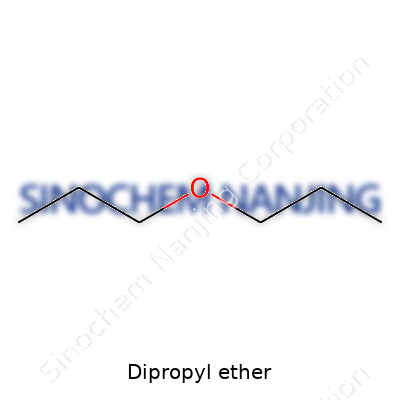
| Names | |
| Preferred IUPAC name | 1-Propoxypropane |
| Other names |
1-Propoxypropane Propyl ether Propyl oxide |
| Pronunciation | /daɪˈprəʊpɪl ˈiːθər/ |
| Identifiers | |
| CAS Number | 111-43-3 |
| Beilstein Reference | 1209694 |
| ChEBI | CHEBI:35783 |
| ChEMBL | CHEMBL140195 |
| ChemSpider | 7274 |
| DrugBank | DB14016 |
| ECHA InfoCard | ECHA InfoCard: 100.003.323 |
| EC Number | 203-940-1 |
| Gmelin Reference | 8223 |
| KEGG | C06521 |
| MeSH | D006697 |
| PubChem CID | 8036 |
| RTECS number | JR8575000 |
| UNII | CZ26WZU4CY |
| UN number | UN2384 |
| Properties | |
| Chemical formula | C6H14O |
| Molar mass | 102.18 g/mol |
| Appearance | Colorless liquid |
| Odor | Sweet, ethereal |
| Density | 0.714 g/mL at 25 °C |
| Solubility in water | 1.1 g/100 mL (20 °C) |
| log P | 2.54 |
| Vapor pressure | 3.32 kPa (at 20 °C) |
| Acidity (pKa) | 18.1 |
| Basicity (pKb) | pKb ≈ 3.85 |
| Magnetic susceptibility (χ) | -65.3·10⁻⁶ cm³/mol |
| Refractive index (nD) | 1.373 |
| Viscosity | 0.38 mPa·s (at 20 °C) |
| Dipole moment | 1.15 D |
| Thermochemistry | |
| Std molar entropy (S⦵298) | 257.7 J·mol⁻¹·K⁻¹ |
| Std enthalpy of formation (ΔfH⦵298) | -345.7 kJ/mol |
| Std enthalpy of combustion (ΔcH⦵298) | -4322.7 kJ/mol |
| Pharmacology | |
| ATC code | N01AB10 |
| Hazards | |
| GHS labelling | GHS02, GHS07 |
| Pictograms | GHS02,GHS07 |
| Signal word | Danger |
| Hazard statements | H225, H302, H319, H336, H351, H373, H411 |
| Precautionary statements | P210, P233, P240, P241, P242, P243, P280, P303+P361+P353, P305+P351+P338, P337+P313, P403+P235, P501 |
| NFPA 704 (fire diamond) | 1-4-0 |
| Flash point | -45 °C |
| Autoignition temperature | 397 °C |
| Explosive limits | 1.1–6.6% |
| Lethal dose or concentration | LD50 oral rat 3,460 mg/kg |
| LD50 (median dose) | LD50 (median dose): Oral-rat LD50: 900 mg/kg |
| NIOSH | NIOSH = "JJ8575000 |
| PEL (Permissible) | 400 ppm |
| REL (Recommended) | 500 |
| IDLH (Immediate danger) | 750 ppm |
| Related compounds | |
| Related compounds |
Diethyl ether Diisopropyl ether Dibutyl ether Ethyl propyl ether |



