Diphenylchloroarsine: Walking Through Its Shadows and Modern Uses
Historical Development
Anyone with a keen interest in the overlap of chemistry and history will tell you that diphenylchloroarsine has a legacy that chills the room. This organoarsenic compound first caught the world’s attention during the First World War. Known by the military code Clark I, diphenylchloroarsine was created as a chemical weapon. The compound’s ability to cause severe sneezing, coughing, and temporary incapacitation made it a tool of warfare rather than scientific investigation. After the chaos of the world wars, researchers shifted gears, moving away from its weaponization and turning their eyes to industrial and scientific domains. The dark start of this chemical didn’t block innovation, but it definitely cast a long shadow that continues to haunt its reputation.
Product Overview
There are not many chemicals whose notoriety overshadows their utility as much as diphenylchloroarsine. Structurally, it looks fairly simple—a chlorinated arsenic attached to two phenyl rings—but this setup gives it a punchy profile in both reactivity and handling. Even now, many treat it with skepticism, which puts some limits on its widespread use. Its infamy as a lachrymatory agent lingers, but the same qualities that make diphenylchloroarsine troublesome on the battlefield can offer unique possibilities in tightly controlled laboratory settings. High reactivity and the ability to introduce a phenylarsenic group make it valuable for researchers willing to take the necessary precautions to avoid personal harm or environmental impact.
Physical & Chemical Properties
It pays to get specific with diphenylchloroarsine’s characteristics. At room temperature, the compound appears as a white to pale yellow crystalline solid. This appearance belies the menace behind its vapor, which can quickly irritate the respiratory tract and eyes. Its molecular weight hovers near 292 g/mol, and its melting point lands just below 40 degrees Celsius. Volatility in air and moderate solubility in organic solvents keep handlers on their toes. The molecule’s structure, featuring the chloride bound to arsenic and flanked by two phenyl rings, creates both stability for storage and reactivity during chemical transformations. For anyone who’s worked around it, the sharp, acrid odor barely leaves memory, especially knowing the complications from accidental inhalation.
Technical Specifications & Labeling
Technical details matter a lot with this compound. The purity of diphenylchloroarsine sold for laboratory use often falls above 98%. Labeling as a highly toxic and lachrymatory substance isn’t just best practice—it’s essential. Producers must also note its volatile nature and the risk of forming hazardous arsenic-containing byproducts if mishandled. Here, adherence to hazard communication standards of OSHA and international regulations becomes non-negotiable. Even storage gets no shortcuts: a cool, dry, well-ventilated environment with tightly sealed containers helps reduce hazard to staff and the environment.
Preparation Method
The process behind the synthesis of diphenylchloroarsine starts with the reaction of chlorinating agents on precursor organoarsenic compounds. Historically, chemists generated this compound through the reaction of diphenylarsine with thionyl chloride, with byproducts including sulfur dioxide and hydrogen chloride, both requiring careful handling themselves. This approach demands strong ventilation, robust containment, and skilled staff with experience in both organic synthesis and hazardous material management. The evolution of production methods focused on reducing byproduct generation and increasing yield—an ongoing balancing act between chemical efficiency and occupational safety. Modern labs also employ analytical techniques like NMR and mass spectrometry to confirm purity and limit hazardous contaminant presence.
Chemical Reactions & Modifications
The reactivity at the arsenic-chloride bond opens doors for a range of derivatization steps. Nucleophilic substitution allows introduction of different groups, making diphenylchloroarsine a handy intermediate for researchers looking to build structures involving arsenic heterocycles or larger organometallic frameworks. Its use in the preparation of complex organoarsenic compounds ensures its place in chemical synthesis textbooks, even as its popularity lags due to safety and environmental constraints. The phenyl rings, while providing some stabilization, do not completely shield the arsenic core from attack, especially under acidic or basic conditions. Every chemist working with the compound walks a tightrope between innovation and the perils of exposure.
Synonyms & Product Names
Names can shape perception, and for diphenylchloroarsine, the list is long. Historically, it has carried code names and synonyms such as Clark I, diphenylarsinous chloride, and phenylarsine chloride. Each name reminds us of its context: battlefield, laboratory, or regulatory document. Familiarity with these aliases helps chemists, regulators, and historians trace its movement across time and purpose.
Safety & Operational Standards
People don’t soon forget the first time they read the safety dossier on diphenylchloroarsine. The compound requires hood work, no exceptions. Chemical splash goggles, gloves impervious to both organics and inorganics, and a properly fitted respirator become the standard wardrobe. Chemical fume hoods shouldn’t just work—they should hum, with regular checks on flow and filters. Inhalation brings tearing, sneezing, and lung pain; even low-level exposures can rack up uncomfortable days and a trip to the occupational health office. Emergency procedures, including evacuation and spill response, stay posted for quick access. Training sessions on arsenical chemistry should not just deliver slides, but involve hands-on drills for what to do if containment breaks. Disposal becomes a joint effort between lab and licensed hazardous waste handlers to avoid accidental release into water or soil, because arsenic, once loose, does not quietly disappear.
Application Area
The original purpose for diphenylchloroarsine sits heavy, but contemporary uses in controlled research settings explore its coordination chemistry and ability to anchor arsenic centers in new ligand frameworks. Some researchers investigate its potential as an intermediate for pharmaceutical candidate molecules containing arsenic, especially for cancer-targeted therapies drawing inspiration from the historic use of arsenic-based drugs like arsenic trioxide. The compound also has a niche in semi-conductor chemistry, where certain organoarsenic frameworks play a role in developing specialized electronic materials and alloys. Stringent regulation and better options have moved diphenylchloroarsine into a supporting role, but its unique chemical profile still drives specialized investigation, especially where no good substitute exists.
Research & Development
Lab teams continue to revisit this compound, motivated by the quest for new organoarsenic chemistry or improved pharmacological agents. Advances in encapsulation technologies and controlled delivery systems allow scientists to minimize the risks inherent in working with arsenic-based reagents. Analytical methods—like gas chromatography and high-resolution NMR—are deployed not because they impress, but because they catch impurities and degradation products that could jeopardize both results and safety. Teams working in universities and chemical technology firms document incident logs and near-misses to drive continuous improvement in handling protocols. Collaborative projects between chemists, toxicologists, and process safety engineers are essential to responsibly unlocking the molecule’s value while limiting risk to researchers or the surrounding community.
Toxicity Research
The danger of diphenylchloroarsine cannot be minimized. Inhalation causes immediate irritation, sneezing, tearing, and sometimes more severe respiratory symptoms. Ingested or absorbed arsenic compounds carry well-known chronic risks, including carcinogenicity and systemic toxicity that can persist for years. Animal studies help establish acute toxicity thresholds and typical exposure symptoms, while clinical toxicologists develop medical guidance for exposure events. Monitoring staff for biological markers of arsenic exposure—such as blood and urine arsenic levels—moves from optional to necessary wherever this substance appears in the inventory. Optimally, all procedures are designed to not just detect accidents, but prevent them.
Future Prospects
Diphenylchloroarsine’s future hangs in a careful balance between its hazardous legacy and the promise of unlocking unique arsenic chemistry. Environmental regulations get stiffer every year, with green chemistry pushing for lower-toxicity alternatives wherever possible. For now, its role will likely shrink as less hazardous arsenic compounds take its place in routine work, but demand for specialized organoarsenic chemistry in medical and semi-conductor research gives it a foothold. Expanded investment in robotic systems and sealed-vessel techniques, along with the rise of computational chemistry, point to further risk reduction. Scientists searching for the next breakthrough in arsenic-related materials or pharmaceuticals keep diphenylchloroarsine on the shelf—under lock, key, and a sharp eye for safety protocol.
What is Diphenylchloroarsine used for?
A Chemical with a Troubled Past
Diphenylchloroarsine grabs attention for all the wrong reasons. The chemical world has its share of infamous substances, but this compound stands out. Its notoriety comes from a history buried deep in twentieth-century warfare, and the truth is, its story is a warning about the darker side of scientific development.
This chemical first showed up in the trenches of World War I. Developed by German chemists, it wasn’t meant for curing diseases or boosting crops, but for disabling enemy troops. Once released, clouds of diphenylchloroarsine would hang in the air, causing severe irritation in the eyes, nose, and lungs. Soldiers exposed to it would cough uncontrollably, struggle to see, and sometimes vomit from the intense pain. In my mind, the fact that anyone could experience such suffering just from a chemical release highlights the importance of scientific responsibility. For all our progress, we can never ignore the potential for harm when dangerous compounds leave the lab and enter the real world.
Why It Still Matters
Some might think such a chemical has faded into total obscurity, but the world doesn’t always work like that. Stockpiles of diphenylchloroarsine still exist. Countries that once used or prepared these substances for war now wrestle with the problem of safe disposal. It’s not just a matter of locking it away; these compounds break down slowly and can contaminate soil and water if not handled properly. In 2004, international agreements like the Chemical Weapons Convention pushed for the destruction of these dangerous agents, but progress is uneven. A quick look at recent reports from arms control groups shows that massive quantities remain, sitting in old barrels or forgotten bunkers, pulling resources from public health budgets that could support positive change.
Potential Uses and the Myth of Utility
Every so often, people ask if diphenylchloroarsine has a use outside its dark past. Chemically speaking, it holds arsenic and chlorine bonded with two phenyl groups, so a creative mind might imagine a role in industrial synthesis or research. But real scientists treat it with intense caution. Its toxicity, persistence in the environment, and lack of obvious benefits mean that labs rarely keep it handy or list it in catalogs. In my experience talking with chemists and hazardous materials experts, no one sees it as a valuable tool—too risky, too difficult to manage, too much history attached. Its reputation has actually shut the door to new research, because no breakthrough can outweigh the harm of accidental exposure or misuse. It sits with other relics of a violent era, relevant only as a lesson in what not to repeat.
Moving Forward: Solutions Over Suspicion
Public safety comes down to honesty and action—acknowledge the problem, then deal with it head-on. Safe destruction technologies exist, and countries must commit resources to make them available. Oversight matters, too; regular inspections and transparent reporting keep old stockpiles from turning into tomorrow’s catastrophe. On a personal level, I see a chance here for learning, both for scientists and for the public at large. Chemical knowledge isn’t just about formulas—it’s about understanding consequences. Diphenylchloroarsine reminds us that choices made in the past still echo today. The only sensible use for this chemical in the present is to serve as an example of why society demands science with conscience and accountability.
What are the safety precautions when handling Diphenylchloroarsine?
Understanding the Risks Up Close
Diphenylchloroarsine doesn’t sound inviting, and it has a reputation to match. It’s a legacy chemical from a time when arsenic-based compounds saw use in warfare and industry. It irritates the lungs, eyes, and nose in ways few folks can ignore, and even short contact can push a healthy body into serious distress. The dangers aren’t distant possibilities—they happen within seconds in a poorly ventilated space or during a rushed transfer.
Learning from Experience: Covering More Than the Basics
Back in grad school, an old storeroom held bottles of Diphenylchloroarsine. The labels warned of “toxic via inhalation and skin contact.” Instructors who had seen accidents drilled the rules into us: full face protection, double gloves, thick lab coats, and never working alone. Straight talk spread—no one should touch that stuff on a whim, because mistakes led to panic and hospital runs.
Chemical protection always starts with the right gear. Small spills become emergencies, so gloves made from nitrile or neoprene make sense. A face shield and tight goggles mean business—not just regular safety glasses. No part of your skin should stay exposed. Lab coats with snug cuffs cut down the risk that dust or fumes sneak inside. If the room lacks a powerful fume hood or has no direct venting outside, it’s safer to shut the project down than risk an exposure.
The Importance of Trustworthy Information
Looking at hard data, Diphenylchloroarsine triggers headaches, shortness of breath, nausea, and long-term effects on the nervous system. Reports from the National Institute for Occupational Safety and Health and the CDC point to the value of air monitoring and having spill kits on hand. Air filters with high-efficiency cartridges become essentials, not accessories, for anyone working near this substance.
Why Complacency Leads to Disaster
Plenty of lab workers get comfortable over years of routine. Fast jobs or skimping on protective gear lead to the kind of stories that get retold for all the wrong reasons. A contaminated glove touches a phone or door handle, and soon unknown hands carry the risk elsewhere. It happened once in our lab—security footage caught the moment, and everyone on that floor had to get checked for symptoms.
Practical Steps Everyone Should Take
Start every task by reading up on the latest safety data. Make sure you understand emergency procedures, not just where the exits sit. Work with a buddy or let others know your schedule. Keep a bottle of clean water and an eyewash station within reach, since timing matters in emergencies.
Waste disposal adds a second layer of risk. Arsenic waste sits high on the hazardous list, so never dump it down the drain or sneak it in routine trash. Call in licensed disposal services and log every movement of the chemical, whether it moves from storage to bench or from bench to bottle.
Building a Culture of Safety—Not Just a Checklist
Newcomers in the lab catch on by watching veterans treat every chemical with respect. Simple habits—like checking gloves for holes, announcing every step out loud, or pausing before opening a container—set the tone. When the focus stays on teamwork and situational awareness, fewer surprises crop up.
If there’s a lesson, it’s that experience, facts, and community matter more than false confidence. Every missed step with Diphenylchloroarsine sends someone on a trip that could have been avoided: trust the science, gear up, and never face it alone.
Is Diphenylchloroarsine toxic to humans?
From the Lab to the Battlefield: A Toxic Legacy
Chemistry, at its best, brings comfort and cures. Some molecules serve darker purposes. Diphenylchloroarsine fits squarely into that second category. Once a tool of chemical warfare, its name alone brings up images of gas masks and trench lines. Yet, even a hundred years later, the risks haven't faded. Knowing what this compound does isn't just chemistry trivia; it’s about health and safety in a world where old stockpiles still exist and new threats can emerge.
Touch, Taste, Breathe: How Exposure Happens
People don’t bump into diphenylchloroarsine at the grocery store or the pharmacy. Its use outside the lab is rare and tightly controlled. The trouble shows up through inhalation, mostly in military or accidental industrial settings. Once it gets into the air, droplets quickly make themselves known. There’s no such thing as gentle exposure. It eats at the lungs, causing instant coughing, sneezing, and choking. Eyes don’t fare any better, stinging and tearing in minutes. Even skin isn't safe—redness, burning, and inflammation follow close behind.
What Science Says: No Safe Passage
Researchers have dug into diphenylchloroarsine since World War I. Evidence points in the same direction each time. The body doesn’t get off easy. Within hours, the vapor triggers chemical irritation in the respiratory system—throat, windpipe, lungs all start to swell and spasm. Sometimes blisters and chemical burns appear. If someone breathes too much of this stuff, they may head straight to the hospital, gasping for breath, risking pneumonia or even death. One small mistake with handling or disposal makes headlines for a reason.
The toxic effects stem from its structure. The arsenic atom, locked inside this molecule, spells trouble for nearly every cell it touches. No amount of ventilation or washing can erase the instant impact of the fumes. The CDC and the European Chemicals Agency both keep this substance on their hazard lists, flagging it for its acute toxicity to people.
Keeping Hazards Out of Everyday Life
I keep an eye out for how authorities push for safer workplaces and communities. The good news: regulation works. Trained professionals in chemical labs or decontamination teams use specialized gear—full-body suits, respirators, post-exposure washing. Laws keep this substance away from most workplaces, schools, and neighborhoods. Families don’t have to worry about a hidden threat in domestic cleaning products or gardens.
Still, forgotten stockpiles and improper storage at old military sites sometimes pop back up during construction or cleanup. These scenarios call for strong emergency response and transparency. Local governments, on alert after environmental accidents elsewhere, send out public health warnings and sometimes order evacuations.
Lessons for Today
History shapes decisions about hazardous compounds. Nations sign treaties to ban chemical weapons. Scientists speak up about the dangers of legacy toxins. Safe chemical handling starts with knowledge and training, not blind faith in safety gear or luck. Removing unused or unwanted chemicals takes time and effort, but it shields future generations from yesterday’s mistakes.
Arsenic’s toxic legacy lives on in compounds like diphenylchloroarsine. Stories from the past and today’s safety manuals both nudge people to keep this molecule at arm’s length. Ultimate protection depends on vigilance, readiness to respond, and choosing prevention over cure every single time.
How should Diphenylchloroarsine be stored?
Reality in the Lab
Every chemist I know warns about chemicals with a reputation like Diphenylchloroarsine. It’s dangerous, not just because of its toxicity, but because it’s sneaky. This compound sees use mainly in chemical research settings, usually under the close watch of professionals who respect just how quickly things can go wrong. Park this stuff in the wrong place, and you end up reading about it in the news for all the wrong reasons.
Safe Spaces Start with the Right Container
The only smart way to store Diphenylchloroarsine is in airtight glass containers. Plastic simply doesn’t make the cut; it breaks down, it warps, and chemicals like this leak out. That leads to contamination. Glass, especially with PTFE-lined stoppers, stands up to the fumes. And if any chemist tells you they trust a cork for this kind of job, don’t trust their lab.
That tight seal serves a bigger purpose than just “following protocol.” Fumes from Diphenylchloroarsine irritate the lungs, the eyes, even your skin. Small cracks, loose lids, even tiny pinholes let those vapors get out and turn a normal workday into an emergency. I’ve seen the aftermath of poor storage: rusted metal, weird powder deposits on shelves, and colleagues getting headaches for days. Good containers cut all that risk off at the source.
Location Really Matters
Anyone storing this chemical can’t just toss it in a closet. Ventilated flammable storage cabinets make a world of difference. Those cabinets process lingering fumes and keep anything inside at a stable temperature, lowering pressure buildup and reducing the odds of a dangerous leak. I once worked adjacent to a facility that didn’t take this seriously; one summer, heat in an unventilated storage room warped seals and set off multiple alarms. Containment and airflow kept the staff safe, not just warning signs.
A dedicated chemical refrigerator can improve temperature control, keeping things cool and minimizing chances for volatile reactions or decomposition. The door should have a clear warning label that everyone can spot, so even the newest intern knows trouble might lurk on the other side.
Training Saves Lives
I spent part of my graduate work with a team that drilled emergency routines every month. We learned firsthand what happens with accidental Diphenylchloroarsine exposure. It never got less frightening. Sharing simple rules—double-check every seal, dedicate separate space, keep inventory logged—kept us from making lazy mistakes. Spills or broken containers meant immediate lockdown and proper hazmat support. Familiar faces from local fire squads even walked us through cleanup protocols more than once.
No Room for Guesswork
Successful storage stems from respect. Monitoring storage conditions, using sealed glass with chemical-resistant linings, updating logs, and strict access control—these habits make a difference. Labs invested in training, maintained good records, and made sure even folks on the night shift had access to spill kits and emergency showers. These details don’t just protect chemicals; they protect people.
Better Safe Than Sorry
Too many labs treat safe storage as a checklist item, not a living discipline. After years in and around chemical storerooms, I’ve lost my patience for shortcuts. Simple fixes—airtight glass, smart ventilation, clear warning labels—hold up under pressure. Every researcher owes it to themselves and their colleagues to respect the risks and prepare for the worst case. That mindset transforms safety culture and keeps the headlines free of avoidable disasters.
What is the chemical formula of Diphenylchloroarsine?
Understanding Diphenylchloroarsine’s Formula
Diphenylchloroarsine carries the chemical formula C12H10AsCl. This formula points to a molecule built from two phenyl groups hooked to an arsenic atom, with a chlorine attached to the same arsenic. I came across this compound during a project on chemical warfare agents for my undergraduate thesis. It’s not something seen in everyday labs, and for good reason. Handling arsenic-based compounds pushes the need for strict attention to safety, driven by the real danger of toxicity.
A Glimpse Into Chemical Weapons Development
There’s a heavy story behind diphenylchloroarsine. During World War I, governments scrambled to find any advantage, including pushing scientists to create compounds that could disorient enemy troops. This chemical got nicknamed “sneezing gas” or “DA” because it irritated the nose, throat, and respiratory system. Stepping back, it’s clear that chemistry in the wrong hands disrupts lives far beyond the lab. Its place in history helped lay the foundation for global agreements limiting the use of chemical weapons.
The Science Behind the Formula
Looking at this formula brings back time spent in chemistry class balancing equations late into the night. Each part of the formula tells a story: carbon and hydrogen build those phenyl rings, so common in organic chemistry. The chlorine isn’t there by accident. It boosts the arsenic’s effects and makes it linger in the environment longer than organic vapors. The arsenic sits at the core, responsible for much of the harm that comes with exposure. These elemental connections paint a picture of the priorities of early chemical warfare science, fixated more on effectiveness than on any ethical concerns.
Health and Safety Lessons
Diphenylchloroarsine exposure causes tearing, coughing, and outright agony. My own course in chemical hygiene drilled in the hazards of both arsenic and chlorinated compounds. Even if not many people will ever bump into this chemical, its risks remain a lesson. The U.S. Centers for Disease Control and Prevention warns that contact can damage the lungs and eyes, and even low exposure leaves lasting effects. Long before workplace safety protocols became common, people suffered permanent harm just from testing these agents.
Sharing Knowledge and Building Trust
Digging into this formula, I’m reminded how sharing specific details helps build trust. A chemist isn’t just a person in a lab coat. Laying out clear facts about a substance’s makeup and origins replaces rumor with science. Transparency is one of the pillars of ethical research. Experts who speak plainly about risks and benefits help the public understand what to avoid, and what to worry about less.
Room for Solutions
Chances of encountering diphenylchloroarsine outside highly controlled environments remain small, but the bigger issue is keeping chemical knowledge from becoming a risk. Stronger regulation, clear labelling, and open education give students and workers the tools to spot hazards early. Campaigns that teach the history behind toxic substances help everyone understand why those laws matter. Personal stories of exposure and recovery echo louder than abstract warnings.
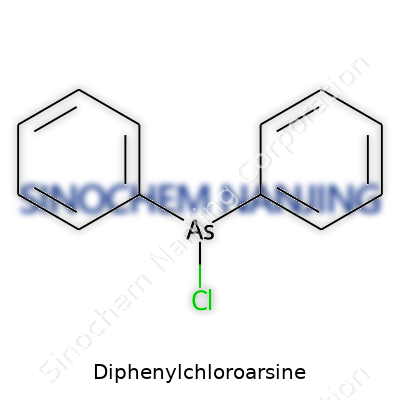
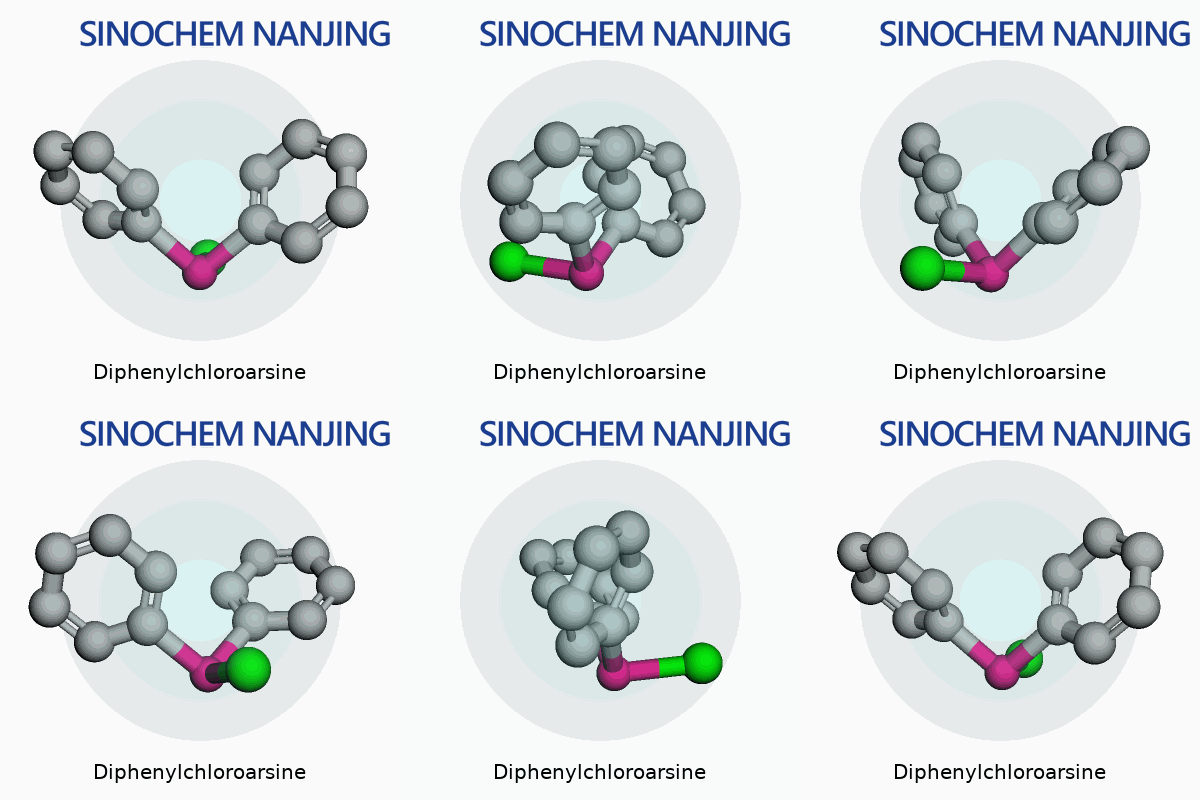
| Names | |
| Preferred IUPAC name | chloro(diphenyl)arsane |
| Other names |
Phenylarsenichloride Chlorodiphenylarsine Diphenylchlorarsine Clark I |
| Pronunciation | /daɪˌfiːnɪlˌklɔːroʊˈɑːrsaɪn/ |
| Identifiers | |
| CAS Number | [603-32-7] |
| Beilstein Reference | 1462597 |
| ChEBI | CHEBI:86397 |
| ChEMBL | CHEMBL1230640 |
| ChemSpider | 12294 |
| DrugBank | DB06733 |
| ECHA InfoCard | ECHA InfoCard: 100.004.682 |
| EC Number | 205-109-9 |
| Gmelin Reference | 58208 |
| KEGG | C14151 |
| MeSH | D004175 |
| PubChem CID | 6644 |
| RTECS number | AG9625000 |
| UNII | BE13DXYS9K |
| UN number | UN2029 |
| Properties | |
| Chemical formula | (C6H5)2AsCl |
| Molar mass | 326.14 g/mol |
| Appearance | White to grey solid |
| Odor | garlic-like |
| Density | 1.65 g/cm³ |
| Solubility in water | Insoluble |
| log P | 3.6 |
| Vapor pressure | 0.01 mmHg (20 °C) |
| Acidity (pKa) | 14.7 |
| Basicity (pKb) | pKb = 7.76 |
| Magnetic susceptibility (χ) | -60.0e-6 cm³/mol |
| Refractive index (nD) | 1.644 |
| Viscosity | Viscous liquid |
| Dipole moment | 1.72 D |
| Thermochemistry | |
| Std molar entropy (S⦵298) | 340.6 J·mol⁻¹·K⁻¹ |
| Std enthalpy of formation (ΔfH⦵298) | -39 kJ·mol⁻¹ |
| Std enthalpy of combustion (ΔcH⦵298) | -807 kJ·mol⁻¹ |
| Hazards | |
| Main hazards | Toxic if swallowed, inhaled or in contact with skin; causes burns; may cause acute poisoning and severe irritation of eyes, skin, and respiratory tract. |
| GHS labelling | GHS02, GHS06, GHS08, GHS09 |
| Pictograms | GHS06, GHS08 |
| Signal word | Danger |
| Hazard statements | H301, H331, H341, H373, H410 |
| Precautionary statements | P260, P261, P280, P284, P301+P310, P304+P340, P308+P311, P320, P330, P361, P403+P233, P405, P501 |
| NFPA 704 (fire diamond) | 3-2-2-W |
| Flash point | 185°C |
| Autoignition temperature | > 535 °C |
| Lethal dose or concentration | LD50 oral (rat) 400 mg/kg |
| LD50 (median dose) | LD50 (median dose): 2 mg/kg (oral, rat) |
| NIOSH | BW6650000 |
| PEL (Permissible) | PEL (Permissible Exposure Limit) of Diphenylchloroarsine: "0.2 mg/m3 |
| REL (Recommended) | 0.005 mg/m3 |
| IDLH (Immediate danger) | 5 mg/m3 |
| Related compounds | |
| Related compounds |
Diphenylcyanoarsine Diphenylarsinic acid Adamsite Clark I Clark II |



