Cycloheptene: Chemistry’s Flexible Seven-Membered Puzzle Piece
Historical Development
Cycloheptene didn’t show up in early chemistry texts as some sort of chemical celebrity. Its seven-membered ring took a back seat in the days when chemists loved five- and six-membered rings for their simplicity and ease of handling. But curiosity drew researchers to the oddballs on the periodic table, and eventually, chemists isolated cycloheptene from petroleum distillates and by synthetic routes in the 19th and 20th centuries. Early pioneer work in the field focused on understanding how ring strain influences molecular stability. Seven-carbon cyclic systems reveal their quirks once chemists try to force double bonds into them. Over time, advances in separation and identification techniques, along with a hunger for novel synthetic building blocks, brought cycloheptene into more research labs and eventually into the toolkit of industrial chemists looking for reliable routes to specialized polymers, pharmaceuticals, and organic intermediates.
Product Overview
Cycloheptene lands somewhere between novelty and utility. It’s a colorless liquid with a distinctive odor, mostly found in the hands of synthetic chemists rather than at the hardware store. With the chemical formula C7H12, cycloheptene features a single double bond locked into a seven-carbon ring. Its structure leaves it reactive enough to take part in addition and ring-opening reactions, yet not so volatile that it causes headaches for handling. In organic chemistry, having a ring system on hand with built-in unsaturation opens doors to all sorts of modifications and transformations. This flexibility draws interest from anyone who wants to insert seven-membered fragments into larger molecules, or research the physics of strained rings.
Physical & Chemical Properties
Cycloheptene boils around 116°C and melts close to -119°C, giving it a broad liquid range at normal conditions. Its relatively low density hints at the usual skeletal arrangement of carbons in a ring. Because the double bond sits inside a medium ring, cycloheptene offers lessons in ring strain and conformational flexibility you won’t see in its five- or six-membered relatives. On the chemical front, it reacts easily with halogens or peracids, and even simple acid treatments can coax it into rearrangements or polymerization. Chemists often point out its sensible reactivity in comparison to the much more strained cyclobutene or the sluggish cyclooctene. Anyone who’s tried to pry open a cyclic double bond knows the unique challenge of manipulating medium rings, balancing steric factors and electronic effects.
Technical Specifications & Labeling
Suppliers provide cycloheptene at various purity levels, usually emphasizing low water content and minimal peroxides or aldehydes. Shipping labels flag it as a flammable liquid. Handling instructions generally recommend using gloves and eye protection, and storing it away from heat or sources of ignition. Purity, by gas chromatography or NMR, matters because trace impurities can trip up sensitive synthetic reactions. Chemically inclined folks want their material fresh, with as little decomposition as possible, and these details find their way onto labeling and batch records. Shipping containers, often steel or high-density plastic, bear hazard markings to alert workers to volatility and flammability.
Preparation Method
Making cycloheptene usually traces back to elimination reactions from cycloheptanol or cycloheptyl halides, using strong acids or bases to strip away a water molecule or a halide ion. Industrial chemists sometimes rely on catalytic dehydrogenation of cycloheptane, especially at elevated temperatures over metal catalysts like platinum or palladium. Chemical engineers tweak reaction conditions to squeeze out higher yields or to minimize side products, like ring-opened chains or over-hydrogenated material. In small-scale research labs, students might start with cycloheptanol, add sulfuric acid, and drive water out to leave behind the double bond. I remember distilling the product under nitrogen to keep it from absorbing moisture or forming peroxides over time—handling pure cycloheptene comes with a definite learning curve.
Chemical Reactions & Modifications
This seven-membered ring is versatile in a flask. Cycloheptene takes up halogens, forming dihalides, and does so faster than larger or smaller rings, thanks to its blend of ring strain and electronic readiness. Peracids deliver the expected epoxidation, opening up access to cycloheptene oxide—a useful intermediate for synthesizing functionalized seven-membered rings. Hydrogenation smooths out the double bond, giving cycloheptane. Under acidic conditions, the ring can rearrange or even cleave, providing access to different skeletons or serving as a testbed for ring-opening reactions. Chemists have spent decades studying how rings like cycloheptene twist and buckle under the influence of reagents, making it a favorite topic in physical organic chemistry lectures. Modification doesn’t stop with addition and rearrangement. Cycloheptene has long been a test case for metathesis reactions, which scramble and reorder double bonds in elegant ways.
Synonyms & Product Names
Cycloheptene might show up in catalogs or publications under names like "heptamethylene oxide precursor," "heptenylene," or just its systematic name—1-cycloheptene. Sometimes chemists abbreviate it as "CHP" or refer to it by registry numbers in papers or safety sheets. The casual chemistry crowd might just call it “the seven-membered ring,” though anyone searching for it in a commercial database will zero in on its proper IUPAC name or CAS number.
Safety & Operational Standards
Lab veterans treat cycloheptene with care. Its volatility calls for proper ventilation and sturdy gloves, and every bottle gets a flammability label whether in an academic lab or on the loading dock. Exposure to high concentrations as a vapor can irritate the eyes and respiratory tract, so fume hoods always stay in play. Chemical compatibility matters too—stashing it away from oxidizers or acids keeps it from decomposing or forming peroxides that can surprise an unwary researcher. Industry guidelines often stress regular peroxide testing, especially after the bottle’s been open a while. I’ve seen more than one research group cycle old stocks into hazardous waste rather than take a risk with aging cycloheptene. Emergency guidelines focus on fire suppression, not water-based efforts, matching those for other volatile hydrocarbons.
Application Area
Cycloheptene carves out a niche in organic synthesis as a source of medium ring chemistry that few other molecules match. It supports research in the field of natural product synthesis, where seven-membered rings play important roles in plant and animal metabolites. Some custom polymers, resins, and specialty materials owe their properties to cycloheptene segments worked into their backbone. The pharmaceutical world taps into it now and then for building complex ring systems that mimic biological structures. And though no blockbuster drugs rest solely on cycloheptene, its intermediates show up in various research routes to antiviral, anticancer, or anti-inflammatory agents. Technically minded chemists find it useful in the development of catalysts and the study of new reaction pathways, especially those that exploit ring strain or double bond reactivity. Its unique reactivity keeps it in the toolbox of anyone chasing novel molecular architectures, especially as scientists seek to make molecules more efficiently, with fewer steps and less waste.
Research & Development
Academic labs use cycloheptene to probe questions about ring strain, conformational analysis, and stereochemistry. Undergraduate and graduate students alike have run reactions with cycloheptene in efforts to understand how rings bend and flex under chemical assault. Those early lessons have real-world payoff—medium rings like cycloheptene sit at the crossroads between compounds that flex easily and those that refuse to budge, offering a testbed for computational chemists and experimentalists alike. In the last few decades, research has expanded into areas like metathesis and photochemistry. Metathesis, popularized by Grubbs and others, found cycloheptene a useful partner for generating oligomers and specialty alkenes. Cutting-edge work explores cycloheptene as a precursor for bioactive molecules or advanced materials with memory, flexibility, or conductivity inspired by nature’s own seven-membered ring systems.
Toxicity Research
Toxicologists give cycloheptene a moderate risk rating. Few cases have landed workers in the hospital, but its potential to irritate mucous membranes means basic exposure control makes sense. Long-term or high-level exposure studies haven’t flagged serious chronic risks in standard animal models, but most references stress not to let it accumulate on skin or in the air. It doesn’t seem to build up in tissues the way some persistent organic pollutants do. Industrial hygiene monitoring checks for airborne levels to keep workspaces safe. The biggest practical risks arise more from its flammability and tendency to form peroxides than from acute toxic effects. Careful labeling, ventilation, and personal protective equipment handle most safety concerns in the lab or plant.
Future Prospects
Looking ahead, cycloheptene offers more than just esoteric interest for ring chemistry fans. The push for efficient synthetic methods and new materials captures fresh attention for medium ring hydrocarbons. Researchers are searching for greener pathways, using catalysts that work gently instead of brute-force conditions. The pharmaceutical hunt for natural-product-inspired compounds keeps cycloheptene relevant, especially as drug-makers tackle targets with seven-membered rings or analogs. Material scientists eye its polymerization potential—there’s a race to create flexible, robust materials that can self-heal or respond to stimuli, and seven-membered motifs add desirable architectural features. As labs and factories ramp up safety culture and sustainability goals, advances in production methods, waste minimization, and recycling could reshape cycloheptene’s journey from raw material to finished product. The story of cycloheptene isn’t static—it’s a small but dynamic chapter in the much larger project of building safer, smarter, and more efficient chemical processes for the future.
What is Cycloheptene used for?
The Role of Cycloheptene in Chemistry
Seeing new compounds pop up in headlines can leave most people scratching their heads. Cycloheptene, an organic compound with the molecular formula C7H12, looks mysterious at first glance. In the lab, it’s a colorless liquid with a recognizable "alkene" double bond, giving it reactive capabilities. This isn’t the sort of chemical anyone keeps around the house, but among chemists, it’s got a knack for getting things moving in the world of synthetic chemistry.
The Building Block of Bigger Things
Chemical research rarely happens in isolation. Cycloheptene often steps onto the stage as a building block. Its ring structure sets the stage for creating medicines, fragrances, and specialized plastics. For instance, researchers often put its double bond to work as a testing ground for catalysts—a kind of “starter puzzle” for learning how new chemical processes will respond. That reactive point on its ring lets scientists attach other pieces, one by one, building up molecules no one could find in nature.
Catalyst Testing and Innovation
Innovation usually starts small. Lab teams use cycloheptene when developing new catalysts, especially in organometallic and transition metal chemistry—think of these as super-powered tools crafted for stitching carbon atoms together. Catalysts that perform well on cycloheptene often work on more complicated molecules too. That feedback loop creates a cycle: experiment, learn, test again. The fact that cycloheptene is just unusual enough (neither too simple nor too busy) makes it the goldilocks of test subjects. New catalysts born from these efforts keep the pharmaceutical and materials industries moving forward, constantly searching for safer or faster ways to make products that touch daily life.
Stepping Stones in Synthesis
Synthesize a new drug or specialty chemical and the recipe card probably features middlemen—compounds that exist just for a few reactions, not found on store shelves. Cycloheptene takes on this role in some synthesis routes. For example, some medicinal chemists use reactions starting with cycloheptene to create intricate cycles, a shape often seen in heart medications or antiviral drugs. It’s easier to change a ring’s structure when there’s a double bond involved, and a seven-membered ring offers unique flexibility in shaping more complex frameworks down the line.
The Story Behind the Scenes
Not every compound grabs headlines or brings in billions. Substances like cycloheptene linger in the shadows, helping scientists run better experiments, test new ideas, and push boundaries. As someone who’s been hands-on in a research setting, it’s tough to overstate the value of simple molecules done right. Cycloheptene’s structure and reactivity might seem humdrum but open doors to quick screening, clear results, and faster troubleshooting—critical when deadlines demand innovation without drama.
Safety and Responsibility
Chemicals should always bring responsibility to mind. Cycloheptene is flammable and can irritate if handled without care, though it doesn’t rank among the world’s most hazardous lab chemicals. People working with it don lab coats, gloves, and always work in well-ventilated rooms. This attitude doesn't just protect the person—it safeguards families, neighbors, and environments beyond the lab walls. Before tackling any creative synthesis, chemists owe it to themselves and others to know exactly what sits in their flasks and how to manage each risk.
Pushing for Better Alternatives
Does cycloheptene end up inside finished products? Rarely. Researchers see it as a tool, a stepping stone, not as an end result. As scientists keep looking for safer, greener, and more efficient chemicals, the past decade has seen shifts toward renewable feedstocks and more biodegradable intermediates. While cycloheptene still holds its place, it reminds everyone in the lab to keep thinking about where chemistry is headed and what tomorrow’s essential building blocks might look like.
What is the molecular formula of Cycloheptene?
Putting a Ring on Chemistry’s Complexities
In chemistry class, “Cycloheptene” lands on the chalkboard and a room full of eyes gloss over. It sounds like the kind of compound tossed out just before the bell rings. Students groan, then race to scribble “C7H12” in notebooks, hoping it shows up on the next quiz. This isn’t just busywork. Understanding the makeup of cycloheptene actually says a lot about patterns in both science and life’s design.
Why C7H12 Matters More Than You Think
Chemists remember learning about alkenes: carbon double bonds giving extra life to hydrocarbons beyond the basic “saturated” formula. Cycloheptene isn’t just another ring—it straddles the worlds of stability and tension, a seven-carbon loop with a double bond. C7H12 tells us every molecule runs with seven carbon atoms and twelve hydrogen atoms. Only one double bond lives in its ring, making all the atoms work a bit harder against the natural strain these shapes create. The more I study the skeletal formulas in textbooks, the clearer it becomes: nature often favors structures like cycloheptene for their reactivity and balance. Molecules like this one remain basic blueprints for medicines, plastics, and flavors that shape daily life.
Digging Into the Numbers
Pulling apart that “C7H12” tells its own story. Every extra hydrogen or carbon hints at a shift from open chains (alkenes like heptene) to the compact architecture of rings. Cycloheptene trades two hydrogens—compared to its fully saturated cousin, cycloheptane—because of that double bond. In simple terms, double bonds take up more space and force the formula to adjust. A formula like C7H12 becomes more than trivia once you realize these little changes tweak how a substance smells, reacts, and even persists in the environment.
Why Students Should Care About a Formula
Handing a high schooler a molecular formula can feel pointless unless you tie it to something grounded. In labs, substances like cycloheptene get used as solvents and stepping stones for organic synthesis. Students learning organic chemistry recognize that mastering formulas builds intuition for naming rules, mapping reactions, and spotting patterns. This sharpens analytical thinking, not just rote memorization. Growing up, I found simulating molecular models (using old plastic kits) made abstract numbers tangible. Knowing what C7H12 stands for, I started seeing the secret language of chemistry flash across product labels and experiment reports.
Building Knowledge, Not Just Memorization
The quiet truth behind learning cycloheptene’s formula is that it gives you a handle on carbon’s versatility. Seven carbons packing themselves into a loop with a single double bond mirrors the flexibility of the discipline itself. Encountering this molecular formula early in your studies frees you up to tackle more complicated reactions later. This is what educational transparency looks like: helping learners tie abstract knowledge to future problem-solving. Science educators everywhere, from high schools to colleges, could make even more impact by linking these formulas to real-world outcomes—from drug design to environmental cleanup. Emphasizing applications of molecules like cycloheptene can spark a student’s interest and drive curiosity beyond the textbook, fueling innovation and critical thinking for years to come.
Is Cycloheptene hazardous or toxic?
What Is Cycloheptene?
Cycloheptene, a colorless liquid with a sharp odor, sits among the family of cyclic alkenes. You’ll find its name on chemical supply lists for research labs and sometimes in organic chemistry textbooks. As a student, I remember the challenge of distilling it safely, always relying on goggles and gloves as familiar armor.
Breaking Down the Risks
Direct skin contact with cycloheptene leaves your fingers tingling and dry. Splash it near the eyes and the sting teaches a long-lasting lesson. Inhalation—tempted fate once, and a headache set in for hours. That personal memory matches up with warnings from trusted health organizations. The compound irritates the respiratory and digestive tracts. Swallowing even a small amount of such solvents often brings nausea or abdominal pain. Data from PubChem and the National Institutes of Health confirm these symptoms, flagging cycloheptene as an irritant, not a mild one.
Fire risk also looms large. This compound evaporates fast at room temperature and the vapors hug the floor. A spark in the wrong place, a static discharge, and ignition follows. I’ve seen enough fume hood fires to know that safety data sheets earn respect, not skimming. Working with cycloheptene in an open room or near flames is asking for trouble. Fire departments label it as highly flammable for a good reason.
Comparing Toxicity
Cycloheptene’s toxicity doesn’t reach the levels of benzene or toluene—the notorious ring compounds—but it doesn’t win any prizes for being gentle either. Animal studies show that high doses over time may damage organs. Still, typical laboratory exposures stay much lower, and with proper ventilation, chronic issues don’t develop. I’ve spent hours in organic synthesis labs where fume hoods ran all day. By sticking to protocols, the risks fell to almost nothing. So, the key lesson from both science and real life points to duration and concentration: short bursts aren’t as dangerous as repeated carelessness.
Environmental Considerations
Accidental spills make their way into soil and water systems. Cycloheptene breaks down after exposure to sunlight, but before that, aquatic systems can face harm. Fish and smaller aquatic animals don’t handle exposure well. Anyone who has mopped up a spill knows the guilt that follows, waiting for the environmental team to assess the damage. Regulations exist for a reason—solvents like this don’t just disappear; they linger unless managed with care.
Improving Safety
Safe handling starts with education. In the labs where I learned, the routine included safety drills and sharp supervision. No shortcuts, no exceptions; each bottle came with gloves and goggles on. Using closed systems, ensuring tight lids, and checking labels twice reduces human error. An overlooked step like storing it near heat sources spells disaster. Disposal also requires following local hazardous waste practices, keeping community water supplies out of harm’s way.
Moving Toward Better Alternatives
Green chemistry efforts now look for solvents with safer profiles. While cycloheptene remains useful for certain reactions, people continue searching for options that won’t cause headaches or panic. Research groups often share successful swaps, helping reduce the wider chemical footprint. Each new, safer compound marks a small win for health and the environment.
What are the storage conditions for Cycloheptene?
The Real Dangers Lurking in That Drum
Storing chemicals sounds simple enough, but anyone who’s spent time in a lab or a plant knows the rules are there for a reason. Cycloheptene catches attention because it’s more volatile than it appears. A small leak, an unmarked container, a little sunshine on a forgotten shelf—trouble brews fast. Left out in the open, cycloheptene evaporates easily and releases fumes. That sharp, unpleasant odor tells you something isn’t right. Its vapors can irritate eyes and lungs, and if the fumes catch a spark, you’re looking at a fire risk. According to the National Institute for Occupational Safety and Health, cycloheptene can form explosive mixtures with air, especially at room temperature.
Not the Kind of Heat You Want
Heat wrecks stability, plain and simple. Cycloheptene reacts with strong oxidizers, so keeping it anywhere near heat sources, sparks, open flame, or even direct sunlight is asking for disaster. Temperature swings inside garages, stockrooms, or vehicles can build up enough pressure in containers to make them burst—or worse, vent vapors that ignite. Storing it in a cool, dry place, away from sunlight and ignition sources, isn’t just some textbook boilerplate. It keeps people working around it safer and avoids expensive cleanup jobs. In real life, a poorly stored drum in Florida’s heat once forced an evacuation. The emergency responders said the whole place reeked of chemicals. It’s a lesson you don’t forget.
Good Containers Matter
Part of smart storage starts with the right container. Cycloheptene eats through some plastics and soft rubbers over time, so it belongs in tightly sealed metal drums or approved glass bottles. Metal cans need a solid seal to stop fumes from leaking and mixing with air. Labels shouldn’t fade or peel. In a crowded storeroom, faded writing leads to mix-ups—and one wrong pour can turn a quiet afternoon into a news headline. I always check seals before moving anything. If the cap’s loose or corroded, flag it for the supervisor—nobody wants to mop up a spill that could have been avoided.
Where You Put It Changes the Whole Game
Picking the storage spot is half the battle. Cycloheptene works best stored in dedicated flammable liquid cabinets with built-in vents. These cabinets keep vapors in check and slow down runaway fires. If the room has exhaust fans, even better. A small leak becomes a major hazard when fumes have nowhere to go. I’ve seen sites skip on ventilation to save money, only to pay much more after a failed inspection. Not worth it. Emergency spill kits have saved plenty of headaches—and worse. Keeping sand, absorbent pads, and neutralizing agents close by isn’t over-cautious; it’s what keeps a small mistake from turning into a health emergency.
Why Training Beats Hope
People mishandle chemicals, not because they mean to, but because nobody takes the time to walk them through the details. Safety Data Sheets aren’t just for show. Reading them and running regular storage checks keeps surprises to a minimum. A few years ago, a new tech stored cycloheptene next to strong acids. The smell tipped us off before anything mixed, but it could have gone much worse. Getting familiar with chemical risks and knowing emergency procedures means people go home in one piece. In my own experience, the sites that invest in training have far fewer incidents, and insurers look at them more favorably. Safety isn’t bureaucracy—it’s good business and common sense.
How is Cycloheptene typically synthesized or produced?
Understanding Cycloheptene’s Role
Cycloheptene falls into a class of seven-membered ring alkenes. Labs and chemical plants both spend time figuring out the best way to get pure samples of this product. I remember watching an old demonstration: a chemist managed to whip up cycloheptene in a cloudy flask, giving off a faint notice of industrial ambition alongside the chemical odor. This compound pops up in specialty synthesis and supports projects needing unusual molecular structures, so chasing better ways to prepare it goes beyond curiosity—it’s practical.
Common Synthesis Methods
The go-to method uses partial catalytic hydrogenation of cycloheptatriene. Manufacturers pour cycloheptatriene—already a tricky molecule—into a pressure vessel with a catalyst, usually palladium on carbon. The hydrogen tank connects, someone opens the valve, and the bubbling starts. The triple double bonds in cycloheptatriene tempt the hydrogen; with just enough control, operators stop the process when a single double bond remains in the ring. That's how cycloheptene shows up in the product stream.
Cost always bites at the bench, so alternatives show up. For instance, some labs generate cycloheptene by pyrolyzing cycloheptene oxide. High temperatures break open the epoxide and produce cycloheptene directly. The catch? This process demands serious temperature control, careful handling, and deals with smaller yields. More exotic routes—like transformations from cyclohexanone derivatives or stepwise ring expansion—tend to stay in the academic literature, since they rarely scale up at a fair price.
Challenges in the Synthesis Process
A big part of the cycloheptene story revolves around selectivity. Operators need to hit the brakes at the right time during hydrogenation or risk burning past cycloheptene straight into cycloheptane. There’s a tricky balance here: Too little time, not enough product; too much, and valuable material gets lost. The industry’s answer? Automated process controls, smarter sensors, tight pressure and temperature management. I’ve met seasoned plant technicians who say nothing beats experienced eyes and noses—sometimes the “old school” way proves hard to replace entirely by computers.
Impurities sneak in easily. Cycloheptatriene contains residues from earlier reaction steps and traces of solvents, so starting with a clean batch remains vital. Columns packed with silica gel and flash chromatography rigs hum in the background, separating what’s wanted from what’s not. It’s hard work and adds cost, but sloppy purification raises the risk of losing out on quality downstream.
Environmental and Safety Concerns
Every time hydrogen tanks and volatile hydrocarbons come near open air, safety teams pay attention. Small leaks can cause big headaches—from fire risks to employee health. So plant designers stack up barriers: double-checked seals, explosion-proof equipment, regular sensor checks. Going green matters, too. Waste generated from purification doesn’t leave the site without treatment. Modern producers look for ways to recycle solvents and cut emissions, both for company image and regulatory peace of mind. Sometimes friends in environmental labs pitch in, chasing ways to scrub streams free of problematic residues, keeping communities safer.
Looking Forward
Innovation in cycloheptene production will rely on smarter catalysts and better process design. Some big players keep research dollars flowing toward reusable catalysts that resist fouling, reducing costs and chemical waste alike. With more industries hunting for specialty ring structures in pharmaceuticals and materials science, cycloheptene will keep its spot. Focusing on cleaner, safer, and more efficient syntheses will help bring this useful molecule into new roles—without leaving a mess behind.
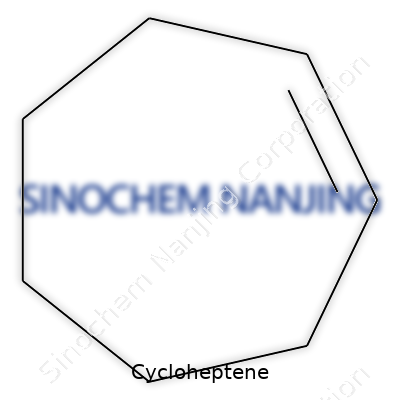
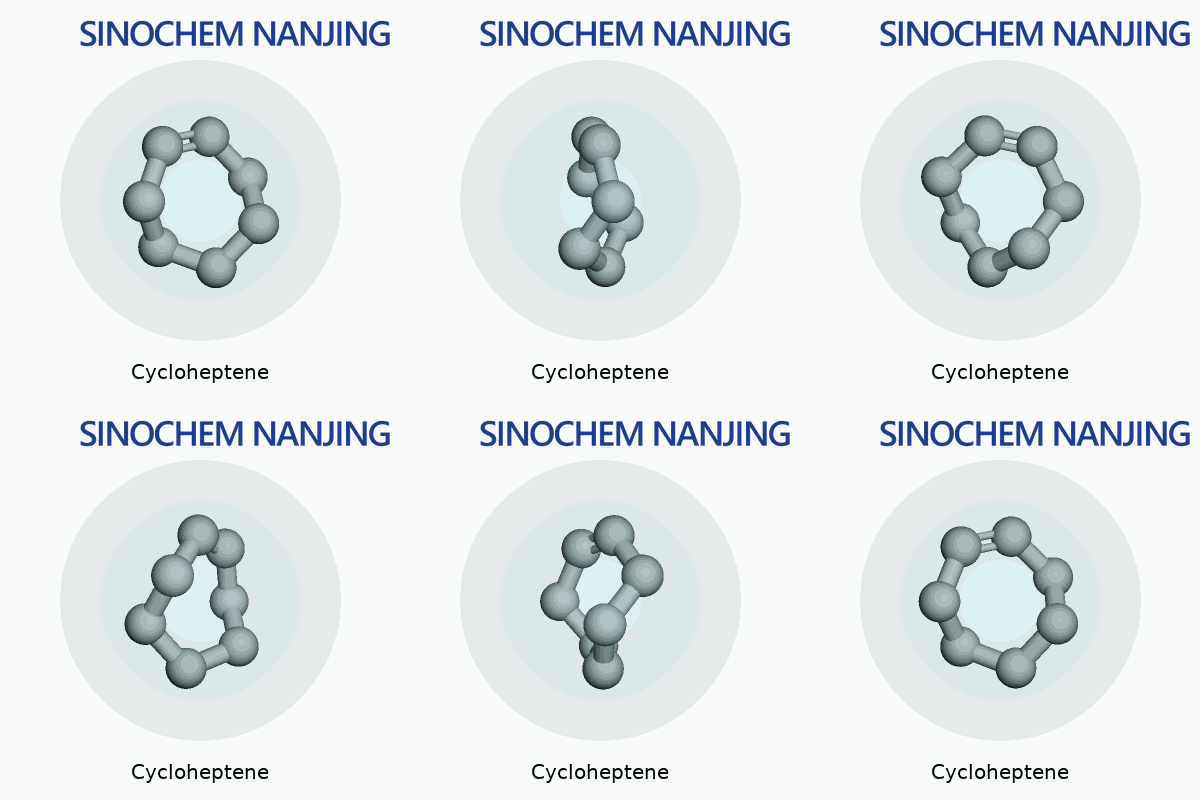
| Names | |
| Preferred IUPAC name | Cycloheptene |
| Other names |
1-Cycloheptene Cycloheptylene |
| Pronunciation | /ˌsaɪ.kloʊˈhɛp.tiːn/ |
| Identifiers | |
| CAS Number | 628-92-2 |
| Beilstein Reference | 1108731 |
| ChEBI | CHEBI:36464 |
| ChEMBL | CHEMBL15720 |
| ChemSpider | 6155 |
| DrugBank | DB08760 |
| ECHA InfoCard | 100.016.972 |
| EC Number | 208-981-9 |
| Gmelin Reference | 82242 |
| KEGG | C06533 |
| MeSH | D003465 |
| PubChem CID | 9254 |
| RTECS number | GU5425000 |
| UNII | 8C9424I2C5 |
| UN number | UN2241 |
| Properties | |
| Chemical formula | C7H12 |
| Molar mass | 96.1702 g/mol |
| Appearance | Colorless liquid |
| Odor | aromatic |
| Density | 0.857 g/mL at 25 °C |
| Solubility in water | Insoluble |
| log P | 1.92 |
| Vapor pressure | 4.44 kPa (at 20 °C) |
| Acidity (pKa) | 15.5 |
| Magnetic susceptibility (χ) | -68.0·10⁻⁶ cm³/mol |
| Refractive index (nD) | 1.465 |
| Viscosity | 3.35 mPa·s (20 °C) |
| Dipole moment | 0.4 D |
| Thermochemistry | |
| Std molar entropy (S⦵298) | 311.0 J·mol⁻¹·K⁻¹ |
| Std enthalpy of formation (ΔfH⦵298) | +92.6 kJ/mol |
| Std enthalpy of combustion (ΔcH⦵298) | -3918.9 kJ/mol |
| Hazards | |
| GHS labelling | GHS02, GHS07 |
| Pictograms | GHS02 |
| Signal word | Warning |
| Precautionary statements | P210, P233, P240, P241, P242, P243, P280, P303+P361+P353, P304+P340, P305+P351+P338, P337+P313, P370+P378, P403+P235, P501 |
| NFPA 704 (fire diamond) | 2-3-2 |
| Flash point | 14 °C (closed cup) |
| Autoignition temperature | autoignition temperature of cycloheptene is 230 °C |
| Explosive limits | Explosive limits: 1.1–6.7% |
| Lethal dose or concentration | Lethal dose or concentration of Cycloheptene: "LD50 (oral, rat): > 5000 mg/kg |
| LD50 (median dose) | LD50 (median dose) of Cycloheptene: **3200 mg/kg (rat, oral)** |
| NIOSH | **CY9300000** |
| PEL (Permissible) | PEL (Permissible Exposure Limit) for Cycloheptene: Not established |
| REL (Recommended) | 5.0 |
| IDLH (Immediate danger) | IDLH: 1000 ppm |



