Cyanogen Bromide: An Old Chemical Facing the Pressure of Modern Standards
Historical Development
Cyanogen bromide has been around since the tail end of the 19th century, popping up in chemistry labs long before we had the kind of detailed regulations or even high-grade protective gear that researchers rely on today. Early chemists used it because it worked, plain and simple. The compound arrived in industrial catalogs as soon as people figured out they could harness its strong reactivity, especially in research and protein chemistry. Looking back at the original literature, a bunch of inquisitive scientists took bold steps into the unknown, with both the good and bad outcomes that approach brings. The history of cyanogen bromide follows an all-too-familiar arc: quick adoption, scattered reports of nasty side effects, and then decades spent learning how to tame or sidestep its dangers. Even now, stories from veteran researchers include passing down wariness about handling this stuff—so its history gets retold person to person as often as it gets published in textbooks.
Product Overview
Anyone who has worked in biochemistry, or even eyed old organic syntheses, knows the stirring sight of that white, crystalline powder sitting in a cold room, broadcasting both promise and warning. Cyanogen bromide has served as a solid-phase cleaving reagent, mostly because it packs significant punch in breaking down proteins at methionine residues. Its industrial uses appear less frequently these days due to stricter regulations and efforts to phase out the most dangerous chemicals when safer options exist. Still, for labs determined to run certain protein sequence analyses or couple fragments in specialty syntheses, cyanogen bromide remains stubbornly irreplaceable. Most of us who have handled it only do so after signing off on paperwork, donning double gloves, and working inside fume hoods that are overdue for an upgrade. The discomfort isn’t without purpose—this compound is as hazardous as it is useful.
Physical & Chemical Properties
Cyanogen bromide is a white, volatile solid at room temperature, melting to a colorless liquid at just over 50 degrees Celsius. The compound's sharp, irritant odor is enough to clear a lab bench in a hurry if ventilation lets you down. As an alkylating agent, it reacts with a wide spectrum of compounds, which is the main reason people keep coming back to it for tough jobs in chemical synthesis. Water breaks it down quickly to poisonous gases—again, not something you want happening unexpectedly. As with so many intensely reactive compounds, it's the edge of aggression that drives both admiration and caution. Experienced chemists keep small vials tucked away in old refrigerators, clearly labeled, far from lunches and forgotten samples.
Technical Specifications & Labeling
Most containers carrying cyanogen bromide bear the scarlet warnings and skull symbols that every lab worker recognizes as shorthand for “think twice before using me.” Standard labeling flags its corrosive and toxic properties, and every vendor shipping it across borders must follow international conventions. The stuff doesn’t tolerate mishandling; even a little moisture or a stray heat source can trigger a hazardous reaction. The specs describe its purity at upwards of 98 percent, and batch reports usually come with a hefty stack of safety recommendations. If you see a container missing those details, you’d be smart to send it straight for disposal.
Preparation Method
Labs that still prepare cyanogen bromide do so by passing bromine gas through cold aqueous solutions of sodium cyanide, immediately releasing hydrogen bromide as a byproduct. This isn't kitchen chemistry and shouldn’t be improvised. Robust fume hoods, trained personnel, and meticulous waste disposal plans are absolutely necessary. Experience tells me, the more one attempts in-house production, the more one realizes it makes sense to purchase high-purity cyanogen bromide from established suppliers instead of skirting obvious hazards. In an era where chemical incidents can shutter entire institutions or businesses, few are willing to take shortcuts here.
Chemical Reactions & Modifications
Cyanogen bromide is unforgivingly reactive. Chemists tap its unique reactivity to cleave peptide chains at methionine, attach molecular labels, and initiate sequences of reactions in constrained syntheses. In my years running protein chemistry protocols, it's still the go-to for splitting complicated chains where enzymes fall short. What works great in a test tube doesn’t always translate to scale, though. This stuff reacts with water, alcohols, amines, and is especially rough on materials that weren't built for such harsh chemicals. Sapphire windows last; plasticware doesn’t. For those involved in developing improved reagents, cyanogen bromide’s selectivity has been both inspiration and cautionary tale.
Synonyms & Product Names
Cyanogen bromide is often known by its formula—BrCN—or sometimes just by its trade names in catalogues. Those trying to disguise its use sometimes refer to it by Systematic names like bromine cyanide, but most experienced researchers just call it what it is. Different naming conventions pop up in older literature, making it worthwhile to double-check language before ordering or substituting related compounds.
Safety & Operational Standards
The dangers surrounding cyanogen bromide are not just academic. The chemical hits quickly and hard; inhalation, skin contact, or even short exposures can produce acute symptoms because it releases toxic cyanide ions inside the body. Protocols demand full PPE: not just gloves and goggles, but splash shields, double gloves, and even respirators under certain conditions. Spills or leaks demand immediate action with cyanide antidotes available and staff trained for emergencies. Regulations have tightened over recent decades, mandating written protocols, incident logs, and waste tracking. Through my own experience watching older colleagues, the importance of treating this chemical with respect stays with you long after you switch to safer alternatives.
Application Area
Most work with cyanogen bromide these days happens in specialized labs focused on peptide chemistry, protein sequencing, or biomolecule labeling. In protein studies, it stands out for reliably cleaving at methionine, producing peptide maps that help piece together the structure once other tools have hit their limits. Certain affinity columns use immobilized cyanogen bromide for coupling ligands to matrices, which keeps showing up in protocols for purifying antibodies, hormones, or other bioactive molecules. While chemical engineers keep looking for alternatives, nothing quite matches its selectivity for these tasks. As medical and research labs grow more safety-conscious, some of the previous uses in organic synthesis or materials science have dropped off, but that small niche of necessity remains, at least for now.
Research & Development
Work continues to find substitutes for cyanogen bromide in core reactions, especially those that limit dangerous byproducts or swap out toxic reagents. Enzymatic alternatives have grown in popularity, especially as high-throughput research looks for greener, safer techniques. Investments in solid-phase peptide synthesis have focused on ways to design reagents that either mimic the selectivity of cyanogen bromide or bypass the hazardous cleavage step entirely. That said, there’s still an active community—particularly among protein chemists and structural biologists—pushing the boundaries of what’s possible with the compound. People regularly devise safer handling methodologies, improve containment, and rethink how to minimize operator exposure. Through experience, it becomes clear that every round of innovation still relies in part on understanding the strengths and weaknesses of chemicals like this one—all while training the next generation to question, not just inherit, these tools.
Toxicity Research
Cyanogen bromide’s toxicity is well-documented. Exposure damages lungs, eyes, and skin, while inhaled vapors deliver cyanide ions that shut down vital enzyme systems in minutes. Over the years, animal studies and several unfortunate workplace incidents have filled the literature with detailed case studies. Hospitals and poison control centers gear up with antidotes like sodium thiosulfate and amyl nitrite, but most doctors outside specialized settings have never encountered a real cyanogen bromide case. Strict exposure monitoring, medical surveillance programs, and air sensors are considered standard. This awareness has nudged academic and industrial researchers to explore reagents with a lower risk profile but comparable performance. As more data surfaces about subtle long-term effects, especially from chronic low-level exposure, there’s growing support for full substitution wherever practical.
Future Prospects
As safety regulation tightens worldwide and as green chemistry takes hold, the outlook for cyanogen bromide grows complicated. In university and clinical research, labs keep pushing for reagents and protocols that cut out hazardous or controversial chemicals. Many established procedures have already migrated away from cyanogen bromide, only revisiting it when newer methods come up short. Regulatory agencies will likely continue to ratchet up restrictions. The compound’s unique chemistry means it won’t disappear from science overnight, but its use will shrink to those specialized corners where there simply isn’t another way—at least until brave chemists succeed in inventing tools that perform these essential tricks without the heavy baggage. That growing sense of obligation to the people in the lab, not just to the data or the experiment, is driving a rethink in research culture, and I see that as both hopeful and overdue.
What are the main uses of Cyanogen Bromide?
Not Just Another Chemical Reagent
Chemical names can sound remote, stuck in thick lab manuals or locked away in technical jargon. Yet, cyanogen bromide stands out, carving a niche for itself among dyes and proteins. Those who spend time in labs know this compound means business, carrying both promise and risks. I learned quickly in biochemistry courses that you handle it with respect—goggles on, gloves up, breathing carefully.
Cleaving Proteins: A Precision Tool in the Lab
The role cyanogen bromide plays in protein research can’t be overstated. It breaks proteins at specific spots—more precisely, right after methionine residues. No wonder researchers keep reaching for it when piecing together protein fragments, mapping out sequences, or creating smaller peptides for further analysis. Without this compound, studying how proteins work inside the body would slow to a crawl. Researchers trying to map disease proteins or design new medicines count on these precise cuts to identify critical regions of complex molecules. Textbooks taught me the theory, but actual lab work made its power clear—one small addition to a solution, and big, messy proteins split predictably into manageable pieces.
Life on the Column: Peptide Synthesis and Affinity Chromatography
Affinity chromatography columns can make or break a purification process in biotech and pharma. Cyanogen bromide activates sepharose, attaching molecules like antigens or enzymes to the beads inside the columns. Next thing you know, you’ve got a tool that sorts out exactly what you want from a tangled mix—life-saving hormones, monoclonal antibodies, or tricky-to-purify enzymes. This method matters for drug research, vaccine development, and nearly every corner of biotechnology that relies on finding and isolating just the right molecule.
Dye Synthesis and Industrial Applications
Outside the world of proteins, industries tap cyanogen bromide to create dyes and photographic chemicals. Certain textile dyes depend on this compound for the right shade and durability. In photography, cyanogen bromide helps develop film and print processes. My curiosity often pulled me behind the scenes at textile mills where vibrant colors start not with artistry, but with a safe, controlled chemical reaction. The right dye can give fabric its signature color, hold it through a hundred washes, and ensure it doesn’t break down under sunlight.
Handling Matters: Risks and Safety Measures
I’ve seen risk sheets as long as my arm for cyanogen bromide. Volatile, toxic, and able to form poisonous gases, it demands attention to detail. Proper ventilation, skilled handling, and airtight storage can mean the difference between routine work and a lab evacuation. Mistakes here carry a heavy price. Regulating bodies—like OSHA and the EPA—spell out strict guidelines for transport, use, and disposal. My own work rarely left this chemical out in the open. It stayed locked away until absolutely necessary. Accidents are rare, but good habits and up-to-date protocols turn a dangerous chemical into a dependable ally.
Room for Improvement: Alternatives and Innovations
Not everyone welcomes cyanogen bromide in their protocols. The potential for exposure and environmental harm pushes scientists to seek safer alternatives where they can. New reagents or enzymatic cleavage methods now compete for the spotlight, gradually reducing reliance on older, riskier chemicals. Yet, for many labs, nothing consistently matches the speed and precision cyanogen bromide offers. Researchers keep searching for substitutes that deliver the same results without the downside.
Building Experience, Delivering Results
Chemistry has changed since my first years in the lab, but cyanogen bromide still finds its way into the toolkit of researchers who value reliability and precision. The risks are known, the rules are clear, and the payoff—better science, new medicines, stronger materials—makes each careful step worthwhile. Skills matter here, as well as respect for the tools in your hands. Cyanogen bromide stands as proof that the right chemical, used wisely, drives science further.
What safety precautions should be taken when handling Cyanogen Bromide?
Breathable Air Isn’t a Given
Anyone who’s cracked open a bottle of Cyanogen Bromide remembers that sharp, nose-piercing odor. This chemical releases a toxic gas that can stop someone from breathing in minutes. Forget the idea of “toughing it out”—regular lab gloves or a standard mask won’t cut it. Only a certified chemical fume hood keeps that vapour contained, and you want goggles that seal right to your face. Without these basic tools, opening a bottle of this stuff in a typical room risks your life and your co-workers’ health.
Skin and Lungs Can’t Handle Mistakes
Direct contact with Cyanogen Bromide wrecks skin, eyes, and the inside of your mouth or lungs. Standard nitrile gloves don’t hold up, so you want heavy-duty butyl rubber gloves. Lab coats need to cover wrists and neck—buttoned, not flapping open. A face shield adds another layer because even a splash can leave lasting scars. One researcher I know suffered burns on her forearms when a tiny drop made it through the gap in her coat cuff. Only full coverage gear puts a real barrier between skin and the toxin.
Proper Storage Isn’t Optional
Some people stash Cyanogen Bromide on a regular shelf, thinking it’s safe sealed. That just means you’ve created a real hazard just waiting for a rushed hand or clumsy moment. Locked cabinets with corrosion-proof lining—far from anything acidic, basic, or damp—take away the “what ifs” after hours. Dryness is non-negotiable because any water kicks off another chemical reaction, making this compound even nastier.
Disposal Requires Respect
Once a bottle’s open, rarely does every last milligram get used. Tossing leftovers down the drain or in a regular bin isn’t just lazy, it’s illegal for a reason. Only designated chemical waste streams hold Cyanogen Bromide safely, and labels never lie—everyone down the disposal chain deserves to know exactly what they’re handling. Labs that ignore this step endanger cleaning staff who may not even know the risk they’re facing.
Chemistry Is a People Business
Ready access to clear protocols saves lives. It’s not enough to leave instructions buried in a binder; every technician and new student must have practical training. Real-world drills and walk-throughs, not just lectures, reveal holes in personal procedures. Too many assume they’ll always remember steps in a crisis, but training hardwires the right moves. I’ve seen seasoned chemists freeze when an alarm blares, simply because unfamiliarity with drills made reaction times slow—training turned that around.
Emergency Response Can’t Wait for Bureaucracy
All the gear and planning in the world falls apart if something does go wrong and the lab doesn’t react quickly. Spill kits specific to Cyanogen Bromide (not just dustpans and generic sand) handle small accidents before they spread. Eyewash and showers right in the lab, not several doors away, give those precious seconds that often decide who comes out unharmed. Emergency numbers posted in plain sight turn panic into action; a hidden number buried in a phone contact list wastes time.
Staying Ahead of Tragedy
Every mistake with Cyanogen Bromide scars memories for years. People who work closely with it know that “just being careful” isn’t enough—the chemical punishes shortcuts. Reliable safety means strong habits, honest assessments, and workplaces built around protection, not luck. Protecting people will always take real investment and daily vigilance, because this isn’t a forgiving compound. Anyone who has spent time in a serious chemistry lab can tell you: the rules for Cyanogen Bromide are written in real blood, not ink.
How should Cyanogen Bromide be stored?
Understanding Cyanogen Bromide and Its Hazards
Cyanogen bromide poses serious chemical risks for both experienced scientists and lab newcomers. With a history in peptide synthesis, this compound doesn’t just carry a fancy name. It brings real danger—high toxicity, extreme volatility, and a pronounced reaction with water. Accidental exposure isn’t something people just brush off, since inhalation or skin contact can lead to severe poisoning. I’ve worked in labs where stories of close calls get shared during coffee breaks, and they stick in the mind as a gut-check on the importance of strict protocols.
Core Storage Practices—What Science and Experience Agree On
Proper storage starts with containment. Cyanogen bromide should always rest in airtight, tightly sealed containers, ideally made from glass or high-grade plastic. Metal corrodes, especially under the influence of acidic vapors, so those containers stay on the shelf. The storage area should stay cool—refrigeration at 2-8°C creates a zone where this chemical can’t heat up and release dangerous vapors. I’ve seen a single lapse in temperature control turn a routine task into an emergency, with alarms blaring and people scrambling for respirators.
Strictly separating cyanogen bromide from water cannot get overstated. Even a small moisture leak can trigger hydrolysis and crank out hydrogen cyanide gas—a notorious killer. In my work, double-bagging hazardous chemicals became second nature, using desiccants to mop up ambient moisture. The protocol saved headaches more than once, especially in humid seasons.
Ventilation stands as another pillar of safety. Cyanogen bromide shouldn’t sit anywhere near central airways, common corridors, or general storage. Instead, a dedicated chemical fume hood or vented storage cabinet provides containment and quick dispersal of accidental off-gassing. Once, a minor bottle crack in a fume hood didn’t lead to any medical emergencies, all because correct storage cut down the exposure risk.
Insulation from Incompatibles
Keeping cyanogen bromide among other chemicals spells disaster. It reacts with acids and bases, as well as with moisture, so the storage chart gets checked every time the shelf changes. Experienced lab managers group chemicals by class and reactivity, with visual diagrams on the wall. A mistake here could mean not just property damage but life-altering accidents.
The Right Eyes and Ears—Access Control
Only people trained in hazardous chemical management should access the storage zone. Locks and sign-in logs go up for a reason, not just for checking compliance boxes. Each accident I’ve seen traces back to someone cutting corners or skipping briefings. Seasonal training refreshers help keep everyone sharp, especially new hires or rotating grad students.
Labeling and Emergency Preparedness
Every time I walk into a well-run lab, the labeling jumps out at me. All containers should carry clear hazard markings—no faded ink or peeling tape. Emergency instructions, spill kits, and a direct line to local poison control round out the storage area. Even with airtight protocols, slip-ups happen, and clear plans save both time and lives. Stories travel fast in scientific circles, and near-misses push us to get better at thinking ahead.
Finding a Path Forward
Working with cyanogen bromide underscores the need for respect and continuous learning in chemistry. Adopting best practices isn’t about ticking off a checklist—it comes from hard-earned experience, the seriousness of chemical risk, and the drive to keep everyone heading home safely at day’s end.
What are the potential health hazards of Cyanogen Bromide exposure?
The Toll on Human Health
Most people have little reason to think about cyanogen bromide until it’s too late. Despite its important role in some scientific and industrial work, it comes with some major risks. Many researchers, lab workers, and chemical plant employees have run into problems due to poor ventilation or unexpected spills.
Inhaling even a small amount of cyanogen bromide vapor can irritate the nose and throat right away. Folks describe a burning sensation, like breathing in a strong cleaning product but far worse and more dangerous. Eyes start to water, skin feels itchy. The compound doesn’t stop at irritation, though—it impacts deeper systems. Headaches, dizziness, and confusion can follow brief exposure. Eyesight gets blurry. People sometimes get shallow, rapid breaths or chest discomfort. More than a few scientists have recounted moments of panic after missing a small leak, feeling their chest tighten in a matter of seconds.
The Science Behind the Symptoms
Cyanogen bromide disrupts how oxygen gets processed in the body. Once inhaled, swallowed, or splashed onto skin, it starts breaking down into chemicals that block cellular respiration—so cells in the brain, heart, and other organs can’t use oxygen properly. That’s when things get serious. At higher concentrations, seizures, loss of consciousness, or even death may result. The Centers for Disease Control and Prevention (CDC) points out that serious harm can happen in less than 30 minutes under the wrong conditions.
It’s not just the immediate impact. Folks who have had a close call with cyanogen bromide say recovery can be rough. Days after exposure, coughing lingers, and mental fog persists. Some cases in medical literature describe chronic lung or nerve damage from single high-dose exposures. Children recover slower. Elders, or anyone with asthma or heart problems, face greater risk. Even healthy folks pay a price.
Lessons from Real Life
Chemical exposures don’t always make headlines, but they shape lives. I remember a story from a lab tech in Boston. He wore gloves and goggles, followed protocols, and trusted everything would run smoothly. One poorly sealed container led to a spill. Even with a quick evacuation, he spent days in the hospital and weeks recovering. The workplace reviewed training, and now shares his story with every new employee. Stories like his reinforce how easy it is to underestimate this compound. They remind us that a lapse—big or small—has consequences.
Facing the Risk
The right gear protects people, but not everyone has access to high-level respiratory protection or properly maintained hoods. Some labs run on shoestring budgets; shortcuts tempt even the best workers. Medical experts and occupational safety agencies recommend using sealed systems, working behind shields, and keeping the material away from open air whenever possible. Sensors that detect airborne levels add another layer of safety. Quick access to showers and eyewash stations can save a life in a bad moment.
Moving Toward Better Safety
Fostering a safety culture matters as much as having rules on paper. Routine training, tales from those who’ve lived through exposure, and visible leadership buy-in help keep risk in check. Medical surveillance—regular check-ups and honest reporting—spot issues early. Ultimately, minimizing how often and how much people need to handle cyanogen bromide saves lives. Alternatives exist for many uses, and the cost of switching is small compared to human health costs. In my own circles, scientists who’ve switched to safer reagents sleep a bit better at night. Their labs run with less fear, and work still gets done. Taking these steps means fewer families get that 3 a.m. hospital call—a tiny but important victory.
What is the chemical formula and structure of Cyanogen Bromide?
Understanding Cyanogen Bromide’s Structure
Cyanogen bromide isn’t a name you hear outside a science lab. Its chemical formula is BrCN, which means this simple molecule is built from just three atoms: bromine, carbon, and nitrogen. Picture it like a straight chain, starting with a bromine atom linked to carbon, with the carbon then triple-bonded to nitrogen. Those triple bonds put plenty of tension in the system, making this compound reactive and somewhat unpredictable in its behavior.
Behind the Laboratory Door
Cyanogen bromide pops up often in biochemistry. Researchers use it for tasks like splitting proteins at specific points, a trick that’s been vital in figuring out what makes up enzymes, hormones, and antibodies. Take protein sequencing—a process my lab group once tackled using BrCN. We needed a clean way to break a huge protein into smaller chunks, and BrCN made it possible. Simple, fast, effective.
Facts matter when using a chemical this hazardous. Cyanogen bromide stands out due to its volatility and toxicity. Even trace exposure can cause burning eyes, headaches, and worse, since it gets into the system fast. Once, I opened a tightly-sealed ampoule of BrCN in a fume hood. A sharp almond smell hit, even through layers of safety gear. That day drove home the importance of airtight procedures and double-checking equipment before starting work.
Why Safety Ranks Above All
Cyanogen bromide has a history outside the lab, too. It has a reputation for being used in chemical synthesis and once cropped up in poorly controlled industrial settings. The World Health Organization has classified it as highly hazardous. Accidental exposure in a small manufacturing plant in the 1980s led to acute poisonings. Most victims recovered, but the incident changed regulations worldwide.
These lessons shaped much of the modern chemical safety culture. Labs now rely on comprehensive ventilation systems and personal protective equipment. Tracking, labeling, and storage rules protect workers from accidental releases. I’ve seen new researchers take shortcuts—assuming experience can substitute for procedure—only to face close calls. Consistent training and frequent drills help cement safe habits. No project deadline or shortcut outweighs the stakes.
Seeking Safer Solutions
Many labs pursue substitutes, especially for protein chemistry. Advances in enzymatic cleavage and milder chemicals remove some risks. Just last year, a graduate student in our department transitioned from BrCN to recombinant enzymes for fragmenting proteins. The technique worked, with none of the usual safety paperwork or tense moments over disposal. Not every research question fits the newer approach, but the progress is real.
Industries can support safety by phasing out cyanogen bromide unless no alternatives exist. Funding for research into greener chemistry helps; so do partnerships that share safer practices. Open access to incident reports and training resources gives workers a real edge. In the end, respecting the raw chemical power of cyanogen bromide matches up with caring about people and the environment. It’s not just the formula on paper—it’s the real-world responsibility that comes with it.
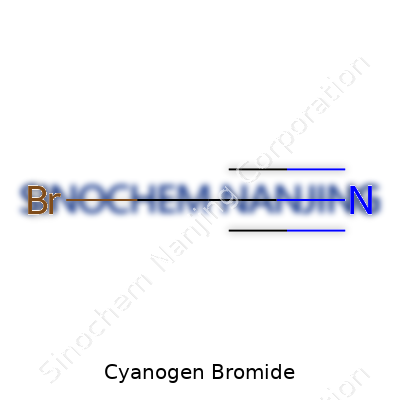
| Names | |
| Preferred IUPAC name | Bromomethanenitrile |
| Other names |
Bromocyan Bromcyan Bromine cyanide Cyanobromide Bromocyanogen |
| Pronunciation | /saɪˌænədʒən ˈbroʊmaɪd/ |
| Identifiers | |
| CAS Number | 506-68-3 |
| Beilstein Reference | 35894 |
| ChEBI | CHEBI:33141 |
| ChEMBL | CHEMBL1376 |
| ChemSpider | 54618 |
| DrugBank | DB03741 |
| ECHA InfoCard | 100.037.056 |
| EC Number | 207-992-3 |
| Gmelin Reference | 358 |
| KEGG | C01781 |
| MeSH | D003568 |
| PubChem CID | 66797 |
| RTECS number | GF1750000 |
| UNII | L8DQ502JJ8 |
| UN number | UN1889 |
| Properties | |
| Chemical formula | CNBr |
| Molar mass | 105.92 g/mol |
| Appearance | White to pale yellow or gray, crystalline solid |
| Odor | pungent |
| Density | 1.97 g/cm³ |
| Solubility in water | 40 g/100 mL (20 °C) |
| log P | 1.17 |
| Vapor pressure | 16 mmHg (20°C) |
| Acidity (pKa) | pKa = 3.46 |
| Basicity (pKb) | pKb = 9.0 |
| Magnetic susceptibility (χ) | -28.0·10⁻⁶ cm³/mol |
| Refractive index (nD) | 1.445 |
| Viscosity | 1.1 mPa·s (20 °C) |
| Dipole moment | 2.29 D |
| Thermochemistry | |
| Std molar entropy (S⦵298) | 110.8 J·mol⁻¹·K⁻¹ |
| Std enthalpy of formation (ΔfH⦵298) | 87.6 kJ/mol |
| Std enthalpy of combustion (ΔcH⦵298) | -234 kJ/mol |
| Pharmacology | |
| ATC code | V03AB32 |
| Hazards | |
| Main hazards | Toxic if swallowed, inhaled or in contact with skin; causes severe skin burns and eye damage; may cause respiratory irritation; contact with water releases toxic gas. |
| GHS labelling | GHS02, GHS06, GHS09 |
| Pictograms | GHS06,GHS03 |
| Signal word | Danger |
| Hazard statements | H300 + H310 + H330: Fatal if swallowed, in contact with skin or if inhaled. |
| Precautionary statements | P260, P261, P264, P271, P273, P280, P301+P310, P303+P361+P353, P304+P340, P305+P351+P338, P310, P320, P330, P361, P363, P403+P233, P405, P501 |
| NFPA 704 (fire diamond) | 3-3-0 |
| Flash point | -20°C |
| Autoignition temperature | 160 °C (320 °F; 433 K) |
| Explosive limits | 6-32% |
| Lethal dose or concentration | LD₅₀ oral rat: 5.0 mg/kg |
| LD50 (median dose) | LD50 (median dose): Oral (rat): 5 mg/kg |
| NIOSH | SD6475000 |
| PEL (Permissible) | PEL (Permissible Exposure Limit) for Cyanogen Bromide: "0.3 ppm (skin) as an 8-hour TWA (OSHA) |
| REL (Recommended) | 5 mg/m³ |
| IDLH (Immediate danger) | 25 ppm |
| Related compounds | |
| Related compounds |
Cyanogen Cyanogen chloride Cyanogen iodide Cyanogen fluoride |



