Copper Cyanide: Tracing Its Journey and Examining Its Modern Role
Historical Development
Copper cyanide traces its roots back to the early developments of metallurgy and the chemical industry, surfacing long before the digital era. Imagine the nineteenth-century laboratories crowded with simple glassware and fragile balances—where curiosity ended up giving humanity a compound now crucial for a range of industries. For those who have wandered the paths of industrial history, copper cyanide came into sharper focus as part of gold extraction and electroplating, where it enabled new processes that shaped entire economies. Advancements in chemistry throughout the last century sharpened scientists' understanding of its structure and capabilities, paving the way for safer handling methods and more precise applications.
Product Overview
Copper cyanide exists mainly as a white or off-white powder and features in many industrial workbenches. In my own early chemistry experiments, the distinct color stood out among the usual slate of dull reagents. While many talk about its use in precious metal industries, it also pops up in organic synthesis, acting as a reagent in specific coupling reactions or as a mechanistic tool for research and small-scale manufacturing. You won’t find it as a household staple, but plenty of factories rely on it to maintain efficient plating lines or to facilitate research in synthesis labs.
Physical & Chemical Properties
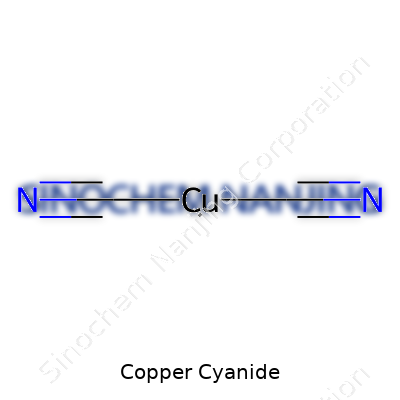
Copper cyanide settles at the intersection of stability and reactivity. It presents as an insoluble, fine powder, commonly white or faintly off-green, thanks to oxidation states or impurities picked up during storage. In the lab, the compound doesn’t dissolve in water, but reacts strongly in solutions containing complexing agents such as ammonia or potassium cyanide, forming soluble complexes. At temperatures above 200°C, copper cyanide decomposes, releasing dangerous hydrogen cyanide gas and copper residues, which calls for careful control in processing environments. The structure, showing copper in a linear coordination with cyanide ions, shapes much of its tricky behavior in chemical reactions.
Technical Specifications & Labeling
Those working in industrial or chemical supply tend to look past the label, but technical details matter, since they dictate safe handling and quality control. Purity often heads over 98 percent for most industrial applications, but trace metal content and particle size distribution also weigh on process outcomes. The labeling no longer treats the compound as a mere raw chemical—now it carries hazard codes, detailed ingredient listings, and strict transport guidelines, reflecting tighter global regulation and an improved understanding of occupational health. Experience shows that the updated regulatory approach helps keep not only workplaces, but supply chains, better aligned with best practices.
Preparation Method
Copper cyanide surfaces in the lab mostly through the reaction of copper sulfate with potassium or sodium cyanide, which immediately forms a precipitate of the compound. In school labs, this reaction often served as a cautionary tale of chemical dangers, as it demonstrates both the beauty and risks inherent in chemistry. Manufacturing at scale demands careful gating of cyanide solutions and copper salts, tight temperature controls, and rigorous ventilation. Any chemist who’s handled cyanides knows why closed systems rule the day now: even a small mistake brings immediate risk to all present. The scale-up from gram-sized reactions to ton-scale production clubs together environmental mitigation, closed-loop processing, and stricter emission controls.
Chemical Reactions & Modifications
Chemists often reach for copper cyanide as a building block in transition-metal-catalyzed reactions or for its coordination properties. The variety of complexes it forms with alkali cyanide or ammonia opens doors to different solubility profiles and reactivities, crucial in gold extraction or plating baths. My own forays into catalysis made clear how fluid the chemistry of copper cyanide can be—it hops between oxidation states, forms soluble anionic complexes, and enables nucleophilic substitution in organic syntheses that tougher reagents can’t manage. Research labs still explore substitutions or modifications of its crystal structure to enhance selectivity or reduce toxicity, with new ligands and additives showing up in journals almost yearly.
Synonyms & Product Names
Many encounter copper cyanide under different banners—cuprous cyanide or simply copper(I) cyanide, reflecting the copper ion's oxidation state. A chemist reading old patents or technical papers could easily trip over other names or formulas, but the core features stay consistent. The label might change, but the reputation for hazard and industrial versatility stays tied closely to its chemical identity.
Safety & Operational Standards
Workplaces dealing with copper cyanide rarely treat it lightly any longer. Cyanide-related incidents spurred significant upgrades in training and PPE requirements, with industry standards now demanding airtight masks, nitrile gloves, and controlled fume hoods. Accidents in the past—some reaching the headlines, others quietly resolved—prompted today's hyper-vigilant protocols. Companies now keep antidotes and specialized first aid on hand, and waste streams often face neutralization routines before leaving a facility. Training extends beyond rote instruction; teams test response drills and update documentation with lessons learned from international incidents. It’s a stark reminder of the compound’s dual role as an industrial asset and a toxic hazard.
Application Area
Copper cyanide finds real-world use most regularly in electroplating, facilitating the deposition of smooth, high-purity copper coatings on electronics, wires, or decorative items. The compound’s chemistry offers uniform plating and good adhesion, key to electronics manufacturing and connectors. In mining, copper cyanide assists with precious metal recovery, providing an efficient way to coax gold and silver from ore deposits that resist more benign methods. Academic groups still turn to it for synthetic purposes, especially in organic coupling reactions where other reagents fall short. Each sector brings its own risk calculations and containment strategies, reflecting the compound’s overlapping benefit and burden.
Research & Development
Researchers haven’t set copper cyanide aside, despite its age. Work in catalysis, green chemistry, and industrial process design continues to focus on minimizing waste, finding substitutes for cyanide-based systems, or engineering new ligands to control the compound’s reactivity. Computational chemistry gives new insight into its molecular behavior, while automation in the lab means fewer people directly exposed to hazards. In applied research, engineers try to lower dosages, introduce process recycling, and discover additives that cut secondary byproducts. No simple replacement for copper cyanide has surfaced for all its applications—so innovation leans towards making its use safer, cleaner, and less socially burdensome.
Toxicity Research
Those who study copper cyanide’s toxicology confront sobering facts about cyanide as a chemical risk. Cyanide compounds disrupt cellular respiration by binding crucial enzymes; copper adds its own layer of toxicity through bioaccumulation and interference with metabolic pathways. Inhalation or ingestion can rapidly overwhelm exposed workers, so real-world safety depends on strict exposure limits and fast-acting response protocols. Toxicology studies now dig deeper into chronic, low-level exposure outcomes and environmental impacts, highlighting contamination risks to water systems surrounding factories. External audits and transparency reports help push both manufacturers and regulators towards higher accountability.
Future Prospects
Copper cyanide’s future won’t simply mirror its past. The demand for advanced electronics and refined precious metals keeps its industrial relevance intact, yet shifting standards in environmental protection and workplace health push the chemical sector to invent new containment and neutralization technology. Research could unlock less hazardous analogues, but copper cyanide’s unique properties keep it in place—at least for now. Lately, pressures from green chemistry advocates and stricter international rules suggest that a day will come when alternatives become common in fields now dominated by cyanide-based methods. For now, it stands at the crossroads of industrial necessity and social responsibility, a reminder of the benefits and risks hard-wired into chemical progress.
What are the main applications of Copper Cyanide?
Core Role in Electroplating
Copper cyanide shows up most often in the electroplating industry. I learned about this process working alongside old-timers in a family-run plating shop. There, copper cyanide acted as the backbone of copper plating baths, turning dull, rough surfaces into bright, conducting layers. Copper, when it bonds in cyanide complexes, gives metals like iron and zinc a uniform copper coating. That thin layer keeps corrosion at bay and prepares surfaces to accept more layers, especially nickel and chrome down the line. It’s hard to overstate how this chemical streamlines everything from electrical connectors to the penny in your pocket.
Electronics and Circuit Board Manufacturing
Shifting over to electronics, copper cyanide’s value gets even more obvious. Printed circuit boards (PCBs) need fine copper traces—think about the intricate green wafers inside your phone or laptop. Electroplating with copper cyanide makes those high-precision copper paths possible. The solution throws down copper in a way that reduces pitting and defects, giving electronics the strength to last in daily use. Failures on these boards aren’t just annoying—they can knock out medical devices, cars, and communication tools.
Gold Mining and Extraction
Many folks don’t realize copper cyanide also shows up wherever gold mining happens. Miners use cyanide solutions to pull gold and silver from ore—a technology that dates back over a century. Copper in ore creates hurdles for gold extraction, often soaking up cyanide meant for gold. By controlling copper cyanide levels, miners cut their chemical costs and boost gold recovery. Mismanaging it, though, pushes up expenses and raises environmental risks.
Chemical Synthesis and Catalysis
Beyond metals and mining, copper cyanide serves as a reagent in organic chemistry. Researchers and manufacturers rely on it to build everything from paints to pharmaceuticals. In these labs, copper cyanide acts as a catalyst, helping molecules link together. This is no small thing—using copper cyanide trims reaction times and sharpens selectivity, which means safer products and less wasted material.
Environmental and Safety Issues
Working with copper cyanide brings tough responsibilities. Cyanide compounds don’t forgive mistakes; small spills or bad ventilation have real-world consequences. In the shops where I worked, everyone kept close watch on air and water, using tight controls and regular safety drills. Toxic waste gets locked down and destroyed, and regulators run a tight ship on waste permits. Still, messes happen. When copper cyanide leaks, local water and wildlife take the hit for generations. The EPA and European regulators have strict rules, but enforcement gaps can pop up anywhere people chase profits and cut corners.
Paths Forward: Safer Practices and Alternatives
A few innovative companies pursue copper plating without cyanide, turning to organic-based and lower-toxicity solutions. Some of these work for simple parts, but they don’t always match the reliability needed in aerospace or medical gear. People still look for substitutes, and researchers keep pushing for new chemistries. In the meantime, everyone in the supply chain—from roughneck miners to clean-room engineers—owes it to themselves, customers, and communities to handle copper cyanide with care. Training, airtight procedures, and regular testing make a difference. Real progress comes from accountability, investment in safer gear, and near-obsessive attention to detail every day copper cyanide sees use.
Is Copper Cyanide toxic or hazardous to handle?
Copper Cyanide’s Real Hazards
Most people walk past the word “cyanide” with a shiver, and for good reason. Experience in chemistry labs taught me early that copper cyanide, a white, powdery compound, deserves that reputation. It doesn’t just irritate the eyes and skin—it can deliver a punch to the nervous system if inhaled or ingested. During one summer internship at an electroplating facility, strict protocols made the risks clear: gloves, protective eyewear, and even special ventilation rules kicked in the moment the container opened. No exceptions, no shortcuts, because health takes a beating when copper cyanide is left unchecked.
Why It Matters: More Than Just a Chemical
Look at the stats. Cyanide compounds sit among the top workplace accidents in the metal industry. Copper cyanide can release hydrogen cyanide gas, especially when it meets an acid or moisture. That’s not a distant, rare event—humidity or a spill can turn a routine task into a panic drill. The gas is colorless and blocks cells from using oxygen, fast. Symptoms show up quickly: dizziness, nausea, headaches, and in severe cases, loss of consciousness. Fatal exposures have happened at just a few hundred parts per million.
On smaller scales, the hands and nose don’t lie. Just a few granules can cause rashes or trigger allergic reactions. Some workers report tasting almonds—a classic warning sign—if traces make it into the air. Official occupational exposure limits, like the OSHA ceiling of 5 mg/m³ for cyanide compounds, exist for a reason, and every credible workplace keeps emergency antidotes on hand.
Not Just About Individual Workers
Companies pay big penalties for ignoring proper storage and disposal. Environmental harm is no small thing. Cyanides sweep through water sources and poison aquatic life, sometimes for years. Back in college, a contaminated local stream wrecked fishing for two summers after an industrial mishap down the block. The cost fell not only on the company but on the community, with cleanup efforts crossing into million-dollar territory.
What Works for Staying Safe
Common sense and reliable practices matter. A few real-world habits stick out from my time in the industry. Genuine training beats any poster on the wall. Everyone who touches copper cyanide gets walked through what to do if it spills, contacts skin, or mixes with incompatible chemicals. “Buddy systems,” where workers check up on each other during transfers, cut down on accidents more than automated alarms ever did. Simple steps, like using scoops instead of hands and never eating or drinking around workstations, protect against mistakes.
Proper storage stands right behind good habits. Copper cyanide stays safe in tightly closed, labeled containers, away from acids and moisture. Spill kits including cyanide antidotes and eye wash stations belong nearby, not in some distant closet. Facilities invest in fume hoods and airflow systems, since one whiff of hydrogen cyanide can ruin a day—or a life.
Strict regulations exist for a reason, but the most effective barrier stays personal. Workers who understand the risks stay sharp. Community safety programs, from local hazard response teams to honest reporting systems, keep incidents from growing into disasters. Regulation enforcement sometimes gets a bad rap, but in my experience, nothing compares to the confidence that comes from knowing the rules really do protect everyone in the building. No shortcut or cost-saving measure is worth risking what copper cyanide can take away in a single instant.
How should Copper Cyanide be stored safely?
Understanding the Risks
Copper cyanide doesn't show up in everyday life, but for people who work in electroplating, mining, or research, this pale green powder demands attention. Years in labs taught me: a chemical like this carries both value and danger. Anybody keeping copper cyanide on hand faces real risks. Exposure, even from powder in the air, can result in serious poisoning. You breathe it, you get it on your skin, trouble starts fast. Keeping everyone safe means treating every step from delivery to disposal as important work.
Where to Store Copper Cyanide
Get the basics right with the storage area. Choose dry, cool rooms, far away from foot traffic and food. Moisture creates a new problem: the compound breaks down and releases deadly hydrogen cyanide gas. A leaky roof or bad AC may go unnoticed, but for copper cyanide, that's an accident waiting to happen.
Sturdy storage calls for locked, clearly labeled cabinets—nothing open, nothing easy to knock over. At the university where I trained, we used steel cabinets paired with thick plastic liners for leak protection. Every bottle or drum stayed in covered secondary containers, so a cracked lid meant a small mess, not a disaster. Labels can’t fade or peel off. Fresh, easy-to-read labels help crew members know exactly what they’re dealing with, even during late-night shifts.
Keep Incompatibles Far Apart
Separate copper cyanide from acids and oxidizers. This combo could mean cyanide gas where you stand. At some sites, careless stacking lands bottles of acid and cyanide on the same shelf. When that happens, a spill or a cracked bottle is enough to cause a deadly emergency. Designate shelves and containers so they never touch.
Protecting People
No one should need to touch copper cyanide without gloves, goggles, and a lab coat. In jobs I’ve held, a buddy system made sure no one worked with cyanide alone. Training means showing—not just telling—staff how to wear gear, use fume hoods, and deal with spills. An emergency shower and eye wash station, placed nearby, lets someone act without scrambling through hallways for help.
Every storage area requires a spill kit. This means not only the right absorbent material, but calcium hypochlorite for safe cleanup. A checklist by the cabinet goes a long way if sudden leaks occur, keeping panic down.
Good Records and Regular Checks
Only trained crew should handle keys to cyanide storage. I kept logs showing who accessed the chemical and how much left the cabinet. That record works two ways: it keeps people honest, and it protects the company if an incident occurs. Regular inspections pick up signs of corrosion, broken seals, or missing labels. These checks catch problems before they grow into full-blown disasters.
Dealing with Leftovers and Waste
Never pour leftover copper cyanide down any drain. Strict hazardous waste procedures matter. Disposal happens through certified hazardous waste companies. Careful packaging in leak-proof, labeled drums is non-negotiable. This is more than just company policy—it's about keeping groundwater safe and preventing local contamination that could hurt communities for years.
Solutions Worth Investing In
Safe storage isn’t about fancy new tech. It comes from habits built over years: double-checking labels, locking cabinets, working with partners, and keeping waste out of the water supply. Most incidents result from small lapses. Clear rules, constant training, and respect for the risks offer the strongest protection. After all, keeping copper cyanide secure isn’t just about your own safety—it's about caring for everyone around you.
What is the chemical formula and appearance of Copper Cyanide?
The Chemistry Behind Copper Cyanide
Copper cyanide stands out for its bright green-blue color, a vivid appearance few materials can claim. The chemical formula is CuCN. Few people run into copper cyanide on a daily basis, but anyone who works in the metal finishing industry or in electroplating will recognize it right away. CuCN has a straightforward structure: each copper atom bonds tightly to one cyanide group. This direct link plays a big part in its chemical behavior during industrial processes.
Distinctive Appearance and Properties
Many chemicals fade into the background, but copper cyanide doesn’t try to blend in. It forms a fine, almost powdery solid with a greenish blue or off-white look, depending on its purity and how it’s prepared. Anyone handling it in a lab sees right away that it’s not just another pale chemical. In the right lighting, that green-blue hue practically pops — it serves as a visual cue for trained chemists to handle the substance with extra care.
Where Copper Cyanide Makes a Difference
In the world of electroplating, copper cyanide fills a unique role. Platers value it for producing smooth, bright metal coatings on jewelry, connectors, and machine parts. The reaction between copper cyanide and other chemicals allows copper to deposit evenly onto a variety of metals, including steel and zinc. Products sporting these coatings resist corrosion and wear, which keeps everything from electronics to watch gears working longer. That matters in my experience growing up around machinists: they never ignored the value of durable parts. One bad batch and hundreds of hours disappeared down the drain, so the reliability that copper cyanide helps offer means fewer replacement parts, less downtime, and lower costs.
Safety and Environmental Considerations
Copper cyanide carries risk far beyond a simple skin or eye irritant. Its toxicity comes from the cyanide component, which disrupts cellular respiration. Mishandling can be deadly. Strict rules guide its use: proper ventilation, sealed containers, and emergency response plans come standard in any decent lab or plating facility. Anyone who’s ever taken a workplace safety course remembers the drills—how to spot a leak, when to evacuate, and what steps to follow if exposure happens.Spills can do real harm to people and the environment. Cyanide doesn’t just disappear—it travels through soil and water, putting aquatic life at risk and threatening drinking supplies. That reality demands constant attention on safe storage, careful disposal, and community education. Recovery and neutralization with hydrogen peroxide or chlorine prevent much of the worst damage, but mistakes create headlines no community wants to see.
Paths Toward Safer Use
Improvement never stops. Some companies look toward substitutes, searching for less hazardous plating solutions that won’t risk worker health or nearby streams. Replacing old equipment with closed-loop systems that capture and recycle cyanide cut the danger dramatically and shrink waste. Regular training reminds staff how to recognize trouble early—prevention always beats response. Industry groups that share best practices help smaller shops match standards set by the safest plants.Communities living near plating facilities often worry about hidden dangers. Open communication between companies and neighbors builds trust—a lesson learned from past spills that soured relationships. Posting clear chemical inventory lists, running regular drills, and inviting local responders for tours give everyone the knowledge they need to keep people safe.
What safety precautions should be followed when working with Copper Cyanide?
Why Extra Care Matters
Copper cyanide often turns up in places like electroplating shops and certain labs, its pale green powder hinting at a dangerous punch. Behind a dull name lurks a compound that packs the toxic punch of cyanide and the hazards of heavy metals. I remember walking into a plating workshop on one of my first gigs—no masks, gloves tossed into a corner, folks humming along as powders mixed. My gut tightened, thinking about all the stories you hear about sudden collapses, a whiff sending someone to the hospital. It made me double-check my own gear from then on. It’s easy to get complacent, especially with chemicals that don’t seem dramatic at first glance.
Good Ventilation Isn’t Optional
Inhalation presents the biggest danger. Cyanide compounds can release hydrogen cyanide gas, and even low vapor levels can cause headaches, dizziness, or worse. Keeping work in a fume hood, or at least in a room with strong exhaust ventilation, matters more than posting warning signs. I’ve seen workers rely on cracked windows and desk fans—those don’t cut it. OSHA highlights that cyanide exposure has been linked to acute poisoning and even death. Simply upgrading to mechanical ventilation reduces the risk for everyone in the building.
Touch Is Trouble
Don’t let copper cyanide touch skin. Forget about “it stings a little” or “I’ll just wash it off.” Once it gets in through a tiny open cut, it goes straight into your bloodstream. Nitrile gloves, lab coats, closed shoes — these make a difference. In my own experience, a colleague once brushed aside glove use, thinking the risk overblown. He spent a rough night in ER after a spill while cleaning glassware. It made the whole team rethink slip-ups. Eye protection stands just as important. Splashes into eyes don’t just burn; they can cause permanent damage or even blindness.
Respect the Storage
Locking up copper cyanide saves lives. It should never sit next to acids, since acids release hydrogen cyanide gas, turning an accident into a disaster. I’ve worked in labs where acids and cyanides were only separated by a plastic tray—that’s playing with fire. A proper locked cabinet, labeled clearly, with an inventory log, helps keep track. Cleaning tools and clothing used in contact with copper cyanide separately avoids cross-contamination that could turn up on doorknobs, phones, or coffee mugs—real issues I’ve seen firsthand in busy workplaces.
Training Changes Everything
No manual replaces hands-on safety drills. Regular safety meetings with “what if” scenarios do more than paperwork or online modules. When the team hears about real cases—fatal slips from poor handling—folks perk up and pay attention. Training needs to include how to handle a spill: neutralizing cyanide with hydrogen peroxide or sodium hypochlorite, knowing exactly where the eyewash and emergency shower are. Employees should never work alone with cyanides and always have a buddy present.
Solutions That Work
Personal accountability makes a difference: checking safety gear before and after shifts, logging chemical usage, and asking supervisors for better tools if what’s provided looks worn out. Management support—making fresh PPE available, enforcing regular safety reviews—sends the message that shortcuts won’t fly. It takes a team to keep everyone safe.
Why It’s Worth the Effort
Copper cyanide rewards careful handling with its unique properties, but the risks are always lurking for those who cut corners. People often underestimate danger because the powder looks so ordinary. Over the years, the people I’ve worked with who stuck around and stayed healthy were the ones who followed every safety step, no matter how much of a hassle it seemed in the moment.
| Names | |
| Preferred IUPAC name | copper(I) cyanide |
| Other names |
Cuprous cyanide Cupricin Copper (I) cyanide Cuprous cyano Cyanocopper |
| Pronunciation | /ˈkɒpər saɪəˌnaɪd/ |
| Identifiers | |
| CAS Number | 544-92-3 |
| Beilstein Reference | Beilstein Reference: "3587176 |
| ChEBI | CHEBI:32268 |
| ChEMBL | CHEMBL3406776 |
| ChemSpider | 14118 |
| DrugBank | DB14557 |
| ECHA InfoCard | 100.032.384 |
| EC Number | 207-019-0 |
| Gmelin Reference | Gmelin Reference: 963 |
| KEGG | C00944 |
| MeSH | D003835 |
| PubChem CID | 27002 |
| RTECS number | GL9625000 |
| UNII | LU49E6626Q |
| UN number | UN 3288 |
| CompTox Dashboard (EPA) | 6SN6X5VW1D |
| Properties | |
| Chemical formula | CuCN |
| Molar mass | 89.56 g/mol |
| Appearance | White powder |
| Odor | Odorless |
| Density | 2.92 g/cm³ |
| Solubility in water | Insoluble |
| log P | -1.48 |
| Vapor pressure | Negligible |
| Acidity (pKa) | 12.9 |
| Basicity (pKb) | 11.1 |
| Magnetic susceptibility (χ) | -0.87×10⁻⁶ |
| Refractive index (nD) | 1.940 |
| Dipole moment | 0 D |
| Thermochemistry | |
| Std molar entropy (S⦵298) | 86.6 J·mol⁻¹·K⁻¹ |
| Std enthalpy of formation (ΔfH⦵298) | -77.6 kJ/mol |
| Std enthalpy of combustion (ΔcH⦵298) | -144 kJ/mol |
| Pharmacology | |
| ATC code | V03AB04 |
| Hazards | |
| Main hazards | Toxic if swallowed, inhaled, or in contact with skin; releases toxic cyanide gas on contact with acids; environmental hazard. |
| GHS labelling | GHS02, GHS06, GHS09 |
| Pictograms | GHS06,GHS09 |
| Signal word | Danger |
| Hazard statements | H301 + H331: Toxic if swallowed or if inhaled. H410: Very toxic to aquatic life with long lasting effects. |
| Precautionary statements | P260, P261, P264, P270, P273, P280, P301+P310, P302+P352, P304+P340, P305+P351+P338, P308+P311, P330, P363, P501 |
| NFPA 704 (fire diamond) | 3 0 2 OX |
| Autoignition temperature | 160 °C |
| Lethal dose or concentration | LD50 oral (rat): 1 mg/kg |
| LD50 (median dose) | LD50 (median dose): Oral (rat): 1 mg/kg |
| NIOSH | TTQ5240000 |
| PEL (Permissible) | PEL (Permissible Exposure Limit) of Copper Cyanide: "0.5 mg/m3 (as Cu, OSHA) |
| REL (Recommended) | 0.01 mg/m3 |
| IDLH (Immediate danger) | 25 mg/m3 |
| Related compounds | |
| Related compounds |
Copper(I) chloride Copper(I) bromide Copper(I) iodide Silver cyanide Gold(I) cyanide |



