Bromoacetone: Unraveling a Chemical with a Storied Past and Cautious Present
Historical Development
Bromoacetone has left its fingerprint across some of the most notorious corners of 20th-century science and warfare. Chemists in the late 19th century noted the strong reactivity of this compound, an alpha-haloketone that drew the attention of industry and governments alike. By the time World War I rolled around, bromoacetone saw grim attention as a chemical weapon. Armies deployed it on the battlefield for its overpowering lachrymatory—tear-inducing—effects. That toxic history sits in the shadow of later, more regulated industrial chemistry, but the legacy shapes bromoacetone’s modern handling and regulations. Chemical safety infrastructure in labs owes a lot to lessons learned from those early years.
Product Overview
Most researchers today encounter bromoacetone as a pungent, volatile reagent in chemical synthesis, not as a weapon. Its role has shrunk in industrial circles, partly because of toxicity and regulatory headaches. Still, it keeps a niche in organic synthesis as a useful building block for more complex molecules. Handling this compound teaches you to respect your chemistry—leak the tiniest amount and the whole lab will know. That strong, choking smell isn't just unpleasant; it serves as a warning that this is not a chemical for the unwary.
Physical & Chemical Properties
Bromoacetone stands out as a clear to yellowish liquid with a boiling point around 137°C and a melting point just under 8°C. Its density sits at about 1.57 g/cm³. The molecule combines a bromine atom and a carbonyl group, making it highly reactive in nucleophilic substitution and addition reactions. Water doesn’t dissolve it easily, but it mixes well with alcohol and ether. Handle it wrong and its volatility works against you, sending irritating fumes through the air. Chemists learn respect for even a small bottle kept in a vented hood.
Technical Specifications & Labeling
Regulatory bodies push for a high level of clarity with bromoacetone packaging. Each container carries hazard warnings for acute toxicity, strong labeling for lachrymatory effects, and instructions for immediate response to spills. Labs run regular audits to check expiry dates and container integrity. Pure bromoacetone typically reaches a technical grade of around 95% purity, but few users see value in ultrapure product given the risk and limited synthetic contexts. Trace impurities, especially acetone and bromide ions, affect certain sensitive syntheses—so manufacturers supply detailed batch records as part of compliance.
Preparation Method
Seasoned organic chemists remember the classic preparation: react acetone with bromine in the presence of an acid catalyst, yielding bromoacetone alongside hydrobromic acid as a by-product. The reaction must be cold; let things warm up and you risk runaway fumes. Industrial routes once scaled up this method, but today, small-batch preparation takes center stage in most academic labs, always under strict fume extraction. Despite advances in greener chemistry, no alternative synthesis has fully replaced this route for those who still need the compound.
Chemical Reactions & Modifications
Bromoacetone acts as a versatile intermediate. Its electrophilic carbon offers a gateway to various nucleophilic substitutions, often replacing the bromine with a desired group to build more complex molecules. Chemists make use of this in designing pharmaceuticals and agrochemicals, where that reactive alpha position drives rapid assembly of structural motifs. React it with amines and you’ll form amino-ketones; with thiols, you step into sulfur chemistry. Its unique reactivity pays dividends in hands that understand the risks and quirks.
Synonyms & Product Names
Ask around the lab, and you’ll hear this chemical called by other names. 1-Bromo-2-propanone and α-Bromopropanone both describe the same molecule. Some databases log it as UN 1694 in hazardous materials parlance. The historical name BA crops up in military texts, a reminder of bromoacetone’s darker days. Whether found as bromoacetone or hiding under an alternate name, its reputation trails close behind.
Safety & Operational Standards
Any lab using bromoacetone takes extra precautions, and for good reason. Exposure brings severe eye and respiratory irritation within seconds. You won’t find it in places lacking fume hoods or full PPE—goggles, gloves, and face shields come standard. Spills prompt immediate evacuation, not casual cleanup. Chemists keep calcium carbonate or sodium thiosulfate on hand to neutralize accidents. Facilities track storage conditions, keeping bottles cool and tightly sealed to minimize dangerous vapor build-up. Regulatory bodies require full documentation for inventory and use—few compounds remind researchers to keep their house so closely in order.
Application Area
Bromoacetone no longer dominates chemical sectors, but it remains a staple for select synthetic applications. Medicinal chemists sometimes reach for it in the construction of biologically active molecules, where its structure helps introduce complexity at an early stage in the build-up of new drug candidates. In academic circles, it sometimes shows up as a teaching tool—if the facility can justify the safety measures. Its past as a tear gas overshadows any wider adoption in crowd control, thanks to international bans and better alternatives. Those working on its chemistry focus on its value as a unique reactive intermediate rather than as part of a broad industrial arsenal.
Research & Development
Most modern R&D with bromoacetone digs into its potential as a springboard for building larger, more complex molecules. Synthetic chemists experiment with modifying its structure to fine-tune reactivity or to introduce new functional groups at the alpha-carbon position. Computational chemistry teams model its reaction pathways to design safer or more selective alternatives. Some teams focus on finding ways to neutralize or safely decompose the compound once used, protecting workers and the environment from its persistent toxicity. Papers in the past decade trend toward these safety-minded innovations instead of mass-scale deployment.
Toxicity Research
Bromoacetone delivers a harsh lesson in toxicology. Inhaling even minute concentrations triggers tearing, coughing, and shortness of breath almost immediately, escalating to pulmonary edema with enough exposure. Chronic effects in lab workers have been rare, but not unheard of when older generations lacked modern ventilation. Animal studies confirm its hazard profile, and regulators set very low permissible exposure limits. Teams working with the chemical regularly submit to health monitoring, and institutions conduct frequent refresher training in emergency response. Hazard literature discourages casual experimentation; the risks stay top-of-mind for any trained chemist.
Future Prospects
As the chemical industry modernizes and safety takes top priority, bromoacetone’s active use faces an ever-shrinking set of scenarios. Regulations worldwide lean toward reducing the presence of materials with strong toxicity and potential for weaponization. Research continues hunting for safer alternatives, both as intermediates and as teaching reagents. Still, for specialized organic synthesis or in certain pharmaceutical contexts, it keeps a grudging foothold. The push for green chemistry throws extra scrutiny on bromoacetone’s waste streams, prompting newer disposal and neutralization technologies. Its splash in the textbooks will linger, but the day-to-day presence in most labs seems destined to fade as newer, safer tools move onto the bench.
What is bromoacetone used for?
A Look at Bromoacetone's History
Bromoacetone, a small molecule that packs a punch, first made headlines for reasons most folks would rather not remember. During World War I, armies reached for chemical agents, and bromoacetone entered the stage as a tear gas. It irritates the eyes and lungs, making the battlefield a nightmare. Later, it became clear that its dangers outweigh any tactical advantage, so military stockpiles faded away. Today, it sometimes pops up on lists of controlled substances for good reason.
The Role in Science and Industry
Chemistry labs handle bromoacetone mainly as a building block. Its strong reactivity means a skilled chemist can use it to string together more complex molecules. For example, the pharmaceutical industry has used bromoacetone while developing new medicines. Turning simple chemicals into intricate drugs sometimes takes harsh conditions, and bromoacetone’s unique properties let it serve as a stepping stone. It pops up in academic research now and again when scientists search for more direct or robust synthetic methods.
Outside medicine, it has fewer friends. Some chemical manufacturing relies on bromoacetone as an intermediate—a kind of chemical helper that shows up midway through a process, then disappears by the final stage. Some examples include certain dyes and photographic chemicals. Still, regulations and modern safety practices mean many industries look for safer alternatives.
Risks and Modern Attitudes
Even for folks with years of lab experience, bromoacetone earns respect. It readily vaporizes and stings the eyes, nose, and throat even at low concentrations. Accidents involving bromoacetone force quick evacuations and careful cleanup. Its toxicity means untrained hands rarely get near it, and regulators keep tight controls on who can buy or handle it.
Media rarely talk about bromoacetone. General awareness dipped after the shift away from chemical warfare and the rise of safer chemicals. But those who study safety or environmental health point out the lessons from its history. Disasters from the last century taught chemists and policymakers to keep a short leash on chemicals that harm both people and the environment.
Where Chemistry and Responsibility Meet
Safer chemistry matters, not just for workers but for communities and the planet. Finding substitutes for hazardous substances like bromoacetone makes life better for all of us. Chemists now invest plenty of time looking for greener paths to reach the same scientific goals. Regulations covering bromoacetone and its relatives cut down on spills, illegal use, and harm to workers.
Some countries require companies to track every gram of bromoacetone as it moves through labs or factories. Strict licensing rules prevent diversion. Strong education about chemical risks helps labs choose less dangerous alternatives whenever possible. Responsible supply chains, emergency response plans, and better personal protection help limit danger.
Bromoacetone may lurk in the footnotes of chemistry books, but its history reveals a lot about how science grows alongside its responsibilities. Even today, those who work with hazardous chemicals rely on a blend of training, experience, and careful rulemaking to keep progress on the right track.
Is bromoacetone hazardous or toxic?
What Bromoacetone Does to the Body
Bromoacetone hits hard. This chemical, which chemists recognize as a volatile lachrymator, can irritate eyes, skin, and respiratory tract almost immediately after contact. Even a whiff of its vapors brings on burning eyes and heavy discomfort, much like tear gas. There’s no guesswork here—scientific records and regulatory agencies place bromoacetone on lists of hazardous substances.
Inhaling small concentrations causes tearing, coughing, and sometimes choking. Higher levels go further. The eyes won’t just water—they ache, and vision can blur. Skin suffers too, reacting with redness and pain. Experience in a college research lab taught me how much a single spill can ruin a workday. Teachers always stressed strict storage because of its sharp odor and the risk it brought to anyone who walks by. The fact bromoacetone got used in chemical weapons during World War I speaks volumes about its potency.
Why Bromoacetone’s Toxicity Matters
Many chemicals in industry require special handling, but bromoacetone stands out because even trace releases bring quick and nasty consequences. The National Institute for Occupational Safety and Health (NIOSH) says it’s dangerous to work around without protection. Poison control centers flag it for its strong effects. Symptoms of overexposure can last well after the initial contact, with the worst cases even affecting the lungs. Handling this chemical without training isn’t an option.
Accidental exposures make headlines more often than some expect. Lab mishaps, waste management accidents, or even shipping errors can turn routine days into emergencies. Kids in my town once got sent home early from school after a railroad incident miles away. The sound of emergency sirens still reminds neighbors of the day a tank car released a small amount, setting off a regional response team and weeks of cleanup. For people with asthma, material like bromoacetone brings real danger—a brief exposure may even trigger hospitalization.
Safer Choices and Preventing Exposure
Personal experience running science outreach programs shows that simple fixes bring real results. Good ventilation, airtight containers, and clear signage around hazardous supplies cut down on risk. Most professionals working with bromoacetone wear gloves, splash-proof goggles, and respirators, because everyday latex or flimsy face masks can’t block the vapors or skin absorption. Strict spill protocols help keep incidents contained, but education makes the biggest difference. Trained workers know what signs point to exposure and how to decontaminate the right way.
Alternatives for research and industrial uses often get selected to avoid bromoacetone altogether. Green chemistry innovations aim for lower-toxicity solvents and reagents. Some manufacturers review their supply lists every year to look for safer, modern substitutes. For example, in many synthetic labs, alternatives with far less severe health effects have taken over. These efforts help protect workers and lower the number of chemical emergencies in the community.
Accountability and Public Health
Facilities that store or use bromoacetone follow strict rules from agencies like OSHA and the EPA. Regular audits, sensor alarms, and community reporting all have a role to play. These steps show a commitment to safety, but more transparency could help build trust where chemicals like this are in use. Local clinics and emergency responders do better when they know which chemicals are onsite.
Access to real-time data and simple alerts for residents can make a big difference in risk awareness. Sharing clear and accurate information builds trust and keeps neighbors safer. Choosing people’s health over convenience isn’t just good policy, it’s the easiest way to avoid the lasting impact that accidents involving toxic chemicals can bring.
How should bromoacetone be stored?
Why Bromoacetone Demands Respect
Anyone who's worked in a laboratory knows the drill with tough chemicals, but bromoacetone asks for extra attention. It’s one thing to follow a safety sheet, but hands-on experience gives you another perspective on risk. This chemical packs a punch—its vapor stings the eyes, nose, and throat. Even a drop on your skin can cause real irritation. These reasons go beyond theory; they remind anyone handling it that good habits stop accidents before they start.
Choosing the Right Container
No one wants to find out their container gave out or leaked. Glass bottles, especially those with Teflon-lined caps, do the best job of keeping vapors in check. Polyethylene and other plastics just don’t cut it; bromoacetone can attack and weaken the structure, which leads to leaks or worse. I’ve seen labs with a cracked plastic jug leaking fumes and the hassle of an emergency evacuation—glass really is worth it, even if it comes with a little extra cost. Plus, splash-proof seals give peace of mind that stays reliable over time.
Cool, Dry, and Dark Wins the Day
I’ve always looked for spots in a lab where sun never gets a peek and the temperature doesn’t swing much. Bromoacetone breaks down in light, generating dangerous gases and losing its stability. Leaving it on a window ledge or a hot shelf calls for an accident. In practice, storage cabinets made of metal, painted or powder-coated for corrosion resistance, resist spills and shield from stray sunlight. Desiccants can help keep moisture away, as water kickstarts unwanted reactions. When cabinets include built-in exhausts, the risk ticks even lower—one of those features that pays for itself by simply working quietly in the background.
Isolation Matters
Chemistry loves surprises, but bromoacetone doesn't play well with most reagents. Acids, bases, and strong oxidizers invite violent outcomes if they’re left near this chemical. A well-organized system, with clear labeling and dedicated trays or bins, keeps reactive compounds apart. At one lab I worked at, color-coded bins set apart each chemical family, making it nearly impossible to reach for the wrong bottle in a hurry and cause a mix-up. Organization felt like extra work until it proved itself during an inspection and helped us avoid hefty fines.
Ventilation: The Hidden Hero
Even if a bottle remains sealed, bromoacetone’s vapor finds tiny routes out over time. I’ve learned to never trust storage in a closed closet or drawer. Fume hoods or ventilated cabinets create a buffer; if a leak happens, vapors move away from breathing space. Carbon filters and chemical traps installed in these cabinets add another layer, making sure any escaping molecules get neutralized before reaching the lab.
Accountability and Emergency Prep
Good records take away guessing. Simple rules—log every entry, update inventory often, check containers for cracks—help spot problems fast. Labs see turnover, and with new faces come fresh risks. I make a point to run drills for spill clean-up and evacuation so no one freezes up if something goes south. Eyewash stations and showers get tested as part of regular routines, not just left as showpieces during audits. Bromoacetone teaches that emergencies don’t make appointments—they show up unannounced.
Moving Toward Safer Labs
Some labs already switch to less wicked alternatives, but sometimes, bromoacetone can't be swapped out. Until that’s possible, careful storage always keeps surprises rare and headaches small. Building a safety-focused culture, where everyone takes responsibility, makes the difference between routine and regret. No chemical deserves careless handling—least of all one as tricky as bromoacetone.
What are the physical properties of bromoacetone?
A Look at the Basics
Bromoacetone grabs attention right away with its pungent smell. Anyone who has worked with chemicals knows the kind of odor I’m talking about—the sharp, stinging sensation that warns you this isn’t something to shrug off. This colorless to yellowish liquid barely needs a drop in the air before you start feeling it in your nose and eyes. People in labs see it as more than a bottle with a label; they remember the burning sensation if the hood isn’t working right.
Appearance and State
You won’t find bromoacetone sitting around as a solid under normal circumstances. It keeps to a liquid state at room temperature, pooling in a slightly oily way that makes spills a real hassle. A little leak turns sticky and tough to clean. You can see a faint yellow in old samples, a signal it’s started to break down a bit after sitting on the shelf too long.
Boiling and Melting Points
In practice, watching bromoacetone boil lets you see its volatility firsthand. With a boiling point around 137 degrees Celsius, it doesn’t hang around as a liquid if the lab or facility overheats. At the other end, it doesn’t freeze easily, only turning solid well below water’s freezing point, at about minus 47 degrees Celsius. This makes storage straightforward, but transporting it without leaks—or without a decent seal on your containers—demands planning.
Solubility and Density
Bromoacetone mixes with many organic solvents, but skips water except for a little bit. Its density sits higher than water, usually near 1.6 grams per milliliter—meaning it quickly sinks if there’s ever a spill into water, carrying its toxic load below the surface. In the lab, quick cleanup is vital, as you don’t want fumes or liquid sitting out longer than it takes to get the job done.
Reactivity and Stability
One fact worth every technician’s attention: bromoacetone reacts with strong bases, acids, and some metals. These reactions can produce heat or even toxic byproducts. No chemist forgets the lesson that one careless mix-up can turn a regular workday into an emergency. Its high volatility also means the stuff evaporates quickly, pushing vapors into the air faster than you might realize. Adequate ventilation isn’t a suggestion; it’s non-negotiable.
Challenges and Safety Measures
For anyone unfamiliar, old textbooks mark bromoacetone as a “lachrymator”—a substance that makes you cry like you’ve sliced a hundred onions. Even tiny amounts make the air nearly unbreathable, which is why gas masks became popular in the early days of chemical warfare. Technicians today rely on fume hoods, sealed goggles, and gloves. It lingers as a prime example of a chemical that earned respect for both its utility and its risks.
Looking Forward
Switching to safer alternatives in industrial and research settings remains a work in progress. Better ventilation, tighter protocols for handling and storage, and research into less volatile compounds help prevent accidents. Bromoacetone reminds us that knowing a material’s properties isn’t just about passing exams—it’s about protecting your health and that of everyone around you.
What precautions are needed when handling bromoacetone?
Getting Personal With Dangerous Chemicals
Carrying out work with bromoacetone always reminds me that chemicals aren’t just lines in a textbook. Back in university, we practiced careful lab technique, but a single whiff from a careless opening stuck with me for weeks. The sharp, stinging smell makes it instantly clear: this isn’t something to shrug off. Bromoacetone, recognized long ago as a chemical weapon, demands real respect every single step of the way.
Why Bromoacetone Is No Joke
Bromoacetone looks simple—a colorless to yellow liquid. Every drop carries the bite of a severe tear gas, burning eyes and lungs even in tiny amounts. Fatal poisoning, skin burns, and chronic lung damage aren’t just theoretical consequences. These surface in medical journals and emergency rooms. Reports from careless labs or mishandled industrial shipments show how leaks linger in the air, causing emergency evacuations and hospital visits. No one wants to get a call from hazmat because of sloppy work.
Simple Gear, Serious Protection
Splash goggles, robust nitrile gloves, and a fitted lab coat with long sleeves form the bare minimum. Adding a chemical-resistant apron builds another wall against disaster. Here, cotton offers no real defense. My own experience taught me the value of double-gloving in case one layer tears—removing gloves with the outside never touching your skin. For face protection where splashing or vapor build-up seems possible, a full-face shield or a properly fitted respirator with organic vapor cartridges becomes non-negotiable.
Ventilate, Dilute, Contain
Fume hoods aren’t just helpful; they’re essential. No fume extractor or specialty ventilation? Don’t risk handling bromoacetone. Controlling the working space, closing all unnecessary bottles and using only as much as the procedure calls for, keeps airborne concentrations down. In one memorable incident, an ill-sealed container leaked for an hour, leading to a complete lab shutdown. Properly sealed glassware with tight Teflon stoppers and using secondary containment trays save on headaches and keep surprise spills from spreading.
Cleaning Up: No Room For Error
Act fast in cleaning small spills with absorbent pads designed for halogenated organics, not standard paper towels. Neutralizing agents sometimes cause violent reactions, so select only those proven safe for bromoacetone. Waste needs sealed chemical waste containers labeled with both hazard class and date—never tip it into the sink or general trash. If anything splashes on your skin, thorough washing with soap and water followed by medical review protects you from painful burns and lasting lung scarring. Colleagues rely on your alertness, as slips and slow response can cost others as much as yourself.
Keys To Safer Chemical Handling
Training, regular refreshers, and clear protocols stop disasters before they start. Safety data sheets, updated instructions, and real-world walkthroughs avoid comical or tragic misunderstandings. Knowing the route to an eyewash station and having spill kits in arm’s reach go further than any classroom lesson. I’ve seen seasoned chemists remind each other to double-check seals, review handling steps out loud, and keep the mood serious until bromoacetone is back on the shelf—still dangerous, but under control. This isn’t about paranoia; it’s about everyone walking away safe at the end of the day.
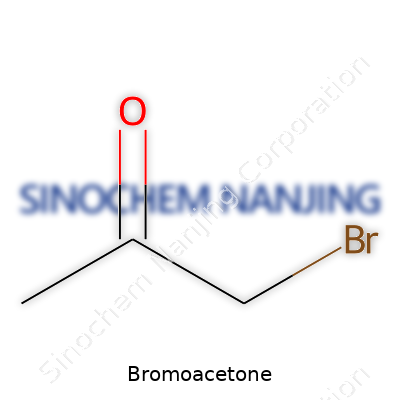
| Names | |
| Preferred IUPAC name | 1-Bromopropan-2-one |
| Pronunciation | /ˌbroʊ.moʊ.əˈsiː.toʊn/ |
| Identifiers | |
| CAS Number | 598-31-2 |
| Beilstein Reference | 1209227 |
| ChEBI | CHEBI:63908 |
| ChEMBL | CHEMBL314876 |
| ChemSpider | 12254 |
| DrugBank | DB01955 |
| ECHA InfoCard | 100.005.158 |
| EC Number | 211-140-8 |
| Gmelin Reference | 613 |
| KEGG | C14130 |
| MeSH | D001950 |
| PubChem CID | 6587 |
| RTECS number | EK8575000 |
| UNII | H5G76VX7P0 |
| UN number | UN1569 |
| CompTox Dashboard (EPA) | DTXSID5020676 |
| Properties | |
| Chemical formula | C3H5BrO |
| Molar mass | 150.00 g/mol |
| Appearance | Colorless to yellow liquid |
| Odor | Pungent |
| Density | 1.429 g/mL at 25 °C |
| Solubility in water | Moderately soluble |
| log P | -0.26 |
| Vapor pressure | 2.11 kPa (at 20 °C) |
| Acidity (pKa) | 13.38 |
| Basicity (pKb) | 2.99 |
| Magnetic susceptibility (χ) | -49.5·10⁻⁶ cm³/mol |
| Refractive index (nD) | 1.499 |
| Viscosity | 0.615 mPa·s (20 °C) |
| Dipole moment | 2.91 D |
| Thermochemistry | |
| Std molar entropy (S⦵298) | 188.5 J·mol⁻¹·K⁻¹ |
| Std enthalpy of formation (ΔfH⦵298) | -121.7 kJ/mol |
| Std enthalpy of combustion (ΔcH⦵298) | -1670.6 kJ/mol |
| Pharmacology | |
| ATC code | D06AX02 |
| Hazards | |
| GHS labelling | GHS02, GHS06, GHS05, GHS07 |
| Pictograms | GHS02,GHS06 |
| Signal word | Danger |
| Hazard statements | H301 + H311 + H331, H314, H319, H335 |
| Precautionary statements | P210, P261, P280, P301+P310, P303+P361+P353, P304+P340, P305+P351+P338, P312, P330, P337+P313, P405, P501 |
| NFPA 704 (fire diamond) | 3-2-1-W |
| Flash point | 10 °C |
| Autoignition temperature | 120 °C (248 °F; 393 K) |
| Explosive limits | Explosive limits: 5.8–24% |
| Lethal dose or concentration | LD50 oral rat 285 mg/kg |
| LD50 (median dose) | LD50 (median dose): 108 mg/kg (rat, oral) |
| NIOSH | RT8750000 |
| PEL (Permissible) | 0.1 ppm |
| REL (Recommended) | 1–5°C |
| IDLH (Immediate danger) | 200 ppm |
| Related compounds | |
| Related compounds |
Acetone Chloroacetone Iodoacetone Fluoroacetone |



