Boron Trichloride: Roots, Science, and Its Emerging Place in Industry
Historical Development
Boron trichloride’s journey traces back to the early days of industrial chemistry, around the late 19th century, when scientific curiosity started blending more deeply with commercial use. European chemists pressed ahead with isolating boron compounds, and in doing so they unlocked a trove of elements and molecules that would drive everything from glassmaking to electronics. Boron trichloride’s significance grew as the demand for high-purity materials for advanced applications started to rise, especially after the discovery of semiconductors. In those post-war decades, as transistors and integrated circuits took center stage, boron trichloride found new jobs far beyond the laboratory.
Product Overview
Boron trichloride isn’t a household product, but you can find its mark in a surprising number of technologies. Chemists see it as a powerful reagent, a source of boron, and a keep-it-quiet linchpin in etching processes. Even if folks outside the field rarely talk about it, manufacturers in microelectronics or specialty glass production couldn’t imagine replacing it so easily. Its practical uses stretch into aluminum refining, where its chemical precision plays a key role, and into pharmaceutical labs, where the need for reactive boron compounds pushes demand.
Physical & Chemical Properties
Open a tank of boron trichloride and you’re greeted by a colorless, fuming gas with a sharp, suffocating odor that cuts right through respiratory comfort. Its boiling point lands well below room temperature, which means containment and handling demand strict attention to leaks and exposure. In the air, it pulls water from its surroundings and quickly breaks down to form hydrochloric acid and boric acid. This aggressiveness makes it a stark presence in any lab or processing plant, requiring tools and storage that are up for the challenge. Unlike more benign gases, boron trichloride eats away at metals and reacts violently if someone fails to respect its power.
Technical Specifications & Labeling
Technical information matters most to those working hands-on, and boron trichloride bottles don’t shy away from warnings and chemical details. Industrial suppliers often standardize it by purity—most users ask for better than 99.9 percent, especially in sensitive electronic-grade applications. Cylinders come heavy, pressure-rated, and tagged with toxicity warnings. Most countries require clear hazard labeling: corrosive gas, toxic if inhaled, can form hazardous byproducts on contact with moisture. No one who works with it forgets the importance of sharp handling routines and the right safety training.
Preparation Method
Factories with big appetites for boron trichloride don’t run on homegrown chemistry. They combine boron oxide or carbide with chlorine at high temperatures, coaxing the reaction to produce pure gas. The process produces hydrochloric acid on the side, so careful separation and cleaning become routine. Over the years, improvements in reactor design and purification have allowed mass production without leaving impurities that would compromise sensitive downstream applications. Plant engineers must stay vigilant, knowing that leakages or incomplete reactions spell danger both for staff and the local environment.
Chemical Reactions & Modifications
Boron trichloride doesn’t just react; it demands respect when it does so. Exposed to water or moist air, it tears itself apart, releasing hydrochloric acid fumes and forming boric acid. It acts as a potent Lewis acid, snatching up electron pairs during catalyst creation or organic synthesis. Chemists pursuing new boron-based polymers or pushing for breakthroughs in organoboron chemistry count on its uncompromising reactivity. The gas can also produce diborane and other boron hydrides under certain lab conditions, opening doors to further research and applications in rocket fuels and specialty materials.
Synonyms & Product Names
Across catalogs and containers, boron trichloride sometimes turns up under alternative names, but most stick to the basics. Some scientists and suppliers opt for “trichloroborane,” others abbreviate to “BCl3,” yet everyone who’s worked with it long enough knows all roads point to the same family of hazards and industrial power. The lack of diversity in naming reflects its focused role in specialized sectors, with less of the consumer-friendly branding found in other chemicals.
Safety & Operational Standards
Forget shortcuts around this compound. Regulations pull no punches about employer responsibilities: mandatory ventilation, full-face respiratory protection, corrosion-resistant piping, and strict leak checks are not up for debate. Storage standards call for dry, well-sealed spaces and ready access to emergency scrubbers and neutralizing agents. No exception for old hands—if protocol drifts, risk soars almost instantly. While decade-old incidents of plant leaks or transport mishaps serve as constant reminders, today’s best-run operations foster a culture where preparation meets accountability, and every operator values health above output. Safety data and audit trails remain as important as technical specs, and with good reason.
Application Area
Look hard enough and boron trichloride pops up in unexpected corners. Its main claim to fame lands in microelectronics, etching precise pathways on silicon wafers driving smartphone chips. Makers of high-performance glass use it to tweak transparency and durability. Aluminum refineries call on it to remove troublesome metal impurities. Even outside heavy industry, chemists eye boron trichloride for synthesizing exotic compounds that might shape cleaner fuels, novel drugs, or stronger ceramics. Research grants and investment dollars tend to land wherever new materials can bring down manufacturing costs or unlock performance gains, so its relevance hardly shrinks.
Research & Development
Ambitious research projects increasingly look at boron trichloride with new eyes, seeing not just a reactive gas but a tool for unlocking next-generation semiconductors or designer catalysts. University chemists publish findings on its role in synthesizing boron-rich frameworks, while industrial labs keep pushing for safer handling methods or greener manufacturing. In real research practice, teams often work across disciplines, pairing process engineers with molecular scientists to wring every ounce of benefit from the compound while minimizing risk. Investment in automation, novel reactor linings, and leak detection all spring from hands-on experience with its temperamental reactions.
Toxicity Research
No debate crops up over its hazards. Inhalation damages lung tissue, causes severe eye burns, and sets off corrosion anywhere moisture meets the gas. Animal studies and accident case reports show the cost of lapses, with acute exposure leading to life-threatening outcomes. Chronic effects remain less well-studied, but regulators err on the side of caution, limiting allowable exposure to levels most workers would find stiflingly low. Scrutinizing alternatives, researchers sometimes dream about more benign boron carriers, but performance, price, and scalability often slam those doors shut, at least for now. The challenge stays: balance chemical power with everyday safety.
Future Prospects
Boron trichloride won’t shrink into the background any time soon, even as technology churns out new materials. Demand for cleaner energy, smarter electronics, and high-resistance glass keeps factories ordering more each year. Better handling and containment options could reduce risk, and new regulations might push for further innovation. Scientists keep probing for less toxic replacements, but for etching and boron chemistry, substitutes drag their feet behind in performance. If any shift stands out for the coming decade, it’s smarter engineering—from remote-operated facilities to AI-driven process controls—that can tame boron trichloride’s hazards without giving up the precision it brings to industry. Experience shows that where there’s a will backed by real investment in safety and sustainability, old risks get tamer, and new ideas take flight.
What is Boron Trichloride used for?
Boron trichloride sounds pretty niche, and for most people, it probably stays that way. Once you start digging into industries that rely on modern tech, its name starts to pop up everywhere you look. I’ve spent years writing about industrial chemicals and seeing how something seemingly obscure carries way more weight than anyone gives it credit for. Most of the time, boron trichloride gets brought up when someone’s asking about where our electronics come from or why high-purity metals remain so expensive and essential.
Making Pure Silicon Happen
The biggest story with boron trichloride comes from the tech sector. High-purity silicon sits at the core of every computer chip, every solar panel, and even the latest electric vehicles. The path from dirty, mined silicon to the clean, precise material found inside a phone isn’t straightforward. Boron trichloride pulls its weight here by removing metal impurities that mess up electrical performance. Factories use it to keep out pesky elements like phosphorus or arsenic that can ruin a batch. You can’t just rinse these metals out; it takes a chemical process, and boron trichloride does that work every day.
Cleaning Up Chemical Plants
Anyone who’s walked through a chemical plant knows how sensitive those systems can get. Boron trichloride steps in as a cleaning agent, keeping equipment free of oxides that slow down chemical reactions. Pipes and machinery last longer, and products keep their quality. There’s no way around the fact that, in these settings, efficient cleaning keeps costs under control and downtime at a minimum. Using something as reactive as boron trichloride is about more than maintenance; it means the whole operation runs smoother.
Etching in Microelectronics
Ever cracked open a phone and stared at the tiny lines and dots inside? Those patterns don’t happen by accident. Semiconductor plants lean on boron trichloride for plasma etching, cutting precise shapes into wafers. Silly as it might sound, cleaning these chips and carving out their patterns gets harder as tech advances. Boron trichloride isn’t glamorous, but device performance depends on its sharp lines and clean edges. Without it, those modern devices wouldn’t perform at the level consumers now expect.
Producing Advanced Alloys
Beyond chips and plastics, boron trichloride helps in making high-performance alloys for aerospace and defense. It introduces boron into the metal, giving tougher, lighter materials that handle high temperatures and stress. Jet engine parts last longer and handle the extremes of flight partly because boron trichloride brings boron where it’s needed.
Health, Safety, and Environmental Concerns
Handling boron trichloride gets tricky since it reacts strongly with water and can form harmful gases if managed poorly. Many plants now use stricter storage and transportation protocols to prevent leaks and accidental exposure. Authorities like the EPA require close monitoring of chemical handling and emissions, since a single slip-up poses risks to workers and nearby residents.
Looking to the Future
Some companies experiment with greener substitutes and more efficient recycling. Others invest in advanced capturing technology, funneling gases into specialized scrubbers that neutralize hazards before they leave the factory. The challenge turns into a balance: push for progress in chips and alloys without putting people or the planet at risk. That goal shows up not just on safety reports or corporate pledges but in the choices made every day on factory floors and in lab coats around the world.
Is Boron Trichloride hazardous or toxic?
Looking Past the Lab Bench
Boron trichloride crops up more often in chemical plants than in headlines, but its reputation deserves attention from anyone interested in what happens behind factory doors, or in the environment. This colorless gas often works quietly in electronics manufacturing and refining aluminum, handling jobs that most people never see. From my years teaching high school chemistry and chatting with engineers, I learned you can’t just brush off talk of safety around chemicals—even ones without a pungent smell that lingers in the room.
The Hazards Lurking In the Fume
Contact with boron trichloride can set off a chain of problems. Breathing it in brings instant irritation—it attacks the nose, throat, and lungs. In cases where workers got a heavy dose, some ended up with coughing, chest pains, and, at times, fluid filling up airways. I’ve heard from someone in copper refining that an accidental puff sent his coworker to urgent care with trouble breathing. Even years after, he couldn’t laugh about it.
Spills spill trouble, too. Water mixes with boron trichloride and creates hydrochloric acid, a chemical that burns on contact. Even a small leak where this stuff touches moisture can make the air harsh and the floors dangerous. Liquid splashes burn, sometimes badly. Safety routines don’t just read like over-cautious suggestions—they’re what let people clock in and come home without burns or worse.
Looking Beyond the Factory
The risks don’t stop at the factory gates. Improper storage or transport threatens emergency workers and the public. Over the years, I have read news stories about chemical rail car leaks that led to evacuations, road closures, and soil remediation. No one wants to worry about stray industrial gases drifting across town, but with boron trichloride, any slip can become headline news. Its toxicity might not mimic poisons in crime dramas, yet its effect on air quality and water can affect whole communities.
Backed by Facts: Regulatory Warning Signs
OSHA, NIOSH, and the EPA have all weighed in on its dangers, setting tight exposure limits and emergency guidelines. You won’t find boron trichloride in children’s science kits for good reason. The American Conference of Governmental Industrial Hygienists keeps its exposure recommendations low, signaling respect for its power to damage lungs and skin. A look through chemical safety databases always details personal protective gear and thorough ventilation, not out of paranoia, but experience.
What Helps: Practical Protections and Real Change
No single fix turns boron trichloride safe, but steady steps reduce risk. In plants where safety culture is strong, teams drill on leaks and keep sensors at the ready. Engineers work on fail-safes and storage containers get physical barriers. Routine air monitoring doesn’t let risks fly under the radar. Some tech companies have started finding cleaner alternatives for processing, lessening the need for boron trichloride altogether. High school and college programs in industrial hygiene help push future workers to ask harder questions and never skip a glove or a respirator.
Accepting that chemicals like boron trichloride have their place doesn’t mean giving up on health. Facts and respect for risk open the door to safer workplaces and cleaner communities. Everyone—engineers, plant managers, community members—stands to gain from treating every cylinder with care and staying cautious about what seeps into the air or runs into the water supply.
How should Boron Trichloride be stored and handled?
Understanding the Hazards
Boron trichloride doesn’t give you second chances. It’s a colorless gas that reacts aggressively with water. Once it escapes containment, it hits the air, and you get white vapors as it pulls moisture right out. Anyone who works with chemicals learns early on that trusting fumes is a bad idea—boron trichloride has a sharp bite, irritating eyes, nose, throat, and lungs. Breathing it in, even for a short time, carries serious risks. Direct skin or eye contact turns into an emergency, not just a bad day at the lab.
Storing It the Right Way
Gas cylinders or drums aren’t just picked at random. You look for well-sealed, corrosion-resistant steel, often lined inside, because boron trichloride goes after metals if you don’t. Moisture is its enemy and yours, so every seal has to be right—no cutting corners, no “close enough.” The storage area matters as much as the container. I keep anything like this in a dry, well-ventilated shed or room, way apart from acids, bases, and especially water. That means clear labeling, secure access, and not storing it with things like ammonia or alcohols.
I’ve learned to think about temperature swings. Heat can build up pressure inside cylinders, making leaks much more likely. Shade and climate control aren’t luxuries, they’re part of the basic setup. Everyone should know where the emergency shutoffs are and how to use them. Storage areas must have leak detectors. Ignoring these details can turn a routine day into news for all the wrong reasons.
Handling Steps I Won’t Skip
Transferring boron trichloride takes planning, double-checking, and supplies on standby. I always put on a full-face shield, acid-resistant gloves, and suit up in chemical-resistant gear. Adequate ventilation isn’t just a fan in the window—it’s fume hoods and exhaust systems that keep the air moving and filter out what you can’t see.
Spill kits are not optional. Fast cleanup gear and neutralizers have to be closer than the cylinder itself, and everyone working nearby should understand how to use them. I’ve seen workers skip steps out of habit. In a boron trichloride environment, habits like that end up costing people their health or worse.
Teamwork also has a role. I never move cylinders or change valves alone. A buddy system protects both people by making sure no step gets missed, and if something goes wrong, nobody faces it solo. Emergency showers and eyewash stations belong within arm’s reach, not “just down the hall.”
Training Makes the Difference
Every place I’ve worked that managed this chemical had regular reviews—who knows the risks, where are the exits, how do you respond if something leaks? Learning doesn’t end after the first safety seminar. Refreshers, drills, and checklists are as important as the containers themselves.
Mistakes usually come from lack of attention rather than lack of knowledge. Opening yourself to ongoing training is the best investment, not just for you, but for everyone around. If I see someone acting careless around boron trichloride, I speak up immediately. It’s about protecting lives, not just following rules.
Better Tools, More Protection
The future brings better sensors, tighter valves, improved materials for containers and gear. Reliable leak detectors and automatic shutoffs prevent tragedies before they start. Adopting new tech isn’t about staying trendy—it’s about keeping workers safe and giving families peace of mind. If a company skips on upgrades to save a buck, they gamble with safety—and that doesn’t end well.
What is the chemical formula and molecular weight of Boron Trichloride?
Chemical Formula of Boron Trichloride
Boron trichloride brings together a single boron atom and three chlorine atoms. The formula is straightforward: BCl3. If you’ve handled chemicals or worked in a lab, this type of notation shows up everywhere so it’s recognizable at a glance.
Molecular Weight of BCl3
To work out the molecular weight, start with the atomic weights. Boron clocks in at about 10.81 grams per mole and chlorine comes in at roughly 35.45 grams per mole. Multiply chlorine by three, since there are three of them: 35.45 × 3 yields 106.35. Add boron's contribution and the total hits about 117.16 grams per mole.
This number doesn’t just exist in textbooks. It matters in everything from chemical engineering, safety calculations, to packaging and transport. If you’re shifting containers or trying to make an exact formulation, these figures keep the process working safely and efficiently.
Why Formula and Weight Shape Chemical Work
Both the chemical formula and molecular weight serve as basic details, kind of like the phone number and address of a chemical. I remember working on metal etching projects where missing a decimal place could throw off a batch and waste a lot of product. Chemists lean on these numbers every day for crafting new recipes or reverse-engineering old ones, making sure nothing blows off more than intended.
Manufacturers producing electronics depend on substances like boron trichloride for processes like plasma etching semiconductors. The purity and ratio in gas blends can affect yields and final product performance. One slip in the formula or an error in measuring weight has the potential to mean the difference between a smooth operation and a reactor shutdown.
Health and Environmental Implications
If you’ve spent any time in a laboratory or a chemical plant, safety glasses and fresh air make a difference. Boron trichloride isn’t something to shrug off. It reacts aggressively with water, producing hydrochloric acid and other fumes that sting the eyes and lungs. The right molecular weight ensures proper ventilation and scrubbing systems match what’s actually in use, not just what someone guessed from a catalog.
Environmental guidelines hold companies to strict limits on what goes up the stacks or down the drains. Waste streams tracked by molecular weight keep the right side of regulations and help avoid expensive cleanups down the line. Anybody handling BCl3 must trust the labeling—and double-check it.
Smarter Solutions for Safe Use
Digital monitoring now catches leaks and reports on chemical inventories in real-time, bringing accountability to every cylinder on-site. Investing in employee training, periodic audits, and using certified scales and meters reduces both loss and risk. It goes a long way to keep both workers and communities protected.
Over the years I’ve seen that keeping track of formula and molecular weight is not just paperwork. It’s fundamental for science that works—and for safety at every step of the process. Boron trichloride’s details might seem simple, but they matter a great deal when people’s health and modern technology both share the same workspace.
What are the safety precautions when working with Boron Trichloride?
What Makes Boron Trichloride Risky
Boron Trichloride is an important gas in fields like electronics and metal refining, but you only need to smell its sharp odor once to know you should not drop your guard. My early days in a research lab taught me that things that fume aggressively—like Boron Trichloride—carry more danger than their clear, colorless appearance suggests. This gas reacts instantly with water, including the moisture in your eyes and lungs, producing hydrogen chloride and boric acid. Both of these can burn you badly, inside and out.
Personal Protection Always Comes First
Walking into a room where Boron Trichloride gets handled, you notice folks wearing full-face shields, chemical splash goggles, and gloves made of thick, specialized rubber. Lab coats and acid-resistant aprons are not for show. No shortcuts with PPE—my hands once tingled uncomfortably from a stray splash because I skipped double-checking wrist coverage. Respirators become a must when ventilation lags or you can’t guarantee that every connection stays tight. Nobody should breathe Boron Trichloride, not even for half a breath.
Why Good Ventilation Means Everything
You learn to respect a fume hood that’s actually working. Local and general exhaust systems move fumes away before they even reach your mask. Anyone who has watched containment fail sees right away what a difference airflow makes. In my experience, making sure those alarms and flow gauges get checked before each shift beats trusting your nose or luck.
Handling and Storage: Small Details Save Lives
It’s not just what you wear, but how you move and store cylinders. Use only tools and tubing rated for corrosive gases. One scratched steel wrench can spark a leak, and that leak turns a regular morning into a mad rush for the emergency shower. Always work upright and secure cylinders so they don’t tip. Double-check that caps seal tightly before turning your back. Weak connections and damaged fittings lead to bigger problems fast.
What to Do If Things Go Wrong
Once, when a regulator failed on me, only a nearby eyewash and quick access to an emergency shower stopped things from getting worse. Every person handling Boron Trichloride should know exactly where to find these emergency resources. Safety showers and eyewash stations work best when nothing blocks them, and their locations stay fresh in memory. Fire extinguishers rated for chemical fires belong nearby, but since Boron Trichloride can produce poisonous gases with water, don’t grab just any extinguisher until you know it won't make things worse.
Training and Communication Build Habits
No matter how good your gear or how tough your lungs, training comes first. Years of experience taught me that a team who practices emergency drills reacts faster under stress. Make time for classroom lessons and real-world rehearsals. Safety Data Sheets aren’t paperwork to file—they matter as guidance for what to expect and which steps make sense in a crisis.
How To Do Better
Encourage a workplace culture where everyone cares about every step, not just their own. Share stories of close calls so newer workers learn what to avoid. Your experience and the facts behind each precaution can keep someone else from making a dangerous mistake. The right habits, the right equipment, and the right attitude keep us safe—even around threats as potent as Boron Trichloride.
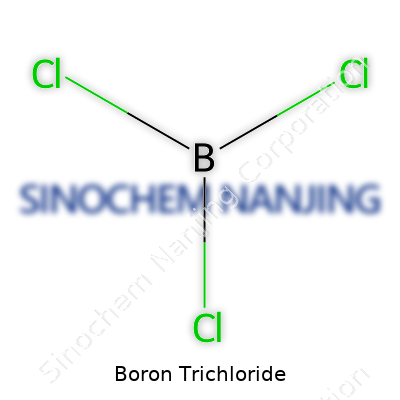
| Names | |
| Preferred IUPAC name | Trichloroborane |
| Other names |
Trichloroborane Boron chloride |
| Pronunciation | /ˈbɔːrɒn traɪˈklɔːraɪd/ |
| Identifiers | |
| CAS Number | 10294-34-5 |
| Beilstein Reference | 3587156 |
| ChEBI | CHEBI:30137 |
| ChEMBL | CHEMBL1231317 |
| ChemSpider | 10191210 |
| DrugBank | DB11140 |
| ECHA InfoCard | 100.007.819 |
| EC Number | 231-569-5 |
| Gmelin Reference | 774 |
| KEGG | C02384 |
| MeSH | D001911 |
| PubChem CID | 24984 |
| RTECS number | ED3325000 |
| UNII | V848864U6V |
| UN number | 1741 |
| Properties | |
| Chemical formula | BCl3 |
| Molar mass | 117.17 g/mol |
| Appearance | Colorless to pale yellow gas |
| Odor | Pungent |
| Density | 1.35 g/cm³ |
| Solubility in water | Reacts violently |
| log P | -1.18 |
| Vapor pressure | > 3.5 bar (20 °C) |
| Acidity (pKa) | -1.1 |
| Basicity (pKb) | -0.21 |
| Magnetic susceptibility (χ) | Diamagnetic |
| Refractive index (nD) | 1.422 |
| Dipole moment | 0.00 D |
| Thermochemistry | |
| Std molar entropy (S⦵298) | S⦵298 = 364.5 J·mol⁻¹·K⁻¹ |
| Std enthalpy of formation (ΔfH⦵298) | –400.1 kJ/mol |
| Std enthalpy of combustion (ΔcH⦵298) | -393.8 kJ/mol |
| Pharmacology | |
| ATC code | V09CX03 |
| Hazards | |
| Main hazards | Toxic if inhaled, causes severe burns to skin and eyes, reacts violently with water. |
| GHS labelling | GHS02, GHS05, GHS06 |
| Pictograms | GHS05, GHS06 |
| Signal word | Danger |
| Hazard statements | H301 + H331: Toxic if swallowed or if inhaled. H314: Causes severe skin burns and eye damage. |
| Precautionary statements | P260, P261, P271, P280, P301+P330+P331, P303+P361+P353, P304+P340, P305+P351+P338, P310, P312, P321, P363, P405, P501 |
| NFPA 704 (fire diamond) | 2-0-0-W |
| Autoignition temperature | 410 °C (770 °F; 683 K) |
| Explosive limits | Non-explosive |
| LD50 (median dose) | 385 mg/kg (rat, oral) |
| NIOSH | CU8225000 |
| PEL (Permissible) | 1 ppm (5 mg/m³) |
| REL (Recommended) | 0.7 mg/m³ |
| IDLH (Immediate danger) | 400 ppm |
| Related compounds | |
| Related compounds |
Boron trifluoride Boron tribromide Boron triiodide |



