Benzyl Cyanide: An Editorial Take on a Classic Chemical
The Historical Arc of Benzyl Cyanide
Benzyl cyanide’s story stretches further back than many imagine, becoming a cornerstone of organic synthesis as far back as the late nineteenth century. Old chemistry texts mention benzyl cyanide alongside foundational reagents like benzaldehyde and toluene. Its practicality kept it relevant through world wars when chemicals once lab curiosities found their way into commercial expansion and medicinal chemistry. Over time, refinements in manufacturing processes increased both yield and purity, which moved this substance out of dimly-lit benchtop experiments and into full-scale industry. As someone who has pored over pre-war German chemistry books, it’s clear how the industrial age intersected with academic curiosity, driving compounds like benzyl cyanide into mainstream relevance. While many chemicals from that era faded from use, benzyl cyanide pushed onward, thanks to its utility and adaptability.
Product Overview
Walk through any facility focusing on agrochemicals, fragrances, or even intermediate pharmaceuticals, and you’ll almost certainly discover benzyl cyanide listed as a key raw material. It’s a transparent to pale yellow oily liquid that, despite its intimidating name, smells faintly aromatic. Factories keep it tightly controlled, but seasoned chemists recognize its versatility right away. The compound acts as a bridge-builder, connecting raw starting materials to countless more specialized end-products. Even in academic labs, it helps researchers explore pathways in heterocyclic synthesis, giving students and senior scientists alike a practical lesson in how simple molecules open doors to much more complex ones.
Physical and Chemical Properties
A solution of benzyl cyanide never truly blends into water, but it dissolves in organic solvents without fuss. Its boiling point hovers around 233°C, letting it withstand standard laboratory heating without breaking down or evaporating too quickly. It displays moderate polarity, with the cyanide group pulling electrons while the benzyl moiety provides stability. I’ve run TLC plates of benzyl cyanide many times, always noticing its distinctive spot—never smudging when handled carefully. It can irritate skin, yet a careful hand and good lab practice keep accidents rare. For anyone handling this compound outside a fume hood, even the smallest spill leaves a noticeable aromatic note in the air, a cautionary signature that this liquid demands respect.
Technical Specifications and Labeling
Benzyl cyanide regulations vary by region, reflecting its dual role as a useful intermediate and potential controlled substance. Most reputable suppliers ship it in dark-glass bottles or sturdy metal drums. Labels display hazard pictograms, the chemical name, and concentration. Pure product usually runs above 98 percent, while trace impurities like toluene or benzyl chloride sometimes crop up if production controls slip. Detailed batch information supports traceability, a necessity since regulatory scrutiny tracks each kilogram. Regulatory bodies, recognizing its overlapping uses in synthesis and potential misuse, enforce shipping rules that complicate casual acquisition—a reality I’ve seen researchers grumble about, though for good reason.
Preparation Method
Industrial players usually rely on the classic nucleophilic substitution of benzyl chloride with sodium cyanide, a cost-efficient and scalable route. This reaction produces sodium chloride as a waste product and requires expert handling due to the toxicity of cyanide reagents. The process involves phase separation, careful temperature control, and swift removal of the product to avoid secondary reactions. While alternative pathways using other leaving groups exist, none surpass the efficiency and economy of this age-old route. In academic settings, this transformation regularly features in undergraduate organic chemistry courses—though under strictly controlled conditions, since both the starting materials and products demand full respect for their hazards.
Chemical Reactions and Modifications
Benzyl cyanide sits at a valuable intersection in synthetic chemistry. Its reactive nitrile group invites a wide range of modifications—acid, base, and catalytic hydrogenation all transform the simple structure into more elaborate products. For instance, hydrolysis produces phenylacetic acid, a fundamental building block in pharmaceuticals. Reduction yields 2-phenylethylamine, widely explored in neurochemistry. Even mild oxidizing agents can tweak the structure, preparing new research intermediates. In my own graduate work, I used benzyl cyanide as a springboard into heterocycle synthesis, performing ring closures that mimic processes seen in high-value drug manufacturing.
Synonyms and Product Names
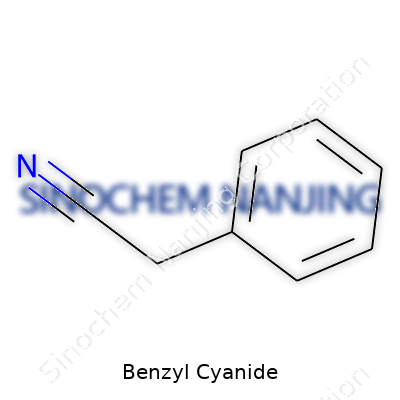
Industry veterans know benzyl cyanide under several guises: phenylacetonitrile, alpha-cyanotoluene, or benzyl nitrile. CAS number 140-29-4 anchors it to chemical inventories no matter the label. Sometimes, suppliers market it under historic or proprietary names, but the chemical structure stays the same—a benzene ring joined to a methylene and a cyano group. This multiplicity of names causes confusion for newcomers, risking errors in procurement or handling, but experienced chemists double-check identifiers before moving forward with any experiment or purchase.
Safety and Operational Standards
Handling benzyl cyanide safely takes more than gloves and goggles. The toxicity of the nitrile group, and its potential to release hydrogen cyanide under acidic or high-temperature conditions, demands respect in every step of storage, transfer, and reaction. Commercial operations install automated leak detectors, invest in local exhaust ventilation, and train personnel to manage emergencies. Spill kits include neutralizers, and strict inventory controls reduce the chance of unauthorized or accidental exposure. Regular safety audits focus on areas where the compound is stored and transferred, reflecting the serious, persistent risks. Anyone who has ever cleared out an old cabinet of lab reagents can attest to the lasting importance of diligent safety habits—one misstep with benzyl cyanide is one too many.
Application Area
Benzyl cyanide’s influence reaches well beyond a single sector. Agrochemical manufacturers use it to build herbicides and fungicides that underpin modern farming. Pharmaceutical companies value it as a precursor en route to antibiotics, antihistamines, and psychoactive compounds. In flavors and fragrances, benzyl cyanide transforms into aromatic esters that grace high-end perfumes and specialty food additives. The compound even finds a niche in academic research, enabling exploration of carbon-nitrogen bond-forming techniques and synthetic methodologies. My own years in both research and applied labs have shown how reliance on solid intermediates like this one underpin both incremental breakthroughs and sweeping innovation in the chemical sciences.
Research and Development Frontiers
Contemporary research focuses on greener, safer ways to make and use benzyl cyanide. Chemists investigate enzymatic and metal-catalyzed reactions as alternatives to hazardous cyanide salts, driven by both sustainability mandates and economic pressures. New work on selective functionalization enables access to increasingly complex molecules, supporting drug discovery with fewer steps and less waste. Recent literature details transition-metal catalyzed couplings, photoredox reactions, and tandem cyclizations as future avenues. Direct commercialization often lags behind academic results, yet every conference season brings new techniques with the promise of cleaner, safer, and more cost-effective production.
Toxicity Research
Toxicological studies track the impact of benzyl cyanide on human health and the environment. Studies in rodents show acute effects at higher doses, mainly through central nervous system depression or respiratory failure, linked to cyanide release. Chronic exposure leads to organ damage, underscoring why strict handling protocols matter. Its volatility and solubility pose environmental risks if containment lapses. Researchers also study metabolic breakdown in biological systems, focusing on enzyme pathways that detoxify or, in some cases, exacerbate cyanide toxicity. Despite its ubiquity in the lab, its hazardous profile demands respect from everyone involved, regardless of experience level.
The Road Ahead: Future Prospects
Looking forward, benzyl cyanide stays vital thanks to its adaptability and the sheer number of industries relying on its chemistry. The ongoing push toward green chemistry will pressure manufacturers to minimize hazardous byproducts and adopt cleaner production methods. Process intensification through continuous flow reactors, improved catalysis, and enzyme-based technologies all stand poised to reduce both cost and risk. Regulatory frameworks grow more robust every year, introducing new reporting and documentation requirements, especially in regions targeting controlled substances. As resources tighten and demand rises for tailored pharmaceuticals, insecticides, and flavorings, efficient, responsible use of classic intermediates like benzyl cyanide will keep scientists and engineers busy—and drive the next generation of chemical innovation.
What is Benzyl Cyanide used for?
Uses of Benzyl Cyanide
Benzyl cyanide grabs attention for the types of products it shows up in, though most people never see it on a label. This chemical acts as a building block in making flavors, fragrances, and even pharmaceuticals. Factories put benzyl cyanide to work in synthesizing compounds used in everyday fragrances—like those soft floral or almond notes in soap or air freshener. It’s also a stepping-stone for drugs like antihistamines and antidepressants. In the lab, chemists start with benzyl cyanide to get more complex molecules scientists and doctors rely on.
The paint and coating industry leans on it, too. Benzyl cyanide helps generate certain plasticizers. These plasticizers make plastics more flexible and durable. In practice, this means food packaging and industrial products are less likely to crack or break. Agrochemical companies use it to make active ingredients for pesticides and herbicides, which protect crops but bring up other debates about safety and farming practices.
Concerns Around Misuse and Safety
Benzyl cyanide doesn’t just earn its spot because of regular commerce; it also raises red flags in law enforcement and chemical safety circles. Some groups have misused it to make dangerous drugs or toxic substances. It’s not something you’d ever want to handle without training—exposure can cause skin burns or respiratory issues and even affect the nervous system. This makes it a regulated substance across many countries. Regulatory bodies, including the U.S. Drug Enforcement Administration (DEA) and the European Chemicals Agency (ECHA), watch the sale and transport of benzyl cyanide.
This isn’t just bureaucracy for the sake of paperwork. Several industries have suffered when regulation got ignored or enforcement failed, leading to public health issues and contamination. Inexperience or neglect during storage or disposal of benzyl cyanide can result in major environmental damage. Soil and water run-offs can impact animal and plant life, sometimes with long-term effects. Major chemical accidents make the news, but smaller spills also add up over time, highlighting the need for proper protocols every step of the way.
Balancing Industrial Progress With Accountability
I’ve talked to chemists and safety managers who see both sides. On one hand, benzyl cyanide supports innovations in medicine, farming, and manufacturing. On the other, labs must train workers carefully, maintain strict controls, and trace every gram from shipment to disposal. Some leading companies get audited several times a year, learning from past accidents—whether their own or a competitor’s. Mistakes on the chemical handling side create real risks for families living near factories and for workers on the job.
Tech improvements can help out. Companies use digital inventory tools and sensor-based leak detection systems that alert teams to spills before they get worse. Industry groups share best practices so smaller operations don’t have to face challenges alone. Responsibility falls not just on companies, but on the entire supply chain. Governments, businesses, and community watchdogs need to stay alert and hold each other accountable, making public health and safety a non-negotiable priority.
Benzyl cyanide isn’t visible to most people, but it quietly shapes the products and medicines that fill grocery shelves and pharmacies. The effort to keep its benefits outweighing its risks depends on thoughtful handling, transparency, and continuous learning from those who use it daily.
Is Benzyl Cyanide hazardous or toxic?
Getting Straight to the Facts
Factories and labs use all sorts of specialty chemicals every day, and Benzyl Cyanide comes up more than you’d think. It’s a building block for perfumes, pharmaceuticals, and even pesticides. Not many people outside the industry talk about what happens if you spill it or breathe it in. My own run-ins with lab-grade chemicals tell me: no chemical should be underestimated, especially one like this.
Hazards That Don’t Get Enough Attention
Benzyl Cyanide isn’t just a strange name in a Material Safety Data Sheet. Spill a little on your hands, and you may feel a tingling or numbness before even realizing you’ve been exposed. Inhaling the vapor can leave you short of breath and dizzy—clear signs your body takes a hit right away. Skin contact leads to redness or even blisters if not cleaned fast enough.
Toxicity goes beyond skin-deep. Prolonged breathing of its fumes can poison the nervous system. Deaths linked to accidental exposure rarely make headlines, but the risk is real. Cyanide in its structure contributes a lot of the danger, since the body struggles to process larger doses. Just a few grams, just a few breaths, and the story changes from inconvenience to medical emergency.
Evidence: Not a Matter of Debate
Government agencies don’t mince words about Benzyl Cyanide. The National Institute for Occupational Safety and Health (NIOSH) and the World Health Organization list it as a dangerous substance. Test data backs them up: rats exposed to high levels developed severe breathing problems, twitching, and convulsions. Long-term effects often escape early detection for workers, who get used to the smell and underestimate the silent toll.
It’s easy to dismiss the concern, thinking about the chemical as just another working hazard, like a cut or bruise. But Benzyl Cyanide doesn't behave that way. It vaporizes at room temperature, so even a loose cap or a broken seal can push risky fumes into the air you breathe. Standard gloves, goggles, and lab coats provide a frontline defense, but accidents still happen.
How Workers and Companies Can Respond
Control starts with old-fashioned vigilance. Spills and leaks should mean an immediate halt to work, with plenty of ventilation and proper cleanup using dedicated gear. Good training gives workers the reflexes they need for fast action—something I’ve seen prevent serious injuries more than once.
Stronger storage rules work better than blind trust. Chemicals should sit in sealed, clearly marked containers, away from heat and direct sunlight. Routine checks on storage sites cut down surprise leaks. Fume hoods and scrubbers protect air quality, turning risky fumes into much less harmful byproducts. On top of that, companies taking safety reviews seriously will find that their employees feel more secure and incidents drop.
Emergency gear—eyewash stations, showers, and oxygen kits—saves lives. People who work around Benzyl Cyanide need fast access to these tools, and drills every quarter to drill home quick action. It doesn’t hurt to make sure everyone on site knows basic first aid for chemical poisoning. I once watched a co-worker’s swift response with an eyewash kit turn what could have been a career-ending accident into just an afternoon of paperwork.
Moving Forward: Respect and Precaution
Benzyl Cyanide holds its place in the toolbox for chemists and manufacturers, but that usefulness comes with a price. Proper care matters because mistakes linger—sometimes on lungs, sometimes on skin, but always in the stories you hear in the break room long after. For anyone working with or near it, respect for the risks is the smartest investment you can make.
What are the storage requirements for Benzyl Cyanide?
Understanding the Nature of Benzyl Cyanide
Benzyl cyanide carries a reputation for being tricky. It brings a sharp, bitter almond smell, and anyone handling it needs to keep safety at the front of their mind. The chemical reacts strongly with moisture, acids, and bases, so sloppy storage can cause problems before anyone notices. People working in labs or production facilities have to account for more than just space and convenience.
Smart Storage Starts with Temperature and Ventilation
Temperature does not always get the attention it deserves. Stick this chemical in a room that’s too warm and those vapors start to build. Get it too cold, and you start to see issues with crystallization or container integrity. Most reliable sources, including the Hazardous Substances Data Bank (HSDB), advise keeping benzyl cyanide between 2°C and 8°C if possible. So, a dedicated chemical refrigerator, not some utility fridge with staff lunches next to it, usually makes the most sense.
Ventilation cannot be an afterthought. Benzyl cyanide vapors irritate eyes, skin, and most of all, lungs. Even a well-sealed bottle can emit enough fumes to bother someone walking close by if air circulation falls short. I learned to respect this after a single day in a poorly ventilated stockroom left my colleague with a nasty headache and watery eyes. Fume hoods or storage rooms with exhaust systems help prevent accidents and protect everyone in the building.
Shelving, Separation, and Container Choice
Flammable liquids and reactive chemicals, including benzyl cyanide, should steer clear of heat sources and direct sunlight. A steel or epoxy-coated flammable storage cabinet usually gives that confidence. Store it away from acids and bases because cross-contamination can cause a dangerous chemical reaction, sometimes even resulting in fire.
Use bottles made from glass or certain kinds of plastic (high-density polyethylene) because benzyl cyanide breaks down many common materials, especially if containers get old or aren’t sealed tight. Regular checks for cracked seals or faded labels need to be a habit, not an afterthought.
Labeling and Emergency Prep
Labels matter. Skip hand-written notes. Always have the chemical name, concentration, hazard information, and date received clearly showing. Emergency showers and eyewash stations should always be within quick reach, not blocked by boxes or furniture. I still remember a minor splash incident in a lab where, because equipment was kept near the door, someone cleaned up in less than a minute—an outcome that could’ve gone far worse.
Stock up on spill kits rated for cyanide compounds. Absorbent pads, neutralizing agents, and personal protective tools not only respond to spills, but send a message: “This lab takes responsibility seriously.” It sets a tone and a standard.
Training and Accountability
No amount of signage or strict rules means much without real-world education. Anyone who opens a bottle or moves containers needs targeted training. New staff learn from experienced workers with hands-on practice, and regular drills reinforce what’s written in lab manuals. People remember stories and near-misses better than essays, so sharing firsthand accounts sharpens respect for proper procedures.
Solid storage practices for benzyl cyanide make a real difference. They keep the workplace safe, prevent property loss, and protect people’s long-term health. For companies and research teams, revisiting those checklists each month is not a sinkhole for time—it helps everyone go home in one piece.
What precautions should be taken when handling Benzyl Cyanide?
What Makes Benzyl Cyanide Risky?
Benzyl Cyanide brings more than a strong almond-like odor to a workspace. My early days in the lab taught me it can irritate skin and eyes in moments. Accidental whiffs might sting the nose and throat, sometimes head to chills or even breathing trouble if vapor lingers. Over the years, I’ve seen the danger of assuming “just a little exposure” won’t cause harm. From chemical burns to headaches, the effects can ramp up before you realize what happened. It’s not just an everyday solvent—you handle it wrong, it can lead to real trouble.
Personal Protective Equipment: No Corners to Cut
No matter the task, nitrile gloves last far longer than latex when working with Benzyl Cyanide. Splash goggles are not up for negotiation. Even a tiny drop stings. A simple lab coat won’t cut it either. I’ve always worn chemical-resistant aprons and long sleeves for anything beyond just transferring small samples. Respiratory protection, such as a fitted cartridge mask, saves from those times when you end up near a fume cloud. It doesn’t take much vapor to ruin your day, so nobody should rely only on fume hoods for protection.
Ventilation: A Frontline Defense
A fume hood with solid airflow stops vapor from building up. The best labs I’ve worked in often install airflow alarms, making sure the fan never quits silently. If you ever smell almonds, it’s time to investigate immediately—safety first, experiments second. Benzyl Cyanide can build up in enclosed rooms, turning a routine task into a health risk. Fans by a window, cracked doors, and backup power for hoods all beat finding out the hard way that exposure levels have crept up.
Smart Storage and Transfer: Think Ahead
Benzyl Cyanide belongs away from acids or oxidizers. I keep it in ventilated cabinets set for flammables, far from break rooms or food storage. Labels clear and fresh prevent someone from mistaking the bottle for something safe. Decanting this liquid into smaller bottles calls for careful funnel use—never by hand and always above a spill tray. Dropping a glass bottle without a secondary container can turn a small error into an emergency cleanup.
Cleanup and Spills: Speed and Skill Save Trouble
Absorbent pads and neutralizers stay close when I work. Rushing in with paper towels or rags just spreads toxic material around. I’ve seen teams practice spill drills, building muscle memory to protect themselves and their colleagues. Every person in the lab gets trained on what to do and when to call for outside help. The day I watched a spill spread under a sink, I learned the hard lesson that even small leaks call for a full response.
Dealing With Exposure: Action Beats Regret
Emergency showers and eyewash stations carry no glamour, but skipping them leads to lasting burns or worse. Every second spent debating can cost tissue. Staff trained to call local poison control or medical help right away stop delays that pile on more harm. In one instance, a coworker quickly rinsed her eye after a splash—her vision saved by not hesitating.
Long-Term Solutions: Building Safer Labs
Routine safety checks, real drills, and reliable signage help tackle most risks. Updating protocol sheets as staff learn from mistakes keeps everyone sharp. I’ve seen improvement when accident logs get shared openly, building a culture where people learn without shame or blame. Replacing Benzyl Cyanide with safer alternatives, when possible, makes the biggest difference. Until then, treating the compound with respect and planning counts for more than luck.
What is the chemical formula of Benzyl Cyanide?
Understanding Benzyl Cyanide
Benzyl cyanide isn’t something most people talk about over coffee. Turn the clock back a few decades, and it belonged squarely in the laboratories of chemists fiddling with organic synthesis. If you lay out its chemical formula, you end up with C8H7N. That’s not just trivia — it’s the skeleton that defines how this molecule behaves, how it mixes with air, water, and everything between.
Everyday Relevance: Beyond the Lab Coat
Some would say chemicals like this stay put in the back rooms with goggles and gloves. Truth is, the reach goes much further. Take the perfume industry. Even a little chemical like benzyl cyanide finds a place creating signature scents. Every time I pick out a fragrance, I remember that molecules like C8H7N play behind the scenes. The potential doesn’t stop at perfumes. Benzyl cyanide shows up while making medicines, dyes, and even in the development of some plastics. The link to so many products underlines why the formula matters.
Safety and Handling: More Than a Label
Experience working with chemicals tells me: safety beats regret every single time. Benzyl cyanide isn’t just another liquid — it has a bitter almond smell, and a small mistake can lead to harmful exposure. Its chemical structure means it doesn’t just sit there, but can be absorbed through skin or inhaled if you’re careless. The need for honest labeling and real training becomes vital wherever this substance is stored or used. It’s hard to overstate how many accidents get avoided when people understand what lies in a bottle labeled C8H7N.
Environmental Impact: The Trail Chemicals Leave
Tossing chemicals down the drain never stays a private act. Waste from industry—especially those handling organic nitriles—has a way of reaching local water and soil. That’s why waste management and strict guidelines are crucial. When I see news stories about toxic spills, the damage usually runs deeper than it first appears. Long-term monitoring and using catchment systems helps limit accidental releases of benzyl cyanide and its relatives. Regulations exist for a reason, and following them protects local communities as well as ecosystems.
What Protects Public Health
Questions about the health risks from chemicals like benzyl cyanide come up every so often. What matters is knowledge—understanding the risks from the formula up. Workers need clear protocols. Families living near production sites deserve honest information about what’s in the air and water. Agencies like the EPA keep a close watch on chemicals with toxic profiles. Policies that support open communication between industries and the public go a long way. Nobody likes surprises when it comes to chemistry in their neighborhood.
Looking Ahead: Safer Solutions
Chemistry always moves forward. Researchers keep searching for safer substitutes, greener processes, and improved protective gear. As someone who’s watched science shift over the years, I’ve seen every improvement make a difference—whether reducing exposure in a lab or cutting down pollution in a river. That triangle—label reading, safety protocols, and pollution prevention—remains central as the uses of benzyl cyanide grow. Getting the basics right on a formula like C8H7N sets the stage for better practices down the road.
| Names | |
| Preferred IUPAC name | Phenylacetonitrile |
| Other names |
Phenylacetonitrile α-Cyanotoluene Benzyl nitrile |
| Pronunciation | /ˈbɛn.zɪl ˈsaɪ.ə.naɪd/ |
| Identifiers | |
| CAS Number | 140-29-4 |
| Beilstein Reference | 1462306 |
| ChEBI | CHEBI:17561 |
| ChEMBL | CHEMBL1505 |
| ChemSpider | 7423 |
| DrugBank | DB14015 |
| ECHA InfoCard | 100.058.946 |
| EC Number | 202-860-4 |
| Gmelin Reference | 6681 |
| KEGG | C01579 |
| MeSH | D001581 |
| PubChem CID | 7509 |
| RTECS number | CU1400000 |
| UNII | 8KXF9N687W |
| UN number | UN1549 |
| Properties | |
| Chemical formula | C8H7N |
| Molar mass | 117.15 g/mol |
| Appearance | Colorless to pale yellow liquid |
| Odor | almond-like |
| Density | 1.01 g/cm3 |
| Solubility in water | 1.2 g/L (20 °C) |
| log P | 1.99 |
| Vapor pressure | 0.133 hPa (20 °C) |
| Acidity (pKa) | 20.1 |
| Basicity (pKb) | 10.04 |
| Magnetic susceptibility (χ) | -72.6 × 10⁻⁶ cm³/mol |
| Refractive index (nD) | 1.523 |
| Viscosity | 1.105 mPa·s (20°C) |
| Dipole moment | 4.10 D |
| Thermochemistry | |
| Std molar entropy (S⦵298) | 324.0 J·mol⁻¹·K⁻¹ |
| Std enthalpy of formation (ΔfH⦵298) | -33.3 kJ/mol |
| Std enthalpy of combustion (ΔcH⦵298) | -4657 kJ/mol |
| Pharmacology | |
| ATC code | N01AX14 |
| Hazards | |
| GHS labelling | GHS02, GHS07, GHS09 |
| Pictograms | GHS02,GHS07,GHS09 |
| Signal word | Danger |
| Hazard statements | H302, H311, H314, H317, H331, H373, H411 |
| Precautionary statements | P261, P264, P270, P271, P273, P280, P301+P312, P302+P352, P304+P340, P305+P351+P338, P308+P311, P330, P362+P364, P403+P233, P405, P501 |
| NFPA 704 (fire diamond) | 3-2-2 |
| Flash point | 102°C |
| Autoignition temperature | 435°C |
| Explosive limits | Explosive limits: 1.4–8.0% |
| Lethal dose or concentration | LD50 oral rat 210 mg/kg |
| LD50 (median dose) | LD50 (median dose): Oral-rat 210 mg/kg |
| NIOSH | NIOSH: DS9625000 |
| PEL (Permissible) | 'NIOSH REL TWA 2 mg/m3 (skin)' |
| REL (Recommended) | REL (Recommended): "Lowest feasible concentration |
| IDLH (Immediate danger) | IDLH: 25 ppm |
| Related compounds | |
| Related compounds |
Phenylacetic acid Phenylacetaldehyde Benzyl chloride Phenylacetonitrile Benzaldehyde |



