Antimony Pentachloride: A Deep Dive Into Its Past, Present, and Prospects
Historical Development
Antimony pentachloride’s story stretches back nearly two centuries. Chemists experimenting with antimony compounds in the early 1800s discovered antimony pentachloride almost by accident while pursuing better ways to isolate the element and make new materials. Nineteenth-century curiosity often focused on what happened when antimony met chlorine gas in tightly controlled glassware. Early documentation described a fuming, pungent liquid with aggressive chemical properties, giving generations of chemists plenty of reasons to handle it with care. Over the years, it earned a reputation in laboratories for its complicated reactions, leading to serious advancements in the understanding of halide chemistry. Each experiment refined techniques and improved industrial production beyond rudimentary methods to something safer and more controlled.
Product Overview
In modern chemistry, antimony pentachloride stands as a clear to slightly yellow fuming liquid, mostly sold in tightly sealed glass or metal containers. Raw material sources usually involve high-purity antimony and reactive chlorine gas, enabling producers to supply this compound to industrial and laboratory users. You can spot it in catalogs under names like Antimony(V) chloride, Antimonic chloride, and Pentachloroantimonic acid. The chemical doesn’t appear in everyday products the way something like sodium chloride might, but its unique properties have attracted niche demand in catalyst design, organic synthesis, and even electronics research.
Physical & Chemical Properties
Antimony pentachloride presents as a colorless to light yellow syrup-like liquid with a distinctly sharp, acrid odor. At room temperature, it produces toxic, white fumes when exposed to moist air, hinting at its pronounced reactivity with water. Its molecular formula, SbCl5, points to a molecule packed with chlorine atoms circling a single antimony center. It boils around 140°C, turns to solid at −8°C, and has a dense, heavy feel when compared to other liquids in the same family. In my hands-on experience, pouring or transferring always demands precision to avoid exposure, as the fumes irritate mucous membranes almost instantly. On the chemical side, antimony pentachloride acts as a strong Lewis acid, inviting attacks from nucleophiles and driving many substitution and addition reactions.
Technical Specifications & Labeling
Labeling includes hazard classifications like “Corrosive” and “Toxic,” with each drum or ampoule clearly marked with hazard pictograms. Manufacturers guarantee purity levels exceeding 99% for analytical grade samples, with exact chlorine and antimony ratios carefully monitored by titration and spectroscopy. Safety data sheets outline emergency procedures for leaks or accidental exposure and detail specifics for required personal protective equipment like face shields and gloves. Transport containers always carry UN numbers and compliance certificates under global chemical transport rules, referencing both the material’s tendency to react with water and its inhalation hazard.
Preparation Method
On the industrial side, antimony pentachloride production comes down to the direct chlorination of pure antimony trichloride. The basic workflow doesn’t change much from the original discovery era: workers feed dry chlorine gas over warmed SbCl3. The reaction builds pressure in the vessel as excess chlorine seeks out every possible antimony atom, nudging the composition toward SbCl5. Engineers collect the resulting liquid under vacuum in specially lined equipment to prevent unwanted side reactions. This method gives a product nearly free of troublesome by-products, though repeated distillation might follow to hit the highest purity targets for electronics or scientific research.
Chemical Reactions & Modifications
Antimony pentachloride’s appetite for certain reactions marks it as an essential tool in organic laboratories. It triggers the chlorination of aromatic compounds like benzene, playing the part of a catalyst or a direct reagent. Reacting it with water proves hazardous, as the substance decomposes violently to antimony oxychloride and hydrochloric acid—a combination that cooks up both toxic fumes and solid precipitation. Adding it to various halogen donor mixes, chemists create tailored intermediates for polymer and pharmaceutical synthesis. In my work, small quantities serve as effective chlorinating agents, though I always respect its vigorous reactivity and tendency to produce secondary pollutants if handled carelessly. Over the years, researchers have also modified the core structure by substituting one or more chlorine atoms, producing derivatives for studying trends in reactivity and bonding.
Synonyms & Product Names
Throughout the chemical trade, antimony pentachloride pops up under several terms, including Antimony pentachloride, SbCl5, Pentachloroantimonic acid, and EMANON 7035 (in niche industrial applications). Using these different names, suppliers signal the product’s intended industry or regional origin. In global science literature, SbCl5 nearly always refers to antimony pentachloride, avoiding confusion with antimony chloride derivatives or lower halides. Over time, standard naming conventions have improved, reducing mislabeling risks and supporting tighter quality control.
Safety & Operational Standards
Working with antimony pentachloride means prioritizing airtight handling and full-body protective equipment. Corrosion-resistant gloves, splash-proof goggles or face shields, and fume hoods define the baseline for safety. Any open transfer or accidental spills release dense, choking gas, causing instant irritation to skin, eyes, and respiratory passages. Occupational agencies, including OSHA and analogous Europe-based regulators, outline strict exposure limits and emergency response plans. I’ve learned from team drills that even brief lapses leave little room for error: chemical showers and eyewash stations need to sit close by, and good ventilation beats any last-minute fix. Waste and spill residues head to high-security chemical waste handlers, since environmental regulations treat antimony compounds as persistent toxins.
Application Area
Looking inside the chemical industry, antimony pentachloride plays a role in catalytic polymerizations, especially in creating specialty plastics and fluorinated polymers. In organic laboratories, its chlorinating power simplifies routes to rare intermediates and pharmaceutical agents. Downstream, companies use it in etching and doping electronic materials, sometimes in circuit board manufacturing or as part of analytical testing protocols. Paint and pigment sectors once flirted with certain antimony pentachlorides for color effects, but most uses here faded as environmental rules tightened. Researchers in the defense sector tested it for smoke generation, though toxicity concerns and new regulations limited further military adoption.
Research & Development
Scientists continue to probe antimony pentachloride’s structure, reactivity, and mechanism, increasingly turning to computational chemistry and advanced spectroscopy for answers. Modern labs use high-powered NMR, X-ray crystallography, and mass spectrometry to make sense of rare or unstable complexes where antimony shifts between oxidation states or bridges different elements in combination with organic ligands. This sustained effort has clarified many reaction mechanisms, helping chemists design cleaner, safer, or more efficient synthesis. There’s ongoing interest in replacing chlorine with alternative halogens for milder activity or new selectivity, though most large-scale syntheses stick to tried-and-true processes because of cost and availability.
Toxicity Research
Decades of research tie antimony compounds, including SbCl5, to toxicity in both humans and animals. Acute exposure leads to burns and blistering, while longer-term contact raises flags for potential carcinogenicity and respiratory damage. Animal studies associate high doses with heart and liver disruption. Antimony pentachloride’s fuming nature increases risk, especially among unprotected handlers. Industrial hygiene studies recommend regular monitoring of air quality and antimony dusts, and companies build rigorous protocols to contain accidental releases. Medical organizations point to Sb levels in blood or urine as reliable biomarkers for exposure, guiding treatment in case of poisoning. Global agencies like IARC continue to review the data, seeking stronger correlations with chronic outcomes in people who spend years working close to these chemicals.
Future Prospects
Looking at industry trends, chemical manufacturers keep pushing for safer antimony pentachloride alternatives, especially for applications that put workers or the environment at risk. Cleaner fluorination processes, less toxic chlorinating reagents, and fully enclosed reaction systems attract investment and research grants. Some innovators target electronic applications that demand ultra-pure, micro-quantities of antimony pentachloride, aiming for breakthroughs in printed electronics or advanced semiconductors. Sustainability groups press for greener disposal and tighter recycling of waste streams, nudging the industry toward closed-loop systems. Over the next decade, regulatory evolution and technological shifts will likely continue to shape the market and practice guidelines surrounding this formidable chemical.
What is Antimony Pentachloride used for?
Getting to Know Antimony Pentachloride
Antimony pentachloride shows up on lists of obscure chemicals, but it plays a bigger role than most folks notice. It’s a yellowish liquid, really reactive, and people who handle chemicals learn early to respect it. Scientists and manufacturers have relied on this substance for decades, especially in fields where very few other chemicals can do the same jobs.
Role in Chemistry and Industry
This chemical gets a lot of attention in the lab, mostly for its power as a strong chlorinating agent. Chemists use it to introduce chlorine atoms into molecules. In organic chemistry, antimony pentachloride helps build certain dyes, rubber accelerators, and pharmaceuticals that need that extra chlorine atom to do their work right. It also acts as a Lewis acid catalyst — that’s a substance that really helps chemical reactions along, making them more efficient or even possible where they’d stall out otherwise.
Connecting Antimony Pentachloride to Real-World Products
Companies that make plastics and flame retardants have good reason to use antimony pentachloride. It helps turn raw chemicals into finished materials that show up in consumer goods. Some cleaning and bleaching agents come from reactions that only work well with this particular compound in the mix. There’s a lot riding on precision in these processes — a small slip could ruin the batch. Having antimony pentachloride available makes more products possible, faster, and often at a lower cost.
Environmental and Health Concerns
Like a lot of powerful chemicals, antimony pentachloride comes with a safety trade-off. People who work near it risk serious burns if they’re not careful, because it reacts sharply with water and gives off hydrochloric acid fumes. Even a small spill can become a big problem, and handling demands heavy-duty gear and top-notch training. Many stories in the chemical industry come down to respecting what you’re working with—antimony pentachloride is a prime example.
Environmental safety rules try to keep spills and leaks out of waterways, since this substance harms aquatic life. Factories that use it for plastics, flame retardants, or cleaning product ingredients must keep a close watch on their waste streams and air emissions. Companies with strong regulatory compliance get frequent inspections.
Pushing for Safer Chemistry
Innovation gives some hope for less risky alternatives in the future. Some researchers already work on chlorine-free processes to replace this chemical in manufacturing, but progress moves slowly. Industry tends to stick with what works until something safer shows the same level of reliability and affordability. Good government oversight helps — frequent audits, exposure limits, and staff education all reduce accidents.
It’s all about balancing benefits against risks. Antimony pentachloride drives essential reactions for products with real-world demand, but it demands respect every step of the way. There’s a gap between what’s possible in the lab and what’s routine in the factory, and bridging that gap takes knowledge, care, and strong oversight. As green chemistry grows, finding ways to move away from such hazardous substances could mark the next big shift.
Is Antimony Pentachloride hazardous or toxic?
Understanding the Substance
Antimony pentachloride works as a heavy hitter in chemical laboratories and industry. Its yellow, smoking liquid form signals danger right away—not just to anyone who’s handled it, but even to folks reading a standard safety sheet. A splash or a waft of its fumes instantly tells your eyes, nose, and skin that this isn’t vinegar or bleach you’re working with. It smells sharp and stings, and those effects are clues. The risks feel real even before you dig into the research.
Direct Health Impacts
Exposure to antimony pentachloride can hurt. Contact with skin brings burns. Eyes can get damaged from even a drop or a little vapor. Lungs tighten up if you breathe it in—coughing, choking, shortness of breath. That’s not just laboratory lore. The National Institute for Occupational Safety and Health (NIOSH) has warnings about inhalation. Mix water into the equation and the acid fumes get worse. In my own days working around hazardous materials, I learned that even with the best gloves and goggles, unexpected leaks can surprise the unwary. Not enough training or slack policies put people in danger fast.
Long-Term Risks and Environmental Impact
Even small amounts add up in the body. Chronic exposure to antimony compounds, including pentachloride, can raise risks of lung problems, skin irritation, and possibly damage to organs over time. Some studies point to antimony exposure affecting heart rhythm and liver function. Workers in older plants or anyone who’s less careful about ventilation gets hurt sooner or later. Local water supplies near chemical plants sometimes show higher antimony levels after spills, impacting both human health and wildlife. Cleanup takes more than effort—it takes time and know-how, and sometimes accidents slip past official reports.
Why Many Still Use It
This chemical doesn’t show up in most homes, which might sound reassuring. But factories rely on antimony pentachloride for plastics, flame retardants, and some types of chemical synthesis. Companies choose it for its strong reactivity. Yet that same punchy nature makes things risky. In practice, plenty of industrial workers—sometimes without full protective gear or clear labeling—face the substance as part of daily routines. Pressure to speed up work or skip steps ramps up risks. Even in controlled labs, storage and waste handling demand vigilance. I remember one facility where a mislabeled drum led to a scare that cost a week of cleanup and retraining.
Handling the Threat
Good policy starts at training. Protective equipment won’t help if workers skip it because it’s hot or awkward. Every site handling antimony pentachloride requires ventilation, splash barriers, and spill kits ready to go. Regulations set standards, but peer pressure and a culture of safety mean more in the real world. Local communities need transparency about what’s on site, and workers deserve health monitoring for possible exposure. For spills, the method isn’t guesswork—neutralize acid fumes, ventilate, and suit up with full protection. Waste needs sealed containers and approved disposal partners, not a trip to the regular dumpster.
Building a Safer Future
Engineering can only take risk so far down the line. Substitutes and safer practices slowly catch on as old equipment gets replaced and as better awareness spreads. Regulators do their bit by updating standards, but sharing knowledge from past mistakes—along with the science—keeps people healthier. Workers, managers, and local authorities all play a part. The facts show this is a hazardous chemical; the challenge lies in building systems and habits that treat it with the respect it demands.
How should Antimony Pentachloride be stored?
Recognizing the Hazards
Antimony pentachloride has never been one of those chemicals I’d want to leave unsupervised. It reacts violently with water and gives off hydrogen chloride gas, a toxic substance on its own, which can lead to burns or breathing problems. As someone who has spent years training scientists and lab technicians, I’ve seen firsthand how a lack of respect for reactive chemicals can quickly turn a quiet workspace into an emergency. Safety depends on recognizing the distinctive risks and understanding the logic behind storage choices.
The Right Container Means Everything
Glass seems like an obvious call for acids or dangerous liquids, but with antimony pentachloride, using glass can backfire. This chemical attacks glass over time. That led us in my old research group to switch to containers made from stainless steel or polytetrafluoroethylene (PTFE). PTFE containers cost more, but no one ever needs to mop up a leaky bag from broken glass or worry about fine cracks developing over the months. It’s a practical decision, not just a theoretical ideal.
Keep Moisture Far Away
You cannot underestimate how fast this chemical will react with humidity. Every stable sample I’ve ever kept had its lid double-checked before the end of the day. Even minor leaks can pull in enough moisture to trigger fumes or pressure build-up. That’s one big reason sealed, airtight bottles earn their place in any storeroom. Add desiccant packs nearby to absorb stray moisture in cabinets. Good airflow in the room (never in the same vent as other chemicals) reduces the odds of vapors collecting and causing corrosion or harm.
Chemical Separation Isn’t Just Best Practice — It’s Survival
You would never want to keep oxidizers, strong bases, or organic materials next to antimony pentachloride. I remember checking storerooms and finding containers stacked too close. Once, a clerk tried to save space by shoving oxidizing acids on the same shelf — one harsh spill could have put everyone in harm’s way. Acid cabinets with steel frames and chemical-resistant liners work best, and it’s key not to let clutter put incompatible substances nearby.
Temperature Control Can’t Be Ignored
High temperatures make this liquid decompose and give off corrosive vapors. Everything sits in cool, well-ventilated rooms, never in direct sun, and never by heat sources as simple as copying machines or overworked freezers. I’ve seen overlooked heat vents warp chemicals, sending their contents upwards in pressure. Store between 15 and 25 degrees Celsius, shielded from sunlight and far away from anything that cycles heat.
Clear Labels and Emergency Access Save Lives
Mislabeling costs more than time. One workplace mishap I’ll never forget involved an unmarked bottle, leading to an accidental exposure after someone assumed it was a less reactive chloride. To prevent confusion, bold warnings on every container matter. Disposal instructions and emergency contacts need taping above the storage area. Spills happen, but quick access to neutralizing agents (like sodium bicarbonate) and emergency eyewash stations limits damage.
Training Makes the System Work
Even the best system fails without awareness. I’ve run safety drills where new staff had never seen corrosive liquid react with water — just one demonstration can leave a lasting lesson. Anyone responsible for Antimony pentachloride must know the risks and follow real habits, not just the rules on paper. That’s the only route to long-term safety and smooth lab operation.
What precautions are necessary when handling Antimony Pentachloride?
The Real Hazards: It’s No Ordinary Chemical
Antimony pentachloride doesn’t play nice. I remember opening a fume hood in an academic lab and just one whiff of its acrid smell convinced me to double-check my gloves and respirator. This substance tends to react violently with water and even moist air, producing thick, suffocating fumes of hydrochloric acid. That reaction can burn skin, eyes, and airways. No one wants a chemical like this splashing around their workspace.
Personal Protection: Suited and Booted for a Reason
Gloves—make them heavy-duty. My hands once tingled from a nitrile glove that wasn’t sturdy enough. PVC, neoprene, or even rubber gives more peace of mind. Splash goggles work much better than standard lab glasses because even a tiny drop feels like a bee sting. Lab coats should extend down the arms, and disposable ones help avoid harsh stains. In instances where antimony pentachloride vapor concentration rises, powered air respirators beat dust masks every time.
Engineering Controls: Don’t Trust a Closed Bottle Alone
A fume hood matters more with antimony pentachloride than almost anything else I’ve handled. The fumes track down any crack or opening, trailing out of flasks in seconds. Ventilation fans have to pull those fumes away, not just circulate them. Spill trays keep the workspace safe, and chemical absorbent pads make a real difference. If I didn’t keep the benchtop lined with absorbents, even one mistake could create a mess that no paper towel would manage.
Storage: Location Sets the Tone
A friend of mine learned the hard way why these storage rules exist. Locking up antimony pentachloride away from any source of water makes sense after seeing a little water in a waste bottle bubble and release clouds of acid fog. Proper storage means corrosion-resistant containers and double containment. Any acid storage cabinet should also be far from any base to avoid mishaps from incompatible compounds.
Handling Spills: Speed and Calm—Never Panic
Even prepared labs face slip-ups. A quick spill plan matters more than expensive equipment. Cat litter and soda ash at the ready help neutralize spills on contact, cutting down dangerous vapor. A wet mop just makes the mess worse, spreading instead of containing. Disposing rags and absorbents in a sealed poly bag stops fumes from leaking out later.
Training and Practice: Keeping People Safe, Not Just the Lab
Familiarity breeds care, not contempt. I’ve seen new team members underestimate the risks, forgetting to double-check seals or eye protection during a rushed experiment. Regular hazard briefings—real stories, not just lists—stick with people. Emergency showers and eyewash stations must stay clear and ready.
Looking Forward: Solutions for Safer Use
Instituting buddy systems during high-risk procedures builds accountability and catches errors fast. Adoption of digital checklists, where each step requires a sign-off, keeps even routine work sharp. Most importantly, a culture where calling out lax safety isn’t shamed but welcomed goes further than any equipment. Caring for colleagues and sharing honest stories lets everyone leave the lab healthy—every single day.
What is the chemical formula and appearance of Antimony Pentachloride?
The Bare Bones: What Is It?
The chemical formula for antimony pentachloride comes down to SbCl5. Five chlorine atoms, one antimony atom, all tightly bound. Most folks working with chemicals recognize the “pentachloride” part as a flag for five chlorine atoms hooked onto a central core, which, in this case, is antimony. There’s a long lineage of compounds like this, but antimony pentachloride brings its own quirks to the table.
Spotting It in the Lab
Some chemical names don’t exactly hint at what you’re going to see when you crack open their bottles. With antimony pentachloride, you’re looking at a mobile, yellowish liquid—oily, and ready to fume the moment it touches moist air. There’s no mistaking that sharp, pungent odor. If you’re around labs or chemical storage, seeing those fumes curl up is usually a sign something reactive is nearby, so this stuff does grab your attention fast. The yellow tint often deepens over time, especially if left out or not sealed up properly. Antimony pentachloride will eat right through corks, and glass stoppers are the only decent way to keep it tame.
Where You Find It—And Why People Care
People don’t keep this liquid on their shelves out of curiosity—antimony pentachloride means business. Folks working in the chemical industry know it best as a strong chlorinating agent. I’ve seen it used to add chlorine atoms to other things, especially where other chlorides won’t cut it. It also steps in as a catalyst in some advanced organic reactions, especially in making pharmaceuticals and specialty plastics. In my experience, its activity comes with a price. The fumes pose real risks to your lungs and skin, so full-body protection rules are not optional. Accidental exposure means immediate action, something I saw firsthand during a lab training drill that went sideways. A quick neutralizing bath and several anxious hours passed before everyone involved could breathe easy.
Why Safety Is More Than Just a Guideline
Poking around with antimony pentachloride isn’t just a question of handling fragile glassware. Both antimony and chlorine compounds bring their own toxic legacies, and together they pack quite the punch. Spills react fast with water, releasing hydrochloric acid vapor on top of the original fumes. In less protected setups, this combo can corrode equipment in short order. Nobody wants a hole eaten through their lab bench or lungs. Real tragedy comes from shortcuts—ignoring ventilation, skipping gloves, or not noticing a leaking container. Those disasters aren’t just stories; they’re shared lessons in any chemistry department worth its salt.
A Better Way Forward
The challenge is finding substitutes with a lighter environmental and health load. Chemists keep searching for milder chlorinating systems that don’t turn every workplace into a danger zone. Some newer protocols use solid reagents or less volatile liquids, which lower the risks by orders of magnitude. Still, in certain cases, nothing else works quite like SbCl5. Until that changes, close training, strong respect for the material, and double-checking every seal and label stay essential. Mistakes come expensive, but good habits keep everyone upright at the end of the day.
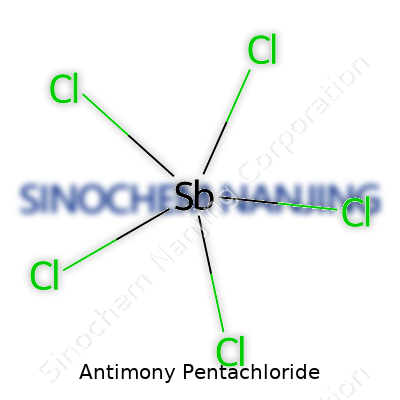
| Names | |
| Preferred IUPAC name | Antimony pentachloride |
| Other names |
Antimony(V) chloride Antimonic chloride Antimony chloride Antimony pentachloride |
| Pronunciation | /ænˈtɪməni ˌpɛntəˈklɔːraɪd/ |
| Identifiers | |
| CAS Number | 10025-91-9 |
| Beilstein Reference | 35837 |
| ChEBI | CHEBI:30438 |
| ChEMBL | CHEMBL1598922 |
| ChemSpider | 21528 |
| DrugBank | DB11166 |
| ECHA InfoCard | 100.028.219 |
| EC Number | 231-780-6 |
| Gmelin Reference | 63238 |
| KEGG | C14154 |
| MeSH | D000940 |
| PubChem CID | 66204 |
| RTECS number | CC9625000 |
| UNII | WN55C0407K |
| UN number | UN1733 |
| CompTox Dashboard (EPA) | DTXSID00895837 |
| Properties | |
| Chemical formula | SbCl5 |
| Molar mass | 299.01 g/mol |
| Appearance | Fuming yellow liquid |
| Odor | Pungent |
| Density | 3.35 g/cm³ |
| Solubility in water | Reacts violently |
| Vapor pressure | 1 mmHg (27 °C) |
| Acidity (pKa) | -3 |
| Basicity (pKb) | -5.44 |
| Magnetic susceptibility (χ) | −73.0×10⁻⁶ cm³/mol |
| Refractive index (nD) | 1.806 |
| Viscosity | 2.3 mPa·s (20 °C) |
| Dipole moment | 2.62 D |
| Thermochemistry | |
| Std molar entropy (S⦵298) | 364.7 J·mol⁻¹·K⁻¹ |
| Std enthalpy of formation (ΔfH⦵298) | -364.0 kJ/mol |
| Std enthalpy of combustion (ΔcH⦵298) | –517.3 kJ·mol⁻¹ |
| Pharmacology | |
| ATC code | V09CX03 |
| Hazards | |
| Main hazards | Causes burns, toxic by inhalation, corrosive to metals, reacts violently with water. |
| GHS labelling | GHS05, GHS06, GHS08 |
| Pictograms | GHS05,GHS06 |
| Signal word | Danger |
| Hazard statements | H314, H330, H410 |
| Precautionary statements | P234, P260, P264, P271, P280, P301+P330+P331, P303+P361+P353, P304+P340, P305+P351+P338, P310, P321, P363, P405, P501 |
| NFPA 704 (fire diamond) | 3-0-2-W |
| Autoignition temperature | 170 °C |
| Explosive limits | Non-explosive |
| Lethal dose or concentration | LD50 oral rat 1500 mg/kg |
| LD50 (median dose) | 110 mg/kg (oral, rat) |
| NIOSH | SN1225000 |
| PEL (Permissible) | PEL (Permissible Exposure Limit) of Antimony Pentachloride: "0.5 mg/m3 (as Sb) |
| REL (Recommended) | 0.1 mg/m³ |
| IDLH (Immediate danger) | 50 mg/m3 |
| Related compounds | |
| Related compounds |
Antimony trichloride Phosphorus pentachloride Arsenic pentachloride Bismuth pentachloride Antimony pentafluoride |



