4-Nitrobenzyl Bromide: A Closer Look
Historical Development
Organic synthesis rests on the shoulders of small but crucial reagents. 4-Nitrobenzyl bromide quietly stepped into laboratory practice in the early 20th century, arriving as research interest in aromatic substitution surged. Scholars and chemists, seeking ways to fine-tune benzyl compounds, found halogenation and nitro-substitution on aromatic rings delivered both utility and manageable hazards. This compound quickly became a staple for functional group transformation, thanks to its reactivity and its place within the tapestry of organic electrophiles. Over time, the steady march beyond academic labs into pharmaceutical discovery, dye chemistry, and advanced materials only increased its demand and strengthened its reputation for reliability.
Product Overview
The world often overlooks small bottles in storerooms, yet these are where many breakthroughs begin. 4-Nitrobenzyl bromide comes as a pale yellow to off-white crystalline powder, often sealed against air and moisture. During inventory checks, researchers count on this substance for alkylation tasks, protecting groups, and as an intermediate in complex synthesis. For those in chemical production, quality standards revolve around purity thresholds, particle uniformity, and consistency. Technical grades usually hit 98-99% purity, which serves well for most preparative work. Analytical certifications accompany each batch, confirming identity and excluding problematic contaminants, laying the groundwork for both academic studies and industrial scale-up.
Physical & Chemical Properties
Anyone who has handled organic halides recognizes the unmistakable sharpness in the air when working with 4-nitrobenzyl bromide. With a melting point clocking in at about 97-99 °C, it holds up under standard storage but sublimates gently at elevated temperatures, hinting at volatility. Water never dissolves it willingly; most rely on polar aprotic solvents like acetonitrile or dimethylformamide for reaction workups. It reacts briskly with nucleophiles and serves as a go-to benzyl group transfer agent. Its nitro group doesn’t just occupy space; it draws electrons, making the adjacent bromine more reactive than in simpler benzyl halides. Infrared spectra confirm the familiar nitro stretches, and nuclear magnetic resonance reveals the benzyl protons, making identification straightforward for practiced eyes.
Technical Specifications & Labeling
Every bottle bears a label with the essential identifiers: chemical name, CAS number 100-11-8, batch, purity, and safety warnings. Producers test for residual solvents, heavy metals, and minimal moisture content to guard against unintended side reactions or hazardous by-products. Physical inspections include color and clarity, while regular audits ensure each shipment matches reference standards. Transport and storage guidelines focus on cool, dry, and ventilated spaces, as decomposition accelerates in warmth or light. Packaging follows chemical safety norms, usually in amber glass or sturdy HDPE containers with tamper seals. Customers checking COA (Certificate of Analysis) sheets spot details about melting point, solubility, and spectral comparisons for peace of mind before that first pipette draws from the stock bottle.
Preparation Method
Chemists often choose to make 4-nitrobenzyl bromide in-house when precise control matters most. The classic route starts from 4-nitrotoluene. Oxidation forms the alcohol (4-nitrobenzyl alcohol), then treatment with phosphorus tribromide or hydrobromic acid swaps the hydroxyl group for bromine. Each step requires careful temperature regulation and slow addition to suppress by-product formation. Recrystallization purifies the final product, stripping away unreacted materials and over-brominated impurities. In laboratories, these syntheses unfold under fume hoods armed with solid glassware skills—spills and mishandling can trigger both exposure risks and losses to yield. The batch size varies from grams for a week’s research to multi-ton for full industrial runs.
Chemical Reactions & Modifications
Work with this compound unlocks an entire category of alkylation chemistry, particularly for introducing the nitrobenzyl moiety as a masking group or as a node for further elaboration. Nucleophilic substitution remains the bread-and-butter use, with thiols, amines, and phenols all serving as reliable partners. In peptide chemistry, 4-nitrobenzyl bromide protects thiol groups or acts as a photo-removable protecting group. Reducible under controlled conditions, the nitro group itself offers a path to amines via catalytic hydrogenation, expanding its scope. Chemists have demonstrated methods for transforming the molecule into 4-nitrobenzyl azide, 4-nitrobenzyl ethers, and complex ureas, opening several pathways in pharmaceutical and materials applications. The interplay of electrophilic and reducible sites places this compound alongside the toolbox heavyweights, drawing respect from seasoned bench scientists.
Synonyms & Product Names
Everyone working across borders or reviewing patents runs up against the shifting language of chemistry. 4-Nitrobenzyl bromide takes on different names in supplier catalogs and publications: p-nitrobenzyl bromide, para-nitrobenzyl bromide, 1-bromo-4-nitrobenzene, and less often, 4-bromomethyl nitrobenzene. No matter the label, sharp eyes track the CAS registry to avoid confusion. In commercial inventories, it pops up branded under specialty reagent lines, and its structural formula can help clear up ambiguity on international safety data sheets.
Safety & Operational Standards
All work involving 4-nitrobenzyl bromide calls for careful judgment, best practices, and an eye for risk reduction. It irritates skin, eyes, and mucous membranes, and inhalation of dust or contact produces acute discomfort. Safety sheets advise the use of nitrile gloves, splash-proof goggles, and fitted masks during weighing and transfer. Laboratory users set up reactions in ventilated fume hoods, mindful of its volatility, especially if working at elevated temperatures. Even though large-scale operations automate much of the handling, spill training and emergency protocols stay front and center. In the event of accidental exposure, prompt rinsing and medical attention reduce complications, while secure storage and routine inventories cut the likelihood of incidents. Waste must be segregated and sent for hazardous disposal, respecting both personnel and environmental regulations.
Application Area
The reach of 4-nitrobenzyl bromide cuts across pure research, applied manufacturing, and exploratory development. Small-molecule synthesis in academic labs taps its benzylating prowess for crafting reference compounds. Pharmaceutical chemists work with it to set up key steps in drug intermediates. Specialty polymers benefit from its ability to generate functionalized aromatic blocks, while photographers in niche circles once harnessed it to crosslink photoresists. Enzyme studies use the compound as a probe; it modifies thiol groups, offering a readout for activity. Recently, bioorthogonal chemistry adopted it for new labeling techniques under mild conditions. The spread of applications points to versatility not just as a reagent but as a cornerstone in optimization, troubleshooting, and creative troubleshooting for fast-moving teams.
Research & Development
Interest has grown in fine-tuning the reactivity and selectivity of 4-nitrobenzyl bromide, especially for applications in greener chemistry and automated synthesis platforms. Researchers tackle lingering challenges by designing variations with different substituents or greener synthesis routes that cut down waste and use fewer toxic reagents. High-throughput screening trials new reactions, with catalysts and solvents under customized conditions to sharpen yields and lower costs. Industrial chemists keep one eye on scalability, pushing toward continuous-flow production to ensure both safety and process economy. Cross-disciplinary collaborations spin out new protocols for large-scale synthesis, while data-driven approaches help labs anticipate side reactions and bottlenecks before going to the bench.
Toxicity Research
Safety records and literature flag genuine concerns over the irritant and toxic effects linked to 4-nitrobenzyl bromide. Animal studies confirm acute effects at moderate exposure levels, prompting strict labeling and documentation in inventory systems. There are indications of both short- and long-term hazards, especially through repeated contact or poor ventilation. Enzyme assays and cell studies continue to assess biomolecular interactions, often with a focus on DNA and protein modification risks. Regulatory agencies track fresh data, updating permissible limits and mandating disclosure across shipping documents. Teams conducting on-site work must manage not only their own exposure but also secondary contamination—tools, surfaces, and waste streams all face periodic testing to prevent accidental transport outside the work area.
Future Prospects
Moving into the next decade, 4-nitrobenzyl bromide stands at a crossroads shaped by evolving regulatory scrutiny and rising standards for process sustainability. Chemists have begun to explore biocatalytic routes and non-halogenated surrogates for its key transformations, aiming to reduce waste and hazardous by-products. Automation and remote synthesis platforms promise tighter containment and reduced occupational risk. In high-value construction, such as targeted pharmaceuticals and smart materials, refinements in chemoselectivity and functional group compatibility will help keep this compound in the toolkit, albeit in more tailored roles. As computational methods predict new reactivities, the demand for safer, cleaner, and more efficient methods may pivot legacy reagents toward specialty niches, maintaining relevance while driving the next phase of technical advancement and safety-focused innovation.
What is 4-Nitrobenzyl Bromide used for?
Not Just Another Lab Chemical
Step into any chemistry lab, and glass bottles fill the shelves. Labels carry names few outside the field recognize. Among those, 4-nitrobenzyl bromide doesn’t often steal the spotlight in headlines, but its role shapes countless reactions and products. Many folks, unless working in pharmaceuticals or organic synthesis, don’t run into this compound, but its influence spreads further than you might think.
A Key Player in Making Complex Molecules
4-nitrobenzyl bromide acts as a strong alkylating agent. That matters to scientists who need to tweak a molecule—add or protect a certain part of it—to make new drugs or study biochemical pathways. Chemistry relies on building up molecules piece by piece, and 4-nitrobenzyl bromide lends a hand with that, especially during the protection of alcohols and amines. Succeeding in these steps opens the door to life-saving medicines, advanced materials, and innovative dyes.
Boosting Research and Medical Discoveries
Researchers use this compound to guard delicate parts of molecules. Without the use of special protecting agents, some chemical reactions spoil easily, like leaving milk out of the fridge on a hot day. By shielding sensitive spots, scientists can run more sophisticated reactions, opening new frontiers in medicine. Some cutting-edge cancer treatments and antibiotics owe their success to clever steps involving this type of chemical aid.
The big pharmaceutical companies and university labs pour hours into perfecting each synthesis. Mistakes can mean wasted money and missed deadlines, not to mention potential setbacks in health care. Experience in the lab taught me patience and respect for every small advantage we gained from reagents like 4-nitrobenzyl bromide. Spending days repeating a failed reaction becomes less painful when the right protecting group speeds things up and reduces error.
Safety and Environmental Questions Deserve Answers
With every useful chemical, there’s a flip side. 4-nitrobenzyl bromide carries risks. It’s toxic and can irritate the skin, eyes, and lungs. In my own lab days, I picked up minor burns and bad headaches before learning better handling practices. Keeping workspaces ventilated and wearing gloves turned from advice into a routine necessity. Chemical firms list strict guidelines for transport and disposal, acknowledging a big problem if it ends up in a city’s water supply or soil.
Recent years reminded us that even specialty chemicals stick around in the environment. Water systems downstream from factories show traces of these substances. This points to a demand for careful waste management. Regulators and company safety officers need to stay alert—better training, real investment in mitigation, not just compliance with the language of old rulebooks.
Building a Safer, Smarter Chemistry Culture
Progress depends on more than just clever chemistry. Greater transparency helps, too. Publishing more robust data about the long-term risks of these substances should go hand-in-hand with highlighting their benefits. Companies could provide more user-friendly guides and updated warnings, not buried deep in technical data sheets. Sharing safer alternatives as technology advances strengthens everyone’s position, from seasoned scientists to new students opening their first bottles.
Learning about 4-nitrobenzyl bromide opens a window into the meticulous world of chemical production and safety. Every bottle represents both potential and challenge, a reminder that the smallest agents can drive enormous progress—if handled with wisdom grounded in experience.
What are the storage conditions for 4-Nitrobenzyl Bromide?
Why Storage Matters with 4-Nitrobenzyl Bromide
Anyone working with organic bromides like 4-nitrobenzyl bromide knows these compounds react aggressively if left in the wrong place. I’ve seen firsthand what a little moisture can do to a reactive chemical. The bottle clumps up, caps get sticky, and what seemed stable starts releasing fumes nobody wants to breathe. For 4-nitrobenzyl bromide, preventing these problems starts with controlled storage.
Temperature and Moisture: The Two Big Enemies
The stuff breaks down a lot faster above room temperature. Shelf life shortens, product can degrade, and unpredictable behavior creeps in. I keep it out of sunlight, at room temperature, or slightly below—never in a hot lab cupboard. A basic refrigerator, away from food and open containers, works well.
Moisture tops the list of things to avoid. Halides like these pull in water from the air, clumping and degrading. Containers that seemed tight turn gritty. Every chemist learns to pick bottles with airtight seals and a solid desiccant. Silica gel or another drying agent in the container protects from ambient humidity and helps keep the powder free-flowing.
Material Choices: Why Glass Trumps Plastics
If you’ve ever stored a reactive chemical in plastic, you know they sometimes cloud up or warp. 4-Nitrobenzyl bromide eats at some plastics and tends to react with rubber-based caps. That’s why experienced labs grab amber glass containers with PTFE-lined lids. The amber glass blocks light, protecting from photodegradation, and those liners hold a good seal.
Avoiding Unwanted Reactions
Leakage ruins more than one research project. The compound’s dust irritates skin and inhaling those vapors stings. I always keep it well labeled—big, readable warnings—and store it far from acids, bases, and anything nucleophilic. If you’re running a shared lab, isolation stops cross-contamination. Never open the container except in a fume hood, with gloves and goggles in place. Eye protection isn’t optional with this stuff.
Logistics: Stock Rotation and Inventory Counts
Outdated chemicals pile up fast in a busy setting. I check the production and opening dates. The fresher, the better. Whenever something shows signs of decomposition—yellowing, crusting, or odd smells—it goes in the waste drum, following hazardous waste rules.
Periodic audits prevent surprises and help keep insurance headaches away. In industry, traceability matters for regulatory audits. One oversight can shut down the whole operation.
Training Makes a Real Difference
New lab members sometimes cut corners. Clear instructions, checklists, and scheduled walkthroughs keep the process consistent. I’ve worked in places where monthly training caught small errors before they spiraled. Mistakes with 4-nitrobenzyl bromide rarely stay small; acetone spills or even wet gloves can lead to bigger problems down the road, especially for new techs.
Up-to-Date Safety Data and Continuous Improvement
Lab guidelines change as new studies come out. The SDS needs to stay close, and every label should carry the most recent hazard data. Communicating risks—not just compliance—builds trust and keeps everyone safe.
Storage isn’t a one-time fix. Revisiting procedures, tracking errors, and learning from near misses ensures a resilient routine. Every improvement pays off in lower risk and higher productivity, no matter the size of the operation.
What is the molecular weight of 4-Nitrobenzyl Bromide?
Real-World Chemistry in Numbers
Whenever I see 4-Nitrobenzyl Bromide on a reagent shelf, I remember late nights in an undergraduate organic chemistry lab, carefully measuring out white crystals. My lab partner and I always double-checked calculations, especially molecular weight. No one wants to mess up stoichiometry in a synthesis. Getting the molecular weight right matters in every stage of chemical work, from lab-scale test tubes to commercial batches. For 4-Nitrobenzyl Bromide, it’s vital for planning reactions and tracking purity.
The Calculation
Every atom in a molecule brings a certain heft. Chemists add up the atomic masses: carbon (about 12.01), hydrogen (1.01), nitrogen (14.01), oxygen (16.00), and bromine (79.90). 4-Nitrobenzyl Bromide contains 7 carbons, 6 hydrogens, 1 nitrogen, 2 oxygens, and 1 bromine. Punching those into the calculator:
- 7 (C) x 12.01 = 84.07
- 6 (H) x 1.01 = 6.06
- 1 (N) x 14.01 = 14.01
- 2 (O) x 16.00 = 32.00
- 1 (Br) x 79.90 = 79.90
Add those numbers together: 84.07 + 6.06 + 14.01 + 32.00 + 79.90 = 216.04 g/mol.
Why the Molecular Weight Really Matters
Anyone scaling up a reaction in an industrial lab depends on that number. Say you’re making a pharmaceutical intermediate. The cost of missing the mark on your quantities can mean wasted materials, production delays, or safety risks. I’ve seen containers rushed into quarantine because of errors that could’ve been prevented with a double-check against the molecular weight. Even in college labs, using too much or too little of a reagent means you lose time — and often a lot of money if the material isn’t cheap.
The Safety Angle
Handling 4-Nitrobenzyl Bromide brings its own hazards. This compound reacts with nucleophiles and the nitro group raises red flags in safety sheets due to toxicity concerns. Weighing it accurately not only keeps reactions efficient — it cuts down unnecessary exposure and waste. Good labs urge new chemists to respect the math as much as the gloves and goggles. Missteps lead to chemical spills or overexposure. Both can get you a talk with the safety officer or even a trip to the hospital. Relying on the correct molecular weight supports safer labs.
Pushing for Fewer Mix-Ups
Mix-ups happen surprisingly often. In my early days, I once ordered moles of a similar-sounding compound by mistake, costing my research group a week. I learned to back up calculations with reliable sources every single time. Tools like electronic lab notebooks and integrated chemistry software can automate molecular weight checks. Standard lab protocols now build molecular weight confirmation into every stage of planning, which reduces errors and saves time. Training new chemists to respect these steps keeps labs more productive and much safer.
Moving Toward Error-Proof Labs
Every chemical synthesis relies on trust in the numbers on a label. Whether working in academic settings or handling bulk material in a plant, the weight of a molecule like 4-Nitrobenzyl Bromide anchors the whole operation. Teaching the next generation of chemists to handle these basics with care not only gets better results, but keeps everyone safer and more efficient in the long run.
Is 4-Nitrobenzyl Bromide hazardous to handle?
Understanding What We’re Dealing With
4-Nitrobenzyl bromide finds a spot in many research labs and chemical syntheses. I’ve worked in a university lab and remember the long safety briefings on compounds like this. The yellow crystalline looks harmless at first glance, but beneath that appearance sits something far more risky. Its brominated structure means it can easily act as an alkylating agent—compounds in this class have a reputation for being reactive, especially with human tissue and DNA. That doesn’t mean instant disaster from a single whiff, but the risk isn’t something to shrug off.
What Hazards Actually Matter?
As a chemical with a nitro group and a bromide, this stuff brings together two dangers. The bromide component can irritate the skin, eyes, and respiratory system. The nitro group has raised eyebrows for its potential health concerns. Based on what the Globally Harmonized System (GHS) and peer-reviewed journals say, 4-nitrobenzyl bromide can burn if it splashes on the skin, and breathing in its powder can harm lung tissue. Even common chemical suppliers slap a toxic label on its Safety Data Sheet. I always wore double gloves and splashed on the goggles when weighing out this kind of compound—not because of paranoia, but because it only takes one mistake to cause damage.
Real-World Risks in the Lab
Chemistry stops being theoretical once you're actually pouring, weighing, or washing up. I’ve seen spilled solid burn a hole in a nitrile glove within a couple of minutes. While stories circulate in academic circles about labs getting temporarily evacuated after accidental releases, these aren’t urban legends. Even for experienced chemists, inhaling dust causes immediate coughing and discomfort that lasts for days. Some cases landed colleagues in the health center for burns or respiratory problems. For anyone handling 4-nitrobenzyl bromide, these aren’t one-off accidents—they’re part of the risk of working with hazardous chemicals.
Protecting Yourself Isn’t Optional
Safety gear makes a real difference. The basics—lab coat, proper gloves, goggles, and a working fume hood—aren’t negotiable in my book. Disposable gloves need to stay thick enough, since thinner gloves break down quickly. A splash on the skin or a whiff in the air means stopping work and heading straight to the safety shower or eyewash. The fume hood isn’t just a convenience, either. It keeps airborne dust and vapors away from your face and lungs. Strict lab protocols insist on waste containers for all potentially reactive or toxic substances, and for good reason.
Training and Culture Save Lives
Everyone deserves to go home healthy after a shift at the bench. Good lab culture doesn’t rely on a sign reminding people to wear PPE—it relies on setting expectations and keeping tabs on compliance. New students and staff need hands-on training, not just a sign-off on a piece of paper. If someone sees a shortcut, calling it out respectfully keeps everyone safe. Ultimately, treating 4-nitrobenzyl bromide with respect isn’t overkill. The chemical’s hazards are well known, and the long-term effects of exposure are too costly for half-measures.
Safer Choices and Smarter Workflows
Many labs look into alternative reagents with lower toxicity, especially if a project stretches on for months. Suppliers now flag hazardous chemicals more clearly, and digital inventories help spot riskier bottles on the shelf. Shifting to less hazardous substitutes sometimes changes the chemistry, but worker health matters more than convenience. Regular safety reviews and listening to the staff add another layer of protection. If accidents do occur, immediate reporting and transparent communication prevent a minor incident from turning into a long-term problem.
Handling 4-nitrobenzyl bromide isn’t just about following rules. It’s about respecting a substance that deserves every ounce of caution. That perspective—grounded in real lab work—protects everyone who steps up to the bench.
What is the chemical formula of 4-Nitrobenzyl Bromide?
Demystifying the Chemistry
Chemical formulas have always unlocked layers of understanding for those who spend time in labs, classrooms, or pharmaceutical research. 4-Nitrobenzyl bromide, written as C7H6BrNO2, brings together bromine and a nitro group on a benzene ring. This arrangement shapes how the compound behaves in reactions and influences the paths chemists take for synthesis or modification. A formula isn’t just a collection of letters and numbers—it weights the decisions made in manufacturing, handling, and applying a substance in everything from drug discovery to basic organic synthesis.
Real World Encounters
Working in the lab, I’ve seen how a clear chemical formula can speed up troubleshooting during synthesis. 4-Nitrobenzyl bromide’s structure allows it to act as an effective alkylating agent, especially in the protection of alcohols and amines, thanks to its benzyl bromide core. That nitro group on the ring pushes electron density out, making the benzylic position even more reactive for nucleophilic substitution. Just one misplaced atom can lead to a failed experiment, wasted resources, or even unsafe conditions. Knowing the exact arrangement—C7H6BrNO2—brings accuracy to protocols and ensures safety checks match the actual risks.
Market and Research Influence
Research and industry both rely on the confidence offered by these details. The pharmaceutical sector depends on the unique activity stemming from subtle changes on the benzene ring. Bringing a bromide and a nitro group together on this ring expands chemical space for those searching for new reactions or therapies. The formula shapes product specs for suppliers. Mislabeling or confusion can mean regulatory headaches, delayed shipments, or even fines. Safety officers and environmental engineers scan these formulas to set proper storage conditions, outline cleanup protocols, and plan for possible exposure emergencies. The formula, seen as just data, actually writes the first draft of a material’s journey from a supplier’s stockroom to a researcher’s bench.
Safety and Handling
Anyone who’s worked with benzyl bromides knows the hazards: irritancy, possible lachrymatory effects, and risks from the nitro group’s oxidizing nature. Precaution always begins with knowledge. Identifying this compound’s formula—C7H6BrNO2—forces anyone handling it to review safety data, consider splash hazards, and choose fume hoods over open benches. Chemists learn quickly that underestimating a molecule with a reactive alkyl bromide and a nitro moiety spells trouble for skin and lungs. Mistakes, sometimes from simple confusion between isomers, land people in the hospital. This deep respect for knowing exactly what a substance is, down to its smallest detail, saves both time and health.
Potential Paths Forward
Mistakes from ambiguous information always frustrate teams and cost money. Clear communication, grounded in a thorough grasp of chemical formulas, stands out as a practical solution. More universal standards for chemical identifiers in ordering and documentation could further reduce errors. Digital tools and barcoding now help track and verify materials, offering new layers of security. These changes arise from practical lessons in the workplace, rather than theory alone. Storing detailed chemical formulas in accessible digital platforms unlocks safer, faster, and more reproducible chemistry for everyone involved.
Conclusion
4-Nitrobenzyl bromide’s chemical formula isn’t just an academic fact. This knowledge, woven into procedures and safety culture, guides everyone in handling, applying, and innovating with the compound. From the classroom to industrial production lines, precision in these details proves its value each day, preventing accidents, improving outcomes, and supporting responsible research and manufacturing.
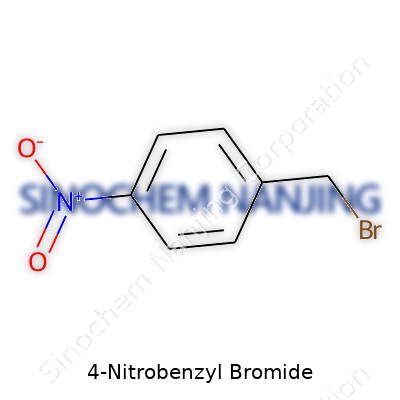
| Names | |
| Preferred IUPAC name | (4-nitrophenyl)methyl bromide |
| Other names |
p-Bromomethylnitrobenzene 1-Bromo-4-nitrobenzene p-Nitrobenzyl bromide 4-Nitro-1-bromomethylbenzene 4-Nitrobenzylbromide |
| Pronunciation | /ˈfɔːr ˈnaɪtrəʊˌbɛn.zɪl ˈbrəʊ.maɪd/ |
| Identifiers | |
| CAS Number | 100-11-8 |
| Beilstein Reference | 1363087 |
| ChEBI | CHEBI:51515 |
| ChEMBL | CHEMBL17243 |
| ChemSpider | 6193 |
| DrugBank | DB08814 |
| ECHA InfoCard | 100.013.828 |
| EC Number | 211-118-3 |
| Gmelin Reference | Gmelin Reference: **136505** |
| KEGG | C14361 |
| MeSH | D017929 |
| PubChem CID | 6924 |
| RTECS number | CU5950000 |
| UNII | L7R4F65314 |
| UN number | UN2731 |
| Properties | |
| Chemical formula | C7H6BrNO2 |
| Molar mass | 274.03 g/mol |
| Appearance | White to light yellow crystalline powder |
| Odor | Odorless |
| Density | 1.54 g/cm³ |
| Solubility in water | Insoluble |
| log P | 1.93 |
| Vapor pressure | 0.000129 hPa (25 °C) |
| Acidity (pKa) | 14.9 |
| Magnetic susceptibility (χ) | -77.0 × 10⁻⁶ cm³/mol |
| Refractive index (nD) | 1.613 |
| Viscosity | Viscosity: 0.936 cP (20°C) |
| Dipole moment | 3.87 D |
| Thermochemistry | |
| Std molar entropy (S⦵298) | 362.6 J/mol·K |
| Pharmacology | |
| ATC code | '' |
| Hazards | |
| GHS labelling | GHS02, GHS05, GHS07, GHS08 |
| Pictograms | GHS06, GHS09 |
| Signal word | Danger |
| Hazard statements | Hazard statements: H302, H315, H319, H335 |
| Precautionary statements | P210, P261, P264, P271, P280, P301+P312, P302+P352, P304+P340, P305+P351+P338, P311, P312, P330, P337+P313, P362+P364, P405, P501 |
| NFPA 704 (fire diamond) | 3-2-1-W |
| Flash point | 109°C |
| Lethal dose or concentration | LD₅₀ (oral, rat): 640 mg/kg |
| LD50 (median dose) | LD50 (median dose): Oral rat LD50 = 1600 mg/kg |
| NIOSH | NA0450000 |
| PEL (Permissible) | No PEL established. |
| REL (Recommended) | 200-500 mg |
| Related compounds | |
| Related compounds |
Benzyl bromide 4-Nitrobenzyl chloride 4-Nitrobenzyl alcohol 4-Nitrobenzaldehyde 4-Nitrotoluene |



