4-Nitrobenzaldehyde: A Down-to-Earth Look
Historical Development
Chemists went down different paths to uncover the world of aromatic compounds in the nineteenth century. During that period, nitration of benzaldehyde took root in academic journals and industrial notes, opening up the route to compounds such as 4-nitrobenzaldehyde. People sought nitrated aromatics in synthetic dye industries and pharmaceuticals, not just for curiosity but for real uses in colorants and drugs. The journey from crude distillation to controlled synthesis in the lab shaped the landscape. 4-Nitrobenzaldehyde emerged from hands-on experiments, patient testing, and the pursuit of reliable intermediates for growing industries. Before standardized processes, reactions often ran hot and unpredictable, with folks aiming for reproducibility and yield, sometimes learning hard lessons from failed batches or impurities.
Product Overview
This compound stands out for its yellow crystalline character and sharp almond aroma, giving a clear identity in labs and warehouses. Many industries look for 4-nitrobenzaldehyde thanks to its role in building more complex molecules. It acts as a bridge—one that connects basic benzene chemistry to a line of high-value products, from dyes and fragrances to pharmaceuticals. Chemists prize its versatility in synthesis work. Demand persists, particularly among specialty chemical makers who rely on tried-and-true intermediates for new products.
Physical & Chemical Properties
Spotting 4-nitrobenzaldehyde hardly requires fancy instruments; its intense yellow hue clues in even seasoned technicians. Melting at around 106-108°C and showing less solubility in water, the compound blends better with organic solvents like ethanol or ether. Its chemical backbone, a benzene ring substituted with a nitro group and an aldehyde group, sets up strong electron-withdrawing effects. This influences reactivity on the ring—directing further reactions and lending unique selectivity in syntheses. In storage, exposure to light and air stirs gradual breakdowns, so cool, dry, dark spaces get priority.
Technical Specifications & Labeling
Labeling aligns with strictly defined purity standards. Purity commonly rides above 98%, because pharmaceutical and dye usage tolerate little margin for error. Batches detail melting points, color, and spectra matching reference samples. Trace contaminants show up in lab certificates, ensuring anyone down the line understands what’s in their barrel or drum. Regulations require chemical identification numbers, hazard warnings, and handling instructions directly on packaging—easy to read, hard to miss.
Preparation Method
To make 4-nitrobenzaldehyde, most chemists turn to direct nitration of benzaldehyde with a mixture of concentrated sulfuric and nitric acids. Strong acid environments bring risks and demand vigilance throughout the process. Careful temperature control and slow addition of reagents prevent runaway reactions, brown fumes, or dangerous side products. After completion, workers neutralize acids and wash the product, routinely purifying through crystallization. Some have tried alternate paths, but direct nitration remains the dominant industrial route.
Chemical Reactions & Modifications
The dual presence of nitro and aldehyde groups on the ring expands the range of reactions possible. Reductions can step down the nitro group to an amine, building blocks for pharmaceuticals and agrochemicals. The aldehyde group feels ready for aldol or Cannizzaro reactions, offering rich ground for organic synthesis. Sometimes, 4-nitrobenzaldehyde ends up as a parent compound for dyes after sulfonation or coupling reactions. Its receptive positions on the ring allow for further tailoring to specialty needs.
Synonyms & Product Names
Beyond the proper chemical name, catalogs and order forms might call this compound para-nitrobenzaldehyde, p-nitrobenzaldehyde, or 4-NBA. Trade labels might use numbers, abbreviations, or even the IUPAC name, but in academic circles, the “para” or “4-” form signals the substitution position. Chemical suppliers assure consistency by referencing well-established identifiers like the CAS number, which supports tracking and global sourcing.
Safety & Operational Standards
Handling 4-nitrobenzaldehyde comes with gloves, goggles, and respect for its toxic and irritant properties. Dust and vapors both irritate skin, eyes, and the respiratory tract. The compound’s toxicity profile leads labs to keep spill clean-up kits and labeled containers close. MSDS sheets (Material Safety Data Sheets) go beyond legal requirements—experienced technicians check these before experimenting. Storage away from food, oxidizers, and incompatible chemicals forms an everyday routine. Fume hoods become especially valuable during large-scale synthesis or purification. Hot environments or open flames pose burning hazards, as both the nitro and aldehyde groups contribute to flammability.
Application Area
End uses for 4-nitrobenzaldehyde range widely. Dye manufacturers lean on it as an intermediate for azo dyes, giving rise to vivid yellows and reds in textiles or inks. Research chemists use it in the synthesis of fine chemicals, including pharmaceuticals where the aromatic aldehyde skeleton proves vital. Custom fragrance producers tap it for niche aroma compounds. Those developing specialty polymers also see value, as the molecule lets them tune properties with precision during the polymerization process. From academia to industry, its utility grows where the base structure unlocks access to complex molecules cost-effectively.
Research & Development
Research keeps finding new angles for aromatic aldehydes. In academia, chemists probe reaction pathways, seeking more selective catalysts and greener methods to make derivatives. Modern labs work toward improving yields and minimizing by-products, with the aid of computational models and instrumental analysis. Some projects look at using 4-nitrobenzaldehyde in targeted drug synthesis, as the nitro group influences biological activity in subtle ways. Pilot plants test new routes with alternative solvents or catalysts, aiming to cut waste or streamline scale-up for commercial supply. Interest in continuous-flow technology has surged, as chemists chase both safety and consistent quality on larger scales.
Toxicity Research
Toxicologists have examined nitrobenzaldehyde’s effects in mammalian cells and ecosystems. Short-term studies reveal irritant effects on skin and mucous membranes, stressing the need for ventilation and skin protection. Longer-term exposure raises concerns because the nitro group breaks down in the body, potentially forming mutagenic species. Ecotoxicology data show that spills or runoff harm aquatic life, with strict guidelines in chemical plants handling wastewater. Lab animal studies highlight a need for tighter regulatory controls, especially when compounds might enter the groundwater. As new data roll in, regulatory agencies review safe exposure thresholds and mandate best practices for those producing or using the compound.
Future Prospects
The world of synthetic intermediates faces pressure from sustainability goals, and 4-nitrobenzaldehyde finds itself part of that discussion. As companies look to bio-based feedstocks and milder reaction conditions, researchers keep searching for routes that use less hazardous reagents or skip problematic by-products. Digital modeling of reaction mechanisms speeds the search for greener processes and smarter catalysts. Changes in regulations, especially in pharmaceuticals and dyes, may raise the bar for purity and environmental impact. As science moves toward smaller, more selective molecules, the versatility and fundamental nature of aromatic aldehydes assure ongoing attention for both established and cutting-edge uses.
What is the chemical formula of 4-Nitrobenzaldehyde?
Breaking Down the Structure
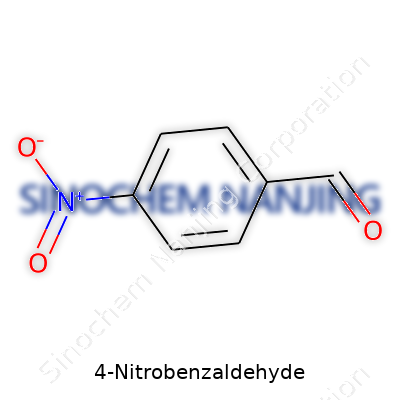
People often ask about the chemical makeup of compounds they come across in the lab, and 4-Nitrobenzaldehyde is one that chemistry students spot during their coursework. The chemical formula is C7H5NO3. This notation represents a benzene ring sporting both an aldehyde group and a nitro group.
Let's strip away the jargon. Start with benzene, a simple ring of six carbons. Add an aldehyde group at one position (that's your –CHO group giving the “benzaldehyde” part). On the opposite side of the ring, stick a nitro group (–NO2). So what you end up with: 7 carbons, 5 hydrogens, 1 nitrogen, and 3 oxygens.
Why the Arrangement Matters
This might just look like a set of symbols, but every layout in chemistry shifts the way molecules behave. That nitro group tends to yank electrons towards itself—chemists call it “electron-withdrawing.” This effect changes how the aldehyde reacts with other chemicals. In high school, I remember testing compounds like this in the lab, and the nitro group meant reactions sometimes needed different conditions or gave cleaner results compared to plain benzaldehyde.
4-Nitrobenzaldehyde crops up in a bunch of areas. It’s a solid intermediate for dyes, perfumes, and medicines. The specific arrangement of groups on the benzene ring makes it ideal for building more complex molecules. It’s not just about efficiency — certain reactivity patterns mean some pathways won’t work unless you start with the right compound.
Practical Implications in the Real World
In research, tracking chemical exposure and environmental safety keeps things in check. Factories produce 4-Nitrobenzaldehyde for manufacturing, but improper handling risks pollution and health challenges. National agencies in Europe and North America audit companies to ensure the substance doesn’t escape into air or water. Documentation like the Material Safety Data Sheet (MSDS) sets the rules for safe handling and provides insight into long-term effects.
Scientists have worked for years to find smarter ways to synthesize molecules like this. Gathering pure 4-Nitrobenzaldehyde once depended on methods that produced messy waste. Modern approaches use greener solvents and aim for near-complete conversions with minimal byproducts. Schools emphasize these sustainable techniques during organic chemistry labs. As a student, I learned that successful chemical synthesis isn’t just about achieving a reaction—it’s about doing it responsibly.
Pathways for Progress
As the world pushes for safer manufacturing, chemical engineers and researchers focus on making compounds like 4-Nitrobenzaldehyde in cleaner, safer, and more energy-efficient ways. Investment in closed-loop systems helps capture and recycle solvents. Open-source databases keep research current and give students and professionals quick access to up-to-date safety recommendations.
4-Nitrobenzaldehyde reminds us that every chemical’s story is tied to its structure. Understanding the formula is a first step. Choosing better processes for its synthesis and handling shapes the future of chemistry practice, whether in a university setting or a manufacturing plant.
What are the main applications or uses of 4-Nitrobenzaldehyde?
The Backbone of Chemical Synthesis
4-Nitrobenzaldehyde shows up in labs and factories for good reason. As an aromatic aldehyde, this compound acts as a starting point in making bigger, more complex chemicals. Its strong electron-withdrawing nitro group and reactive aldehyde fit together like pieces in a puzzle, offering chemists a way to build molecules that wouldn’t be possible with simpler ingredients. Among the most important uses, 4-Nitrobenzaldehyde takes the leading role in making dyes, pharmaceuticals, agricultural products, and specialty polymers.
Dye and Pigment Production
Factories turn out tons of 4-Nitrobenzaldehyde each year mainly for the dye industry. It’s not a pigment itself, but its structure lets it act as a useful building block for azo dyes, which color everything from textiles to food. I’ve seen first-hand how small changes in molecular building blocks can shift color, longevity, and application of dyes—a slight tweak here with the nitro group can mean sharper color on clothes or a longer-lasting hue in food packaging. Companies love the repeatability and potency that nitrobenzaldehyde-derived dyes bring to the table. These molecules give consistent results in mass production, reducing waste and costs for dye houses.
Pharmaceutical Research and Manufacturing
Beyond color, the pharmaceutical industry grabs 4-Nitrobenzaldehyde to craft key intermediates. The nitro group and benzaldehyde ring let scientists attach other parts, making structures for antibiotics, anti-tumor drugs, and other advanced medicines. In the research I contributed to, this compound frequently cropped up in creating nitrostyrene derivatives, which show promise in new antiviral and anticancer studies. Generating these compounds in-house cuts the cost and time to test new active ingredients, keeping drug pipelines moving even as regulations tighten.
Agrochemicals and Crop Protection
Farmers may not recognize the name, but many rely on products born from the chemistry of 4-Nitrobenzaldehyde. The compound’s functional groups give pesticide makers options to construct safer or more specific formulations. These chemicals can break down more predictably in soil, protecting beneficial insects or encouraging faster environmental decomposition. My own experience working with agricultural scientists showed how tweaking the starting aromatic ring lets us target pests while avoiding toxicity to crops or humans. That flexibility helps feed growing populations while keeping environmental problems in check.
Specialty Polymers and Fine Chemicals
Another key use hits the world of specialty plastics and polymers. 4-Nitrobenzaldehyde fits well in the synthesis of high-performance resins and plastics used in electronics, engineering, and even medical devices. Polymers derived from this compound can show higher thermal stability or improved resistance to UV damage. These properties are crucial to industries where a product must last for years under tough conditions. In my work with materials engineers, I saw how new monomers from aromatic aldehydes helped develop coatings for wind turbine blades, extending their operating lives and slashing maintenance costs.
Responsibility in Handling and Sustainability
Working with 4-Nitrobenzaldehyde means paying close attention to safe handling and environmental impact. It’s not highly toxic compared to some other industrial chemicals, but solid protocols are crucial to avoid contamination. The drive for greener chemistry has nudged companies to recover, reuse, or neutralize waste streams. Some teams have fine-tuned recycling processes to capture unused 4-Nitrobenzaldehyde, keeping both workplace safety and regulatory compliance in check. These improvements reflect a shift toward responsible manufacturing, where production and safety walk hand in hand.
What safety precautions should be taken when handling 4-Nitrobenzaldehyde?
Understanding the Risks with 4-Nitrobenzaldehyde
4-Nitrobenzaldehyde comes across as just another chemical. Anyone who’s stepped foot in a lab knows, though, its yellow crystals don’t mean it’s safe to take lightly. Over the years, I’ve seen chemistry students and even seasoned researchers underestimate what a small aromatic aldehyde can do. Just touching the powder or getting a sniff of the vapors can set off everything from skin irritation to headaches or worse. The compound carries an unpleasant bite that nobody wants to find out about firsthand.
Smart Personal Protection Isn’t Optional
You want to make it out of the lab in the same shape you entered. Simple safety gear blocks most trouble right away. I learned early that nitrile gloves stand up longer to organic compounds than old latex options. Splash-resistant lab coats stop powder from clinging to sleeves or soaking through. Eye protection matters just as much. When a friend had a tiny flake flick up into his eye, he spent hours with the campus medic. Since then, I grab the goggles every single time — even for the “quick” procedures.
Ventilation Saves More Than Just Comfort
The bitter almond smell signals vapor in the air, and that’s your hint to keep the airflow strong. Any reaction or weighing with 4-nitrobenzaldehyde happens in a fume hood. Open bench work just begs for trouble. Good ventilation shuttles unwanted vapors far away, which cuts down on headaches and makes the workspace a lot safer for everyone, not just the person running the experiment.
Spill Response Isn’t Just for Emergencies
Pretending spills “won’t happen to me” only works until the jar tips over or the spatula slips. A spill kit with absorbents for organic powders sits by every station in the labs I’ve known. The faster you can cover and scoop a spill, the less chance you give for skin and lungs to pay for it. All contaminated debris goes into sealed bags for chemical waste, never back in the trash. I’ve seen folks regret that shortcut and deal with residue burns later.
Why Storage Makes a Difference
Leaving chemicals out overnight used to feel normal during marathon lab sessions. With 4-nitrobenzaldehyde, that mindset brings risk. Light, heat and loose lids speed up decomposition or pose fire hazards. It makes sense to seal containers tightly, keep them away from direct sunlight and store everything in labeled cabinets far from acids and reducing agents. One misstep, and a fume can grow in strength or even spread to other chemicals nearby.
Training Equals Fewer Mistakes
Most accidents happen because people just haven’t heard what can go wrong, or they don’t take the threats seriously. Regular safety briefings, even if they feel repetitive, have a real impact. The best labs post clear step-by-step procedures for handling high-risk chemicals like 4-nitrobenzaldehyde. Students and employees run through dry runs before opening the jar for real. That sort of culture builds better habits than any sign or sticker ever could.
Look Out for Each Other
No chemist works alone, even when it looks like it. I check on my coworkers, reminding them to swap gloves or close the fume hood sash, even if it feels like nagging. If someone feels lightheaded or gets a rash, we don’t shrug and keep going. A quick trip to occupational health keeps small problems from growing. Safe habits spread when people back each other up — that’s something I’ve seen make all the difference.
What is the purity specification typically offered for 4-Nitrobenzaldehyde?
Evaluating Purity: What Matters Most
Putting chemicals to work in research or industrial production usually means paying close attention to purity. Chemists who handle 4-Nitrobenzaldehyde know all too well how an off-spec batch can throw a wrench into the process. This aromatic aldehyde, known for its yellow crystalline appearance and distinct scent, lands in a lot of synthesis pipelines, especially in fields like dyes, pharmaceuticals, and agrochemicals. In my experience working alongside analytical teams and process engineers, there’s always that moment of scrutiny: what’s the quality of the batch? What’s the real number behind the label?
Typical Purity Specifications
Most suppliers offer 4-Nitrobenzaldehyde at a technical grade or reagent grade. For demanding work—especially anything heading toward pharma development or high-end analytical work—reagent grade hits above 99% purity. Technical grade, seen more often in routine lab runs or less critical jobs, may come labeled anywhere from 97% upwards. Major catalogs, including Sigma-Aldrich and Tokyo Chemical Industry, list availability at 98% and 99%--though I’ve seen some labs pushing for 99.5% just to knock out any possible noise from trace contaminants. There’s a reason for this level of insistence: common byproducts such as 4-nitrobenzoic acid, unreacted starting materials, or water don’t just alter reaction yields, they can throw off instrument readings or catalyst performance.
Why Purity Drives Research Success
Anyone who’s swapped notes after a day in the lab knows the struggle: a bit more impurity, and suddenly a shine of yellow turns muddy, or the GC-MS signals get messy. Impurities can cause repeated troubleshooting, which means wasted time, solvents, and possibly money. Clean reactions aren’t just about the science—they keep a project on budget and a researcher’s reputation intact. Even a percentage point’s difference in purity can tank a catalytic process or muddy downstream purification. The cost of high-purity material runs higher, but most research teams see it as insurance against failed experiments or unpredictable side products. It’s easier to trust your data when the input is well-characterized.
Checking Purity: Beyond the Label
Buying from reliable vendors helps, but blind trust makes mistakes more expensive. I’ve learned to tighten lab routines around every new shipment. Melting point checks, TLC spots, and NMR spectra reveal plenty that a certificate sometimes misses. Chromatographic methods—HPLC and GC—offer even more confidence. Some senior colleagues swear by running a small test reaction, just to see if the yields match expectations. If not, scrutiny goes to impurities, sometimes even to trace metals or solvents that might sneak in during packing.
Solutions for Better Consistency
Over the years, some research groups have set up internal guidelines: always verify new supplies, stick with a short list of vendors, and don’t mix different batches in the middle of an important project. This kind of discipline limits surprises. In industrial settings, incoming materials undergo batch-to-batch analysis—a safeguard I’ve seen catch out-of-spec shipments before they cost a production run.
Final Thoughts on Purity Specification
Purity specification for 4-Nitrobenzaldehyde, usually at 98% or above, keeps research and production humming along. The quality of the starting point makes all the difference. Tight specs aren’t just a paper promise—they support cleaner results, save precious time, and keep the chemistry running smoothly.
How should 4-Nitrobenzaldehyde be stored to maintain its stability?
What Makes 4-Nitrobenzaldehyde Tricky?
4-Nitrobenzaldehyde isn’t something most folks encounter every day, but in the world of labs and fine chemicals, it shows up on a regular basis. I remember handling it in a university setting — the bright yellow coloration stands out, but so does its tendency to change if left uncared for. It’s mildly toxic and, like many aromatic aldehydes, sensitive to both air and light. Anyone who’s come back to a bottle with a crusty, brownish cap knows: this stuff reacts with oxygen before you notice.
Moisture and Air: The Hidden Thieves
The aldehyde function on the molecule draws water like a sponge. It absorbs moisture from humid air, and reacts over time. I’ve witnessed ruined batches from careless storage, and that translates directly into wasted materials, safety risks, and extra work. Even if a chemical looks fine on the shelf, subtle reactions can spoil its usefulness, especially for someone working toward precise outcomes.
Modern guidelines from chemical suppliers, as well as the experience shared among researchers, are pretty clear: improper storage kicks oxidative degradation into high gear. You’ll start seeing color changes and odd smells, classic signs the compound’s gone off.
Light Exposure: A Big Problem in Small Doses
A glass container on a bright window ledge might look picturesque, but for 4-Nitrobenzaldehyde, that’s a shortcut to breakdown. UV light fuels unwanted side reactions, sometimes producing compounds that trigger allergies or other health effects. In an academic setting, we always stored this material in amber bottles, sometimes double-sealed with foil tape, because even short exposures to light can tip the balance.
Stable Storage Strategies
Some solutions feel obvious yet get ignored in busy environments. Use airtight, screw-capped bottles. Push out as much air as possible before sealing. Keep the bottle in a cool, dry cupboard, away from sunlight. Refrigeration extends shelf life by slowing the molecules down, reducing the risks of both self-condensation and reaction with oxygen.
Desiccators play a huge role, as I’ve learned the hard way. Tossing in a silica gel pouch or using an active desiccant jar is simple, cheap insurance. The few minutes it takes to protect your container means less chance of finding spoilt product six months later.
Safety: Where Sloppiness Bites Back
Labs can get complacent over time, especially during hectic periods. But consistent labeling with dates and hazard notes makes a difference. More than once, I’ve seen mismarked bottles lingering, leading to accidents or compromised safety protocols. Regular checks on chemical stores and disposition reports reduce headaches down the line.
Following supplier documentation may sound boring, but those protocols get written on the backs of hard-learned lessons. Data from industrial incidents shows an uptick in small fires or gas releases connected to poorly kept aldehydes — not just with 4-Nitrobenzaldehyde but across the aromatic family.
Why Good Storage Pays Off
Caring for chemicals like 4-Nitrobenzaldehyde is less about fancy systems and more about consistency. By keeping it cool, dry, and in the dark, you protect the compound’s integrity as well as your time and budget. Reducing waste and improving safety are more than lab rules; they’re steps toward better science and peace of mind for everyone involved.
| Names | |
| Preferred IUPAC name | 4-nitrobenzaldehyde |
| Other names |
p-Nitrobenzaldehyde para-Nitrobenzaldehyde 4-Formylnitrobenzene |
| Pronunciation | /ˌfɔːrˌnaɪ.trəʊ.bɛnˈzæl.dɪ.haɪd/ |
| Identifiers | |
| CAS Number | 555-16-8 |
| Beilstein Reference | 1090804 |
| ChEBI | CHEBI:74619 |
| ChEMBL | CHEMBL15404 |
| ChemSpider | 7143 |
| DrugBank | DB14161 |
| ECHA InfoCard | ECHA InfoCard: 100.003.371 |
| EC Number | 211-014-3 |
| Gmelin Reference | 79217 |
| KEGG | C01058 |
| MeSH | D009634 |
| PubChem CID | 1000 |
| RTECS number | CU1400000 |
| UNII | U0VL721A8B |
| UN number | UN1667 |
| Properties | |
| Chemical formula | C7H5NO3 |
| Molar mass | 151.12 g/mol |
| Appearance | Pale yellow crystalline powder |
| Odor | almond-like |
| Density | 1.204 g/cm³ |
| Solubility in water | Slightly soluble |
| log P | 1.98 |
| Vapor pressure | 0.000133 hPa (25 °C) |
| Acidity (pKa) | 7.1 |
| Basicity (pKb) | 12.00 |
| Magnetic susceptibility (χ) | -50.4·10⁻⁶ cm³/mol |
| Refractive index (nD) | 1.629 |
| Viscosity | 2.15 mPa·s (25 °C) |
| Dipole moment | 4.29 D |
| Thermochemistry | |
| Std molar entropy (S⦵298) | 159.2 J·mol⁻¹·K⁻¹ |
| Std enthalpy of formation (ΔfH⦵298) | -47.6 kJ/mol |
| Std enthalpy of combustion (ΔcH⦵298) | -1774 kJ·mol⁻¹ |
| Hazards | |
| Main hazards | Harmful if swallowed, causes skin and eye irritation, may cause respiratory irritation |
| GHS labelling | GHS02,GHS07 |
| Pictograms | GHS07, GHS09 |
| Signal word | Warning |
| Hazard statements | H302, H315, H319, H335 |
| Precautionary statements | P210, P261, P280, P305+P351+P338, P309+P311 |
| NFPA 704 (fire diamond) | 3-2-2 |
| Flash point | 145°C |
| Autoignition temperature | 550 °C |
| Lethal dose or concentration | LD₅₀ (oral, rat): 640 mg/kg |
| LD50 (median dose) | LD50 (median dose): Oral rat LD50 = 640 mg/kg |
| NIOSH | NL0745000 |
| PEL (Permissible) | PEL: 5 mg/m³ |
| REL (Recommended) | 25g, 100g, 500g |
| IDLH (Immediate danger) | IDLH: 100 mg/m3 |
| Related compounds | |
| Related compounds |
Benzaldehyde 4-Nitrobenzoic acid 4-Nitrobenzyl alcohol 4-Aminobenzaldehyde 4-Methoxybenzaldehyde |



