4-Methylbenzonitrile: A Closer Look at its Progress, Properties, and Potential
Historical Development
People often overlook compounds that don’t grab headlines, yet 4-Methylbenzonitrile holds its own story stitched into decades of chemical progress. The birth of benzonitrile derivatives dates back more than a century when chemists first learned how aromatic rings could swap their hydrogen atoms for nitrile groups, paving fresh routes for synthesis. With rising interest in fine chemicals, researchers in the mid-20th century started exploring methyl-substituted benzonitriles. They found that adding a methyl group at the para position (the 4 spot on the ring) changed both the reactivity and the uses of the molecule, leading up to today’s diverse applications in labs and industry.
Product Overview
What we call 4-Methylbenzonitrile, some might know as p-Tolunitrile. As the name hints, it features a benzene ring attached to a nitrile group and a methyl group directly across from the nitrile. Simple in formula but rich in utility, this compound stands as a key intermediate for synthesizing dyes, pharmaceuticals, and specialty chemicals. Its appeal isn’t in unique effects or colors, but in how it lets chemists make specific changes to molecules, building bigger or more useful compounds from this starting block.
Physical & Chemical Properties
The substance shows up as a colorless or pale yellow liquid at room temperature. The faint almond-like odor ties back to its nitrile group—a marker familiar to anyone who has worked with simple aromatic nitriles. With a boiling point near 230°C and moderate solubility in organic solvents, it moves through most laboratory settings without fuss. It stands up well against moderate heat and resists quick breakdown, so handling doesn’t bring too many shocks for folks used to aromatic organic chemicals. The molecule’s size and shape let it slip into reactions without much steric hindrance, and its electron-donating methyl group tunes the nitrile’s reactivity just enough to matter in synthesis.
Technical Specifications & Labeling
Most suppliers grade 4-Methylbenzonitrile by purity, often offering material over 98 percent pure, verified by gas chromatography or high-performance liquid chromatography. Labels flag the hazards—irritation risk, the need for gloves, and keeping away from open flames. The packaging, often amber glass or high-density polyethylene, reflects a need to protect contents from light and accidental spills, following safety standards rooted in decades of chemical supply knowledge. Standard shipping marks will signal flammability and health warnings rather than any unique transport considerations.
Preparation Method
Synthesis starts most often with p-toluidine or p-tolualdehyde, converted into the nitrile by treating with dehydrating agents, such as phosphorus pentoxide or thionyl chloride, or through catalytic ammoxidation. Modern green chemistry thinking tries to ditch toxic reagents and tough conditions by using milder, less wasteful methods wherever possible. Electrochemical oxidation or transition metal-catalyzed routes have seen some research attention, driven by interest in cleaner, more scalable synthesis options. For anyone trying to make a batch in the lab, the older textbook approaches still show up as the most accessible, using tools and chemicals familiar to any trained synthetic chemist.
Chemical Reactions & Modifications
Chemists love this molecule because it takes part in versatile reactions. The nitrile group acts as a blank check—hydrolyze it and you get a carboxylic acid, reduce it and up pops an amine. Each path opens up a tree of possibilities for new products, from agrochemicals to building blocks of active pharmaceutical ingredients. The methyl group gives options, too, letting chemists perform halogenation or oxidation on the ring, tailoring reactivity in ways that suit more specialized reactions. Electrophilic aromatic substitution will favor positions next to the methyl, giving more room for creative routes in the pursuit of customized molecules.
Synonyms & Product Names
You’ll see chemists call this compound p-Tolunitrile, 4-Cyanotoluene, or 1-Methyl-4-cyanobenzene. The plethora of names comes from traditions in organic chemistry and the needs of different naming systems—whether IUPAC, CAS, or trade standards. If you flip through chemical catalogs, you’ll spot all these used interchangeably, proof of the compound’s broad recognition and utility.
Safety & Operational Standards
Handling 4-Methylbenzonitrile asks for respect and attention. The nitrile group brings a risk of irritation if spilled on skin, and nobody wants fumes near their face. Gloves, goggles, and proper ventilation all matter; it doesn’t take a major leak to cause discomfort, so labs stress careful operation. Storage keeps the chemical out of sunlight and away from heat. Industrial users take these guidelines and wrap them up with broader occupational health standards, making sure exposure limits stay below recommended levels and staff know emergency procedures. Waste treatment—especially any containing residual nitriles—follows strict local rules to keep cyanide-related toxicity risks out of the environment.
Application Area
The molecule’s true value shows up in the number and depth of its applications. Dye makers count on it for its ability to build complex chromophores, pushing colors deeper and brighter. Pharmaceutical developers exploit the nitrile for synthesizing molecules one step closer to active drugs or intermediates, while agrochemical companies lean on the compound to bridge into other functionalized benzene derivatives. In research labs, students and professionals use 4-Methylbenzonitrile as an entry point for experiments in organic mechanisms, new material synthesis, and probe design, so its role straddles both the foundation of learning and the vanguard of commercial discovery.
Research & Development
In the push to make chemicals greener, safer, and more efficient, research teams worldwide pore over benzonitrile derivatives, 4-Methylbenzonitrile included. They investigate how it breaks down in the environment, how new catalysts turn it into more useful products without harsh conditions, and how end-use products might deliver better outcomes with less waste. Some teams look for new pharmacological activity in its derivatives, targeting enzymes or receptors, while others map out the best reaction partners for the next generation of specialty polymers. Slow but steady, this research helps the molecule hold its spot as a mainstay of innovative synthesis.
Toxicity Research
Work with aromatic nitriles, including 4-Methylbenzonitrile, follows a legacy of caution borne out by toxicity studies. Animal tests over the years point to moderate toxicity if swallowed or inhaled, making it less dangerous than some relatives, but far from risk-free. Long-term exposure at low levels draws concern in industrial settings, spurring calls for comprehensive monitoring and safeguards. Environmental persistence keeps toxicologists busy, as breakdown products and bioaccumulation potential remain important topics. Regulatory bodies actively review toxicity data to update guidelines, mindful of the need to protect both human health and ecological systems.
Future Prospects
The story of 4-Methylbenzonitrile doesn’t end with current applications. With demand for tailored pharmaceuticals and advanced materials still rising, this compound stays relevant as a building block for future projects. Complex molecule synthesis keeps finding new uses for derivatives, advancing both medicinal chemistry and material science. Greener reactions that cut waste and emissions get more attention, and research on alternative preparation methods grows each year. As regulations tighten and industries adapt, ongoing research aims to streamline synthesis, improve safety, and expand end uses—a reminder that even straightforward molecules like 4-Methylbenzonitrile can drive meaningful progress when researchers and industry hold them under the microscope, looking for that next breakthrough.
What is 4-Methylbenzonitrile used for?
Introduction
Most people wouldn’t give 4-Methylbenzonitrile a second thought. It looks more like a puzzle than something you find in everyday life. Yet beneath its odd-sounding name, this chemical makes its presence felt in more daily touchpoints than folks realize.
Role in Chemical Synthesis
4-Methylbenzonitrile is a valuable building block in chemical synthesis. I’ve seen chemists rely on it in laboratories when they want to make complicated molecules for pharmaceuticals and specialty materials. Its structure lets scientists add, modify, and even construct entirely new molecules, speeding up steps that could drag for months. In practical terms, this chemical acts almost like a shortcut in larger, more complex reactions.
Stepping Stone for Pharmaceuticals and Dyes
Drug development isn’t a straight path, and countless trials begin with substances that only exist in small bottles and paperwork. 4-Methylbenzonitrile helps speed that experimentation. Research chemists use it as a starting point when developing antipsychotics, antihistamines, or even some cancer drugs. The benzene ring and the nitrile group in this compound allow a wide variety of customizations through further reactions. The same chemical backbone pops up in the dye industry. It serves as a launchpad for making colorants, including those seen in textiles and plastics.
Bridges Research and Industry
Beyond the lab, 4-Methylbenzonitrile finds its way into the manufacturing world. In real-world production, speed and efficiency mean everything. I’ve seen manufacturers use it to produce coatings and specialty polymers with unique properties, such as improved strength or resistance to chemicals. Companies rely on intermediates like this because they slot neatly into large-scale industrial processes, offering consistency batch after batch.
Environmental and Health Considerations
Chemicals like this one bring real benefits, but safety can't be left out. Handling nitriles calls for caution since exposure may lead to health risks. Studies cite irritation of the skin or respiratory tract if mishandled, and so safety measures must follow strict regulatory standards. Testing, ventilation, and protective gear play a big part every day in settings where exposure might happen. In my experience, digital records and transparent tracking help ensure these safeguards stay effective, reducing the risk of accidents in busy labs or factories.
A Look Toward Greener Processes
Sustainable chemistry attracts a lot of attention now. Researchers chase alternatives and strive to shrink the environmental impact of every step. There’s an ongoing push to use less toxic starting materials, recycle reagents, and cut down on waste. Green chemistry principles now shape how chemical intermediates, including 4-Methylbenzonitrile, are managed. I’ve watched labs switch to water-based reaction conditions or run continuous processes to capture and reuse solvents, driving real progress.
Final Thoughts
4-Methylbenzonitrile might sound niche, but it fuels breakthroughs behind the scenes. Whether it’s forming the base for life-changing medicines, lending color to daily objects, or playing a silent part in industrial materials, this chemical matters. As industries and researchers work on cleaner, safer ways to handle such compounds, its impact will keep reaching further out—often in ways most people never see.
What is the chemical formula of 4-Methylbenzonitrile?
Getting to Know 4-Methylbenzonitrile
Chemistry teaches us how small changes to a molecule can change the way it behaves. Take 4-Methylbenzonitrile. This compound shows up in many experiments and industrial processes. Its chemical formula is C8H7N. That means every molecule packs eight carbon atoms, seven hydrogen atoms, and one nitrogen atom. Even a one-atom switch can change a lot about how the chemical interacts with other substances. Here, a methyl group hooks onto a benzene ring, with a nitrile group sitting at the opposite end. The methyl group at the “para” or fourth position on the ring makes all the difference.
Why C8H7N Is More Than a String of Letters
Working in a lab, knowing molecular formulas helps keep things precise. Oversights don’t just lead to wasted time—wrong calculations risk safety or send costs soaring. One day, my team prepped a batch of custom-made dyes. We aimed for a special tint, but someone mixed up the methyl group’s position in our structure. Instead of the bright blue we wanted, we got a dull shade. The worst part: the wasted chemicals. Molecular structure directly shaped the outcome.
4-Methylbenzonitrile’s makeup guides how it’s used. C8H7N forms the backbone for many other substances. Pharmaceutical research taps it for new drug candidates. Material scientists build on it to shape plastics or resins. The methyl group changes the reactivity, often making synthesis smoother or less harsh. In fact, some personal care products start with this molecule as a building block. Errors with the formula or mislabeling slow everything to a crawl. Mistakes here eat up project budgets.
Public and Environmental Stakes
C8H7N isn’t a household name. But the industries using it can’t afford confusion between 4-Methylbenzonitrile and its close cousins. Bad recordkeeping contaminates supply chains and can trigger safety alerts. Consider this: improper disposal can let byproducts sneak into soil or water. With a cyanide group tethered to the ring, environmental managers keep a close watch. Permits demand tight controls on handling, storage, and waste. It only takes one missed shipment to bring fines or news headlines about pollution in a river downstream.
Real-World Solutions
Chemicals build a safer society when used responsibly. Training staff goes beyond dry theory. Workers should see real molecules, not just names on an inventory list. Clear labeling and double-checking such structures before scaling up keeps supply chains strong. Software helps, but nothing beats a second human review before production. In my early days, I almost signed off on the wrong material for a safety test. My supervisor spotted the mistake—just before it reached the reactor.
Digital tools—barcode scanners, up-to-date chemical inventories—make life easier. They prevent mismatches and trace every gram from purchase to disposal. Even small labs can adopt QR-coded labels linked to verified datasheets. These checklists stop errors before they hit the balance scale.
Final Thoughts for Lab and Industry
WORKING with chemicals like C8H7N means paying attention to details. A strong team relies on accurate formulas, solid training, and checks at every stage. Recognizing 4-Methylbenzonitrile’s formula—eight carbons, seven hydrogens, one nitrogen—helps keep experiments reliable, safe, and productive. In chemistry, small details often have big consequences.
Is 4-Methylbenzonitrile hazardous or toxic?
What Is 4-Methylbenzonitrile?
Spend enough time around a chemistry lab or materials science, and you eventually notice how many compounds trigger warnings. 4-Methylbenzonitrile is one of these. Used to make dyes and pharmaceuticals, it pops up in synthetic routes more than most people realize. The name might not ring bells outside specialist circles, but its structure—a benzene ring with a methyl and a nitrile group—signals the need for careful handling.
Handling Chemistry: Health Risks of 4-Methylbenzonitrile
If you’ve ever cracked open a safety data sheet, you know the drill: keep your gloves on and the room well-ventilated. With 4-Methylbenzonitrile, the stakes rise because both the physical form and chemical nature push it into hazard territory. Inhaling its dust or vapors leaves you with more than a headache; exposure can bring on irritation to the nose and throat, and at higher levels, cause central nervous system depression. Splash this substance on skin or let it linger too long, and irritation follows. Worst case, repeated or prolonged exposure ramps up risks further.
Toxic effects vary, but animal studies—usually the backbone of chemical risk assessment—show the compound carries moderate toxicity. The nitrile group’s main concern is its potential to release cyanide during metabolism, which poses dangerous consequences at higher exposures. Acute poisoning affects breathing, heart rate, and even consciousness. Fatalities remain rare in lab settings, thanks to good practices, but the danger can’t be brushed off.
Piling On: Environmental Impact and Chemical Safety
Working with this compound over the years, the routine is clear: the less release to air and water, the better. 4-Methylbenzonitrile does not break down easily in the environment, and persistent chemicals spell trouble for wildlife—and long-term soil or water health. Any accidental contamination will stick around, soaking into sediments or aquatic organisms, pushing risk along the food chain. The chemical’s profile puts technicians on guard during disposal. Nobody wants a legacy of pollution for a shortcut today.
Staying Safe in Schools, Labs, and Factories
Colleagues always talk about the basics—good ventilation and gloves—but common sense matters just as much as technical rules. The recommended threshold limit for airborne concentrations sits low enough that only careful handling makes sense, documented by the likes of NIOSH and OSHA. Personal experience has taught me that, with toxicology, overconfidence breeds carelessness. Whether at a university or in industry, spills cleaned up quickly, protective eyewear, and storage in well-sealed containers form the trifecta of safety. Accidents drop off rapidly in facilities where staff don’t cut corners and treat every batch as a potential hazard.
What Can Be Done Better?
Manufacturers and labs can invest in closed systems and automated handling, which minimize exposure during transfers. Training sessions get results when people participate in drills rather than just reading three-ring binders. Emergency protocols should do more than sit on a shelf; they have to translate to fast, clear action. Regulatory guidance on proper waste treatment and air emphases remain essential. Waste treatment facilities need information on effective neutralization—hydrolysis or incineration at high temperatures—with oversight to prevent incomplete destruction. Labs benefit from real stories, too, not just hypothetical case studies—so people recognize that what goes wrong is not a remote scenario.
What are the storage conditions for 4-Methylbenzonitrile?
Why Safe Storage Matters for 4-Methylbenzonitrile
Anyone who’s spent time in a lab understands that chemicals have their own personalities—some quiet and safe, some volatile, and some simply need the right kind of attention. 4-Methylbenzonitrile falls closer to the quietly demanding end of the spectrum. It’s not likely to explode, but it calls for clear respect. Even on the shelf, chemicals like this shape the safety culture in a lab. A single open container or a poorly labeled bottle can put personal health, data integrity, and the broader goal of research at risk.
Key Conditions for Storage
The reality with 4-Methylbenzonitrile is that it keeps best in a cool, dry place, away from light. This isn’t just rote advice. Warm, humid rooms can cause this compound to degrade or react in unexpected ways, and few want mystery substances leaching out of storage. Dry environments cut down on hydrolysis or accidental mixing with moisture. I’ve seen otherwise careful colleagues lose batches just because basement humidity crept above the safe threshold.
Light protection isn’t only about preserving color or appearance—strong light can kick off reactions in organic chemicals. In my past research, we kept materials like this in amber bottles, tucked in cabinets far from windows. A labeled, ventilated cupboard keeps flammable vapors from building up and stops casual passersby from grabbing the wrong jar.
Practical Lessons from Experience
Safety isn’t an abstract concept in the lab; it’s what drives every moment of careful work. Once, I was part of a group that lost weeks of effort because a colleague stored a sensitive compound near a window ledge. The sun did what it does, heat built up, and a promising batch of product turned useless. It was a small mistake, but it sent a lesson home.
Acids, bases, and strong oxidizers belong nowhere near 4-Methylbenzonitrile. Even trace mixing can cause reactions or, at best, ruin planned experiments. Separate cabinets for acids and organics solve this. I’ve seen the difference these storage habits make—not just in individual safety, but in the smooth pace of daily work.
Supporting Claims: What Guidelines Say
Material Safety Data Sheets back all this up. These documents—written by experts with years of chemical handling under their belts—recommend low humidity, sealed storage, and plenty of ventilation. Unlabeled or mismatched containers spell disaster; chemical safety audits love to drill into these details because real-world incidents rise from the smallest neglect.
Toward Better Solutions
Most labs avoid trouble by keeping chemical inventories tight. Regular audits catch old or cross-contaminated samples. Ventilated cabinets with dedicated labeling help, especially when students or new staff cycle through. Training also matters. Instead of droning through lectures, hands-on safety walks tend to hammer home the real risks, far more than binders full of guidelines ever can.
No one wants drama around chemical storage. Simple, proven habits ensure the work gets done, people stay healthy, and good science keeps moving forward. That’s more valuable than a warehouse full of gear.
What is the purity specification for 4-Methylbenzonitrile?
Looking Beyond the Label
4-Methylbenzonitrile might not be a household name, but it plays a real role in everyday products, especially as a building block in drug and dye manufacturing. Many in the chemical industry learn early how critical the purity of any chemical is, but not everyone gets to see firsthand the headaches that come from cutting corners in this area. I’ve dealt with reactions where a small trace of impurity turned a whole experiment into a mess. So, let’s talk about what “purity” means here and why anyone working with 4-methylbenzonitrile pays close attention to the numbers.
What Does Purity Actually Mean?
Companies rarely settle for vague standards—most set the bar at no less than 98% purity for 4-methylbenzonitrile, with the best labs pushing closer to 99%. Synthetic chemistry in pharma and materials science relies on clear standards, often set out in product specifications and material safety data sheets. These documents list not only the percentage purity, but also dictate acceptable levels of water, ash, or metals that could show up if manufacturing controls slip. Through gas and liquid chromatography, companies catch side-products and contaminants early, reducing headaches and waste later.
The Risks Behind Low Purity
Anybody using 4-methylbenzonitrile for research or industrial synthesis learns fast that low-purity material derails projects. I once ran a reaction with solvent-grade material instead of analytical grade—yields dropped, products turned murky, and the troubleshooting spiraled into wasted days. Even a one percent impurity can introduce unwanted side products, mess with catalyst activity, and leave behind stubborn residues during purification. In pharmaceuticals, that means risks for patient safety and missed regulatory targets. For dye or pigment makers, it means inconsistency between batches, which affects profits and customer trust alike.
Industry Checks and Balances
Experienced chemical buyers look for supplier certificates of analysis—not all COAs are created equal. Trustworthy suppliers carry out tests for melting point, moisture content, and identify trace elements like iron or copper that might catalyze unwanted side reactions. Analytical instruments—usually high-performance liquid chromatography (HPLC) or gas chromatography—double-check these values. Pharmaceutical-grade material often gets even tighter controls, sometimes demanding less than 0.5% unknowns and meeting both regulatory and internal company standards.
What Can Help Improve Purity?
Tighter quality oversight is the way forward. Producers who use strict batch records, and regularly calibrate their analysis tools, catch inconsistencies before they leave the factory. Smaller labs benefit from closer supplier relationships and keeping a running archive of past batch results—cross-checking numbers limits risk. Even at early research stages, it's smarter to pay for certified higher-grade chemicals rather than struggle with unhelpful byproducts. Open communication with suppliers also pays off—sharing your real application and asking for targeted impurity profiles guides them to recommend the right grade, not simply the cheapest option.
Why Paying Attention Pays Off
Neglecting purity turns routine chemical work into a guessing game. Higher standards in 4-methylbenzonitrile mean more reliable end results, less waste, and fewer surprises for end users downstream. Whether developing new therapies or pigments, details around sourcing and verifying chemicals shape the whole project. Purity isn’t just a number on a page—it’s the backbone of every successful reaction and process built on this compound.
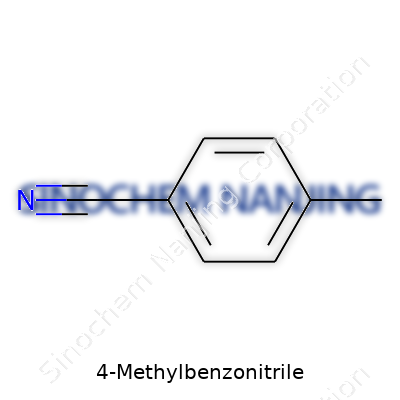
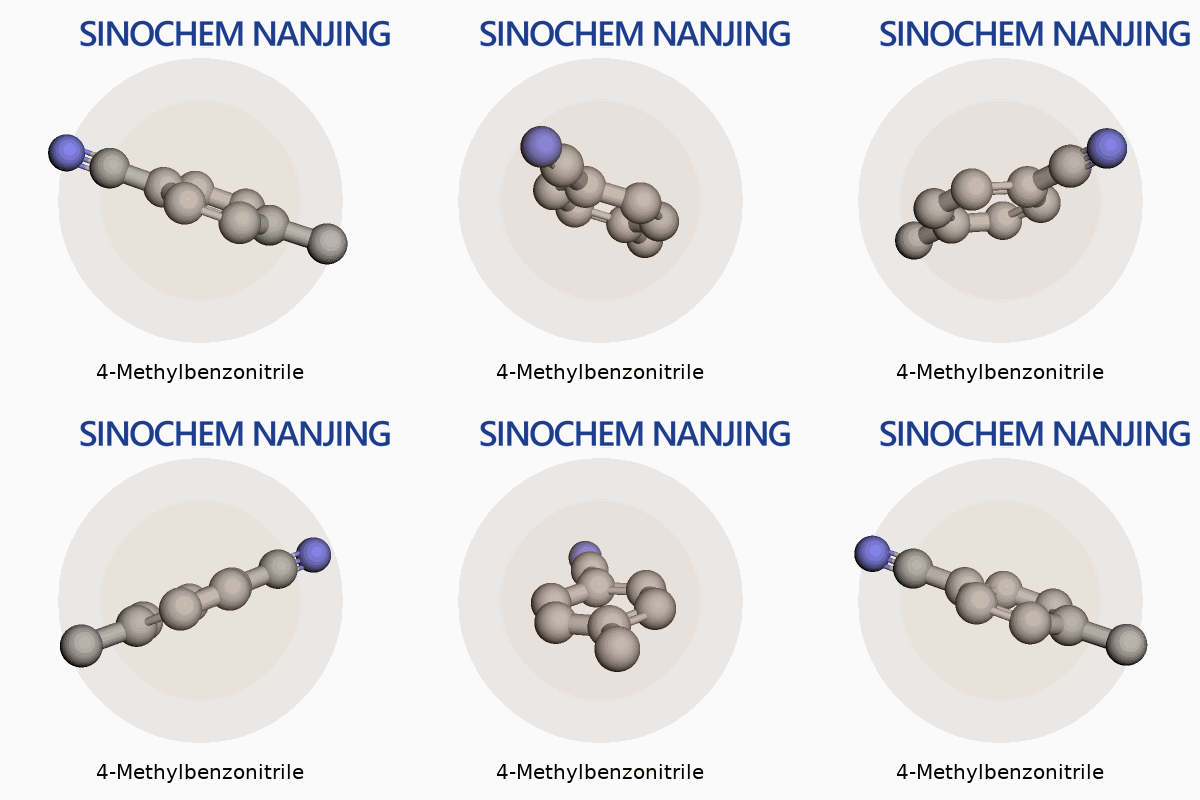
| Names | |
| Preferred IUPAC name | 4-methylbenzenecarbonitrile |
| Other names |
p-Tolunitrile 4-Cyanotoluene p-Methylbenzonitrile 4-Methylbenzenecarbonitrile p-Toluonitrile |
| Pronunciation | /ˌfɔːrˌmɛθ.ɪl.bɛnˈzəʊ.nɪˌtraɪl/ |
| Identifiers | |
| CAS Number | 620-22-4 |
| Beilstein Reference | 1209486 |
| ChEBI | CHEBI:86187 |
| ChEMBL | CHEMBL16162 |
| ChemSpider | 13397 |
| DrugBank | DB14107 |
| ECHA InfoCard | 100.046.724 |
| EC Number | 202-198-1 |
| Gmelin Reference | **7 924** |
| KEGG | C06785 |
| MeSH | D017907 |
| PubChem CID | 8557 |
| RTECS number | GO3150000 |
| UNII | 26473098HL |
| UN number | UN3439 |
| Properties | |
| Chemical formula | C8H7N |
| Molar mass | 117.15 g/mol |
| Appearance | Colorless to light yellow liquid |
| Odor | sweet almond-like |
| Density | 1.003 g/mL at 25 °C (lit.) |
| Solubility in water | slightly soluble |
| log P | 2.7 |
| Vapor pressure | 0.09 mmHg (25°C) |
| Acidity (pKa) | 22.7 |
| Basicity (pKb) | 8.77 |
| Magnetic susceptibility (χ) | -59.0 × 10⁻⁶ cm³/mol |
| Refractive index (nD) | 1.525 |
| Viscosity | 1.08 mPa·s (25 °C) |
| Dipole moment | 4.29 D |
| Thermochemistry | |
| Std molar entropy (S⦵298) | 296.7 J·mol⁻¹·K⁻¹ |
| Std enthalpy of formation (ΔfH⦵298) | 132.9 kJ/mol |
| Std enthalpy of combustion (ΔcH⦵298) | -4466 kJ/mol |
| Pharmacology | |
| ATC code | Not assigned |
| Hazards | |
| GHS labelling | GHS02, GHS07 |
| Pictograms | GHS07 |
| Signal word | Warning |
| Hazard statements | H302, H312, H332 |
| Precautionary statements | P210, P261, P264, P271, P301+P312, P304+P340, P312, P330, P403+P233 |
| NFPA 704 (fire diamond) | 2-2-0 |
| Flash point | Flash point: 113°C |
| Autoignition temperature | 540°C |
| Lethal dose or concentration | LD50 (oral, rat): 1890 mg/kg |
| LD50 (median dose) | LD50 (median dose) of 4-Methylbenzonitrile: Oral rat LD50: 3070 mg/kg |
| PEL (Permissible) | Not established |
| REL (Recommended) | 4°C |
| Related compounds | |
| Related compounds |
Benzonitrile 4-Chlorobenzonitrile 4-Nitrobenzonitrile 4-Methoxybenzonitrile 4-Fluorobenzonitrile 4-Aminobenzonitrile |



