4-Methyl-1-Pentene: Beyond a Polymer, A Look at Its Substance and Story
Historical Development
4-Methyl-1-pentene didn’t catch the world’s attention for its name alone. This compound came out of the mid-20th century surge in polymer science, at a time when industries were searching for lighter, more resilient materials. Polyolefins had already made their mark, but chemists saw that a more niche branched olefin like 4-methyl-1-pentene brought unexpected advantages. I remember seeing its story pop up in research as pioneers like Karl Ziegler and his team looked past the typical ethylene and propylene, working out techniques that allowed specialty comonomers into the ring. Back then, rigid standards, clumsy tools, and spotty yields limited progress, but pushes from both industry and academia kept it going. As Japan’s Mitsui Chemicals introduced TPX, the most famous polymer based on this monomer, the world saw applications multiply, even though it never rivaled polyethylene in volume. Each step in this journey shows how persistence, curiosity, and, frankly, a bit of luck carve new spaces in chemistry.
Product Overview
You might walk past huge drums of 4-methyl-1-pentene or never notice it at all, but its role matters in several fields. You’ll find the monomer as a colorless, highly flammable liquid with a faint, almost unnoticeable odor. In polymer form, it appears as crystalline, lightweight resin—a far cry from the run-of-the-mill plastic bag. I’ve seen folks in the lab appreciate TPX’s glass-like transparency and lightweight feel, two features that bode well for anything requiring clarity and light transmission without using glass. Its resistance to acids and a handful of solvents keeps it valuable in specific uses. This isn’t just a monomer for chemists; it’s a material that quietly shapes labware, food packaging, and more.
Physical & Chemical Properties
One striking aspect of 4-methyl-1-pentene stands out—the way its branching influences physical behavior. Boiling point hovers under 70°C, which makes handling a careful business, especially when vapors escape at room temperature. The monomer resists water well but doesn’t play nicely with strong oxidizers, and it stores best in cool, dry spots with airtight seals. Its polymer, on the other hand, can withstand heat that melts many plastics. TPX laughs off microwaves, stands up to a variety of chemicals, and holds up where optical clarity becomes critical. I’ve found its low density—lighter than water—opens the door to applications where shaving weight actually saves energy and cost over time. In summary, this isn’t just another hydrocarbon in a database; it stands as an example of how molecular structure changes every practical attribute.
Technical Specifications & Labeling
Specifics run deeper than a chemical label, but the basics count. 4-methyl-1-pentene sits under CAS number 763-29-1, making regulatory tracking straightforward for those who handle it. Purity matters—commercial lots usually push above 99%, with tight controls for water, peroxides, and heavy metals. Proper labeling flags it as flammable and potentially hazardous, and shipping regulations treat it with respect. The resin version, TPX, earns grades for molecular weight, melt flow rate, and optical properties, which all influence final product behavior. I learned first-hand that these specifications aren’t bureaucratic fluff; a few points off spec can mean the difference between a flawless analytical cuvette and a warped, unusable lump.
Preparation Method
Getting from base chemicals to 4-methyl-1-pentene involves clever organic synthesis. Butene-1 usually acts as a core feedstock, where selective alkylation or isomerization steps help add the methyl branch without stray side reactions. Industrial production favors catalytic processes—often Ziegler-type catalysts, though newer routes exist—because selectivity and yield drive down cost and environmental impact. Controlling impurities at every stage is critical since traces of unwanted isomers or byproducts can disrupt polymerization later. I’ve watched engineers obsess over process controls, knowing that a small hiccup can throw off entire batches. These details matter, and while most consumers won’t realize it, the effort under the hood saves time, resources, and trouble down the line.
Chemical Reactions & Modifications
A simple-looking molecule, 4-methyl-1-pentene reacts just like you’d expect from an alkene, with the double bond inviting addition reactions. Its real moment to shine comes from polymerization, especially with carefully chosen catalysts. Ziegler-Natta or metallocene catalysts coax it into long-chain poly(4-methyl-1-pentene), where the building blocks arrange in isotactic or syndiotactic orientation, each changing thermal and optical properties. Crosslinking and copolymerization can further tailor its attributes. Experience has taught me that even small tweaks in reaction conditions—pressure, temperature, catalyst type—shift how the polymer behaves, so control at this stage shapes every step that follows. The field keeps searching for modifications that unlock new uses or solve stubborn technical challenges, showing how even a stable molecule can adapt to changing needs.
Synonyms & Product Names
Chemistry never shies away from multiple names. 4-methyl-1-pentene sometimes appears as 4M1P, but the polymer world mostly talks about TPX, the commercial resin based on it. Synonyms like isobutyl ethylene or 4-methylpent-1-ene surface in literature, though clarity matters to avoid confusion. Labels shift, but the core molecule remains. Across languages and brands, the demand for clarity—whether in research, regulations, or commerce—keeps the name game serious, with authorities sticking close to official designations to keep everyone on the same page.
Safety & Operational Standards
Anyone working with 4-methyl-1-pentene learns quickly that safety takes priority. Vapors ignite easily, so sparks, flames, and heat belong nowhere near storage or use. I remember drills focused on grounding containers—just one stray static discharge could set off trouble. Gloves, goggles, and ventilation gear see regular use, protecting against accidental splashes and inhalation. Regulatory agencies like OSHA and the European Chemicals Agency carve out clear rules. Disposal demands care, and spills warrant swift cleanup with absorbent, non-sparking tools. In the right hands, risks drop to manageable levels, but everyone must keep respect for this chemical on their mind.
Application Area
Walk through any research lab or peek into some food factories, and TPX appears where it matters most. Its clarity, chemical resistance, and heat tolerance win in applications like microwave components, analytical cuvettes, and even medical devices—especially where visibility and cleanliness guide standards. I’ve seen TPX parts survive repeated sterilization cycles and exposure to aggressive chemicals that shatter lesser plastics. Unlike glass, these products don’t shatter, saving time and cost in replacements. Electronics, automotive, and packaging fields each carve out niches for it, capitalizing on its unique combination of lightweight and robust performance. It doesn’t steal the spotlight, but wherever a better plastic beats glass, you’ll usually find a reference to 4-methyl-1-pentene in the background.
Research & Development
Researchers don’t stop tinkering with this monomer and its polymers. Current R&D stretches everything from catalyst systems that boost efficiency to additives and blends that push thermal or optical boundaries. Studies track how TPX films let light, water vapor, and gases pass, unlocking filtration and membrane uses invisible just a few decades ago. I’ve read reports of medical device engineers fine-tuning molecular weight distributions for flexibility or transparency, tailoring products for new treatments. New applications keep cropping up, driven by environmental pressure for safer, better-performing plastics. The quest for greener, more efficient production sits squarely in ongoing lab work, and advances in reactor technology and process chemistry keep the field fresh for scientists and engineers.
Toxicity Research
Decades of scrutiny reassure most users about the safety profile of poly(4-methyl-1-pentene), but research ethic compels continuous study. The monomer itself raises more caution—its volatility and flammability pose immediate risks, and safety data underline the need for responsible handling. Acute toxicity studies, largely in rodents, rank it as low-to-moderate hazard at typical exposures, but no one should play fast and loose with the stuff. The polymer, once processed and cooled, shows minimal migration or leaching under standard use. Any chemical intended for food packaging or medical exposure faces regulatory hurdles and repeated toxicological evaluation, and TPX has met those regularly. Future work looks to minimize residual monomer and byproducts, keeping exposure as close to zero as feasible. The whole history says something valuable: don’t take safety for granted, even with seemingly benign materials.
Future Prospects
The road ahead for 4-methyl-1-pentene and TPX isn’t about conquering every sector but proving value where it counts. Demands for lighter, safer, and more transparent materials aren’t slowing down. Sustainability pushes raise tough questions about recycling and environmental impact—a challenge since polyolefins resist most natural breakdown, but also an opportunity for process engineers and circular economy advocates to innovate. New catalyst technologies promise greener paths, while advanced blending with bio-based or recycled materials hints at future breakthroughs. I see potential in medical, filtration, and microelectronics, where precision, purity, and performance all need to co-exist. As consumer expectations and regulations tighten, the only way for these materials to thrive is by proving their worth over and over, not only in the lab but in the hands of people who rely on them every day.
What are the main applications of 4-Methyl-1-Pentene?
Lightweight Polymers that Change How We See Plastics
I remember years back working with some medical research teams who had struggled to find transparent, tough plastics that wouldn’t fog up or break down from constant sterilization. That’s where 4-Methyl-1-Pentene makes a difference. People in the field usually recognize it by its polymer form, TPX, which has shown up in everything from science labs to food factories. Its low density lifts the burden off designers who want resilient yet featherlight materials. This stuff doesn’t cloud over the way polystyrene or even basic polypropylene tends to under harsh lighting or after a run through the steam sterilizer.
Crystal Clear in Medicine and Labs
In healthcare, seeing clearly can be just as important as keeping things clean. 4-Methyl-1-Pentene’s unmatched clarity earned it a place in medical equipment like test tubes, petri dishes, and even some surgical tools. It stands up to repeated cycles in an autoclave without warping or losing transparency. This resilience under heat and pressure means less waste and less risk for contamination. Reliability becomes personal in pharmacists’ and lab technicians’ work, since a mix-up from foggy or warped containers can mean bad news for patients.
Steaming Through Cooking and Food Safety
Take microwave cookware and the protective domes found in commercial kitchens. 4-Methyl-1-Pentene handles heat far better than old-school plastics. I’ve seen kitchens where the plastic lids go through hundreds of dishwashing cycles and still pop back on without a hint of distortion. The food industry leans on this polymer’s chemical resistance — sauces, oils, and cleaning agents rarely leave a mark. Unlike some alternatives, you won’t smell that odd “plastic” scent after heating food, since TPX keeps volatile compounds firmly locked in.
Specialized Roles: From Electronics to Membranes
Beyond its visible applications, 4-Methyl-1-Pentene finds a home in electronics manufacturing and high-tech filtration. Because it barely interacts with water and stands up to a range of chemicals, engineers shape it into membranes for gas separation. These membranes help create ultra-pure hydrogen for fuel cells and other clean energy systems. I’ve talked to engineers who trust this material in specialized capacitor films and insulation sleeves, since it doesn’t soak up moisture and stands strong against electrical stress.
Challenges and Paths Forward
Nothing’s perfect. The price tag on 4-Methyl-1-Pentene beats out regular polypropylene or polycarbonate, so use stays focused on places where performance justifies the cost. Recycling infrastructure also lags behind, so end-of-life plastics often land in landfills or incinerators. Producers and research groups must get creative, either by improving recycling methods or making blends that reclaim more of this valuable material.
I see a bigger opportunity for community discussion about plastics that outlast and outperform — not just replacing single-use items, but extending the useful life of every tool in the chain. With tighter regulations and higher sustainability standards, demand only grows for options that mix toughness, clarity, and safety. 4-Methyl-1-Pentene keeps proving that with the right mix of science and practical knowhow, materials science can offer answers instead of just new problems.
What is the chemical structure and formula of 4-Methyl-1-Pentene?
Understanding the Backbone
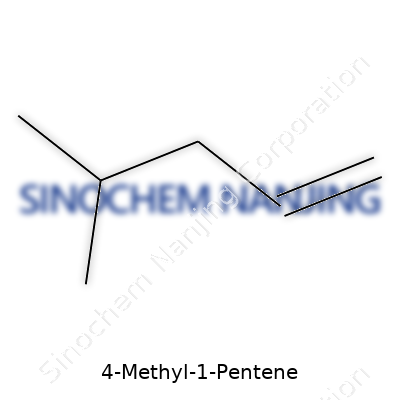
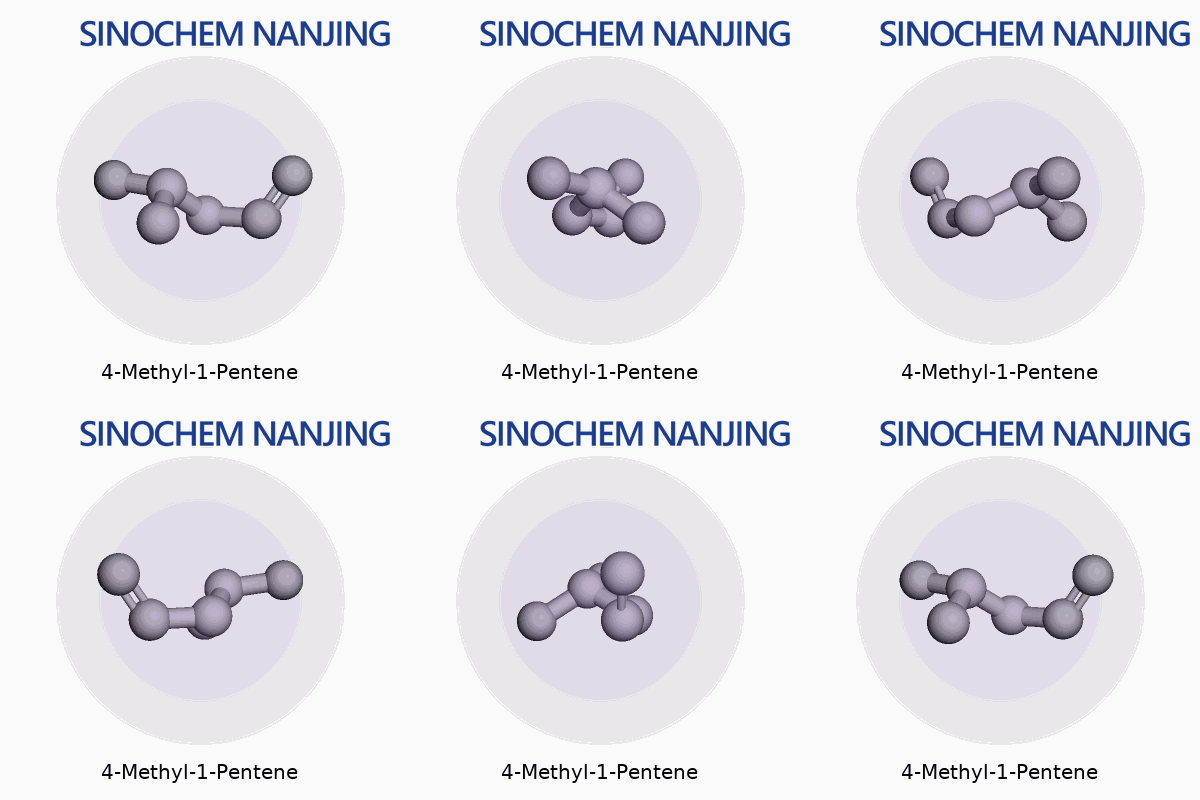
4-Methyl-1-pentene stands as a clear example of how even simple shifts in structure can create real impact in the world of materials. The chemical formula appears straightforward at first glance: C6H12. Look deeper, and every carbon placement sets the stage for properties that drive its use. Six carbon atoms, twelve hydrogens, but the real story shows up in how those atoms line up. You get a five-carbon chain, called pentene, and then a methyl group branches off the fourth carbon. The double bond hugs the far end, right on carbon number one. Chemists say the name, but they’re visualizing a zigzag backbone with a sidekick methyl group toward the tail.
Why Small Changes Pack a Punch
It always surprises me how arranging atoms gives one product such a useful life, while another rearrangement can be unremarkable. With 4-Methyl-1-pentene, one shift in where you attach a few hydrogens or place the double bond means you step away from something industrial experts talk about for high performance. In daily work, that specificity can mean success or failure. The difference goes beyond chemical trivia—this sort of detail lays the groundwork for quality in plastics and films used in demanding fields.
Structure at a Glance
Here’s what stands out: start at the end of a five-carbon chain. The first carbon holds a double bond. The methyl group lands on the fourth carbon, sticking out to the side. It’s easy to imagine this if you picture CH2=CH-CH2-CH(CH3)-CH3 stretched along a line, hydrogens filling in around the edges. These days, seeing skeletal formulas scribbled on a lab notebook page takes me right back to college, elbow to elbow with classmates all peering at the same backbone and nodding as the pieces clicked into place.
Importance in the Real World
The value of 4-Methyl-1-pentene shows up outside the chemistry classroom. Industrial chemists rely on it for its use in specialty polymers, particularly a material called poly(4-methyl-1-pentene), or PMP. PMP holds up even under steam sterilization and brings a clarity rarely matched in plastics. That matters in labs, healthcare settings, and places where seeing through a barrier counts. Scientists picked up on these benefits through hands-on testing, making the molecular details more than academic.
Safety and Handling: No Afterthought
Caring about chemical structure also means keeping an eye on safety. Volatile organic compounds can get risky, especially in big production runs or research settings. Good facility design, proper ventilation and training make a real difference in avoiding headaches—both literal and regulatory. Reading about large spills or disregard for storage procedures reminds me there is no shortcut for careful respect and planning with chemicals.
Better Chemistry, Smarter Industry
The unique structure of 4-Methyl-1-pentene suggests there’s a lot left to tweak in monomer design. Researchers keep exploring substitutions and chain modifications to chase higher performance. That kind of work shapes the next generation of transparent, temperature-resistant plastics. Young scientists get inspired by these challenges, and industry looks for more options.
Is 4-Methyl-1-Pentene hazardous or require special handling?
What Is 4-Methyl-1-Pentene?
4-Methyl-1-pentene belongs to the family of alpha-olefins. Chemical companies use it in specialty polymers, high purity packaging, and electronics. The compound serves a role in industrial labs for synthesizing transparent plastics, such as TPX resin. Many don't encounter it outside controlled environments, but for those who do, practical knowledge gains importance.
Why the Hazards Matter
Even though 4-Methyl-1-pentene doesn’t explode on contact with air or water, mishandling creates risks. It releases flammable vapors. Strike a spark nearby and the stuff can catch fire before you realize it. A liquid, low flash point, and invisible vapor trails lead to mistakes—no loud warning clatter or strong odor. I learned to never dismiss colorless vapors as harmless during my lab days, having seen more seasoned chemists wave off seemingly safe solvents only to end up scrambling for an extinguisher. OSHA and NIOSH classify such liquids as serious flammable hazards for good reason.
Health Risks: More Than Just a Noseful
Direct exposure—spills on skin, breathing in the stuff—brings its own set of headaches. Prolonged or repeated exposure might not lay you out on day one, but irritation and headaches add up. The material safety data sheets flag its ability to irritate skin and respiratory systems. Long-term exposure links to organ strain, according to chemical safety literature. The ill effects sneak up, especially in poorly ventilated spaces or cramped production lines.
Special Handling: Smart Moves Save Trouble
Special handling of 4-Methyl-1-pentene makes sense as a matter of routine safety. Storing the chemical away from open flames isn’t just a checkbox in a manual; it’s basic survival. I’ve kept volatile liquids in flame-resistant cabinets, not on open lab benches. The best facilities enforce spark-proof tools, anti-static workwear, and local ventilation. I’ve watched colleagues hurriedly mop up small leaks with the wrong gear, only to spread vapor further.
Wearing nitrile gloves, eye protection, and lab coats closes one route for exposure. Using chemical fume hoods limits inhalation. If your shop skips these steps, accidents multiply. Fire marshals and safety managers all harp on grounding storage drums and keeping spill kits nearby. These steps aren’t just to please inspectors—they minimize panic during an emergency. My own minor slip ended in nothing thanks to proper spill response gear tucked under the counter, and I never ignored those blue kits again.
Why Attention Pays Off
Neglect or cutting corners brings real costs—burns, chemical injuries, and occasional property damage. High polymer labs know better than to trust routine. Small improvements make a difference: investing in ventilation upgrades reduced our absences and health complaints. Once, an old extractor fan failed and vapors pooled in minutes, showing how quickly things can get out of hand.
Steps Forward and Safer
Better signage and training give teams confidence. Refresher workshops on flammable liquids, clear storage rules, quick-access emergency eyewash stations, and employee feedback help reduce risk. Facilities sometimes turn to less volatile alternatives for some projects. Even if full replacement isn’t always practical, adapting procedures—double-checking seals, updating safety data, getting buy-in from those on the line—keeps people healthy and work moving forward. In every workplace, moments spent on these details pay back in fewer incidents and steadier production. That’s not theory; that’s my own hard-earned experience translated into daily safety and peace of mind.
What is the purity level typically available for 4-Methyl-1-Pentene?
Understanding Purity in Practical Use
Anyone working in specialty chemicals or advanced plastics probably comes across 4-Methyl-1-Pentene in some form. Its value often rides on how pure the material arrives. In research and manufacturing, purity matters because small traces of other substances introduce problems—compromising reaction yields, affecting product clarity, or even shutting down an entire production line with contamination. People tend to ask: what can you actually expect if you order 4-Methyl-1-Pentene from a reputable supplier?
Purity Percentages You’ll Encounter
Standard grades from established chemical providers usually clock in above 98 percent purity. For most lab and manufacturing applications, this threshold works well. Higher grades—often labeled as “high-purity” or “ultra-pure”—reach up to 99.5 percent or even above. These grades become essential in electronics, precise analytical work, and medical device applications. If you’re pushing for polymer synthesis where even trace impurities ruin the final film, only the top end of the spectrum delivers reliable results.
Companies like Sigma-Aldrich or TCI detail specifications on each lot. It’s not uncommon to see 99 percent minimum as a spec, backed with gas chromatography or similar analytical proof. That means if a drum or bottle carries a 99 percent label, the other one percent consists of very closely monitored trace organics or solvents lingering from the purification process. Anything falling below 98 percent gets sorted out for more basic uses—spots where a clean but not ultra-pure material is all the process asks for, such as general research or non-critical plastic blending.
Why Purity Makes or Breaks Results
In my work at materials labs, I’ve seen how different batches make or break months of effort. Run an NMR, and minor impurities can confuse the spectrum. Build a plastic part and contaminants turn up as failure points long after production ends. Production engineers know that investing a little more in higher-purity feedstock saves costs downstream: fewer filtration steps, less waste, and far easier troubleshooting if a process turns sour.
Electronics and medical device manufacturers go a step further. Their auditors require documentation, precise tracking, and Certificates of Analysis for every barrel. Even 0.05 percent impurity sometimes triggers an investigation. If a supplier doesn’t keep up with consistent, high-level purification, the customer goes elsewhere because the risk of downtime or lost batches costs more than any price difference.
Staying Informed and Building Trust
Transparency from suppliers is the best line of defense. Data sheets should spell out impurities and not hide behind vague tolerances. Calls with technical support reveal how tightly quality teams control every run and whether laboratories regularly recalibrate their equipment. Trust isn’t built overnight. I’ve watched purchasing teams switch vendors after shipments miss specs by just a fraction of a percent. It’s about reputation, not just numbers on a page.
Improving the System For the Long Haul
Real progress arrives through collaboration. Technical buyers talk with suppliers about future needs, flagging issues before they disrupt lines. End-users push for new testing methods, which drive improvements in purification. Technology steps in—automated analyzers, tighter process controls, faster feedback after each production run. The purity standards for 4-Methyl-1-Pentene reflect that dynamic, and they keep getting stronger each year. Whatever the grade, asking more questions and sharing more information always pays off.
How should 4-Methyl-1-Pentene be stored and transported?
Why Handling Chemicals Demands Respect
Working in labs through the years, I’ve learned that underestimating chemicals causes problems, even with something that doesn’t make headlines. 4-Methyl-1-Pentene often pops up in polymer production, which means it travels from factories and warehouses to processing plants. Storing a flammable chemical should never happen in a slapdash way, and that comes from experience: small mistakes with storage conditions or the wrong type of drum can snowball into hazardous leaks or even fires.
Key Concerns with 4-Methyl-1-Pentene
4-Methyl-1-Pentene counts as a flammable and volatile liquid. It can release vapors at ordinary temperatures, and those vapors catch fire easily. I still remember walking past a row of barrels stacked in sunlight — you could actually smell the difference as they warmed. Heat ramps up pressure inside closed containers, so using tight-sealing, vented drums helps relieve buildup and reduces risk. Nobody wants to handle a swollen or leaking barrel.
Storage That Keeps People and Products Safe
Forget stacking these drums in common areas or shoving them next to reactive chemicals. A well-ventilated, dedicated storage room, preferably with a sprinkler system, goes a long way toward protection. The temperature should stay cool and constant, far from ignition sources. It helps to store drums off the ground on grates or pallets, making leaks easier to spot. Fire-resistant cabinets or rooms add a buffer, keeping things contained if there’s a spill or a spark.
I once worked in a plant where regular checks meant the difference between an uneventful shift and a harrowing night — checking for corrosion, cracked seals, and any hint of vapor around the lids. Putting out proper hazard signs stops accidents before they start. It’s not enough to rely on everyone knowing what’s inside a barrel; clear labeling, including hazard warnings, removes doubt.
Moving Chemicals Without Trouble
Loading and unloading this liquid asks for care. Before transport, it helps to double-check drums for dents or damage. Truck drivers and warehouse staff need training — not just a written guideline, but real hands-on sessions. Good companies pack chemical shipments with physical barriers to prevent drum movement, and sometimes, a blanket of inert gas like nitrogen covers the liquid inside, reducing fire risk during shipping. I’ve seen shipments that arrived just fine thanks to strict tie-downs and packaging that isolated the drums from metal-to-metal impact.
Shipping documentation stays crucial. Knowing what you’re carrying and who to contact in an emergency makes everyone safer. Experienced carriers follow international transport regulations, such as those set out by the United Nations for hazardous goods, as well as any national rules in play. It’s more than legal compliance; it’s about sending chemicals on journeys where nothing dramatic happens.
Moving Forward—Better Practices, Safer Days
If there’s one thing years in the field taught me, it’s that practice matters more than paperwork. Frequent drills, honest conversations about small errors, and a willingness to step back and redesign a storage area set up real safety. Technology helps — remote sensors for leaks, temperature alarms, digital logs. At the end of the day, personal investment in safe chemical handling changes outcomes, not a checklist sitting in a drawer.
| Names | |
| Preferred IUPAC name | 4-Methylpent-1-ene |
| Other names |
1-Pentene, 4-methyl- Isobutylethylene |
| Pronunciation | /ˈfɔːrˈmɛθɪl waɪnˈpɛntin/ |
| Identifiers | |
| CAS Number | 763-29-1 |
| Beilstein Reference | 1858733 |
| ChEBI | CHEBI:51170 |
| ChEMBL | CHEMBL133048 |
| ChemSpider | 68257 |
| DrugBank | DB14089 |
| ECHA InfoCard | 100.113.502 |
| EC Number | 207-898-1 |
| Gmelin Reference | 81440 |
| KEGG | C06535 |
| MeSH | D010482 |
| PubChem CID | 11208 |
| RTECS number | SY8575000 |
| UNII | 84R12CD7T6 |
| UN number | UN1993 |
| Properties | |
| Chemical formula | C6H12 |
| Molar mass | 84.16 g/mol |
| Appearance | Colorless liquid |
| Odor | mild, camphor-like |
| Density | 0.654 g/mL at 25 °C(lit.) |
| Solubility in water | Insoluble |
| log P | 2.8 |
| Vapor pressure | 2.9 kPa (20 °C) |
| Acidity (pKa) | pKa ≈ 44 |
| Magnetic susceptibility (χ) | -7.36 × 10⁻⁶ cm³/mol |
| Refractive index (nD) | 1.3873 |
| Viscosity | 0.346 mPa·s (25 °C) |
| Dipole moment | 0.46 D |
| Thermochemistry | |
| Std molar entropy (S⦵298) | 309.5 J·mol⁻¹·K⁻¹ |
| Std enthalpy of formation (ΔfH⦵298) | -34.3 kJ·mol⁻¹ |
| Std enthalpy of combustion (ΔcH⦵298) | -3756 kJ/mol |
| Pharmacology | |
| ATC code | |
| Hazards | |
| GHS labelling | Not a hazardous substance or mixture according to the Globally Harmonized System (GHS). |
| Pictograms | GHS07 |
| Signal word | Warning |
| Precautionary statements | P210, P233, P240, P241, P242, P243, P280, P303+P361+P353, P370+P378 |
| NFPA 704 (fire diamond) | 1-2-0 |
| Flash point | -11 °C (12.2 °F; 262.15 K) |
| Autoignition temperature | 220 °C (428 °F; 493 K) |
| Explosive limits | 1.1–9.7% |
| Lethal dose or concentration | LD50 (oral, rat): > 10 g/kg |
| LD50 (median dose) | LD50 (rat, oral) > 3000 mg/kg |
| NIOSH | RN2900 |
| PEL (Permissible) | Not established |
| REL (Recommended) | REL (Recommended): **NIOSH REL: 500 ppm (2,350 mg/m³) TWA** |
| Related compounds | |
| Related compounds |
1-Hexene 2-Methyl-1-pentene 3-Methyl-1-pentene 2-Hexene Cyclohexene |



