4-Bromobenzoyl Chloride: A Deep Dive into Chemical Craftsmanship
Historical Development
Chemists first started tinkering with benzoyl chlorides in the late 1800s, during a period alive with innovation and bold risk-taking. Early work focused on using halogenation as a tool to shake up aromatic compounds, searching for new properties and downstream applications. The introduction of bromine atoms onto benzene rings became more than just an academic exercise once folks realized these halogenated intermediates could channel the power to transform not just dyes, but also agrochemicals and medicines. By the early twentieth century, 4-bromobenzoyl chloride emerged in research aimed at pharmaceutical building blocks, where precision and reactivity met. Over decades, progress in handling, safety, and purification processes helped industrial labs adopt the compound, leading to wider use in designer molecules and specialty chemicals.
Product Overview
4-Bromobenzoyl chloride stands out as a crucial ingredient for anyone working on specialty synthesis. Its molecular structure, featuring a para-bromo substituent on a benzoyl chloride framework, gives chemists a clear route to both reactivity and molecular design. That bromo component not only increases the compound’s reactivity toward nucleophiles, but also creates access to more advanced synthetic transformations. This substance isn’t just for academic chemistry; it gets pulled off the shelf by pharmaceutical developers, material scientists, and anyone else aiming for reliability and consistent performance in their end-product.
Physical & Chemical Properties
Handling 4-bromobenzoyl chloride means working with a white to off-white solid that emits a sharp, pungent odor reminiscent of strong acyl chlorides. Its melting point tends to settle between 26–30°C, so even minor fluctuations in temperature can bring it from solid to liquid. The compound’s molecular weight tips the scale at about 219.47 g/mol, with a chemical formula of C7H4BrClO. It dissolves easily in common organic solvents like dichloromethane, chloroform, or ether, but recoils at the sight of water—hydrolysis can be both rapid and exothermic, releasing hydrogen chloride fumes that demand caution and smart ventilation. This chemical’s keen reactivity, particularly at the acyl chloride group, has made it a workhorse for transformations that build out more complicated molecular architectures.
Technical Specifications & Labeling
Quality-focused suppliers supply 4-bromobenzoyl chloride in sealed, amber glass bottles to keep light and moisture at bay. Typical purity ranges from 98% to upwards of 99.5%, giving researchers predictability from batch to batch. Labels display the IUPAC name (4-bromobenzoyl chloride), the CAS number (99-91-2), hazard designations, storage instructions (keep in a cool, dry environment), and lot-specific details for traceability. Ventilated enclosures and proper handling gear aren’t just regulatory boxes to check; they shape the daily chore of weighing, transferring, and repackaging reactive substances. Standardized barcodes simplify both inventory and emergency response, adding another layer of operational security.
Preparation Method
Manufacturers usually prepare 4-bromobenzoyl chloride by reacting 4-bromobenzoic acid with thionyl chloride or oxalyl chloride, both known to slice through the carboxylic acid bond to yield the targeted acyl chloride. The reaction mixture heats under reflux, sometimes with a catalytic pinch of DMF to lubricate the conversion. As by-products like sulfur dioxide and hydrogen chloride gas evolve, containment and scrubbing measures keep things safe for both worker and environment. After workup, careful distillation or recrystallization drives the purity up, laying groundwork for high-grade chemical outcomes. For large-scale runs, automation and closed processes protect workers from corrosive vapors.
Chemical Reactions & Modifications
This compound regularly plays the starring role in Friedel–Crafts acylations, transforming boring aromatics into valuable ketones. Its eagerness to react with amines helps pump out new amides—an essential backbone for both drug molecules and advanced materials. Chemists also use this acyl chloride to tag alcohols, introducing ester functionality in the blink of an eye. Cross-coupling reactions, such as Suzuki and Stille protocols, tap into the bromo handle, letting researchers build increasingly complex scaffolds with precision and speed. The reactivity balance, anchored between the bromo substituent and the acyl chloride group, opens a toolkit for fast-moving research and custom molecule design.
Synonyms & Product Names
Don’t let the tongue-twisting IUPAC name fool you; 4-bromobenzoyl chloride also answers to para-bromobenzoyl chloride, p-bromobenzoyl chloride, and Benzoyl chloride, 4-bromo-. Those names appear on safety data sheets, procurement forms, and shipping documents. Whether it’s a boutique catalog or a bulk supplier, such aliases ease confusion, especially for teams scanning for cross-references among regulatory agencies or research publications.
Safety & Operational Standards
Safety drives the culture in spaces where this potent acyl chloride gets used. Direct exposure brings risk of chemical burns, serious respiratory irritation, and eye injury. Nitrile gloves, face shields, and splash goggles stay within arm’s reach whenever the bottles come out. Fume hoods handle the sharp vapors like a seasoned pro, channeling hazardous gases away from workers. Fire safety officers train staff in spill response and proper waste management using neutralizing agents such as sodium thiosulfate or sodium bicarbonate. Material safety data sheets—regularly reviewed and digitally stored—establish routines for both accident prevention and swift incident response. Adopting a “never-work-alone” policy in laboratories and manufacturing lines adds another human layer, where vigilance and teamwork keep danger at bay.
Application Area
Pharmaceutical companies often use 4-bromobenzoyl chloride to unlock new routes for drug candidates, especially within anti-infective and anti-inflammatory screens. Materials scientists see its value for making specialty polymers or tuning small-molecule electronics. Fine chemical manufacturers enjoy the versatility it brings to protecting groups, linker design, and custom synthesis. Crop science outfits dig into its capacity for building herbicides and fungicides, where precision at the molecular level guides both performance and regulatory acceptance. Chemical educators find it a rewarding teaching example, giving students a hands-on look at reactive chlorides, safe handling measures, and chemical intuition in action.
Research & Development
Research teams devote much effort to uncovering new reaction pathways using 4-bromobenzoyl chloride as a platform. Green chemistry practitioners try replacing traditional solvents with greener alternatives or finding catalysts that lower the temperature or time needed for conversion. Advances in combinatorial synthesis push for high-throughput screening of derivatives, seeking better selectivity, biological activity, or material properties. Recent literature shows that biochemists and molecular biologists adopt derivatives for protein labeling and probe development, helping crack mysteries in cell signaling and enzyme function. Each improvement in process safety, yield, or scalability nudges the chemistry community toward greater efficiency and inventive applications.
Toxicity Research
Systematic toxicity assays reveal that 4-bromobenzoyl chloride can produce strong irritation for skin, eyes, and mucous membranes, with documented symptoms that include redness, pain, and inflammation. Short-term inhalation brings acute lung effects, and animal studies point to moderate systemic toxicity at high doses. Researchers classify this substance as corrosive and an environmental threat to aquatic organisms because of both the parent molecule and its hydrolysis products. Current best practice calls for thorough risk assessments before new experiments, especially those reaching gram- or kilogram-scale. Proper labeling, ventilation, and personal protection don’t guarantee zero risk, but support ongoing safety improvements and a more transparent disclosure culture. Waste disposal relies on neutralization and careful collection, keeping both workers and the wider public safer.
Future Prospects
More research teams look to harness 4-bromobenzoyl chloride for targeted synthesis, especially as demand grows for precision medicine, advanced materials, and sustainable crop protection strategies. Companies seek ways to manufacture it with less toxic reagents, less waste, or fewer process steps. Calls for reducing hazardous by-products push innovation in continuous-flow reactors, which offer both containment and the chance for real-time monitoring. Sensors and digital tracking, paired with machine learning, unlock process optimization that fits both safety and sustainability objectives. With the right drive and focus, 4-bromobenzoyl chloride promises to remain vital not just for its current uses, but for applications nobody has thought up yet.
What is the chemical formula of 4-Bromobenzoyl Chloride?
Why Chemical Formulas Matter
Chemical formulas tell a lot more than just what sits in a lab bottle. They guide chemists, pharmacists and researchers in understanding both hazards and opportunities that come from each compound. 4-Bromobenzoyl chloride may sound like a deep cut from a textbook, but its formula—C7H4BrClO—has a real role in day-to-day science. Every letter and number shares something about its structure and reactivity, so anyone dealing with synthesis, pharmaceuticals, or chemical safety deserves a close look at this information.
Breaking Down C7H4BrClO
The formula packs a lot into a short string. The compound starts with a benzene ring, recognizable in organic chemistry lab work for its stability and foundation for countless reactions. Swapping out a hydrogen atom for a bromine at the fourth position gives unique reactivity—bromine doesn’t just change the weight; it nudges the electron cloud and influences where reactions might happen. Then comes the carbonyl chloride end, which turns a stable ring into a reactive player. That part opens doors for acylation reactions or for preparing pharmaceutical intermediates.
Applications Touching Everyday Life
Looking past the formula, 4-Bromobenzoyl chloride shows up in places you wouldn’t expect. Some specialty plastics, advanced dyes, and certain drugs trace origins back to this compound. The pharmaceutical industry probably has the most at stake, since this molecule can open a pathway to anti-inflammatory drugs or tools for synthesizing more complex agents. Safety information here is key—chlorinated benzoyl compounds don’t just sit quietly. Chlorides can bring about burns or respiratory risks if handled carelessly, and bromine tags signal even more need for solid lab practices and clear safety data sheets.
Handling Safety and Environmental Impact
Every lab worker remembers lessons about acyl chlorides and their reactions with water. That hissing sound when moisture gets in the wrong bottle can wake up even the most seasoned chemist. Hydrochloric acid fumes aren’t just an inconvenience—they drift easily, so ventilation needs to be in place before even weighing out this solid. On the environmental side, improper disposal spells trouble. Halogenated organics don’t break down easily; they linger in water and soil, sometimes with effects that echo through ecosystems. Labs carrying out research or manufacturing with 4-Bromobenzoyl chloride need its safety data on hand and up-to-date, and a clear plan for collection and neutralization of any waste.
Room for Improvement in Chemical Management
Many organizations still run on outdated protocols, and that’s a gap with a real cost. Training that focuses on the actual risks and jobs at hand—backed up by modern equipment—can head off most emergencies. Automated documentation, digital tracking, and transparent labels for every bottle put information where hands and eyes land, not buried in manuals. Sharing knowledge within research communities, updating protocols, and insisting that disposal services meet modern standards keeps both staff and neighborhoods safer.
Final Thoughts
C7H4BrClO stands as more than numbers and letters. Each point in that formula means something for chemists mixing reagents, companies designing new materials, and communities keeping an eye on environmental health. Keeping the right focus on safety, updating how we work with legacy chemicals, and taking responsibility for waste drives better outcomes in labs and beyond.
What are the common uses or applications of 4-Bromobenzoyl Chloride?
Behind the Chemical Name
Step into a research lab or flip through the pages of a pharmaceutical catalogue, and 4-Bromobenzoyl Chloride tends to pop up more than most folks might expect. My years tinkering in university chemistry labs taught me that many of the compounds with tough-sounding names often lie at the center of simple yet important applications. This molecule, for example, packs a punch in synthesis—laying groundwork for both new medicines and useful chemical tools.
Key Role in Pharmaceutical Development
No one in drug development can ignore the significance of building blocks that get stitched into complex drug molecules. My conversations with medicinal chemists often turn up this compound, since it delivers a reactive site for introducing the benzoyl group into organic frameworks. Take fluoroquinolone antibiotics as an example. The process calls for the pairing of various acid chlorides with other key fragments. 4-Bromobenzoyl Chloride stands out during early optimization phases, letting researchers tweak potency and safety of drug candidates. Publications and patent reviews back up this real impact; plenty of new molecules in cancer research, anti-inflammatory therapies, or CNS-active agents spring from reactions involving chlorinated benzoyl compounds.
Designing Agrochemicals with Precision
Sitting with a team focused on crop protection, I learned firsthand how companies look for new ways to manage pests without disrupting the environment. Here, the bromine atom in 4-Bromobenzoyl Chloride adds extra leverage. By using this compound to tailor molecular structure, chemists manage to boost activity or fine-tune selectivity. For example, certain herbicides and fungicides rely on benzoyl building blocks in their backbone. The chloroformate part of the molecule acts like a flexible connector, letting inventors attach different functional groups in the hunt for new options on the farm. Data from regulatory bodies show the ever-increasing number of new submissions for brominated pesticides, proving the real value discovered during field trials.
Supporting Roles in Advanced Materials
In the world of advanced materials and specialty polymers, functionality counts for everything. During my stint working with specialty adhesives, I saw firsthand how additives based on 4-Bromobenzoyl Chloride controlled properties like resistance to heat or harsh chemicals. It acts as a monomer or a crosslinking agent in creating new plastics or coating materials. These changes let engineers lock down qualities in electronics, lubricants, and hard-wearing lacquers. Watch any demonstration on high-performance coatings, and you'd see how little tweaks in base chemistry—sometimes through the signaling group from our molecule—lead to leaps in stability or toughness.
Building Research Tools
Research doesn't stop at products you can see on the shelf. In protein labeling and biochemical assays, 4-Bromobenzoyl Chloride works as a labeling agent. Scientists attach it to amino acids or peptides, then track interactions in cell cultures. Years back, I helped with a project using this chemical to illuminate pathways in a disease model—its bromine atom serving as a signature detectable by certain analytic methods.
Safer Handling and Future Conversations
With all this activity, safety and oversight stay front and center. I've watched lab managers hammer home the importance of chemical fume hoods and good protocols. Organizations like OSHA and the European Chemicals Agency put 4-Bromobenzoyl Chloride under scrutiny for reactivity and health risks. Training fresh scientists on practical handling techniques matters just as much as the chemistry itself.
What safety precautions should be taken when handling 4-Bromobenzoyl Chloride?
Respect the Hazards
4-Bromobenzoyl chloride is nothing to mess with. I remember the sting in my nose when someone cracked a bottle open in an unventilated lab. This chemical releases nasty vapors—hydrochloric acid gas for one, and that brings burning eyes, coughing, and irritated skin to anyone who’s nearby. If skin contact happens, corrosive burns can follow. Inhaling even small amounts of the fume may mean respiratory issues for days.
Running experiments with reactive acyl chlorides puts your health on the line. I’ve seen colleagues take shortcuts and pay for it. Fuming liquids like this highlight the need for respect with every move.
Ventilation and Engineering Controls
A standard fume hood isn’t optional. Lab air won’t cut it. Even if a task seems quick, reactions and transfers should always go under a properly maintained hood, sash down to eye level. Local exhaust ventilation pulls away the invisible acid mist and limits inhalation risk. Good airflow means fewer long-term issues for your lungs.
Before reaching for 4-bromobenzoyl chloride, check that spill kits and neutralizers like sodium bicarbonate are stocked. Eyewash stations and safety showers need to be within arm’s reach. These places should function and get checked regularly.
Personal Protective Equipment
You won’t find me anywhere near an open bottle without splash goggles or a well-sealed face shield. Some people get lazy and wear only safety glasses—that oversight can cost your vision. Rubber or nitrile gloves—double gloving isn’t overkill—protect your skin. A heavy-duty lab coat, fully buttoned with sleeves over the glove cuffs, keeps splashes off your arms and chest.
Even the smallest drops make clothes unsafe. If contact occurs, contaminated clothing must come off immediately. I never put these garments through a regular wash cycle—professional chemical laundry is the only safe cleanup.
Storage and Handling
I keep 4-bromobenzoyl chloride bottles inside chemical storage cabinets, well labeled and segregated from water, amines, alcohols, or strong bases. Never store with anything remotely reactive. Moisture leads to hazardous decomposition. After use, wipe the threads and rim, recap, and seal the bottle. This small habit keeps the next person safe.
Never pipette by mouth. Use only chemically resistant pipettes and avoid glass if there’s any risk of breakage. For weighing, I always open bottles inside a hood and use boats or spatulas designed for corrosive powders and liquids.
Training and Spill Procedures
A clear protocol makes a difference when spills happen. Everyone in my workplace gets trained in emergency response. I don’t let new people work with this chemical before demonstrating the steps—containment, neutralization, decontamination, medical help. Every action counts in those first seconds.
Disposing of waste means segregating corrosives into appropriate, clearly labeled bins. Mixing with other trash can trigger violent reactions and off-gas corrosives.
Continuous Vigilance
The stakes are always high with hazardous reagents. Routine, muscle memory, and peer checks help stop mistakes before they start. Regular reviews of best practices, supply inventory, PPE fit, and working ventilation shouldn’t wait for inspection day. This approach, shaped by experience, forms a real barrier between chemists and harm.
What is the proper storage condition for 4-Bromobenzoyl Chloride?
Understanding the Risks
Working with chemicals like 4-Bromobenzoyl Chloride doesn’t just mean understanding its uses; safety depends as much on storage as it does on handling or disposal. This compound packs a punch because it reacts with water, sending out harmful gases and corrosive hydrochloric acid. That gives anyone who’s handled a leaky bottle a good memory to last. From experience, even a tiny spill causes fumes that sting the nose and eyes, and cleaning up isn’t pleasant.
Not all storage issues show up as accidents, though. Wrong storage lets the material break down, making it less effective for synthesis work or quality control. Looking after it properly protects people and preserves purity. The chemical world relies on results. A sub-par reagent puts experiments and entire projects in jeopardy.
Location and Environment
I’ve learned that keeping 4-Bromobenzoyl Chloride safe means picking the right spot. Dry, cool rooms out of direct sunlight prevent unwanted reactions. Moisture kicks off trouble, so a desiccator or at least a tightly sealed container helps keep air and humidity away. For labs that fight with damp climates, extra desiccants pay off. I’ve seen desiccators filled with silica gel in every corner, and people still add extra jars when the rainy season hits.
Temperature matters. Store this compound below 25°C to slow down any side reactions or degradation. Too much warmth speeds up decomposition. Most stockrooms avoid extremes; regular air conditioning works fine, but don’t count on that alone if the outside temperature rises. Some labs label certain fridges for reactive chemicals—not every fridge fits the bill, so I check for gasket seals and avoid any with visible condensation or ice buildup. The aim is low humidity, not just low temperature.
Safe Containers
Amber glass bottles earn their place for chemicals that break down in light. Screw caps with PTFE liners give a strong seal and resist corrosion. Cheap stoppers crumble after a few months; investing in high-quality closures saves trouble. Labels from original suppliers should stay visible—peeling tags tempt mistakes, and mixing up bottles can invite dangerous cross-contamination.
Tight closures slow down the entry of air and water. I learned not to rely on roll-top jars or recycled soda bottles, no matter how tempting during budget cuts. Replacement costs after contamination always exceed the money “saved” by cutting corners. Secure lids cut down risks of both spills and air intrusion.
Limiting Exposure and Inventory
It helps to keep only as much 4-Bromobenzoyl Chloride as needed for practical use. Stockpiling brings storage headaches and increases risk over time. In one lab, rotating stocks—using the oldest bottles first—made a huge difference. Regular checks help spot broken seals or cloudiness in the liquid, both warnings that the rest should be tested or safely disposed of.
Handling Mistakes and Emergency Planning
Spills and splashes need fast action. Eyewash stations and spill kits stocked near storage shelves give teams a fighting chance to respond before injuries happen. Training goes a long way. Knowledge about the dangers of improper storage turns caution into a habit. Sometimes, seasoned staff can spot bad storage practices instantly—such as condensation inside bottles or faint chemical smells—that fresh eyes might miss.
Building a Culture of Care
Making safe storage a team commitment stops problems before they start. Routine inspections, ongoing training, and open reporting let everyone look out for potential trouble. The point here isn’t just compliance or keeping auditors happy. Lives and careers depend on good habits and respect for the science and danger inside each bottle.
What is the purity and available packaging size for 4-Bromobenzoyl Chloride?
Why Purity Matters in Chemistry
Purity has always carried weight in chemical processes. In my time working with synthetic routes for pharmaceuticals and specialty polymers, I’ve noticed the slightest contaminants can throw off reactions and outcomes. Pure 4-Bromobenzoyl Chloride is vital for researchers and manufacturers, since even trace impurities get inherited by the next step. Labs and production lines often use material that hits at least 98% purity, and plenty of suppliers regularly offer grades from 98% up to 99% and higher, for those who can’t risk batch variation. Some research groups take an extra step, checking certificates of analysis for specific impurity profiles, looking for info on residual solvents and related brominated compounds.
Sizing Up Packaging Options
Not every project calls for the same volume. I spent a few years in a start-up lab where a couple of grams got us through a whole quarter, so small glass bottles fit our needs and our budget. On the other hand, contract manufacturers or bigger research outfits want efficiency and value, so they lean toward bulk. Standard sizes usually start around 5 grams, bumping up to 25 grams, then into hundreds — 100-gram and 500-gram containers show up on plenty of major distributor listings. Commercial partners with more serious throughput needs order kilogram drums, with the volume shaped by storage regs and shelf life, since the acid chloride group in this compound stays reactive and can break down if left too long, especially in humid air.
Quality Control and Handling
In one place I worked, everyone handled acid chlorides like 4-Bromobenzoyl Chloride with serious caution — fume hoods, powder-free gloves, and solid glassware. Even small leaks led to eye-watering fumes and ruined reactions. Packaging materials matter; some containers come with PTFE-lined caps instead of plain plastic, cutting down on cross-contamination or unplanned hydrolysis. Fisher Scientific, Sigma-Aldrich, and Alfa Aesar stick with amber glass to protect light-sensitive compounds, which helps stretch out shelf life.
Challenges for Small Labs and Hobbyists
Access doesn’t work the same for everybody. For students or DIY chemists, minimum order sizes can price people out, and regulations in some countries close off supplies unless you’re tied to a registered organization. In those cases, partners can look for chemical distributors with a rep for transparent paperwork and batch traceability, so the risk of surprise impurities or mislabeled product drops. Many outlets now post quality assurance and trace impurity lists online. Anyone handling this compound should pay attention to the expiry date and storage guides — this isn’t the sort of reagent you want leaking in a shared fridge.
Improving Access and Reliability
One thing that can help: building stronger bridges between academic supply networks and industrial vendors. If my old university had shared bulk purchasing power across departments, we could have saved on both cost and waste. Increasing transparency in specification sheets, including details on heavy metal traces and water content, goes a long way for everyone trying to run clean experiments. Incentives for suppliers to offer micro-packs or return programs can give smaller operations more flexibility.
Final Thoughts
Good research often starts with good raw materials. 4-Bromobenzoyl Chloride is only as reliable as its purity and storage, and the smallest labs need the same confidence in supply as major manufacturers. Clear info on available grades — whether in a 5g bottle or a 1kg drum — empowers safer use and better science, no matter who’s buying or how much they need.
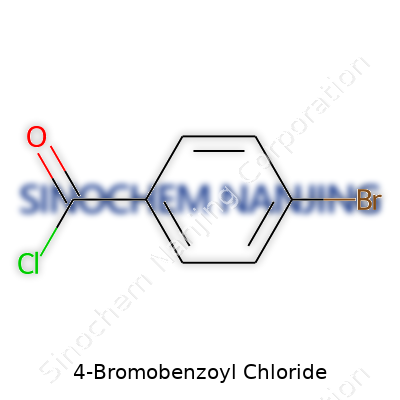
| Names | |
| Preferred IUPAC name | 4-Bromobenzoyl chloride |
| Other names |
p-Bromobenzoyl chloride 4-Bromobenzenecarbonyl chloride 4-Bromobenzoyl chloride |
| Pronunciation | /brəʊˌmoʊˈbɛn.zɔɪl ˈklɔːr.aɪd/ |
| Identifiers | |
| CAS Number | 1670-24-0 |
| Beilstein Reference | 1209247 |
| ChEBI | CHEBI:27656 |
| ChEMBL | CHEMBL379030 |
| ChemSpider | 108549 |
| DrugBank | DB14124 |
| ECHA InfoCard | 100.012.227 |
| EC Number | 211-096-3 |
| Gmelin Reference | Gmelin Reference: 8044 |
| KEGG | C19222 |
| MeSH | D017320 |
| PubChem CID | 84301 |
| RTECS number | CU5950000 |
| UNII | 3YO6B0N39S |
| UN number | UN1737 |
| CompTox Dashboard (EPA) | DTXSID5056932 |
| Properties | |
| Chemical formula | C7H4BrClO |
| Molar mass | 231.45 g/mol |
| Appearance | White to off-white crystalline powder |
| Odor | pungent |
| Density | 1.701 g/cm3 |
| Solubility in water | Decomposes in water |
| log P | 2.9 |
| Vapor pressure | 0.15 mmHg (25°C) |
| Acidity (pKa) | 1.02 |
| Basicity (pKb) | pKb: 12.86 |
| Magnetic susceptibility (χ) | -73.0e-6 cm³/mol |
| Refractive index (nD) | 1.613 |
| Viscosity | 0.954 cP (20°C) |
| Dipole moment | 1.98 D |
| Thermochemistry | |
| Std molar entropy (S⦵298) | 325.9 J·mol⁻¹·K⁻¹ |
| Std enthalpy of formation (ΔfH⦵298) | -44.7 kJ/mol |
| Pharmacology | |
| ATC code | '' |
| Hazards | |
| Main hazards | Causes severe skin burns and eye damage; may cause respiratory irritation. |
| GHS labelling | GHS05, GHS07 |
| Pictograms | GHS05, GHS07 |
| Signal word | Danger |
| Hazard statements | H302, H314, H315, H318, H335 |
| Precautionary statements | P260, P261, P264, P271, P280, P301+P330+P331, P303+P361+P353, P304+P340, P305+P351+P338, P310, P312, P321, P363, P405, P501 |
| NFPA 704 (fire diamond) | '3-2-0-W' |
| Flash point | 100 °C |
| Lethal dose or concentration | LD50/oral/rat = 1890 mg/kg |
| LD50 (median dose) | LD50 (median dose): Rat oral 3100 mg/kg |
| NIOSH | Not established |
| PEL (Permissible) | Not established |
| REL (Recommended) | 0.2 |
| IDLH (Immediate danger) | IDLH not established |



