4-Aminobiphenyl: An Editorial Look at a Chemical’s Legacy and Lurking Dangers
Historical Development
Back in the late nineteenth and early twentieth centuries, dye production drove a big part of the chemical industry, and 4-aminobiphenyl earned a reputation as one of those useful intermediates scientists leaned on. German chemists, fascinated by both color and carcinogens, found practical use for it before the health impacts became clear. It was synthesized as a building block for a range of dyes, long before anyone considered the trade-off between industrial progress and the human body. Factories pushed out tons of it for textile and rubber work. In those early decades, little attention landed on worker health, even as families near dye factories caught wind of odd illnesses spreading among their own. Looking back, the unchecked production and casual handling of 4-aminobiphenyl reflects an era when chemistry walked ahead of ethics and epidemiology.
Product Overview
4-Aminobiphenyl, or simply para-aminobiphenyl, carries a certain notoriety. It’s a synthetic aromatic amine, part of a class of chemicals known for building blocks in dye manufacturing, pollution science, and cancer research. This molecule is not just a lab curiosity. Its darker legacy comes from tobacco smoke, and occupational exposures, where it drifts from test tubes into lungs and rivers. There’s no way to talk about it without mentioning its status as a known human carcinogen, something health authorities do not downplay. Despite the restrictions, this compound still lingers in chemical catalogs, usually tagged for research or as part of controlled industrial processes. Every mention of this chemical ties back to its track record with bladder cancer, a fact impossible to ignore.
Physical & Chemical Properties
This compound forms pale, yellowish crystals that melt around 53 to 55 degrees Celsius. Its faint amine-like odor came as a constant in old factories. 4-Aminobiphenyl dissolves in most organic solvents, and has limited solubility in water, which makes spill cleanups complicated and recycling a challenge. It sticks around, both chemically and, in a sense, historically. The presence of both an amino group and biphenyl backbone makes it reactive in a way that appeals to chemists, but this reactivity also explains why it wreaks havoc in living cells. Its stubbornness under natural conditions challenges environmental clean-up projects, while its volatility is low enough that airborne contamination usually centers on dust or fine particulate matter rather than vapor clouds.
Technical Specifications & Labeling
Labels scream hazard in bold pictograms and urgent warnings for a reason. 4-Aminobiphenyl’s classification under both GHS and earlier standards always lands it on shortlists for occupational exposure limits, if not outright bans. Chemical suppliers provide it in sealed ampoules, not casual bottles. The amount allowed outside secure labs shrank as toxicity research nailed down the risks. Legal requirements demand exhaustive paperwork for transportation or experimentation. Even in a well-equipped lab, anyone handling it needs face shields, gloves, and serious ventilation—rules hammered into researchers and inspectors by decades of workplace tragedies.
Preparation Method
Big chemical manufacturers in the twentieth century tended to roll through nitration and reduction of biphenyl, spitting out 4-nitrobiphenyl as an intermediate. Catalytic hydrogenation usually followed. In some setups, iron filings and acid worked as reducing agents, just because hydrogen gas wasn’t always cheap or easy to manage. Everyone in that game likely remembers the sharply exothermic steps, the tight temperature control needed, and the awful consequences of getting it wrong. Pilot plants favored reliability over speed, since things could go south so quickly. Less developed labs sometimes skipped safety protocols, not out of malice, but in pursuit of quotas and synthetic yields. That pattern led straight to later regulatory crackdowns.
Chemical Reactions & Modifications
4-Aminobiphenyl serves as a starting point for diazotization, gone on to make azo dyes or link up with other aromatic partners. Its amino group opens doors for acylation and sulfonation, creating entire families of dye intermediates and coupling agents. In the wrong hands, the same reactivity spells danger—metabolic conversion in humans triggers formation of active metabolites that attach to DNA, leading to mutations nobody wants. If left unchecked, it can drift through wastewater streams into wider ecosystems. The chemical’s knack for aromatic substitution under mild conditions saved production costs for old-school dye factories, although the price paid later in cancer cases tells a grim tale about short-term thinking.
Synonyms & Product Names
The scientific literature and older industrial catalogs spill over with ways to refer to 4-aminobiphenyl. Some might call it para-aminodiphenyl, 4-phenylaniline, or simply 4-ABP. Each name links back to the same compound, but the diversity in nomenclature can trip up researchers and regulators sifting through historical incident records. The multiplicity of names reflects how chemical industries prioritized speed over clarity—what mattered most to traders or dye barons was transactional convenience, not worker safety or environmental legacy.
Safety & Operational Standards
The international bans and restrictions on 4-aminobiphenyl became ironclad once medical studies drew unmistakable links to cancer in workers. You can tell by the number of times the phrase “No Safe Exposure Level” pops up in safety handbooks. Handling in labs now follows strict containment protocols—full PPE, local exhaust systems, and rigorous waste management. Modern rules require training and real-time monitoring for exposure, and many industries phased it out entirely. Where it remains in use, oversight agencies conduct routine audits, and only researchers or specialists with years of chemical hygiene experience get anywhere near it. It’s not an exaggeration to call 4-aminobiphenyl a poster child for chemical accountability movements that demanded both transparency and compensation for affected communities.
Application Area
In the past, 4-aminobiphenyl lined up for roles in dye synthesis, rubber polymerization accelerators, and as a tool for organic synthesis research. Certain analytic labs continue to use it for calibration or tracer tests in pollution studies, while universities sometimes study it as an example in mutagen biology courses or forensic chemistry. Though substitute compounds fill many of its former roles, no other chemical demonstrates the bridge between industrial utility and biological disaster quite so well. For the regulatory agencies and occupational health researchers, it acts as both a warning sign and a case study. Even today, whenever scientists detect it in tobacco smoke, it pushes public health advocates to keep fighting for cleaner air and better warnings.
Research & Development
Modern research focuses more on what 4-aminobiphenyl can tell us about metabolic pathways, carcinogen risk assessment, and DNA adduct formation than on practical manufacturing uses. Pharmacologists rely on it as a benchmark for testing new bladder cancer therapies, while toxicologists use it to track how environmental toxins get processed in animal and human bodies. Every significant finding supplements the database of occupational carcinogens and strengthens calls for better chemical testing before new compounds reach factory floors. Environmental engineers study how residues break down in soil and water, hoping to forestall long-term damage from past contamination. Each generation finds new tools—genomics, proteomics, sensitive mass spectrometry—that clarify the dangers and offer glimpses of repair mechanisms, but the story remains one of caution rather than enthusiasm.
Toxicity Research
If ever a molecule defined the term “occupational carcinogen,” it’s this one. Decades of epidemiological studies—especially in dye and rubber plant workers—trace a line from exposure to bladder cancer with chilling regularity. Regulatory agencies didn’t need piles of animal studies to push for bans, but those studies came anyway, confirming what human medicine already suspected. Even minute levels, inhaled or absorbed through skin, can trigger mutations after metabolic activation in the liver. Animal models replicate the same rare cancers showing up in exposed workers, and those findings fueled both lawsuits and public demands for compensation. Chemists, pathologists, and union leaders all know the value of solid toxicity data: it moves debates out of backrooms and into boardrooms, and forces better policies when profits clash with worker health.
Future Prospects
In my experience, nothing about this chemical encourages optimism for its return to regular use. The lessons learned from decades of tragedy and toughened regulation build a compelling argument for moving away from such chemicals entirely. Rather than seeking new applications, today’s advances lean into green chemistry, strict exposure monitoring, and environmentally-friendly substitutes. Public health officials and chemists alike point to 4-aminobiphenyl as a reason for thorough pre-market risk reviews of new compounds. Former pollution hotspots still require cleanup and monitoring, so environmental science and remediation technology will likely see more focus. The lasting impact of 4-aminobiphenyl reaches beyond chemistry—its story shapes ethics conversations in science, pushes for more transparency, and underscores the bitter lesson that some industrial advances extract too high a toll.
What is 4-Aminobiphenyl used for?
A Chemical with a Legacy
4-Aminobiphenyl once popped up across several industries. Though the name might sound unfamiliar, its impact goes deep—especially for workers, public health experts, and anyone tuned in to chemical safety debates. It plays a part in the story of industrial progress and its sometimes harsh fallout.
Real-World Uses of 4-Aminobiphenyl
This chemical found its way into the making of dyes and chemicals used for rubber processing. Factories needed reliable colorants and curing agents, and 4-Aminobiphenyl seemed to do the job. Chemists saw it as a key intermediate for developing benzidine-based dyes, which colored textiles, paper, and leather goods. Its molecular structure let it react and combine in ways that supported these complex manufacturing steps. Some labs also looked to it for scientific research: testing cancer mechanisms, or using it as a marker in metabolic studies explaining how the human body responds to certain toxins.
Health Hazards Outweigh the Benefits
The ugly truth is simple: 4-Aminobiphenyl carries huge cancer risks. Researchers found a direct tie between this chemical and bladder cancer. During the early and mid-20th century, workers who handled it day in and day out started showing alarming cancer rates compared to the general public. By the 1970s, these connections weren’t just theories—they were facts published in major medical journals, backed by detailed workplace reports.
Governments responded. Agencies like OSHA and IARC stuck a "carcinogen" label on it. Factory doors started shutting for processes involving this material. Once those research papers circulated, companies faced growing public pressure to remove it from the production chain. States in the US and most European countries put bans or tight controls in place. The health science pushed decisions more than any market preference or technological innovation.
Personal Reflections and the Broader Issue
My perspective comes from years spent listening to factory workers talk about the daily grind—mixing chemicals, coughing through dusty shifts, later watching old colleagues fall sick. No paycheck can swap out lost health, and the voices of those affected hold more weight than technical descriptions ever could. Safety standards aren’t just policy—they protect lives, families, and futures.
Many companies already switched to safer dye-making alternatives. Regulations forced the shift, but watchdog groups, worker advocates, and regular people deserve the credit for demanding change. Everyone has a stake in chemical safety—the risks don’t stick to factory gates. They travel, ending up in rivers, air, and ultimately in our communities.
Better Solutions Going Forward
Demanding transparency about what chemicals run through supply chains remains key. People deserve to know what’s getting into workplaces and water supplies. Investing in safer alternatives pays off—not only for shareholders, but especially for employees and neighbors. Researchers keep finding new, less hazardous pathways for chemical manufacturing. By supporting education and strong regulations, we give tomorrow’s workers a better shot at a healthy life.
4-Aminobiphenyl stands as a warning. Cutting corners with dangerous chemicals leaves permanent scars. Urging industries to lean into green chemistry, pushing for unbiased testing, and listening to the people who spend their lives on the line—these steps shape a safer future for all.
Is 4-Aminobiphenyl hazardous or carcinogenic?
What Folks Might Not Know About 4-Aminobiphenyl
4-Aminobiphenyl sounds like one of those chemicals that only pops up in lab manuals or dense science journals, but it's got a history that hits closer to home than many people realize. Decades ago, big industries used this chemical to make dyes and rubber products, shaping everything from office supplies to car parts. It took too many years before bosses and regulators understood what was really at stake for human health.
Cancer Isn’t Just a Statistic
Ask anyone who’s worked in factories with 4-Aminobiphenyl—stories run deep about folks getting bladders checked every year, worried about something they can’t even see or smell. The science doesn’t mince words here: 4-Aminobiphenyl raises the risk of bladder cancer. The U.S. Environmental Protection Agency and the International Agency for Research on Cancer both cut to the chase, labeling it as a known human carcinogen. The connection isn’t just some academic footnote—it’s been shown through studies with chemical workers facing higher cancer rates than anyone ever should.
Personal Experience and Workplace Realities
I remember meeting a neighbor back in the nineties who worked for a dye manufacturing plant in New Jersey. He always carried a thick binder full of his own medical notes, worried about chemicals like 4-Aminobiphenyl. He told stories of guys getting sick in their forties or fifties, not knowing if the job or something else tipped things over. These weren’t men who smoked much, either—turns out, the material doesn't care if folks smoke or not, but cigarettes actually make exposure even worse. The chemical clings to tobacco, slipping into the bodies of smokers and even those breathing nearby.
Why Cleanups and Strong Rules Matter
The trouble is, chemicals can hang around long after they’ve been banned in one country or another. Old machinery, abandoned lots, and unguarded landfills still leak toxic leftovers. Without strong enforcement and someone actually checking up on the rules, those risks remain. The government does push for careful monitoring and cleanup, but watchdogs can’t be everywhere at once. It only takes a little looking the other way for a mess to happen. People living near these old industrial sites don’t always get a say, and sometimes they only find out by getting sick.
What We Can Do
It helps to keep raising awareness, making sure that regulators step in before instead of after. In small towns and big cities alike, folks can push for tighter controls and better transparency about what chemicals still linger nearby. Workers need the right protective gear, and proper training should never feel optional or rushed. Medical monitoring for those at risk must continue, even decades after the exposure stops. It’s not just about avoiding cancer; it’s about doing right by the families who relied on those jobs and trusted that companies valued their health.
Lessons for the Next Generation
Kids growing up near old industrial corridors ought to know that vigilance matters. Science keeps proving what ordinary folks figured out through hard experience—some chemicals demand extra care and oversight. By keeping this conversation going, communities can push for research, cleanup, and accountability, making sure chemicals like 4-Aminobiphenyl never surprise anyone again.
What are the safety precautions for handling 4-Aminobiphenyl?
Recognizing the Hazard
4-Aminobiphenyl landed on lists of hazardous chemicals for a reason. Its legacy in occupational health shows a long history of carcinogenicity. Cases of bladder cancer among workers in dye and rubber industries have direct links to this substance. Many people in labs remember it as a chemical with extra caution labels, not just another bottle on a shelf.
Personal Protective Equipment
Chemists and technicians know latex gloves are never enough with this compound. Nitrile gloves, face shields, and tightly fitted goggles offer some protection. The chemical easily absorbs through skin, so double-gloving and splash-resistant lab coats help prevent contact. Shoes that don't have holes, not sandals, and leaving no skin exposed below the knee matter. Respirators designed for organic chemicals make sense if dust or fumes hang in the air.
Proper Handling and Storage
People sometimes learn these lessons the hard way. 4-Aminobiphenyl must not be opened outside a chemical fume hood. Open benches invite contamination of notebooks, pens, desks, and coffee cups. Each transfer and weighing step deserves slow, thoughtful actions. Even a quick wipe across a counter can spread this chemical without good technique. Keeping it locked up and separated from oxidizers, acids, or anything reactive reduces risks. Labels on every container should stand out so nobody makes mistakes, especially in a busy lab.
Spill and Waste Disposal Protocols
Spill kits help control accidents, but the best spill is the one that never occurs. Absorbent pads treated with neutralizing agents handle dust or small leaks. Workers should know to avoid vacuuming it up or brushing it aside. I remember a training session urging students to treat all bench tops as contaminated surfaces until they pass a glove check. All waste—gloves, wipes, pipette tips—should immediately enter hazardous waste bins. Pouring it down any drain creates problems for everyone downstream, so dedicated waste containers become part of the daily routine.
Medical Monitoring and Exposure Reporting
Many companies run yearly health checks tailored for employees exposed to workplace carcinogens. Simple health and urine tests may reveal signs of overexposure before symptoms show up. Workers benefit from having clear ways to report spills, suspicious health symptoms, or safety lapses without worrying about getting into trouble. Quick, honest reporting protects everyone who shares the same space. A coworker once confided that they initially felt the procedures seemed excessive, but after attending a seminar featuring a survivor of chemical exposure, their perspective changed instantly.
Education and Training
Training never stops with a single briefing. Real understanding grows as safety officers tell real-life stories and handle “what if” scenarios face to face. People forget the rules until a supervisor repeats demonstrations and checks compliance. Posted signs and detailed operating procedures close the memory gaps and help newcomers avoid mistakes. Watching experienced hands work with hazardous stuff trains everyone better than a checklist alone.
Improving the Safety Culture
Leadership plays a part in making sure that safety walks the walk, not just talks the talk. Managers who check in, respond to questions, and provide extra gloves or lab coats send a message. Workers learn that shortcuts don’t help get the job done. Talking about why rules exist, using evidence from occupational health studies, and reviewing near-misses in meetings empowers teams to make safer choices every day.
How is 4-Aminobiphenyl stored and disposed of safely?
Recognizing the Risk
4-Aminobiphenyl isn’t just another lab chemical. Its history within the manufacturing of dyes, rubber, and pharmaceuticals has left a tough reputation. Cancer studies decades ago flagged it as a potent bladder carcinogen, prompting scientists and regulators to handle it with the same gravity as the most notorious toxins. Keeping it away from workers and the environment stands as a priority for every responsible lab manager. After firsthand encounters wearing double gloves and full-face shields, it’s clear that minimizing direct exposure is never just a box on a safety checklist.
Practical Storage Steps
Laboratories keep 4-Aminobiphenyl tightly contained in sealed glass bottles, commonly with screw-top lids. These bottles don’t sit on open benches or mix with other solvents. Instead, they stay locked inside corrosion-resistant safety cabinets marked with bold hazard warnings and chemical inventory numbers. Personal experiences watching colleagues triple-check these containers bring one thought: trust but verify. Leaks and cross-contamination spell disaster, so only trained technicians move or handle these bottles, and all transfers happen under vented hoods designed to suck up any stray dust or vapor.
Temperature stays stable on purpose. No one stores this chemical on a windowsill or next to a heater. Fluctuation can crack containers or nudge volatile substances to leak. The best labs run checks on cabinet vents, spill trays, and emergency showers nearby. If I had to pinpoint one lesson, it’s that redundancy beats regret every single time.
Disposal: Strict and Supervised
Leaving traces of 4-Aminobiphenyl in the trash or down the drain isn’t just careless—it’s illegal. Regulations from agencies like the EPA and OSHA demand rigorous disposal methods. Designated hazardous waste containers collect any unused powder, cleaning rags, gloves, and other contaminated materials. These containers feature sealable, chemical-resistant liners and sit in restricted areas far away from regular garbage. Only certified hazardous waste firms get the task of picking them up.
Advanced disposal involves incineration at specialized facilities where temperatures break down every last toxic molecule. A couple years ago, I observed a disposal team run through their checklist: scanning barcodes, logging weights, and triple-bagging every scrap. No shortcuts, because local landfills lining rural townships can’t handle these molecules trickling into the water supply. Paperwork tracks everything, and regulators regularly audit records to catch sloppy practices.
Worker and Community Safety
Workers never risk regular inhalation or skin exposure since even tiny doses can spell health trouble over time. Full PPE isn’t up for debate. Respirators, eye shields, gloves, and buttoned-up lab coats go on before the bottle comes out. Anyone complaining about the discomfort hasn’t seen what bladder cancer does.
Communities living near industrial facilities have good reason to pay attention. In the past, chemical spills and improper disposal poisoned watersheds and ruined farmland. Lessons from those disasters sparked today’s strict containment and commercial incineration rules. Keeping storage cabinets locked, spill kits prepped, and disposal pathways clear says plenty about the priorities of a safe workplace.
Solutions Moving Forward
Alternatives to 4-Aminobiphenyl now exist, driving down demand across the globe. Substitution remains the cleanest solution for industry, backed by grants supporting new dye chemistries and non-carcinogenic scientific workarounds. For legacy stockpiles, extra funding to community hazardous waste programs can ease the burden on small municipalities. Clearer rules around labeling, documentation, and incident reporting would help keep everyone honest. Above all, routine inspections and updated training teach the lesson often forgotten: safety culture lives in daily routines and honest conversations, not just compliance binders.
What are the physical and chemical properties of 4-Aminobiphenyl?
Physical Character
4-Aminobiphenyl has a simple, unmistakable look: light brown to pale yellow crystals. A whiff of it gives off a faint, sometimes aromatic scent—not something you’d want nearby in the lab without protection. At 1.18 grams per cubic centimeter, it doesn’t float; it sinks right into water or any organic solvent. The melting point hovers just above body temperature, around 53–56°C. I’ve worked with aromatic amines before, and these compounds tend to get a little greasy at room temperature, sometimes forming oily patches on surfaces if you don’t keep things tidy.
This chemical dissolves better in organic liquids like benzene or ether than in water; that’s classic biphenyl behavior. Water just isn’t friendly to its dual-ring structure, but throw it in a solvent with ring-like molecules, and it blends right in. I remember spending half a day in the lab watching oily droplets of an amine like this refuse to break up in water during an extraction, only to dissolve easily in toluene. Protective gear is non-negotiable.
Chemical Personality
That amino group at the number four position—the “para” spot—is where the serious chemistry happens. 4-Aminobiphenyl reacts with acids to make salts, and those get even easier to handle in water. Put it under strong light or heat, and things start to break down: you’ll see oxidation, or even a bit of polymerization under the wrong conditions. It’s not just theoretical. In settings I’ve worked, protecting chemicals like this from strong sunlight and careless heating kept them from turning weird colors or going sticky.
Because of the amino group, 4-Aminobiphenyl can take part in acylation, diazotization, and coupling reactions. These routes produce dyes, pigments, and sometimes pharmaceutical intermediates. Not much escapes its ability to form bonds at that open nitrogen site.
Why It Matters Outside the Lab
Let’s not dodge the tough subject: 4-Aminobiphenyl’s reputation comes from its health impact. It earned a spot as a known human carcinogen, especially linked to bladder cancer for workers in dye and rubber industries. This isn’t scare talk—it’s documented by the National Institute for Occupational Safety and Health and the International Agency for Research on Cancer. People exposed in the 20th century often didn’t get much warning, and the results changed lives, families, and workplace safety rules for decades.
As someone with years in industrial settings, I learned that safety rules around aromatic amines exist for good reason—sometimes, lessons came at enormous human cost. Handling requires gloves, fume hoods, and strict protocols. Employers keep exposure as close to zero as possible, using closed systems and regular monitoring. The legacy of harm shaped everything from ventilation standards to how we talk about risk in chemistry classrooms.History keeps reminding us that understanding what a molecule does isn’t just about lab tricks—it’s about protecting workers and the environment long after the beaker has been cleaned.
Finding Balance: Science and Safety
No substance like 4-Aminobiphenyl gets used lightly. Chemists and workers value its reactivity but treat it with deep respect. For every benefit—synthetic dyes, precision chemistry—there’s a need to minimize danger and spread awareness. I’ve seen labs shift away from hazardous methods, finding safer chemicals or better controls year by year. That’s progress built on knowledge, not just procedures. At the end of the day, every physical and chemical property is part of a bigger story about health, responsibility, and the long fight to turn hard lessons into safer science.
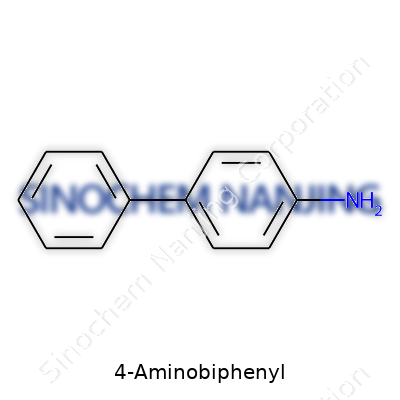
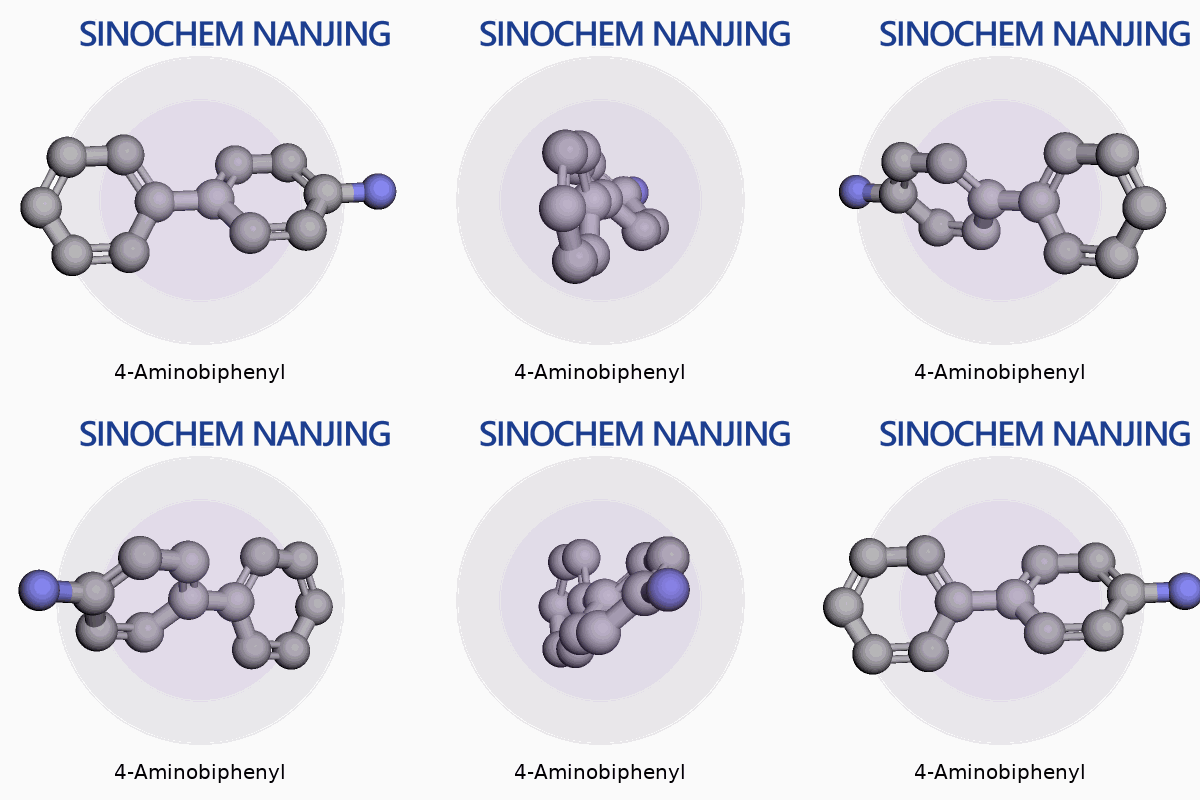
| Names | |
| Preferred IUPAC name | N-(phenyl)benzenamine |
| Other names |
4-Aminobiphenyl 4-Phenylaniline 4-Biphenylamine p-Phenylaniline p-Aminobiphenyl 4-Biphenylamine p-Biphenylamine |
| Pronunciation | /ˌfɔːr.əˌmiː.nəʊ.baɪˈfiː.nɪl/ |
| Identifiers | |
| CAS Number | 92-67-1 |
| Beilstein Reference | '077873' |
| ChEBI | CHEBI:28238 |
| ChEMBL | CHEMBL1421 |
| ChemSpider | 13660 |
| DrugBank | DB06732 |
| ECHA InfoCard | 100.007.222 |
| EC Number | 202-177-1 |
| Gmelin Reference | 79238 |
| KEGG | C06585 |
| MeSH | D001815 |
| PubChem CID | 7079 |
| RTECS number | AU1400000 |
| UNII | R8XD0U73Z3 |
| UN number | UN3442 |
| Properties | |
| Chemical formula | C12H11N |
| Molar mass | 169.22 g/mol |
| Appearance | Light brown crystalline solid |
| Odor | amine-like |
| Density | 1.186 g/cm³ |
| Solubility in water | Insoluble |
| log P | 1.8 |
| Vapor pressure | 1.62E-3 mm Hg at 25 °C |
| Acidity (pKa) | 4.6 |
| Basicity (pKb) | 3.68 |
| Magnetic susceptibility (χ) | -66×10⁻⁶ cm³/mol |
| Refractive index (nD) | 1.666 |
| Dipole moment | 2.17 D |
| Thermochemistry | |
| Std molar entropy (S⦵298) | 286.7 J·mol⁻¹·K⁻¹ |
| Std enthalpy of formation (ΔfH⦵298) | 134.7 kJ/mol |
| Std enthalpy of combustion (ΔcH⦵298) | −4476 kJ/mol |
| Pharmacology | |
| ATC code | D03AX10 |
| Hazards | |
| Main hazards | May cause cancer. Causes damage to organs through prolonged or repeated exposure. Toxic if swallowed, in contact with skin or if inhaled. |
| GHS labelling | GHS02, GHS06, GHS08 |
| Pictograms | GHS06,GHS08 |
| Signal word | Danger |
| Hazard statements | H350: May cause cancer. |
| Precautionary statements | P201, P202, P260, P264, P270, P280, P301+P310, P308+P313, P405, P501 |
| NFPA 704 (fire diamond) | 3-2-2-** |
| Flash point | 138°C |
| Autoignition temperature | 615 °C (1139 °F; 888 K) |
| Lethal dose or concentration | LD50 oral (rat) 200 mg/kg |
| LD50 (median dose) | 207 mg/kg (rat, oral) |
| NIOSH | NILO38000 |
| PEL (Permissible) | PEL: 0.1 mg/m3 |
| REL (Recommended) | 0.01 mg/m³ |
| IDLH (Immediate danger) | 0.2 mg/m3 |
| Related compounds | |
| Related compounds |
Biphenyl Azobiphenyl N-Phenyl-2-naphthylamine Benzidine |



