3-Octyne: A Commentary on an Unsung Building Block
Historical Development
3-Octyne might not spark recognition like acetylene or ethylene, but chemists have been tinkering with its carbon backbone for generations. Alkyne chemistry shaped organic synthesis through the 19th and 20th centuries, fueled by the hunger for new routes to pharmaceuticals, materials, and fuels. Triple bonds drew early attention thanks to their reactivity, and as alkyne synthesis techniques matured, straight-chain internal alkynes like 3-octyne entered practical laboratories. From Grignard reagents in the early 1900s to organometallics in the postwar era, the path to 3-octyne broadened, supporting transformations unheard of in earlier decades. Today, demand for cleaner processes and targeted synthesis keeps interest alive as folks explore new applications for this molecule.
Product Overview
3-Octyne, an internal alkyne with eight carbons and a triple bond at the third position, stands as a versatile intermediate. Chemists rely on its terminal methyl groups and hidden reactivity within its triple bond to prepare specialized compounds. It appears in research labs as a colorless liquid, often bottled under inert gas due to its tendency to react with air and moisture. Distributors provide standardized specifications, but in academia and industry, hands tend to reach for 3-octyne mostly in tasks where selectivity and manageable volatility matter.
Physical & Chemical Properties
Pouring 3-octyne feels much like pouring most mid-length hydrocarbons: a lightweight, clear liquid, often with a mild, characteristic odor sometimes described as sweet. It boils around 144°C, making handling under standard atmospheric pressure straightforward if done with care. The triple bond makes it stand out from more inert alkanes and alkenes. Its density floats just under 0.74 g/cm3 at 20°C. Low solubility in water keeps cleanup manageable, but it dissolves well in organic solvents, such as ether or dichloromethane. The π bonds of the alkyne crack open a world of chemistry, from cycloadditions to reductions, strategies that form the backbone of modern molecular design.
Technical Specifications & Labeling
Firms distribute 3-octyne in glass bottles, sealed with screw caps and sometimes septa for repeated withdrawals using syringes. Labels list the standard technical details: molecular formula (C8H14), molecular weight (110.2 g/mol), and registry numbers like CAS 629-81-4. Suppliers often guarantee purities above 97%, specifying trace impurities when possible. Labels also warn of its flammability and call out safety measures—details that experienced chemists take seriously, especially where open flames or static discharges lurk nearby.
Preparation Method
Practical synthesis rests on solid organic methods. A common lab approach starts with a dihalo-octane precursor, such as 3,3-dibromooctane. Treatment with strong bases, often sodium amide or potassium tert-butoxide, strips away halides and generates the triple bond at the third position. Another route links smaller alkynes or alkenes via coupling reactions with palladium catalysts, especially when functional group compatibility matters. In industry, the challenge grows with scale, as distillation and purification must balance cost and safety. Each process draws from a history of incremental improvements—a tradition running back through decades of laboratory trial and refinement.
Chemical Reactions & Modifications
The triple bond in 3-octyne makes it a playground for reactions. Hydrogenation over Lindlar's catalyst quietly converts it into cis-3-octene, while sodium in ammonia pulls it down to the trans isomer. Halogenation offers quick routes to dihalo derivatives, often serving as intermediates for further coupling or substitution. Ozonolysis splits the alkyne into smaller aldehydes and ketones, feeding directly into synthetic plans for fragrances, agrochemicals, or pharmaceuticals. With the right metal catalysts, cross-couplings tack on side chains that open up access to designer molecules. These reactions echo the deep toolbox organic chemists lean on to solve real-world synthesis puzzles.
Synonyms & Product Names
Beyond “3-octyne,” this compound surfaces under several names: Oct-3-yne, dipropylacetylene, and 3-Oktin all describe the same structure. CAS number 629-81-4 remains the best way to order the compound without confusion, but naming habits differ across catalogs, reference works, and languages. Strict adherence to IUPAC rules helps researchers communicate across borders, but many still hunt for familiar names from the days before strict standardization.
Safety & Operational Standards
People dealing with 3-octyne owe themselves a close reading of its safety data. This liquid catches fire easily—vapors can ignite at room temperature—so open flames, sparks, or even warm heating elements become hazards. The liquid irritates skin and eyes, and inhalation should be avoided by working in a well-ventilated fume hood. Storage in tightly sealed containers under inert gas minimizes oxidation. Professional protocols require flame-resistant lab coats, goggles, and gloves. Safety data sheets recommend Class B fire extinguishers for emergencies, and training ensures that lab personnel know the right procedures, instead of simply reacting to an accident.
Application Area
Mainstream uses of 3-octyne stay close to the lab, but its broader significance lies in synthesis. Organic chemists use it as an intermediate for pharmaceuticals, fragrance molecules, and specialty polymers. Certain ligands for catalysis grow from the triple bond, giving chemists new ways to control complex reactions. In materials science, modified alkynes form the backbone of crosslinkers and specialty coatings. Not many direct applications outside specialized research markets exist, but its legacy recycles through products people use every day—from medications to consumer electronics—via its role in their synthesis.
Research & Development
Research groups push the boundaries of alkyne chemistry, and scarcely a year passes without new methods for making or transforming molecules like 3-octyne. Recent work explores more efficient coupling reactions, seeking ways to stitch atoms together with less waste and lower energy. Advances in catalysis now let chemists introduce functional groups where they matter most, improving yields of targeted products. Computational chemistry helps predict possible byproducts or hazards, tightening up process controls both in academic labs and pilot plants. These innovations draw on broad experience and an ever-growing collection of real-world data, driving the shift toward greener, safer methods.
Toxicity Research
Direct toxicity data for 3-octyne remains limited, partly due to its confined usage to professional environments. Most of the risk comes from its flammability and potential to depress the central nervous system through inhalation, much like many other medium-chain hydrocarbons. Animal studies suggest moderate acute toxicity but little evidence for chronic or carcinogenic effects at the levels used in labs. No one should discount long-term risks, since solvents and reactive intermediates often surprise with slow-building effects. Best practice calls for the strict use of personal protective equipment, fume hoods, and careful waste disposal—habits that keep exposure far below any dangerous threshold.
Future Prospects
Attention increasingly turns to sustainable processes, and 3-octyne fits into this trend as both a test case and a tool. Chemists search for ways to recycle byproducts, replace toxic reagents, and improve atom economy in synthetic routes involving alkynes. Automation and data analytics help spot trouble areas—energy use, waste generation, or worker exposure—and bring new solutions to old challenges. As the chemical industry tightens restrictions and pursues ever-cleaner targets, specialty alkynes like 3-octyne stand to benefit from greater standardization and fresh methods for safer synthesis. Continued research, bolstered by cross-disciplinary cooperation, keeps the possibilities open—reshaping the landscape for products, processes, and the people who rely on them.
What is 3-Octyne used for?
What Makes 3-Octyne Special?
3-Octyne doesn’t pop up in everyday conversations outside a chemistry lab, but it plays a bigger role than most people think. This molecule looks like a simple chain: eight carbon atoms lined up, with a triple bond buried between the third and fourth carbons. That triple bond is more than just a structural quirk—it gives 3-Octyne unique energy. Chemists, especially those who work in organic synthesis, treat molecules like these as building blocks for creating new compounds.
Sparking Reactions in the Lab
I spent my chemistry grad school days elbow-deep in organic reactions, and alkynes like 3-Octyne always drew interest. That reactive triple bond doesn’t just sit there—it opens the door to all sorts of transformations. You start with 3-Octyne if you need to add atoms in very specific ways, which matters when building medicines or specialty chemicals. In cross-coupling reactions, for instance, 3-Octyne helps chemists link together carbon fragments, a step that often shows up in the creation of pharmaceutical intermediates or designer materials. Those connections don’t just happen by accident; you need a solid starting point, and this alkyne offers that.
A Niche Ingredient in Research
Most people will never see a jug labeled “3-Octyne” outside a lab, but it plays a behind-the-scenes part in shaping materials and drugs. In research, small quantities usually suffice. The labs I worked in used 3-Octyne as a “model substrate,” meaning scientists test new reactions on it to see what sticks. The triple bond reacts in predictable ways, helping chemists predict how stranger, more complex molecules might behave. This step saves both time and money, which matters a lot in research budgets stretched tight.
Impacts on Industry and Beyond
Chemical manufacturers don’t churn out 3-Octyne by the ton, but they keep a steady supply for specialty applications. Even with my background in drug discovery, I saw 3-Octyne show up now and then in patents and process tweaks. For dyes and electronic materials, manufacturers rely on small adjustments at the molecular level. 3-Octyne’s reactive triple bond lets them add new groups or change how electrons flow through a molecule. The end result affects properties like conductivity or color—attributes crucial in everything from solar cells to OLED displays.
Handling and Safety Concerns
There’s a flipside to this molecule’s reactivity: you want steady hands when handling it. Like other small alkynes, 3-Octyne can irritate skin and lungs. Spills need prompt cleanup, and storage calls for a cool, well-ventilated space. Chemists need to keep these facts front of mind, because it’s no good chasing new discoveries if you ignore basic safety.
Thinking Ahead: Sustainability and Efficiency
As labs everywhere try to cut waste and improve efficiency, 3-Octyne’s story isn’t finished. Chemists continue searching for greener ways to make and use specialized alkynes. Recyclable catalysts and less toxic solvents are gaining ground. My former colleagues now talk about atom economy—not just getting to the right molecule, but creating less waste in the process. Progress moves step by step, and each tweak brings society a little closer to safer, more sustainable science.
What is the chemical formula of 3-Octyne?
Chemistry’s Real-World Puzzles
Chemical formulas might look intimidating, but getting down to the nuts and bolts of a compound’s structure actually says a lot about its use and safety. 3-Octyne has a straightforward formula: C8H14. This formula sits at the crossroads of organic chemistry and real life, showing what happens when carbon bonds build something more than just an abstract shape.
Why Structure Matters
Take 3-Octyne as an example. It forms with eight carbons in a row, plus a triple bond wedged between the third and fourth carbon. This feature splits the formula from other octynes, making it a specific target for chemists in research and industry. Double-checking the formula gives more than rote facts. C8H14 isn’t random; it comes from the way each extra bond between carbon atoms “removes” hydrogen from the typical alkane count. That shift changes how the compound acts—something that matters whether a synthetic chemist or someone handling materials in a warehouse.
What 3-Octyne Is Good For
Most folks don’t run into 3-Octyne at the grocery store, but it still earns its keep in labs. Triple-bonded compounds like this show up in reactions aiming for new molecules. Those reactions matter in drug discovery and material science, pushing boundaries of what chemists use in renewable energy or electronics. For someone tinkering with molecular design, getting the formula wrong means the whole reaction falls apart. C8H14 helps keep that target precise.
Real Risks and Handling
Reading safety sheets, 3-Octyne’s formula tells you to expect volatility. With fewer hydrogens compared to its saturated cousin octane, that triple bond opens up the molecule for reactions that can get out of hand fast. The industry sees plenty of cases where accidental ignition or poor storage triggers dangerous events. Sticking to proper labeling—right down to the formula—reduces that confusion and protects both lab workers and the public.
Improving Chemical Literacy
In schools, students hit walls with chemistry formulas, thinking it’s all memorizing. Demystifying a formula like C8H14 changes that. Students picking up connections between structure, reactivity, and use will build skills to spot mistakes before they snowball. Seeing how a small difference in the formula means everything also supports smarter regulation policy—especially as new synthetic compounds stack up on the market faster than regulators can test them.
Clear Guidelines for Industry
No formula alone guarantees safety or innovation, but paying attention to the fine print pays off. Manufacturers standing by firm identification and training avoid costly recalls or incidents. Chemists need to label, store, and use compounds based on a correct understanding of what sits on their shelf. Getting a handle on something as simple as 3-Octyne’s chemical formula, C8H14, keeps businesses and communities safer—and pushes work forward, not back.
What are the storage and handling requirements for 3-Octyne?
Why 3-Octyne Deserves Respect in the Lab
3-Octyne often shows up in organic synthesis work, and its triple-bonded nature brings both opportunity and risk. I’ve worked with a fair share of lab reagents, but few demand as much care as an alkyne like this one. Triple bonds store a lot of energy, and most alkynes stay flammable. One careless spark can turn a routine task into an emergency.
Keeping 3-Octyne Safe: Temperature, Air, and Light
Experience taught me to always read the label before unstopping any bottle labeled “alkyne.” 3-Octyne holds a flash point far below room temperature—around 37°C. Imagine a hot summer day in a poorly ventilated storeroom: that’s all it takes to cross the line from safe to risky. The right storage space for 3-Octyne uses controlled temperatures, away from any sources of ignition, and keeps air circulation in mind. Sealing the container tightly stops vapors from escaping and meets OSHA's and NFPA's safety codes.
Most chemists store this liquid in flammable safety cabinets made of metal, not wood or plastic. Open shelves simply don’t offer enough protection, in my view. Light speeds up certain unwanted reactions, especially if the compound starts with a high-energy bond. That’s why you find 3-Octyne in amber glass bottles, tucked out of direct sunlight.
Why Water and Oxidizers Spell Trouble
If you’ve ever worked with reactive chemicals, you know not all substances get along. 3-Octyne reacts strongly with oxidizers—nitric acid or perchlorates, for instance. Even a drop of the wrong chemical in the bottle easily leads to fires. I always double-check to keep alkynes far from acids, bases, and halogens. A splash of water often causes more problems than it solves, as water may spread the compound or form hazardous mixtures. Dry, clean hands and tools reduce those risks.
The Right Tools and Personal Protection
My own mistakes taught me not to take shortcuts on personal gear. Handling 3-Octyne always starts with chemical splash goggles, a flame-resistant lab coat, and gloves made of nitrile or butyl rubber—never bare hands or cheap latex. Sometimes, even the best containers leak or crack, so using glassware in good condition makes a big difference.
Chemical fume hoods, not open benches, deserve the job of handling vapors. Breathing in any volatile organic compound feels risky, but with 3-Octyne, even a short exposure irritates the respiratory system. Proper airflow and well-fitted masks in tight spaces mean safer work for everyone.
What Happens After the Job is Done
Simple disposal habits sparred me trouble in the past. Pouring leftover 3-Octyne down the drain breaks both the law and good sense. Instead, the compound goes into organic waste containers, stored separately from acids, to get picked up by hazardous waste teams. Spills require a clear head and absorbent pads meant for solvents—not paper towels or rags.
Building Safer Habits: Training and Planning
The best safety tool isn’t hiding in a cabinet or a kit; it's knowing your chemicals and routines. Regular fire drills and safety reviews turned out to be more useful than any warning sign on a cabinet door. Sharing lessons from close calls, checking the latest guidelines, and investing in hands-on training shape a safer lab culture. In my time, simple, well-taught protocols helped new staff build confidence and prevented serious accidents before they had a chance to begin.
Is 3-Octyne hazardous or toxic?
What is 3-Octyne?
3-Octyne sits under the family of alkynes. You find it in labs as a colorless liquid, and it's used mostly for synthesizing other chemicals or in advanced research and development projects. Unlike everyday substances, most folks won't come across this compound outside controlled settings. The name might fly over most heads, but anyone working around it has a reason to pay close attention to what it does and how it behaves.
Working With 3-Octyne Isn’t a Free Pass
Step into a chemistry lab, and you learn to respect each bottle’s label. 3-Octyne carries the sort of warnings you shouldn't brush off. If it touches skin, expect irritation. If it sneaks into your eyes, pain and damage are likely. Getting a strong whiff isn’t pleasant either – inhaling its fumes can leave your throat sore or coughs lingering. I remember working with similar hydrocarbons in research, always wearing gloves and running reactions under a fume hood. The air in those labs needed constant checking, and the smallest spill meant a scramble for spill kits and an immediate report.
Thinking Beyond the Label
SDS (Safety Data Sheets) label 3-Octyne as both flammable and an irritant, and these aren't empty warnings. It can catch fire easily if exposed to a spark or open flame. The vapors spread fast and can travel across a room to an ignition source you didn't even see coming. Fire risk jumps in labs where solvents and reactive chemicals mix. In my days helping grad students set up experiments, training always started with fire drills and emergency shower demonstrations before we even touched the bottles.
Is 3-Octyne Toxic?
Toxicity hides in the details. Data on 3-Octyne remains spotty compared to big-name toxins, yet it's still clear: this isn’t a chemical to take lightly. As with many alkynes, exposure over time can lead to headaches, dizziness, and possible nervous system effects. These symptoms mirror what you find in hydrocarbon misuse cases. Drinking or eating 3-Octyne? That would kick up serious stomach and nervous system trouble, much like swallowing other solvents. Regulatory agencies, including OSHA and the European Chemicals Agency, place strict use and exposure limits on chemicals in this family for good reason.
Environmental Impact and Disposal Problems
Flushing unused 3-Octyne down the sink? Bad call. Left unchecked, organic solvents pollute water sources, and aquatic life suffers. Years in shared research spaces hammered in lessons about proper disposal. Licensed hazardous waste handlers, not students or staff, have the last word in getting rid of such materials. Many schools post regular reminders in chemical storage rooms: no shortcuts, no exceptions.
How to Manage The Risks
No science building runs on luck. Personal protective equipment covers the basics—gloves, splash goggles, and fume hoods. Knowledge takes center stage. Any team that gets lazy about safety soon learns the cost. Annual safety trainings boil down to one point: Most accidents start with small oversights. Good habits, such as labeling containers and airing out spaces, don't just protect workers—they keep costly incidents from shutting down projects.
Push for updated protocols and independent audits. Trust, but verify. Listen to the professionals who’ve spent years around high-risk reagents. Their rules aren’t about slowing research; they’re there so the work keeps moving forward, and everyone goes home whole at the end of the day.
Where can I purchase 3-Octyne?
The Straight Story on Sourcing 3-Octyne
You don’t find 3-Octyne at a local hardware store. This kind of specialty compound usually finds its way into research labs, chemical syntheses, or advanced manufacturing. In the real world, that means suppliers dealing with high-purity chemicals serve up 3-Octyne—think Sigma-Aldrich, TCI, Alfa Aesar, or Fisher Scientific. These companies live and breathe chemical sourcing, but the rules around it don’t play. Most will ask for proof you’re not just curious but actually need 3-Octyne for legit research or business.
Safety and Regulation
No one hands out 3-Octyne to just anyone, especially after so many crackdowns on chemical misuse. Suppliers often require more than just a credit card. Registration, a valid business or institutional account, and details about intended use become part of the transaction. In my lab days, ordering something as common as acetone involved reams of paperwork, so expect a few more hoops for an alkyne like this. Regulatory frameworks such as REACH in Europe and federal guidelines in the US keep tabs on who buys and how they store these chemicals, and for good reason. Misuse or mishandling can turn a simple transaction into a news headline.
Why Purity Isn’t Just a Buzzword
There’s a big difference between 99% and lower purities, especially in chemical synthesis. Trace contaminants might not seem like much, but they can derail experiments or introduce dangerous byproducts. Suppliers publish technical data sheets and Certificates of Analysis—anyone with hands-on experience learns to double-check these before hitting the order button.
Pricing and Access
Anyone familiar with the market knows pricing swings wildly depending on scale. Universities and accredited labs often score deals through standing agreements, but individuals buying a small bottle for a class project find themselves paying a premium. Shipping tacks on extra expense, to say nothing of regulations governing the movement of potentially hazardous materials. Air shipping usually isn’t even an option.
How Responsible Buyers Operate
The days of the "Wild West" approach to laboratory chemicals are long gone. Credibility matters. Academic credentials, legitimate project goals, and a clear understanding of chemical handling go a long way. Responsible buyers always lean on training, safety data sheets, and secure storage. I remember a time a simple lapse in process nearly resulted in an incident—reminders like that stick.
Supporting Safe and Ethical Use
The chemistry community puts a premium on trust. Ethical sourcing doesn’t just shield buyers from legal hot water; it protects everything from lab personnel to the environment. Instructors, lab managers, and project leads should take every purchase as a teaching opportunity. Document purchases, monitor usage, and make sure everyone on the team knows the risks and safety steps associated with the chemicals in use. That’s how a community builds trust over time and keeps harm at bay.
Smart Choices Move the Field Forward
Looking forward, a lot of suppliers have started upgrading online platforms, giving buyers better transparency on availability, lead times, and legal requirements. Building clear channels between buyers and sellers—supported by strong safety standards—sets everyone up for success. 3-Octyne isn’t just another bottle on a shelf. It represents a test of professional responsibility, from sourcing and storage to final use.
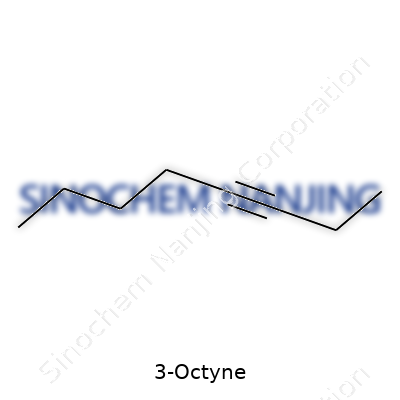
| Names | |
| Preferred IUPAC name | oct-3-yne |
| Other names |
Ethylpentylacetylene Dipropylacetylene |
| Pronunciation | /ˈθriːˈɒktaɪn/ |
| Identifiers | |
| CAS Number | 629-09-4 |
| Beilstein Reference | 0111303 |
| ChEBI | CHEBI:53288 |
| ChEMBL | CHEMBL1220862 |
| ChemSpider | 65035 |
| DrugBank | DB01976 |
| ECHA InfoCard | 100.120.967 |
| EC Number | 208-864-5 |
| Gmelin Reference | 67637 |
| KEGG | C01716 |
| MeSH | D010342 |
| PubChem CID | 78441 |
| RTECS number | RN2125000 |
| UNII | 85A6V2C36G |
| UN number | UN3295 |
| CompTox Dashboard (EPA) | DJ04Z9195C |
| Properties | |
| Chemical formula | C8H14 |
| Molar mass | 110.19 g/mol |
| Appearance | Colorless liquid |
| Odor | Unpleasant |
| Density | 0.748 g/mL at 25 °C (lit.) |
| Solubility in water | Insoluble |
| log P | 1.99 |
| Vapor pressure | 0.93 mmHg (at 25 °C) |
| Acidity (pKa) | 25 |
| Basicity (pKb) | pKb = 25.0 |
| Magnetic susceptibility (χ) | -29.3e-6 cm³/mol |
| Refractive index (nD) | 1.416 |
| Viscosity | 0.694 mPa·s (at 20 °C) |
| Dipole moment | 0.44 D |
| Thermochemistry | |
| Std molar entropy (S⦵298) | 254.7 J·mol⁻¹·K⁻¹ |
| Std enthalpy of formation (ΔfH⦵298) | 114.1 kJ/mol |
| Std enthalpy of combustion (ΔcH⦵298) | -4704.8 kJ/mol |
| Hazards | |
| GHS labelling | GHS02, GHS07 |
| Pictograms | GHS02,GHS07 |
| Signal word | Danger |
| Hazard statements | H226, H315, H319, H335 |
| Precautionary statements | P210, P261, P280, P305+P351+P338, P312 |
| NFPA 704 (fire diamond) | 2 3 2 |
| Flash point | 35 °C (95 °F; 308 K) |
| Autoignition temperature | 225 °C |
| Explosive limits | 1% - 7.2% |
| Lethal dose or concentration | LD50 (oral, rat): 7000 mg/kg |
| NIOSH | RN2001 |
| PEL (Permissible) | Not established |
| REL (Recommended) | 0.6 ppm |
| IDLH (Immediate danger) | No IDLH established. |



