3-Nitroanisole: A Comprehensive Commentary
Historical Development
The journey of 3-nitroanisole traces back over a century, rooted in early synthetic organic chemistry research before World War I. Early chemists—many working with limited analytical tools—discovered that the methoxy group and the nitro group could be combined on a benzene ring, unlocking new reactivity and potential applications. Industrial interest really took off in the mid-20th century, spurred by the proliferation of dye and pharmaceutical manufacturing. As chemical synthesis grew more advanced, so did methods for making 3-nitroanisole, shifting production from small batch experiments to large-scale processes. Over the decades, regulation and safety standards grew more strict, reflecting society’s changing relationship with chemicals and worker safety. The molecule didn’t just attract industry; academic researchers used it to study aromatic substitution, crystal structure, and molecular electronics, pushing the field forward.
Product Overview
3-Nitroanisole stands out with its pale yellow crystalline form. It doesn’t draw much attention in the household chemicals aisle, but in laboratories and manufacturing floors, it tells an important story. Chemists pick it as a starting material for pharmaceuticals, dyes, and agrochemicals. It offers both electron-rich and electron-withdrawing features, making it flexible for designing new molecules. In my own work, few substances combine practicality and reactivity as effectively—its presence often signals that a synthesis route brings together creativity and practicality in one vessel.
Physical & Chemical Properties
3-Nitroanisole appears as yellow crystals or a light brown powder, melting around 57–59°C. Density measures near 1.25 g/cm³, with a molecular formula of C7H7NO3 and a molar mass of 153.14 g/mol. Its solubility profile draws a line: soluble in organic solvents like ethanol, ether, and acetone but nearly insoluble in water. The methoxy group strongly influences its boiling point, set high enough for distillation but low enough to avoid harsh conditions—roughly 290°C. These properties make storage straightforward, though the compound shouldn’t mix with strong acids or bases due to potential degradation. While its structure looks ordinary, the arrangement of functional groups creates interesting electronic properties exploited in both synthesis and research.
Technical Specifications & Labeling
Industry demands clear labeling and documentation. Technical grades specify purity levels—often above 98% for pharmaceutical use—while manufacturers provide humidity and impurity data to help end users avoid contamination problems. Labels include the CAS number 555-19-3, UN number for transport, and hazard warnings per global harmonized systems. Any container, from a 1 kg lab bottle to a 200 kg industrial drum, carries this information. In my experience, oversight creeps in when teams forget that even small trace contaminants disturb sensitive catalytic reactions, so rigorous record-keeping matters.
Preparation Method
Most producers synthesize 3-nitroanisole using nitration of anisole. This classic process mixes anisole with a mixture of concentrated nitric and sulfuric acids, managing temperature to ensure the nitro group lands in the meta position. Not every synthetic chemist enjoys handling strong acids, but the results prove reliable. Yields often surpass 75% with careful temperature control and post-reaction work-up—neutralization, extraction, and crystallization. Parallel research explores greener approaches, such as using solid acid catalysts or less hazardous reagents, in response to waste and environmental challenges tied to traditional nitration.
Chemical Reactions & Modifications
3-Nitroanisole offers a reactive template for a host of transformations. The nitro group lends itself to reduction, opening access to 3-methoxyaniline—a useful intermediate for dye and drug synthesis. Nucleophilic substitution or coupling reactions with the methoxy group can yield compounds for research or technology applications. In pharmaceutical laboratories, hydrogenation transforms the compound further. In each case, chemists adjust conditions—catalyst, pressure, pH—to enrich yields or selectivity. Reactions proceed smoothly due to a balance of electron-donating and withdrawing features, making the molecule both tunable and versatile.
Synonyms & Product Names
In catalogs, 3-nitroanisole appears under several names: m-nitroanisole, meta-nitroanisole, and 1-methoxy-3-nitrobenzene. Some suppliers use identifiers like UNII, EINECS, or regulatory codes, but most researchers cite the CAS number to avoid confusion. Each synonym stems from the molecule’s position of the nitro group relative to the methoxy moiety. This alphabet soup sometimes confuses new researchers, but a sharp eye on the molecular formula or structure resolves ambiguity.
Safety & Operational Standards
Handling 3-nitroanisole puts safety front and center. The compound can cause skin and eye irritation, so lab workers rely on gloves, goggles, and fume hoods. Dust production or direct inhalation triggers respiratory discomfort, so best practices mean closed transfer or proper ventilation. Regulatory bodies classify the compound as hazardous, requiring companies to maintain up-to-date Safety Data Sheets (SDS) and employee training. My own workplace drills regular spill response protocols—absorbent materials, protective suits—because accidents, though rare, shouldn’t catch anyone unprepared.
Application Area
3-Nitroanisole’s main role surfaces in organic synthesis. In pharmaceuticals, it leads to new analgesics, anti-inflammatory agents, and local anesthetics. Agrochemical producers use it as a precursor for herbicides and fungicides. Dyes and pigments industries count on it for producing intermediates, especially where purity and colorfastness make or break the product. More recently, research teams explore its role in specialty chemicals, including liquid crystals and materials for organic electronic devices—a reminder that even classic intermediates find new places.
Research & Development
Research around 3-nitroanisole continues evolving, mostly in greener synthesis and novel reactivity. Teams test alternative catalysts for nitration, aiming to lower hazardous waste and cost. Some studies center on detailed reaction mechanisms, using the molecule to map electron flow and substituent effects in aromatic systems. Novel derivatives, especially those with biological activity, often trace their lineage back to 3-nitroanisole. Computational chemists study its properties to model molecular electronics, gauging how substitutions alter conductivity at the nanoscale—work that underpins advances in sensors and optoelectronics.
Toxicity Research
Toxicological studies show 3-nitroanisole can harm living systems at moderate to high exposures. Animal tests indicate possible liver and kidney effects with repeated contact. In humans, acute contact irritates skin, eyes, and—less commonly—the respiratory tract. No hard evidence ties ordinary laboratory use to cancer or chronic disease, but caution rules practice and policy. Environmental persistence and breakdown raise more red flags, pushing regulators to limit emissions and waste. The chemical doesn’t threaten in the same league as classic carcinogens, yet its risks deserve attention and respect.
Future Prospects
3-Nitroanisole carries lessons from the past into the future. As regulations tighten and demand for greener, safer chemical processes grows, new synthesis techniques will likely use renewable feedstocks, alternative energy sources, or continuous flow reactors. Creative researchers may invent new uses in fine chemicals, electronic materials, or functional polymers. Its balanced reactivity—able to launch a wide array of transformations—keeps it on the radar for both academic and industrial chemists looking for efficiency and innovation. The key remains stewardship: using established knowledge to manage risks while exploring new opportunities, and always keeping an eye open for safer, more effective ways forward.
What is 3-Nitroanisole used for?
A Closer Look at 3-Nitroanisole in Industrial Chemistry
Walking through a chemical plant, I've seen many bottles marked with names that barely roll off the tongue. One of those, 3-nitroanisole, might not draw a crowd, but its impact reaches farther than its modest place on the shelf suggests. Folks in the dye and pigment sector know this compound well. Chemists use 3-nitroanisole as a starting material to make a family of azo dyes. These dyes color everything from fabrics to plastics, giving everyday objects those vibrant reds and deep blues you spot at the mall. Factories use this compound to make intermediates for certain pharmaceuticals, too.
Producing Colors and More
3-Nitroanisole’s real influence comes from its role in creating vivid, lasting dyes. Cotton shirts, synthetic fibers, coatings, and inks owe much to intermediates like this one. A chemical tweak here, a reduction step there, and the product can become a building block for paracetamol or a key piece in sunscreen agents. It’s not just about color — this compound sits at the beginning of a production chain that ends up in medicine cabinets and art studios alike.
Handling Risks and the Human Side
During my time around chemical labs, I’ve met plenty of smart folks who understand that handling 3-nitroanisole brings real hazards. Inhaling its dust or getting it on your skin doesn’t end well. Long-term exposure affects organs and sometimes shows up in blood test results as cause for concern. Europe’s REACH framework flags this chemical for careful handling because it threatens both human health and the environment if things go sideways. Workers need gloves, goggles, real ventilation, and strong training. These aren’t just OSHA checklist items — I saw firsthand how a single slip-up could lead to days off work or a trip to an urgent care clinic.
Lack of awareness sometimes leads to risky behavior. I remember a shift where a new technician skipped her mask, figuring “it’s just a little powder.” She learned fast: safety isn’t extra, it’s essential.
Finding Safer and Greener Paths
Environmental impact remains a sticking point. Disposing of chemical waste from dye synthesis contributes to water pollution downstream. Companies face public pressure and legal incentives to improve their track record. Better closed systems, real-time monitoring, and green chemistry offer genuine hope. Green chemistry, for example, designs chemistries that cut hazardous byproducts, which means fewer headaches for plant staff and less damage to rivers.
Education also has a seat at the table. Training sessions that go beyond the basics — not just safety lectures but hands-on drills with actual spill responses — make a real difference. Sharing success stories across companies pushes the entire field to keep standards high.
Looking Toward an Informed Future
3-Nitroanisole’s story speaks to the balancing act between progress and responsibility. We depend on its chemistry for colors, medicines, and materials that fuel modern life. At the same time, stronger oversight, better worker protections, and cleaner production steps offer a path where benefits don’t have to come at the cost of health or the environment. Speaking from experience, having clear rules and a culture that values every worker’s safety raises the bar for everyone involved.
What is the chemical structure of 3-Nitroanisole?
Digging Into the Structure
3-Nitroanisole’s formula shows up in chemistry books as C7H7NO3. It's easy to get lost in formulas, but let’s break it down. There's a benzene ring as its backbone—a classic six-carbon loop with alternating double bonds. Add a methoxy group—basically an oxygen attached to a methyl (–OCH3)—hooked to the first carbon. Then, hang a nitro group (–NO2) off the third carbon. This setup puts the nitro and methoxy groups in what chemists call the “meta” positions, separated by one carbon on the ring.
In the lab, seeing those bright yellow crystals reminds you that structure shapes function. The methoxy part tweaks where reactions hit the ring, making some positions more attractive for incoming chemicals. The nitro stretches the molecule’s electronics, so it responds differently than plain anisole.
Why Structure Matters Outside the Lab
It’s tempting to see molecules like 3-nitroanisole as background players, but their details affect plenty of real-world problems. One example is dye manufacturing. This molecule pops up when you start fiddling with azo dyes for textiles. Factories depend on a reliable process, so understanding where that nitro group sits makes life easier for process chemists—get the wrong position, and the final color might not last through a single wash cycle.
Living near a chemical plant growing up taught me respect for what leaves those smokestacks. Structure directs not just how a molecule works, but how stubborn it gets in the environment. That nitro group makes these compounds less likely to break down when they hit soil or water. Studies remind us: aromatic nitro compounds like this one hang around much longer than expected, sometimes getting into the food chain. The EPA’s records show several nitroaromatic byproducts drifting into river sediment or drinking water near old industrial sites.
Health and Safety: Concerns With Real Impact
Breathing, touching, or swallowing nitro-compounds carries risk. Chronic exposure can trigger headaches or, in rare circumstances, more serious issues if the dose is high. Some nitro aromatics have shown up in animal studies as possible carcinogens, raising enough concern that factory workers get extra protection. The World Health Organization and OSHA recommend strict limits and better monitoring for workers handling compounds with a similar structure. Gloves, masks, and fume hoods aren’t just for show in settings like these—they give workers a fighting chance to avoid harm from molecules with stubborn nitro groups.
Toward Better Uses and Smarter Choices
Safer handling starts with understanding what we’re looking at. Knowledge about 3-nitroanisole’s groups, their effects, and their persistence gives communities and regulators the information they need to push for safer processes. Synthetic chemists can swap in less toxic substitutes or design routes that skip problematic intermediates. Fishermen and families near rivers see better results after cleanup—testing and treating for nitro aromatics, not just headline-grabbing toxins, helps keep food and water safer.
Every molecule tells a story if you care to look. 3-Nitroanisole’s chemical structure hints at industrial growth and environmental responsibilities. The real progress happens when workers, companies, and communities treat these lessons as daily decisions, not distant facts.
Is 3-Nitroanisole hazardous or toxic?
Peeling Back the Label: What Is 3-Nitroanisole?
3-Nitroanisole shows up in the world of chemical manufacturing as a pale-yellow liquid, known to chemists who use it when making dyes, pharmaceuticals, and other specialty products. It carries a name that isn't familiar to many folks outside a lab, but the real question is whether it deserves more attention in conversations about safety and health at work and in the environment.
Digging Into Hazard Warnings
Right out of the gate, safety data sheets (SDS) for 3-Nitroanisole highlight a few red flags. Its main dangers come through inhalation, skin contact, or accidental ingestion. Exposure can bring headaches, drowsiness, and cyanosis—a bluish cast to the skin that hits when blood doesn't carry enough oxygen. Eye and skin irritation aren't just possible, they’re reported in documented cases.
Like other nitroaromatic compounds, 3-Nitroanisole belongs to a family known for being tough on the body if exposure piles up. Lab research and real-world accidents tell the story: workers making or using nitroaromatic chemicals have battled skin rashes and breathing issues for decades. It's not just about one incident—it’s the buildup that matters, and it doesn't take an expert to see how chronic exposure at low levels piles up risks over time.
Toxicity: Hear from Authority and Evidence
Agencies such as the European Chemicals Agency (ECHA) and the U.S. Environmental Protection Agency (EPA) speak openly about the risks. Animal studies connect regular contact with 3-Nitroanisole to changes in liver function and can impact bone marrow. That may sound like lab-only knowledge, but these facts reinforce the reason why protective gloves, masks, and ventilation systems matter so much in places where the chemical shows up.
I remember touring a facility years ago where attention to detail ranked high—there were signs of trust in personal protective equipment (PPE) everywhere. Only the trained staff could approach storage tanks, and everyone followed solid protocols. There's good reason: mistakes cost more than just time; they risk health and even lives if a spill or inhalation happens in a hurry.
Where the Danger Spreads: Spills and Disposal
This type of chemical doesn't stay in the lab. Accidental leaks or spills risk running into groundwater or soil. It doesn't break down quickly, so plants, insects, and small animals can carry longer-term risks. Once in a waterway, survival rates drop for aquatic life—nitro compounds reduce oxygen levels and stack more toxins in the food chain.
Regulations guide how to store, handle, and dispose of 3-Nitroanisole safely. Yet, in places with weak oversight, improper dumping or storage leaks happen. You see the real cost in regions where old chemical sites dump untreated waste; neighbors notice changes in water color and odor, often before tests confirm what's inside.
Practical Steps to Cut the Risk
Industry can shrink health impacts by using closed systems, boosting ventilation, and making PPE mandatory. Training programs should walk new hires through more than checklists—real-life stories and case studies make risks hit home. Community watchdog groups that push for transparency around chemical storage, reporting, and disposal build trust and provide an essential check on how responsibly companies act.
Solid policies only matter if people follow them. Managers, workers, and neighbors all have a role in catching slip-ups before they have a chance to hurt people or the environment. I’ve seen teams run drills, double-check labels, and keep records tidy—these steps might sound small, but they keep communities safer and uphold trust in businesses using chemicals like 3-Nitroanisole.
What are the physical properties of 3-Nitroanisole?
Understanding the Basics
3-Nitroanisole walks into the world of chemicals as a nitroaromatic compound and doesn't try to hide its yellowish look. Scientists and lab technicians spot it as a solid with a melting point hanging around 54 degrees Celsius. That means, in most lab rooms, it hangs out as a crystal, only turning to liquid if things heat up past a warm spring day. People have to take care with it because it lands right in that category of materials you don’t want melting on your hands.
The compound carries a slight, recognizable aroma, not sharp enough to turn heads, but it marks its presence clearly. In terms of density, it rests at about 1.29 g/cm³ at room temperature. So, a scoopful feels a little heavier than water but nowhere near metals. That weight gives some predictability when mixing it, packaging it, or moving it around in bottles.
Solubility and Behaviour in Liquids
Diving into water doesn’t come naturally for 3-nitroanisole. At room temperature, only a small fraction ends up dissolving in a glass of water. On the flip side, it mingles far more eagerly with organic solvents like ethanol, ether, acetone, or chloroform. That trait doesn’t just affect how you clean up spills; it shapes every decision in storage, handling, and synthesizing. Workers in chemical plants know the risks if they get sloppy with solvents around this compound.
Unlike some highly volatile organics, 3-nitroanisole keeps its cool. Its vapor pressure stays low at room conditions, so it doesn’t just vanish into the air. Labs can run high-precision reactions without worrying that the compound will drift away when someone opens a flask. This behavior reduces the risk of inhalation exposure and makes for a safer bench.
Stability and Reactivity
3-Nitroanisole stands up well under regular storage conditions, but no one ignores its nitro group. Strong heat or certain reducing agents can change the game, leading to potentially hazardous situations if not managed with respect. That nitro group sets it apart from commonplace substances, demanding care in both industrial scale and small research labs. Most fires in chemical plants come from ignoring details like these.
It doesn’t play well with strong acids, bases, or reducing agents. Improper handling or accidental mixing often leads to exothermic reactions or off-gassing that causes harm. This safety aspect doesn’t just matter for professionals. Students picking up their first samples in university labs often get lectures about this compound’s fiery side, learning quickly that book knowledge saves fingers.
Applications That Highlight Importance
Some see 3-nitroanisole as just another lab curiosity, but its properties put it front and center in pharmaceutical research and dye production. That low melting point means it works as an intermediate in chemical syntheses without excessive heating, saving time and energy. Its selective solubility tailors it for specific reactions, letting scientists draw clear boundaries between products and impurities. In the end, every bottle of 3-nitroanisole stands for a balance between reactivity and manageability—a physical story that touches many branches of applied science.
Practical Handling and Moving Toward Safety
The irritant nature of 3-nitroanisole pushes for gloves, goggles, and good ventilation as standard gear. Overexposure leads to headaches, nausea, and worse. Many experienced lab workers keep a mental note to store it in a cool, dry place, away from eager reactants or open flames. Awareness and clear guidelines prevent accidents far better than any warning label ever could.
Every bottle on a shelf serves as a quiet reminder: knowing a chemical’s physical properties doesn’t just help answer exam questions; it builds the habits and instincts that keep people out of harm’s way.
How should 3-Nitroanisole be stored and handled?
Realities of Working with 3-Nitroanisole
Anyone who has spent time in a laboratory knows that safety demands real habits, not rulebooks gathering dust on a shelf. 3-Nitroanisole sits in a category that calls for a bit more respect than your average organic compound. With experiences from cramped college labs to larger facilities, it sticks out as a chemical you want neither spilling nor vaporizing around you. Breathing in fumes or getting it on your skin is far from ideal, and it only takes a little lapse to learn that lesson the uncomfortable way.
Why Storage Matters More Than You Think
3-Nitroanisole can produce toxic fumes if it heats up too much or sits open to the air. Leaving that bottle near a sunny window or beside a source of heat may seem minor, but such choices risk not only lab equipment, but people’s health. I’ve seen once-organized shelves become overcrowded with old samples, forgotten, and leaking. Vapor sneaks up on you, especially after hours or on weekends, when the air system isn’t running at full strength. Keeping this compound locked away in a cool, well-ventilated space with good airflow helps block those toxic fumes from collecting. Sturdy metal or chemical-resistant cabinets outlast cheap plastic containers that crack or warp after repeated use.
Labeling and Segregation
I still remember the time a new hire thought all “yellow powders” could go on one shelf. Sorting by color can get you into trouble fast. 3-Nitroanisole belongs with compounds it won’t react with if a bottle cracks. Storing it away from acids, strong bases, and easily oxidized materials stops accidental reactions that can range from annoying to explosive. Clear, printed labels in bold fonts actually get read even on hectic days, unlike faded handwriting or cryptic markings.
Personal Experiences on Protective Equipment
Goggles and gloves sound basic, but more than once I’ve watched seasoned chemists wipe spills with bare hands, figuring a quick wash will do. With something like 3-Nitroanisole, skin contact isn’t just an irritation—it can absorb faster than you think. The right nitrile gloves don’t cost much, and sacrificing a pair at the first sign of contamination prevents plenty of problems. Lab coats and chemical splash goggles give an extra layer of security, especially during pouring or transfer.
Practical Solutions for Safer Labs
Good handling means more than just careful pouring. Using small containers and only bringing out as much as you need cuts down the chances of major spills. Designated chemical trays with raised edges catch drips before they reach the floor. Keeping all safety data sheets nearby builds trust—no one wants to scroll through emails while holding a leaking bottle. I’ve watched teams run regular “what-if” spill response drills, and every time, the act turns up issues you can fix before a real emergency hits.
Why Training Beats Any Label
People learn best by doing. Peer-to-peer training and demonstrations stick much better than a long policy handbook. A culture where people speak up about unsafe storage, no matter the source, means fewer accidents. It’s not about paranoia, but the simple reality that things go wrong fast, especially toward the end of a long shift or during a rushed experiment.
Final Thoughts on Responsibility
Working with 3-Nitroanisole presses you to stay vigilant. Every bit of attention on storage, labeling, and personal habits pays back tenfold in safety. Relying on up-to-date science, real experience, and shared responsibility across the team turns chemical handling from a risk into a routine. That’s the kind of approach that keeps labs thriving and people safe.
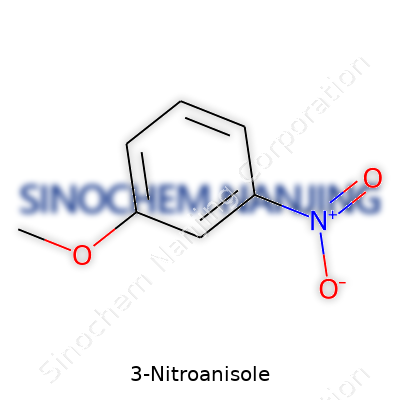
| Names | |
| Preferred IUPAC name | 1-Methoxy-3-nitrobenzene |
| Other names |
m-Nitroanisole 3-Methoxynitrobenzene 1-Methoxy-3-nitrobenzene |
| Pronunciation | /ˌθriːˌnaɪ.trəʊˈæn.ɪˌsoʊl/ |
| Identifiers | |
| CAS Number | [ "529-22-0" ] |
| Beilstein Reference | 1368810 |
| ChEBI | CHEBI:77543 |
| ChEMBL | CHEMBL318033 |
| ChemSpider | 10096 |
| DrugBank | DB01838 |
| ECHA InfoCard | EC Inventory, 3-Nitroanisole, ECHA InfoCard: 100.011.069 |
| EC Number | 208-944-6 |
| Gmelin Reference | 89217 |
| KEGG | C01719 |
| MeSH | D018348 |
| PubChem CID | 7506 |
| RTECS number | BZ9625000 |
| UNII | 73D72A2U9M |
| UN number | UN1664 |
| CompTox Dashboard (EPA) | DTXSID8013609 |
| Properties | |
| Chemical formula | C7H7NO3 |
| Molar mass | Molar mass: 153.13 g/mol |
| Appearance | Colorless to pale yellow liquid |
| Odor | aromatic |
| Density | 1.199 g/cm³ |
| Solubility in water | Insoluble |
| log P | 1.95 |
| Vapor pressure | 0.0225 mmHg (25°C) |
| Acidity (pKa) | 14.9 |
| Basicity (pKb) | 12.29 |
| Magnetic susceptibility (χ) | -66.0e-6 cm³/mol |
| Refractive index (nD) | 1.599 |
| Viscosity | 1.235 mPa·s (25 °C) |
| Dipole moment | 3.74 D |
| Thermochemistry | |
| Std molar entropy (S⦵298) | 326.6 J·mol⁻¹·K⁻¹ |
| Std enthalpy of formation (ΔfH⦵298) | –42.5 kJ mol⁻¹ |
| Std enthalpy of combustion (ΔcH⦵298) | -3872.7 kJ/mol |
| Hazards | |
| Main hazards | Harmful if swallowed, causes skin and eye irritation, may cause respiratory irritation. |
| GHS labelling | GHS02, GHS07 |
| Pictograms | GHS07, GHS09 |
| Signal word | Warning |
| Hazard statements | H302: Harmful if swallowed. H315: Causes skin irritation. H319: Causes serious eye irritation. H317: May cause an allergic skin reaction. H411: Toxic to aquatic life with long lasting effects. |
| Precautionary statements | P261, P264, P271, P272, P280, P302+P352, P305+P351+P338, P308+P313, P321, P333+P313, P363, P405, P501 |
| Flash point | 114°C |
| Autoignition temperature | 566°C |
| Explosive limits | Explosive limits: 1.3–8.0% |
| Lethal dose or concentration | LD50 oral rat 1050 mg/kg |
| LD50 (median dose) | LD50 (median dose): Rat oral 1850 mg/kg |
| NIOSH | NA0450000 |
| PEL (Permissible) | Not established |
| REL (Recommended) | 0.2 mg/m³ |
| IDLH (Immediate danger) | Not established |
| Related compounds | |
| Related compounds |
Anisole Nitrobenzene 2-Nitroanisole 4-Nitroanisole |



