The Role of 3-Methylheptane: A Closer Look at a Tool for Science and Industry
Historical Context of 3-Methylheptane
Over the years, the field of organic chemistry has produced a chorus of compounds, each with a story that stretches from the laboratory bench to the manufacturing line. 3-Methylheptane sits in a niche among the branched alkanes discovered in the age where chemists strove to map out hydrocarbon frameworks. Early synthetic work focused on the separation of alkanes from petroleum, and it took careful distillation and fractionation before researchers could reliably identify and characterize molecules like 3-Methylheptane. Before the era of modern analytical equipment, detailed knowledge often developed at an uneven pace, as researchers relied on boiling points, combustion properties, and clever chemical transformations to pin down these molecules.
Product Overview and Relevance
3-Methylheptane offers a clear example of how chemistry builds the foundation for applied science. In the wider pool of hydrocarbons, this molecule stands out because of its branch and chain length, giving it properties distinct from its straight-chain cousin n-octane. Industrial relevance comes from its ability to serve as a standard or model, especially for the study of hydrocarbon behavior, refining strategies, or fuel formulation.
Physical & Chemical Properties
This hydrocarbon falls into the family of alkanes, composed of carbon and hydrogen in a single-bonded, saturated framework. With the methyl group attached to the third carbon in the heptane chain, 3-Methylheptane has a molecular formula of C8H18, just like its isomers. Its branching leads to a slightly lower boiling point when stacked against straight-chain structures, which often makes identification possible through distillation and chromatography. Its colorless liquid form, limited water solubility, and lack of notable odor echo common features among light alkanes, though subtle distinctions exist in how it interacts with other organic solvents. These details lay a foundation for its selection as a reference standard for certain analytical methods, or as a blending component in fuels.
Technical Specifications & Labeling Practices
Packaging and labeling for 3-Methylheptane should reflect a respect for safety and fidelity to chemical specifications. Clear chemical names, structure information, purity, and known impurities are crucial for reliable use in analytical labs or chemical manufacturing. Regulatory bodies often ask for global harmonization in labels, emphasizing hazard information and guidelines for handling, even if the molecule’s simple structure suggests low acute toxicity. Handling recommendations usually point out standard precautions for flammable liquids, as both storage and use bring a risk of vapor release.
Production Techniques
The story behind preparation weaves through decades of synthetic organic chemistry development. In the past, cracking or catalytic reforming of petroleum fractions provided branched alkanes in mixtures, where separation involved painstaking distillation and chemical tests. Today, advanced separation and synthesis methods allow chemists to access high-purity 3-Methylheptane. One route involves the alkylation of 1-heptene with methylating reagents, controlled with precision to guide the branch to the right spot. Purification cycles use modern chromatography and distillation, slicing up the hydrocarbon mixture until only the target structure remains. Now, access to analytical tools such as NMR and GC-MS ensures that every batch can be certified for purity, structure, and absence of contamination.
Chemical Reactions & Modifications
3-Methylheptane plays a role both as a substrate and as a reference in chemical reactions. In the hydrocarbon family, reactivity hinges on radical processes, combustion, or high-energy substitution. Catalytic reforming can branch or unbranch the chain, subtly altering its octane number, an aspect important in fuel chemistry. Chlorination, oxidation, and cracking help chemists model refinery reactions or explore the transformation of alkanes into more valuable intermediates. Its role as a model compound feeds into computational chemistry and mechanistic studies seeking to predict reaction pathways and product distributions in complex mixtures.
Synonyms & Product Names
3-Methylheptane goes by a handful of standard chemical names, reflecting the conventions used by IUPAC and the broader scientific community. Common synonyms include iso-octane (though this can introduce confusion, since 2,2,4-trimethylpentane bears that name in fuel science), methylheptyl, and more descriptive names that clarify the position of the methyl group on the chain. In catalogs, its CAS number uniquely identifies it across suppliers and research literature.
Safety Measures & Operational Standards
Experience in the lab teaches the value of rigor in safety protocols, even with alkanes that seem chemically inert. 3-Methylheptane shares the flammability risks found among its peers. Proper ventilation, use of explosion-proof equipment, and avoidance of open flames keep risks down. Spillage demands containment with non-sparking tools and cleanup guided by chemical compatibility. Safety data sheets provide the information needed to assess risk, including personal protective equipment and fire containment tactics. For researchers, consistent review of standards and regular editing of process documentation provide reassurance that no oversight will threaten health or facility.
Application Areas
Industries dealing with fuels, lubricants, and petrochemical derivatives all touch on the utility of branched alkanes like 3-Methylheptane. In the development of octane ratings, researchers blend reference alkanes to tweak performance and study the link between structure and engine behavior. Researchers investigating environmental fate also turn to such molecules to explore the breakdown and persistence of hydrocarbons in soil and groundwater. I’ve seen experimental protocols where 3-Methylheptane serves as a standard for calibrating detectors or simulating real-world fuel blends in engine performance tests. It pops up in academic studies looking at the oxidation chemistry of alkanes, as well as in broader research on atmospheric chemistry.
Ongoing Research & Development
People who work in synthetic and analytical chemistry see a steady demand for new data on molecules that seem simple at first glance. As new combustion models come online, data on the oxidation and radical transformation of branched alkanes drive improvement in engine efficiency and emissions predictions. Advanced spectroscopy and quantum chemistry calculations now dig deeper into reaction intermediates, giving insight that older generations could only guess at. Industry-funded labs focus on modeling large-scale chemical processes, where material choices ripple through supply chains, energy use, and emissions profiles. I’ve watched as new detection methods raised the bar for trace analysis, requiring unambiguous reference materials and pure standards, pushing chemical suppliers to adopt more transparent and reliable characterization protocols.
Assessment of Toxicity
Older toxicology data for light hydrocarbons often painted them as relatively benign in acute exposure scenarios outside of their flammability. For 3-Methylheptane, inhalation and ingestion studies show low toxicity compared to smaller or more reactive hydrocarbons, but systemic effects from high doses or chronic exposure, such as CNS depression, should not be dismissed. Regulatory agencies outline exposure limits for workplace safety, with particular attention to ensuring proper ventilation and minimizing vapor accumulation. Animal studies help establish thresholds, but as with many petroleum-derived products, assessment of chronic exposure and environmental persistence receive ongoing scrutiny. The drive for transparent risk communication grows stronger with every new study, favoring full disclosure of available data and clear labeling.
Future Prospects
Looking ahead, 3-Methylheptane seems likely to remain an important benchmark, both for fuel science and for environmental chemistry. As the world shifts to lower-carbon alternatives and fuel complexity rises, alkanes like this one may serve as stepping stones in the development of greener fuels, or as points of comparison for bio-derived analogs. In the academic world, exploration of mechanism and environmental pathway studies ensures that even overlooked molecules receive sustained attention. For industry and regulation, ongoing refinement of handling, analysis, and risk assessment pushes up standards, creating ripple effects that raise safety and reliability across the board. While the hydrocarbon’s core structure stays the same, its role in science keeps evolving, shaped by advances in technology, new regulations, and fresh demands for cleaner, safer, and more efficient products.
What is 3-Methylheptane used for?
What is 3-Methylheptane?
3-Methylheptane sits among the many hydrocarbons that build the backbone of traditional chemistry and modern industry. Chemically, it’s a branched alkane—just one of the many isomers of octane. You might not bump into it at your local grocery store, but its story reaches into several industries people rely on every day.
Where 3-Methylheptane Makes a Difference
Fuel stands out as the main field where 3-Methylheptane matters. Refineries mix it into gasoline, not because drivers ask for it by name, but because every grade of fuel depends on a recipe of hydrocarbons that meet strict standards. Gasoline needs compounds with just the right combustion profile, and branched alkanes like 3-Methylheptane help reduce engine knock. Knock knocks more than engines: it hurts efficiency and shortens the lifespan of vehicles. Getting this blend right keeps car rides smoother and engines lasting longer.
Scientists didn’t just find these facts in dusty books—they have studied fuel blends for generations, going back to the early days of automobiles. Over time, the octane rating system evolved. 3-Methylheptane gave researchers a model to observe how branched molecules perform. So whenever car makers or fuel producers talk about octane quality, compounds like this one are behind the scenes, setting reliable benchmarks for performance.
The Lab Bench: Not Glamorous, Always Necessary
Lab researchers find 3-Methylheptane handy too. Working with pure hydrocarbons helps train students, calibrate machinery, and check reactions in organic chemistry. Chemists use it to test how instruments respond to different alkanes. Plenty of environmental studies require standard references, and this molecule often fills that role. In my university days, running gas chromatography on alkane mixtures, I saw how pure samples like this one serve as a gold-standard for calibration—making sure the data you get is real and reproducible.
Quality matters everywhere. Manufacturers need reference compounds to guarantee that their tests deliver useful, accurate results. Authentic materials limit confusion about what’s actually in each batch. Even small mistakes in calibration can waste days of work or set entire projects off track.
Challenges to Consider
On the environmental side, alkanes in gas and oil spark concerns. They emit carbon dioxide and other byproducts as vehicles burn them. Even something as nondescript as 3-Methylheptane falls under scrutiny today. Researchers and engineers want to reduce reliance on petroleum, shrink emissions, and find ways to recycle carbon. Biofuels and synthetic alternatives are rising. Every time these replacements reach the lab, benchmarks like 3-Methylheptane keep the science honest—allowing head-to-head comparisons on performance and safety.
Where Innovation Comes Next
The future doesn’t erase hydrocarbons, but it does demand cleaner solutions. Saving fuel, improving engine technology, and exploring alternatives often start with the basics—just like measuring with 3-Methylheptane in the lab. More scientists now look into reusing carbon from old hydrocarbons in new products. The puzzle includes renewable energy, efficient recycling, and lower emissions, but the standards that classic molecules like this set will continue guiding the next phase.
What is the chemical formula of 3-Methylheptane?
Looking Beyond the Name
A lot of people feel chemistry stays out of reach, hiding behind textbook diagrams and heavy jargon. Truth is, molecules like 3-methylheptane play a quiet role in what keeps the engine running, both figuratively and literally. 3-methylheptane, as the name suggests, belongs to the alkane family—those basic hydrocarbons that build much of what fuels cars and forms plastics.
Dissecting 3-Methylheptane’s Core Structure
To figure out the chemical formula, it helps to sketch out how the name reveals the structure. “Heptane” means seven carbons strung together in a chain. The “3-methyl” part attaches an extra carbon, branching out at the third position in the chain. Alkane rules say every carbon gets surrounded by as many hydrogens as it can handle without forming double bonds—no fancy tricks.
Counting up the carbons comes naturally. Seven for heptane, one more for the methyl branch. Eight carbons total. With eight carbons in an alkane, the tried-and-true formula CnH2n+2 steps in, so C8H18 covers 3-methylheptane. No rocket science, only logic.
Knowing Why Structure Matters
Couldn’t any molecule with eight carbons and eighteen hydrogens look the same? Turns out, structure changes everything. Straight-chain octane and branched 3-methylheptane both count the same atoms but act differently. The shape and the way carbon atoms link up affect boiling point, stability, and how well a fuel resists knocking inside an engine. This isomer story underlines why formulas alone never paint the full picture of what happens inside a beaker—or a fuel tank.
As someone who’s had the chance to see fuel quality tested in simple university labs, I remember how small changes to molecules changed outcomes. More branching, like in 3-methylheptane, generally means better fuel stability and cleaner burning. These details influence real-life choices far from the classroom, in places like oil refineries and environmental labs.
The Broader Impact of Simple Molecules
It isn’t only fuel companies that care about molecular branches. Environmental agencies rely on this knowledge to predict how chemicals behave once they reach air or water. Learning how 3-methylheptane and related compounds break down helps set better safety rules and guides clean-up methods after a spill. Researchers at the Environmental Protection Agency and similar agencies keep databases tracking these details for precisely these reasons.
Keeping accurate chemical formulas and structural details also supports a wide range of efforts to replace petroleum fuels with renewable energy sources. Some teams use bioengineering to create tailored hydrocarbons with chain designs meant to mimic the best traits of molecules like 3-methylheptane. Deeper understanding can chip away at air pollution and dependency on imported oil.
Closing Thoughts On the Importance of Knowing Chemical Formulas
The formula for 3-methylheptane, C8H18, doesn’t look intimidating on its own, but recognizing what it means and where it leads can push entire industries forward. Precision in chemistry isn’t just about avoiding mistakes in recipes—it’s a starting point for safer products, smarter fuel systems, and lasting environmental protection. That’s how a simple name on a test tube label ties into bigger challenges people face today.
What are the physical properties of 3-Methylheptane?
What Sets 3-Methylheptane Apart
Most folks don’t spend much time thinking about chemical compounds, but 3-Methylheptane shows up in refineries and labs all over the world. This eight-carbon molecule forms part of the alkane family, a group with a straightforward formula and a reputation for fueling engines and lighting up Bunsen burners. The small tweak—adding a methyl branch on the third carbon—gives this colorless liquid a personality different from straight-chain heptane.
Boiling Point and Melting Point: The Real-World Markers
3-Methylheptane boils at about 117 degrees Celsius. It flows as a liquid at room temperature, but like most alkanes, it won’t stick around in vapor form unless temperatures heat up a bit. Freezing it down to -119 degrees Celsius transforms it from a liquid to a solid—not exactly conditions you find outside a walk-in freezer or a serious laboratory. These numbers matter in a real sense: they determine how this hydrocarbon gets handled and stored.
Density and Taste of the Air
Pouring 3-Methylheptane into a graduated cylinder shows a density close to 0.71 grams per cubic centimeter. Lighter than water, it floats and spreads out, layers forming in laboratory separation funnels with ease. Density answers the practical questions in pipelines, tankers, and when calculating fuel weights. This is the sort of data that affects logistics—from shipping costs down to the precise timing of shut-off valves for mixing and blending.
Solubility and Chemical Behavior
If you try to mix 3-Methylheptane with water, you’re out of luck. This compound remains hydrophobic, forming its own layer and refusing to blend. That non-polar behavior makes it useful in the world of extraction—pulling non-water-soluble substances out of solutions. It dissolves in other non-polar solvents, joining a group of reliable agents for separating, cleaning, and formulating.
Other Sensible Details
Looking at 3-Methylheptane on a safety data sheet, flammability flashes among the warnings. With a flash point hovering just above 23 degrees Celsius, it can catch fire pretty easily. Anyone in charge of transport, storage, or use of this chemical takes note. The vapor can build up, and with the right spark, cause fires.
The molecular weight of about 128.25 grams per mole puts it in line with other similar hydrocarbons—not heavy, but not wispy or insubstantial either. This trait becomes handy in distillation towers, where engineers separate crude oil’s hundreds of ingredients. Compounds with similar weights come off in the same fractions, ticking through refinery systems and ending up as part of the fuel in a car or the feedstock for plastic.
Responsibility in the Lab and Beyond
Working with 3-Methylheptane, I’ve noticed how its properties can’t be separated from its uses. Those points where it boils, freezes, or catches fire aren’t abstract—they turn into rules for storage in sealed containers, away from sparks and open flames. The density, solubility, and volatility influence how processes run smoothly, with spill kits ready and monitoring equipment in place. Accuracy in reporting and using these numbers isn’t just academic; it’s a matter of safety and keeping operations on track.
Is 3-Methylheptane hazardous or toxic?
What is 3-Methylheptane and Where is it Found?
3-Methylheptane, a branched-chain hydrocarbon, shows up in fuels and industrial solvents. Long carbon chains like this one often show up as byproducts in refining oil or show up in mixtures for combustion engines. In labs, I’ve seen it as one of those clear, oily liquids with very little scent, not the kind that screams trouble at first glance. But, chemicals rarely give you warnings based on looks.
Inhalation, Skin, and Eye Exposure
Even if a chemical smells faint, you can’t trust your nose to tell you whether it’s risky. The Material Safety Data Sheets (MSDS) flag 3-Methylheptane as an irritant. Inhalation draws the most concern. Breathing those vapors for too long can set off headaches, dizziness, nausea — the usual suspects for hydrocarbons. You catch these symptoms before you see any bigger issues, which is lucky. Long exposure, though, piles up risk to your nervous system and lungs. I’ve heard colleagues in petrochemical plants talk about skin dryness and rashes after spills, which matches the MSDS warnings. Eyes don’t take much exposure to start burning or watering.
Combustibility and Environmental Risk
3-Methylheptane catches fire easily. Open flame, sparks, even a hot plate, and you’ll have a flash fire. The fumes alone carry enough vapor to ignite at room temperature. In the emergency response world, we always treat spills of hydrocarbons like this as fire hazards first, before we even start worrying about toxicity. In big spills, those vapors drift low to the ground and spread, meaning an ignition source yards away can lead to a sudden blaze.
This stuff floats on water, and spills flow quickly across surfaces. Waterways tainted by hydrocarbons take months, sometimes years, to recover. Fish and insect larvae suffocate because the chemical cuts off oxygen at the surface. I’ve seen marshes around old refineries still recovering years after small leaks, with polluted mud and fewer water insects.
Is It Carcinogenic or Chronic?
Health agencies haven’t flagged 3-Methylheptane as a known carcinogen, which lines up with info from NIOSH and the Environmental Protection Agency. Still, hydrocarbons with similar structures sometimes have long-term effects with repeated exposure. The immediate risk remains higher than slow, chronic buildup at this point. Poison control and health clinics focus on treating acute symptoms — headaches, loss of coordination, nausea — rather than long-term treatments.
Practical Risk Prevention and Handling
Personal experience working with solvents teaches the same lesson every time: ventilation matters. Gloves and goggles may seem excessive, but a splash or a few hours of vapor exposure changes your mind pretty fast. Spill cleanup kits with absorbent pads, plenty of fresh air, and spark-proof tools remain standard precautions. You don’t cut corners where hydrocarbons are involved.
At the policy level, clear labeling and strong workplace training help keep exposures low. Managers budgeting for safety equipment, and enforcing training, see fewer accidents. For storage and transport, fully sealed containers, away from heat and light, make handling less risky.
Finding Better Alternatives
The industry shifts slowly, but some companies already work with less volatile or less toxic hydrocarbons as part of green chemistry initiatives. Substituting for chemicals with lower vapor pressure or better biodegradability is already part of my daily practice at the lab, especially when it keeps cleanup simpler and air quality better. Less fire hazard, less skin contact, less hassle. That’s a win for health and for the environment.
How is 3-Methylheptane stored and handled safely?
Understanding What You’re Working With
3-Methylheptane belongs to the group of alkanes, a class of chemicals widely used in laboratories and industry. It brings a clear, colorless liquid to the workbench and, much like its chemical cousins, carries a risk of fire and fumes. Anyone who has worked with organic solvents knows the routine pain points—spills, flammable vapors, and that ever-present worry about breathing in something invisible and dangerous.
Why Good Storage Isn’t Fancy, Just Smart
Back in my days supervising a college organic chemistry lab, we had a few unwelcome lessons thanks to careless storage. Even a rarely used chemical like 3-Methylheptane can cause problems if left uncapped or stored near heat. Flammable liquids need metal safety cans or proper glass bottles with tight-fitting lids. Missing lids invite evaporation, which pollutes the air. A numbered, labeled spot in a ventilated chemical storage cabinet keeps everything organized and easy to find. More than once, I’ve seen labels smeared by drips or solvents, making it tough to tell one bottle from another. Waterproof markers and good labeling habits rescue everyone from confusion down the road.
Temperature makes a difference, too. 3-Methylheptane burns at lower temperatures than you might guess. Storage away from sunlight and heat sources lowers the chance of accidents. I’ve always liked cabinets with a little spill-catching tray on the bottom—any leaks stay put instead of running out over the floor.
Everyday Handling: Gloves, Goggles, and Common Sense
Nobody loves suiting up for handling organic solvents. Gloves, goggles, and lab coats feel bulky, but one careless splash into your eyes changes everything. Even outside the lab, people working with chemicals in small machine shops, for example, need to think about ventilation and skin protection. The vapors sneak up on you. On more than one occasion, poor airflow led to headaches before anyone realized fumes had built up past safe limits.
Science isn’t always high-tech. A working fume hood and open windows offer real protection. Standard nitrile gloves work well for 3-Methylheptane, and disposable aprons cut down on ruined clothes. I’ve always insisted on keeping an extra eye-wash bottle on the bench—accidents don’t give you time to hunt around for help.
Spills and Clean-Up: Swift Action Matters
Every experienced lab worker has seen a spill or two. With 3-Methylheptane, speed and smarts matter. Wipe up small amounts with an absorbent pad, then bag and tag the mess for hazardous waste disposal. Skip water or paper towels; they spread the chemical and put more people at risk. Keep sand or commercial spill kits on hand—waiting for cleanup gear wastes minutes in an emergency.
Fire: The Big Risk
3-Methylheptane belongs near the top of the flammable liquids list. Even a tiny spark can set off a fire. Keeping it locked up in a flammables cabinet, never alongside oxidizers or acids, prevents accidental mix-ups. Fire extinguishers rated for solvents—the classic dry chemical type—stand ready just a few steps away. I’ve seen hesitation burn precious seconds during a drill; training turns nervousness into muscle memory. The best-prepared crews avoid panic because they’ve drilled for the worst.
Final Word—Build Good Habits from Day One
Safe storage and handling of chemicals like 3-Methylheptane hinges less on fancy equipment and more on good habits. Label, store, ventilate, wear protective gear, and clean up fast—these basics protect health and prevent disasters. My years in the lab have taught me that every splash, every spill, every accident avoided owes credit to someone following these simple, clear steps.
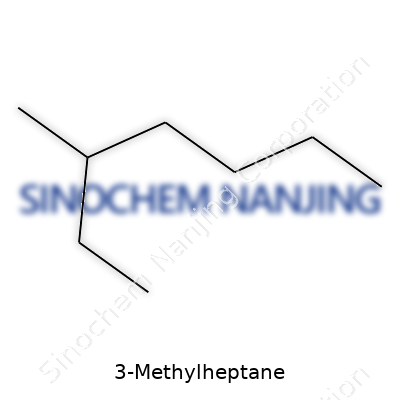
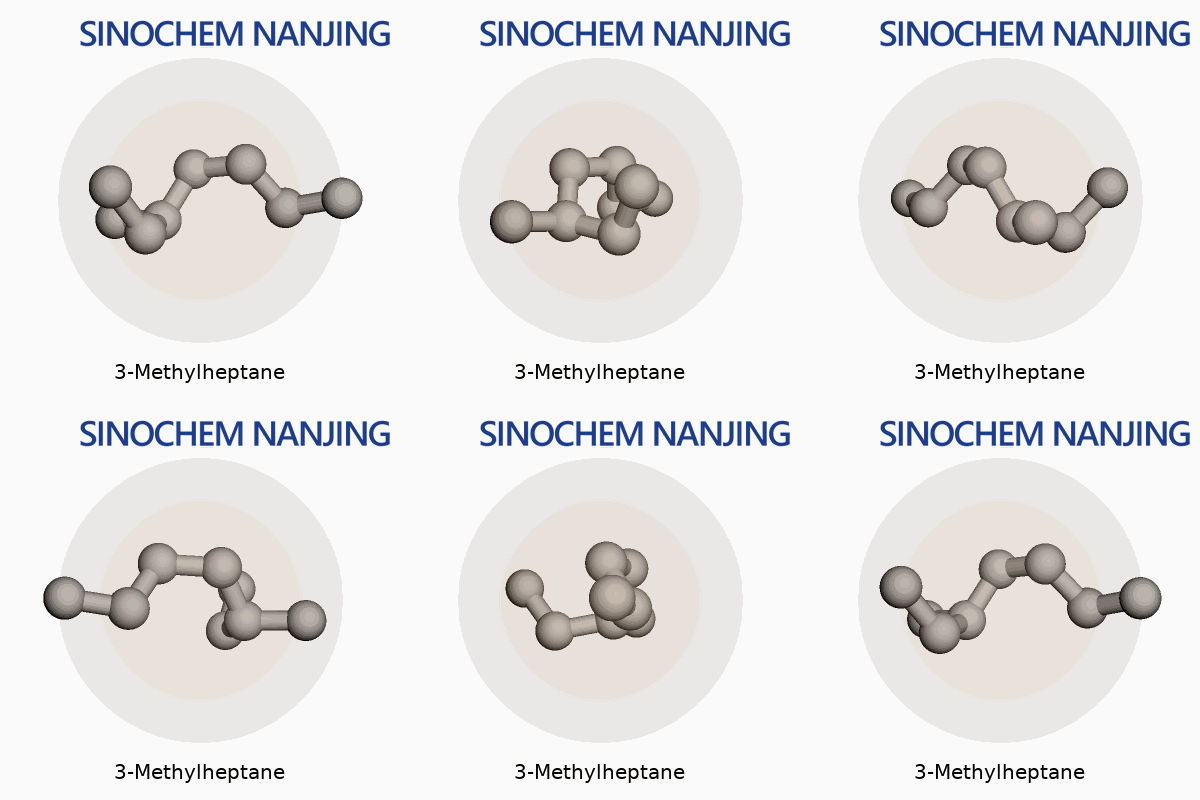
| Names | |
| Preferred IUPAC name | 3-Methylheptane |
| Other names |
Diethylbutylmethane Dipropylmethane |
| Pronunciation | /ˌθriːˌmɛθ.ɪlˈhɛp.teɪn/ |
| Identifiers | |
| CAS Number | 589-81-1 |
| Beilstein Reference | 1718732 |
| ChEBI | CHEBI:15748 |
| ChEMBL | CHEMBL1701983 |
| ChemSpider | 54678 |
| DrugBank | DB14182 |
| ECHA InfoCard | ECHA InfoCard: 100.113.733 |
| EC Number | 203-195-6 |
| Gmelin Reference | 78416 |
| KEGG | C08260 |
| MeSH | D008886 |
| PubChem CID | 11575 |
| RTECS number | MI0700000 |
| UNII | CJ4Y09B4V7 |
| UN number | 1206 |
| Properties | |
| Chemical formula | C8H18 |
| Molar mass | 128.255 g/mol |
| Appearance | Colorless liquid |
| Odor | Odorless |
| Density | 0.714 g/mL at 25 °C(lit.) |
| Solubility in water | Insoluble |
| log P | 4.39 |
| Vapor pressure | 3.82 mmHg (25°C) |
| Acidity (pKa) | 50 |
| Basicity (pKb) | Product 3-Methylheptane does not have a defined pKb value, as it is a neutral alkane and does not act as a base in aqueous solution. |
| Magnetic susceptibility (χ) | -72.6×10⁻⁶ cm³/mol |
| Refractive index (nD) | 0.7250 |
| Viscosity | 0.674 mPa·s |
| Dipole moment | 0.13 D |
| Thermochemistry | |
| Std molar entropy (S⦵298) | (350.6 J·mol⁻¹·K⁻¹) |
| Std enthalpy of formation (ΔfH⦵298) | -198.7 kJ/mol |
| Std enthalpy of combustion (ΔcH⦵298) | –4814.7 kJ/mol |
| Pharmacology | |
| ATC code | V03AE06 |
| Hazards | |
| GHS labelling | No GHS labelling. |
| Pictograms | GHS02,GHS07 |
| Signal word | No signal word |
| Precautionary statements | P210, P233, P240, P241, P242, P243, P261, P271, P301+P310, P303+P361+P353, P304+P340, P305+P351+P338, P331, P370+P378, P403+P235, P501 |
| NFPA 704 (fire diamond) | 1-1-0 |
| Flash point | 52°C |
| Autoignition temperature | 210 °C |
| Explosive limits | 1.1–6.0% |
| LD50 (median dose) | LD50 (median dose): Oral rat LD50 >5000 mg/kg |
| NIOSH | NIOSH = "MB9275000 |
| PEL (Permissible) | No PEL established |
| REL (Recommended) | 15.8 |
| IDLH (Immediate danger) | IDLH: 900 ppm |
| Related compounds | |
| Related compounds |
2-Methylheptane 3-Ethylhexane Isooctane Heptane 2,2-Dimethylhexane |



