3-Indolebutyric Acid: From Discovery to Modern Day Use
Historical Development
Long before greenhouse horticulture became a controlled science, plant physiologists hunted for compounds that could drive roots to grow faster and stronger. In the 1930s, researchers noticed that certain indole compounds promoted root formation and soon identified 3-Indolebutyric acid (IBA) as a powerful root-inducing factor. IBA joined a family of plant hormones known as auxins, each following its own path through patent wars, agricultural adoption, and worldwide production. The growth regulator's story intertwines with improved agricultural yields and more reliable plant propagation, especially in crops where cuttings often struggle to root. Seeing how quickly nurseries and research institutions embraced IBA, it’s clear that the compound filled a serious gap in plant science.
Product Overview
3-Indolebutyric Acid appears as a white to off-white crystalline powder, familiar to lab technicians around the world. Producers usually ship IBA in several purities, recognizing that academic labs, greenhouses, and industrial farms want the choice between research grade and bulk agricultural formulations. Though some hobbyists once dissolved it in makeshift rooting gels, today's reputable suppliers sell standardized formulations, carefully checked for contaminants that could affect sensitive plant tissues. Quality keeps IBA in demand for everything from large-scale plant propagation to hydroponic research.
Physical & Chemical Properties
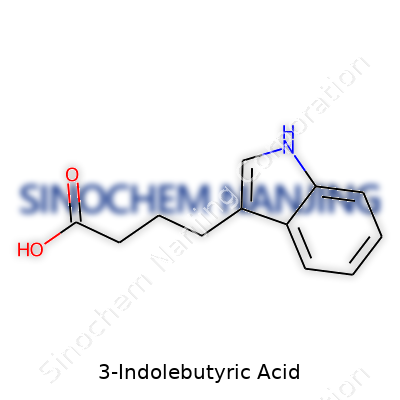
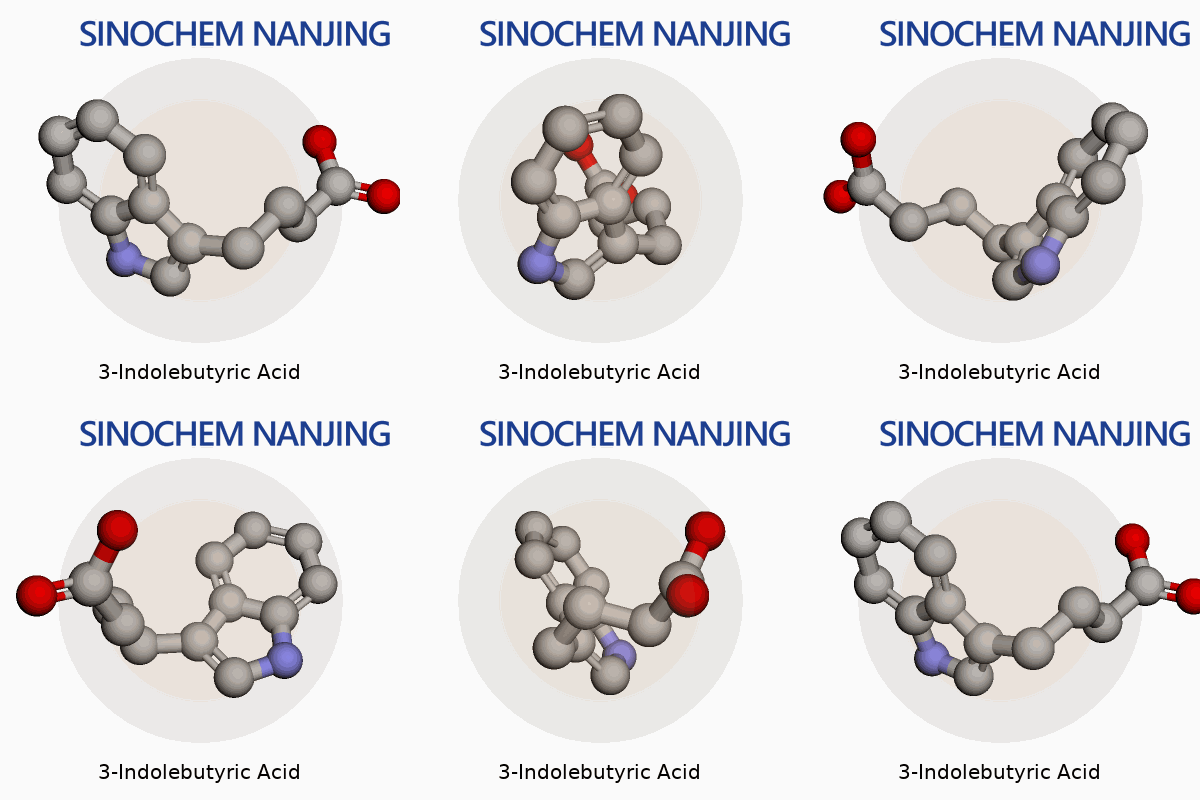
As a solid, 3-Indolebutyric Acid looks unremarkable. Its melting point falls around 123–124°C, and it does not dissolve easily in water without some adjustment—making ethanol or dimethyl sulfoxide common solvents. A quick whiff delivers little odor, another reason it gained ground over some more pungent auxins. Its molecular weight sits at 203.24 g/mol, and its chemical formula, C12H13NO2, marks it as a member of the indole family with a butyric acid side chain. The indole core, inherited from many natural plant hormones, imparts both biochemical activity and stability, which matters in storage and shelf life.
Technical Specifications & Labeling
Manufacturers usually highlight IBA’s purity—often greater than 98%, with precise batch analysis showing any trace elements or byproducts. Labels list the CAS number 133-32-4, offering clarity against phony substitutes or mislabeling, an important point as improper identification could spoil sensitive experiments. Package inserts and safety data sheets give clear directions for safe handling, dilution, and storage, often suggesting amber containers to limit photodegradation. Any regulatory statements pop up in bold, especially when shipped internationally under plant health or hazardous materials codes.
Preparation Method
Industrial production often relies on Fischer indole synthesis or similar methods, tweaking reaction conditions to yield the butyric acid side chain instead of simpler analogs like indoleacetic acid. After synthesis, the crude product goes through several purification steps, including recrystallization and solvent extraction, to remove byproducts. The goal stays the same: reliable, batch-to-batch consistency. Labs sometimes prepare IBA by direct substitution from indole using Grignard reagents and suitable acid chlorides, but this approach stays rare outside pilot-scale settings due to cost and yield limitations.
Chemical Reactions & Modifications
Chemists can tweak IBA's molecule in several spots, aiming to change its solubility or improve transport into plant tissues. For example, esters of IBA, such as methyl or butyl indolebutyrates, break down slowly, providing longer hormone release inside plant cuttings. Some research groups play with substituents on the indole ring to chase improved rooting effects or altered metabolic stability. On the greenhouse bench, though, raw IBA powder or its simplest salts carry the day, as field trials often show these versions work well for a broad range of plants without excessive fuss.
Synonyms & Product Names
In catalogs and research papers, 3-Indolebutyric Acid appears under several names: Indole-3-butyric acid, IBA, and sometimes even 1H-Indole-3-butanoic acid. Commercial brands, especially in agriculture, label their rooting powders with “IBA” either as a headline or buried in technical data. Researchers and growers should double-check synonyms and codes, as language barriers and translation quirks sometimes create confusion. Avoiding mix-ups starts with checking that CAS number and verifying the country’s registration status.
Safety & Operational Standards
Direct contact with IBA does not cause acute symptoms for most users, but careful handling stays important. Extended exposure, especially in powder form, means gloves, dust masks, and good eye protection make sense in both lab and greenhouse environments. Safety data sheets highlight the importance of preventing IBA runoff into water systems, as it doesn't naturally occur in most environments and could interfere with aquatic plant growth. Workbenches need cleanup protocols because hormone contamination can affect sensitive experiments nearby. Training staff to recognize accidental spills, proper disposal, and basic first aid builds a safety culture that prevents incidents before they become problems.
Application Area
Nothing changed commercial plant propagation quite like IBA. Ornamental horticulture, forestry seedling nurseries, and crop breeding programs reach for it to encourage rapid, reliable root formation. Difficult-to-root species, including many fruit tree stocks, produce roots more quickly after a brief dip in IBA solution—a technique that hundreds of thousands of agricultural workers now use daily. Some researchers experiment with foliar application, measuring subtle responses, but most usage still targets plant cuttings before planting, either with liquids, powders, or gel formulations. Greenhouse managers appreciate the speed and predictability it brings, while backyard gardeners sometimes rely on small starter kits from their local supply shops.
Research & Development
Scientists continue to unravel how IBA travels inside plants and how plant cells recognize it. One major discovery involves IBA converting to indoleacetic acid (IAA) in plant tissues—a metabolic pathway that determines how this synthetic hormone mimics natural auxins. Research teams now explore transporters, metabolic enzymes, and cross-talk with other plant hormones, aiming to explain why certain species respond more strongly than others. New delivery forms such as biodegradable films and slow-release pellets attract attention, especially as labor shortages push propagators to automate rooting operations.
Toxicity Research
Animal studies point to a relatively low acute toxicity profile for IBA, though it can irritate when inhaled or swallowed in concentrated form. Chronic exposure tests in lab animals haven’t found strong evidence of carcinogenicity, but data stay incomplete. The Environmental Protection Agency and similar bodies in Europe and Asia monitored repeated applications on food crops, concluding that residues did not pose significant risks at labeled rates. Safety margins exist, but regular reviews update those decisions, especially as more sophisticated tests look for subtle hormonal disruptions in non-target species. Wastewater handling and field runoff studies remind users to avoid careless dumping, since even small molecules can eventually find their way to sensitive habitats.
Future Prospects
3-Indolebutyric Acid remains vital in both commercial farming and greenhouse innovation. As plant breeding grows more complex—embracing gene-editing techniques and sustainable agriculture—the demand for flexible, well-tested rooting agents like IBA keeps rising. Companies and academic labs alike focus on improved formulations, integration with precision-dosing systems, and even biological production methods. Some startups chase biodegradable encapsulation, promising field workers less exposure and more efficient uptake in drought-prone regions. Climate change and the search for new crop species also keep researchers testing IBA on plants native to harsher conditions, hoping for breakthroughs in food security. Reliable rooting lays the groundwork for reforestation, restoration, and next-generation horticulture, and IBA’s legacy looks set to grow even deeper roots.
What is 3-Indolebutyric Acid used for?
What 3-Indolebutyric Acid Really Does
3-Indolebutyric acid (IBA) makes a big difference on the farm, in home gardens, and even in plant science labs. People use it every day to get their cuttings to start new roots. It might sound fancy, but its action is quite simple: IBA spurs a plant to send out roots from stems and leaves. If you walk into a greenhouse and watch someone propagating new roses or fruit trees, they often dust or dip the cut end of a stem in a white powder—chances are, that's IBA at work. Rooting cuttings turns one plant into many. For nurseries, that means lower costs and more plants.
The Science Behind the Success
IBA doesn't work by magic. It mimics a natural plant hormone called auxin, which plants already use to manage their growth. The difference—nature makes just enough for its own business, but gardeners want consistent, predictable results. Apply IBA, and you improve rooting success for hard-to-propagate plants like blueberries, grapevines, camellias, or ornamental shrubs. Without a little help, some of these popular plants root poorly or die before they get a chance to grow. Peer-reviewed trials, such as those reported by the International Society for Horticultural Science, repeatedly show higher rooting percentages when IBA enters the process.
Farmers and researchers have come to rely on IBA. I got hooked on growing elderberries a few years back. I'd snip strong stems in winter and tried to root them straight in water—most turned black and rotted away. Adding a little IBA powder to fresh cuttings changed everything: within weeks, white roots poked through the soil, and survival rates jumped. This experience gets repeated worldwide, season after season.
Growing Food, Saving Space, Saving Time
Urban gardeners or small-scale food producers face tight budgets and even tighter growing areas. Many people want more production from less land, so rapid propagation means a family or community can go from a handful of berry canes to a living hedge in just a couple years. Sustainable food systems depend on sharing plants that suit each region. IBA helps turn a single healthy plum tree into dozens gifted to neighbors and friends.
Environmental Responsibility and Safe Use
Rooting powders and gels should always be handled with respect. It’s important to read instructions and measure correctly. Reports from regulatory agencies such as the US Environmental Protection Agency confirm that common use on ornamentals and food crops, following product labels, presents low risk to people and pollinators. Still, nobody should dump spent powders in water drains or handle any chemical without gloves.
Alternatives and Practical Solutions
Some gardeners try willow water or aloe to get similar results. Willow cuttings release their own natural auxins when soaked in water. These homemade brews can work, but the strength is inconsistent. For tricky plants, IBA’s reliability stands out—I wouldn't risk a rare vine on guesswork. That said, folks who want organic-only solutions should research plant-based hormones or stick with what nature provides.
Innovation and Ongoing Research
Researchers keep testing better ways to deliver IBA and balancing plant health with soil and pollinator safety. Ongoing studies explore alternatives for certified organic growers and expand its use into forestry and conservation. The story of IBA grows every year, helping more people start healthy plants and close the loop on sustainable gardening.
How do you apply 3-Indolebutyric Acid to plants?
What Is 3-Indolebutyric Acid?
Some folks in the gardening world swear by root hormones. Among those, 3-Indolebutyric Acid, or IBA for short, often gets praise for its knack at helping plants develop strong, healthy roots. Gardeners and horticulturists have leaned on it for decades, especially when propagating cuttings. I first came across IBA during a school experiment with bean seeds. Plants treated with it outperformed the rest — fuller roots, more vigor, and a better shot at surviving transplantation shock.
Why Even Bother With IBA?
Most cuttings struggle to root on their own, especially woody or semi-hardwood stems. IBA nudges those stubborn cuttings to send out roots more quickly and reliably. Research backs this up in commercial greenhouse production, tree nurseries, and even home propagation. I remember rescuing basil trimmings from the compost. After a quick dip in an IBA powder, those stems sprouted roots in less than a week. Without it, survival rates drop, especially during tough seasons.
Different Ways Gardeners Apply IBA
IBA usually comes as a powder, liquid concentrate, or in gel form. Each works a bit differently. Powder formats work well for home use. For liquid, commercial growers often dilute it based on the plant type. For houseplants and most garden cuttings, a lower concentration—between 500 and 2000 parts per million—often works just fine. Using gel gets popular with orchids and hard-to-root species because it sticks to the stem and doesn’t wash off easily.
How To Apply IBA — Simple Steps That Work
I always trim a healthy cutting below a node, strip away extra leaves, and check for disease or damage. For powder, I dip the end of the stem in water, tap off excess moisture, then roll it in the powder. After dusting, straight into the planting medium—usually damp perlite or a clean potting mix. With liquid IBA, I dunk the cut ends for no longer than five seconds, then transfer them to soil. Gels go on just like toothpaste; just squeeze a little on the cut end and stick it right into the growing medium.
Safety First With Hormones
Every gardener should glove up when handling any plant hormone. IBA isn’t toxic at the tiny doses for garden use, but too much skin contact can irritate. Storing it in a dry, dark spot away from pets and food stops accidental messes. Always go with the label dosage. If you accidentally spill or use too much, pitch the batch and mix a new solution.
Looking At The Bigger Picture
Professional horticulturists track which hormone works best with each species — roses, grapes, and camellias get the highest benefit from IBA, according to decades of field and lab testing. People growing rare or endangered species rely on IBA to keep plant lines alive. Simple, science-backed hormones like IBA often level the playing field for backyard growers and commercial producers alike. After years dabbling with cuttings, I won’t skip IBA for tricky plants.
Is 3-Indolebutyric Acid safe for all plant species?
What 3-Indolebutyric Acid Does for Plants
Gardeners and commercial growers often swear by rooting hormones to improve plant propagation. 3-Indolebutyric acid (IBA) stands out as one of the main ingredients. Many use it on cuttings to help roots develop, especially in woody and semi-woody plants. It’s easy to find in hormone powders and gels sold at garden centers. But anyone who has tried rooting everything from succulents to hydrangeas knows not every plant responds the same way to IBA.
Not All Plants Appreciate IBA the Same Way
Looking at my own garden, I found that some plants react better to a gentle touch. Soft-stemmed tropicals, like some philodendrons, sometimes show leaf yellowing or stunted growth after a dose of IBA, especially if concentrations are too high. Scientists have flagged the same things: too much IBA piles up in plant tissue or breaks down into compounds that can stress or damage more sensitive species. Cacti and succulents prove especially touchy. They often need very little or even no IBA for successful rooting.
Research from horticulture labs echoes those backyard findings. In particular, members of the Proteaceae family, including native Australian species, wilt quickly or show root abnormalities if treated with standard concentrations. Blueberries, some beans, and rare orchids also show tip dieback or callousing instead of good root development when exposed to IBA. The key factor isn’t just the plant type, but also the stage of growth, the time of year, and the environmental conditions during propagation.
Why People Misunderstand Safety
A lot of beginners figure a store-bought rooting hormone will work for everything. There’s an idea that if it spurs root growth in roses, it will help with any plant. In reality, some plants manage perfectly well without synthetic rooting aids, or even prefer to root on their own. Others, especially clones of fruit trees or ornamentals, can benefit greatly if handled right. The problem begins when growers apply one-size-fits-all advice. Too much IBA can block or slow down root initiation. Instead of healthy roots, you get brown, shriveled cuttings dumped in the compost.
Regulators say IBA breaks down quickly in soil and water and poses a low risk of toxicity in the broader environment. But there’s less research about what happens in rare or less commonly grown species. Most of the safety studies focus on food crops or ornamental shrubs and trees popular in landscaping. That makes it riskier to apply off-the-shelf hormone to every obscure tropical or alpine plant without testing.
Solutions and Smarter Practices
For professionals and home growers alike, it pays to start with trusted information. Extension offices, botanic gardens, and university sources often run trials showing the right IBA rates for specific species. Testing on a few cuttings before treating the whole batch limits damage from overdose. Alternative methods like wounding the stem, using willow water, or adjusting humidity sometimes help as much as commercial rooting formulas for sensitive plants.
In short, IBA works well for many species, especially tough-stemmed cuttings that might otherwise struggle. Yet, real plant diversity calls for careful choices. By reading up and experimenting, growers can keep plants healthy and thriving, without assuming every chemical fix is truly universal.
What is the recommended dosage or concentration of 3-Indolebutyric Acid?
Why Dosage Matters for Plant Growth
We often overlook how much science goes into something as simple as rooting a plant cutting. Growing up, I used to dab a little rooting powder on stems in the backyard and cheer on each sprout. It wasn't until I dug deeper that I realized the wrong amount of rooting hormone—not too little, not too much—can make or break the process. 3-Indolebutyric Acid, or IBA, stands out as a top-drawer rooting agent because of its power to kickstart root development in both woody and soft cuttings. Getting the dosage right supports healthy root systems, speeds up propagation, and promotes stronger plants.
Common Concentrations for IBA in Horticulture
In day-to-day propagation work, dosages range a lot by plant type and form. For herbaceous cuttings, such as coleus or basil, many growers see the best results with 500 to 1,000 ppm (parts per million) dissolved in water. Woody cuttings—think rose or apple—often call for a heavier touch. Here, concentrations usually jump to standards between 2,000 and 5,000 ppm. Liquid dips work for fast batch jobs, while commercial nurseries sometimes use powders around 0.1% to 0.4% active ingredient by weight. Each approach flows right out of university trials and years of nursery bench work.
Field Knowledge and Scientific Evidence
Experience and research often line up. For example, a 2013 University of Florida study found that azalea cuttings responded best to an IBA dip at 2,000 ppm, while higher doses actually hurt root length and strength. Overdosing risks burning plant tissue and wasting product, and trace amounts may leave cuttings stuck in suspended animation, refusing to grow. American Society for Horticultural Science journals lay out similar findings for scores of ornamentals and fruit varieties. These fact-checked results echo what’s already practiced in many greenhouses.
Mixing and Applying Safely
At-home use shouldn’t feel intimidating, but a splash of caution pays off. Wear gloves and measure accurately. Weigh powders out on a small kitchen scale, or use premixed liquids for easier handling. Stick with distilled water to avoid reaction with hard water minerals. Short dips—between five and ten seconds—work better than soaking, especially for tender cuttings prone to rot. Throw out leftover solution instead of keeping it on a shelf. It loses its punch and risks fungal contamination over time.
Balancing Growth and Regulation
Regulation matters too. In the United States and many other countries, agencies monitor safe use and labeling of plant growth regulators like IBA. The Environmental Protection Agency outlines precautions, such as proper storage and keeping products away from kids and pets. Garden centers and suppliers with good reputations keep only approved concentrations on their shelves. Online sellers sometimes cut corners, so look for proof of analysis or buy from trusted sources.
Conclusion: Knowledge Builds Confident Propagators
Getting familiar with IBA doses shifts plant propagation from guesswork to predictable results. Ask around local gardening groups, track plant progress in a notebook, and adjust as needed. Growers who learn from research and practical feedback support overall plant health and save resources in the process.
How should 3-Indolebutyric Acid be stored?
Why Care About Storage at All?
Spend a little time in a university lab or a greenhouse, and you start to notice one thing: bottles and containers stack up fast. Anyone working with plant growth substances like 3-Indolebutyric Acid, often called IBA, knows how valuable these powders and solutions are for rooting cuttings and pushing plant health forward. The real trouble starts when containers get shuffled around, left beside windows, or even forgotten on a shelf above a hot radiator. I’ve seen more than a few ruined batches just because someone didn’t think much about temperature or light. Money lost, research set back, even entire crops failing to root. That’s enough of a headache to pay attention the next time you reach for the bottle.
Keep 3-Indolebutyric Acid Dry
Water and powdered chemicals mix about as well as oil and busy afternoons. Moisture in the air can clump up IBA, make it hard to measure, or even mess with its ability to spur roots. I once watched a graduate student spend an hour trying to break up a caked-solid bottle because the cap let in just a bit of humidity. It’s always best to store IBA in a tightly sealed container, maybe even with a small desiccant pack tossed in, away from sinks and wet benches.
Cool Temperatures Matter More Than You Think
Every summer brings stories of labs or garden sheds turning into saunas. IBA prefers a cool, steady environment—think refrigerator cold, not freezer. Throwing it in a deep freeze risks condensation when you take it out, which can lead to bigger problems. Most packages come with storage instructions—often 2-8°C. Manufacturing data out of accredited facilities backs this; at these temps, IBA’s chemical stability stretches far beyond if left out at room temperature. Live plants might love warmth, but the powder sitting in a bottle definitely doesn’t.
Keep It in the Dark
Sunlight isn’t kind to many plant hormones, and IBA holds no surprises here. Direct light—especially UV—triggers breakdown. In bright labs or greenhouses with glass ceilings, keeping bottles out on open benches means burning through shelf life in weeks. Store it in the dark, and you get a much longer, more reliable product. Simple brown or amber glass bottles work well, and keeping those deep inside a cupboard pays off big time. I learned the hard way after losing a set of experiments to degraded IBA from a clear jar.
Safe Storage Prevents More Than Waste
Beyond the money, think about safety. A cluttered work area, open bottles, and unmarked powders only tempt mistakes. Label everything with the full chemical name, concentration, and the date. You work faster and with fewer mix-ups that way. Locking up larger amounts limits accidents with pets or kids in home or greenhouse setups.
Old Supplies, Fresh Solutions
If you spot color changes, unusual odors, or clumping, it’s safer to toss that batch than risk ruined research or crops. Reliable suppliers offer quality checks—and plenty of documentation to back up storage methods. Paying a little attention to storage habits saves big headaches and frustration. IBA isn’t cheap, but following these habits means each gram works as hard as you do.
| Names | |
| Preferred IUPAC name | 4-(1H-indol-3-yl)butanoic acid |
| Other names |
IBA Indole-3-butyric acid 3-Indolylbutyric acid Hortomone Indolebutyric acid |
| Pronunciation | /ɪnˈdoʊl.bjuːˈtɪr.ɪk ˈæsɪd/ |
| Identifiers | |
| CAS Number | 133-32-4 |
| Beilstein Reference | 1208733 |
| ChEBI | CHEBI:28623 |
| ChEMBL | CHEMBL1401 |
| ChemSpider | 17710 |
| DrugBank | DB04138 |
| ECHA InfoCard | 02bdaa07-a15f-4cdf-834c-6cafbe4f815c |
| EC Number | 3.1.1.26 |
| Gmelin Reference | 8849 |
| KEGG | C06537 |
| MeSH | D007222 |
| PubChem CID | 3739 |
| RTECS number | UF8225000 |
| UNII | 396M13J5U4 |
| UN number | 3245 |
| Properties | |
| Chemical formula | C12H13NO2 |
| Molar mass | 203.24 g/mol |
| Appearance | White to off-white crystalline powder |
| Odor | Odorless |
| Density | Density: 1.24 g/cm³ |
| Solubility in water | Slightly soluble |
| log P | 1.6 |
| Vapor pressure | 1.7 x 10^-7 mmHg (25°C) |
| Acidity (pKa) | 4.8 |
| Basicity (pKb) | pKb: 10.6 |
| Magnetic susceptibility (χ) | −6.2×10⁻⁶ cm³/mol |
| Refractive index (nD) | 1.663 |
| Viscosity | Viscous liquid |
| Dipole moment | 2.42 D |
| Thermochemistry | |
| Std molar entropy (S⦵298) | 170.7 J·mol⁻¹·K⁻¹ |
| Std enthalpy of combustion (ΔcH⦵298) | -3671 kJ/mol |
| Pharmacology | |
| ATC code | A2022000110 |
| Hazards | |
| Main hazards | May cause respiratory irritation. Causes serious eye irritation. May cause drowsiness or dizziness. May cause an allergic skin reaction. |
| GHS labelling | GHS07, GHS08 |
| Pictograms | GHS05,GHS07 |
| Signal word | Danger |
| Hazard statements | H302, H315, H319, H335 |
| Precautionary statements | P261, P273, P280, P304+P340, P305+P351+P338, P312 |
| Flash point | Flash point: 230 °C |
| Autoignition temperature | 515°C |
| Lethal dose or concentration | LD50 oral rat 1000 mg/kg |
| LD50 (median dose) | LD50 (median dose): Oral rat LD50 > 5000 mg/kg |
| NIOSH | HM9625000 |
| PEL (Permissible) | Not established |
| REL (Recommended) | 1000 mg/L |
| Related compounds | |
| Related compounds |
Indole-3-acetic acid Indole-3-propionic acid Indole-3-butyronitrile Indole-3-carbinol |



