3-Ethylhexane: A Deep Dive Into Its Background, Uses, and Research
Historical Development
Chemistry builds on small, persistent efforts from curious minds, and 3-ethylhexane proves this point. Beginning in the early-to-mid 20th century, synthetic organic chemistry took off worldwide, and researchers started mapping new branches on the alkane family tree. 3-Ethylhexane showed up during that chemical expansion, not as a blockbuster molecule but as a quiet cousin in the isomeric lineup of octane derivatives. Instead of the usual industrial spotlight, it lived in the margins, appreciated for its specific traits by academics and chemists who explored the subtle differences between alkane isomers. The development of 3-ethylhexane didn’t come with a single breakthrough or patent moment. It rode on advances in crude oil refining, fractional distillation, and the understanding of hydrocarbon branching, each small step shaping how product chemists think about structure and function.
Product Overview
Chemically, 3-ethylhexane fits snugly within the family of branched chain alkanes with the formula C8H18. You’ll find it wherever detailed gasoline composition matters, because its molecular structure nudges the balances of volatility and combustion. Commercial supplies often go straight to studies on fuel performance, analytical chemistry standards, or as a reference compound. It’s colorless, unassuming in appearance. Most users encounter it as a laboratory-grade liquid that comes labeled with purity in mind, ready for analytical or small-scale synthesis needs, rather than for direct consumer or bulk industrial use. Its character—low reactivity, low toxicity at ambient temperatures, no smell—puts it squarely in the “engineering molecule” camp, a tool for those chasing precision in hydrocarbon analyses.
Physical & Chemical Properties
You know what to expect from most alkanes: low reactivity, hydrophobicity, clear appearance, and a distinct set of boiling and melting points. 3-Ethylhexane boils around 117°C to 119°C, falling within the same general range as other similar-mass hydrocarbons, but slight branching means you don’t see exact matches with n-octane or 2,2,4-trimethylpentane (isooctane). Its melting point drops under -100°C, so it stays liquid well below freezing. The density hovers just under 0.7 g/cm³, representing a typical alkane profile. As a nonpolar hydrocarbon, it refuses to mix with water and clings to the hydrophobic world—think of it mixing easily with other oils or petroleum-derived fluids. On the chemistry front, you get chemical stability under normal conditions, but strong oxidizers or halogenation agents can push it into more reactive territory, as with most straight and branched-chain alkanes.
Technical Specifications & Labeling
Suppliers ship 3-ethylhexane in amber glass bottles, usually between 100 milliliters and 1 liter, with purity often listed above 98%. The labeling sticks to international standards: product name, chemical formula, CAS number (589-43-5), lot number, expiration or retest date, manufacturer, and hazards. Laboratory packs emphasize flammability markers, and any accompanying documentation lines up with GHS safety guidelines. Testing certificates note impurities down to the fraction of a percent, sometimes including extra data points for density, refractive index, or residual solvent traces—key for researchers conducting analytical benchmark work.
Preparation Method
Manufacturing 3-ethylhexane rarely attracts headlines, but it brings together bread-and-butter organic synthesis steps. Petrochemical feedstocks supply a mixture of octane isomers, produced through methods such as catalytic cracking or hydrogenation of petroleum fractions. Fractional distillation and selective adsorption then separate closely related hydrocarbons. To sharpen purity, labs may blend distillation with precision organic synthesis like alkylation—reacting hexane with ethyl halides, catalyzed by acids or transition metals under tightly controlled conditions, yields higher concentrations of the desired isomer. That means a lot of grunt work in characterization, where researchers lean on gas chromatography and mass spectrometry to confirm the right structure and weed out stray isomers. Every batch draws scrutiny before buyers see a sticker with confidence-affirming numbers.
Chemical Reactions & Modifications
As a saturated hydrocarbon, 3-ethylhexane shrugs off most reagents at room temperature—acids, bases, and mild oxidizers pass by without much fuss. Under harsher conditions, the molecule breaks its silence. Strong oxidizers, like potassium permanganate or ozone, cleave C–H and C–C bonds to yield smaller acids or ketones. Halogenation under UV light throws chlorine or bromine into the mix, producing alkyl halides at random across the eight-carbon skeleton. These halogenated derivatives spark interest as building blocks or markers in environmental studies. Cracking reactions at elevated heat can break up the carbon backbone, giving off lighter alkanes or even hydrogen. In research, such stability lets the molecule serve as a control or baseline, making it valuable for those running comparative studies of more functionalized hydrocarbons.
Synonyms & Product Names
Chemists keep lists of synonyms to avoid confusion at the bench. 3-ethylhexane goes by a handful of names, including triethylmethane and ethylisohexane in some texts, but most catalogues keep it simple: 3-ethylhexane. The CAS number (589-43-5) removes any doubt, lining up with chemical registries across the globe. Researchers rarely stumble over naming if they stick to the IUPAC format, and bottles from reputable suppliers don’t complicate things—they state the name plainly, usually in English, French, and German to cover the main scientific readership.
Safety & Operational Standards
Safety with 3-ethylhexane reflects general protocols for light hydrocarbons. Flammable label leads the warnings—open flames, sparks, and high temperatures spell danger. Labs and storage must rely on fire-rated cabinets and proper ventilation. Direct contact with skin or eyes rarely causes severe irritation, but gloves and goggles act as standard PPE. Vapors displace air and may create asphyxiation risks in enclosed spaces, so you need regular air flow or appropriate fume extraction. Transport regulations place it in the same hazard class as other alkanes, and shipping paperwork flags its flammability for everyone involved. Waste management doesn’t get tricky: incineration in facilities approved for volatile organics keeps risk low. Emergency response plans echo those for other gasoline-range hydrocarbons, focusing on ventilation, ignition source isolation, and evacuation routes, with MSDS sheets required at all storage and handling points.
Application Area
Many folks have never heard of 3-ethylhexane, yet its uses steady the work of those patching together the bigger picture in energy, materials science, and environmental testing. Petroleum engineers dip into its analysis as a model for understanding isomeric effects in gasoline. Analytical chemists reach for it as a benchmark and calibration standard in gas chromatography—the subtle differences between octane isomers sharpen instrument sensitivity. Some researchers use it to simulate hydrocarbon behavior in air, soil, or water, letting them track environmental fate and degradation. Specialty fuel blends sometimes play with precise ratios of isomers, testing how knock resistance responds. For the curious, 3-ethylhexane adds a crucial rung on the data ladder, refining models that play out in everything from cleaner-burning engines to oil spill remediation technologies.
Research & Development
Ongoing research circles around better separation techniques, greener synthesis, and fine-tuning analytical methods. Scientists continue calibrating internal standards for gas or liquid chromatography, with 3-ethylhexane anchoring results when parsing complex petroleum or environmental samples. Some groups explore the impact of various alkane isomers on advanced combustion technologies—think high-efficiency engines or cleaner fuel mixes. New catalysts and process tweaks search for purer, more sustainable ways to assemble the molecule on demand, sometimes using bio-based feedstocks as starting points. Data from these projects trickles into regulatory agencies, engine manufacturers, and environmental labs, shaping standards on fuel composition, emissions, and pollutant tracking.
Toxicity Research
Toxicity stays low by most hydrocarbon metrics, but inhalation remains the main concern. Lab tests show little acute toxicity from skin or oral contact, though concentrated vapor exposure can bring dizziness, headaches, or a light narcotic effect due to displacement of oxygen. High doses in animal studies push toward central nervous system depression, in line with other gasoline-range hydrocarbons. Chronic exposure doesn’t seem to prompt major cancer risks, but caution lingers because many branched alkanes can act as solvents, dissolving lipid layers and causing skin dryness or irritation over time. Researchers keep repeating exposure studies, especially in occupational settings, since real-world data always helps clarify where subtle health effects might hide. Regulators continue to scan for emerging evidence, but current rules fit snugly with broader alkane controls—limit time spent in high-vapor zones, keep PPE on deck, and always treat spills or leaks as flammable and asphyxiant hazards.
Future Prospects
The road ahead for 3-ethylhexane bends in a few key directions. Instrument makers chase finer detection limits, leveraging the stable, predictable profile of 3-ethylhexane for more sensitive analysis chips and portable detection gear. Energy experts lean into octane isomer research, knowing that understanding subtle differences impacts cleaner combustion, engine knock prevention, and regulatory limits on fuel formulations. Green chemistry advances draw up plans for biotechnological production routes and waste valorization, hinting at processes less reliant on fossil inputs. Environmental scientists plug this molecule into larger studies on atmospheric breakdown, hoping to map out pathways and byproducts that could nudge air quality or climate shifts. For each of these applications, people depend on a detailed, reliable, and well-studied product—one that keeps ordinary hydrocarbon work grounded in solid, measurable science.
What is 3-Ethylhexane used for?
Getting to Know 3-Ethylhexane
3-Ethylhexane sounds like something straight out of a college chemistry class, and to most people outside the field, it probably is. For those who spend time working with hydrocarbons, it sparks more interest. This chemical falls into the family of alkanes, made up of eight carbon atoms and eighteen hydrogen atoms. On paper, it’s just a colorless liquid, but its uses go well beyond a textbook.
Real-Life Applications
The truth is, you won’t see 3-ethylhexane in headlines or as a household name. Its main role stays behind the scenes, supporting much bigger stories in industry and research. One of the main uses pops up in laboratories, especially those specializing in organic chemistry. Researchers often turn to 3-ethylhexane as a reference compound in gas chromatography. In my own undergrad days, I remember my lab partner stacking vials of different alkanes, including this one, while students compared retention times to identify unknowns. It’s easy to miss how important these simple steps are in building chemical understanding. Even if you aren’t a chemist, results from these tests end up shaping the products and materials we rely on daily.
Contributions to Industry
3-Ethylhexane steps into the industrial spotlight as a model compound. Companies testing new fuel additives or processing methods need test samples to monitor how hydrocarbons react or break down under certain conditions. Because it behaves in a predictable way, researchers use it to track combustion efficiency and help calibrate equipment that measures the output from engines or petrochemical processes. I once talked to a friend who works in automotive engineering. He explained that small tweaks in fuel formulation can mean the difference between a car that purrs along or sputters with every push of the gas pedal. By using model compounds like 3-ethylhexane, engineers produce reliable test results, improving both fuel performance and environmental safety.
Supporting Safe and Effective Testing
The importance of reference standards grows every time a new regulation hits the books. With fuel standards getting stricter, manufacturers need benchmarks. Here, 3-ethylhexane helps create datasets for calibration. Gasoline, diesel, and jet fuel all contain a mix of hydrocarbons in varying amounts. Without solid references, detecting impurities in these complex mixes becomes guesswork. The value of accuracy shows up in public health—fewer harmful emissions, better engine efficiency, and safer air to breathe. Years back, I watched an environmental scientist measure hydrocarbon traces near an oil refinery in our town. Honest results depended entirely on properly calibrated equipment, which all hinges on trustworthy reference chemicals.
Room for Improvement and Innovation
Chemistry never stands still, and neither does industry. The increasing demand for cleaner fuels and green chemistry forces researchers to look for even better testing compounds and stricter certifications. Companies working with 3-ethylhexane need transparency about purity, sourcing, and environmental impacts. Regular audits and reviews boost confidence in results, protecting everyone along the way. Students and workers alike benefit from up-to-date information and hands-on safety protocols to prevent the kind of accidents that often go unreported outside professional circles.
Looking Ahead
3-Ethylhexane supports progress without ever making headlines. Sustained focus on data-driven practices and honest handling helps it remain a trusted resource across lab benches and factory floors. Science doesn’t have to be flashy to matter; sometimes, being steady and reliable keeps projects rolling and communities safe.
What is the molecular formula of 3-Ethylhexane?
Getting to Know the Structure
Understanding a molecule starts by sitting down with pen and paper or a model kit, piecing together the atoms like a puzzle. 3-Ethylhexane brings a familiar smell to anyone who’s mixed hydrocarbons in a chemistry class or worked on hydrocarbon analysis in a fuel lab. The name 3-Ethylhexane hints at a straight hexane backbone, but with a branching twist—a two-carbon ethyl group sits off the third carbon.
Counting Carbons and Hydrogens in 3-Ethylhexane
Let’s break that down. Hexane itself tells us the main chain has six carbons. The ethyl side group—two more carbons—sticks to the third carbon atom on that chain. Counting up, the main chain structure remains unbroken. The total carbon count climbs to eight after adding the branch. It’s common in organic chemistry to build a model or draw the chain, marking carbons and hydrogens for accuracy. High school teachers often stress this, since a single miscount throws off the entire formula.
Once the carbon count lands at eight, hydrogen is next. Alkanes, by definition, offer saturated carbon atoms with single bonds everywhere—no double or triple bonds complicate things. The general formula CnH2n+2 gives a strong hint. Plug eight into the formula, the result leads to C8H18. No ring structures, no unsaturation, no odd features. It’s simple, yet elegant.
Practical Importance and Relevance
Why does the molecular formula of a branched alkane come up outside dusty textbooks? Fuel industries rely on branching for specific properties. More branches in alkane structures, such as in 3-Ethylhexane, change how the molecule burns. Highly branched alkanes offer a higher octane rating and resist knocking in gasoline engines. I’ve seen refinery engineers analyze hydrocarbon runs, adjusting ratios of branched to straight alkanes to optimize performance and meet environmental standards. Branched hydrocarbons show up everywhere, from modern gasoline blends to formulations for specialty solvents.
Bigger picture, accurate molecular formulas inform not just the basic science, but safety protocols too. The flash point, boiling point, and vapor pressure all tie back to the structure and the formula. I remember consulting for a warehouse that ignored this link—a chemical labeled simply “octane” revealed, when checked, to be mostly branched isomers. Safety data sheets needed a rewrite, and ventilation systems needed upgrades, since branched isomers often vaporize and ignite differently. Real harm happens if these steps get skipped.
Fact-Checking and Reliable Information
Mistakes pop up everywhere in chemistry, both on pop science blogs and in well-funded labs. Standard procedures—checking reputable textbooks, cross-referencing with databases like PubChem—keep everyone honest. There’s no cutting corners with essential chemical data, especially in labs handling large quantities. For 3-Ethylhexane, C8H18 stands as the molecular formula, confirmed by multiple peer-reviewed sources.
Building Trust Through Accurate Communication
Teachers and engineers, safety officers and lab techs know the dangers of sloppy data. I’ve watched new hires get tripped up over basic molecular structures, causing waste or lower yields. Companies with a strong record of chemical safety keep trusted resources on hand and train staff to double-check formulas before paperwork or shipments go out the door. Precise details, like the formula of 3-Ethylhexane, act as the foundation for safe and effective science and industry practices.
Solutions to Common Mistakes
Some mistakes in naming and drawing branched alkanes stem from pressure to move fast or anxiety over exams. Slowing down, building models, and counting atoms methodically shields against error. In the workplace, digital tools or checklists—scanned into labels or production logs—support even veteran chemists on deadline. Companies also benefit from fostering open communication; new employees should feel comfortable double-checking data without fear.
Is 3-Ethylhexane hazardous or toxic?
Digging Into What We Know
Every day, people run across thousands of chemicals at home, at work, and out in the world. Often, folks feel uneasy about materials with names that sound unfamiliar—especially if they crop up in workplace manuals or product ingredient lists. 3-Ethylhexane lands in that group. It carries a technical name that might set off alarm bells, but what’s the risk, really?
Looking at Real-World Uses and Research
3-Ethylhexane belongs to the hydrocarbon family. Most folks who have reason to encounter it probably work in petrochemicals, laboratories, or in places where fuel and solvents are routine. Here’s the simple truth: scientific studies on 3-Ethylhexane itself are thin. Most health and safety databases don’t list much about it. The material closely resembles other alkanes found in gasoline and some industrial products. Comparing it to straight-chain alkanes, you’re likely to spot similar traits. Alkanes with low molecular weight often carry the risk of inhalation exposure—think irritation in your nose and throat, dizziness, or headaches if you breathe lots of vapor in a poorly-ventilated space. The longer the carbon chain, the more likely it sticks around in the environment. Still, very few regulatory agencies flag 3-Ethylhexane as acutely toxic or hazardous, and typical workplace safety information, like that from the ECHA or NIOSH, often places it among substances requiring caution but not alarm.
Practical Hazards in Real Life
Just because reports don’t shout “danger” doesn’t mean you turn a blind eye. Similar materials have burned folks plenty of times before. I remember one warehouse incident when a leaky drum of a comparable alkane pooled up on the floor. Nobody worried; then someone plugged in a fan. Within minutes, fire broke out in a flash. Hydrocarbons like 3-Ethylhexane fuel combustion fast if sparks or heat meet fumes. Long-term health risks? There’s always a debate, but there’s little evidence that 3-Ethylhexane alone triggers chronic illness at everyday exposure. That said, if you get it on your hands or breathe it in over and over, you might notice dry skin, headaches, or even some nausea. Swallowing hydrocarbon liquids can bring on chemical pneumonia, a nasty condition that doesn’t need much exposure to take root.
Why Responsible Handling Still Matters
Science changes, regulations change, so no one should gamble on the unknown. Folks sometimes take a relaxed approach to hydrocarbon storage or spill clean-ups, figuring the odds are low. From my years in industrial safety, stories of “close calls” usually start with someone not wearing gloves or skipping a mask for just a few minutes. PPE—gloves, safety glasses, good ventilation—should be second nature. Closed containers, well-marked labels, and routine training go a long way to stop headaches later. Basic spill kits don’t cost much and pay off big the day someone knocks over a jug.
Better Safe Than Sorry
It’s tempting to forget about “invisible” chemicals that haven’t made headlines. But today’s safe-seeming hydrocarbon might trigger stricter scrutiny tomorrow. Scientists still look into what small doses do in the long run, especially for workers exposed every shift. Until there’s more concrete science, leaning into good habits matters. Training, common-sense storage, and a healthy respect for unfamiliar liquids keep people safer, no matter what surprises the research brings down the line.
What are the physical properties of 3-Ethylhexane?
What Makes 3-Ethylhexane Stand Out?
3-Ethylhexane doesn’t jump off the supermarket shelf, but there’s more to it than a complicated name. This molecule shows up as a clear, colorless liquid. One of the first things people in the lab learn: its boiling point sits around 124–126°C, which comes in handy if you need to separate it from other similar substances. That's just above the temperature where water boils, though it doesn’t mix with water—this substance floats right on top, just like other hydrocarbons.
If you catch a whiff, there’s that faint, gasoline-like scent. That’s common for compounds built from mostly carbon and hydrogen, and it’s a quick reminder to ventilate your space and handle it carefully. While it won’t catch fire as easily as lighter alkanes, it still counts as flammable. Safety data sheets tell the story: you keep it away from open flames and sparks.
The density comes out a bit less than water, around 0.71-0.74 grams per cubic centimeter at room temperature. Pour some in a glass and water forms layers beneath it, not above. That quality lines it up with the rest of its family—think of regular hexane and its cousins. Density offers clues for storage and transport, especially in the warehouse or on a chemical plant’s inventory list.
Why Physical Properties Matter in Everyday Use
These basic numbers and features—boiling point, density, smell—translate into real details for jobs outside the lab. If you deal with fuel components, solvents, or anything that draws on the power of hydrocarbons, you care about evaporation and handling. The volatility of 3-ethylhexane pushes it to evaporate faster than heavier hydrocarbons but not as fast as some of the lightest, like pentane. That can matter for anyone blending fuels or managing emissions.
Take colorless appearance and low viscosity. They make it easier to mix 3-ethylhexane with other non-polar liquids. When companies work on formulating specialty solvents, these qualities keep it in the conversation. I’ve seen chemists reach for it or its close relatives to tweak a mixture’s flammability or boiling point during pilot projects—never mind what they tell you about everything being replaceable; sometimes, a certain molecule just works for a reason.
Handling and Health: A Bit of Common Sense
Solvents like 3-ethylhexane don’t usually hit the front page, but everyone near a drum or bottle should respect it. Its vapor spreads easily at room temp. Breathing it in over a long shift may dry out your skin or cause headaches. Years ago, a colleague described how a cloud of vapor slipped through a warehouse because a lid wasn’t sealed. No one got hurt, but it set off a round of label-checking and fresh gloves. These stories stick because they remind you: there's nothing “basic” about basics in the real world.
Storage is about more than just keeping dust out. Flammability demands tight controls—especially in places where engines or machinery run constantly. Factories need exhaust systems and proper containers. Labs depend on good habits. Mistakes are expensive, and mistakes with flammable substances never get cheaper.
Moving Toward Safer Use and Smarter Choices
Safer handling starts with real data. Proper labeling, fresh training, and open communication between workers matter more than any memo. For organizations, finding greener alternatives doesn't always mean ditching 3-ethylhexane but making smart substitutions where possible. I’ve worked on teams that put safer solvents through field tests—not always with easy answers, but worth the effort.
Knowing these physical traits isn’t just for the textbook. They make a difference for people stocking shelves, cleaning up, and keeping operations smooth. That’s what E-E-A-T aims for—everyday know-how shaped by facts, not just theory. The next time a shipment arrives, or a technician suits up, those boiling points and densities are hard at work, even if nobody’s talking about them.
How should 3-Ethylhexane be stored and handled?
Understanding the Chemical
3-Ethylhexane isn’t a compound most folks have heard of unless they’ve dipped their toes into the world of organic chemicals. It’s a hydrocarbon—flammable, colorless, and used mostly in labs or in making other chemicals. Sounds pretty straightforward, but like a lot of things in a chemical storeroom, problems crop up if the basics of storage and handling get ignored.
Safe Storage Starts with Simple Rules
I’ve worked around enough chemicals to know the old phrase “out of sight, out of mind” doesn’t fly here. Anybody storing 3-Ethylhexane wants a dedicated spot away from heat, sparks, and open flames. We’re talking about a compound with a low flash point, so it doesn’t take much for vapors to light up. Never put the container near radiators or anywhere sunlight pours in non-stop. If it gets too warm, the risk rises—plain and simple.
Keep it tightly sealed. Even a small leak can lead to fumes building up. I’ve seen folks improvise covers with tape or foil, but only containers designed for flammable liquids actually keep vapors in. That means metal or high-density plastic, marked clearly, with the correct hazard symbols. Mixing up containers leads to confusion, and mistakes follow close behind.
Ventilation and Fire Safety
Some folks overlook ventilation. That’s a shortcut to a dangerous atmosphere. A fume hood or a dedicated chemical ventilator should always be running if the liquid’s being poured, transferred, or measured. Even a small spill leaves enough vapor to make the air feel heavy. If someone feels lightheaded, it’s time to step out fast.
Fire safety gear—extinguishers rated for chemical fires, sand buckets, fire blankets—should be close, not tucked away across the building. Practicing fire drills isn’t just a box-ticking exercise; knowing those escape routes is a form of insurance you hope you never cash in. The statistics don’t lie: most lab fires come from flammable liquid mishandling, not wild accidents.
Handling Means Respecting the Risks
Gloves and goggles sound basic but they’re non-negotiable. The goal isn’t just avoiding stained hands; it’s about steering clear of headaches, dizziness, or worse. Inhaling too much vapor, even by accident, can put someone on the floor. Labels should always be legible—smudged or faded writing causes slip-ups nobody wants.
Cleanup kits, absorbent materials, and proper disposal bins shouldn’t be an afterthought. Spills of 3-Ethylhexane can spread fast and keep evaporating. If a mop or cloth is the only tool handy, that contamination sticks around. Specific disposal methods, usually supplied by local authorities or company protocols, stop hazardous waste from sneaking into drains or trash cans.
Training and Local Laws Shape Good Practices
I’ve seen the best results where everyone gets training on chemicals they actually use, not just a random slideshow at hiring. Updates help too, since safety info and legal requirements change. Keeping an eye on workplace exposure limits, legal storage volumes, and reporting rules helps avoid fines and, more importantly, keeps people safe.
3-Ethylhexane isn’t special compared to some nastier chemicals, but that doesn’t mean it’s harmless. Respect for its properties, clear storage rules, solid gear, and up-to-date training go farther than any fancy equipment. The risks drop once everyone in the room knows what they’re working with—and why cutting corners isn’t worth it.
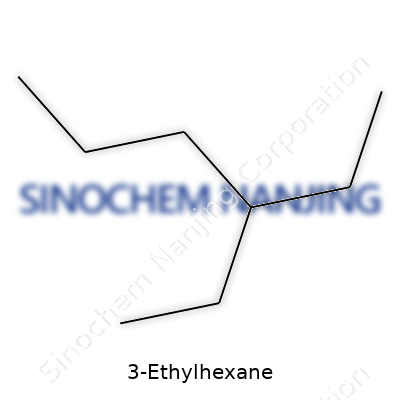
| Names | |
| Preferred IUPAC name | 3-Ethylhexane |
| Other names |
3-Ethylhexan |
| Pronunciation | /ˈθriː ˌɛθ.ɪlˈhɛk.seɪn/ |
| Identifiers | |
| CAS Number | 589-34-4 |
| 3D model (JSmol) | `JSmol("C(C)CCCCC(C)C")` |
| Beilstein Reference | 1721197 |
| ChEBI | CHEBI:34423 |
| ChEMBL | CHEMBL153160 |
| ChemSpider | 59493 |
| DrugBank | DB16666 |
| ECHA InfoCard | 100.191.542 |
| EC Number | 206-383-4 |
| Gmelin Reference | 605383 |
| KEGG | C21051 |
| MeSH | D000435 |
| PubChem CID | 12311 |
| RTECS number | MI2625000 |
| UNII | 2UX5G3T67M |
| UN number | UN2734 |
| Properties | |
| Chemical formula | C8H18 |
| Molar mass | 114.22852 g/mol |
| Appearance | Colorless liquid |
| Odor | Odorless |
| Density | 0.714 g/mL at 25 °C (lit.) |
| Solubility in water | Insoluble |
| log P | 3.78 |
| Vapor pressure | 0.761 mmHg (25 °C) |
| Acidity (pKa) | pKa ≈ 50 |
| Refractive index (nD) | 1.410 |
| Viscosity | 0.660 cP (20°C) |
| Dipole moment | 0.00 D |
| Thermochemistry | |
| Std molar entropy (S⦵298) | 359.5 J·mol⁻¹·K⁻¹ |
| Std enthalpy of formation (ΔfH⦵298) | -214.9 kJ/mol |
| Std enthalpy of combustion (ΔcH⦵298) | -4716.8 kJ/mol |
| Hazards | |
| GHS labelling | GHS labelling of 3-Ethylhexane: `"Not a hazardous substance or mixture according to Regulation (EC) No. 1272/2008 (CLP/GHS)"` |
| Pictograms | GHS02, GHS07 |
| Hazard statements | H315: Causes skin irritation. H319: Causes serious eye irritation. H335: May cause respiratory irritation. |
| Precautionary statements | P261, P271, P304+P340, P312 |
| NFPA 704 (fire diamond) | 1-1-0 |
| Flash point | Flash point: -18 °C |
| Autoignition temperature | 210 °C |
| Explosive limits | Explosive limits: 1.1–6.5% |
| Lethal dose or concentration | LD50 (oral, rat): > 5000 mg/kg |
| NIOSH | NIOSH: *MZ1600000* |
| PEL (Permissible) | Not established |
| REL (Recommended) | 0.1 |
| Related compounds | |
| Related compounds |
Hexane 3-Methylhexane 2-Methylhexane 2,3-Dimethylpentane 2,4-Dimethylpentane Isooctane Heptane |



