3-Bromopropyne: A Closer Look at Its Development, Uses, and Challenges
Historical Development
People have searched for ways to introduce reactivity into organic molecules since the early days of chemistry. 3-Bromopropyne came about as researchers explored halogenated compounds in the nineteenth century. Early documentation of propyne derivatives appeared alongside growing industrial interest in acetylene and propargyl compounds. Gradually, 3-bromopropyne found its way into the catalogs of chemical suppliers once synthetic chemists realized its value as an alkynyl building block. As the chemical industry grew in the twentieth century, manufacturers honed industrial routes for halogenation of small alkynes, syncing commercial production of 3-bromopropyne with rising demand for specialty intermediates in pharmaceuticals, agrochemicals, and materials research.
Product Overview
3-Bromopropyne holds a reputation as a versatile alkyl halide, featuring both a terminal alkyne and bromine atom. Its combination of bromine's leaving group potential and carbon-carbon triple bond gives researchers and industry a handy toolbox to build complexity into molecules. The compound’s structure (BrCH2C≡CH) allows it to participate in substitution and coupling reactions while bringing unique reactivity to synthetic routes. Over years of personal lab experience, it surfaces most often in cross-coupling chemistry, enabling introduction of sp-carbon fragments into small molecules.
Physical & Chemical Properties
3-Bromopropyne typically appears as a colorless to slightly yellow liquid with a boiling point hovering near 60–62°C. Volatility and a sharp, acrid odor make it easy to detect. Its density comes in around 1.5 g/cm3. Water solubility remains low, but miscibility with most organic solvents means it fits well in conventional synthetic setups. Chemically, 3-bromopropyne combines the nucleophilicity of a terminal alkyne hydrogen with the electrophilic character of an alkyl bromide, which opens doors for nucleophilic substitution, elimination, and even cycloaddition reactions. This chemical behavior boosts its use beyond routine alkylations; it finds a niche for crafting molecules in a way few other three-carbon motifs can match.
Technical Specifications & Labeling
Commercial 3-bromopropyne often lands in laboratories at purities above 95%. Labels usually include hazard information tied to its toxicity, flammability, and reactivity. GHS labeling highlights acute toxicity, skin and respiratory irritation, and environmental hazards. Containers resist attack by halides, with metal cans or Teflon-lined bottles making up standard storage. For handling, chemical manufacturers ship under nitrogen to slow decomposition. Product sheets always remind researchers about the need for full PPE—gloves, goggles, lab coats—because a moment’s exposure can leave lasting effects on skin or lungs.
Preparation Method
Producing 3-bromopropyne in the lab usually relies on bromination of propyne or propargyl alcohol derivatives. Industrial processes often begin with propargyl alcohol, converting it to propargyl bromide using reagents like phosphorus tribromide or hydrobromic acid. Each method trades off yields, byproduct generation, and cost, but propargyl alcohol to propargyl bromide conversion tends to dominate due to simplicity and lower risk of polymerization compared to working with propyne gas. This synthesis forms the backbone of pilot-scale and industrial production, though safety protocols require careful venting and temperature control to keep exothermic reactions and toxic gas release in check.
Chemical Reactions & Modifications
Personal experience taught me how 3-bromopropyne’s structure brings diversity to the reaction bench. Its halide enables both SN1 and SN2 displacement, feeding straightforward routes to propargyl ethers, amines, and sulfides when paired with appropriate nucleophiles. In addition, the triple bond acts as a linchpin for coupling reactions—a favorite of medicinal chemists seeking new heterocycles or carbon frameworks. Common transformations leverage palladium-catalyzed couplings, Lewis acid additions, and hydrogenation, giving chemists almost free rein to manipulate the carbon backbone. This utility lays a foundation for high-value libraries in drug discovery, especially once analogs with greater selectivity or potency turn up as leads.
Synonyms & Product Names
Chemical catalogs use several names for 3-bromopropyne, including propargyl bromide, 1-bromo-2-propyne, and 3-bromoprop-1-yne. I’ve worked with suppliers listing it as "Propargyl bromide stabilized" or "Bromopropargyl compound" depending on the formulation. Researchers should stay alert to these alternative names because regulatory documents or safety data sheets don’t always use a single consistent term. CAS number 106-96-7 clears up most confusion, but industry players stick to familiar synonyms in batch records or shipments, linking back to decades of chemical shorthand on the production floor.
Safety & Operational Standards
First encounters with 3-bromopropyne in the lab drive home the importance of rigorous safety. Acute toxicity aligns with its reputation as a potent alkylating agent; vapors irritate mucous membranes and inhalation brings respiratory distress. Skin exposure is a clear hazard, leading to blistering, and environmental risk ranks high. For this reason, chemical fume hoods, impervious gloves, and tightly sealed vessels anchor any handling scheme. Emergency protocols stress immediate access to eyewash stations and proper spill kits, while routine disposal demands incineration above 1000°C or neutralization with sodium thiosulfate. These standards protect both researchers and the environment from the compound’s severe and lasting effects, echoing lessons hard-learned from industrial accidents in the twentieth century.
Application Area
Major uses for 3-bromopropyne sit at the intersection of chemical synthesis and materials development. Drug discovery teams value it as an intermediate for custom molecules in antiviral, anticancer, and CNS-targeted therapies. Crop protection research taps into its ability to link structural motifs for new fungicides or insecticides. Polymer scientists use it to modify chain ends or introduce reactive sites, driven by the robust carbon-carbon triple bond. Even in academic chemistry, students and postdocs shape complex scaffolds and conjugated systems thanks to propargyl bromide’s reactivity. Its footprint even reached electronics manufacturing, where reactive alkynes find application in circuit fabrication and surface modification. The reach goes further as emerging industries experiment with click chemistry and bioconjugation, opening up even more routes for innovation.
Research & Development
From years in research settings, I have seen 3-bromopropyne serve as a springboard for combinatorial libraries and advanced functional materials. Its role as a propargyl source in copper-catalyzed azide-alkyne cycloadditions remains a gold standard in chemical biology, driving the bioconjugation of probes to biomolecules. R&D groups focus on expanding compatibility with new catalysts, improving selectivity for site-specific modifications, and integrating this building block into greener synthetic protocols. Studies tackle the need for safer analogs or stabilizers to mitigate risks without sacrificing the compound’s unique utility. Industry also funds rigorous work to minimize byproduct formation and scale up continuous-flow bromination for greater efficiency and lower environmental footprint.
Toxicity Research
Toxicologists picked up on propargyl bromide’s risks early, running animal and in vitro studies to map out its toxicity. Acute exposure damages lung and nervous tissue, while chronic exposure raises cancer risks and organ damage. Researchers uncovered mechanisms tied to alkylation of DNA and protein, stacking up data on genotoxicity that triggered tighter handling requirements in labs and industry. Recent toxicity screening has zeroed in on off-target effects during bioconjugation, guiding the push for safer reagents and protocols. Regulatory agencies update exposure limits and recommend controls based on findings from new models, reconsidering standards as evidence grows.
Future Prospects
3-Bromopropyne probably won’t fade from the synthetic chemist’s toolkit any time soon. As more companies explore click chemistry and bioorthogonal reactions, demand for efficient, reactive building blocks looks set to rise. The next wave of development could spring from more sustainable processes—continuous flow chemistry, safer brominating agents, or green solvents that curb both cost and environmental load. A shift toward digital synthesis planning, powered by machine learning, promises to unlock new uses for propargyl bromide, guiding chemists to safer, more selective, less wasteful routes. With careful attention to safety, regulation, and environmental responsibility, this molecule keeps offering up solutions for the most complex challenges in drug, materials, and bioengineering research.
What is 3-Bromopropyne used for?
Where 3-Bromopropyne Plays a Role
3-Bromopropyne sounds like one of those mysterious names you only see in chemistry textbooks. On the ground, this compound pops up in a handful of industries that rely on the unique ways carbon and bromine bond together. If you work in a lab, you might know it as propargyl bromide. The people mixing things up in chemical research and pharmaceuticals see this compound as a tool, not just a hazard on a safety sheet.
Getting Down to Science
In the lab, 3-Bromopropyne comes in as an alkylating agent. Basically, it helps snap new pieces onto molecules, which sounds simple but opens the door to lots of new possibilities in organic synthesis. Researchers chase new paths for making cancer medicines, solvents, and additives by experimenting with this compound.
A real-life example: if scientists want to make certain benzofurans — structures you find in some drugs — 3-Bromopropyne sits on their list of go-to reagents. The triple bond in its structure sets it apart. The “alkyne” group attached to that bromine atom acts like a construction site full of potential, giving chemists a way to extend or bend molecules around new corners. Students in university labs first learn about 3-Bromopropyne when they run syntheses that need precision and a little risk-taking; this chemical offers both.
Industry Applications that Matter
Beyond research, large-scale industrial processes lean on 3-Bromopropyne, especially when making new materials or specialty coatings. Anyone who’s built a prototype flexible circuit or push-button knows how tricky the chemistry behind those plastics can get. Brominated alkynes help tweak the characteristics of polymers, sometimes making them stronger, sometimes lending them unique physicochemical properties. Precision here matters. Mistakes on the factory floor or in a test batch are not just costly—they can be dangerous. A material scientist in plastics once told me that the smallest tweaks to a base chemical recipe can mean the difference between a failure and a breakthrough.
Safety and Challenges
No one can overlook the risk tied to 3-Bromopropyne. The substance can irritate skin, eyes, and lungs, and large spills threaten people and the environment. So, strict rules keep everyone honest about storage and handling. Chemists wearing double gloves, goggles, and working under a fume hood treat this compound with respect born from hard-learned safety lectures and accident reports. Regulators in the European Union and the United States rank this chemical under restricted categories because of its reactivity and toxicity. Companies juggling compliance must budget for specialized ventilation and waste systems that drive up costs but save lives.
Looking Ahead and Focusing on Solutions
Safer alternatives and greener chemistry top the priority list for people who work with 3-Bromopropyne. Some researchers keep testing milder alkylating agents that cut down risk and environmental impact. Digital databases tracking every drum and bottle, paired with strict laboratory training, promise to keep incidents rare. For now, the world relies on the hands and judgment of trained scientists to make use of this compound and to keep one eye on the next big innovation — one that improves safety even further without sacrificing discovery or industrial progress.
What is the chemical formula of 3-Bromopropyne?
What Makes 3-Bromopropyne Unique?
3-Bromopropyne shows up in plenty of labs and discussions about organic synthesis. Its chemical formula is C3H3Br. The structure carries three carbons, three hydrogens, and a single bromine. The triple bond between the first two carbons gives it the “propyne” profile. Add a bromine atom onto the third carbon, and you’ve got a molecule that packs a punch in reactivity.
Why Understanding the Formula Matters
Many overlook what difference a simple chemical formula can make. For a student in an undergraduate organic chemistry class, a misstep over a single atom in a structure often leads to incorrect predictions in experiments. A poor grasp of that C3H3Br framework spells trouble for selecting correct reagents or planning a synthesis.
A mistake in the structure sometimes looks minor on paper. In reality, it could mean an entire batch of wasted chemicals. More than wasted cash, it can lead to safety issues. 3-Bromopropyne’s triple bond and bromine atom aren’t just academic details. The bromine draws attention because of its electronegativity, boosting the molecule’s reactivity. An underestimation of its power could lead to dangerous by-products or even explosions if mishandled in scale-up.
Real-World Uses and Safety
Chemists don’t just admire 3-Bromopropyne on paper. Its formula shapes how it gets used in industry and research labs. Producers reach for it when building carbon-carbon bonds or crafting heterocycles. Even small errors in the name risk pulling the wrong chemical from a shelf, kicking off a domino effect that blocks progress for weeks.
Mistaking its formula or structure means missing out on its ability to serve as a versatile building block. Companies rely on chemists to know these details so they can work effectively with pharmaceuticals, agrochemicals, and specialty materials. The formula guides handling and storage too. Brominated alkynes, such as 3-Bromopropyne, require secure storage away from ignition sources. Without accurate labeling and formula recognition, safety protocols fall apart.
Lessons From Experience
My early days in the lab taught me that memorizing formulas like C3H3Br isn’t just academic—it's about efficiency and safety. I’ve seen a technician assume a brominated alkyne behaved like a more benign compound, only to trigger a runaway reaction. Columbia University’s chemical safety records highlight incidents from such oversights each year. The right formula on the bottle, double-checked and understood, matters for every single user.
A version of this issue surfaced during a synthesis project for a fine-chemicals startup. We’d ordered 3-bromopropyne to build specific intermediates. A mix-up between C3H3Br and a similar-looking molecule stalled the project for three days, as a chain reaction failed due to incorrect substitution points. Time and resources get wasted when basics slip through the cracks.
Solutions for Chemical Literacy
A commitment to chemical literacy protects workers and speeds up research. Routine training on structure, formula, and properties curbs confusion. Clear labeling, periodic reviews, and ongoing education programs make sure formulas get embedded beyond rote memorization. Automated inventory with chemical structure graphics slashes human error. Combining experience, vigilance, and updated knowledge lets teams squeeze the best from every bottle and keeps accidents rare.
What are the safety precautions for handling 3-Bromopropyne?
Understanding the Risks
3-Bromopropyne doesn’t announce itself with a strong smell or bright color, but that shouldn’t fool anyone into thinking it’s harmless. Just a little of this chemical in the wrong place can cause headaches, dizziness, and a burning feeling in the nose and throat. I remember my first chemistry internship: the rule for working with unfamiliar solvents was to check the signs—the safety sheets were posted on every cabinet. 3-Bromopropyne makes that list, and there’s a reason. The stuff can irritate skin and eyes on contact, and inhaling its vapor is no joke.
Basic Safety Gear
No one should handle this chemical without putting on proper protective gear. I’m talking about thick nitrile gloves, goggles that seal around your eyes, and a lab coat that fits snugly at the wrists. I’ve seen colleagues splash chemicals simply by rushing, so adding a face shield makes accidents less scary. Closed-toe shoes and long pants are a must. There’s a powerful lesson in safety: the gear may feel like a hassle, but one slipup is all it takes for a trip to the clinic.
Working Environment Matters
A regular desk or open room doesn’t cut it. Every time I’ve used 3-Bromopropyne, the fume hood was my best friend. Good ventilation pulls away vapors, protecting anyone nearby. Chemicals like this release invisible fumes, so opening a window is never enough. Fume hoods also help cut down on spills since there’s less clutter and a set routine for moving bottles and pipettes.
Handling and Storage
3-Bromopropyne doesn’t play nice with air and moisture, so storing it in tightly sealed, labeled bottles in a cool, dry spot keeps everyone safer. At my last lab, nobody ever took from an unmarked container. Sharpie labels right on the glass made it clear what was inside. Everyone had the habit of cleaning up drops or residue, no matter how small the spill seemed. Quick action keeps vapors from floating around or residues from soaking through gloves.
What to Do in Case of an Accident
Everyone should know where the eye wash and safety shower stations are, since response time matters. In one of my old labs, I had to sprint a fellow intern to the shower after a chemical splash. Seconds count, and practice drills help more than people admit. If skin contact happens, flushing with water for at least 15 minutes helps. For inhalation, moving to fresh air is best. Chemists train for these emergencies every semester, and the training pays off when you’re facing the real thing. Seek medical attention right away for any exposure beyond a single splash.
Responsible Waste Disposal
Pouring leftover 3-Bromopropyne down the drain never entered our minds. Chemical waste collection is the only proper path. In my experience, hazardous waste labels and daily log sheets make it harder to lose track of any vial or flask. Working with a trusted disposal company gives peace of mind and protects the wider community from exposure.
Building a Culture of Safety
Labs that don’t take shortcuts set everyone up for fewer surprises. Training sessions, regular reminders about the risks, and a clear sense of responsibility benefit all. I’ve always believed that safety comes down to habits and caring for each other as much as for our own health. With 3-Bromopropyne in the room, it pays to respect its hazards and never get complacent.
How should 3-Bromopropyne be stored?
Why Attention to Detail Makes a Difference
I've walked more than a few lab corridors and seen the aftermath of simple mistakes—broken glass, unexpected odors, and sheepish looks from researchers who forgot which bottle demanded extra care. 3-Bromopropyne isn't just another chemical in the fridge. It brings a unique set of risks that go well beyond a textbook hazard label. This compound, with its reactivity and volatility, represents one of those situations where rules exist for good reason.
Hazards Lurk in Plain Sight
3-Bromopropyne does not play well with air, water, or heat. It burns on contact with air, releases fumes that attack the lungs, eyes, and skin, and can form dangerously explosive mixtures. Just reading that sends me right back to my graduate days, reminding me how even careful chemists can get caught off-guard. There's real urgency here. I remember a time when a fume hood failure nearly turned a minor storage oversight into a lab evacuation.
Storage Demands a Plan, Not Improvisation
You can’t shove it into any bottle and call it a day. Use glass containers with tight, chemical-resistant seals. These need labels that shout their contents in no uncertain terms. You could store other brominated substances in plastic now and then, but 3-Bromopropyne can eat through low-grade plastics. I've picked up bottles leaking at the seams, and each time, the cleanup that follows takes far more time than just doing it right at the start.
Shelving counts, too. Place containers away from light and heat. Ambient sunlight through a window or a warm spot near compressors creates enough warmth to break down the compound and raise pressure in the bottle. Explosion-resistant refrigerators, clearly marked for chemicals—not for food samples or drinks—keep temperatures stable and reduce fire risk. Chemical fridges cost more, but every researcher who’s ever lost a bottle to a common fridge learns the lesson hard: you get what you pay for.
Keep Moisture Out, Keep Air Out
Water sneaks into bottles when caps don’t seal, and 3-Bromopropyne loves to hydrolyze, forming corrosive acids inside the vessel. Invest in a dry, inert atmosphere for storage. Argon or nitrogen gas makes this easy. Purge the air above the stored liquid before sealing. One old-timer chemist taught me the trick: a small squirt of inert gas just before the cap goes on, every time. That habit spares a lot of trouble.
Never Store Alone—Safety in Numbers
Don’t overlook the value of an inventory system. I once took over a space where two bottles had gone missing because someone “put them somewhere safe.” Multiple sets of eyes, redundant logging, and regular checks keep everyone accountable. Share information and let everyone know what’s where. If you suspect a leak, don’t open the fridge yourself. Notify your safety officer and follow protocol.
Personal Protection Isn’t a Last Resort
Whenever you touch or move this compound, full PPE matters: goggles, gloves rated for chemical exposure, and lab coats that button up to the throat. Have a spill kit designed for alkyl halides within reach.
Continuous Vigilance Is the Solution
Every storage practice above comes from hard-won experience and documented accidents. Regulatory agencies, like OSHA and the CDC, have clear guidelines supporting these steps, and the chemical’s safety data sheet backs up the need for gloves, cooling, ventilation, and labeling. They’re right—the margin for error is razor-thin. Listen to the stories, trust the science, and don’t cut corners. Storing 3-Bromopropyne is not busywork—it’s the front line of lab safety.
What are the physical and chemical properties of 3-Bromopropyne?
Understanding the Substance
3-Bromopropyne, with the formula C3H3Br, stands out among small organobromine molecules for its reactivity and its bite as an intermediate in organic synthesis. Most chemists recognize this compound for its sharp, ether-like odor and clarity as a colorless to light yellow liquid. Add in a low boiling point—hovering around 59°C—and you’ve got a liquid that wants to turn into vapor right under your nose. Anyone who has opened a bottle of this stuff and caught a whiff remembers it.
Physical Properties in the Real World
In a lab, you can spot 3-Bromopropyne by its volatility. This property brings a level of unpredictability. You cap the bottle tightly, knowing it evaporates fast at room temperature. It dissolves fairly well in organic solvents, especially ether and acetone, but don’t bother with water—it doesn’t mix, and any vapor can sting the eyes or nose just from handling.
Its density is higher than water, at about 1.5 g/cm3, and it’s lighter than many brominated solvents. 3-Bromopropyne also has a pretty high vapor pressure, which means storage and handling take care. Flammability raises a flag, especially around open flames or hot surfaces. A lot of labs keep it under nitrogen or in the fridge—not because it’ll break down in seconds, but because nobody wants a room filled with its fumes.
Chemical Properties and Reactivity
The triple bond sets this molecule apart. It gives the compound extra punch when it meets nucleophiles, and it opens the door to a wide range of coupling and addition reactions. That terminal alkyne behaves like a magnet in organic chemistry. It pulls in attacks from bases and makes the molecule a favorite in propargylation and cross-coupling reactions.
In industry and academic settings, 3-Bromopropyne sees the most action as an intermediate. The bromine atom acts as a leaving group, making it a springboard for attaching the propargyl group to other compounds—carbons, nitrogens, sulfurs. There’s value here for building pharmaceuticals, agrochemicals, and advanced materials.
The molecule brings some hazards. It’s toxic and irritates the skin, eyes, and lungs. Spills tend to scramble a lab into action, with fume hoods blasting and gloves pulled on fast. These aren’t just rules—they come from stories of real burns and raw throats.
Handling Challenges and Solutions
The chemistry of 3-Bromopropyne prompts careful handling and responsible disposal. Its volatility drives most users to keep stock small, rotating out old material quickly. Ventilated cabinets matter here; simple shelving rarely cuts it. Accidents usually come from skipping these steps, not from some mystery fault in the molecule itself.
In research, substituting safer building blocks starts with understanding both the benefits and the risks. Alternative halogenated alkynes and better containment tech cut down on exposure. Training plays a role too—many mistakes link back to inconsistent safety practices rather than quirks in physical or chemical behavior.
Why Pay Attention?
3-Bromopropyne tells a story about chemistry’s power and its responsibility. One molecule, used well, can drive progress in drug development, electronics, and specialty chemicals. At the same time, overlooking its hazards puts both health and research at risk. Systems for ventilation, labeling, and emergency action make a real difference. The compound’s quirks aren’t unique, but they demand respect and clear-eyed planning from everyone on the bench.
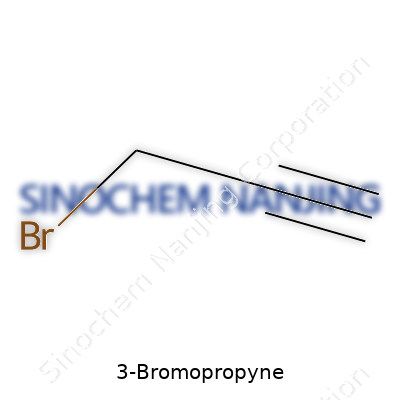
| Names | |
| Preferred IUPAC name | 3-Bromoprop-1-yne |
| Other names |
Propargyl bromide 1-Bromo-2-propyne 3-Bromoprop-1-yne 1-Bromoprop-2-yne Propargylic bromide |
| Pronunciation | /ˌθriːˌbroʊmoʊˈprɑːpaɪn/ |
| Identifiers | |
| CAS Number | 106-96-7 |
| Beilstein Reference | 1207446 |
| ChEBI | CHEBI:51735 |
| ChEMBL | CHEMBL1497950 |
| ChemSpider | 13286 |
| DrugBank | DB08315 |
| ECHA InfoCard | ECHA InfoCard: 100.003.990 |
| EC Number | 203-602-2 |
| Gmelin Reference | 1437 |
| KEGG | C00790 |
| MeSH | D002449 |
| PubChem CID | 10715 |
| RTECS number | UY8575000 |
| UNII | 0M8L6713KP |
| UN number | UN2345 |
| Properties | |
| Chemical formula | C3H3Br |
| Molar mass | 99.01 g/mol |
| Appearance | Colorless to light yellow liquid |
| Odor | Unpleasant |
| Density | 1.422 g/mL at 25 °C (lit.) |
| Solubility in water | Slightly soluble |
| log P | 0.3 |
| Vapor pressure | 15.64 psi (20 °C) |
| Acidity (pKa) | pKa ≈ 13 |
| Basicity (pKb) | pKb = 9.26 |
| Magnetic susceptibility (χ) | -48.2×10⁻⁶ cm³/mol |
| Refractive index (nD) | 1.436 |
| Viscosity | 1.36 cP at 25 °C |
| Dipole moment | 2.08 D |
| Thermochemistry | |
| Std molar entropy (S⦵298) | S⦵298 = 304.6 J·mol⁻¹·K⁻¹ |
| Std enthalpy of formation (ΔfH⦵298) | 85.1 kJ/mol |
| Std enthalpy of combustion (ΔcH⦵298) | -167.1 kJ/mol |
| Hazards | |
| GHS labelling | GHS02, GHS06 |
| Pictograms | GHS02,GHS06 |
| Signal word | Danger |
| Hazard statements | H226, H301, H311, H331, H315, H319, H335 |
| Precautionary statements | Precautionary statements of 3-Bromopropyne: "P210, P261, P280, P304+P340, P312, P403+P233, P501 |
| NFPA 704 (fire diamond) | 3-1-2-W |
| Flash point | 12 °C (closed cup) |
| Autoignition temperature | 405 °C |
| Explosive limits | 4.5–14% |
| Lethal dose or concentration | LD50 (rat, oral): 54 mg/kg |
| LD50 (median dose) | LD50 (median dose): Oral rat LD50: 107 mg/kg |
| NIOSH | SN 3850000 |
| PEL (Permissible) | PEL: 1 ppm (3 mg/m³) as an 8-hour TWA (OSHA) |
| REL (Recommended) | 3–7°C |
| IDLH (Immediate danger) | No IDLH established. |
| Related compounds | |
| Related compounds |
Propargyl chloride Propargyl alcohol 1-Bromo-2-propyne 1-Bromo-1-propene |



