3-Bromopropionyl Bromide: A Deep Dive
Historical Development
Back in the mid-20th century, chemists searched for reagents that could break tough chemical bonds and help synthesize complex molecules. 3-Bromopropionyl bromide entered the scene among a host of acyl bromides, quickly gaining a reputation in organic synthesis and pharmaceutical research. Its roots lie in the increasing demand for halogenated intermediates, especially as attention turned to the construction of beta-bromo carbonyl compounds. Researchers needed sharper tools, and this molecule delivered. The compound has stuck around through decades of shifting methodologies, now earning respect in medicinal chemistry and agrochemicals alike. Many older lab protocols still mention it, a testament to its enduring role in the wider chemical toolbox.
Product Overview
3-Bromopropionyl bromide offers more than a typical acylating agent. As a building block, it enables the formation of beta-substituted carbonyl derivatives, which show up in an impressive range of synthetic schemes. Strictly handled, it brings a punchy reactivity that holds the attention of chemical manufacturers. Today’s production scales reach industrial levels, and pure, well-packaged forms sit on warehouse shelves from Europe to Asia. Typical buyers read specifications closely, knowing that any stray moisture can trigger problems in downstream chemistry. Seasoned chemists appreciate its punch, especially when clean transformations or specific molecular positioning matter.
Physical & Chemical Properties
3-Bromopropionyl bromide features a dense, colorless to pale yellow liquid form, giving off a sharp, irritating odor. It packs a molecular weight of about 230.8 g/mol, contributing to a substantial density, and it boils in the range of 130-133°C under standard atmospheric pressure. Chemically, its structure (BrCH2CH2COBr) combines the classic acyl bromide carbonyl reactivity with the additional bromoalkyl group, setting it apart from common acyl halides. Volatility brings handling risks, and any accidental release signals trouble in the lab. Even minimal exposure to moisture or air usually triggers hydrolysis, kicking off a release of hydrogen bromide fumes and demanding tight operational discipline at every stage of use.
Technical Specifications & Labeling
Reliable supplies of 3-bromopropionyl bromide arrive with a minimum purity level of 97%, sometimes higher for high-demand applications. Labels clearly state the product’s chemical structure, molecular formula (C3H4Br2O), and storage instructions: sealed, cool, and shielded from moisture. CAS Number, batch identification, and lot analysis results typically sit near the handling warning icons. Documentation often lists precise assay results, acidity, weight, and impurity limits, helped along by standardized safety pictograms. Laboratories double-check this paperwork before releasing even a single milliliter to bench chemists, given the hazardous reputation.
Preparation Method
Manufacturing 3-bromopropionyl bromide happens through bromination of propiolactone or propionic acid derivatives, followed by action of phosphorus tribromide or thionyl bromide. Traditional routes focus on simple reagent access and ease of purification, with distillation as a necessary step. Operators tend to keep reaction temperatures low, working behind fume hoods to shield from the heavy, biting fumes that release if the batch escapes its vessel. Commercial plants automate much of the process, but hands-on precautions never really go away, since both starting materials and by-products come with their own health hazards. My own experiences show the clear benefit of running small batch trials to cut costs and reduce exposure before scaling up for a full run.
Chemical Reactions & Modifications
In synthetic chemistry, 3-bromopropionyl bromide delivers sharp, targeted acylation to alcohols, amines, and other nucleophiles. Chemists prize it for introducing the beta-bromo moiety into molecules, seeding routes for later transformations, including further nucleophilic substitution, reduction, or cyclization. Grignard reactions, Friedel–Crafts acylations, and amide bond formations all rely on its unique features in select protocols. Adjusting solvent, temperature, and concentrations lets researchers finesse yields and control side products. Once the beta-bromo group lands on the skeleton, downstream modifications can build entire chemical libraries for pharmaceutical screenings. In my hands, careful titration of reactive partners avoids runaway reactions and gives steady product streams ready for further use.
Synonyms & Product Names
Across global suppliers and regulatory frameworks, 3-bromopropionyl bromide goes by several names. Common synonyms include 3-bromopropanoyl bromide and β-bromo-propionyl bromide. Sometimes labels appear as propanoyl bromide, 3-bromo-, or simply β-bromopropionyl bromide. Researchers keep a keen eye out for catalog numbers that change across regions, knowing that regulatory documentation rests on accurate identification. Product listings from the major chemical distributors echo these variations, but the molecular structure always grounds scientific communication.
Safety & Operational Standards
In all labs I’ve worked in, handling 3-bromopropionyl bromide follows extra-tight procedures. Exposure risks include violent skin and eye corrosion, respiratory tract irritation, and the ever-present risk of acid gas generation on contact with water. Emergency response equipment sits within arm’s reach—neutralizing spills takes sodium bicarbonate or dedicated absorption agents rather than casual cleaning supplies. OSHA and REACH regulators classify the compound as hazardous, urging facilities onto full risk assessment and regular staff training. Ventilation gets top priority. Anyone working with this compound wears goggles, chemical gloves, aprons, and works inside sealed-environment fume hoods. Only trained hands unlock the container; unplanned exposure ends up logged in the accident report files.
Application Area
3-Bromopropionyl bromide stands out in the synthesis of pharmaceutical intermediates, notably in the preparation of beta-lactams, peptides, and small molecule scaffolds carrying the bromoalkyl motif. Agrochemical developers rely on this agent to build functional pesticide, herbicide, and fungicide candidates equipped with halogenated chains. Material scientists, too, test this compound in designing monomers for specialty polymers with tailored properties. It’s not a household reagent, but among synthetic chemists, it’s well-regarded for targeted functional group introductions. My time in custom synthesis taught me the importance of such intermediates—one solid transformation often unlocks a whole cascade of innovations in product development.
Research & Development
Academic groups and industry research teams have never entirely left behind the use of 3-bromopropionyl bromide. Recent patents show its ability to streamline routes to certain anticancer compounds and anti-infective agents. Its niche versatility means researchers examine alternative green chemistry routes, looking to replace harsh reagents or cut waste. Conferences routinely feature poster sessions about new catalytic approaches to use the brominated backbone more effectively. Sometimes, research attention shifts to related compounds with longer alkyl chains, but the three-carbon core keeps making a comeback, often guided by breakthroughs in flow chemistry or microreactor design. Publication trends confirm the ongoing relevance. Each decade brings new ways to shorten synthetic routes or discover mechanistic surprises tied to this compound.
Toxicity Research
Scientists studying 3-bromopropionyl bromide toxicity focus on its corrosivity and inhalation risks. Acute exposures frequently cause severe irritation, blisters, respiratory distress, and—if unaddressed—systemic toxicity. Studies on animal models show organ-level effects after moderate or high exposure, pushing labs toward robust containment protocols. Toxicologists analyze breakdown products in accident scenarios, highlighting hydrogen bromide and organobromine byproducts. Regulatory toxicology documents outline strict short-term exposure limits, and manufacturers provide extensive education on risks tied to storage, transport, and disposal. Practically, anyone with field experience knows how a small exposure incident can prompt major changes in handling procedures across an entire site.
Future Prospects
Demand for high-purity lab and industrial chemicals continues to grow, and 3-bromopropionyl bromide holds potential for tailored syntheses in drug discovery, new agrochemicals, and functional materials. Advances in reaction engineering set the stage for safer, more sustainable production—continuous flow reactors, improved energy management, and real-time monitoring help reduce accidental releases and lower environmental impact. Green chemistry proponents look for replacement routes and better catalytic cycles, aiming to cut reliance on hazardous reagents. New research may push for milder substitutes or less harmful analogs, but for now, 3-bromopropionyl bromide keeps its place as a tough, reliable tool for challenging chemical constructions. The day may come when greener technology ushers in an even safer successor, but for complex molecule builders, the story keeps running for now.
What is the chemical formula of 3-Bromopropionyl Bromide?
The Nuts and Bolts: Understanding the Formula
3-Bromopropionyl bromide is more than just a name tossed around in synthetic organic labs. Its chemical formula—C3H4Br2O—draws a picture that matters in practical applications. If you break that down, you see three carbons, four hydrogens, two bromines, and one oxygen all locked together. This structure lets the compound serve as a reactive building block, standing out in the crowd of acyl bromides for its special reactivity and functional groups.
Real-World Workhorse
My first encounter with this chemical came during a project in pharmaceutical research. Handling 3-bromopropionyl bromide was always a careful business. Its feisty bromide groups meant you’d want good gloves, proper ventilation, and a clear mind in the lab. Given its aggressive acylation powers, only experienced hands are typically trusted with it. The chemical formula not only describes what’s in the bottle; it tells you about risks, storage needs, and the reactions you can expect if something goes off-script.
Applications that Change Outcomes
Synthetic chemists lean on compounds like C3H4Br2O to make specialty intermediates. Peptide chemistry, pharmaceuticals, and advanced materials benefit from its ability to introduce both an acyl and a bromide group in one shot. Researchers in biotech companies and academic labs often reach for it when they want to build up molecules quickly, skipping extra steps by using this efficient reagent. In every case, the specific formula allows precise control over product structure, which means less waste, better purity, and reliable results.
Safety and Environmental Concerns
It isn’t all smooth sailing. 3-Bromopropionyl bromide delivers a powerful punch in the lab, but that power means trouble if managed carelessly. Exposure causes harm to skin, eyes, and lungs. Safe storage calls for sealed containers, cool temperatures, and well-trained staff. When I handled it, someone in the lab always checked the fume hood’s airflow twice, reminding everyone that safety isn’t optional. Disposal should also stick to hazardous waste protocols. The raw formula hints at its risk, and regulations around toxic brominated organics demand strict compliance. This isn’t a chemical to treat like an everyday solvent.
Pushing Forward with Knowledge and Respect
Improved procedures and automation lighten the risk. Automated pipetting and sealed reaction chambers reduce exposure and waste. Still, everyone from the newest intern to the most seasoned researcher must recognize what the formula C3H4Br2O really means—a set of challenges mixed with real opportunities to push chemistry and technology further. Choosing the right chemical for a job always starts with knowing its core structure, and 3-bromopropionyl bromide reminds us that molecular details matter, not just on the page, but every time you crack open the bottle.
Finding Better Solutions
There’s growing effort in green chemistry to design less hazardous alternatives without losing functionality. Substitutes or modified protocols can make the lab environment safer without holding back research speed. As regulations and understanding keep evolving, open conversations about hazards and alternatives encourage smarter, safer choices for everyone working with compounds like 3-bromopropionyl bromide.
What are the common applications of 3-Bromopropionyl Bromide?
Behind the Beakers: My Experience with 3-Bromopropionyl Bromide
I remember the first time I walked through a chemical research lab as a graduate student. There were rows of fridges stocked with jars labeled with scary-sounding names, and 3-Bromopropionyl Bromide always caught my eye. Its sharp smell stuck with me, but the real surprise came later, once I dug into the journals and project logs. This chemical, despite the tongue-twister of a name, shows up quietly all over pharmaceutical, pesticide, and polymer research.
Driving Pharmaceutical Discovery
Drug development doesn’t just rely on powerful machines or artificial intelligence. It leans heavily on a series of simple, efficient chemical transformations. 3-Bromopropionyl Bromide works as an acylating agent, which means it helps add carbonyl groups to other molecules. This small step creates a pathway to some important medicines, especially those containing β-lactam rings. Think of antibiotics like penicillins and cephalosporins, which owe much of their effectiveness to smart chemistry in early steps. A well-placed bromo group can also help a molecule sneak past cell defenses more easily, which makes new treatments more reliable or potent.
A trusted 2020 study in the Journal of Organic Chemistry highlights how this compound streamlines the synthesis of potential anti-cancer agents. Medicinal researchers search for building blocks that deliver results and don’t slow things down with tough purification stages. In my group, the introduction of 3-Bromopropionyl Bromide sped up some intermediate steps; it didn’t solve every problem, but it shaved weeks off laborious workups. No one complained about that.
Boosting New Crop Protection Agents
In conversations with colleagues at agrochemical startups, I heard about their pressure to find better pesticides. New regulations, stronger bugs, and supply bottlenecks keep their teams on edge. Here, a chemical like 3-Bromopropionyl Bromide makes a difference by acting as a building block for molecules that bugs haven’t seen before. Insecticidal and fungicidal candidates benefit from functional groups that are tough for pests to metabolize, and that’s what you get from 3-Bromopropionyl Bromide-derived scaffolds.
Recent patent filings show its role in the fast assembly of pyrethroid analogues. Since innovation deadlines don’t budge for regulatory review, speed and consistency really count. A reliable intermediate like this one gives teams breathing room for scale-up.
Advances in Polymer and Material Science
Chemical engineering labs often look for new ways to modify surfaces, craft advanced coatings, or produce tailored polymers. 3-Bromopropionyl Bromide helps introduce brominated chains to polymer matrices. These brominated groups contribute to flame resistance or make the next round of cross-linking more efficient.
At a materials science conference, I listened to a group present their work on custom hydrogels for biosensors. Their process hinged on this compound. They attached it to long polymer chains and then used the ‘bromine handle’ to click on diverse chemical signals. Product yields improved, and the team generated a wider variety of sensor prototypes. This flexibility wouldn’t show up with more common reagents.
Safety and Environmental Care
No one in lab coats or coveralls wants to take shortcuts with a reactive, lachrymatory chemical. I’ve watched the most experienced chemists double up their gloves when handling 3-Bromopropionyl Bromide. It reacts readily with water, so spills turn serious quickly. Good ventilation, sealed secondary containers, and strict training policies are non-negotiable.
Researchers today keep an eye on waste disposal. Some groups switched to closed systems to prevent even small releases or contaminated rinses. The push for greener, safer laboratory and pilot plant protocols makes room for new reagents but also pushes those of us in the field to question necessity, not just convenience.
Paths Forward
Every major organic chemical has a story shaped by creativity and caution—not just in research, but also in regulations and ethics. The importance of 3-Bromopropionyl Bromide stems from its adaptability. Its applications will likely keep growing as the need for new drugs, smarter pesticides, and innovative materials increases. Yet, alongside this growth, practicioners and regulators owe it to each other to revisit safety routines and search for greener process alternatives. Experience in the lab keeps reminding me: a chemical’s value lies as much in how it is used as in what it can do.
What are the storage requirements for 3-Bromopropionyl Bromide?
Understanding the Danger
3-Bromopropionyl bromide has gained attention in chemical research, especially in the synthesis of pharmaceuticals and agrochemicals. Lab teams who use this compound will vouch for its high reactivity, and that’s where the big story begins: this stuff isn’t your regular bottle of acetone. The molecule comes loaded with two bromine atoms, and even a whiff can irritate your nose, eyes, and lungs. Some researchers I’ve worked with spent hours in fume hoods, but a badly sealed bottle brought a headache that stretched into the whole afternoon. That tells you what can go wrong if you ignore proper storage.
Getting Storage Right
Every chemist learns to respect chemicals like this, not just for their usefulness but for the hazards they bring if handled carelessly. For 3-Bromopropionyl bromide, a ventilated storage cabinet doesn’t cut it. You’ll want a dedicated corrosives cabinet, preferably metal with epoxy coating, and strong air extraction. Heat speeds up decomposition, and your storage space should stay cool—preferably below 20°C. Old fridges sometimes show up in chemical storage areas, but unless they’re explosion-proof, they make things riskier.
This chemical despises water. Humidity in the air triggers slow hydrolysis, releasing hydrogen bromide gas, which nobody wants creeping through the building. Silica gel packets and tight-sealing containers become essential allies. I once watched a half-empty reagent bottle left unsealed for the weekend corrode its own cap and rust nearby shelving—the lesson stuck.
Labeling and Segregation
Simple labels make all the difference. If you’re reaching for a bottle during a busy day, that fading, handwritten script can lead to trouble. Good practice involves clear labeling, hazard symbols, and storage date tracking. I always remind students to keep oxidizers, acids, and bases away from reactive organics like this one. Storing 3-Bromopropionyl bromide near anything vaguely moist or basic only increases risk—reactivity can escalate far too quickly for comfort.
I’ve seen labs try to save shelf space, packing incompatible chemicals together. It only takes one accidental spill or leaking cap to start a headache or worse. Separate storage spaces aren’t just a regulation—they’re insurance against ruined experiments and emergency calls.
Personal Experience and Lessons Learned
Years of lab work left me with a deep distrust of shortcuts. I’ve seen seasoned researchers get careless when they’re close to a breakthrough, but that excitement isn’t worth a contaminated hood or an evacuating building. Using a double containment system—primary bottle inside a secondary sealed container—helped us catch leaks before they spread. That low-cost solution turned out more important than any fancy sensor.
Raising the Standard
Education keeps risks in check. New students and technicians sometimes think protocols only exist to slow them down. Sharing stories, not just statistics, makes the reality of accidents hit home. Transparency about near-misses encourages honesty and sharper vigilance.
Keeping 3-Bromopropionyl bromide stable boils down to respecting its volatility, separating it from water and reactive neighbors, and never letting labeling or containment slide. These habits protect people and research, keeping the lab a productive and safe place for ambitious science.
Is 3-Bromopropionyl Bromide hazardous or toxic?
Understanding the Chemical
3-Bromopropionyl bromide shows up in the lab as a sharp-smelling liquid with a chemical bite. Its use sits mostly in organic synthesis, getting slotted into research for making pharmaceuticals or agrochemicals. Safety data sheets put warning symbols all over it — those aren’t for decoration. I’ve worked alongside chemists who respect this compound for one simple reason: It causes fast damage if you let down your guard.
Where the Dangers Hit Hardest
Few people outside a chemistry department give much thought to skin burns or eye injury in their daily life. Splash a little 3-bromopropionyl bromide on your hand, and you rethink your glove choices. This stuff attacks tissue on contact. One minor slip, or a broken pipette, can turn into a trip to the emergency eyewash. It reacts with water, producing corrosive hydrogen bromide. People have landed in the hospital trying to clean up their benchtop with a wet wipe, learning the hard way that this compound releases fumes hot enough to scar the inside of your throat.
I’ve seen firsthand how careless handling triggers nosebleeds, breathing problems, and headaches. The literature tells the same story: exposure risks include severe chemical burns, lung injury, and lasting eye damage. OSHA doesn’t mince words — this is a hazardous material. A lot rides on ventilation, personal protective equipment, and proper waste handling.
Toxicity and Chronic Risks
Danger doesn’t just end at the skin. Inhalation exposure brings bigger worries. Animal testing data highlights that 3-bromopropionyl bromide causes not just irritation. It has the potential to compromise the lungs and bring on chemical pneumonia, which means a bad spill could land someone in serious medical trouble. Cumulative exposure — over weeks or months — ramps up the risk for chronic health issues, with the possibility of sensitization to even trace amounts over time.
Why Precaution Beats Regret
Every lab accident I’ve watched usually came from breaking routine or skipping a simple step. Shops supplying chemicals like this require transport in UN-approved containers, and the Material Safety Data Sheet doesn’t read like a dinner recipe. It drills home the need for a mask, chemical splash goggles, nitrile gloves, and fume hoods at all times. Chemical hygiene might sound boring till your health depends on it. Supporting safety isn’t just about checking boxes; it’s about having that lifesaver eyewash station close and the confidence to say “stop” and recheck the setup before starting a reaction.
Moving Toward Smarter Practices
Tight regulation and strict protocols exist for a reason. Labs have the responsibility to invest in good training, honest reporting, and the right personal protection equipment. Substituting milder reagents when possible can drop the risk down several notches. For those working with high-hazard reagents, continual refreshers on emergency response serve as insurance. Air monitoring, automatic shutoff features, and spill kits give peace of mind and actually save lives.
3-Bromopropionyl bromide demands respect, not just from the person pipetting out a solution, but from everyone along the supply chain. Knowledge, preparation, and the right gear keep researchers out of the hospital and focused on discovery.
What is the purity specification for commercial 3-Bromopropionyl Bromide?
Looking at Commercial Purity Standards
3-Bromopropionyl bromide, an acyl bromide used in organic synthesis and pharmaceutical development, often comes with a purity tag above 97%. That percentage isn’t just a number for show; it traces straight into quality control labs, regulatory paperwork, and the very way research teams plan their synthesis. Most commercial samples list their purity at around 98%, with some premium batches reaching 99%. Even a percent or two makes a difference, especially if someone's cooking up pharma compounds, specialty polymers, or active intermediates where contamination could lead to trouble down the road.
Why Purity Stirs Up So Much Attention
Those who work in organic chemistry remember the times a reaction went sideways due to a dirty reagent. Hidden water or a bit of leftover starting material from manufacturing can trip up a sensitive synthesis. In the case of 3-bromopropionyl bromide, impurities like unreacted propionic acid, other bromo derivatives, or simply moisture can mess with yields, create byproducts, or disrupt scale-up for production runs.
Purity, then, isn’t just about avoiding headaches in downstream steps. Regulatory bodies like the European Medicines Agency and the U.S. FDA watch for every stray compound in materials that touch the pharmaceutical pathway. Bioactivity screens, toxicology work, and process validation hinge on knowing exactly what’s in those bottles. Any impurity above the 1-2% mark, especially if it’s not well-characterized, can put a whole project on hold.
How Purity Levels Factor into Pricing and Choices
Nearly every chemist has juggled between a cheaper, lower-purity sample and a pricier ultra-pure version. If someone’s optimizing an academic route or proofing a concept, 97% might work out fine. For preclinical drug candidates, higher purity means fewer surprises as the compound heads toward animal studies or human trials. There’s a cost trade-off: each percent of purity gets more expensive, both in raw material and in how much labor it takes for purification and documentation.
Solvents and storage come into play too. 3-Bromopropionyl bromide reacts easily with water, and storage in sealed, dry containers keeps it from picking up unwanted hydrolysis products. Distribution companies use certificates of analysis, which detail water content, trace metals, and related substances. Verifying those details beats blind trust—one can cross-check these numbers by NMR or titration in their own lab for peace of mind.
Addressing Gaps and Pushing for Better Standards
Inconsistent purity specs between suppliers create plenty of confusion. Some vendors skip full impurity profiling, and the onus lands on the buyer to ask for chromatograms or trace impurity breakdowns. As someone who has hunted through supplier data sheets at 2 a.m., more transparency would save time. Industry moves toward harmonized standards—driven by regulatory push and demand from big buyers—could close loopholes and help scientists trust what’s on the label.
Batch-to-batch consistency also ranks high on the wishlist. It’s not just about today’s sample—long-term contracts and clinical supply chains rely on knowing future shipments match the original profile. More manufacturers now invest in process analytical technology and automated systems to hold consistency close. Every step in that direction means less troubleshooting and fewer unexpected bumps in the research and production pipeline.
Aim for the Details
Anyone picking up a bottle of 3-bromopropionyl bromide benefits from reading beyond the purity percent. Dig into the fine print. Ask for documentation, and make use of in-house methods to confirm what's been promised. Purity isn’t just a checkbox; it’s the difference between smooth progress and wasted resources in labs big and small.
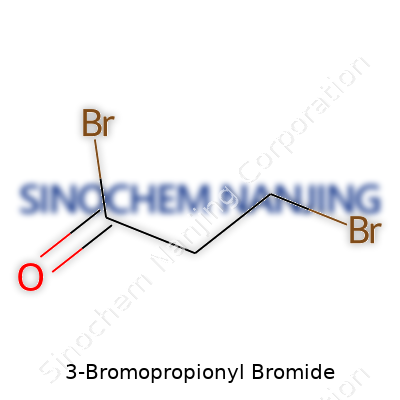
| Names | |
| Preferred IUPAC name | 3-bromopropanoyl bromide |
| Other names |
3-Bromopropanoyl bromide Propionyl bromide, 3-bromo- 3-Bromo-1-propanoyl bromide |
| Pronunciation | /ˌθriːˌbroʊ.moʊ.prəˈpɪə.nɪl ˈbroʊ.maɪd/ |
| Identifiers | |
| CAS Number | 816-40-0 |
| 3D model (JSmol) | `3Dmol:'BrCCC(=O)Br'` |
| Beilstein Reference | 742118 |
| ChEBI | CHEBI:51836 |
| ChEMBL | CHEMBL154625 |
| ChemSpider | 2297352 |
| DrugBank | DB08239 |
| ECHA InfoCard | 100.007.791 |
| EC Number | 211-191-8 |
| Gmelin Reference | 5296 |
| KEGG | C19133 |
| MeSH | D017870 |
| PubChem CID | 70323 |
| RTECS number | AG7701000 |
| UNII | 11X64A567C |
| UN number | UN1737 |
| CompTox Dashboard (EPA) | 3-Bromopropionyl Bromide CompTox Dashboard: "DTXSID70189780 |
| Properties | |
| Chemical formula | C3H4Br2O |
| Molar mass | 212.87 g/mol |
| Appearance | Colorless to light yellow liquid |
| Odor | Pungent |
| Density | 1.991 g/mL at 25 °C |
| Solubility in water | Reacts with water |
| log P | 0.9 |
| Vapor pressure | 3.3 hPa (20 °C) |
| Acidity (pKa) | -7.1 |
| Basicity (pKb) | 0.8 |
| Magnetic susceptibility (χ) | -7.07 × 10⁻⁶ cm³/mol |
| Refractive index (nD) | 1.556 |
| Viscosity | 1.758 mPa·s (20°C) |
| Dipole moment | 2.60 D |
| Thermochemistry | |
| Std molar entropy (S⦵298) | 367.6 J·mol⁻¹·K⁻¹ |
| Std enthalpy of formation (ΔfH⦵298) | -89.7 kJ/mol |
| Std enthalpy of combustion (ΔcH⦵298) | -502.7 kJ/mol |
| Pharmacology | |
| ATC code | Not assigned |
| Hazards | |
| GHS labelling | GHS02, GHS05, GHS06 |
| Pictograms | GHS05,GHS06 |
| Signal word | Danger |
| Hazard statements | H314, H331, H302 |
| Precautionary statements | P260, P261, P264, P271, P280, P301+P330+P331, P303+P361+P353, P304+P340, P305+P351+P338, P310, P312, P321, P330, P363, P405, P501 |
| NFPA 704 (fire diamond) | 3-3-1-W |
| Flash point | 40 °C |
| Autoignition temperature | Autoignition temperature: 465 °C |
| Lethal dose or concentration | LD50 (oral, rat): 430 mg/kg |
| LD50 (median dose) | LD50 (median dose) = 390 mg/kg (rat, oral) |
| NIOSH | AS8575000 |
| PEL (Permissible) | Not established |
| REL (Recommended) | 0.1 ppm |
| IDLH (Immediate danger) | IDLH: Not established |
| Related compounds | |
| Related compounds |
3-Bromopropionic acid 3-Bromopropionamide Propionyl bromide Bromoacetyl bromide 2-Bromopropionyl bromide |



