3-Aminopropene: An Editorial Look Behind the Chemistry
Historical Development
Few specialty chemicals generate the kind of practical curiosity in the lab as 3-aminopropene. Known to some as allylamine, this organic compound entered the chemistry scene during an era when researchers hunted for new building blocks that could open paths to modern polymers or improved drug formulations. Early chemists, driven by equal parts persistent problem-solving and excitement over possible applications, developed ways to produce 3-aminopropene with better yields and fewer byproducts. Speaking from the collective experience of countless synthetic routes, its accessibility grew alongside advances in catalytic hydrogenation and safer handling of amines. Many milestones centered not on flashy breakthroughs but on small, relentless tweaks—improved controls, more stable intermediates, and purification tricks passed down in research groups or shared across universities. I remember seeing stacks of dog-eared lab notebooks where predecessors scribbled notes on crystallization temperatures or the reactivity of the amine function, laying groundwork for work that continues today.
Product Overview
3-Aminopropene shows up in the lab most often as a colorless to slightly yellow liquid with a pungent, biting odor—hardly pleasant, but unmistakable for anyone with a nose for amine chemistry. In the bottle, its basic nature stands out, quickly grabbing moisture and even picking up trace carbon dioxide from open air. Using it on the bench means dealing with a material that’s both reactive and unforgiving if left uncapped. Researchers who work with allylamine get familiar with its agility as a chemical handle, lending itself to making pharmaceuticals, fungicides, or synthetic crosslinking agents. That versatility reflects both the underlying reactivity of the alkene and the amine, two sites just waiting for an inventive approach.
Physical & Chemical Properties
Allylamine holds its own in the family of small amines—volatile, low-boiling, and highly soluble in water as well as alcohols. If you ever open a bottle in a poorly ventilated room, the vapor sharpness serves as a quick reminder to respect proper handling, as the liquid evaporates quickly and fills the air with an acrid smell. Chemically, the combination of a nucleophilic amine and an electrophilic double bond allows for a vast range of transformations in both academic and applied settings. The molecule’s small size and hydrophilicity allow it to participate easily in biological or industrial processes that favor smaller scaffolds. On a practical note, storage containers always require a dry, airtight seal to avoid unwanted reaction with ambient acid gases.
Technical Specifications & Labeling
Experienced chemists know that specifications for allylamine center around purity, water content, and residual stabilizers. Many suppliers label the percent amine, noting both the potential presence of stabilizers to prevent polymerization and the importance of clear hazard symbols on every shipped bottle. Labeling is more than red tape—for chemicals like this, regulatory requirements reduce risk to researchers through clear warnings about toxicity and volatility. I’ve seen safety officers insist on unambiguous, large-print hazard icons and the tracking of expiry dates, knowing that even a little hydrolysis or oxidation over time can transform material into something neither safe nor suitable for critical experiments.
Preparation Method
Industrial production rests on catalytic amination of allyl chloride, using ammonia as the nitrogen source. This isn’t a back-room process—pressurized reactors and precise temperature control let technicians push past side reactions and collect pure product efficiently. In an academic setting, small-scale synthesis often leans on alkylation of ammonia with allyl bromide, carefully controlling molar ratios to avoid a mix of mono- and dialkylated products. Each step, from quenching the reaction to final distillation, benefits from a hands-on approach. A colleague once spent a week tweaking the distillation head’s angle to shave half a degree off the boiling range, because he needed an ultra-pure fraction for a sensitive catalytic run. This kind of effort characterizes the way preparation methods evolve, with minute details often carrying the greatest weight.
Chemical Reactions & Modifications
Allylamine opens up a practical range of synthetic opportunities. Add an acid and you’ll make the corresponding salt, useful in stabilizing the amine or shifting solubility for downstream reactions. React the double bond with an electrophile, such as in Michael addition chemistry, and you get a string of potential intermediates for drug and material research. Oxidize the amine and new pathways emerge for making nitriles or other functional groups. Chemists who spend years optimizing such modifications know that even a shift in solvent or catalyst can reroute yields, selectivities, or even the clean-up process. I’ve seen trial runs exploring enantioselective additions at the amine function, with chiral catalysts granting new ways to access molecules with real pharmacological value. Each reaction involving 3-aminopropene seems to demand both an appreciation of textbook mechanisms and a willingness to fail, document, and try again.
Synonyms & Product Names
Ask around any chemistry lab, and you’ll hear 3-aminopropene called allylamine, 3-propenylamine, or even propenamine, depending on the naming habits of each group. International markets sometimes list it under its CAS registry number, bridging language barriers across suppliers and regulatory agencies alike. Label checks require diligence, especially if you’re sourcing from regions with differing standard nomenclatures; I’ve had shipments nearly delayed over something as simple as a misread alternate name on an import form. Old-timers will still call it allylamine most of the time, no matter what the label says.
Safety & Operational Standards
Handling allylamine never drifts far from safety considerations. The pungent odor serves as an early warning of vapor leaks. Gloves and goggles aren’t optional, with fume hoods providing a safe zone for any open handling or pipetting. If a spill happens, it’s not just the liquid—vapors can quickly irritate eyes, skin, and upper airways. Lab safety protocols put strict focus on storing allylamine away from acids or oxidizers, using properly labeled, chemically resistant secondary containment. Over the years, I’ve seen how a culture of shared safety allows experienced staff to spot and correct small slip-ups long before they cascade into accidents.
Application Area
Allylamine pulls its weight in diverse research and industrial settings. In medicine, it becomes a raw material for drugs that rely on the amine moiety for bioactivity. Polymer scientists exploit its double bond to craft new materials with flexibility, adhesion, or reactivity built in from the ground up. Water treatment processes use derivatized forms as tracers or stabilizers to counteract fouling or unwanted mineral scaling. In agriculture, certain pesticide formulations call for intermediates that start their journey with this molecule. Speaking from practical lab work, even a simple one-gram scale run can have ripple effects downstream in a process that ends up at a ton-scale reactor. Each application brings its own unique set of demands: trace impurities matter a great deal in pharmaceuticals, while consistent supply at scale becomes priority for industrial clients.
Research & Development
Research surrounding allylamine remains as lively as ever, largely because there’s so much untapped in both reactivity and application space. Years spent working with this compound taught me that academic curiosity often dovetails with industry’s hunger for new functionalities, greener processes, and improved routes to key intermediates. Chiral catalysis, new polymeric backbones, and bio-conjugation methods—these represent only a sliver of ongoing efforts to expand what 3-aminopropene can do. Each innovation builds on the foundational knowledge established decades ago and rewards those willing to work through repeated setbacks to achieve more reliable, affordable, and sustainable results.
Toxicity Research
Toxicity always factors into any serious conversation about small amines. Studies show allylamine has irritant properties and can inflict tissue damage with high exposures, especially via inhalation or skin contact. Long-term animal studies raise red flags about possible organ-specific risks, prompting regulatory agencies to mandate strict control of both occupational exposure and waste management. Researchers working with 3-aminopropene learn quickly never to take shortcuts: lab incidents, minor or otherwise, bring home the message that prevention beats reaction every time. I recall labmates debating the tradeoffs among various decontamination agents, weighing efficacy against secondary risks to handlers. Precise records, regular safety reviews, and investment in proper response kits help minimize both acute and chronic hazards.
Future Prospects
Looking ahead, allylamine stands to see continued, even expanded, roles in both established and emerging fields. Green chemistry movements drive renewed interest in catalytic processes that make use of renewable feedstocks and less hazardous conditions, and 3-aminopropene could easily play a part in designing these reactions. Biomedical research sees promise in using this scaffold for next-generation drugs, polymeric carriers, or diagnostic tools. Each new method for safe, high-purity production opens doors for broader applications, whether it’s in specialized materials, environmental engineering, or novel catalytic cycles. Future breakthroughs will probably rest on both technological leaps and strengthened collaboration between safety regulators, producers, and end-users—a process that will remain as dynamic as the compound itself.
What is 3-Aminopropene used for?
Chemistry Behind 3-Aminopropene
3-Aminopropene, also known as allylamine, plays a unique role in modern chemistry and industry. The structure gives it a reactive edge, making it a valuable building block for different fields. Growing up around a small workshop, I’ve seen how versatile compounds like this one can solve big manufacturing problems. Chemistry classes barely scratch the surface of what 3-aminopropene enables behind factory doors.
Pharmaceutical Building Block
Ask scientists in the pharmaceutical industry and they’ll tell you that 3-aminopropene steps into the scene as a foundational intermediate. For making drugs to treat ailments like hypertension and mental health disorders, 3-aminopropene brings just the right chemical backbone. One prominent example is the synthesis of selegiline, a medication for Parkinson’s disease. In these labs, every intermediate saves time and money, reduces waste, and pushes innovations forward. In fact, the shift from older, cumbersome processes to ones streamlined by 3-aminopropene marks real progress in patient care.
Polymers and Resins
Big factories run day and night making everything from plastics to resins. Here, 3-aminopropene gets used as a monomer or as part of the mix to create specialty polymers. These materials go into coatings, adhesives, and high-performance composites. Talk to any engineer working with these resins, and you’ll hear stories about better flexibility, improved strength, and a balance of toughness that cheaper alternatives can’t match. This isn’t some abstract benefit: builders, electricians, and automotive workers rely on these resins to keep products safe and effective.
Pesticides and Agriculture
Farmers depend on chemistry for better yields and pest control. 3-Aminopropene finds a place in synthesizing certain crop protection agents and herbicides. Companies shape these chemicals into agents that target weeds while sparing crops, helping farmers gain a harvest they can count on. I remember summers at my cousin’s farm, hearing about the struggles with weeds and insects. With compounds like this, the balance shifts—good chemistry boosts food supply and reduces need for older, harsher chemicals that linger in the soil and water.
Rubber Processing and Vulcanization
Tires, shoes, and industrial equipment wouldn’t last long without tough rubber. In this corner of manufacturing, 3-aminopropene acts as an accelerator in vulcanization, a process that gives rubber its resilience. This means more durable tires for truckers, safer shoes for workers, and better gaskets on factory floors. Downtime costs money, and well-cured rubber makes all the difference. It’s easy to take for granted, but these details matter for businesses running on tight margins.
Industrial Water Treatment and Chemicals
Modern industry faces strict rules about water and environmental impact. 3-Aminopropene sometimes serves as a precursor for water treatment chemicals. These agents help keep pipes clear, prevent scale, and minimize corrosion. My own experience working summers in municipal water treatment showed that even minor chemical tweaks could prevent equipment failure and keep drinking water safe.
Room for Responsible Chemical Handling
No commentary about chemicals feels complete without addressing risk and safety. Like many industrial chemicals, 3-aminopropene poses health hazards—skin irritation, inhalation risks, flammability. Companies need strict protocols, proper training, and reliable equipment. Solutions range from better personal protective gear to improved ventilation and remote monitoring systems. These aren’t optional—mistakes cost lives, productivity, and environmental trust. In a world demanding both performance and sustainability, 3-aminopropene requires respect for its power and potential.
What is the chemical formula of 3-Aminopropene?
Understanding 3-Aminopropene
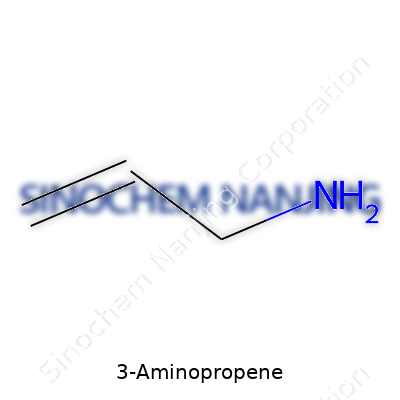
Pulling apart the name "3-aminopropene" brings memories of late-night study sessions and scribbled notes crowded with structural drawings. For anyone interested in chemistry or who has crossed paths with organic compounds, it's more than just a trivia question. This compound lines up as an organic molecule with three carbon atoms in its backbone, a double bond, and an amino group fixing itself onto the chain. Chemists out there might spot its formula: C3H7N.
Why 3-Aminopropene Matters
Organic chemistry changes the world in small and big ways. 3-Aminopropene, with its simple structure, goes further than textbooks. It acts a bit like a bridge in chemical synthesis, often used in making other compounds or as an intermediate in pharmaceutical research. Every new idea in chemical manufacturing, whether in labs or industry, traces back to modest molecules like this one.
Breaking Down the Structure
Take three carbons, string them in a line. Attach a double bond at one end. Add an amino group, -NH2, to the last carbon. Structurally, that sets this molecule apart from similar names that follow different rules – chemists call those isomers. The placement of the double bond and the amine can turn an everyday chemical into something with very different behavior or uses. Getting the formula right matters not only for creating the compound but for making sure that any reactions line up safely and predictably.
Real-Life Impact and Usage
Small molecules drive larger reactions, especially in materials science and drug discovery. 3-Aminopropene shows up in conversations around building blocks for larger chains and exploring new drug candidates. Imagine synthesizing a new medicine: starting with a simple molecule, making small tweaks, and watching lab results change one test at a time. Years working with research teams taught me that every atom in a formula like C3H7N counts.
Challenges in Chemical Identification
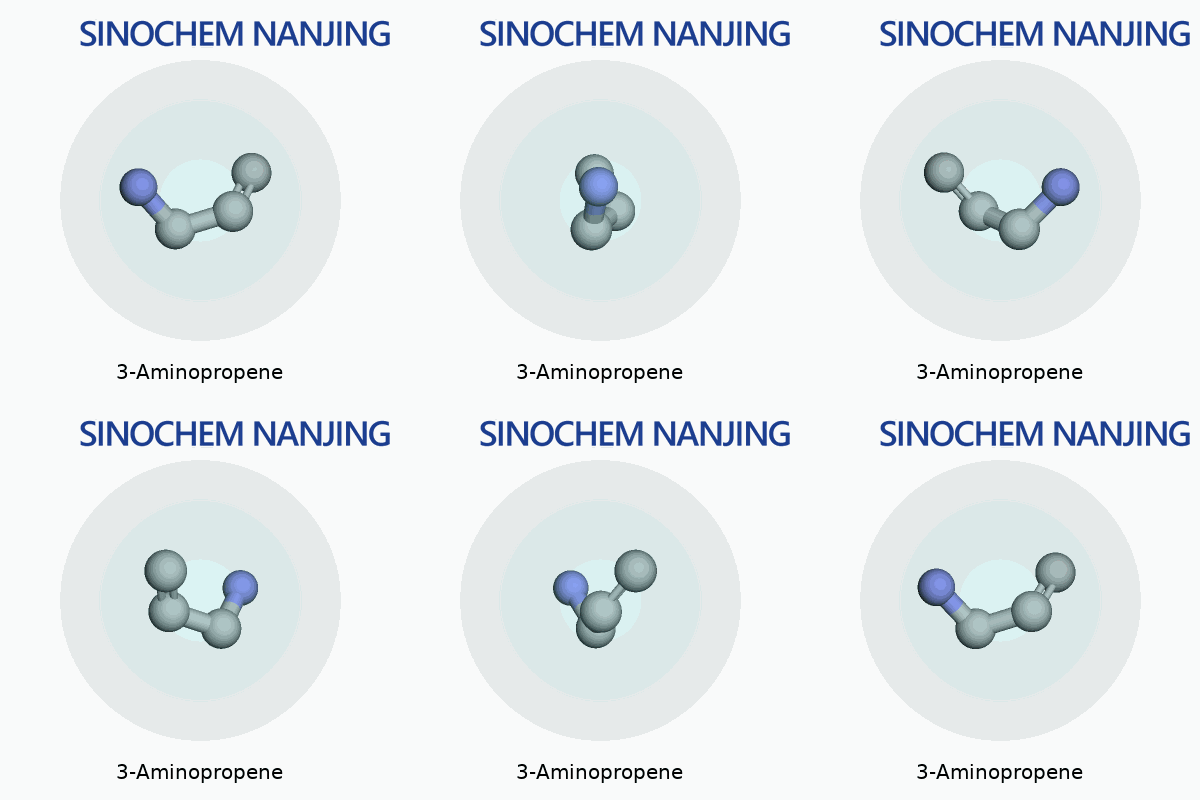
Lab mistakes usually start with confusion over chemical names. '3-Aminopropene' follows IUPAC nomenclature, but in practice, synonyms and abbreviations create a mess in research archives. I’ve seen teams waste days chasing the wrong chemical because someone pulled a bottle with a similar but not identical name. Clear education and easy access to databases reduce mix-ups. Digital platforms like PubChem and ChemSpider bring molecules like 3-aminopropene to life beyond static textbook tables, with safety data and 3D visualizations. Staying vigilant with chemical formulas and structures isn't just for the big names, but for everyday precision and safety.
Improving Chemical Communication
Stronger habits around label-checking, hands-on training, and frequent updates to chemical inventories keep labs safer and more productive. Writing out the full formula, checking CAS numbers, and pulling up structural diagrams every time helps teams avoid costly slips. Mistakes shrink when education sticks and safety remains front-and-center.
Solutions for Better Understanding
Open-access resources, structured onboarding for chemistry students, and building a culture of double-checking formulas help everyone, from beginner to expert. 3-Aminopropene may pass as just another name to some, but the ripple effect of accurate chemical identification shapes research outcomes, safety records, and product quality far beyond its small carbon chain.
Is 3-Aminopropene hazardous or toxic?
Understanding What 3-Aminopropene Really Means
Ask someone with a background in chemistry about 3-aminopropene, and you’ll probably notice a furrowed brow. The name sounds a bit out of place—chemists usually talk about allylamine. That’s the common name for this compound, and it shows up on safety data sheets around the world. My experience working in industrial labs taught me that old habits die hard, and names sometimes change on paper faster than in the storage room. So whether the label reads “allylamine” or “3-aminopropene,” you’re dealing with the same liquid: a colorless chemical that smells like ammonia and can pack a punch if handled recklessly.
Direct Contact Has Real Risks
Getting direct exposure to 3-aminopropene isn’t like brushing up against household cleaners. Even a quick hit of those vapors brings burning in the eyes and nose. Skin contact feels like trouble—burns, redness, even blisters can follow from a mild splash. Working in an adhesive plant, I learned to double-check gloves before picking up containers filled with this stuff. Labs—and especially workers—need to treat leaks or spills seriously since it vaporizes fast and can fill closed spaces with fumes.
Toxic Effects Go Beyond Annoyance
Toxicity matters once you dig into what happens inside the body. Short bursts of vapor may trigger dizziness, headaches, or nausea. Breathing it in every day, even at low levels, sets up a recipe for chronic lung damage. Animal studies showed changes in liver and kidney function after repeated exposure to high doses. Though the numbers aren’t huge, agencies like the National Institute for Occupational Safety and Health set aggressive exposure limits—no one wants lab staff or factory operators breathing it in for long.
Environmental Fate and Worker Safety
3-Aminopropene doesn’t just drift away harmlessly. Spills soak into soil, and if dumped down drains, rivers and streams can pick it up. Fish and aquatic insects don’t fare well against allylamine—lethal concentrations are measured in milligrams per liter. These facts have pushed companies to improve their containment protocols. The last chemical plant I worked in spent six months upgrading air scrubbers and spill containment after a minor accident. Training sessions hammered home how personal vigilance and airtight equipment make a difference.
Facts Back Precaution, Not Panic
Some might ask if 3-aminopropene is classified as a carcinogen. Agencies such as the International Agency for Research on Cancer have not put allylamine on their lists of cancer-causing chemicals. That said, the focus shifts to organ toxicity, caustic action, and environmental hazard. Exposure limits in the US and Europe are strict: workplace air shouldn’t pass 2 parts per million over an eight-hour shift. To keep people safe, tank trucks and barrels must stay sealed, staff wear chemical-resistant gloves, and ventilation runs at full tilt wherever this material gets handled.
Looking Ahead: Solutions and Best Practices
In practice, reducing risk with 3-aminopropene takes more than good intentions. Automated transfer lines and continuous air monitoring support a culture of safety. Engineers and managers watch for better substitutes when possible. Regular emergency drills keep readiness sharp. As a worker, listening to those warning signs (burning eyes, breathlessness) and respectfully following protocols always seemed more reliable than trusting luck. Real risk exists, but so do rock-solid ways to protect workers and the environment. That’s something worth carrying into every shift.
How should 3-Aminopropene be stored?
Why Proper Storage Can't Be Ignored
Safety often begins long before anyone starts handling chemicals. 3-Aminopropene, also called allylamine, isn't just another compound on a lab shelf. It's volatile, flammable, and brings direct health risks like irritation to the skin, eyes, and respiratory system. I've worked in labs where careless storage nearly ended in disaster—not because these risks were unknown, but because routines got sloppy. Living proof, I saw a vial of allylamine leak in a crowded cold room, and the headache came on almost immediately. The lesson stuck: storage is not just policy, it's protection.
Knowing What You're Dealing With
A clear understanding of 3-Aminopropene’s properties lies at the core of safe storage. Liquid at room temperature, it evaporates quickly and catches fire just as fast. The vapors rise before you notice, and they can ignite from simple sources—static sparks, forgotten light switches, hot tools. Inhaling the fumes brings coughing and dizziness, even if exposure lasts only a minute. If this sits in a poor location or an unsealed container, evacuation protocols can become a reality overnight.
Essentials of Safe Storage
Every chemical storage area should limit risks up front. For 3-Aminopropene, that means a cool, well-ventilated, and dry storage space away from direct sunlight and ignition points. Standard flammable liquid cabinets with self-closing doors give a strong layer of defense. These cabinets slow the rise of vapor, and if a fire starts elsewhere, they’ll keep the temperature down for as long as possible. I insist on storing all flammable amines at eye-level or lower, away from glassware and sharps, so bumps, splashes, and drops have less chance to escalate.
Reliable labeling and airtight secondary containers help everyone see what’s on the shelf and recognize a hazard before grabbing a bottle. Experienced coworkers know better than to mix incompatible chemicals together: oxidizers, acids, and certain plastics can turn a spill into an emergency fast. Regulatory agencies like OSHA and the National Fire Protection Association set clear boundaries about how much of these chemicals can be stacked in one room. Even a small overstock soon becomes a red flag during inspections.
Handling and Routine Checks
Good practice means not just locking chemicals away, but checking up on them. I run routine inspections every week—checking for damaged containers, crusted seals, or discoloring. If 3-Aminopropene’s container cracks or shows clouding, dispose of it right away under your institution’s hazardous waste rules. Never return used or contaminated chemicals to the original bottle; doing so multiplies the risk of unexpected reactions.
Cultivating Shared Responsibility
Training sits behind every success story in chemical safety. A lab culture where everyone looks out for each other, reports issues, and refreshes their knowledge every year prevents routine from breeding complacency. Emergency kits, eye washes, and spill containment materials belong within reach, not buried under paperwork or tucked at the back of a dusty storage closet.
Above all, the right storage plan for 3-Aminopropene reflects care for people as much as property. Following strict safety rules, paying attention to environmental controls, and encouraging others to do the same underline a commitment to health, trust, and long-term success.
What are the physical properties of 3-Aminopropene?
Why 3-Aminopropene Matters in Everyday Chemistry
3-Aminopropene grabs attention because it’s one of those organic molecules that sounds simple, but has a knack for shaping reactivity in the lab. Folks in my undergrad chemistry courses used to talk about what 3-Aminopropene does that sets it apart from similar amines and alkenes, even though most people haven’t heard of it, sitting between the more famous acrylic amine cousins and the classic propene itself.
Physical State and Appearance
Walk into a lab with a bottle labeled 3-Aminopropene, and you’re going to see a colorless liquid. I’ve handled similar small amines—these usually don’t stand out by color or visibility. No mysterious powders or thick gels, just a straightforward transparent layer that could fade into the background with the rest of your reagents if you aren’t careful. That transparent look hints at its purity, and experienced chemists can practically smell the warning in the air; this compound has an odor you’re unlikely to forget, usually sharp and fishy—the calling card of volatile organic amines.
Boiling Point and Stability
With a boiling point hovering around 56-57 °C at normal air pressure, 3-Aminopropene won’t hang around long if you leave it open on the bench. Anyone doing extractions or distillations quickly gets the point—keep those flasks cooled or capped unless you want to lose half your sample. Compared to heavier amines that can sit open without a fuss, this volatile nature pushes users to respect proper storage and safety.
Solubility and Reactivity: The Hidden Hand
Getting 3-Aminopropene to dissolve in water comes easy—polar bonds help it find friends in polar solvents, which lets chemists dilute it for reactions or dispose of it with less hassle. Mix it with other organics like ethanol or acetone, and it’ll blend right in, almost too eager at times. This solubility means researchers can’t treat it like an oil or a chunky powder. Instead, they have to think ahead about potential reactions and safety in every medium.
Density, Viscosity, and Touch
If you’re measuring out a dose in the lab, expect a liquid that pours smoothly at room temperature. The density clocks in around 0.84 g/cm³—less than water, so it will float. Users familiar with pipetting will notice it moves quickly, doesn’t stick much, and tends to make handling and mixing a breeze, as long as gloves stay on. Unlike sticky glycols or dense oils, this one behaves more like a light solvent. Just don’t forget its tendency to slip away if spilled.
Flammability and Handling Risks
Turn the lights down, bring out the ignition source, and 3-Aminopropene bursts into flame. That low boiling point and high vapor pressure mean fumes pick up quickly in a warm room. Any space that handles this compound needs decent ventilation. In my lab days, stories about careless spills or vapor exposure usually ended in someone getting escorted outside for fresh air. It isn’t just a theoretical concern—safety data backs up the need for protection and quick cleanup procedures.
Applications and Fixes for Real-World Handling
Lab work and small-scale synthesis rely on the straightforward properties of 3-Aminopropene—a base that also offers reactive alkenes. This combination makes it valuable but puts a burden on handlers to control exposures and minimize environmental release. Investing in safer containers, using automated dosing systems, and keeping samples chilled all make a difference. Simple tools, such as lined gloves and splash goggles, change the handling experience from risky to routine. The awareness built from regular training and shared stories lets new researchers learn safety without repeating old mistakes. Experience with these properties shapes habits, and habits build safer labs.
| Names | |
| Preferred IUPAC name | prop-2-en-1-amine |
| Other names |
Allylamine 3-Aminopropylene 1-Propene, 3-amino- Aminopropene UN 2334 |
| Pronunciation | /ˌθriː-əˌmiːnoʊ-prəˈpiːn/ |
| Identifiers | |
| CAS Number | 107-11-9 |
| Beilstein Reference | 1209242 |
| ChEBI | CHEBI:51875 |
| ChEMBL | CHEMBL116035 |
| ChemSpider | 12041 |
| DrugBank | DB01900 |
| ECHA InfoCard | 100.007.940 |
| EC Number | 207-236-8 |
| Gmelin Reference | 6357 |
| KEGG | C21109 |
| MeSH | D066409 |
| PubChem CID | 12378 |
| RTECS number | UC2800000 |
| UNII | 62HHV8355L |
| UN number | UN2372 |
| Properties | |
| Chemical formula | C3H7N |
| Molar mass | 57.09 g/mol |
| Appearance | Colorless liquid |
| Odor | Ammonia-like |
| Density | 0.739 g/mL at 25 °C (lit.) |
| Solubility in water | Soluble |
| log P | -0.6 |
| Vapor pressure | 1.61E+03 mmHg (25°C) |
| Acidity (pKa) | 15.8 |
| Basicity (pKb) | 4.03 |
| Magnetic susceptibility (χ) | -8.03×10⁻⁶ cm³/mol |
| Refractive index (nD) | 1.427 |
| Viscosity | 0.6 mPa·s (25 °C) |
| Dipole moment | 1.67 D |
| Thermochemistry | |
| Std molar entropy (S⦵298) | 274.0 J·mol⁻¹·K⁻¹ |
| Std enthalpy of formation (ΔfH⦵298) | -20.4 kJ/mol |
| Std enthalpy of combustion (ΔcH⦵298) | -1713 kJ·mol⁻¹ |
| Pharmacology | |
| ATC code | V03AB25 |
| Hazards | |
| GHS labelling | GHS02, GHS07 |
| Pictograms | GHS02,GHS07 |
| Signal word | Danger |
| Hazard statements | H226, H301, H311, H331, H315, H319, H335 |
| Precautionary statements | P210, P233, P240, P241, P242, P243, P261, P271, P301+P310, P303+P361+P353, P304+P340, P305+P351+P338, P370+P378, P403+P235, P405, P501 |
| NFPA 704 (fire diamond) | 2-3-2 |
| Flash point | -18 °C (closed cup) |
| Autoignition temperature | 430 °C |
| Explosive limits | Explosive limits: 2.8–11.0% |
| Lethal dose or concentration | LD50 oral rat 1470 mg/kg |
| LD50 (median dose) | LD50 (median dose): 80 mg/kg (intraperitoneal, mouse) |
| NIOSH | SN2100000 |
| PEL (Permissible) | Not established |
| REL (Recommended) | 0.002 ppm |
| IDLH (Immediate danger) | IDLH: 100 ppm |
| Related compounds | |
| Related compounds |
Allylamine Acrylonitrile Propene Propenal (Acrolein) Propylamine Allyl alcohol |



