3,5-Dimethylheptane: A Closer Look at Its Role in Science and Industry
Historical Development
The story of 3,5-dimethylheptane traces back to the era when organic chemistry took its leap into modernity. Alkane isomers like this compound found their place on the long list of hydrocarbons discovered during the height of petroleum-based research in the twentieth century. Researchers built on foundational work laid by pioneers like Kekulé and Zaitsev, mapping out the vast combinations of carbon and hydrogen atoms. As refineries and laboratories delved further into the byproducts of crude oil processing, chemists isolated and catalogued branched alkanes to better understand their properties and roles. The demand for improved engine fuels and the growing interest in chemical synthesis methods gave compounds such as 3,5-dimethylheptane relevance beyond academic interest. Over the decades, the study of this molecule shifted from the blackboard to applied science—playing its own part in both petrochemical process optimization and environmental scrutiny.
Product Overview
3,5-Dimethylheptane belongs to the class of branched-chain alkanes. Structurally, it consists of a seven-carbon backbone with methyl groups attached at the third and fifth positions. Unlike straight-chain heptane, this variant has different physical characteristics that become important in blending fuels. The drive to identify hydrocarbon purity, especially in quality control labs, put molecules like this under routine analysis. Gasoline formulation benefits from knowledge of alkane isomers, and 3,5-dimethylheptane’s role as a reference compound in high-precision analytical methods often goes unnoticed by those outside the laboratory walls. I remember running chromatograms where separating out similar isomers was both a test of patience and technical skill, and standard compounds such as this one provided almost a sense of relief by clarifying test results.
Physical & Chemical Properties
3,5-Dimethylheptane appears as a clear, colorless liquid at room temperature. Compared to its straight-chain counterpart, it offers a lower boiling point and slightly higher volatility, attributes shaped by the extra methyl branches which hinder the close packing of molecules. Like all alkanes, it remains largely inert under standard conditions. Its solubility profile matches most non-polar solvents, and one finds it floats stubbornly atop water due to lower density. The compound hardly dazzles with reactivity—one could let it sit exposed, and it will not react with air or light. In practical use, though, it can ignite, reminding anyone handling it to respect proper storage away from ignition sources. My own experience shows that odorless, nearly invisible liquids tend to lull researchers into underestimating their presence until a safety reminder brings everyone back to reality.
Technical Specifications & Labeling
Standard labeling points out its CAS number and empirical formula. Manufacturers must detail purity specifications since even minor impurities can skew analytical outcomes. The rise of regulatory frameworks means consistent hazard pictograms and risk phrases appear on containers now. Labels typically include information on flammability, shelf life, and recommended storage conditions. It remains fundamental to insist on traceable supply chains, especially in the analytical field, where each bottle must support robust chain-of-custody requirements. Traceability took on new significance over recent years—the era of cheap, untraceable chemicals now looks reckless in hindsight, especially given tightening environmental and safety rules.
Preparation Method
Synthesis of 3,5-dimethylheptane revolves around alkylation chemistry. Chemists often rely on targeted catalytic reactions involving methyl donors and suitable heptane frameworks. Early procedures depended on Friedel-Crafts alkylation, where a Lewis acid catalyzes the attachment of the methyl groups at set positions, although side-reactions and over-alkylation periodically plagued yields. Improved controls in temperature, reagent ratios, and purification steps refined the method. Distillation forms the backbone of purification, a technique older chemists muse about as both a simple art and a complex science. Lab-scale preparation sometimes shifts toward more selective organometallic approaches, where one benefits from narrower byproduct formation and improved selectivity. In research programs focused on fuel standards, producing reference-quality isomers draws in the most meticulous workers, as validation tests hang on the confidence of compound identity.
Chemical Reactions & Modifications
3,5-Dimethylheptane takes part in standard alkane chemistry, which primarily involves substitution or oxidation under harsh enough conditions. It resists most laboratory attempts at functionalization unless exposed to strong oxidizers or subjected to halogenation reactions under UV light. Its chemical stubbornness makes it useful as a control or reference material—one rarely expects surprises from it during analysis. For large-scale transformations, catalytic cracking can break it into shorter fragments, an operation relevant more to refinery operations than academic benches. Exploring alternative catalytic methods for mild functionalization remains of limited economic incentive, given its widespread use as a hydrocarbon benchmark.
Synonyms & Product Names
You may find this compound listed as 3,5-dimethyl-heptane, or less commonly as heptane, 3,5-dimethyl-. Nomenclature standards, dictated by IUPAC, leave little room for ambiguity when it comes to branched alkanes of this size. Some catalogs might refer to it using systematic order, while others provide a shorthand, but anyone in the field can match the structure with the label once the main carbon chain and attached groups have been noted. The quest for standardization across databases and chemical libraries stems from times when researchers lost precious hours sorting through various synonyms, a frustration students still meet on poorly indexed online catalogs.
Safety & Operational Standards
Safety standards insist on keeping flammable hydrocarbons like 3,5-dimethylheptane away from open flames and heated surfaces. Proper ventilation cuts back on inhalation risks, and closed systems reduce loss by evaporation. Regulations push for storage in tightly sealed containers. The training I received in handling volatile organics stressed routine use of fume hoods and personal protective equipment. Many underestimate the fire risk of invisible vapors, especially in older lab spaces where airflow is less than reliable. Since the compound poses little acute toxicity, the routine safety focus remains on its flammability and the potential for asphyxiation in high concentrations. Institutions drive home the lesson that a lapse in storage protocol rarely ends well.
Application Area
The main field where 3,5-dimethylheptane matters lies in analytical chemistry. Laboratories use it as a reference standard for gas chromatography, helping separate and identify components in complex hydrocarbon mixtures. Regulatory agencies and gasoline refiners both depend on reliable standards as they track and certify fuel blends. Research on combustion and fuel performance pulls in data from branched isomers like this to help model engine efficiency and to monitor emissions profiles more reliably. Some industrial chemists employ it to explore hydrocarbon reactivity, and others use it to benchmark against environmental releases. The compound rarely finds use on its own outside these professional settings, but its role as a calibration tool keeps it indispensable.
Research & Development
Research efforts lately have focused more on refining detection methods than inventing new uses for the compound itself. Projects seek to improve high-throughput analytical techniques, where separating closely related alkanes permits more precise environmental and fuel quality assessments. Creating portable sensors that distinguish 3,5-dimethylheptane from other isomers could help field teams speed up inspection cycles at refineries and fuel depots. Every gain in method sensitivity benefits a chain of applications—from soil contamination checks to high-octane fuel design. Meanwhile, green chemistry initiatives investigate less hazardous synthesis methods by swapping out classic corrosive reagents for more benign catalysts, reflecting the shift toward sustainable lab practices.
Toxicity Research
Concerns about toxicity center on inhaling vapors or accidental ingestion, as with nearly every light hydrocarbon. Studies indicate that exposure in typical lab settings carries little cumulative risk if proper procedures stay in place. The main health risk arises from asphyxiation in closed spaces or from solvent abuse scenarios, situations rarely faced by seasoned professionals but always present in risk assessments. Environmental toxicology tracks its fate in air and groundwater, where its rapid evaporation limits ecological persistence. The renewed focus on chronic low-dose exposure, especially in industrial areas, pushes for more sensitive detection and monitoring. I have witnessed first-hand how basic safety steps protect against both immediate and hidden hazards—habits reinforced by regular oversight and a culture that values vigilance over complacency.
Future Prospects
Looking ahead, the relevance of 3,5-dimethylheptane will probably ride on advancements in analytical instrumentation. As fuel blends grow more complex and regulatory targets tighten, demand for proven, traceable reference standards will hold steady. Environmental watchdogs expect sharper monitoring tools, and this reinforces the need for high-purity calibration compounds. The shift toward digital and automated analysis could increase the value of reference hydrocarbons by enabling real-time, on-site verification. On the chemical synthesis front, the search for sustainable production methods will keep shaping how the compound is made and supplied. The core lesson from decades of hydrocarbon work remains clear: even molecules that rarely draw attention prove critical behind the scenes—fueling accuracy, safety, and progress in allied fields of science and industry.
What is 3,5-Dimethylheptane used for?
The Role of Hydrocarbons Beyond the Gas Pump
Look at a molecule like 3,5-dimethylheptane, and you might see a pretty basic hydrocarbon. Seven carbons in the chain, two methyl groups hanging off at carbons three and five. It doesn’t sound especially exciting. Yet, dig a bit deeper, and you find it woven into the fabric of what keeps society running—energy, materials, and science.
Fuel Blends and Octane Ratings
The gasoline powering millions of vehicles takes careful planning. Not every hydrocarbon is made equal for combustion. 3,5-dimethylheptane turns up there for a reason. With its branched structure, it holds a higher octane rating than its straight-chained cousins. High-octane hydrocarbons help engines run without annoying knocks and pings, improving efficiency and reducing wear. I remember my old car running smoother on premium fuel; that’s a quiet nod to these branched molecules at work.
Refineries rely on molecules like this one to fine-tune their gasoline recipes. Oil and chemistry pros measure the performance of fuel types, and 3,5-dimethylheptane often lands on their data sheets as a controlled component in calibration studies. Its known boiling and octane characteristics make it a useful point of comparison when figuring out how differently structured hydrocarbons behave under heat and pressure.
Reference Standard in Research
In the lab, you’ll often see bottles labeled with all sorts of obscure names. 3,5-dimethylheptane is one of the alkanes used, not as a star performer, but as a trusty yardstick. It shows up in gas chromatography, an analytical process that separates and identifies compounds in complex mixtures. Scientists need fixed reference points. This molecule provides them with reliability, because its physical and chemical behavior are well documented. Think of it like a ruler for chemicals—if you compare a new fuel sample to a known standard, you can measure quality and consistency much more accurately.
Learning from the Mundane
For most of us, molecules like this simply do their job in the background. But any time I get curious about what sits pumped into the family car, or the materials lining the lab shelves, there’s an “aha” moment. These chemicals carry decades of learning behind them. Researchers have measured how 3,5-dimethylheptane reacts and vaporizes, how it mixes into blends, and what that tells us about refining crude oil or engineering cleaner fuels.
Room for Smarter Chemistry
What matters now is the onward march toward cleaner air and less climate impact. Molecules in the alkane family, including 3,5-dimethylheptane, still figure in the puzzle. Our world runs on fossil fuels, yet the future points toward smarter chemistry and alternatives. Chronic air pollution and carbon emissions hurt real people. So, researchers are diving deeper into how each molecule burns and what it leaves behind. Cleaner-burning fuels, better catalysts, and synthetic blends could use this molecule as a stepping stone, or as a control, in developing tomorrow’s solutions.
I think about the science teacher who once said, “Every molecule in your tank tells a story.” 3,5-dimethylheptane’s story plays out at gas stations, in testing labs, and in the quest for better energy. Understanding even the “plain” hydrocarbons brings us closer to making well-informed choices for energy and environment alike.
What is the chemical formula of 3,5-Dimethylheptane?
Knowing the Building Blocks Matters
Anyone who's poked around in a garage or worked on engines probably caught the whiff of gasoline and wondered what lies in that mix. Straight-chain alkanes and their branched cousins play a huge part. It pays off knowing their formulas—3,5-dimethylheptane, for example, isn’t just a mouthful to say. This molecule follows simple, logical rules that link chemistry to what fuels our world.
Breaking Down the Name
The name “3,5-dimethylheptane” gives away its structure. The “heptane” part means seven carbon atoms line up for the main chain. “Dimethyl” tells you two extra methyl groups (groups with one carbon and three hydrogens) latch onto the main line. Those numbers, 3 and 5, mark the exact spots where those methyl groups branch off.
Counting Up the Atoms
Start with a seven-carbon backbone. Adding the two methyl branches tacks on two more carbons, bringing the total carbon count to nine. Hydrogen always wants to fill out the remaining bonds. The formula for any non-cyclic alkane follows CnH2n+2. Using that, nine carbons carry twenty hydrogens. You're left with C9H20. That’s the chemical formula for 3,5-dimethylheptane.
The Role It Plays in Our Lives
It’s easy to overlook what these formulas really mean outside a chemistry classroom. Hydrocarbons like this show up in the gas tanks of cars. They make up a fair chunk of the mixture that burns to move pistons and wheels. Research shows that branching, like in 3,5-dimethylheptane, changes how gasoline burns. More branching leads to better combustion and less knocking—almost every auto enthusiast has read about how knocking damages engines over time. Developing fuels with branched alkanes helped make motors run smoother and last longer.
Bridging Chemistry and Environmental Impact
Plenty of debate circles around fuel efficiency and cleaner alternatives. While hydrocarbons like 3,5-dimethylheptane keep cars running, they also contribute to emissions. According to reports from the EPA, transportation pumps out nearly a third of total greenhouse gas emissions in the US. That’s not just an academic concern. It's something I’ve seen firsthand at community meetings where folks worry about air quality, especially near busy highways. Knowing a seemingly simple molecule’s makeup can spark bigger questions about energy policy and cleaner-burning alternatives.
Solutions Rooted in Chemistry
Refiners and chemists look for ways to reformulate fuels, drawing on knowledge about hydrocarbon structure. Mixing more branched alkanes helps improve performance and lower emissions from engines. Investments in research can pull formulas like C9H20 into cleaner blends, while electrification of transport picks up steam. It helps having educated communities who push for both innovation and responsible habits. Public outreach—simple charts and friendly workshops—teaches why molecular structure isn’t just a scientist’s concern. It shapes what comes out of tailpipes and the air everyone breathes.
Final Reflections
3,5-dimethylheptane’s formula, C9H20, draws a direct line from classroom chemistry to roads and policies that touch day-to-day life. Grasping those links gives each one of us a nudge to ask smarter questions about what fuels the world, and what that means for the air and landscapes we share.
Is 3,5-Dimethylheptane hazardous or toxic?
What 3,5-Dimethylheptane Really Is
3,5-Dimethylheptane gets counted among saturated hydrocarbons. It sits in crude oil and finds use mostly as a reference chemical in laboratory tests. Think of it as a building block in fuels. At first glance, the chemistry world often paints these compounds as routine and uneventful. Folks working in refineries or chemistry labs spend time around this material without thinking much about it.
What We Know About Health Effects
Plenty of research speaks about alkanes—the family to which this compound belongs. These substances usually blend into gasoline and other fuels. The straight truth: most of them go right through our systems without locking in for the long haul. If you put hydrocarbons on your skin or take in the fumes for a short while, most people don’t report instant symptoms except for irritation or a headache. It’s easy to get complacent, yet every chemical deserves some respect.
Long exposure or swallowing large amounts changes the equation. Like other hydrocarbons, 3,5-Dimethylheptane triggers trouble if inhaled in heavy doses or swallowed, especially by kids. People inhaling too much can feel dizzy or get light-headed, and liquid alkanes going down the wrong way may land someone in an emergency room with lung problems. This risk isn’t unique to 3,5-Dimethylheptane—it’s the rule across most alkanes. Agencies such as the United States Centers for Disease Control and Prevention teach that aspiration (liquid in the lungs) poses the main risk, not buildup in the body.
Working around these chemicals in high concentration can dry out skin, and long-term daily exposure in workplaces may link to nerve damage. Researchers haven’t flagged 3,5-Dimethylheptane by name on cancer watchlists. The International Agency for Research on Cancer hasn’t placed it among the strongest suspects. This doesn’t mean it's safe to throw caution away—plenty of workplace safety lessons clawed through the hard way.
Environmental Perspective
Once spilled, 3,5-Dimethylheptane floats and evaporates with time. It’s not especially stubborn in soil or water. Yet, fuel spills cloud lakes and rivers, robbing aquatic life of oxygen. though one molecule doesn’t seem like a villain, the bigger mix of hydrocarbons always raises questions for fish, birds, and plants. Anyone who loves the outdoors wants limits on fuel runoff, no matter which hydrocarbon makes headlines.
Real World Encounters and Safety Solutions
Over years in industrial settings and fieldwork, keeping an eye on vapors mattered more than just reading chemical labels. Proper ventilation made the difference. Gloves and eye protection cut down on trouble from splashing. Quick cleanup of spills always took priority—less for fear of toxicity and more because fuel fumes mess with brains and lungs. No one on my crews wanted to end a shift with headaches or worse.
Government standards exist for workplace exposure to many hydrocarbons. Regular air checks, training, and spill control plans save time and health. Labeling chemicals clearly, teaching safe storage, and swapping out old habits for better ones build workplace trust. These strategies work best not by focusing just on the molecule but by approaching all fuels and solvents with a strong dose of caution and respect.
Not a Household Threat—but Not Harmless
You probably won’t run into pure 3,5-Dimethylheptane at home. For most, it rides along in fuels or as a trace impurity. Rules in refineries and labs keep the odds of dangerous exposure low, as workers stick with best practices. Any chemical with the power to knock someone off balance or cause chemical pneumonia deserves to be handled thoughtfully, never carelessly.
Alkanes like this teach us a basic rule: everyday chemicals keep our world running, but even boring-sounding compounds shape the stories of workplace safety and environmental care.
What are the physical properties of 3,5-Dimethylheptane?
Why 3,5-Dimethylheptane Stands Out
3,5-Dimethylheptane doesn’t show up in everyday conversation, but its physical properties make it a good example of how subtle changes in chemical structure shape a substance’s behavior in real life. Imagine two straight chains joined by a couple of methyl side-branches – this is where 3,5-Dimethylheptane comes from. Its structure ends up influencing everything from how it flows to how easy it is to turn into vapor.
Liquid at Room Temperature, Slippery to the Touch
This compound packs nine carbon atoms and a pair of methyl groups. It comes as a clear liquid with a faintly sweet, gasoline-like smell. It won’t crystallize or freeze easily – you need to bring the temperature down to about -107°C before it starts to solidify. On the other end, 3,5-Dimethylheptane’s boiling point sits close to 150°C. This means it sticks around as a liquid under most weather conditions, but evaporates given a bit of heat.
Its viscosity is low. If you poured it on glass, it would run smoothly and spread quickly. This makes sense in the context of many hydrocarbons: methyl branches disrupt the close packing of molecules, so the substance does not feel thick or heavy. Plenty of chemical and fuel industries keep tabs on this property. It ties directly to handling, storage, and safety on a busy worksite.
Density and Solubility: No Surprises, Just Reliable Patterns
Density sits around 0.72 grams per cubic centimeter at room temperature. That’s lighter than water. Pouring this liquid into a bottle of water would have it floating on top, refusing to mix. Like most nonpolar hydrocarbons, 3,5-Dimethylheptane does not mix with water. It prefers the company of other nonpolar solvents — think hexane or toluene. So, in cleaning or extraction jobs where mixing with water creates trouble, this property offers predictability and safety in industrial planning.
Flash Point: Safety Checks in the Real World
Safety conversations often cut right to the chase regarding the flash point. For 3,5-Dimethylheptane, the flash point lands around 38°C. Workers need to respect this limit, since the risk for producing flammable vapor is very real, especially in warm environments and around sparking tools. Even in open spaces, vapors can travel along surfaces to an ignition source. Rushed storage or careless use can spell trouble. There’s something grounding about understanding these numbers — once you know a substance flashes off so easily, it shapes how you handle containers, assess ventilation, or train new hands.
In the Larger Chemical Picture
No chemical exists by itself, and the story of 3,5-Dimethylheptane fits into a much bigger pattern within hydrocarbon families. Branching often means lower boiling and melting points compared to straight-chain cousins. This is why industries and educators reference it when breaking down octane ratings or explaining real-world fuel performance. In practice, knowledge of these physical properties feeds into engine design, pollution controls, and the larger ecosystem of chemical safety rules. A strong grasp of these numbers puts professionals in a better spot to make choices that matter.
How should 3,5-Dimethylheptane be stored and handled?
Seeing the Risks Clearly
3,5-Dimethylheptane looks a lot like many common hydrocarbon liquids. It’s clear, nearly odorless, and flows like water. These familiar qualities often hide its true hazards. This chemical belongs to the family of alkanes, which share one thing in common: they burn much more easily than folks often expect. Spills and carelessness around this material have led to real incidents in factories and labs. Younger technicians or workers, especially those just starting out, sometimes treat these chemicals as though they are harmless. This attitude has resulted in hospital visits, burned skin and property, and serious fire scares.
Simple Methods That Work
Anyone storing or handling this compound should keep it away from heat, sparks, flames, and static discharge. That means using it only in spaces where ignition sources are strictly controlled or removed. In my own work, we gave every container its own clear labeling and placed them in dedicated flame-resistant cabinets. These cabinets survive small fires and prevent bigger ones. For decades, regulations have called for metal or specially rated plastic containers with tight-fitting, spark-proof lids. It's more than tradition. Data from the Chemical Safety Board shows ignition risks get cut nearly in half by following these rules.
Air and Ventilation Matter
Poor ventilation leads to slow buildup of vapor. Invisible clouds of 3,5-Dimethylheptane vapor have sparked flash fires when someone clicked a light switch or dropped a wrench. Opening windows is not enough, especially in industrial or school labs. Forced air systems or chemical fume hoods pull vapors away, protecting everyone in the room. Even in small workplaces, a sturdy fume hood makes a real difference. I’ve seen workers walk away from headaches after improved airflow, not realizing vapors likely caused their symptoms.
Checking Personal Protective Equipment
Simple gloves, goggles, and cotton lab coats form the backbone of chemical safety. Any skin or eye contact with this hydrocarbon brings redness and sometimes burns. Busy workers may skip gloves for “just a quick transfer,” and those are exactly the moments accidents strike. I always double-check that eye wash and emergency showers work. No one expects to need them, but in a real emergency, seconds count.
Preparing for Spills
It’s impossible to completely eliminate spills. Absorbent materials such as pads and special clay work better than rags or paper towels. These products soak up more liquid and as a bonus, they don’t add fuel in the event of a fire. Disposal instructions matter here—chemicals and used materials go in metal drums, and those drums get picked up by professionals. Municipal trash collectors don’t want these surprises in their trucks.
Staying Consistent Builds Trust
Training makes all the difference. Team members look out for each other and catch small mistakes before they turn into big problems. OSHA and EPA guidelines exist because, from experience, gaps in awareness lead straight to disaster. Regular short trainings and quick drills on spill response and proper storage have helped dozens of my colleagues stay free from serious injuries, even during busy seasons.
Looking Ahead
By focusing on good labeling, robust containers, careful ventilation, and the right personal gear, workplaces turn a risky material into a manageable one. This approach shows respect for every coworker’s health. Clearing up confusion and building habits around safe storage and handling of 3,5-Dimethylheptane isn’t just following the rules—it protects lives and property, plain and simple.
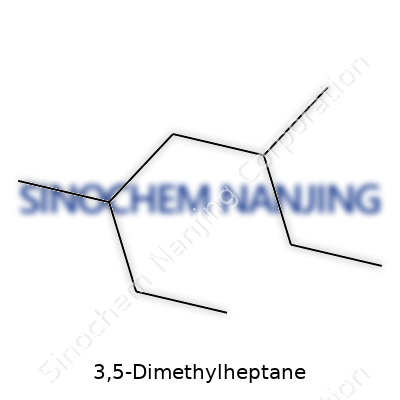
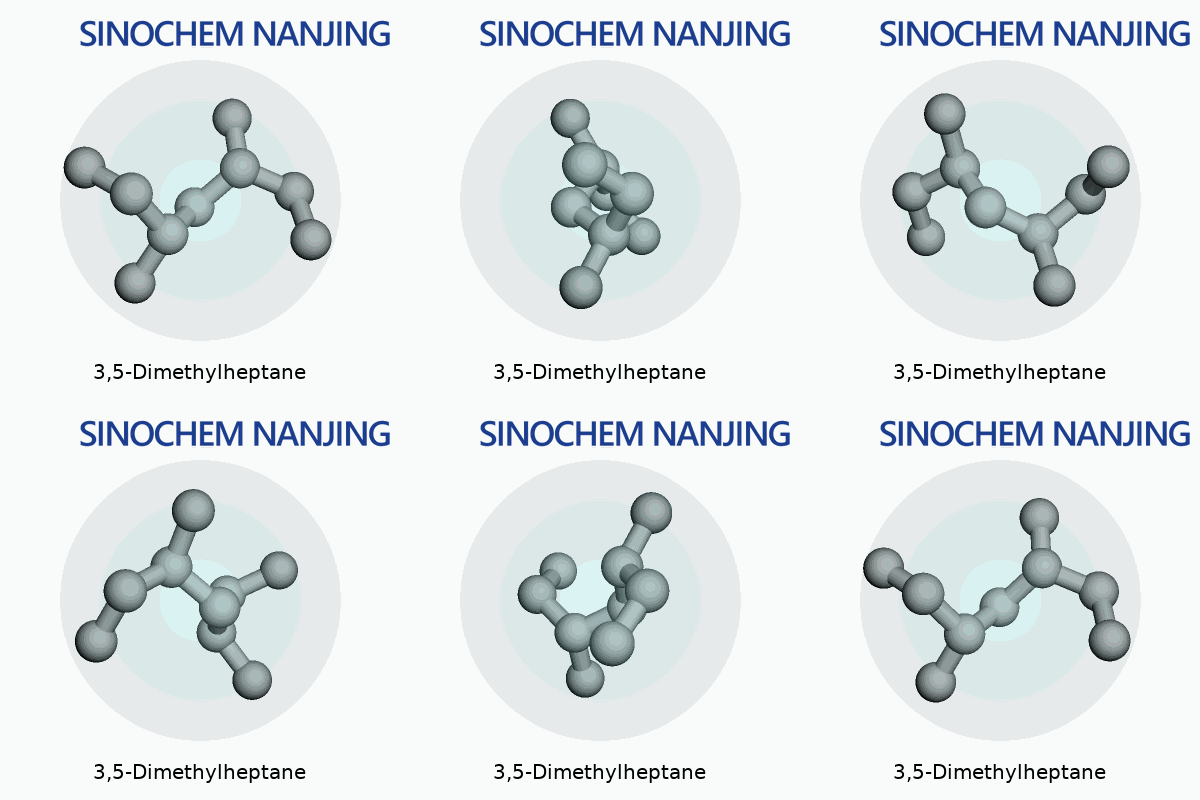
| Names | |
| Preferred IUPAC name | 3,5-Dimethylheptane |
| Other names |
Heptane, 3,5-dimethyl- iso-octane |
| Pronunciation | /ˈθriː,faɪv daɪˈmɛθɪlˈhɛpteɪn/ |
| Identifiers | |
| CAS Number | 589-81-1 |
| 3D model (JSmol) | `3DShape ChemDoodle "CCCC(C)CC(C)C"` |
| Beilstein Reference | 1718734 |
| ChEBI | CHEBI:15705 |
| ChEMBL | CHEMBL153238 |
| ChemSpider | 107520 |
| DrugBank | DB14074 |
| ECHA InfoCard | 14e4795c-6d3a-48c0-9c36-7e624fb9e758 |
| EC Number | 203-511-5 |
| Gmelin Reference | 82298 |
| KEGG | C07223 |
| MeSH | D003573 |
| PubChem CID | 11580 |
| RTECS number | EL6471000 |
| UNII | PY5U6N6E3F |
| UN number | UN2332 |
| Properties | |
| Chemical formula | C9H20 |
| Molar mass | 128.26 g/mol |
| Appearance | Colorless liquid |
| Odor | Odorless |
| Density | 0.719 g/mL at 25 °C (lit.) |
| Solubility in water | Insoluble in water |
| log P | 4.8 |
| Vapor pressure | 1.73 mmHg (at 25 °C) |
| Acidity (pKa) | 10.6 |
| Magnetic susceptibility (χ) | -77.5e-6 cm³/mol |
| Refractive index (nD) | 1.408 |
| Viscosity | 0.722 mPa·s (25 °C) |
| Dipole moment | 0.00 D |
| Thermochemistry | |
| Std molar entropy (S⦵298) | 373.1 J·mol⁻¹·K⁻¹ |
| Std enthalpy of formation (ΔfH⦵298) | −241.3 kJ·mol⁻¹ |
| Std enthalpy of combustion (ΔcH⦵298) | –4886.7 kJ/mol |
| Hazards | |
| GHS labelling | No GHS labelling. |
| Pictograms | GHS02 |
| Signal word | No signal word |
| Precautionary statements | P210, P233, P240, P241, P242, P243, P261, P271, P301+P310, P303+P361+P353, P304+P340, P331, P370+P378, P403+P235, P405, P501 |
| NFPA 704 (fire diamond) | 1-1-0 |
| Flash point | Flash point: 49 °C (120 °F; 322 K) |
| Autoignition temperature | /autoignition temperature/: 245 °C (473 °F; 518 K) |
| Explosive limits | 1.1 - 6.5% |
| Lethal dose or concentration | LD50 (oral, rat): > 5,000 mg/kg |
| NIOSH | NIOSH: XM2975000 |
| PEL (Permissible) | Not established |
| IDLH (Immediate danger) | IDLH: 900 ppm |
| Related compounds | |
| Related compounds |
2,4-Dimethylheptane 3-Ethyl-3-methylpentane 2,2-Dimethylheptane Isooctane |



