3,4-Dichlorobenzyl Chloride: A Closer Look at a Chemical Workhorse
Historical Development
Walk back through the chemical industry’s history, and you will find moments that reshaped synthetic chemistry. The discovery and early industrial use of chlorinated aromatic compounds stands out. 3,4-Dichlorobenzyl chloride, a molecule emerging from workhorse base chemicals like benzene, grew out of the expanding toolbox of organic synthesis during the 20th century. Researchers and manufacturers both saw the commercial promise of selectively chlorinated benzylic compounds. Its roots lie in the post-war boom, as pharmaceuticals, specialty plastics, and crop protection agents all called on new intermediates. By the 1960s, specialized halogenation and side-chain modification techniques allowed for the increased availability of 3,4-dichlorobenzyl derivatives, paving the way for applications in everything from biocides to dyes. Historical chemical literature puts this substance in the broader narrative of how society ramped up productivity in materials science and public health, but not without hard-learned lessons on handling stability, reactivity, and safety.
Product Overview
3,4-Dichlorobenzyl chloride is not a household name, but chemists know it as a useful benzylic halide, sporting two chlorine atoms on the aromatic ring. With a sharp, sometimes pungent aroma, it serves a specific group of researchers and process engineers. Its real draw comes from the balance of stability and reactivity; the glue holding its benzyl chloride backbone together resists breakdown, while the halides make it a good platform for a range of reactions. Over the years, manufacturers refined purification and bulk production, making it economically accessible for extended industrial programs and research. Spending time in research labs, you see the value: its transformations open pathways that simpler, unhalogenated benzylic compounds just can’t reach.
Physical & Chemical Properties
3,4-Dichlorobenzyl chloride appears as a clear to pale yellow liquid under standard conditions, its characteristic odor giving a sharp warning of its chemical potency. The presence of two chlorine atoms at the 3 and 4 positions on the benzene ring pushes its density higher than many other benzylic compounds. At room temperature, it remains stable, but the halogenated benzyl group makes it more reactive toward nucleophilic substitutions or further halogenations. Compared to its mono-chloro siblings, the dual substitution pattern shifts boiling points and influences how easily it participates in specific reaction pathways. In handling 3,4-dichlorobenzyl chloride, anyone with practical experience knows its low to moderate volatility, making vapor containment good practice in both bench and plant-scale applications.
Technical Specifications & Labeling
Labs and commercial users rely heavily on purity, moisture content, and inhibitor levels when selecting 3,4-dichlorobenzyl chloride. High-purity batches reduce the risk of side reactions, especially for pharmaceutical and fine chemicals applications. Labels do more than tick regulatory boxes; they signal proper storage, shelf stability, and hazards—flammability, skin and eye irritation, potential carcinogenicity. Freight and storage rules worldwide treat chlorinated aromatics with respect, requiring leak-proof containers, clear labeling for corrosive and toxic classification, and explicit handling instructions. Regulatory agencies set the bar for transport and disposal, applying lessons from decades of chemical mishaps and environmental incidents.
Preparation Method
Synthesis of 3,4-dichlorobenzyl chloride usually starts with a dichlorotoluene isomer or by chlorinating toluene itself under controlled conditions. Experienced chemists will choose selective chlorination, often using a Lewis acid catalyst to guide both ring and side-chain substitution. The process can produce a mix of isomers, so careful fractionation or crystallization helps isolate the target compound. In larger facilities, batch reactors and precautionary scrubber systems handle off-gassing byproducts, particularly when free HCl gas is generated. Seasoned plant operators favor continuous monitoring for temperature and pressure, which keeps the exothermic reactions from running out of control. For smaller scale or lab use, glassware and fume hoods are mainstays for safety. Waste treatment focuses on neutralizing acid byproducts, a practice that has become much stricter due to environmental oversight growing over recent years.
Chemical Reactions & Modifications
3,4-Dichlorobenzyl chloride serves as a launching pad for a diverse set of downstream transformations. Under basic or catalytic conditions, it will undergo nucleophilic substitution, replacing the benzylic chlorine with functions like amine, hydroxyl, or thiol groups. Metal-catalyzed couplings can build more complex aromatic frameworks incorporating this dichloro motif. In the lab, you see trial runs where simple amines or phenols react with it, yielding intermediates for biocides and agricultural actives. As more synthetic strategies have emerged, particularly palladium and copper-catalyzed cross-couplings, researchers turn to 3,4-dichlorobenzyl chloride for building larger, more functionalized molecules. The nature of the dichloro substitution both activates and blocks positions on the ring, leading to a selectivity that seasoned chemists use to their advantage. Its modifications have also spurred research into specialty polymers and resins for adhesives and protective coatings.
Synonyms & Product Names
3,4-Dichlorobenzyl chloride goes by a handful of synonyms in chemical catalogs, including 1-(Chloromethyl)-3,4-dichlorobenzene and 3,4-DCBC. More systematic terms like benzyl chloride, substituted at the 3 and 4 positions with chlorine, turn up in regulatory lists and inventory management systems. In practice, most scientists and technicians working with the substance stick to the simplest, clearest naming convention, always cross-referenced with CAS numbers to avoid confusion.
Safety & Operational Standards
Handling 3,4-dichlorobenzyl chloride brings a set of challenges; it does not reward shortcuts. Direct contact irritates skin, eyes, and respiratory tract, prompting strict rules on gloves, goggles, and ventilation. I’ve spent hours in fume hoods and can appreciate the peace of mind that comes from knowing splashes won’t escape containment. Overexposure can bring acute symptoms like coughing, shortness of breath, or headaches, so clear emergency protocols matter. Industry regulations demand stability tests for storage and call for controlled incineration or chemical neutralization for waste treatment. The reach of safety regulations expanded with incidents reported throughout the 1970s and 1980s, each reinforcing the need for airtight containers, spill containment plans, and up-to-date training for everyone along the supply chain. From warehouse to process room, mistakes can escalate, so rigid adherence to procedural checklists makes a real difference.
Application Area
3,4-Dichlorobenzyl chloride rarely claims the headlines, but serves as a vital intermediate across sectors such as pharmaceuticals, agrochemicals, and specialty materials. Medicinal chemists look to it for building blocks in antimicrobial agents, where its dichlorophenyl ring shapes target binding in a broad range of bioactive compounds. Crop science leans on it for synthesizing agents that offer disease control or growth regulation benefits. Materials science teams have explored its use in functional polymer frameworks, exploring how added chlorine atoms impact flexibility, strength, and chemical resistance. The flexibility inherent in this molecule’s chemistry means new uses regularly emerge as researchers probe unsolved problems, from biocidal coatings to time-release formulations in advanced drug delivery systems.
Research & Development
Each year brings new reports from research institutions and chemical companies on expanded uses and novel derivatives of 3,4-dichlorobenzyl chloride. With advances in green chemistry and atom-economical synthesis, researchers aim to limit waste and hazardous byproducts, seeking catalysts and processes that produce less environmental impact. High-throughput screening technologies now make it easier to scan hundreds of 3,4-disubstituted analogues for desirable biological or material properties. Cross-disciplinary collaborations, pairing chemists with toxicologists and environmental scientists, drive the search for derivatives that retain performance but break down more easily in the environment. These trends mark a shift from the more single-minded focus of earlier decades, reflecting the need for accountability and sustainability alongside classic chemical utility.
Toxicity Research
Questions about human and environmental safety follow every halogenated organic compound, and 3,4-dichlorobenzyl chloride is no exception. Toxicologists have mapped out both acute and longer-term effects. Short contacts bring irritation, especially for the skin and airways. Longer exposures or high doses raise questions about mutagenicity and carcinogenicity, with studies in animal models flagging the need for careful limits in exposure. Regulatory agencies continue to review the environmental persistence and potential for bioaccumulation. Water treatment experts have warned about the risks of chlorinated aromatics reaching the environment, prompting calls for better effluent treatment and stricter emissions tracking at manufacturing sites. Advances in analytical detection—gas chromatography, mass spectrometry—have made it possible to identify trace residues in both workplace environments and natural waters, pushing the industry toward ever-lower allowable limits in products and emissions.
Future Prospects
Forward-looking researchers cast 3,4-dichlorobenzyl chloride as a test case for how the chemical industry balances utility with environmental and human responsibility. Growth in applications may depend less on bulk demand and more on added value: new pharmaceuticals, advanced crop protection agents, and engineered materials with precise structure-function relationships. At the same time, the drive for green alternatives means future chemists could adopt bio-based feedstocks or develop catalysts that clean up residual chlorinated waste streams. Industry will likely face increasing pressure for sustainable sourcing, rigorous safety upgrades, and investment in closed-loop production methods—practices that match both customer expectations and evolving regulations. The molecule’s future sits at the intersection of invention, stewardship, and tougher scrutiny. Those of us who spend time in the lab, or on the production floor, see progress as steady but hard-won, and the choices made today will leave their mark for decades to come.
What are the main uses of 3,4-Dichlorobenzyl Chloride?
Inside the Lab and Beyond
Chemicals with complicated names often do most of their work behind the scenes, and 3,4-Dichlorobenzyl Chloride fits right into that role. This compound pushes plenty of doors open in different industries, from making medicines to turning out crop protection products.
Pharmaceutical Building Block
Most of my own chemistry training focused on how small, carbon-based compounds turn into lifesaving drugs and treatments. In any pharmaceutical factory, you might come across 3,4-Dichlorobenzyl Chloride as a starting point for more complex molecules. Certain antibacterials rely on it to add the right chemical group at just the correct spot. For example, this compound finds a place in formulas for some throat lozenges—anything needing a little extra germ-fighting power gets a boost from chlorinated benzyl groups.
Crop Protection and Pesticides
Walk onto a farm, and there’s a good chance the field’s been managed with products that started life in a chemical plant. 3,4-Dichlorobenzyl Chloride often acts as a building block for pesticides and herbicides. Many modern pesticides owe their formula to these kinds of synthetic base chemicals. Disease and pests can take out whole harvests, so growers turn to lab-made compounds to protect crops and keep food supplies steady.
Creative Chemistry and New Discoveries
University labs and research teams use this compound for experiments with synthetic pathways. Because its two chlorine atoms and the benzyl chloride group bring a unique reactivity, researchers can test new reactions and try out new products. In the world of chemical synthesis, having something like 3,4-Dichlorobenzyl Chloride on the shelf allows chemists to tweak molecules and discover new medicines or ways to fight pests that have developed resistance to older treatments.
Public Health Considerations
Every chemical brings benefits but also risks. Exposure to benzyl chlorides should be handled with caution. I’ve worn gloves and kept up with training in every lab that stocks the stuff. Reports from regulatory agencies highlight the risks of accidental contact or inhalation. Safe storage and clear labels matter as much as the science itself. Across the European Union and the United States, rules lay out how workers handle and dispose of chlorinated compounds like these. It takes real, on-the-ground vigilance—no shortcuts.
Sustainability: The Next Chapter
Manufacturers now face questions about the environmental effects of chlorinated organics. Some byproducts from pesticide manufacturing or the use of pharmaceuticals can linger in soils and waterways, showing up years after they're spread. Green chemistry offers hope here. Some labs now explore routes to make and break down these chemicals with less waste or safer byproducts. We’ve started seeing companies swap out old synthesis routes with newer ones designed to address pollution at the source.
Moving Forward with Knowledge
Products based on 3,4-Dichlorobenzyl Chloride won’t vanish overnight. With the push for safer production and greener alternatives, manufacturers and regulators must keep watch and adapt fast. Sharing research and tightening up safety culture can protect workers, farmers, and communities who depend on what this chemical helps create.
What is the chemical formula and molecular weight of 3,4-Dichlorobenzyl Chloride?
Why Knowing the Formula Matters
Understanding chemical names and numbers always came in handy during my university years. The full name—3,4-Dichlorobenzyl Chloride—gives away a lot about its structure without looking at the actual formula. Whether you work in a lab or just want to read labels at home, seeing the relationship between a chemical’s name, its formula, and its weight paints a bigger picture about how it acts and how we use it.
The Chemical Formula
3,4-Dichlorobenzyl Chloride features a benzene ring as the backbone, which is a ring of six carbon atoms. On this ring, there are two chlorine atoms, attached to the third and fourth positions, and a side group—called a benzyl chloride group—hanging off another carbon. Put together, the formula comes out as C7H5Cl3. This means seven carbons, five hydrogens, and three chlorines make up one molecule.
Molecular Weight and Why It’s Useful
Anyone weighing chemicals for a reaction, making pharmaceuticals, or analyzing environmental samples relies on molecular weight for every calculation. The molecular weight here is the sum of the atomic weights: carbon (12.01), hydrogen (1.01), and chlorine (35.45). For 3,4-Dichlorobenzyl Chloride, it adds up to about 211.48 g/mol. This number guides how much to measure out for experiments and lets companies label products with precise information. For instance, handling a chemical with three chlorine atoms needs a clear understanding of its hazards, as extra chlorine changes toxicity and reactivity.
Why It Shows Up in the Real World
I’ve seen this compound pop up in industrial organic chemistry. It sometimes shows up in the creation of dyes, pesticides, or other specialty chemicals. The two chlorines on the benzene ring shift how this compound behaves. Chlorine slows down reactions on the ring, making it more resistant to breakdown. That property influences everything from how effective a chemical is in stopping pests, to how persistent it stays in the environment after use. That sticks out for anyone interested in pollution or human health.
Staying Safe and Smart
Anyone who has worked in a chemical store room or ever had to clean up a spill knows caution matters—especially with volatile chemicals like this one. The presence of three chlorine atoms means extra care should go into ventilation and protective gear. Safety data often gets overlooked, especially by those rushing to finish an experiment or meet a production deadline. The weight and makeup of a chemical directly connect to how harmful fumes might be or how fast the skin might absorb it. Facts from material safety data sheets back up the need for gloves, masks, and careful disposal. There’s no shortcut around preparation, especially with compounds involving multiple chlorines.
Solutions and Improvements
Steps to boost lab and industrial safety could start with clear signage of both the molecular formula and weight on containers. Education makes a difference too. Training sessions on reading chemical labels or understanding reactivity might stop an accident before it starts. For those working on the supply side, investing in leak-proof packaging and tighter tracking during transport would cut down on spills and environmental releases. More open access to reliable chemical databases would level the playing field for students and workers who need to look up formulas and safety tips in a hurry.
What are the safety precautions when handling 3,4-Dichlorobenzyl Chloride?
Real Risks in Real Workspaces
No one forgets that stinging vapor in the nose after opening a drum of a strong-smelling chemical. 3,4-Dichlorobenzyl Chloride sends an unmistakable whiff that begs for respect. Over the years, chemical handling taught me not just to trust labels but my nose, skin, and eyes—because this compound attacks all three. It’s more than a nuisance. It’s an irritant, targeting mucous membranes, causing skin burns, and sparking eye redness or worse.
Personal Protective Equipment is Non-Negotiable
Latex gloves fail against tough organics; pick nitrile or butyl ones to block leaks. Splash goggles matter, not just safety glasses. Tight seals around eyes can mean the difference between finishing your shift and heading to urgent care. Lab coats or chemical-resistant aprons keep splashes off your arms and chest. The right gear often feels over-the-top until a bottle tips and you’re grateful for every layer.
Ventilation and Air Quality
Fumes build up in quiet corners of poorly ventilated rooms. If your workspace runs on basic fans or open windows, that’s just not enough for a compound like this. Local exhaust—fume hoods—keeps the breathing zone as clean as the supply room. Never trust a stuffy room. I’ve seen colleagues push through only to get headaches and watery eyes before lunch. Well-maintained ventilation pulls those hazards away from your lungs before you even realize they’re there.
Spill Response Prepares You for Surprises
Buckets and rags just move the mess around. Absorbent pads rated for organics actually trap the spill. Keep neutralizing solutions ready; products like sodium bicarbonate won’t foam but can help break down smaller drops. Dispose of clean-up materials as hazardous waste—even a small error here means a call from the safety officer next week. The training I got in spill drills never felt useful until a bottle slipped, and then every second counted.
No Eating or Drinking—Ever
It’s tempting to think a closed bottle on the other side of the lab can’t cause harm. Once, I watched someone drink from a water bottle they’d used near samples. Hours later, tingling lips and a stomach ache sent them to the ER. 3,4-Dichlorobenzyl Chloride isn’t something you want in your system. Food and drinks wait outside. No snack is worth the risk.
Strict Storage Pays Dividends
This compound won’t forgive a flimsy cap or a cracked bottle. Store it tightly sealed in a cool, dry cabinet made for chemicals. Double containment—storing bottles in trays—saves headaches if a bottle fails. Never stack heavy items above it; costly mistakes come from bottles tumbling out during a rushed inventory.
Smart Solutions: Training and Open Communication
Workshops trump thick manuals. Watching a veteran handle a spill reveals subtle moves you won’t find in tables or charts. Sharing near-misses openly turns mistakes into lessons for the whole team. Clear signage, routine safety talks, and easy-to-read data sheets help keep everyone on the same page. A strong safety culture thrives on folks looking out for each other, not just following checklists.
How should 3,4-Dichlorobenzyl Chloride be stored?
Why Storage Matters So Much
Chemicals like 3,4-Dichlorobenzyl Chloride come from the kind of labs that don’t mess around. This compound gets used for everything from making medicines to agricultural work. It’s not olive oil—it has bite. The safety sheet spells this out pretty clearly, but over the years, I’ve seen too many people stash this stuff like it’s nothing worse than paint thinner. Next thing you know, you’re dealing with vapor where you shouldn’t, or leaky containers, or a full-blown chemical incident.
I remember at one warehouse in my early career, a seasoned worker cracked a joke about “chloride cologne” after a spill. Nobody laughed. This stuff can irritate eyes, skin, and lungs. That’s just after brief exposure. Long-term or heavy spills hurt a lot more than pride.
Practical Storage Tips That Keep You Safe
Start with the basics: strong containers. I’ve seen polyethylene and glass work well. Keep metal away from this compound, since it corrodes easily. You want a tight lid, not one of those loose types that always show up in the wrong place at the wrong time.
Separate storage always trumps the “stick it on a shelf” approach. Don’t stack 3,4-Dichlorobenzyl Chloride anywhere near anything flammable or with acids, bases, or stuff you don’t completely recognize. A splash, a leak, and you might get a surprise reaction that’s much worse than a mess on the floor.
Space makes a difference too. Use cool, dry rooms. Moisture gets into chemicals where air leaks in, causing bottles to sweat and sometimes break down. I’ve found slugging this stuff in humid places risks both the quality of the product and the shelf life. Steer clear of sunlight—heat can change chemical stability and create pressure inside containers.
Labeling: One Small Step, Big Results
You’d think folks label their bottles every time. Turns out, not always. In smaller labs, I’ve watched people grab a marker only after they forget what’s in the jar. One clever label—enough to clearly show what’s inside, danger warnings, and the date—goes a long way. Don’t trust your memory; humans forget all kinds of things in busy workshops.
Ventilation and Spill Plans
Ask anyone with chemical work in their background and you’ll hear the same story—one strong smell, and the panic rises. Good airflow in storage areas stops those moments before they start. Set up spill kits nearby—at minimum, gloves, goggles, absorbent pads, and a disposal container you won’t use for anything else. I remember chasing down a bottle that slipped loose during delivery; only a nearby kit kept things from getting ugly.
Training Beats Blind Luck
Every time I teach safety in a new lab, I emphasize review sessions. Bad habits from one place turn into accidents somewhere new. Take twenty minutes every quarter to run through chemical handling steps. Point out what’s off, and get questions out in the open. Proper training sticks longer than any posted checklist.
This compound can serve labs well, but only when treated with genuine respect. Strong routines, good judgment, and a bit of preparation keep things running smooth. Safety isn’t about luck—it’s habit, backed up by experience and attention to detail.
What are the potential health hazards of exposure to 3,4-Dichlorobenzyl Chloride?
What Happens with Contact
Smelling chemicals like 3,4-Dichlorobenzyl Chloride in a workplace or lab triggers more than just concern about odd odors. If it touches skin, people often feel an intense burning or tingling. Splashes in the eyes lead to pain, redness, and temporary blurred vision. Based on cases reported among workers, direct contact often brings out rashes, blisters, and discomfort. Without gloves and goggles, no one’s really protected.
Problems with Breathing the Fumes
Open a barrel of this chemical and the vapor drifts fast. Breathing it irritates the throat and nose. Folks near leaking containers end up coughing, sneezing, and feeling a tight chest. With heavy exposure, nausea and headache appear — not just because of the smell, but because the lungs are absorbing a toxin. Even if someone thinks they’ve “gotten used to it,” the body starts reacting long before the mind adapts.
More Serious Health Risks
Longer exposure brings bigger worries. The liver and kidneys both work overtime to clean out compounds like 3,4-Dichlorobenzyl Chloride. Over months or years, that extra load adds up, taking a toll on these organs. Occupational health studies, especially from manufacturing environments in China and Europe, show increased reports of chronic respiratory problems and skin disorders among workers who regularly handled this substance without solid protective measures.
Cancer risk enters the conversation whenever chemicals from the benzene family come up. Though direct links to human cancer from this compound aren’t yet fully proven, research points to potential risks. Animal studies suggest breakdown products can damage cells’ DNA. Caution makes sense here, especially since tiny exposures build up over time.
Routes to Safer Workplaces
Factories or workshops using 3,4-Dichlorobenzyl Chloride need more than warning labels. Strong ventilation and airtight storage go far. Fume hoods pull vapors away from breathing zones. Well-fitted gloves and goggles cover the most likely points of contact. Many companies act only after accidents. Proactive moves, including training and monitoring air quality, help prevent problems before they start.
Standard safety sheets call for showers near workspaces where this chemical gets handled. Quick rinsing limits the damage—delaying even a few minutes increases the chance of lasting burns. Disposable suits and boot covers remove another route of skin contact, a lesson learned from older chemical plants where protective gear was rare.
Why Public Awareness Matters
People who work in labs, warehouses, or chemical plants won’t spot the effects unless they know what to watch for. The same goes for at-home tinkerers or students. Sometimes, labels don’t give the full picture. Community outreach and real conversations about risks close the information gap.
Regulations evolve, but staying ahead of the latest scientific findings saves lives and livelihoods. Sharing what’s learned from past incidents gives workers and managers practical steps to stay safe. Listening to healthcare experts, reporting new symptoms quickly, and investing in safety now sets up a healthier future for everyone involved.
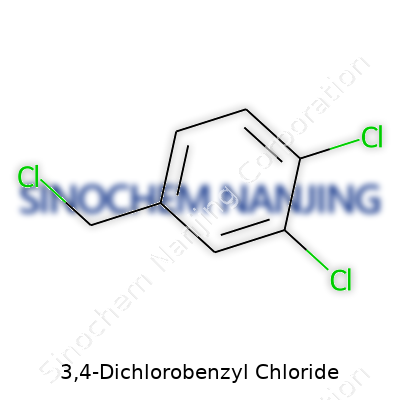
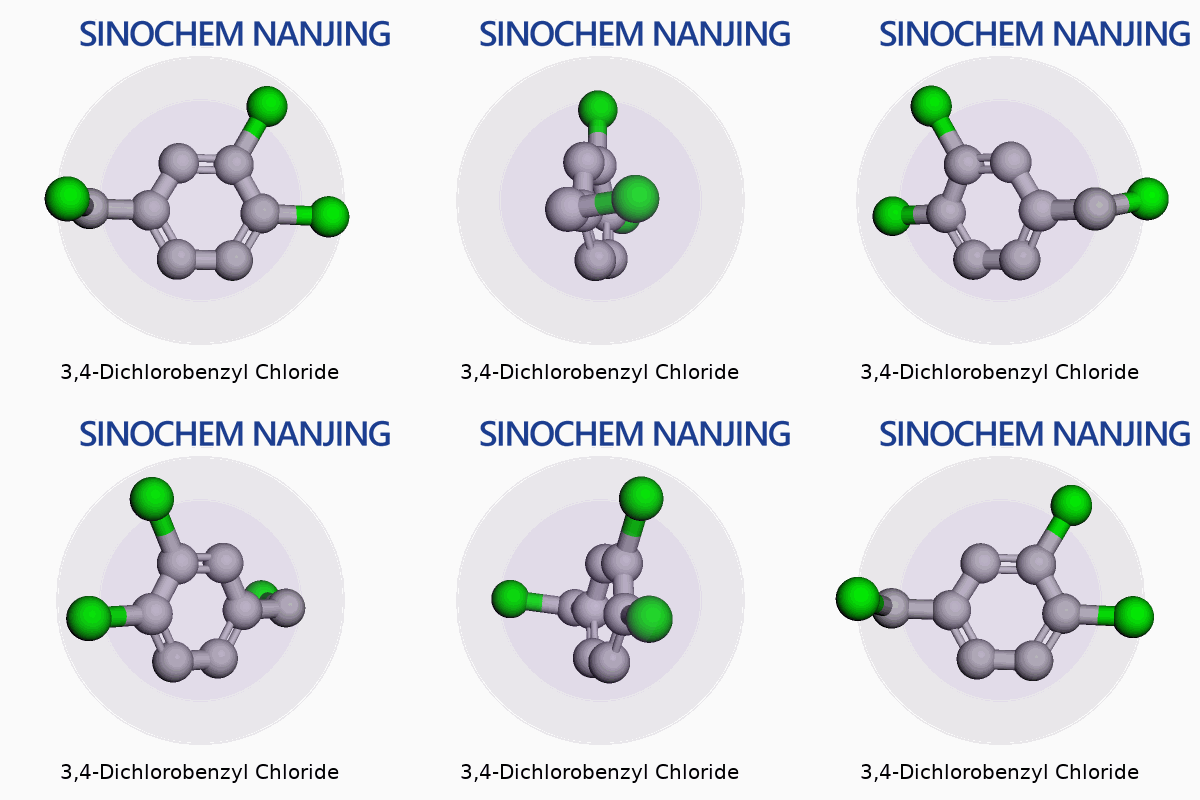
| Names | |
| Preferred IUPAC name | 1,2-dichloro-4-(chloromethyl)benzene |
| Other names |
Benzyl chloride, 3,4-dichloro- 3,4-Dichlorobenzylchlorid 3,4-Dichlorophenylmethyl chloride p-Chloro-α,α-dichlorotoluene |
| Pronunciation | /ˈθriːˌfɔːr daɪˈklɔːr.oʊˌbɛn.zɪl ˈklɔːr.aɪd/ |
| Identifiers | |
| CAS Number | [1125-00-6] |
| 3D model (JSmol) | `3D model (JSmol)` string for **3,4-Dichlorobenzyl Chloride** (also known as 1-(3,4-dichlorophenyl)methyl chloride): ``` Clc1ccc(CCl)cc1Cl ``` This is the **SMILES** string that can be used in JSmol to render the 3D model. |
| Beilstein Reference | 1517174 |
| ChEBI | CHEBI:84582 |
| ChEMBL | CHEMBL45837 |
| ChemSpider | 154063 |
| DrugBank | DB13963 |
| ECHA InfoCard | 100.013.899 |
| EC Number | 203-404-7 |
| Gmelin Reference | 1711934 |
| KEGG | C19027 |
| MeSH | D015916 |
| PubChem CID | 85762 |
| RTECS number | GO8575000 |
| UNII | LR8R86WFG1 |
| UN number | UN2684 |
| Properties | |
| Chemical formula | C7H5Cl3 |
| Molar mass | 207.00 g/mol |
| Appearance | Colorless to light yellow liquid |
| Odor | Pungent |
| Density | 1.43 g/cm³ |
| Solubility in water | Insoluble |
| log P | 2.9 |
| Vapor pressure | 0.2 mmHg (25°C) |
| Magnetic susceptibility (χ) | -79.0·10⁻⁶ cm³/mol |
| Refractive index (nD) | 1.5920 |
| Viscosity | 1.63 cP (20℃) |
| Dipole moment | 2.56 D |
| Thermochemistry | |
| Std molar entropy (S⦵298) | 354.6 J·mol⁻¹·K⁻¹ |
| Std enthalpy of formation (ΔfH⦵298) | -67.3 kJ/mol |
| Std enthalpy of combustion (ΔcH⦵298) | -4775.7 kJ/mol |
| Pharmacology | |
| ATC code | R02AA20 |
| Hazards | |
| GHS labelling | GHS05, GHS07 |
| Pictograms | GHS05,GHS07 |
| Signal word | Warning |
| Hazard statements | H302, H314, H317, H410 |
| Precautionary statements | P261, P264, P271, P280, P301+P312, P305+P351+P338, P304+P340, P312, P330, P337+P313, P405, P501 |
| NFPA 704 (fire diamond) | 2-2-1 |
| Flash point | > 97 °C |
| Autoignition temperature | 340°C |
| Lethal dose or concentration | LD₅₀ (oral, rat): 1510 mg/kg |
| LD50 (median dose) | LD50 (median dose): Oral rat LD50 = 1820 mg/kg |
| NIOSH | SN8750000 |
| PEL (Permissible) | Not established |
| REL (Recommended) | 0.1 ppm (0.6 mg/m³) |
| IDLH (Immediate danger) | IDLH: 10 ppm |
| Related compounds | |
| Related compounds |
Benzyl chloride 4-Chlorobenzyl chloride 3,5-Dichlorobenzyl chloride 3,4-Dichlorotoluene 3,4-Dichlorophenylacetic acid |



