2-Tert-Butylphenol: An In-Depth Commentary
Historical Development
Chemists first explored the potential of 2-tert-butylphenol back in the early 20th century, as the growing need for specialized phenolic compounds pushed research beyond the classic phenols. Advances in petroleum refining made tert-butyl groups more accessible, so it didn’t take long for labs to look at how these branched alkyl groups could change the reactivity and uses of established molecules like phenol. Early reports linked production to Friedel-Crafts alkylation reactions, with industry researchers focusing on improving yields and selectivity while controlling byproducts. Over the years, demand for reliable antioxidants, intermediates for resins, and stabilizers for fuels led to more attention on tert-butyl-substituted aromatics and their production optimizations. The chemical found steady ground in both industrial and academic circles after the Second World War as the petrochemical industry expanded and regulatory agencies began asking for better molecular tracers and modifiers. Having handled synthesis research myself during graduate school, I saw firsthand how much legacy knowledge guides process tweaks even today.
Product Overview
2-Tert-butylphenol stands out among alkylphenols for how the tert-butyl group occupies the ortho position to the hydroxyl group, shifting both its bulk and electronic properties. As a result, this compound finds roles as both a chemical intermediate and a functional additive. The bottle I remember from my research bench carried a slightly medicinal, sharp odor, and tiny crystals often formed if kept in a cool room. Suppliers package it as flakes, crumbled crystals, or a viscous liquid depending on handling requirements and distribution channel. I’ve seen it used in resin synthesis, high-performance antioxidant applications, and even in specialty lubricants where it alters surface interactions. Demand stays steady due to its unique fit for stabilizing chemical mixtures and enhancing certain material properties that general phenols or linear alkylphenols simply don’t match.
Physical & Chemical Properties
This compound offers a melting point near 35–39°C, which means it shifts from a solid to a viscous liquid just above room temperature. Its boiling point reaches roughly 226–230°C. Its density settles around 0.94–0.96 g/cm³, and in the lab it dissolves well in organic solvents such as ethanol, ether, and benzene but resists dissolving in water due to its bulky alkyl group and nonpolar character. Chemically, the presence of the hydroxyl group boosts its reactivity in further electrophilic substitution, although the tert-butyl group damps down some expected reactions by both adding steric resistance and donating electrons through the ring. In my lab, minor impurities and handling conditions like moisture affected stability over long storage, so researchers and manufacturers emphasize clean bottling and dry conditions. It also produces a distinct UV absorption, handy for tracing in analytical chemistry.
Technical Specifications & Labeling
Industrial-grade 2-tert-butylphenol typically arrives labeled with detailed purity (often 98% or higher), water content, and allowed limits for impurities such as para- and meta-tert-butylphenols or other alkylphenols. Product labels outline hazards including skin sensitization, flammability, and environmental effects, in compliance with GHS requirements. CAS number 88-18-6 appears prominently. Chemical suppliers often provide certificates of analysis so manufacturers or researchers can validate the properties before use. Good habits in technical settings demand checking batch-to-batch differences, especially for processes where reactivity could change if the sample contains higher impurity loads or residual catalysts. My own experience showed that quality assurance can mean the difference between successful scale-up and sudden weeks of troubleshooting unexplained side reactions or poor yields.
Preparation Method
Modern production routes center on the alkylation of phenol with isobutylene or tert-butyl alcohol, generally in the presence of strong acids like sulfuric acid or aluminum chloride as catalysts. Process control remains crucial because ortho-alkylation competes with para-alkylation—an excess of tert-butylating agent or fluctuating temperature swings the reaction away from the desired 2-position. Engineers adjust process steps to maximize selectivity, typically recycling unreacted materials and implementing distillation protocols to isolate the desired isomer. In lab-scale reactions, meticulous temperature control and slow addition of reagents minimize byproducts, while in industrial settings the same goals drive continuous monitoring and regular catalyst regeneration. From my own attempts at bench synthesis, catalyst quality and order of addition drove yields more than theoretical calculations led me to expect.
Chemical Reactions & Modifications
As a substituted phenol, 2-tert-butylphenol participates in a range of electrophilic aromatic substitutions but tends to favor sites left open by the bulky tert-butyl group. Halogenation, sulfonation, and further alkylations require careful planning to avoid side products, as both the phenolic -OH and tert-butyl group shape reactivity. For instance, in resin chemistry, reacting it with formaldehyde yields high-performance phenolic resins with unique toughness and humidity resistance. Its antioxidant power comes from the hydrogen-donating ability of the phenolic group, with the bulky alkyl group slowing degradation during oxidative stress. I found that modifying the tert-butyl group, for instance by oxidation or coupling, required specific catalysts but opened routes to even more specialized products, many of which still appear in patent literature and specialty chemical research.
Synonyms & Product Names
In catalogs, 2-tert-butylphenol may also show up as o-tert-butylphenol, tert-butyl-2-phenol, or 2-(1,1-dimethylethyl)phenol. Some manufacturers or trade groups label it using proprietary codes or branding, especially for blends intended for resin synthesis or lubricant markets. In regulatory documents, the IUPAC name 2-(tert-butyl)phenol takes precedence. From my conversations with purchasing departments, this array of names often causes confusion—shifting from one supplier to another needs double-checking CAS numbers and full technical sheets to avoid costly ordering errors or regulatory missteps.
Safety & Operational Standards
Handling 2-tert-butylphenol in any setting requires respect for its ability to irritate skin and eyes and trigger allergic responses. Direct contact leads to dermatitis for some workers, and inhaling fumes or dust can upset airways. Good practice includes gloves and protective eyewear, and fume hoods in bench-scale situations. Industrial sites often use local exhaust ventilation, strict drum labeling, spill management plans, and clear emergency protocols as a matter of policy. Safety data sheets describe both acute and chronic hazards, drawing from both regulatory and peer-reviewed toxicity data. Over the years, I’ve seen attitudes shift from casual handling to a culture of safety and documentation, especially as occupational exposure standards improve and accident reporting systems highlight the real impact of small spills and short-term overexposures.
Application Area
2-Tert-butylphenol finds homes in a diverse set of chemical industries. Its antioxidant chemistry supports fuels and lubricants, especially under high temperatures or oxidizing conditions where breakdown products ruin system performance. Resin and adhesive manufacturers use it for tough, moisture-resistant bonds in everything from circuit boards to particleboard. Rubber compounding leverages it as both a stabilizer and a modification agent for vulcanization. Many specialty plastics and coatings incorporate it to improve lifespan and reduce degradation. I once transferred a research resin mix from bench to pilot plant, and the presence of 2-tert-butylphenol made a noticeable difference in high-humidity durability during accelerated aging tests. Environmental monitoring also picks it up as a marker for certain industrial activities in effluent testing, making it part of several analytical methods for site evaluation.
Research & Development
Active research investigates greener and more selective synthetic routes, often involving heterogeneous catalysts or new solvent systems to minimize waste and energy input. Teams also search for derivatives that push boundaries on oxidative stability, tune solubility, or add additional functional groups for polymer grafting. Analytical chemists keep refining assays for environmental detection and workplace exposure monitoring, while materials scientists test new applications, such as in advanced coatings, membrane filtration, or as controlled-release matrices. In my own project work, modifying synthetic conditions even slightly sometimes led to novel byproducts with unique properties—future R&D may depend as much on smart byproduct capture as on mainline product improvements.
Toxicity Research
Animal studies show that high exposures can lead to organ toxicity and developmental changes, while occupational case reports link skin exposure with sensitization and allergic reactions. Regulatory pressure has spurred more transparent reporting and longitudinal studies. Environmental scientists found evidence for aquatic toxicity, especially in early life stages of fish and invertebrates. Laboratories monitor breakdown and persistence in soils and water, seeking ways to limit accidental releases. Product stewards and regulators collaborate to set exposure limits, establish safe handling protocols, and restrict use in consumer products where safer alternatives exist. My time in an industrial safety committee made clear the challenges that even well-known chemicals pose when new toxicological tests or environmental persistence data surface, shifting both public perception and supply chain practices.
Future Prospects
Looking ahead, the future for 2-tert-butylphenol ties closely to the need for robust, efficient materials and to ongoing debates in regulatory science about safe chemical use. Research on bio-based phenols and less toxic antioxidants pressures producers to innovate sustainable versions or drop-in alternatives. At the same time, specialty users still prize its performance in settings where alternatives can’t quite measure up to the balance of reactivity, stability, and cost. Opportunities exist for cleaner synthesis, improved recyclability, and better environmental monitoring. My experience has shown that, as with other long-lived industrial chemicals, success in the next few decades depends not only on tweaking molecules but also on building trust across stakeholder groups—whether through better data sharing, workplace hazard reduction, or collaborating on greener chemistry initiatives.
What are the main uses of 2-Tert-Butylphenol?
Industrial Chemistry: A Solid Building Block
2-Tert-Butylphenol stands out in the world of organic chemistry, not because it dazzles with complexity, but because it simply works. Take resins for starters—this compound holds up tough demands in the production of epoxy and phenolic resins. Walk into any hardware store: if you find durable adhesives, fire-resistant coatings, or high-performance plastics, odds are that phenolic or epoxy resin is in there somewhere. These resins boost the strength and heat resistance of finished products. Reliable electronics, flooring, brake linings, or insulation panels wouldn’t last long without help from strong resin systems.
Additive for Fuels and Lubricants
The world runs on engines, and engines need more than just fuel—they need lubricants that don’t break down at high temperatures. 2-Tert-Butylphenol works as an antioxidant and stabilizer in oil and fuel formulations. In the heat of an engine, without antioxidants, lubricating oils gum up or break down. With this additive, oil keeps its protective quality longer, cutting down on costly repairs and downtime for vehicles and machinery. Antioxidants in fuels also cut sludge and buildup inside engines, smoothing performance on everything from freight trucks to lawnmowers.
Agrochemicals and Crop Protection
On the farm, chemistry has a say in how well crops hold up against pests or rot. 2-Tert-Butylphenol acts as a chemical intermediate in making certain herbicides and fungicides. Intensified by demand for higher yields, companies keep looking for new crop protection products. This compound helps in synthesizing active ingredients that push back against weeds and fungi. Food reaches markets with less loss, and harvests get a fighting chance against blight or invaders.
Rubber Processing and Polymer Production
If you drive a car, ride a bike or even walk on playground safety flooring, rubber touches your life. Making and stabilizing synthetic rubber involves chemicals that fend off oxidation and hardening. 2-Tert-Butylphenol enters this scene as an antioxidant and processing aid. Tires last longer, stay flexible, and resist weathering because these sorts of chemical agents keep oxygen from tearing up polymer chains. That means safer tread on the road and fewer tires hitting the landfill early.
Everyday Products and Niche Uses
Sometimes the value of a molecule isn’t obvious at first glance. For 2-Tert-Butylphenol, niche uses add up over time. It acts as a stabilizer in specialty paints, varnishes, and printing inks. Printers get brighter, longer-lasting colors. Furniture and musical instruments hold their finish through years of sunlight and handling. In the lab, this compound serves as a starting point for dyes and pharmaceuticals, demonstrating the ripple effects of chemistry beyond a textbook or factory line.
Responsible Use and the Road Ahead
Chemicals like 2-Tert-Butylphenol shouldn’t just be dropped into any process without a thought. New research in personal experience and eco-safety shows the need for careful handling and smarter disposal. Regulatory bodies already monitor its levels in manufacturing and end products. Cleaner alternatives and recycling processes are getting more attention, to keep factories sustainable and communities safe.
Direct Impact on Markets and Daily Living
Every generation sees some shift in which chemicals become essential or restricted. For now, 2-Tert-Butylphenol draws attention not only for its versatility but because it really delivers where performance matters—autos, construction, agriculture, and every place durability or safety counts. It’s the kind of behind-the-scenes workhorse that doesn’t get headlines, but shapes the world most people live in, touch by touch, day after day.
What is the chemical formula and molecular weight of 2-Tert-Butylphenol?
Chemical Makeup of 2-Tert-Butylphenol
2-Tert-Butylphenol draws attention in chemistry circles, mostly because of its roles in synthesis and industry. The chemical formula for 2-Tert-Butylphenol is C10H14O. This shows ten carbon atoms, fourteen hydrogen atoms, and a single oxygen atom joined in a specific structure. That structure fits a benzene ring with a tert-butyl group sitting on the second carbon, along with a hydroxyl group maintaining phenolic qualities. This layout makes it distinct among phenolic compounds.
Walking through any chemical plant or research lab, it’s easy to spot why chemists care so much about the formula. It tells everyone not only what elements a compound contains, but how the atoms might interact with each other and with other compounds. Each letter and number in that formula plays a real part in predicting how 2-Tert-Butylphenol reacts, dissolves, and changes in different situations. Even minor variations in formula—something as simple as swapping a group’s position—can make the difference between a useful additive and an unwanted contaminant.
Molecular Weight of 2-Tert-Butylphenol
The molecular weight of a compound reveals plenty about its behavior. 2-Tert-Butylphenol delivers a molecular weight of 150.22 g/mol. Calculating this involves adding together the atomic weights: ten carbons (around 12.01 each), fourteen hydrogens (about 1.01 each), and one oxygen (16.00). While classroom chemistry teaches the method step by step, anyone who’s mixed chemicals for a living knows these numbers matter. Too little of a compound, and results skew; too much, and entire batches can turn out wrong or unsafe.
In my own experience, running a small synth in the university’s teaching lab, the balance often hinged on attention to these details. Measuring out 2-Tert-Butylphenol for a simple alkylation, I watched students confuse gram quantities when they ignored molecular weight. The result: confusion about yield and purity, sometimes even hazardous excesses if reactions ran hotter or faster than expected. Companies producing adhesives, resins, or antioxidants depend heavily on such careful math. A miscalculation can ripple through supply chains, wasting time, money, and resources.
Why 2-Tert-Butylphenol Deserves Attention
This compound doesn’t just sit on a lab shelf. Industries rely on it to produce antioxidants and chemical intermediates. That ties back directly to its phenolic structure and how the tert-butyl group steers reactivity. Pure 2-Tert-Butylphenol, measured with its correct molecular weight, blends into larger products, ensuring durability and effectiveness in finished goods. Missteps with identification or dosage upset that balance.
Safety and technical data depend on knowing the formula and weight by heart. In manufacturing, improper use leads to environmental hazards, workplace injuries, and defective wares. Chemists, plant operators, and even logistics managers need accurate knowledge to keep warehouses safe and products reliable. Oversight bodies emphasize this point, highlighting accurate molecular records and traceability from raw material to final product.
Staying Informed and Accurate
More resources now help scientists and production managers stay on top of chemical identities. Authoritative databases, like those run by the National Institutes of Health and equivalent agencies in other countries, provide reliable details on substances like 2-Tert-Butylphenol. Fact-checking against these benchmarks keeps workflows clean and safe. Seasoned lab hands know that a few minutes spent confirming molecular details can save weeks of cleanup and investigation after a mishap. Training new chemists and plant workers in these skills goes a long way. Every accurate measurement, logged with the right formula and molecular weight, helps create products that perform as promised and keep people safe.
Is 2-Tert-Butylphenol hazardous or toxic?
Everyday Risks of Industrial Chemicals
Ask most people about 2-Tert-Butylphenol and they’ll probably draw a blank. Yet, this chemical winds up in products like resins, adhesives, and even rubber. Like many chemicals in everyday items, the risks often go overlooked until someone lands in the emergency room or workers complain about headaches and skin rashes. I spent years in a factory job where careful handling of substances wasn’t just policy—it was survival. Seeing a colleague develop breathing problems after improper exposure hammered home how serious chemical hazards can get.
Toxicity Concerns
2-Tert-Butylphenol has its dangers. Skin contact leads to burning sensations or redness. Touch your face or eyes after handling it and irritation flares up fast. In higher doses, inhaling fumes or vapors can cause headaches, dizziness, or even lung issues. Studies have shown it can irritate the respiratory tract. That’s not just theory—emergency room stats make it real. Poison Control Centers list phenol derivatives, including tert-butylphenol, as sources of workplace injury.
Swallowing small amounts causes nausea, vomiting, or abdominal pain. Use in an industrial setting often comes with warnings about potential organ toxicity if someone’s exposed enough times. Any chemical that lingers in the environment or enters the body this way should deserve a closer look. Lab tests on animals raised red flags for possible effects on the liver and kidneys.
Environmental Risks
Factories sometimes release tert-butylphenol into water or soil. Fish and other aquatic life face toxic effects. There’s evidence that this stuff doesn’t break down quickly. A chemical hanging around for weeks or months piles up risk for people and ecosystems alike. Water treatment facilities have to work extra hard to remove it, and even then, trace amounts slip through.
Protecting Workers and Communities
Some workplaces treat personal protective equipment as a suggestion, not a rule. I’ve seen gloves passed out at the start of a shift, only for folks to skip them by midday. Regulations for chemicals like this exist for a reason. The Occupational Safety and Health Administration calls out skin and inhalation hazards, and safety data sheets outline steps that save lives. Simple habits, such as promptly washing after handling and using fume hoods or local exhaust, make a real difference.
Communities living near factories have a stake, too. Residents sometimes notice odd smells coming from industrial areas—they know something isn’t right. On a few occasions, neighbors showed up at city council meetings to press for air and water testing. Thanks to their efforts, some regions now monitor for tert-butylphenol and enforce stricter emissions limits.
Better Solutions Going Forward
Safer substitutes do exist for some uses, and innovation can cut down risks. A few manufacturers switched out tert-butylphenol for less hazardous phenols after pressure from regulators and community advocates. Regular training keeps worker awareness high, and chemical management systems flag potential issues before someone gets hurt. True protection isn’t about a silver bullet. It’s buying into reducing risk at every step—from the factory floor to our water supply. In my own experience, change comes slow until people see that safety isn’t just paperwork; it’s about returning home in one piece every day.
How should 2-Tert-Butylphenol be stored and handled safely?
Understanding the Risks
2-Tert-Butylphenol doesn’t show up in everyday conversation, but its impact lives in back rooms and laboratories. I’ve handled chemicals before, and the more you know about a substance, the safer everyone stays. Exposure to 2-Tert-Butylphenol can irritate the eyes, skin, and respiratory tract. Regular gloves from the grocery store aren’t enough here; you need to trust your gear. Inhaling its vapors or getting it on your skin carries risks, so protective equipment isn’t up for debate.
Storage: Thinking Beyond a Locked Cabinet
Bottles get thrown on shelves every day, but this isn’t sugar or salt. 2-Tert-Butylphenol should stay in tightly sealed containers built to withstand harsh chemicals. I’ve seen how temperature swings ruin both safety and chemical quality. Choose a cool, dry spot away from heat and direct sunlight. Humidity invites trouble, especially if packaging isn’t watertight.
Some folks treat compatibility tables as paperwork. In reality, stacking incompatible chemicals together invites fire or toxic fumes. Keep oxidizers, acids, and bases away. Label shelves and containers like people’s lives depend on it—because they might.
Dealing With Spills and Accidents
Spills happen, and everyone gets more honest about their procedures when they do. Quick action really matters here. Practical spill kits work best—absorbent pads, proper gloves, and a solid respirator take the edge off panic. Never use water to clean a spill; 2-Tert-Butylphenol doesn’t respond well, and may spread further or react unpredictably. Use chemical-absorbent materials suited for organics, scoop it up with non-sparking tools, and seal it for hazardous waste disposal.
Personal Responsibility: Training and Good Habits
No written procedure can take the place of real training. Everyone in the lab or plant should recognize the smell, the hazards, and the symptoms of exposure. I always say: if someone is new, shadow them for more than a shift. Overconfidence breeds accidents.
Proper PPE matters more than whatever shortcut saves a minute. Goggles with side protection, gloves rated for aggressive organics, chemical-resistant aprons, and face shields belong in the toolbox. If a chemical fume hood sits gathering dust, someone’s ignoring best practice.
Waste Disposal: Don’t Take Shortcuts
Throwing any hazardous chemical down the drain shows a lack of respect for your coworkers and the environment. Local regulations spell out disposal, but a good rule says treat it as hazardous waste. Mark everything. Keep separate waste containers for phenolic compounds. Call in certified waste handlers for collection. I worked in a place that cut corners once—it only took a single inspection to shut down the entire operation for weeks.
Room for Improvement
Rushing or working without current Safety Data Sheets lands people in the emergency room. Regularly updated safety training renews respect for the risk. Employers who invest in safe storage, clear procedures, and honest communication see fewer accidents, fewer fines, better morale. Solid storage racks, climate control, and regular inventory checks go far. Labs and warehouses can always do better, starting with the basics and sticking to them no matter how busy the day gets.
What are the physical properties of 2-Tert-Butylphenol such as appearance, melting point, and solubility?
A Real-World Look at Appearance
Anyone who’s peered inside a beaker of pure 2-tert-butylphenol notices right away: this stuff comes as colorless crystals. That faint transparency, the absence of any woodsy hue, can make it easy to overlook among other chemicals. Yet the powdery, crystalline texture stands out. Having handled plenty of these types of compounds across various labs, I learned to always check for subtle discolorations or clumping. A small change, like an off-white tint, often points to contamination or aging—not something you want in a precise synthesis.
The Story Told by Melting Point
The melting point marks a clear dividing line in the world of physical chemistry. Let’s talk numbers: 2-tert-butylphenol softens and turns liquid around 97 to 99 degrees Celsius. That’s a safe distance above room temperature and enough to draw out memories of cautious afternoons heating samples in a fume hood. A sharp melting range usually hints at high purity, which matters for reactions that don’t tolerate much interference. A batch that starts melting too early—or stays grainy above 100 degrees—ends up in the waste bench, not the product flask.
Thinking Through Solubility
Dissolving 2-tert-butylphenol calls for thinking past water. Drop it straight into water and not much happens. Poor solubility means only a trace amount will go into solution—no matter how long the mixture sits. Try organic solvents, though, and the story changes. Alcohol, ether, or benzene opens up possibilities. That’s because the tert-butyl group bumps up the molecule’s bulk and non-polar surface, so it mixes better with other non-polar or slightly polar liquids. Over time, I’ve watched friends in the pharmaceutical industry carefully choose solvents based on how well their starting ingredients dissolve. Get the solvent wrong, and hours of mixing lead nowhere.
Why Do Physical Properties Matter?
These characteristics drive more than curiosity. Working with 2-tert-butylphenol demands a reliable sense of its form and how it reacts to temperature and solvents. In environmental monitoring, spills become easier to clean when you know where the substance will travel—solid crystals aren’t breezing off in the wind, but if they melt or dissolve, containment gets tougher. In chemical manufacturing, the sharp melting point helps confirm identity. A mismatch suggests a mix-up, tainted stock, or maybe even deliberate fraud. Regulators and quality control specialists depend on these physical cues—they’re the difference between safe handling and unexpected hazards.
Looking for Better Handling and Storage
Strict labeling and airtight containers help deter the problems linked to accidental water exposure. I once watched a project fizzle because a shipment arrived damp, turning free-flowing crystals into dense, unusable clumps. Drier climates, desiccators, and silica gel packs aren’t just for show—they keep the material close to its textbook state and ready for work. Even disposal needs thought: since this molecule doesn’t dissolve well in water, improper dumping leaves behind residues that stick around, impacting soil or lab surfaces. Many labs now return unused or old phenolic compounds for incineration or special treatment to keep them out of wastewater and landfill streams.
Building Safer Processes Through Chemistry
Getting hands-on with chemicals like 2-tert-butylphenol teaches more than textbook facts. Real experience shows why properties like melting point and solubility demand respect in any workflow, from research benches to commercial plants. Regular checks, safe storage, and smart solvent choice turn a potentially troublesome substance into a reliable tool. That foundational respect for the details anchors good science—and protects people, labs, and the broader world beyond.
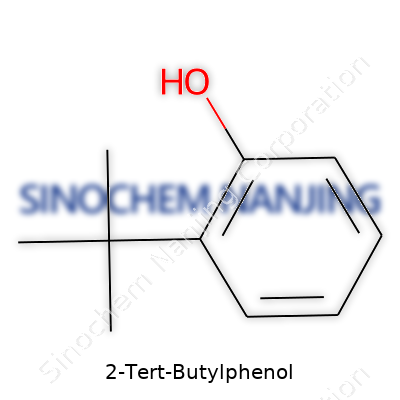
| Names | |
| Preferred IUPAC name | 2-(tert-Butyl)phenol |
| Other names |
2-(1,1-Dimethylethyl)phenol o-Tert-butylphenol 2-TBP 2-tert-Butylphenol 2-Tert-butyl-phenol |
| Pronunciation | /tuː tɜːrt ˈbɜːtɪl ˈfiːnɒl/ |
| Identifiers | |
| CAS Number | 88-18-6 |
| Beilstein Reference | 1718734 |
| ChEBI | CHEBI:34445 |
| ChEMBL | CHEMBL16230 |
| ChemSpider | 14124 |
| DrugBank | DB14089 |
| ECHA InfoCard | 056f8b95-30d5-4e30-8b57-8dfeaa14f50d |
| EC Number | 205-438-8 |
| Gmelin Reference | 90753 |
| KEGG | C06505 |
| MeSH | D016692 |
| PubChem CID | 6638 |
| RTECS number | OG8225000 |
| UNII | 9A3U720FOB |
| UN number | UN2323 |
| Properties | |
| Chemical formula | C10H14O |
| Molar mass | 150.22 g/mol |
| Appearance | White to yellowish crystals or powder |
| Odor | Phenolic |
| Density | 0.917 g/cm3 |
| Solubility in water | slightly soluble |
| log P | 2.8 |
| Vapor pressure | 0.04 mmHg (25°C) |
| Acidity (pKa) | 11.65 |
| Basicity (pKb) | 10.37 |
| Magnetic susceptibility (χ) | -67.2·10⁻⁶ cm³/mol |
| Refractive index (nD) | 1.513 |
| Viscosity | 1.8 mPa·s (20 °C) |
| Dipole moment | 1.85 D |
| Thermochemistry | |
| Std molar entropy (S⦵298) | 322.04 J·mol⁻¹·K⁻¹ |
| Std enthalpy of formation (ΔfH⦵298) | -322.6 kJ/mol |
| Std enthalpy of combustion (ΔcH⦵298) | -5279 kJ/mol |
| Pharmacology | |
| ATC code | D22BC01 |
| Hazards | |
| GHS labelling | GHS02, GHS07 |
| Pictograms | GHS07 |
| Signal word | Warning |
| Hazard statements | H315, H319, H400 |
| Precautionary statements | P210, P261, P280, P305+P351+P338, P310 |
| NFPA 704 (fire diamond) | 2-1-0 |
| Flash point | 113°C |
| Autoignition temperature | 515°C |
| Explosive limits | Explosive limits: 1.1–6.6% |
| Lethal dose or concentration | LD50 oral rat 4000 mg/kg |
| LD50 (median dose) | Rat oral LD50: 3,600 mg/kg |
| NIOSH | UR7790000 |
| PEL (Permissible) | PEL (Permissible Exposure Limit) for 2-Tert-Butylphenol: 5 ppm (skin) (OSHA) |
| REL (Recommended) | 10 mg/m³ |
| IDLH (Immediate danger) | IDLH: 200 ppm |
| Related compounds | |
| Related compounds |
4-tert-Butylphenol 2,6-Di-tert-butylphenol Phenol 2-sec-Butylphenol 2-tert-Amylphenol |



