2-Nonene: From Synthesis to Modern Industry Roles
Historical Development of 2-Nonene
Exploring the history of 2-Nonene brings back the spirit of early organic chemistry. Chemists tracked down its structure as a straightforward alkene in the growing landscape of petroleum refining during the twentieth century. Once the petroleum boom gained its momentum, folks realized that odd-numbered alkenes with double bonds didn't only exist as byproducts—they actually served as valuable platforms for building more complex molecules. In the world of synthetic chemistry, 2-Nonene arrived as both a curiosity and a practical solution. Researchers layered in knowledge about its reactivity, saw how it held up under various reaction conditions, and started piecing together the role these alkenes could play in industry. By the middle of the twentieth century, folks were no longer guessing. They knew that 2-Nonene could help produce detergents, lubricants, and other chemicals that shaped daily life. These discoveries grew out of persistent efforts, involving plenty of failed experiments and careful observation.
Overview and Real-World Uses of 2-Nonene
Most people have never heard of 2-Nonene, but its fingerprints turn up in products that touch our lives every day. This molecule stands out because it’s a nine-carbon chain with a double bond tucked into the second position. Why does that matter? The location of the double bond creates a crossroads for chemical modification, which means companies can tailor the molecule for different uses. Over the years, industries realized that 2-Nonene helped build alkylated aromatics, serving as crucial building blocks for the surfactant industry. In simple terms, you’d find its chemical descendants cleaning your dishes, washing your clothes, or lubricating machine parts. Technical development kept reducing waste, improving yields, and boosting purity—all critical for industries that care about efficiency, safety, and cost control. More recently, researchers took a closer look at the routes to 2-Nonene that avoid excess hydrocarbons, since regulatory pressure keeps growing for low-emission production lines.
Physical and Chemical Properties
To recognize 2-Nonene, look past its invisible role in consumer products. You’ll find it stands as a clear, oily liquid at room temperature, fairly stable under standard conditions, but quick to evaporate if left in the air. With a boiling point hovering around 146–149°C and a melting point well below freezing, it stores well in drums, tanks, and pipelines. Chemically, the alkene double bond marks it as more reactive than a simple paraffin. Turn up the heat or add the right catalyst, and that bond cracks open possibilities—a fact that continues to shape industrial chemistry. Under the right set of conditions, 2-Nonene turns into more complex structures, partnering with aromatic rings or other functional groups in ways that are impossible for saturated hydrocarbons. These properties explain why refiners and chemists keep a close eye on temperature, pressure, and exposure to air when storing or moving this feedstock.
Technical Specifications and Labeling: What Stands Out
Manufacturers focus on purity for 2-Nonene. The right grade means far more than hitting a certain percentage; it’s about cutting out residual solvents, byproducts, and moisture. The smallest tap of water or contaminant can throw off downstream processes—especially in pharmaceutical or specialty chemical applications. Labels stick closely to international guidelines. Most containers list out percent purity, identity checks such as refractive index, and sometimes batch traceability. Regulations force accuracy, but real-world users learned long ago that sloppy documentation brings expensive surprises. That’s why industry teams keep tightly written logs, run regular chromatography tests, and train staff to spot subtle inconsistencies at the loading dock or on the shop floor. Being casual about these details only brings lost time and safety hazards down the line.
Preparation Methods—A Focus on Industrial Realities
The backbone of 2-Nonene production ties into the cracking of petroleum fractions and the selective oligomerization of smaller alkenes. Catalysis dominates these processes. Once, folks mainly relied on acid-catalyzed oligomerization—using strong acids to stitch propylene or butenes into longer, odd-numbered chains. Over time, operators moved toward more tailored catalysts that increase yield, limit unwanted isomers, and shrink waste. Outside of large refineries, some chemical producers run batch syntheses for specialty needs, but that’s the exception, given the efficiency of continuous cracking and catalytic reforming. Operating conditions walk a fine line between maximizing conversion and minimizing the growth of side products that eat up profits and clog equipment. Real-world problems, such as catalyst fouling and variable feedstock quality, challenge technicians and engineers to keep the process both cost-effective and reliable. Researchers keep tinkering with catalysts to reduce byproduct formation and further purify product streams at the refinery.
Chemical Reactions and Modifications
Chemists see 2-Nonene as fertile ground for transformation. That double bond gives way to classic reactions: hydrogenation smooths the molecule out into nonane, which is less reactive and slips comfortably into fuel blends. Alkylation brings together 2-Nonene and aromatic rings, producing nonylphenols and other intermediates that set the foundation for surfactant synthesis. Oxidation opens a radically different pathway, leading to acids or alcohols valuable to industrial chemistry. Each change starts with the same foundation—the accessibility of the double bond. Chemists have shaped and reshaped this molecule to fit shifting demands, learning to push the double bond into different configurations (cis or trans) depending on downstream needs. These chemical tweaks make 2-Nonene a workhorse for innovation, even if the end product never resembles the original feedstock.
Alternate Names and Industry Jargon
In the world of chemistry, a simple molecule often travels under many names. 2-Nonene won’t only show up on lists by its IUPAC designation. Older textbooks called it beta-nonylene or 2-nonylene, and some factory logs shorten it further. These synonyms reflect both historical legacy and day-to-day habits of people working in production or research. Experienced chemists spot the number and double bond position and instantly know the reactivity in play. For buyers and planners, getting familiar with alternate names cuts through confusion and speeds up procurement, especially when supply chains bring in materials from different continents.
Safety and Operational Standards
Those who handle 2-Nonene every day know that safety isn’t an afterthought. The sharp, slightly sweet smell signals volatility, and that matters. Even a small spill brings the risk of fire, especially near hot surfaces or sparks. Skin contact leads to dryness and irritation, which drives workers to use gloves and eye protection. People used to think that serious exposure needed major incidents, but mounting data shows chronic inhalation can have real health impacts. Training programs spell out storage, transport, and spill response protocols. Local and international organizations publish guidelines, but frontline workers rely most on their own routines: use of vapor-tight containers, careful pressure checks, and regular ventilation audits. Companies also run drills and keep material data sheets close by, not just to tick boxes but because emergency teams need instant access to chemical-specific information in a crisis.
Application Areas: Across Industries
2-Nonene’s most famous application sits in the production of nonylphenols, which flow directly into the creation of surfactants used in detergents and cleaners worldwide. These detergents find their way from homes to factories, from textile mills to food processing lines. Lubricant formulators look to 2-Nonene when they need to introduce particular branching or modify molecular structure for stability at high temperatures. Polymer chemists find it useful as a comonomer or modifier, adjusting elasticity or toughness without resorting to bulkier additives. Beyond these headline uses, specialty manufacturers explore 2-Nonene for tailored chemical syntheses, such as producing certain flavors, fragrances, or even pharmaceutical precursors on a limited scale. As regulations change in the detergent industry, especially concerning alkylphenol ethoxylates, producers face tough decisions and adjust formulations to maintain performance but cut environmental impacts.
Research, Development, and Shifting Horizons
Teams in chemical R&D never stop searching for better synthesis routes or more sustainable applications for 2-Nonene. Catalysis research moves ahead, often using metal-organic frameworks and advanced zeolites to wring out higher yields and cut harmful byproducts. Environmental scientists continually assess emissions profiles and breakdown products, especially as wastewater standards keep tightening. The picture gets more complex every year. Researchers track routes to synthesize 2-Nonene directly from bio-based precursors, driven by the wider push for renewable resources. Though these projects often start in university laboratories, pilot plants across North America, Europe, and Asia keep scaling up biobased trials, eager to avoid the carbon penalties and political risks associated with fossil-based feedstocks. Meanwhile, computer modeling and spectroscopy open new windows into how 2-Nonene reacts under different process conditions, providing a knowledge base that guides day-to-day decision-making on the plant floor.
Toxicology and Long-Term Safety
Early toxicology studies on 2-Nonene gave the molecule a clean bill of health so long as exposure remained modest and proper handling reduced skin and respiratory contact. Over time, as governments raised standards on workplace safety and environmental discharge, the discussion changed. Chronic exposure, even at low levels, can affect health—especially among workers who spend years near open tanks or in production lines with poor ventilation. Regulators and company safety managers listen closely to new toxicology findings, balancing operational ease with worker safety and downstream environmental risks. Professional experience in chemical plants taught me that it takes more than warnings on paper to change habits; real change comes from close supervision, regular training, and a culture where team members watch out for each other as much as for themselves.
Looking Ahead: Future Prospects for 2-Nonene
As global markets pivot toward more sustainable and tightly regulated chemical supply chains, the outlook for 2-Nonene grows more nuanced. The molecule’s core structure remains valuable, but expectations keep rising. Downstream users demand purer material with ever-lower residuals, while regulators push hard for life cycle transparency. European chemicals policy, for example, now places tight restrictions on nonylphenol derivatives due to toxicity and persistence in aquatic environments. This makes producers scramble for greener routes and constantly look for safer, faster, and less polluting production processes. Look ahead, and it’s clear that the next gains for 2-Nonene will depend less on squeezing out another fraction of a percent in yield, and more on reshaping the feedstock’s story—reducing fossil impacts, improving worker protection, and closing loops on waste streams. Meanwhile, innovation pushes forward, tested in both academic labs and industrial plants. The next chapter gets written every shift, by hands in gloves, eyes over gauges, and minds looking for smarter ways to get the job done.
What is 2-Nonene used for?
Understanding Where 2-Nonene Fits
2-Nonene might not sound familiar, but its fingerprints show up in a lot of everyday products. The chemical belongs to a family of alkenes, a group that tends to show up as building blocks for bigger molecules. Most of us don’t give a thought to what keeps our fuels flowing safely down pipelines or what unlocks the cleaning magic in detergents. Yet, 2-Nonene helps make these possible.
The Story Behind the Molecule
2-Nonene comes from the process of cracking larger hydrocarbons found in petroleum. Industries see it as a way to start many synthetic chains. The double bond in its structure lets chemists add different pieces to create new chemicals. In my college chem lab, we talked a lot about chain reactions and how simple molecules branch out into entire industries. Seeing the process face-to-face makes you realize nearly everything on store shelves has a backstory, and 2-Nonene often plays a silent role in those stories.
Applications in Fuel and Oil
One big use for 2-Nonene tackles a problem anyone who’s worked around engines understands—oil doesn’t stay clean on its own. Oils collect sludge, dirt, and oxidize under heat. Chemical manufacturers take 2-Nonene, run it through more reactions, and end up with alkylated naphthalene, which becomes a key ingredient in engine oils. This result boosts oil stability and performance. The end goal: longer-lasting engines and fewer breakdowns, saving both money and time. It’s not about flashy marketing—it’s about invisible improvements noticed only when things don’t go wrong.
Making Everyday Cleaners Work
Head over to the laundry aisle, and 2-Nonene finishes its job in another disguise. Producers combine it with benzene or other compounds to make nonylphenol, a surfactant that shows up in countless detergents and cleaning solutions. The surfactant side of chemistry always fascinated me. Most grime just laughs at plain water, but surfactants break up oil and dirt so water can do its job. 2-Nonene sits at the start of that chain, sometimes far upstream from the shiny plastic bottle at the store.
2-Nonene’s Place in the Big Picture
Behind every industrial advance, there’s a set of chemicals moving the pieces into place. 2-Nonene does not draw headlines, but cracking and rearranging molecules still underpins much of modern convenience. More regulations have arrived about pollutants, so chemists have been challenged to create cleaner end products. Finding alternatives or greener additives often means reducing side reactions during production—something that people working in chemical plants talk about every day.
Looking Toward Safer and Sustainable Use
As communities keep pushing for safer products, some cleaning compounds made from 2-Nonene have raised environmental questions. Watching my own town wrestle with water quality has made sustainability feel personal, not abstract. Smaller companies have started looking at new catalysts and recycling processes, hoping to lower environmental risk. Creating a dialogue between industry, scientists, and regulators tends to spark new ideas rather than one-size-fits-all answers. Better research and tracking can help keep both people and the environment safe while industries keep their gears moving.
What are the physical and chemical properties of 2-Nonene?
Understanding 2-Nonene in the Lab and Industry
2-Nonene steps out as a colorless liquid hydrocarbon with the molecular formula C9H18. Structurally, it belongs to the nonene family—a group of alkenes carrying a double bond along a nine-carbon chain. The “2” flags the double bond positioned at the second carbon, setting it apart from its other isomers in how it reacts and where it finds use. In my own experience working near industrial labs, chemists often favor 2-Nonene for its reliable behavior during organic syntheses, as it couples predictability with reactivity.
Physical Properties in Practice
2-Nonene boils between 146 to 151°C, according to hands-on distillation logs I’ve watched recorded in research settings. That keeps it liquid at room temperature—even in a summer workshop—making it easily transported and handled. Its density floats a bit below that of water, coming in around 0.74 to 0.75 g/cm³. Pour a small batch into a beaker with water, and you’ll see it form a distinct layer on top, revealing its lighter nature. When exposed, it evaporates at a moderate rate—faster than water but not as quickly as solvents like acetone, a property that keeps it manageable during bench work, unless heated or left for extended periods.
Smell this liquid, and you’ll notice a mild, hydrocarbon-like scent—nothing aggressive, but enough to remind you of its petroleum origins. It doesn’t mix well with water, preferring solvents like ether or most hydrocarbons for solution. That trait shapes how it’s cleaned up in spills or separated during industrial processes. Factories and labs use this property to recover or purify it with less effort, often through basic separation funnels or distillation.
Chemical Properties: Reactivity and Risks
The double bond in 2-Nonene offers plenty of chemical opportunity. It welcomes addition reactions, drawing in bromine, hydrogen, or halogens under the right prompts. Organic chemists often reach for 2-Nonene to model alkene reactions or create specialty lubricants and surfactant intermediates. In the workplace, that reactivity requires attention. Combine it from storage with strong oxidizers—think concentrated nitric acid or potassium permanganate—and you’re courting danger: violent reactions can follow, sometimes with fire. Anybody who’s read the incident logs knows why short training and proper PPE are part of the deal.
Its double bond can form polymers, although it doesn’t make the strongest plastics or rubbers on its own compared to ethylene or butadiene. In most factories, folks push 2-Nonene through hydroformylation to produce longer-chain alcohols—the building blocks for detergents. The practical problem? Controlling the reaction to keep unwanted byproducts to a minimum, which eats up time and resources.
Safety and Environmental Touchpoints
Handling 2-Nonene comes with real-world hazards. Inhalation can irritate airways. Some workers have reported dizziness or headaches without proper ventilation. Direct skin spills can leave irritation, and over time, poorly managed exposure raises long-term health questions. I’ve watched experienced shop floor leads stress the importance of well-fitted gloves, safety goggles, and spill kits, especially in old plants with mixed-chemical lines. As for environmental risk, 2-Nonene’s low solubility matters if it enters waterways. It will quickly reach the surface, posing threats to aquatic life due to hydrocarbon toxicity. Regulations push for rapid containment and strict controls on disposal, but small leaks or handling mistakes still slip through at times.
Practical Takeaways and Safer Use
To tackle issues around 2-Nonene, refiners and lab managers should double down on training, ventilation upgrades, and detection systems for leaks. Closed-loop handling and sealed containers prevent open-air contact. On-site labs have started switching to digital inventory tools, so chemical volumes and conditions stay updated—less guesswork, fewer surprises. Keeping standard operating procedures sharp pays off not just in safety, but in cutting down wasted material and costly shutdowns. Even a well-known hydrocarbon like 2-Nonene brings its own set of challenges, demanding respect for both its promise and its risks.
Is 2-Nonene hazardous or toxic?
What’s in a Chemical Name?
2-Nonene sounds like something far removed from everyday concerns. You won’t find it in your kitchen, but it matters for anyone close to chemical industries, transport, or manufacturing. Chemists know 2-Nonene as a hydrocarbon, an unsaturated one, often tapped as a building block in making detergents and lubricants. The question, though, centers on its real-world risk. What happens if you spill, breathe, or touch it?
Looking at the Science
The label "toxic," when used in regulations, isn’t just an insult. It calls for actual consequences—special handling, rules, and disclosures. Studies so far don’t put 2-Nonene in the same camp as lead or mercury, but it’s far from harmless. Short-term contact brings the sort of irritation that can ruin your day: red skin, watery eyes, a sore throat if the vapors drift your way. Nobody wants that, but it doesn’t land 2-Nonene in the highest hazard category.
Animal tests give some idea of risk, though applying those results to people has limits. Data shows high doses can mess with nervous systems and breathing in lab rats. That’s enough reason to handle the stuff carefully and avoid careless exposure. No solid proof links 2-Nonene to cancer or genetic grief, but lack of data doesn’t always mean something is safe. Plenty of chemicals sat under the radar for years before the truth came out.
Real-World Exposure and Safety
Workplace safety professionals—people who’ve spent time around vats, barrels, and tangled pipes—know that 2-Nonene calls for gloves, goggles, and good ventilation. Fumes may not be deadly in small whiffs, but headaches, dizziness, and coughing can stack up when exposure stretches out. Spills aren’t just messy; they put cleanup crews and even first responders at risk of chemical burns or worse.
I’ve spent time in industrial settings where labels and warning symbols do more than just fill out forms—they shape real habits. Regular folks may never run across pure 2-Nonene. Workers moving or processing it, though, have a right to worry. Federal agencies like OSHA, NIOSH, and the EPA don’t yet have strict limits in place, which leaves a lot of burden on employers to set their own rules and err on the side of caution.
Why It Matters Beyond the Factory
Spill stories don’t get prime-time coverage unless neighborhoods get evacuated or rivers turn strange colors. Still, every leak adds up in ways people can’t always see—long-term impacts on air and water smack local wildlife and, in the worst cases, work their way back to people. Unchecked, even chemicals with a bland safety profile can build up in unexpected places.
Alternatives exist, but switching takes time and investment. Green chemistry pushes for safer substitutes, but industry inertia stalls change. Training, clear labels, and honest hazard communication stand out as simple steps anyone can take—especially for those responsible for health on and off the plant floor. Nobody can dodge all risk, but honest help and smart policy go a long way to keep things safer for everyone.
How should 2-Nonene be stored and handled?
Understanding the Real World Risks
2-Nonene catches the eye as a useful chemical, especially for folks in the industrial, polymer, and chemical manufacturing fields. Most of us working in labs or warehouses know it by that characteristic petroleum-like smell, its clear appearance, and the reminder in our training that skin and eyes don’t appreciate much contact with it. If you’ve had to mop up a spill or received a warning after a classroom demo, the message sticks: handle with respect.
Not Just Another Storage Issue
Straight talk: you can’t shove 2-Nonene onto a shelf with generic solvents. This stuff is a liquid hydrocarbon, pretty flammable, prone to making big fumes—nobody wants a spark or a forgotten open container. Fires have started in less-than-careful storerooms. The flash point hovers around 40°C (104°F), which is lower than you’d hope for in a hot warehouse in July. So temperature control and good airflow matter more than with other chemicals.
What Storage Should Look Like
In my earliest work at a specialty chemicals plant, we had a separate chemical room with metal safety cans lined up, every lid tight, away from sunlight or heat sources. 2-Nonene keeps well in drums or proper containers, provided they’re labeled and closed at all times. Forgetting a small crack in a lid meant trouble; leaks meant headaches and inspections. Nobody enjoyed those emergency drills, which is why staying strict about containers became habit fast.
The best set-up is simple: keep it away from ignition sources, even minor ones like a static spark. Grounding and bonding metal drums isn’t wasted effort; I’ve seen oily rags go up from less. Store it with other flammables and never next to oxidizers or acids, since unwanted reactions ruin more than just a workday.
Handling: More than Just Gloves and Goggles
People sometimes treat PPE as a box to check, but with organics like 2-Nonene, it’s about prevention. Gloves (nitrile or neoprene usually hold up), splash goggles, and lab coats protect against those accidental splashes that always seem to happen right before lunch. I remember swapping a favorite shirt one afternoon after a stray drop—one mistake is all it takes. Good ventilation, like a working fume hood or exhaust fan, keeps fumes from building up. Nobody wants to find out how quickly headaches and dizziness set in after breathing vapor, and it’s always someone who thinks “it’s just one quick transfer.”
Never work alone. Having a second set of eyes—and hands—keeps everyone honest about using spill kits and fire extinguishers. Peppering the space with Material Safety Data Sheets means anybody can check hazard details in a pinch.
Finding Better Solutions
I’ve seen some shops limit 2-Nonene on site with just-in-time deliveries, cutting down how much sits vulnerable in storage. Others tag their containers with RFID, allowing crew to spot missing stock or leaks before things escalate. These practices save lives, protect property, and keep operations running.
Getting chemical storage and handling right isn’t a box-ticking exercise. It’s about collective responsibility, a series of habits learned from real mistakes and close calls. 2-Nonene fits squarely in the group of chemicals that keep you sharp. With good habits, smart storage, and serious respect, accidents and injuries shrink from real threats to rare stories told over coffee.
What is the molecular formula and structure of 2-Nonene?
Diving Into 2-Nonene
Ask any chemist about 2-Nonene, and you’ll get a quick answer: it’s a nine-carbon alkene featuring a double bond between the second and third carbon atoms. Its molecular formula is C9H18. Drawing out the structure, you’ll see the backbone of nine carbons, with a double bond right after the first methyl group. The most common layout looks like this: CH3–CH=CH–(CH2)6–CH3. This simple combination hides a unique role in day-to-day manufacturing and research.
A Practical Player in Industry
In my time working alongside chemical engineers, I came to appreciate simple molecules like 2-Nonene. It’s an unsung hero in the world of chemistry, transforming heavy industry and everyday products. Major companies rely on it to produce certain plasticizers, surfactants, and even specialty fuels. These aren’t just technical buzzwords. Surfactants keep our detergents effective, plasticizers make flexible plastics possible, and specialty fuels give rise to cleaner-burning options for industry. It’s easy to overlook how many products in our kitchens, garages, and offices depend on compounds that look as simple as 2-Nonene at first glance.
Structure Creates Opportunity
The straight-chain, non-branched structure lets manufacturers use 2-Nonene as a base for more complex molecules. The double bond in the second position isn’t an accident. Chemistry is all about position—move that double bond just one notch, and you get a completely different set of reactions and applications. I’ve watched colleagues convert 2-Nonene into additives for motor oil, or turn it into intermediates for making specialty polymers.
Molecular Details and Clean Processing
Science depends on getting details right. Each carbon and hydrogen atom in 2-Nonene has a purpose. The double bond isn’t just for show. It’s a reactive site that serves as a convenient handle for all sorts of cross-linking reactions and transformations. In many labs, 2-Nonene becomes a starting point for further synthesis, creating building blocks that go into flavors, fragrances, and even certain pesticides. The clean structure means fewer by-products, cutting waste and lowering costs for producers. That’s worth celebrating. Chemicals that reduce processing waste make the supply chain stronger and friendlier to the planet.
Making Chemistry Safer and Smarter
When I think about the future, I see chemists putting more emphasis on safety and sustainability. 2-Nonene is a step in the right direction. Straightforward molecules with well-understood behaviors stand less chance of causing accidental reactions or toxic byproducts. This is exactly what the Responsible Care program in the chemical industry highlights. Fewer unknowns mean more consistency in production and safer workplaces for the people who handle these chemicals every day.
Finding Solutions From What’s Simple
Clean chemistry offers hope for tomorrow’s products. By building with simple, single-double-bond hydrocarbons like 2-Nonene, my colleagues and I have found ways to cut down on waste. These choices echo far beyond labs and plants. Safer intermediates mean cleaner water, healthier communities, and a more resilient world economy. Molecules may seem small, but careful design makes a world of difference. The story of 2-Nonene reminds us: simplicity and transparency in molecular design pave the way for safer, smarter industry.
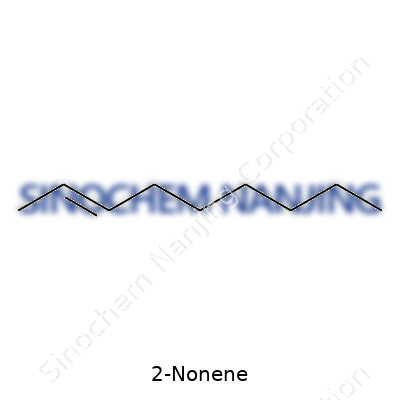
| Names | |
| Preferred IUPAC name | non-2-ene |
| Other names |
β-Octylethylene Non-2-ene |
| Pronunciation | /tuːˈnɒniːn/ |
| Identifiers | |
| CAS Number | Coordonné Cassini |
| Beilstein Reference | 2038736 |
| ChEBI | CHEBI:45011 |
| ChEMBL | CHEMBL3318754 |
| ChemSpider | 10983 |
| DrugBank | DB13849 |
| ECHA InfoCard | 13e076b4-1e0a-4434-abb2-616776cb187d |
| EC Number | 207-441-0 |
| Gmelin Reference | 7,178 |
| KEGG | C16536 |
| MeSH | D009667 |
| PubChem CID | 5283437 |
| RTECS number | RQ8750000 |
| UNII | 25L6H25W2D |
| UN number | UN2462 |
| Properties | |
| Chemical formula | C9H18 |
| Molar mass | 126.24 g/mol |
| Appearance | Colorless liquid |
| Odor | pleasant, sweet |
| Density | 0.748 g/mL at 25 °C(lit.) |
| Solubility in water | Insoluble |
| log P | 3.9 |
| Vapor pressure | 0.49 mmHg (at 25 °C) |
| Acidity (pKa) | 15.7 |
| Basicity (pKb) | pKb: 15.7 |
| Magnetic susceptibility (χ) | -70.0e-6 cm³/mol |
| Refractive index (nD) | 1.416 |
| Viscosity | 1.209 mPa·s (20 °C) |
| Dipole moment | 0.13 D |
| Thermochemistry | |
| Std molar entropy (S⦵298) | 216.3 J·mol⁻¹·K⁻¹ |
| Std enthalpy of formation (ΔfH⦵298) | “-44.6 kJ/mol” |
| Std enthalpy of combustion (ΔcH⦵298) | -5534.6 kJ/mol |
| Hazards | |
| GHS labelling | GHS02, GHS07 |
| Pictograms | GHS02, GHS07 |
| Signal word | Warning |
| Precautionary statements | P210, P233, P240, P241, P242, P243, P261, P264, P271, P280, P303+P361+P353, P304+P340, P305+P351+P338, P312, P337+P313, P370+P378, P403+P235, P405, P501 |
| Flash point | 65 °C (closed cup) |
| Autoignition temperature | 180 °C |
| Explosive limits | Explosive limits: 0.9–6.0% |
| Lethal dose or concentration | LD50 oral rat 3730 mg/kg |
| LD50 (median dose) | LD50 (oral, rat): 2300 mg/kg |
| NIOSH | AL9650000 |
| REL (Recommended) | 10 ppm |
| IDLH (Immediate danger) | IDLH: 250 ppm |



