2-Methylhexane: An Editorial Commentary on its Scientific Relevance and Practical Outlook
Historical Development
Chemistry in the 20th century saw a rapid expansion of knowledge around hydrocarbons, both straight-chained and branched. The study of compounds like 2-methylhexane stretches back to early petroleum research, where scientists tried to break down complex crude mixtures. In the decades following World War II, organic chemists recognized branched alkanes as distinct from their straight-chain relatives not just in boiling points, but also in subtle reactivity. This set up a pattern: every advancement in separating and characterizing hydrocarbons fed into both industry practice and pure science. Today, the naming and cataloging of 2-methylhexane seems unremarkable, but its journey from an obscure fraction in an oil barrel to a staple in chemical texts reflects the larger evolution of hydrocarbon research.
Product Overview
2-Methylhexane appears as a branched alkane with the formula C7H16. In the world of industrial solvents and organic analysis, it finds its home among the lesser-known isomers of heptane. Chemists reach for it in the lab to test reaction pathways or when simulating gasoline performance. In fuel science, every variant of heptane tells a different story about octane ratings and combustion qualities. Years of use in industry and research have distilled a simple truth: small changes in molecular shape, like adding a methyl group to hexane, offer outsized effects on physical behavior and reactivity.
Physical and Chemical Properties
Compared to its straight-chained counterpart, 2-methylhexane boasts a slightly lower boiling point and enjoys somewhat greater resistance to knocking when blended with gasoline. Its flammability stands out, as with all low-molecular-weight alkanes, making safe handling a priority. The colorless, odorous liquid barely mixes with water but dissolves easily in most organic solvents. Its vapor spreads quickly in confined areas, underlining the need for good ventilation anywhere it’s used. In countless undergraduate labs, students quickly learn how branching alters not just melting and boiling points, but also density and viscosity—a lesson any organic chemist recalls from years past.
Technical Specifications & Labeling
Every chemical bottle tells a story by how it’s labeled and quantified. 2-Methylhexane finds its CAS number—592-27-8—on every shipment, with a purity percentage that often exceeds 98%. The labeling warns of flammability and the imperative to store away from heat sources. Modern practice demands clear hazard pictograms and mention of safe storage temperatures, since the risks of careless handling have become all too familiar over generations of chemical work. Tracking technical specs matters for compliance with occupational health rules, but more importantly, it prevents accidents in busy workplaces where dozens of similar liquids may be in use nearby.
Preparation Method
Production of 2-methylhexane generally relies on the catalytic isomerization of n-heptane or similar straight-chain alkanes. Refinery processes put metal catalysts to work at high temperatures, rearranging molecular structures without breaking apart the carbon backbone. Early chemists spent months distilling and redistilling hydrocarbon mixtures to isolate each isomer. Now, sophisticated fractionation separates out highly pure 2-methylhexane, often for sale as a standard or reference compound. At the bench scale, students sometimes make an alkyl halide from 2-methylhexanol, then reduce it to give the hydrocarbon—a demonstration of classic organic transformations, repeated in labs around the globe.
Chemical Reactions & Modifications
2-Methylhexane behaves much like other alkanes in that it resists reaction unless pushed with heat, light, or strong reagents. Halogenation offers a textbook example: exposing it to chlorine or bromine under UV light yields a mix of substituted products. Cracking—breaking apart the molecule under high temperature or in the presence of a catalyst—generates lighter alkanes and alkenes, important in both research and industry. For those seeking to build more complex molecules, the chemistry can get tricky, since activating inert hydrocarbons means walking a fine line between getting nothing and breaking the molecule into fragments. Most practitioners know the real challenge involves controlling selectivity, given the subtle influences of branching on reaction pathways.
Synonyms & Product Names
Chemists, if nothing else, carry a fondness for naming things in a dozen different ways. 2-Methylhexane sometimes appears as isoheptane, though that term can apply to several branched isomers. The systematic nomenclature, recognized by IUPAC, wins out in technical writing, but some suppliers still use trade names that harken back to old refinery jargon. In research contexts, exact naming avoids confusion, especially since small errors can mean the difference between a safe procedure and a mishap.
Safety & Operational Standards
The story of 2-methylhexane’s safety reads like that of many low-boiling alkanes: vapors present a serious fire hazard, and inhalation can cause dizziness or nausea in poorly ventilated rooms. I’ve worked in university labs where a careless spill turned an ordinary day into a fire drill. Regulators demand rigorous labeling and tightly sealed containers, as delayed cap closures or faulty seals cause more trouble than anyone likes to admit. OSHA, NIOSH, and their international counterparts set exposure limits and call for explosion-proof equipment. Spill kits and fume hoods aren’t just bureaucracy—they reflect decades of hard lessons paid for in property damage and close calls.
Application Area
In my own work, 2-methylhexane mostly appeared in quality control and reference testing, where purity and precise boiling range were critical. At petroleum refineries and research labs alike, analysts use it to calibrate instruments and verify product specifications. It shows up in fuel research, testing antiknock properties in combustion engines. Not all uses are so grandiose: sometimes it simply acts as a harmless, non-polar solvent when a reaction calls for something inert. Beyond the lab, its utility shrinks, since larger quantities mostly turn up as a constituent part of gasoline, not as a stand-alone product.
Research & Development
Scientific inquiry into branched alkanes tends to focus on improving yields in refinery processes, optimizing separation techniques, or investigating new catalytic pathways. Students getting their introduction to spectroscopic analysis often rely on this hydrocarbon when calibrating NMR or GC-MS instruments. In recent years, curiosity about combustion efficiency and cleaner-burning fuels has returned 2-methylhexane to the spotlight, as small changes in structure influence carbon emissions and exhaust composition. Academic and private researchers routinely publish work on cleaner isomerization technologies, spurred on by both regulatory pressures and market demand for greener fuels.
Toxicity Research
Every alkane’s safety profile receives scrutiny, and 2-methylhexane is no exception. Toxicological studies point out that, like other light hydrocarbons, it poses inhalation risks, with possible effects on the central nervous system and long-term occupational exposure concerns. Chronic studies in lab animals inform workplace safety standards, and my own reading of the literature suggests acute toxicity remains low compared to aromatic solvents, although cumulative effects can’t be ignored. The push for better industrial hygiene practices, from better gloves to more effective fume extraction, grows out of these findings. Researchers keep mapping metabolic pathways to see how the body breaks down branched alkanes, hunting for unexpected hazards.
Future Prospects
2-Methylhexane, simple as it seems, stands at an interesting intersection: not likely to revolutionize any sector, but too useful to ignore. Demand from refining and analytical labs continues, especially as fuel standards tighten and clean-burning requirements reshape the broader market. Research into more selective isomerization, lower-impact separation methods, and ways to track trace amounts in environmental science keeps the hydrocarbon in circulation. In an age where circular economy and sustainability drive innovation, even minor hydrocarbons undergo re-examination for their potential in cleaner processes and alternative fuel blends. Students and professionals alike keep 2-methylhexane in rotation, knowing that every molecule tells its own story—one that stretches from the first days of organic chemistry to tomorrow’s challenges in energy and safety.
What is 2-Methylhexane used for?
Chemistry Without the Fuss
2-Methylhexane often shows up as a clear, colorless liquid with a gasoline-like smell. Chemists recognize it as one of the isomers that make up commercial-grade heptane. Its structure puts a methyl group on the second carbon, which gives it a set of distinguishing characteristics and several real-world uses. Most people outside chemistry circles don’t recognize its name, but they often encounter products or fuels involving this compound.
The Role in Fuels and Industry
Growing up near a refinery town, I saw firsthand how companies worked to meet fuel standards. Gasoline isn’t a single liquid; it’s a blend. 2-Methylhexane becomes important in this context. Its molecules don’t knock around the way some others do, so it helps raise the octane number. Higher octane keeps engines running smoother and cleaner, reducing engine knocking. Refineries blend different hydrocarbons, including 2-Methylhexane, to dial in just the right performance for modern engines. Standard unleaded or premium fuels benefit from these refinements. According to the U.S. Environmental Protection Agency, careful octane management also reduces emissions, so there’s a public health connection as well.
Lab Applications
In university chemistry classes, we spent hours using different hexane isomers to separate and identify other chemicals. 2-Methylhexane pops up as a reference hydrocarbon in many analytical settings. Gas chromatography labs use it for calibrating their instruments, making sure their tests stay accurate. Its known boiling point and composition provide a helpful anchor for comparing more exotic or unknown substances. This reliability becomes crucial for researchers in fields like pharmaceuticals and petrochemicals. Reliable laboratory measurements support everything from medicine safety checks to quality control on manufactured goods.
Production and Storage Realities
Most 2-Methylhexane comes as a byproduct when companies crack larger hydrocarbon molecules to make fuels from crude oil. Advances in refinery tech let them pull off the right balance; my neighbor’s dad, a refinery engineer, often worked long nights during shutdowns to ensure everything worked just right. The product then travels in steel drums or tankers, kept away from sparks and open flames because it evaporates quickly and ignites easily. OSHA and similar watchdogs set clear guidelines for storage and handling, since breathing its fumes in poorly ventilated areas can harm workers. Common sense matters here: keep it capped, don’t smoke around it, and never pour it down drains or onto soil.
Concerns and Safer Alternatives
The main drawbacks tie back to health and the environment. 2-Methylhexane, like plenty of other alkane solvents, can cause headaches or dizziness if inhaled. Extended or repeated exposure raises bigger risks to lungs and nervous system function. The Environmental Protection Agency and NIOSH publish worker safety facts, offering ways to control exposure using fume hoods and personal protection gear.
Green chemistry is pushing for less reliance on volatile organics. Research labs and fuel scientists are developing additives and materials that achieve the same results with less health risk and shorter persistence in the air. This shift isn’t overnight. Industry takes time to validate every alternative, and legacy infrastructure keeps hydrocarbons like 2-Methylhexane in circulation. With tighter policies and better tools, a drop in workplace accidents and environmental releases looks possible. Regular training, improved monitors, and clearer labeling help bridge the gap until safer choices become standard.
What are the physical properties of 2-Methylhexane?
2-Methylhexane in Everyday Life
2-Methylhexane comes up a lot in industries dealing with fuels and solvents. Having spent years working in labs analyzing hydrocarbons, I’ve seen how its physical properties put it in a particular corner of the chemical world. Lots of people never hear about it, yet every bottle tells a story about volatility, safety, and value.
What Sets It Apart
This compound falls under the category of branched alkanes. It doesn’t take much to recognize it by its clear, colorless appearance and its signature gasoline-like aroma. Most people working with fuels or organic chemistry recognize that smell right away. Its boiling point lands around 90–92 °C, which places it a notch higher than lighter hydrocarbons like hexane, but below bigger molecules. It evaporates fast at room temperature, which makes it especially tricky to handle outside the lab or industrial settings.
Density always gets brought up in quality checks, especially when purity is critical. At 20 °C, it has a density of about 0.68 g/cm³. Put two bottles side by side, one filled with 2-methylhexane and another with water, the difference is obvious — the hydrocarbon feels almost featherlight. This property matters in fuel blending, since energy content by volume shifts with every molecule in the mix.
Working with Flammability and Safety
Ask anyone in a refinery about fire safety, and they’ll mention flashpoint. 2-Methylhexane’s flashpoint sits at about -8 °C, which means it releases vapors that ignite at pretty low temperatures. Even a small spark can set it off. Ignition temperature hovers near 260 °C. In a world where accidents can spiral fast, these numbers shape storage, transport, and spill management. Safety training routinely brings up these flashpoints — it’s become second nature for workers to double-check for ignition sources in storage rooms.
Solubility throws another curveball. 2-Methylhexane doesn’t mix well with water. Try to rinse a spill with water and it sits right on the surface. This clear boundary makes cleanups tough, since standard water-based solutions don’t do much. Organic solvents handle it better, and this property becomes a sticking point during environmental clean-ups or accidental discharges in the field.
Handling, Storage, and Environmental Choices
I’ve watched teams debate the best way to store volatile liquids like this. Storing in cool, ventilated spaces makes sense, because higher temperatures push vapor pressure up and set the stage for leaks and evaporation. Proper sealing — not heavy equipment, just tight seals and clear labelling — saves headaches later on, especially in shared storage spaces.
Any time there’s a spill, the environmental risk isn’t just about how much gets released. It’s the sheer speed at which this stuff moves into air and soils. 2-Methylhexane doesn’t hang around to break down easily. Its low solubility means once it seeps into gravel or soil, getting it out requires more than just water and patience. Companies with a footprint in sensitive ecosystems have a duty to set up proper containment — absorbent pads, vapor detectors, and a close eye on waste treatment.
Building a Safer Approach
Better labeling, routine training, and a habit of checking those physical properties before storage decisions make a world of difference. Fewer accidents, less waste, and greater awareness — these steps go a lot further than expensive interventions down the line. People forget that a compound's physical traits chart the safest, smartest path for handling and disposal, not just in a textbook but on the job site each day.
Is 2-Methylhexane hazardous to health?
The Basics of 2-Methylhexane
2-Methylhexane turns up in places where folks work with fuels, oils, and solvents. It’s a type of hydrocarbon, falling under the category of alkanes. Most people who come across it regularly do so in refineries, labs, or certain manufacturing jobs. It often ends up as a minor component in gasoline blends.
What Science Tells Us About Health Risks
Breathing in fumes from products like 2-Methylhexane brings short-term effects—dizziness, headaches, sometimes nausea. I’ve worked in spaces where proper ventilation made all the difference. No one wants a pounding head or that heavy, woozy feeling just from showing up to work. Exposure at higher levels, especially in closed-off rooms, raises those immediate risks. That stuffy, gasoline-like smell serves as a clear warning to step away or mask up.
Skin contact with 2-Methylhexane often means dryness or irritation. If you spill it on your hands, it seems to suck out every bit of moisture. In my experience, anyone working with solvents washes up with soap and water quickly, then grabs the nearest moisturizer, sometimes just to feel normal again. Prolonged exposure raises the chances for worse problems—think red, chapped skin or even rashes.
Chronic exposure, even at lower doses over weeks or months, might lead to longer-lasting health troubles. Research into alkanes shows that they can impact the nervous system with long-term contact. Think brain fog or problems with memory. The International Agency for Research on Cancer hasn’t classified 2-Methylhexane as a known cancer risk, but the lack of long-term health studies sets off alarm bells for many safety experts.
Everyday Protection and Real-World Precautions
Folks in labs and factories don’t just gamble with fumes and hope for the best. Industry standards call for gloves, splash goggles, and real airflow—fans, open doors, and the like. These basics pop up in standard operating procedures for a reason. Years ago, I watched a co-worker get careless about gloves and end up dealing with raw, itchy skin for weeks. That memory sticks with anyone dealing with chemicals more than once.
Even for people at home, using products with 2-Methylhexane calls for care. If that gasoline or degreaser smell hits your nose, it means those chemicals are floating in the air. Open windows, or step outside whenever possible. Don’t forget that 2-Methylhexane lights up easily, so keep it far from flames or sparks. Fires caused by improper storage or disposal cause bigger headaches than a few extra safety steps.
Looking at Safer Alternatives
The chemical industry never stands still. Newer solvents and degreasers often claim lower health hazards than old-school hydrocarbon blends. Switching to safer options protects workers, the environment, and future customers. Companies making that change show real leadership, especially where health worries top the list.
Regular training helps too. Even seasoned employees forget a step now and then, so fresh reminders go a long way. Keeping safety data sheets updated and easy to grab means questions get answered fast, not months later when trouble crops up.
The Bottom Line
Every chemical brings its own risks. 2-Methylhexane deserves the same caution as other common solvents. A few simple habits—good ventilation, regular training, and proper protective gear—help sidestep most risks. Real safety culture grows from people looking out for each other, not just ticking boxes.
How should 2-Methylhexane be stored?
Why Proper Storage Really Matters
Storing chemicals like 2-Methylhexane isn’t just about following regulations. Any mishandling means risking people’s safety, property, and the planet itself. This liquid offers up a high flammability. Ask any facility manager who’s heard the whoosh of ignited vapors—no one forgets a close call. Years spent around chemical warehouses make you respect how quickly an overlooked drum can become an emergency.
Most incidents trace back to someone skipping a step: lids left cracked open, a poorly labeled barrel, a forgotten ground wire. These habits—manageable with training—matter more than fancy storage systems alone.
2-Methylhexane’s Prickly Nature
Let’s put cards on the table: this chemical brings a low flash point and happily evaporates even at room temp. Vapors hover close to the ground, sneak into tiny spaces, and build up without much warning. Fire risk jumps as soon as sparks, static, or a single pilot light shows up. In my experience, people always underestimate how fast vapors collect in a storeroom that isn’t ventilated enough.
Location Makes All the Difference
No one wants a fire in the main work area. Keep drums or bottles of 2-Methylhexane outside main buildings if there’s an option. Detached sheds built from non-combustible materials help offer a better first line of defense. Distance makes a difference if disaster strikes.
Inside, solid barriers separate this solvent from oxidizers or acids. Placing incompatible chemicals on opposite sides of a chemical room—never in the same locker—avoids chain reactions that spiral out of control.
Containers and Labeling
Plastic jugs often give a false sense of security; not all plastics stand up to pure solvents for long. Metal cans with pressure-resistant caps, kept tightly sealed, prevent leaks and accidental mixing. My own time in a busy plant showed how faded labels cause confusion. Fresh, clear hazard signs in easy-to-read fonts cut mistakes in half. Every staff training pushes the idea—visible, unmistakable labels can save lives.
Ventilation and Temperature
Airflow makes or breaks chemical storage safety. Chemical vapors don’t just stink up a room; they can knock someone out or spark an explosion. Mechanical ventilation systems fitted with spark-proof fans pull fumes out and send them somewhere they won’t cause danger. I’ve seen shop-built fans light up flammable gases and cause the very problem they were meant to solve, which proves the need for certified, explosion-proof fittings.
Spiking temperatures mean more vapors and higher accident chances. Keeping rooms cool, well below the flash point, pushes risk down. Shade, insulation, and temperature monitors all help.
Spill Control and Training
Even careful workers face spills. Absorbents and sand—never sawdust, since it can combust—stand ready at every storage station. Staff need real-world drills. Walking through spill response with the team, rather than handing out a printed procedure, turns an abstract rule into muscle memory.
Final Thoughts On Safe 2-Methylhexane Storage
Every layer of caution pays off: solid containers, proper placement, real ventilation, hands-on training. Sites with strong safety cultures—where everyone knows the “why” behind the rules—see fewer accidents year after year. Choose storage methods that put people first and respect how unpredictable chemicals like 2-Methylhexane can behave.
What is the chemical structure of 2-Methylhexane?
Understanding 2-Methylhexane: More than Just a Hydrocarbon
2-Methylhexane stands out as one of those organic molecules chemists see early on, but its value stretches beyond the classroom. Take its structure: it’s a branched alkane, which might sound technical, yet that small tweak in bonding makes a big difference both in the lab and in real-world applications. Picture hexane, a straightforward six-carbon chain. Add a single methyl group to the second carbon, and you end up with 2-methylhexane. The formula doesn’t change much—C7H16, just like all the heptane isomers—but that branching tells its own story.
Chemical Structure That Changes the Game
Lay it flat on paper, and 2-methylhexane looks like this: CH3-CH(CH3)-CH2-CH2-CH2-CH3. What jumps out is that methyl group attached to the second carbon. This changes the way molecules interact. It can be easy to gloss over, but branching drops the boiling point compared to normal straight-chain hexane. That’s something I found useful working with solvents: you choose branched over straight chains when you need to tweak volatility or deal with evaporation.
Relevance in Daily and Industrial Contexts
Chemicals like 2-methylhexane have plenty of real uses: you spot them as building blocks in making fuels, testing lab methods, or understanding air pollution. Not many people realize car engines didn’t run smoothly before engineers figured out the link between alkane structures and knocking. Straight chains like n-heptane tend to knock more, but once you toss in branches like 2-methylhexane, the combustion smooths out. In fuel laboratories, octane ratings depend on subtle differences in branching. 2-Methylhexane plays a part in those calibration mixes, even if it isn’t headlining as a main ingredient.
Learning from Chemical Details
I recall sorting through bottles in the university stockroom, where each isomer told a story. Safe handling mattered. 2-Methylhexane carries those familiar health warnings—don’t breathe the vapor, keep away from open flames. But understanding its place in a shelf full of nearly-identical liquids mattered even more. Chemists tap into the subtleties. Those little changes in structure—one methyl branch—shift physical properties, so you end up with one compound that evaporates faster or dissolves something others won’t. Small tweaks bring big impacts.
Problems and Solutions in Handling and Use
Working with volatile organics comes with challenges. Breathing in fumes can cause dizziness; spills create fire hazards. Labs have controls in place because history taught us hard lessons about safety. There’s a push for improved storage systems and tight air control. Industries develop alternatives and recycle solvents to cut down on emissions. Training students and workers never stops, since basic knowledge sometimes gets skipped over when pressure mounts. The solution doesn’t just sit in a binder: it’s in every routine check and every question a newcomer asks.
Why Paying Attention Helps
Studying small organic molecules brings up a bigger point. Even a simple branch in a carbon chain connects to problems we face on a wider scale—from lab safety to energy production and environmental impact. The details locked inside a bottle of 2-methylhexane reach into fuel formulation, pollution monitoring, and workplace risk. Tackling these issues takes both technical skill and practical decision-making. That pattern—digging into details, asking questions, learning real-world consequences—is what keeps chemistry relevant long after the exams end.
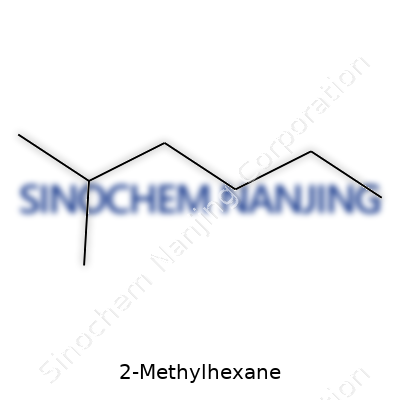
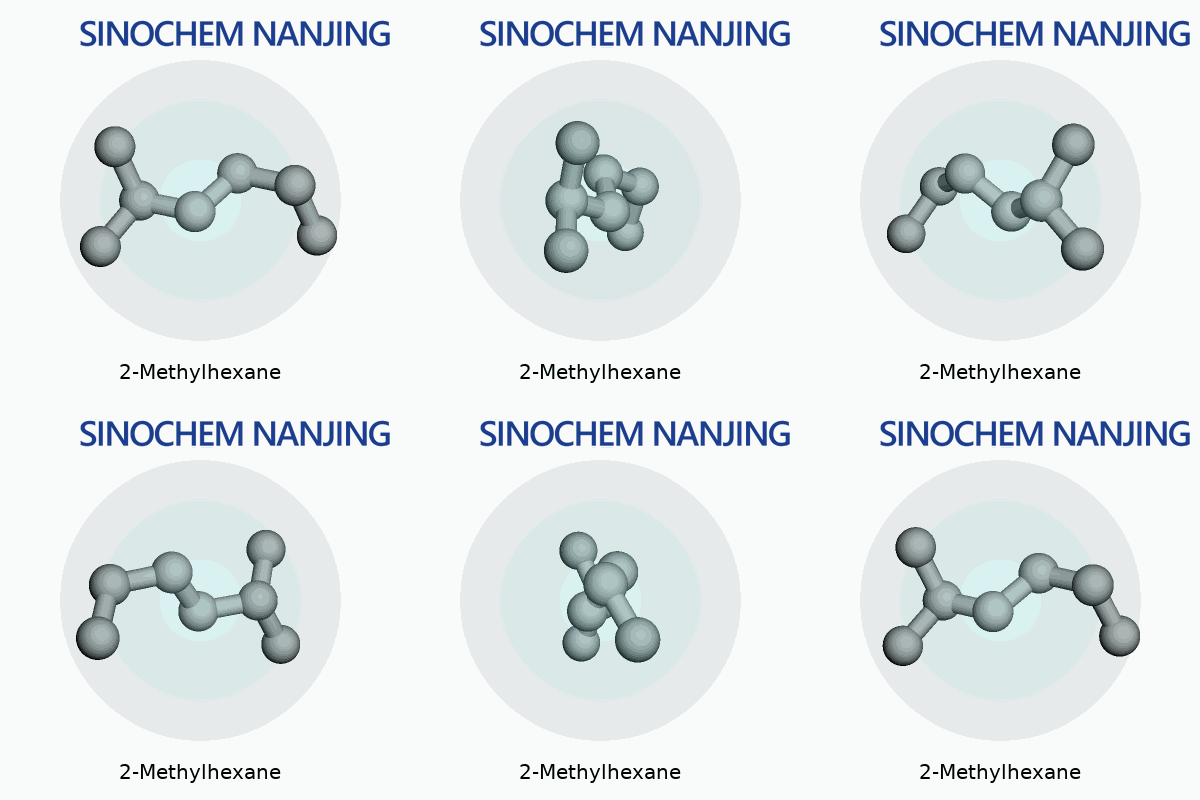
| Names | |
| Preferred IUPAC name | 2-Methylhexane |
| Other names |
Diethylbutane Isoheptylane |
| Pronunciation | /tuː-ˈmɛθ.əl.ˈhɛk.seɪn/ |
| Identifiers | |
| CAS Number | 591-76-4 |
| Beilstein Reference | 1418734 |
| ChEBI | CHEBI:88373 |
| ChEMBL | CHEMBL15701 |
| ChemSpider | 54600 |
| DrugBank | DB14065 |
| ECHA InfoCard | ECHA InfoCard: 100.009.366 |
| EC Number | 214-638-2 |
| Gmelin Reference | 82285 |
| KEGG | C06587 |
| MeSH | D000604 |
| PubChem CID | 11573 |
| RTECS number | MN9275000 |
| UNII | 7G2A2N4K31 |
| UN number | UN1206 |
| Properties | |
| Chemical formula | C7H16 |
| Molar mass | 100.20 g/mol |
| Appearance | Colorless liquid |
| Odor | gasoline |
| Density | 0.673 g/mL at 25 °C |
| Solubility in water | insoluble |
| log P | 3.5 |
| Vapor pressure | 3.23 kPa (at 25 °C) |
| Acidity (pKa) | pKa ≈ 50 |
| Magnetic susceptibility (χ) | -7.9e-6 |
| Refractive index (nD) | 1.387 |
| Viscosity | 0.547 mPa·s |
| Dipole moment | 0.13 D |
| Thermochemistry | |
| Std molar entropy (S⦵298) | 302.6 J·mol⁻¹·K⁻¹ |
| Std enthalpy of formation (ΔfH⦵298) | -198.7 kJ/mol |
| Std enthalpy of combustion (ΔcH⦵298) | -4159.9 kJ/mol |
| Hazards | |
| GHS labelling | GHS02, GHS07 |
| Pictograms | GHS02,GHS07 |
| Signal word | Warning |
| Hazard statements | H226, H304, H336, H411 |
| Precautionary statements | P210, P261, P301+P310, P331, P304+P340, P312, P403+P235 |
| NFPA 704 (fire diamond) | 1-1-0 |
| Flash point | “-7 °C (19 °F; 266 K)” |
| Autoignition temperature | 221 °C (430 °F; 494 K) |
| Explosive limits | 1.1% - 6% |
| Lethal dose or concentration | LD50 (oral, rat): 5,000 mg/kg |
| LD50 (median dose) | LD50 (median dose) of 2-Methylhexane: "LD50 (oral, rat) > 5000 mg/kg |
| NIOSH | NIOSH: MI4725000 |
| PEL (Permissible) | PEL (Permissible Exposure Limit) of 2-Methylhexane: "500 ppm (1800 mg/m3) |
| REL (Recommended) | 250 mg/m3 |
| IDLH (Immediate danger) | IDLH: 1,500 ppm |
| Related compounds | |
| Related compounds |
Hexane Isooctane 3-Methylhexane 2,3-Dimethylpentane Heptane |



